
Leg 6. From Hong Kong to Auckland (III). Value when considering FDI?
Dear all:
Before I can continue with the following posts of this leg 6, I would like to share with you a very interesting graph which explains what is the meaning of “perceived value”. Since we are understanding the concept of Value, Utility Drivers, and Cost Drivers before starting to understand the Value Chain Analysis, let me explain what is VALUE with the following example:
As you know, I was for a couple of years the Investments Advisor for International Finance Corporation (IFC at The World Bank). My role was to look for private companies with interest to be financed by the IFC in El Salvador. I was looking for private sector projects with good sponsors (ethical and well-recognized reputation), good projects (with development impact), and good numbers (excellent financial returns and solid financial statements). I loved my job because I was able to see the innovation of the local private sector projects, moreover, I was reviewing the business models and strategically I was busy understanding every single value proposition, economic and financing proposal shown to me by the private companies who wanted to raise funds with us. I was not interested in doing auditing, nor due diligence, because I am a strategic advisor, and I was looking at the private sector projects from the point of view of a strategist. In addition, since I don´t hold a political flag (As you know I avoid with all my soul being tagged with the left or right parties in town, and I even avoid interacting with politically exposed people since I returned from Switzerland 15 years ago), to work for the World Bank was a blessing. It was a refuge from all the ideological polarization in town. I don´t like to be involved in politics, and I have suffered economically because of this, as you have no idea. I won´t compromise my ethical values for any political party. I won´t do it.
 Moreover, for me, marriage is important. Having my own babies is my most beloved precious wish and trésor aspiration, and I really hope this dream comes true. In summary, a future marriage and professional life in balance are crucial for any person. The first factor augments personal happiness. The second factor increases the possibility of secure cashflows. And entrepreneurship is an excellent path. Instead of being an employee, I have chosen the most difficult path. But I am just starting to add the best great VALUE to my life, and I won´t participate in politics of any kind, not even in dreams.
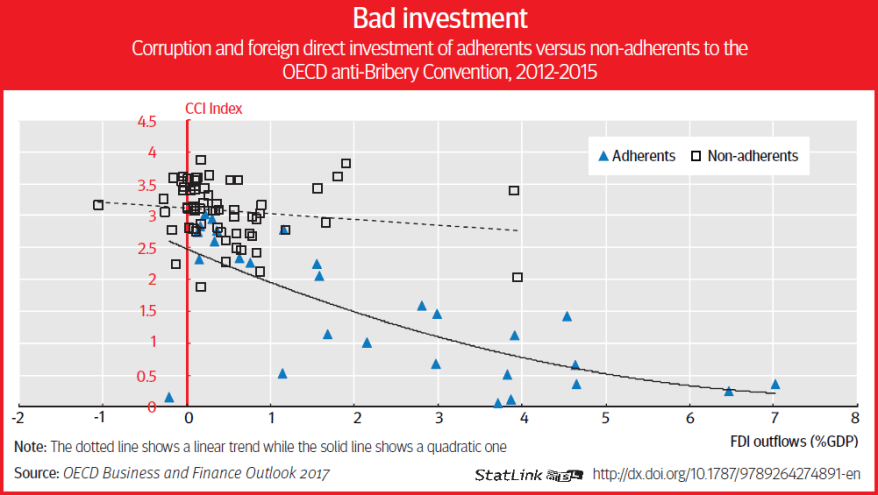
The OECD has stated: “Anyone looking for proof that international agreements work should look at the OECD Anti-bribery Convention. One reason is investment. In fact, countries that adhere to the OECD Anti-Bribery Convention (currently 43 countries) invest more abroad than those that have not joined.
Corruption wastes resources that could otherwise be invested abroad–each year individuals and companies pay bribes roughly of the order of France’s GDP, around US$2 trillion. However, bribes don’t pay, as the clear correlation between lower levels of corruption and higher foreign direct investment (FDI) outflows suggests in our graph. The vast majority of countries adhering to the OECD Anti-bribery Convention are less corrupt and invest much more abroad than non-adhering countries, and therefore are more likely to benefit from foreign sales and scale economies. These countries are not all OECD members, as the convention’s reach extends beyond the area of the organization, to incorporate eight non-OECD countries among its adherents, such as Bulgaria, Colombia, and South Africa”.
“Joining the convention means committing to several rules, such as criminalizing the offering of bribes to foreign public officials, and committing to co-operate in monitoring and promoting the full implementation of the convention. The OECD is determined to continue its efforts on implementation, as called for in the 2017 Ministerial Council statement. As the graph shows, such efforts could improve countries’ positions as investors. Unlike bribes, anti-corruption measures pay by freeing up resources for investment”.
 When we have countries with sounding corruption-bribery cases such as Odebrecht (and this is just one example or the tip of the iceberg), the “perceived value” of that country in terms of anti-corruption is not good. From my former position as IFC Investments Advisor-El Salvador, I was committed to attracting IFC-World Bank funds for El Salvador’s private sector, but I couldn´t do it because of the “perceived value” of my country. What is the “perceived value” of my country in terms of anti-corruption”?, Has my country adhered to the OECD Anti-Bribery Convention?, Are our Latin American Governments committed to stopping briberies and corruption in all Ministries, Permit Bureaus, particularly Public Works and Environmental Permit Offices, and all other institutional levels?. Anti-corruption measures pay by freeing up international resources for investments.
Just when we have governments with all their institutional offices aligned to don´t accept briberies from ANYONE, only then, we will be able to attract and invest the FDI that is so much needed in our countries.
Best, have a good night.
21:01 pm – El Salvador.
Source References:
http://oecdobserver.org/news/fullstory.php/aid/5942/Bribes_don_92t_pay.html
Disclaimer: All the pictures or videos shown on this blog are not mine. I do not own any of the lovely photos posted unless otherwise stated.
 Eleonora Escalante Strategy - Strategic Reflections Think Tank