
Central America:A Quest for the Progression of Economic Value Season II. Episode 7. Philip II: Carrying heritage duty
Dear readers:
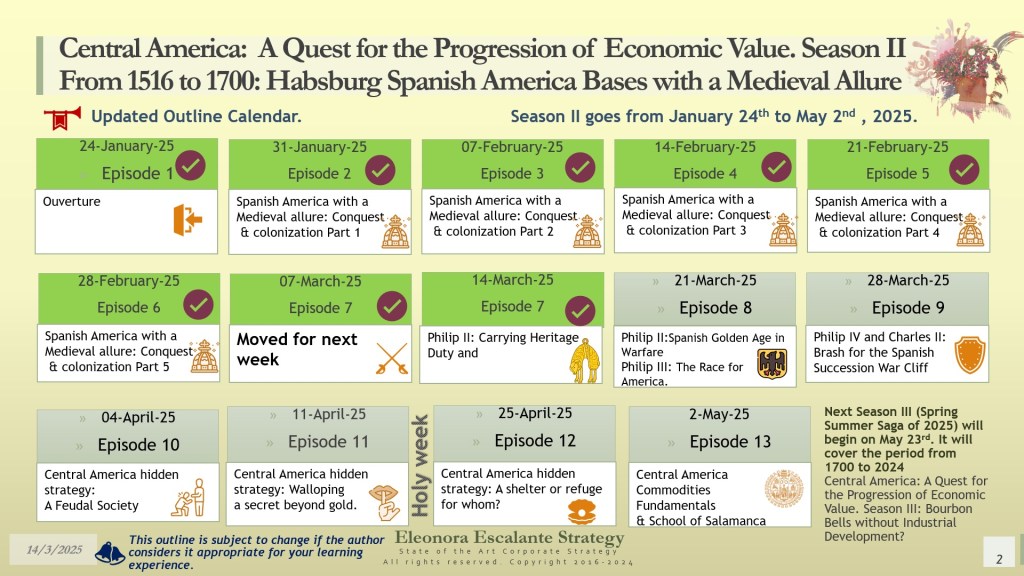
Find below our framework of analysis about the life of Philip II. I have been double-checking, confronting multiple sources of historians with tons of caring and delicacy about the life of the son of Charles V Holy Roman Emperor. In the process, I have found answers that will help us to make sense of the last 4 episodes of this saga. Please visit our outline calendar on slide 3.
As usual, I am presenting the slides so you can read them over the weekend. Our strategic reflections will follow on Monday, the 17th of March. The reason why we are role-modeling you to pause before making strategic reflections is a lesson that was hard for me to learn. None of us like to wait at pause at work. Most of our supervisors eagerly request immediate results without introspection, contemplation, meditation, and re-examination. Strategic consulting houses of high value, such as Bain, Boston Consulting Group, McKinsey, Ernst & Young, Deloitte, PWC Strategic Consulting division, etc., are under time pressure to finish their quantitative and qualitative analysis to fulfill the deadlines for their corporate, industrial, or institutional clients. Partners and Directors are also busy with their respective standard reviews, and there is no dedication of time for strategic reflections for the soul. However, strategic reflections are the apex of our vocation. Suppose we don´t teach how to reflect after an analysis: In that case, we are not recreating responsible solutions according to ethical values and to the degree of impact of our commercial decisions at the most important levels of society: social interactions, health, community building, environmental aspects, and family relations. At the level of entrepreneurship and venture capital, the lack of strategic reflections may cause a misleading path to entrepreneurs who launch products and services that are super profitable but can damage the well-being of people who buy them. At the level of efficiency pursued by reducing costs, a consulting house that does not provide strategic reflections to clients may cause tremendous damage to society. The same occurs with the innumerable problems that artificial intelligence is causing without regulation, the addiction and damage to our brains by excessive utilization of Smartphones and screen devices, the destruction of Middle-Class as a consequence of inequality caused by the digital begging technological system, and many additionally new disturbances that our civilization of the 21st century has begun to handle. We have arrived at a point in which our desire to make things easier has taken a deep toll on our health and long-term mental balance.
In consequence, our strategic house recommends to all the consulting directors and partners, to make a pause of a few days after finishing the clients’ work. Always procure strategic reflections after the results, analysis, solutions, and findings have been finalized. Once the head is cold and ready, the process of strategic reflection can be initiated. You will be surprised by so many overlooked elements that arise. An excellent strategic reflection, after a pause of a few days, behind the analysis that has been completed, can shift the paradigms of the clients, can make a wake-up call for integrity, and even provide a new whole solution when reasoning with the clients. When consulting professionals follow the flashy trends of the moment, a “group-think” societal rationale pushes for inevitable foolishness. The lack of good sense and judicious decision-making is established, and consulting houses are dishonoring their mission to create a better world for all.
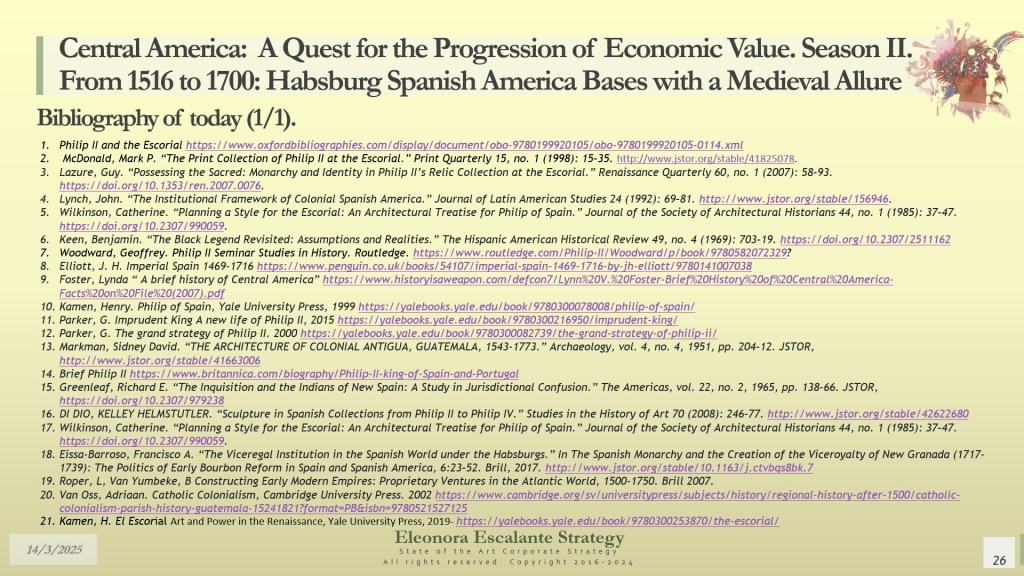
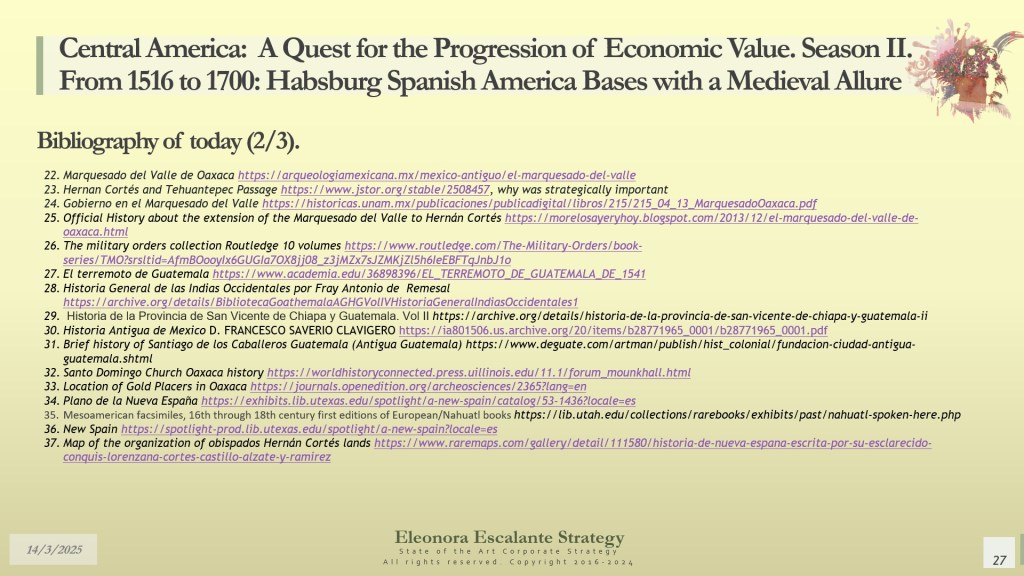
Based on the above, find our package of slides for your consideration. Feel free to pass them on to your friends, colleagues, students, superiors, etc. Download and print them. Try to write your ideas and questions next to our material. You can read the bibliography, too.


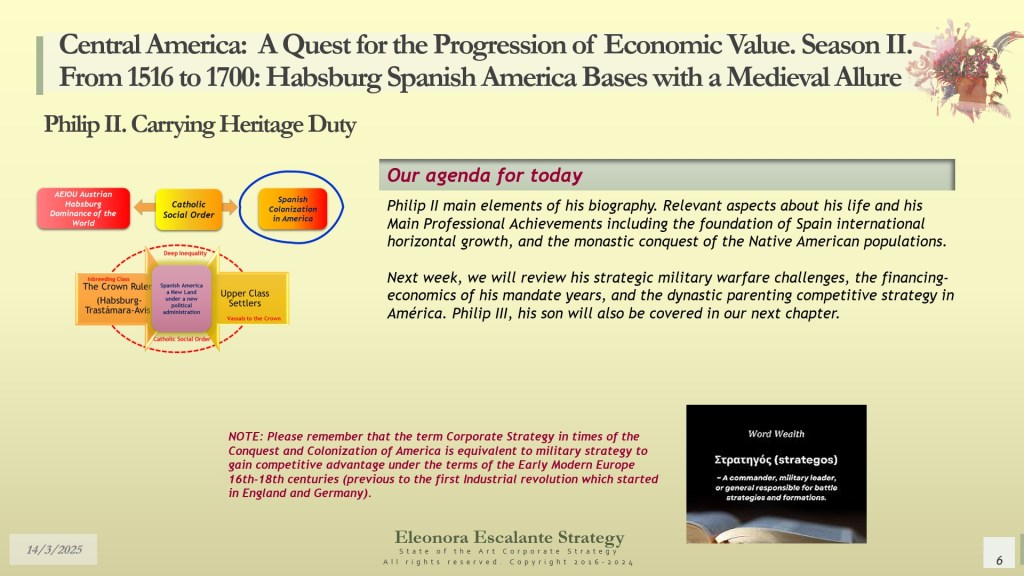
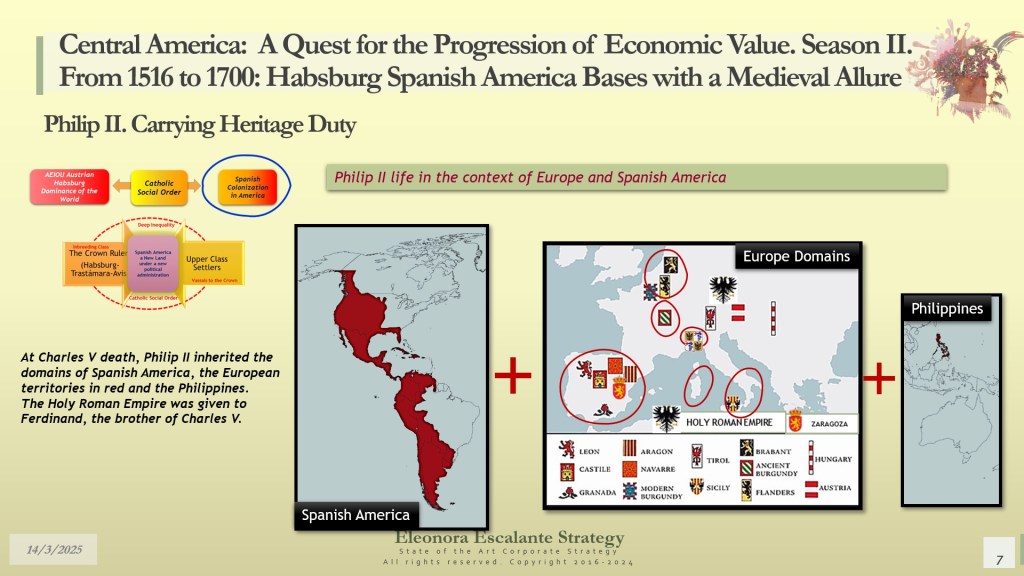

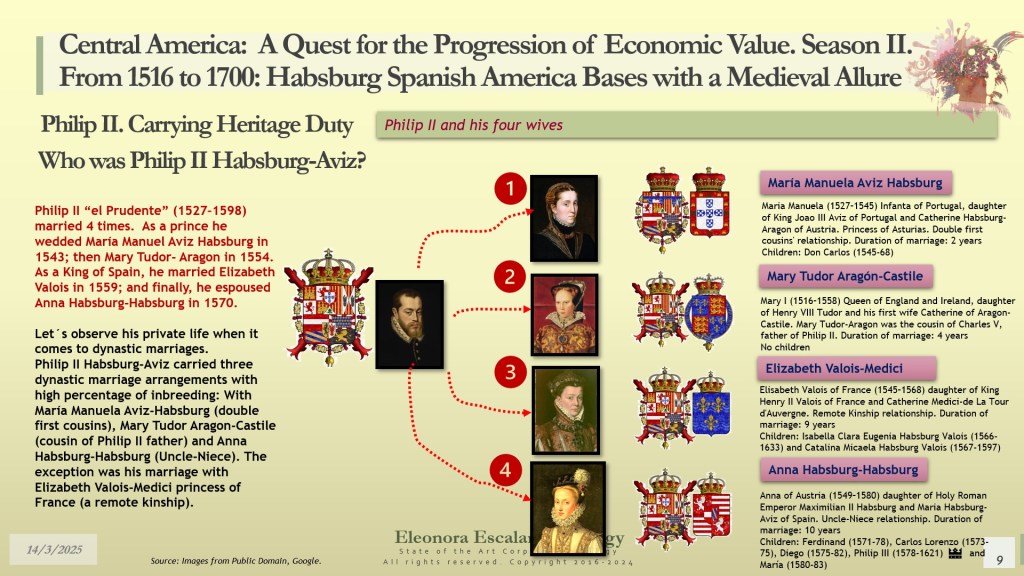

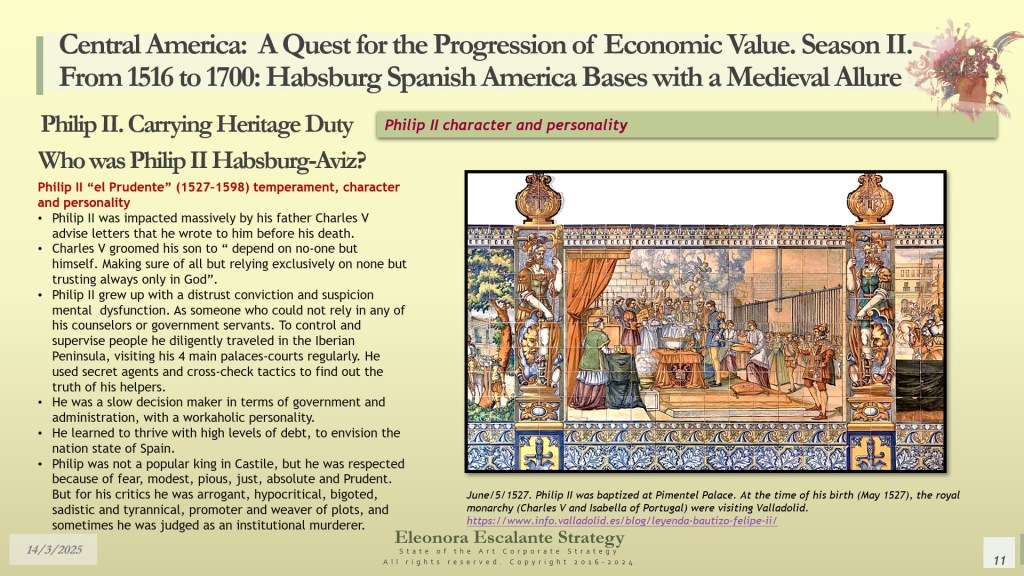




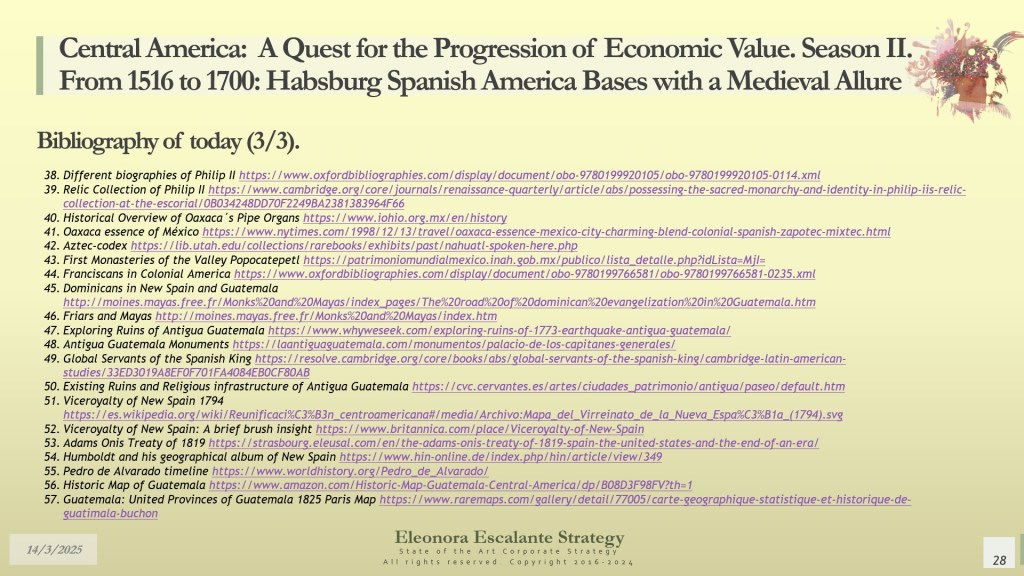

We invite you to return next Monday, the 17th of March, to read our additional strategic reflections about this work-in-progress chapter.
During the weekend, please ask yourself different alternatives of comprehension about the life of Philip II. Write down whatever idea you might have envisaged while reading our document. Only then will you be able to compare your reflections with ours. When our reflections are ready, they will appear in the paragraph below.
Additional strategic reflections (added below on Monday, 17th of March).
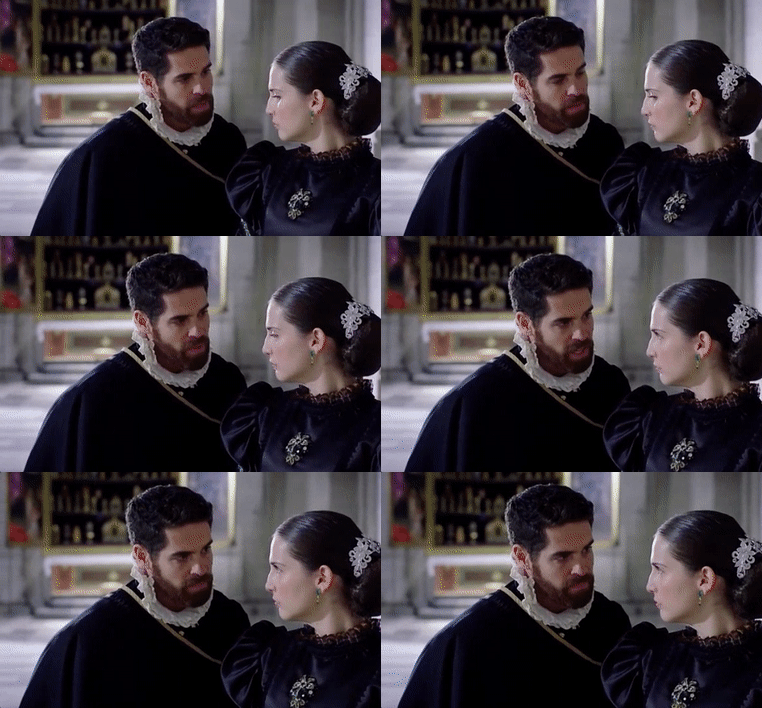
- There is no doubt that the conquistadors existed and there are records of evidence of his biographies which were never hidden by the Spanish Crown. The conquistadores of New Spain (with the Kingdom of Guatemala included) were led mainly by Hernándo Cortés and Pedro de Alvarado (the flaming reddish-blond beard and marron-scarlet hair). Most of the chronicles written during the 16th and 17th centuries mention Jerónimo de Aguilar (Cortés interpreter), Bernal Díaz del Castillo (who later became a chronicler), Juan de Grijalva, Francisco Hernandez de Córdova, Pánfilo de Narváez, Cristobal de Olid, Gonzalo de Sandoval, Diego Velásquez de Cuéllar, etc.
The Viceroyalty of Peru (1542-1824), the Viceroyalty of New Granada (1717-1819), and the Viceroyalty of the Río de la Plata (1776-1810) were different in their strategic settlement because Imperial Spain was led by different crown dynasties then. - Our hypothesis about the main members of the Habsburg families coming to conquest America through Lisboa Port is based on our perception (based on Indian CODEX and the empty spots of the historians) that the identity of the main conquistadors was swapped for certain years with those of the main conquistador leaders. A son of a Holy Roman Emperor came to conquer México (that is our hypothesis), but he did his work and returned home as soon as his mission was fulfilled. In exchange, the real Hernán Cortés was granted recognition of a special coat of arms, land, and encomiendas. It could be possible (we bet at least with an 80% probability), that the same strategy was used by other Iberian and Portuguese Royals to swap their identity with the most famous captains of the Conquista such as Pedro de Alvarado (Guatemala), Francisco Pizarro (Perú), Gonzalo Jimenez de Quesada (New Granada), and maybe Bartolomé de las Casas (he was a priest). We do not mean to offend the regal distinctiveness of the members of the Habsburg dynasty. We don´t want to hurt their feelings either. We simply wish to know the real truth, so our Latin American problems of today can be fixed appropriately by the true responsibles of our organic poverty during the last 500 years. It is a matter of rectitude and a pending geopolitical debt.
- With the chivalric mentality of medieval times, royal leaders of the 16th century, couldn’t delegate their role as omnipotent warfare front-runners while they stayed in their European castles solving issues with the German protestants. It was not possible, particularly when they recognized what size of the new land was in the game; and if won, this amazing continent was going to be added to Spain, if conquered successfully. What type of low scummy kings would be if they delegated top strategic matters into the hands of ambitious mercenaries and military knights coming to America to kill Aztecs, Incas, and Mayans without any type of direct commanding supervision? When Granada was reconquered by the Spanish Catholic Monarchs (Isabella and Ferdinand II), “King Fernando II directed the campaign against the kingdom of Granada, showing his military talent to good effect, and he conquered the kingdom inch by inch, winning its final capitulation on January 2, 1492”(1). Philosophically and militarily, there is not one percent of probability that a king won´t be next, “coude à coude”, to his army at the time of Charles V HRE. The Christian European and Muslim kings of that time were psychologically, mystically, and mentally prepared for war. They accompanied the Crusades to Jerusalem. They fought to expel the Muslims from the Peninsula. They captured Constantinople and almost took Vienna. These kings fought against each other, jousted tournaments for pleasure, and sacked cities, including Rome. Their specialized “black armor knights” coming from Extremadura, Andalusia, and León must have been led by kings, sons of kings, or VIP admirals of the Golden Fleece league. There are records of the conquistadores coming from Spain to the New World, and these were registered by the Casa de la Contratación in Sevilla since 1503. Sadly, the data is incomplete, mainly the correspondent to the first decade of the 16th century, and specifically, the year 1518 (2). In addition, little is known about those who departed from Lisbon port. Furthermore, there is evidence that around two-thirds of the conquistadores’ armies were between 20 to 39 years old, and a good percentage of them, were tough men of Portuguese and Italian origin. So, as academic researchers and strategic counselors, it is valid for us to doubt about the nature of the people who traveled to America, particularly if there are years in which most of the records have “magically” disappeared.
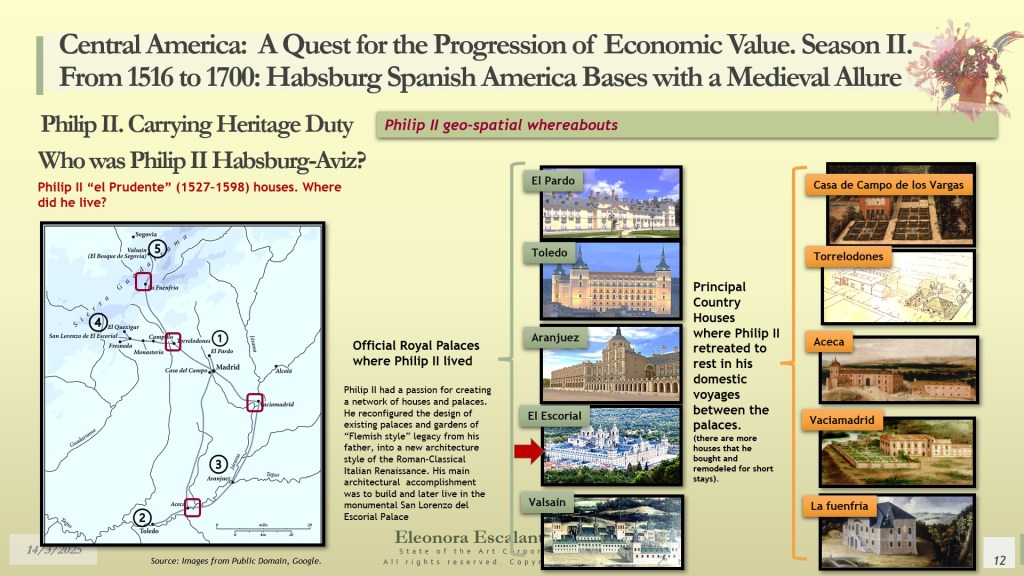
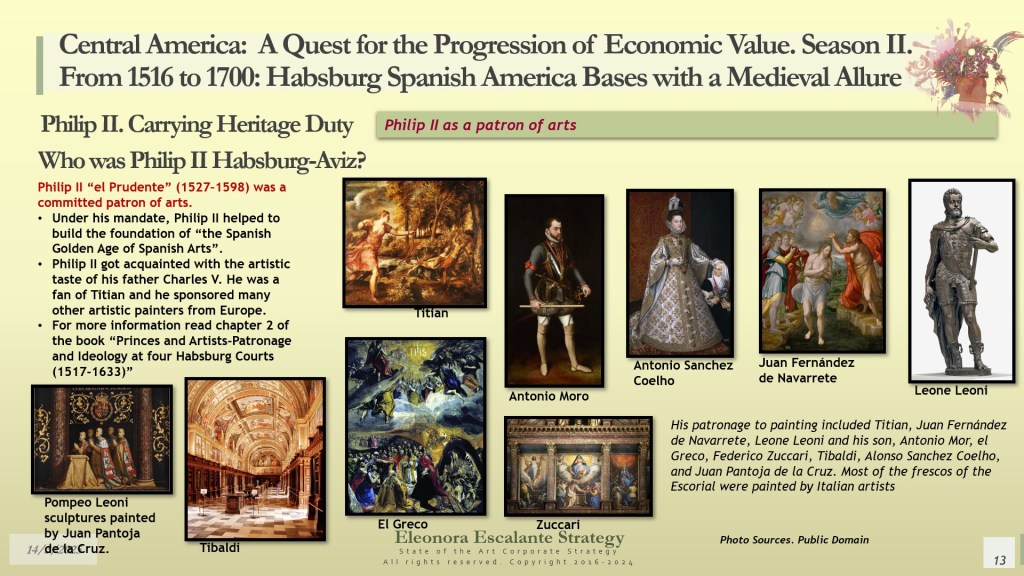
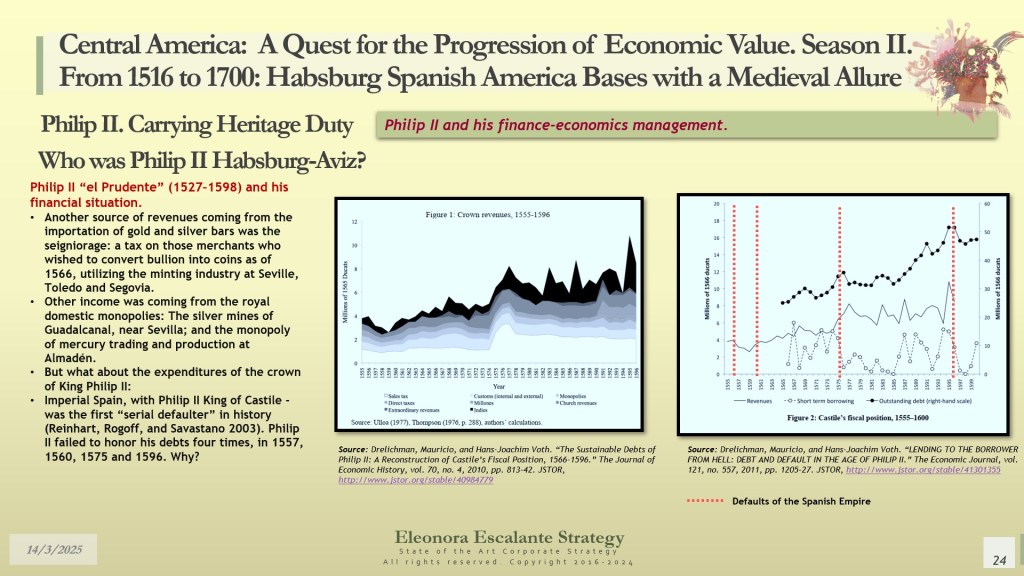
- The proof of evidence of our latter paragraph is what Philip II Habsburg Aviz (1527-1598) performed during his reign. Our work (from slides 6 to 25) shows the most relevant aspects of how Philip II was achieving the heritage duty that his famous father instructed him in letters, wills (several testaments), and training lessons. Philip II was prepared as a king under “Castilian terms.” His formation was clearly based on Spain. Despite his mother being Portuguese, he only spoke Castilian. He made no effort to learn French or Dutch dialects at all. Charles V Emperor cut the cords of his domains in Germany, by leaving the Holy Roman Empire to his brother Ferdinand, not as a sign of weakness, but as a strategic move of strength. If Ferdinand Habsburg Castile-Aragon (1503-1564) participated in the conquest of Spanish America, we truly don´t know it (I am not focusing this research on him). But it might be a potential scenario.
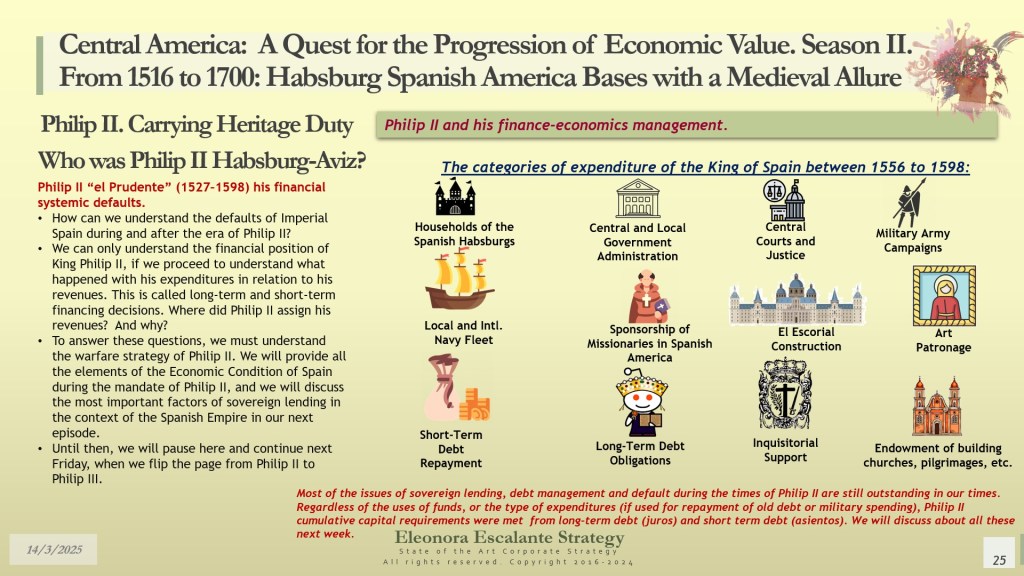
- The AEIOU Habsburg vision was the essence of this family. AEIOU is “Austriae est imperare orbi universo (it falls to Austria to rule over the whole globe)”. Philip II was clearly building his headquarters´ hub for the Americas. Most historians qualify his main achievement in terms of European geopolitics, but everything that Philip II did, including his 4 marriages, was aligned with the infinite wish to protect his sources of funds: The gold and silver mines of Spanish America, his new land domains for all the Habsburgs, who were considerably more important than the San Lorenzo del Escorial palace. The reason why this enormous castle was built as a monastery, doesn´t surprise us given the religious compromise of the medieval allure of the family, but to build a castle as a mausoleum for keeping the body corps of top members of the royal Habsburg house (by the way, not all were re-buried there) is very intriguing for us. No king on earth builds a home for the dead, but to create life for the future. What was Philip II doing there? Giving a sign of Brussels Valois splendor majesty to his “new enemies”? Which adversaries?
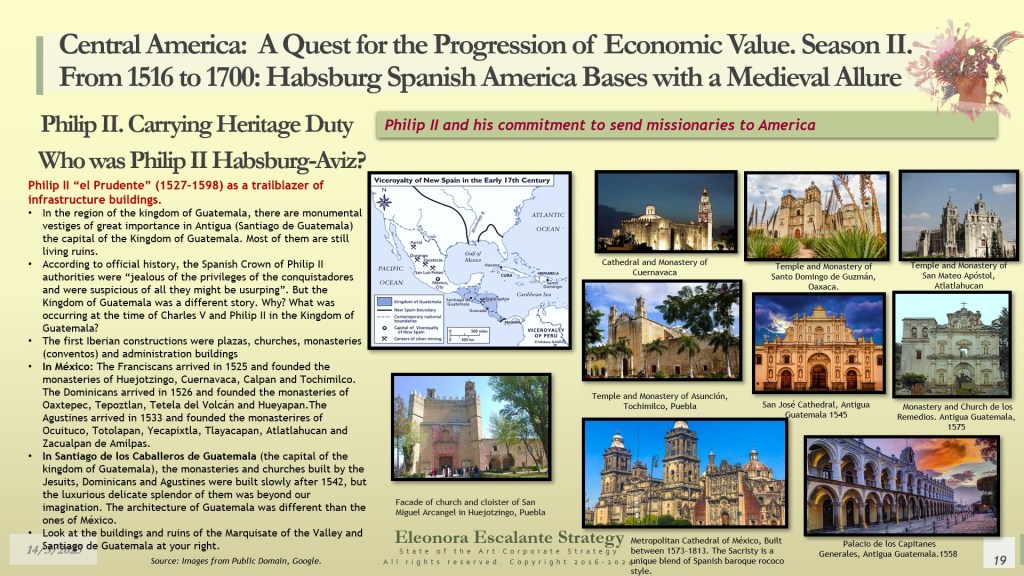
The Habsburgs-Aviz-Valois-Bourbons took the nation of Hispania (Castile, Aragon, and Portugal) and from there, the dynasty expanded to the New World. It was a family endeavor. It wasn´t only Charles V. It was a blood-successional thing. To build El Escorial’s gigantic multipurpose palace, was a message for the local Spaniards. Suddenly, Philip II began to reap the bullion coming from the mines of México and South America; and in parallel, he continued to establish control of the new world using the Catholic missionaries that his Dad sent to America. The military strategy of Philip II will be analyzed and reflected next week. As an “avant preview” for our next episode: Philip II’s military strategy was so cruel against the influence of Bartolomé de Las Casas and his Indianist movement in Iberia, that the reputation of the newly established “Spain” won the brand of “Black Legend.” - The Black Legend was caused by Philip II in his pursuit to restore a single Catholic Empire in Europe while stopping any potential flow of Protestantism into Spanish America. The “Black Legend” relates to how Spanish authorities and government were tagged as oppressive, backward, and obscurantist, even worse than the standards of the lingering Medievalism and/or colonialism elsewhere. The Spanish Inquisition in Europe and the New World was associated with the “Black Legend,” which included torture, terror, persecution, confiscations, inquisitorial repression of conscience, burning of books, people (auto de fé), and corruption within the clergy. Philip II had no stop with the inquisition against the protestants in the Netherlands. Duke of Alba was ruthless with it, while the Spanish Fury sacked Antwerp smashing with murder and mayhem (3). Spain’s “Black Legend” was not a myth but a real “Eighty Years´ War from 1568 to 1648” against the lands of the Netherlands. As much as his conflicts with the Netherlands, Philip II joined the battlefield with England after the dissolution of his marriage to Mary Tudor, and he later seized Portugal. We believe these clashes were provoked to keep Portugal, England, and France busy, while he was expanding in Spanish America with the Catholic church network of obispados and his new territorial organization.
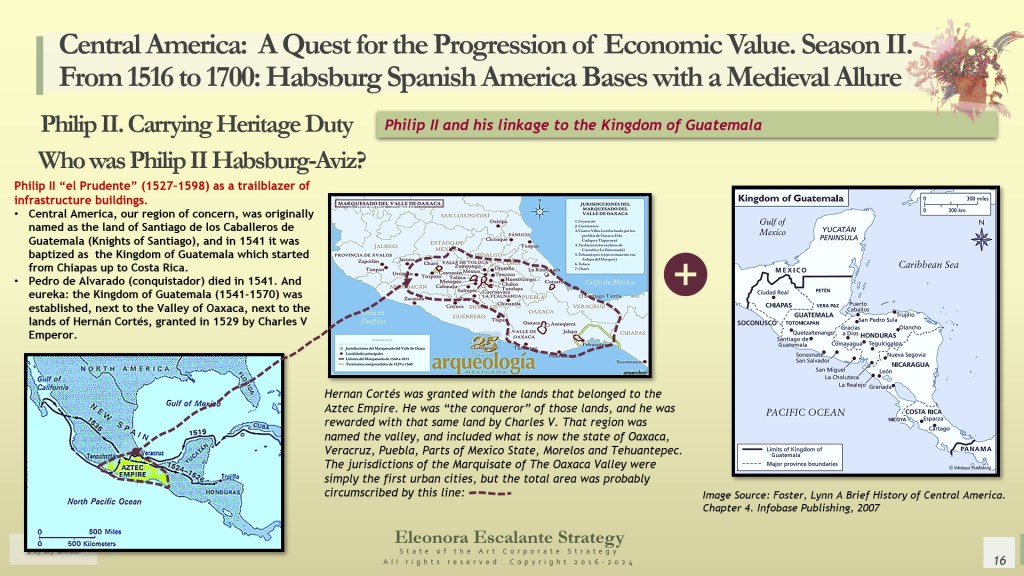
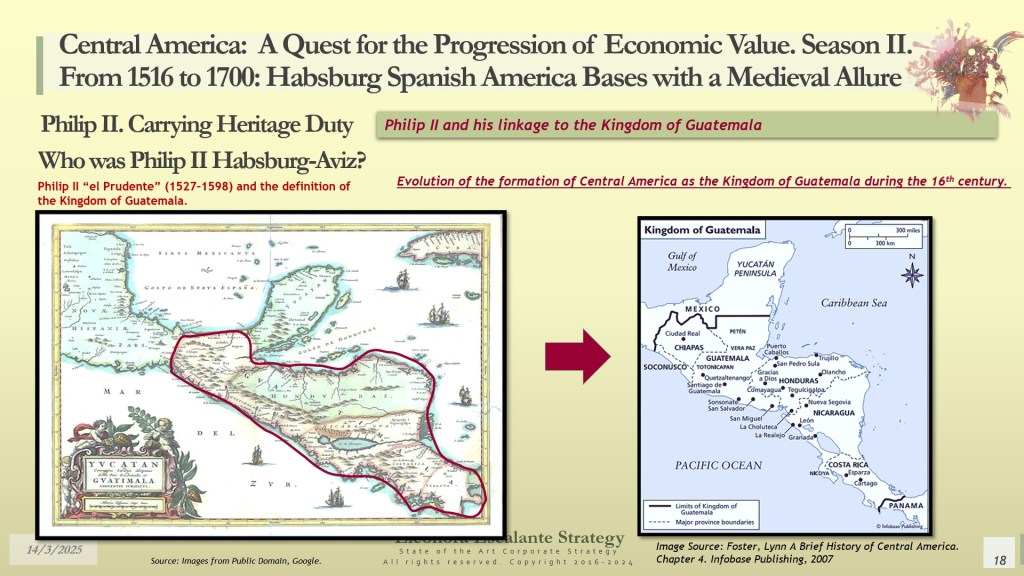
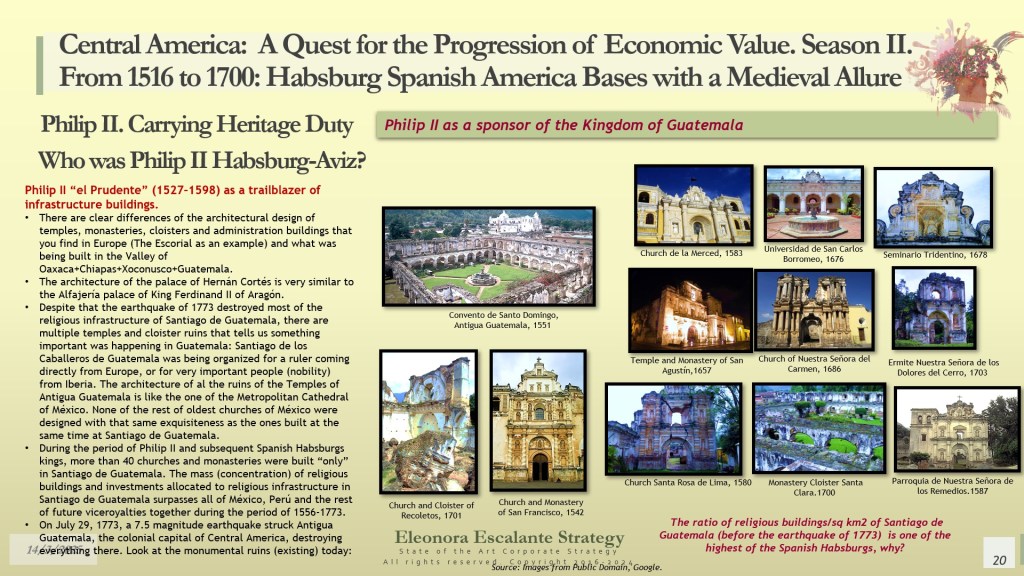
- Philip II’s reign left enough evidence of infrastructure buildings in the New World. His sponsorship of the Catholic missions was relevant enough everywhere. But in Guatemala, there was a special mission doing something extremely important after the arrival of Francisco Marroquin. The beauty and majesty of the Catholic temples and monasteries built in Santiago de los Caballeros (Antigua Guatemala) has no competition with any other network of Catholic temples in México or Perú. The ratio of religious buildings per sq km is higher there than anywhere else in the new continent (ratio measured as construction investments between 1542 to 1700). The place of worship of Santiago de Guatemala was being prepared for the royal Habsburgs, with the occasion of safeguarding this place for their future. This is our best-anticipated bet, and we will demonstrate it by the end of Season II. Other Habsburg lines prepared the path for further hubs in South America as of the 18th century too. Read slides 16 to 20.
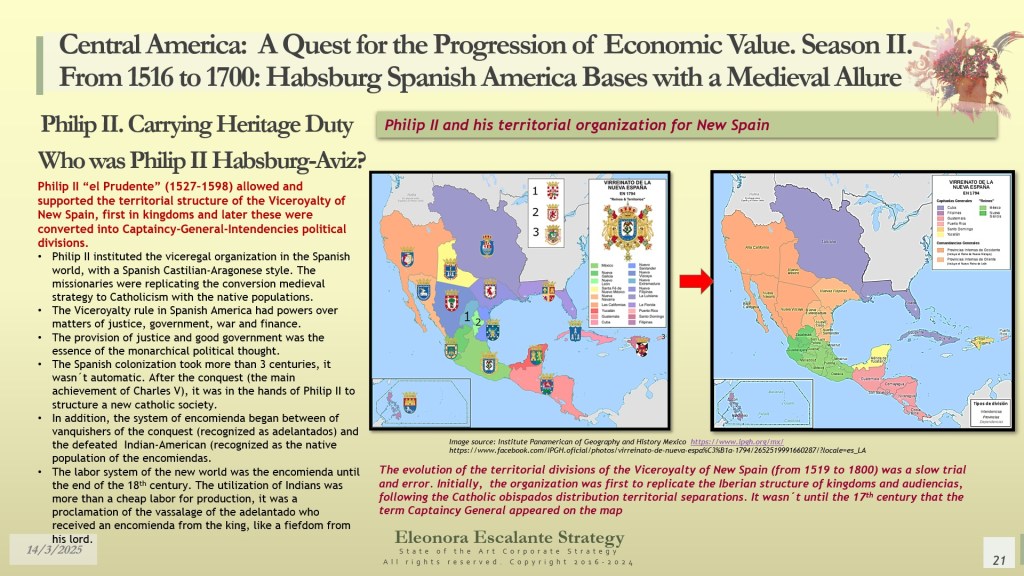
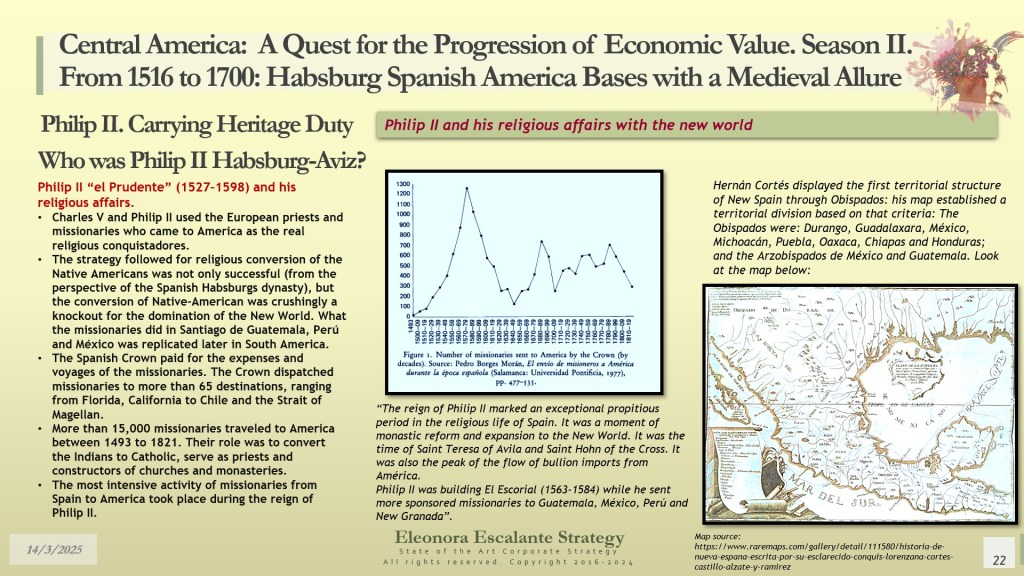
- It was under Philip II’s ruling time, that the territorial organization of Spanish America took place. It was a Castilian-Italian political division. See slide 21, please. We reflect on the role of Italian infusion practical modus operandi because most of the clergy commitments in New Spain and the Kingdom of Guatemala answered to the Papacy, which was in Rome. The crown of Spain paid for them to come to convert Indians, but they had a double line of reporting: the Papacy in Rome and the Spanish Government. The real conquistadores of the Indian communities were the Church priests and missionaries. Their enthusiastic mandate to convert the Natives to Catholicism saved the Indians from being inquisitorially fired in “autos de fé”, but the Church couldn´t protect them from the encomiendas, the diseases, and the long-term low-wage slavery exercised by the Spaniards since then. See slide 22, please. Our strategic house is convinced that if Charles V hadn´t sent the Franciscans, the Augustinos, the Dominicans, the Mercedarians, and later the Jesuits, the Convent of the Descalzas Reales to México and the Kingdom of Guatemala, there wouldn´t be one single Aztec or Mayan alive to our days.
- The analysis of the finances and warfare of Philip II of Spain will continue in our next episode. Be aware that so much information about the foundations of Central America and México was lost during these 500 years. Plenty of our real history has been burned, and the “official versions” don´t answer to a minimum of common sense. It is crucial to learn to find the truth in the middle of all these falsehoods and lies because our rulers will continue making the same mistakes as our ancestors in other worst modern circumstances. Without the truth, we can´t mend what was wrong. And we are condemned to repeat the same mistakes on and on and on until the restoration and repair of the descendants of those who were unjustly affected may occur. Otherwise, the curse of the past is carried over from generation to generation.

Announcement.
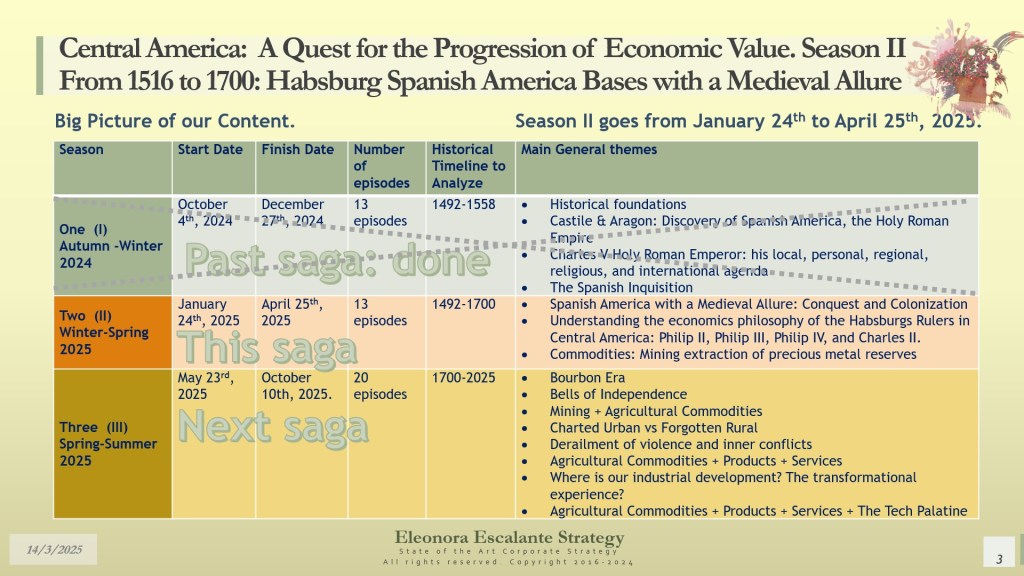
Next week, we will continue exploring the financial situation of Philip II of Spain according to his grand strategy of warfare. The reign of Philip III as a king was short, and it will be included in our next chapter; in consequence, we are well on track with our outline calendar. Please do not lose sight of the fact that we are comprehending the corporate strategy of the Spanish Habsburgs from 1519 to 1700 in our quest to understand the economic foundations of the Kingdom of Guatemala, the lands that later were called the United Provinces of Central America.
Musical Section.
Our selection of music during this saga will continue to explore adorable music produced between the 16th and 17th centuries. Season II is dedicated to the lute. Our choice for today´s episode is from the lutenist Michael Schaffer (1637-1978), the first German lutenist who recreated how to play the Lute, not as a guitarist, but as a Medieval Lutenist. He observed all the medieval paintings and reviewed old tutorials in his quest to play the instrument as it was done originally. The following album, “French Baroque Lute Suites”, embraces his exquisite interpretation of 4 music pieces: Suite in G Minor, composed by Francois Du Fault; Suite In D Minor composed By Jacques Gallot; Suite In A Minor composed By Esaias Reusner Jr.; and Suite in A Major, composed by Johann Gottfried Conradi. Schaffer’s breathtaking interpretation of the lute has accompanied us during the week. Enjoy!
Thank you for reading http://www.eleonoraescalantestrategy.com. It is a privilege to learn. Blessings.

Sources of reference and Bibliography utilized today. All are listed in the document. If needed, we will add more over the weekend. Sources of this document post:
(1) https://www.britannica.com/biography/Ferdinand-II-king-of-Spain
(2) https://read.dukeupress.edu/hahr/article/74/2/259/145870/The-Origins-of-the-Conquistadores-of-Mexico-City
(3) https://www.bloomsbury.com/ca/age-of-wars-of-religion-10001650-9780313086748/ Spain, and Philip II
Disclaimer: Eleonora Escalante paints Illustrations in Watercolor. Other types of illustrations or videos (which are not mine) are used for educational purposes ONLY. All are used as Illustrative and non-commercial images. Utilized only informatively for the public good. Nevertheless, most of this blog’s pictures, images, and videos are not mine. I do not own any of the lovely photos or images unless otherwise stated.
 Eleonora Escalante Strategy - Strategic Reflections Think Tank