
Central America: A Quest for the Progression of Economic Value. Bonus-Season V. Sugar Sugar America. Part 5. The British sugar model. Jamaica
Dear fantastic readers: Our British West Indies epic continues. Today is the turn to explore delicate topics about the foundations of the British Empire. It is not our aim to hurt the ancestors of the existing royal families of Europe. We do not compose to hurt anyone. We do not want to create more disturbance. On the contrary, what we aspire to is offer the truth of the roots of our current strategic frameworks. We have no choice but to show you under what conditions the different sugar production models of the 17th and 18th centuries constructed the evidence used for business modeling, and why we are perpetuating slavery under a whole distinct scheme. By rolling out a complex world of Artificial Intelligence tools and applications, we are building profitable companies that are replacing the middle class. The contraction is felt in every single industry and economic sector. The descendants of the Atlantic Empires and the moguls of the technological giants, global concentrated monopolies of today, must recognize the roots of our current situation. Otherwise, the economic, social, cultural, political, and systemic consequences of our wrong business decisions will be unbearable for the next generations to come.
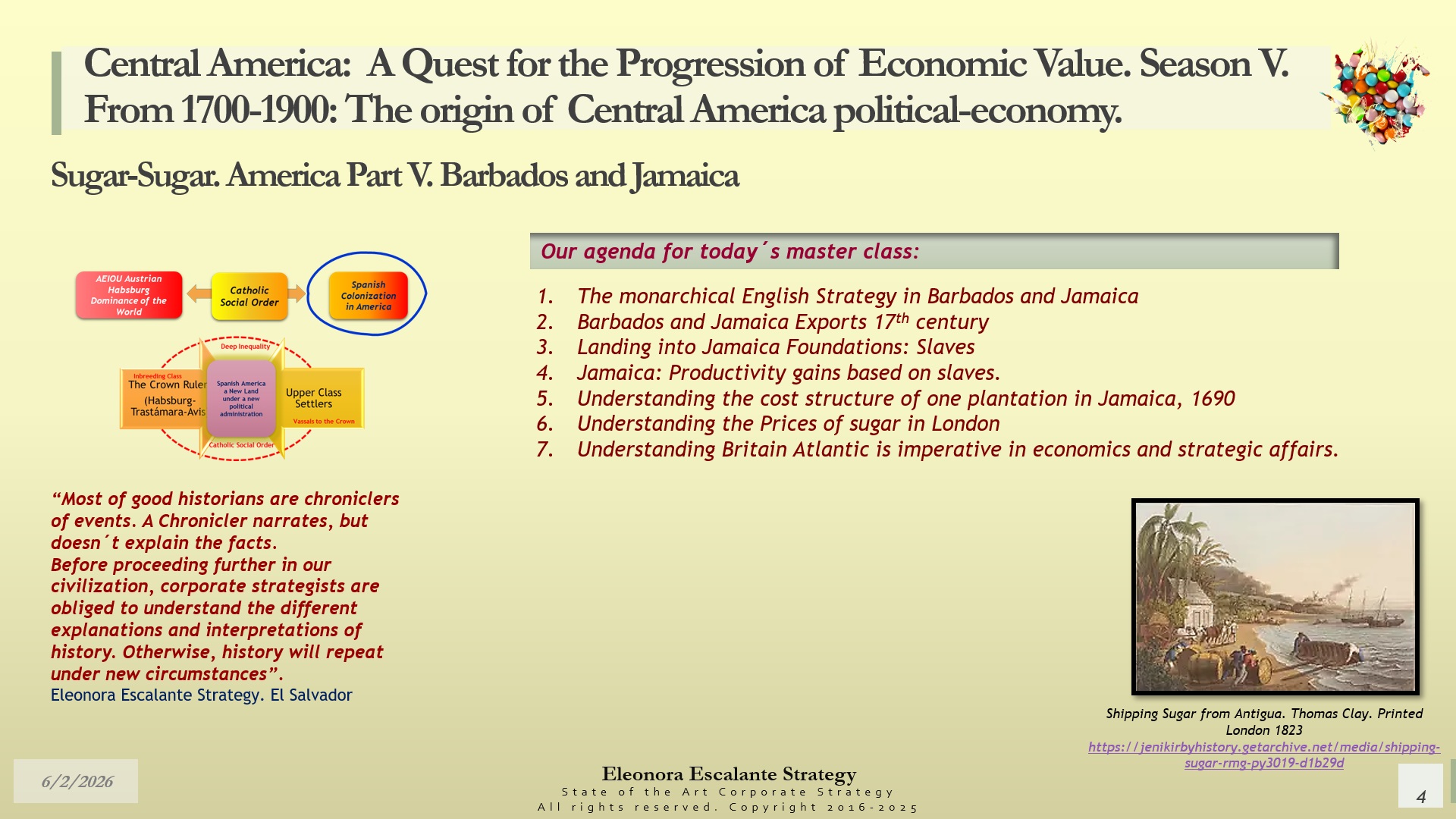
Let´s start with our agenda for today:
- The monarchical English Strategy in Barbados and Jamaica
- Barbados and Jamaica Exports 17thcentury
- Landing in the Jamaica Foundations: Slaves
- Jamaica: Productivity gains based on slaves.
- Understanding the cost structure of one plantation in Jamaica, 1690
- Understanding the Prices of Sugar in London
- Understanding Britain Atlantic is imperative in economics and strategic affairs.
We wish to introduce the following package of slides. It is your material for the weekend. Read the slides carefully. Download them. Print them. File them for our reference studies. You are free to discuss this material with your professors, colleagues, friends, and acquaintances. We all learn together by talking about our course material.
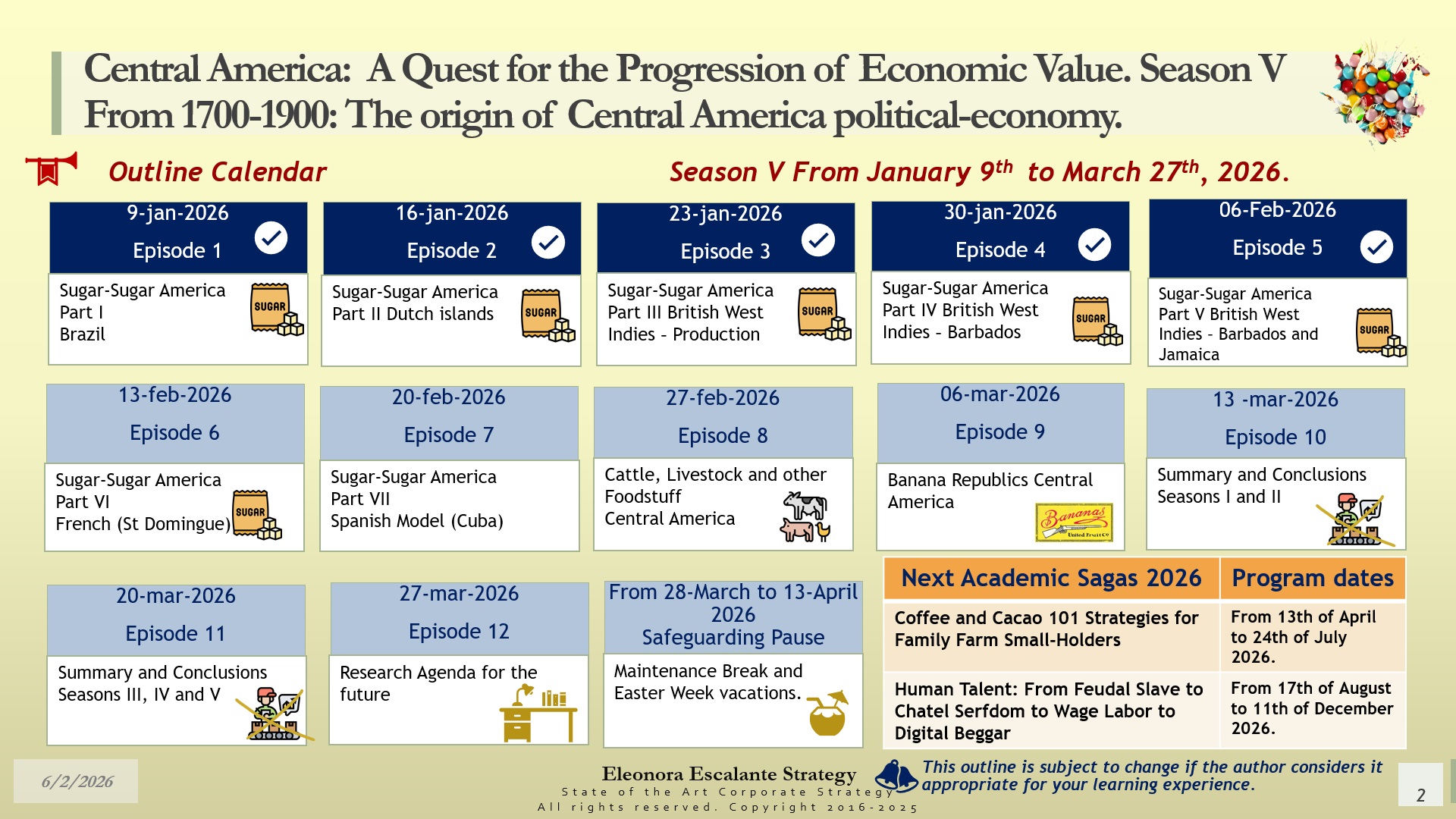
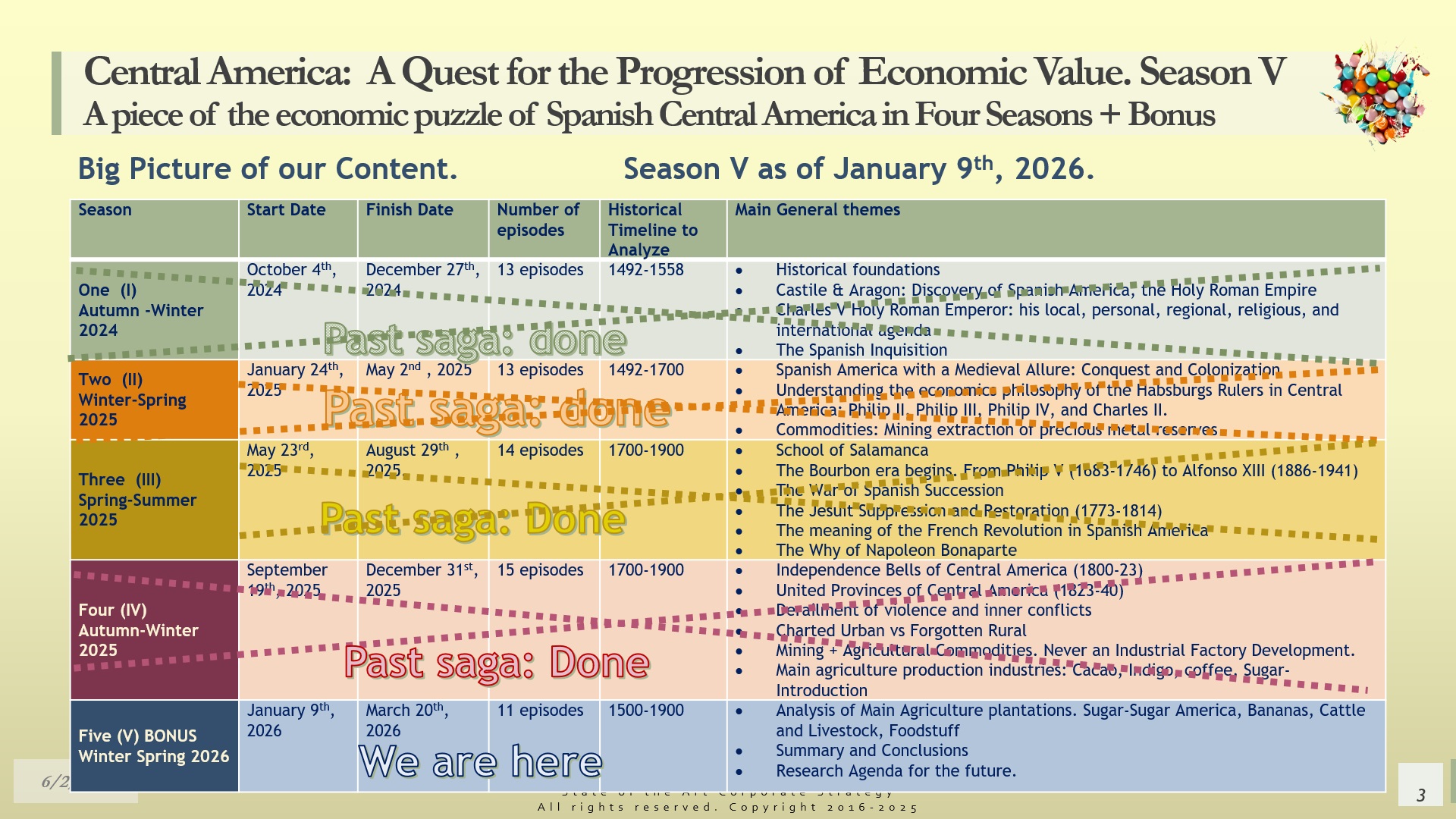
We kindly ask that you return next Monday, February 9th, 2026, to review our extra strategic reflections on this chapter.
We encourage our readers to familiarize themselves with our Friday master class by reviewing the slides over the weekend. We expect you to create ideas that are or are not strategic reflections. Every Monday, we upload our strategic inferences below. These will be discussed in the next paragraph. Only then will you be able to compare your own reflections with our introspection.
Additional strategic reflections on this episode. These will be in the section below on Monday, February 9th, 2026.
Public domain. Illustrative and non-commercial GIF image. Used for educational purposes. Used only for the public good, informative for this class.
Strategic Reflections on “Central America: A quest for the progression of economic value. Bonus Season V. Episode 5. British America. Barbados and Jamaica.
Key Contextual Explanation of the British Atlantic of the 17th century.
There is a fascinating approach to learning about the royal dynasties from our past. Every single royal house since the time of the cuneiform tablets was accompanied by courtiers, advisors, a substantial number of people as staff, religious leaders, servants, and slaves. Within the staff, a team of chroniclers was engaged to keep a journal of all the activities of the royal members, and these information-keepers were always accompanying and traveling with them. The records of the lives of the monarchs and their respective families were kept in secret places, most of the time, with at least a few copies of the original manuscript in the hands of other information guardians (such as the Vatican priests) or religious representatives. Additionally, the historians always kept a personal copy hidden, at risk of the death penalty if the truth came to light. No king or queen wanted to be read for posterity with the negative public flank. As a result, royal historians were forced to tell half the truth, or to make up annals, or use written secret ciphered alphabets. However, there are other sources of truth that were kept by priests or royal confessors, who acted not just as spiritual advisors, but also as secret guardians of the monarchs and their families. How to find the truth so many centuries later? Not easy, eh. Nowadays, the hustle should be a historical multidisciplinary, anthropological and archaeological community effort. Historians are taught to ascertain with evidence whatever they find from ancient written records or paintings. But as we have explained above, the information is partially available. After America was discovered under the design of Maximilian Habsburg-Aviz, the truth about concealed royal conquering and living in the New World was hidden on purpose. How to reconstruct economic sources of wealth from royal dynasty houses that decided to live concealed in Central America, México, Colombia, Perú, or Brazil? Economic historians have tried to rebuild the exports, imports, and customs duty information using theoretical frameworks in which Europe continued to be the epicenter of history. We doubt this is the correct approach. And we have been analyzing it under a new light. We believe that what economists call peripheries were the new hubs of the European dynasties. We have found that while some of the royals remained in Europe, taking care of their palaces and estates, the kings and the queens came to establish to America. We are convinced that at least a section of the constellation of royal families, as from Charles V Habsburg-Valois/Castile-Aragón and Isabel Aviz-Aragón, came to reside in America.
In consequence, how to know what amount of wealth was sent to their European households, and how much remained here? Can you see the shift of perspective? Philosophically, why would a royal family that decided to leave Europe to reside in America continue to send their riches to Europe? It doesn´t sound right? When the Catholic Stewart Scottish-French kings took the power of England, the Bourbon side of that dynasty sought the part of Spanish America that was “theirs” too. In consequence, managing economic data from monarchs who were residents in America, but kept part of their family in Europe, implies seeing the collection of data from a different perspective. The theory of extractive economies, sending all the raw materials to Europe, can´t be totally true, because some of the revenues of that Spanish American production remained intact within the concealed coffers in America. When the Stuart-Bourbon lineage arrived in England´s power, most of the 13 colonies were established in North America, in parallel to the colonization of the Atlantic sugar islands. Since King James I, the goal of the Stuart-Bourbon Dynasty was to grow under a horizontal expansionism strategy in America. And, eureka!, the English initiated the agricultural plantations in their newlyacquired territories, following the sugar Portuguese model, which was massively amplified in Brazil. The English began to cultivate tobacco in the Chesapeake and sugar in their new British Caribbean Islands. The model of sugar plantations was more successful than tobacco, because sugar demand became a commodity of necessity in Europe. By the second half of the 17th century, Barbados was the sugar economy of Britain, fully operational, using slaves, serving the English markets.
Virginia (with its capital Jamestown, in honor to King James I Stuart) was established 100 years after the odyssey of Hernan Cortés-Aragón or Habsburg. The rest of the English colonies were tied to the Stuart-Bourbon family. And that was the origin of British America. See table below:
| Colony | Date of Establishment (as of) | |
| 1 | Virginia | 1607 |
| 2 | Massachusetts | 1620 (Puritans) |
| 3 | New Hampshire | 1623 |
| 4 | Maine | 1622 |
| 5 | New York | 1624 (by the Netherlands), 1664 (Britain) |
| 6 | Maryland | 1634 |
| 7 | Connecticut | 1635 |
| 8 | Rhode Island | 1636 |
| 9 | Delaware | 1638 (by Sweden) 1655 (by the Netherlands) 1664 (Britain) |
| 10 | New Jersey | 1660 (by the Netherlands), 1664 (Britain) |
| 11 | The Carolinas | 1663, split in South and North as of 1729 |
| 12 | Pennsylvania | 1681 |
| 13 | Georgia | 1733 |
The colonization of the British sugar islands occurred during the period of the Stuart-Bourbon dynasty, specifically in the 17th century. King James I Stuart, and his son King Charles I Stuart Oldenburg (the Scottish Danish king) made it possible, but Charles I´s plans were interrupted by the Oliver Cromwell period (1649-60). By the decade of 1660s, Barbados was already exporting its sugar production to England.
It is in this Stuart-Bourbon context of England-Ireland-Scotland and France, that we ask ourselves the following question: If the 13 colonies of British America and the sum of all the sugar islands of Britain Atlantic were a whole block of territories glued through the Atlantic, why would a king remain in a small Island of Europe, if the new colonies in America represented an “one of a kind” new challenge, with the potential to expand into new continental territories later? If the Stuart-Bourbon family (as descendants of King Henry VII Tudor) were diligently directing all their resources to expand and produce in America, why would they remain on the island of Great Britain? It doesn´t make any sense.
If the Spanish-Habsburgs came to reside in Central América after Hernán Cortés, it is unquestionable and infallible that members of the royal Stuart-Bourbon branch also decided to jump into British America (including the British Atlantic territories), leaving Great Britain during the time of Cromwell. Subsequently, we bet, they also transferred their authority in Europe to the hands of the protestant Hannover (Welf-Wittelsbach and their Anglo-Saxon relatives) after the death of Queen Anne Stuart Bourbon in 1714. In season II, Episode 12, we dared to speculate that King William II Orange Nassau/Solms Braunfels (who was married to Marie Henrietta Stuart-Bourbon) could have possibly been the figure of Hermano Pedro of Guatemala. So, it is likely that they pursued the same tactic in North America.
It is under this context that our strategic house, Eleonora Escalante Strategy, has developed the following rationale: If the English Stuart-Bourbon royals moved to North America to expand the Western-Design program, why do we accept the idea that Great Britain was pulling all the wealth creation from the British Colonies in the New World? Of course, there was a demand for sugar in England, and the value creation of muscovado sugar shipping was part of the transatlantic slave trade, but the available data might be only the value of the slave trade, not the total amount of production of the sugar colonies. Are you following me? In short, we believe that the production of sugar from Barbados, Jamaica, and the Leeward Islands was greater than the data in the exports-imports records available from the British ports. Only then can we comprehend why more than 3,259,000 African Slaves were transferred by British ships to their domains in the New World.
How to really know the wealth numbers built by sugar plantations, beyond the slave trade that represents the transatlantic triangle commerce explained to you last week? It is very simple: Every European royal house had an accountant, the finance representative of the king, and those wealth records are private (if still existing) in the household of the ruler´s descendants. The global transatlantic products flow from America to Europe and Asia, and from Asia, Europe, and Africa to America, has been partially reconstructed. With that in consideration, our hypothesis of Spanish America under the Habsburgs residing in Central America, can be widened to the rest of royal families who came consecutively after, and only then we can explain the French Revolution Terror (1789-1799), the Haitian Saint-Domingue Slave Rebellion (1791-1804), the Napoleon Bonaparte´s Phenomenon (1799-1815) and the Independence Movements of Spanish America underneath the America´s restructuring.
Can you see how much is still needed to be done in history? My work this month has involved reviewing, analyzing, and gathering bits and pieces of information, but the whole disclosure of the situation is still far from being completed. Can you observe the importance of our strategic reflections? If I move to analyze incomplete data, I am wasting my time. And I fall into the trap of not adding anything pristine and valuable to what my academic peers have already tried to rebuild. By positioning myself in the shoes of those who designed the monarchical strategy of the royal families in America, I was able to perceive that the puzzle is still incomplete. It only provides information about the African slave trade (labor) used for the plantations (of the British Islands and the North American colonies), but it doesn´t answer the rest of the elements of the plantation business model. So, how to measure the truth?
We are sure that all the royal business records from 1492 to this day must have been documented by the accountants of the kings. Double-entry bookkeeping appeared in Italy by the late 13th century. In consequence, by the time of HRE Maximilian Habsburg-Aviz, the organization of the Royal Courts in Europe held at least one secretary of finance, who later evolved into a Council of Finance, led by the Controller-General of Finances or Chancellor of the Exchequer (the case of England). It was a custom for each royal dynasty (small or large) to maintain special ministers who managed the royal revenues and assets, treasury records, and national expenditures. The income and expenses of a royal house were in the hands of these high-caliber individuals who kept those memories alive.
“He who makes no memory of himself during his lifetime will have none after his death and will be forgotten with the tolling of the final knell”. (1)
HRE Maximilian I, Habsburg-Piast/Aviz-Enríquez (Castilla).
Our strategy house has logged on to economic historians who have published books and academic papers. We have done a scrutiny of their data and information. But still, there are an abundance of things that we need to discover. Access to the king´s economic records is only through their existing archives. In the case of the sugar plantations of the British Atlantic, if the English Stewart royals of the 17th century were involved as investors (which we have confirmed today), there should be accounting records available in the hands of the dynastic descendants. Without those numbers, all we have is a limited collection of records that offer a partial approximation of what could have occurred. When conflicts destroy the historical memory of the kings, part of our understanding is deleted. If the two world wars destroyed those files, we are somewhat blind. A war that nullifies our historical memory has harmed our civilization much more than you could ever imagine. If the past violence of Europe has barred those royal files, our understanding of economic history is obstructed. Any huge war or ferocious attack that damages the past archives hurts not only the comprehension of the royal dynasties’ finances, but it also jeopardizes the knowledge of the monarchical decision-making strategy and its respective business models. Any destruction of past archives also vandalizes the ability of a theoretical reconstruction based on the truth, which is so necessary to be taught through social sciences, economics, politics, business, philosophy, etc. And the peril of not knowing that truth today is still the cause of repeating the same mistakes under our modern circumstances.
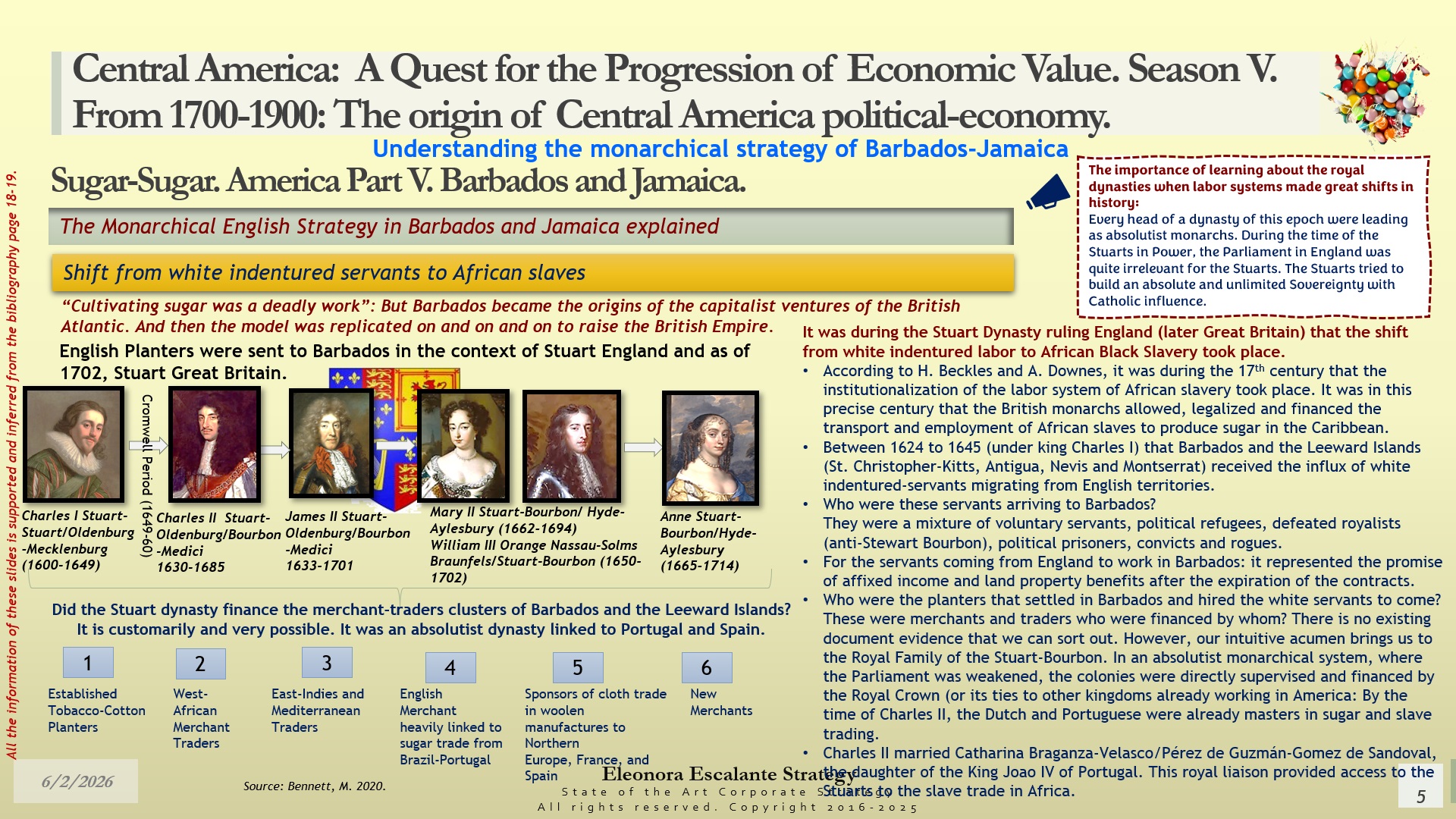
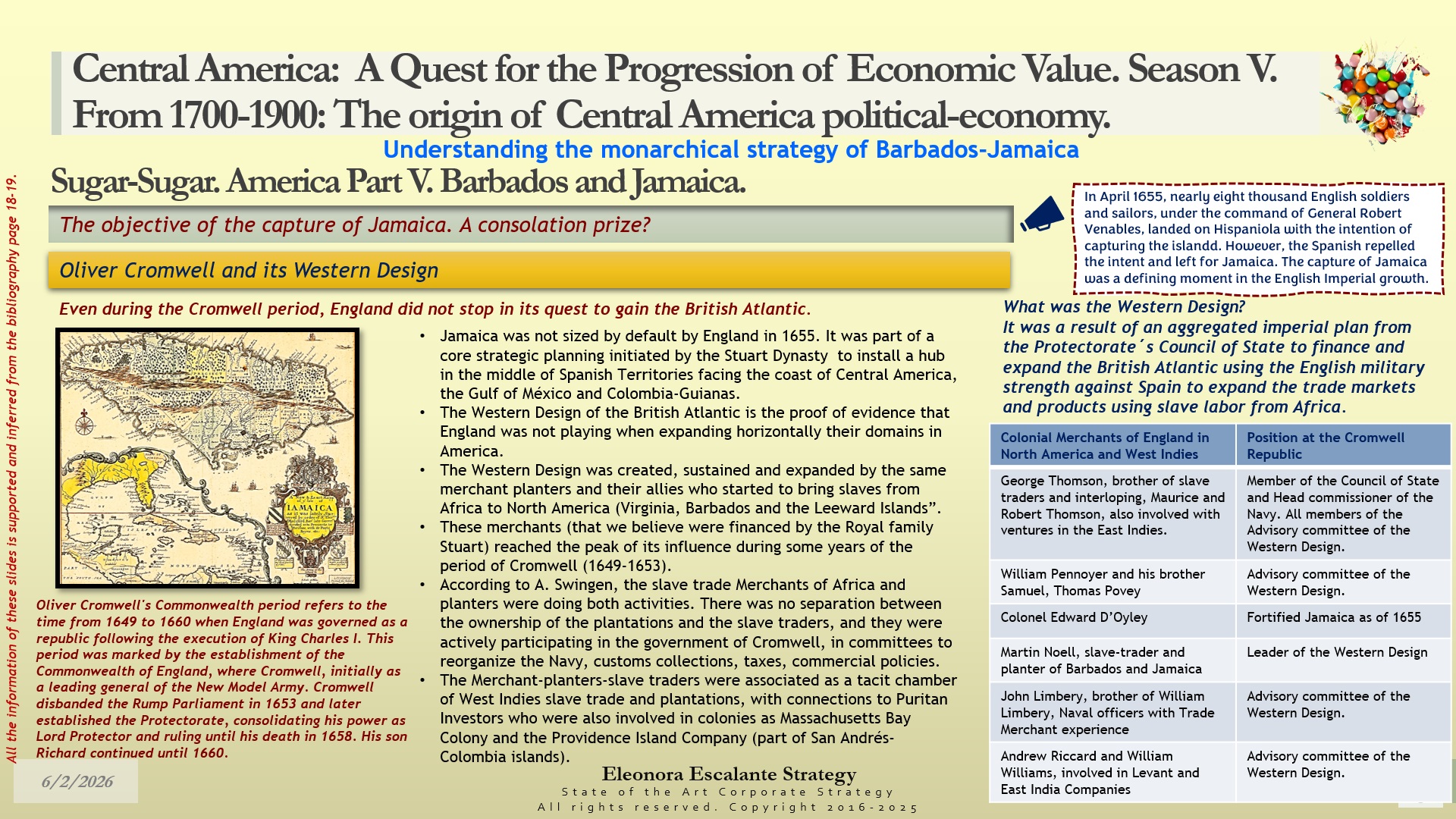
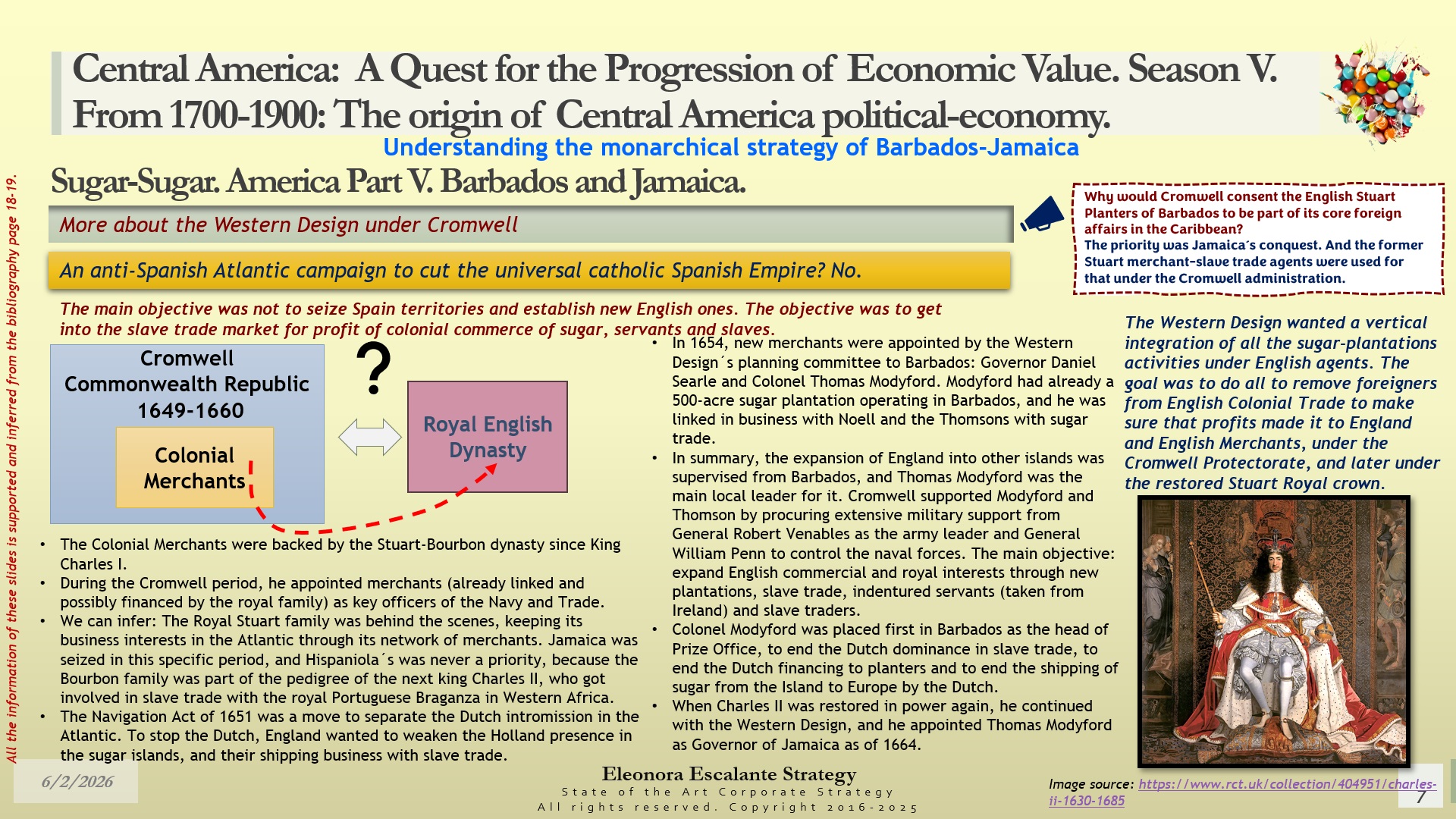
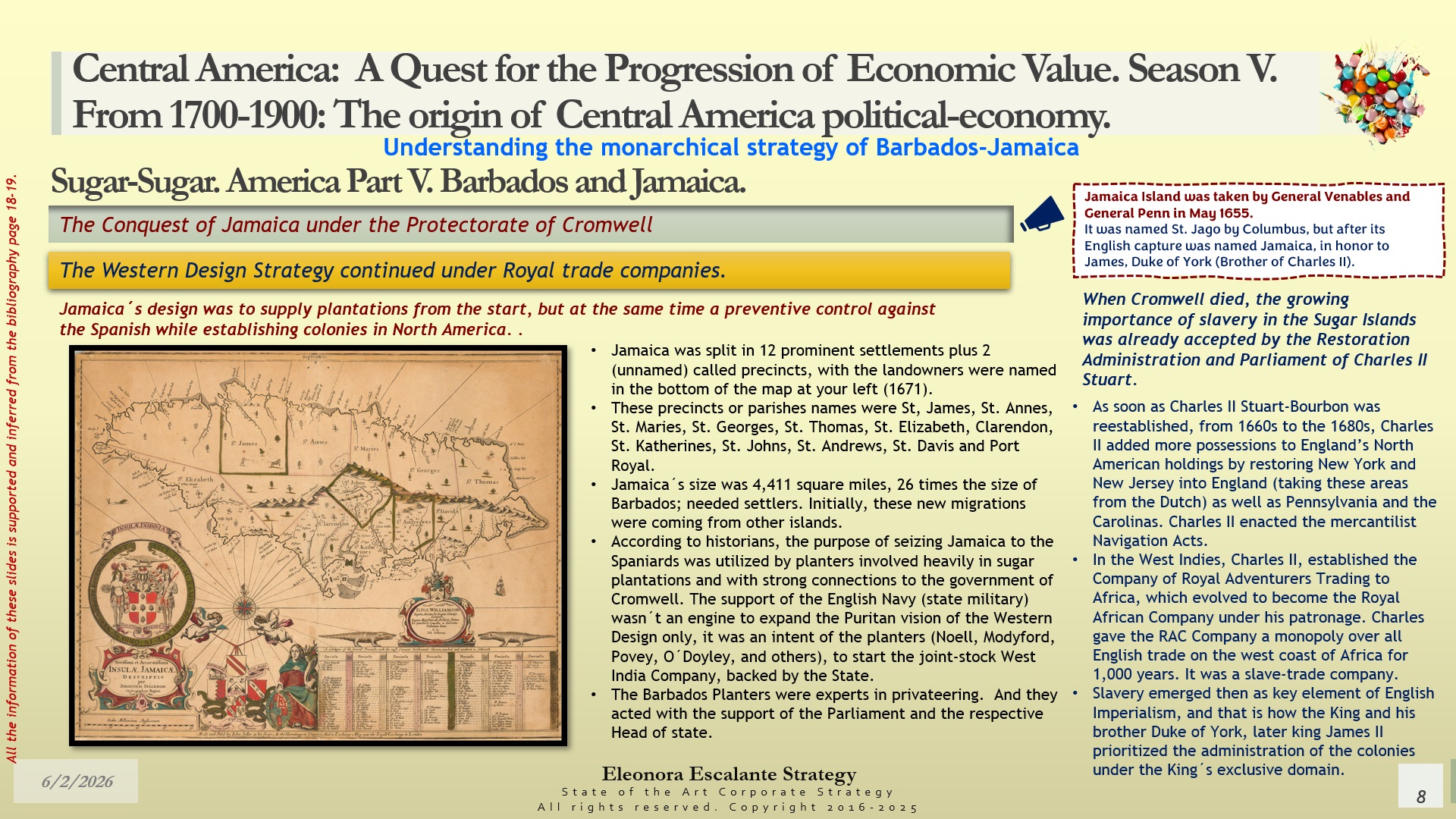
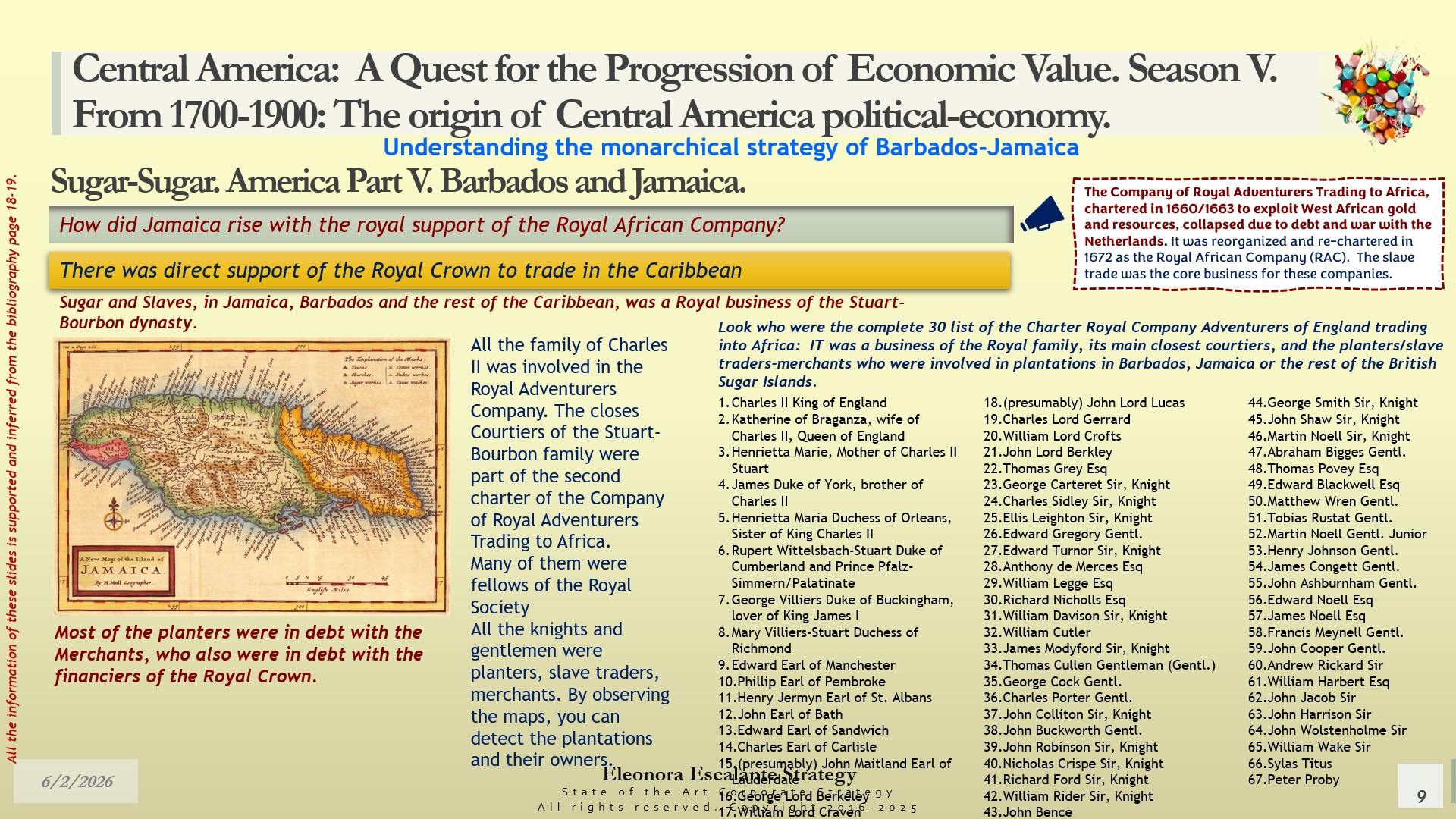
Understanding the Monarchical Strategy of the Stuart-Bourbon family (17th century) Slides 6 to 9: We recommend you read all our slides. Without that reading, you are going to be completely lost. Our strategic slides touched the core of the situation that pertains to this saga. The sugar, cotton, tobacco, indigo, cacao, bananas, and coffee plantations were based on business models that allowed American territories to expand wealth for the royal families, who traveled to establish themselves in the region. Their philosophy was to make the new lands productive beyond silver, gold, and precious stone mines. The pioneers were the Spanish Habsburgs of the brothers Charles V of Spain and Ferdinand I of Hungary (New Spain, Central America, and Perú). In waves, the rest of their families continued their expansion under the Catholic evangelization of the natives. When the Stewart-Bourbon dynasty began its conquest and colonization of North America, the rest of the associated German kingdoms continued to populate through warfare and migration. Africa’s people were used as a labor force in the plantations. In the case of sugar plantations, the British royal family was directly involved, particularly since the marriage of Charles II Stuart-Bourbon to Catherine Braganza of Portugal. The Royal Company Adventurers of England, trading into Africa, chartered in 1660/63, was a Stuart-Bourbon business. All the members of the royal family around King Charles II Stuart Bourbon appear listed, see slide 9; (2) and (3). Most of the slave traders, merchants, and planters were knights and gentlemen (nobles-courtiers), members of the English Royal Society, and all of them were controlled as subjects of the Stuart royal family. The RAC was the continuation of the Royal Adventurers charter, and as of 1677, was restructured with the explicit purpose of selling African slaves to English planters and Spanish/French Merchants in Britain Atlantic.
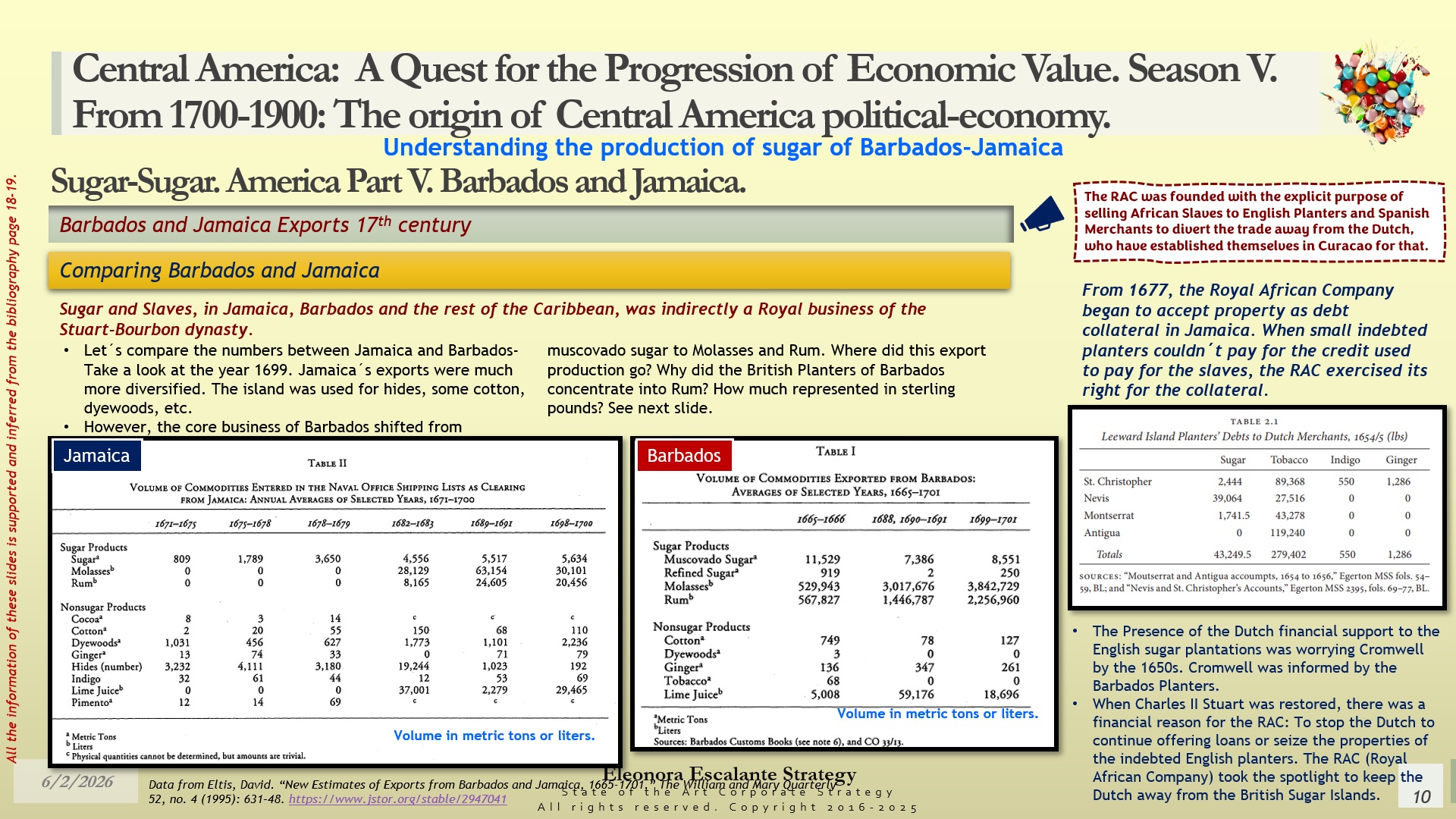
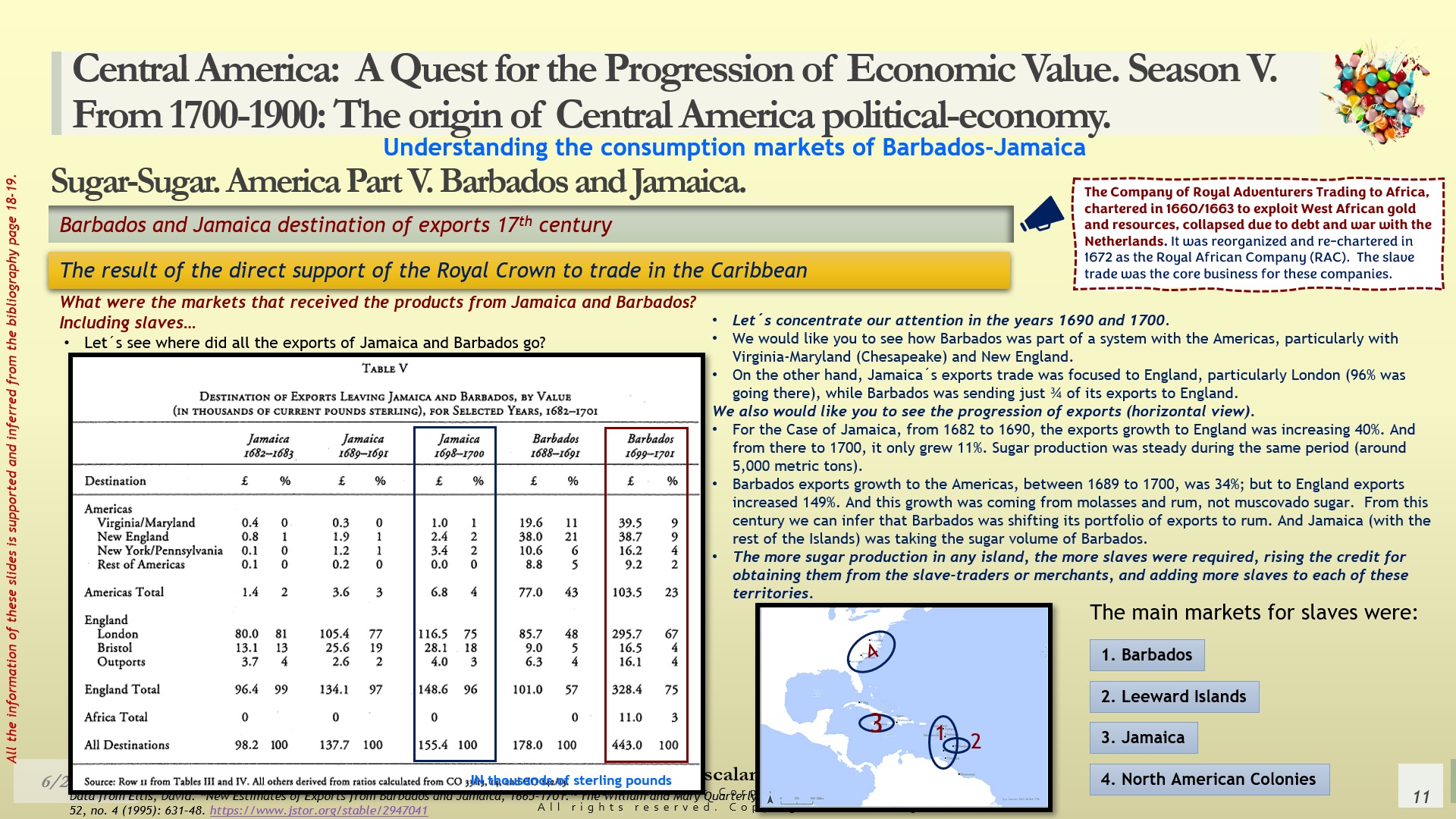
Understanding the volume production and sugar markets of the sugar produced in Jamaica and Barbados. Slides 10 and 11. The comparison of the volume of commodities entering England from Barbados and Jamaica is shown in this slide. These are the academic numbers (from Eltis’ research) (4) that describe the volumes of the products arriving at English ports. If these numbers are correct, the sugar, its byproducts, and other non-sugar goods have only fitted the transaction value of the slaves per year. Our readers can compare the year 1700, and you can observe that 25% of Barbados production was going to British America, and the rest to London, Bristol, and other English ports. See slide 11. On the contrary, Jamaica´s production for that same year was the 35% of Barbados. This is significant because Jamaica was occupied by the English in 1655. The more sugar cane was planted, the more African workers were required, and if the working conditions were as cruel as the Portuguese ones, that means an African worker couldn´t last more than 3 safras (2.5 years alive maximum).
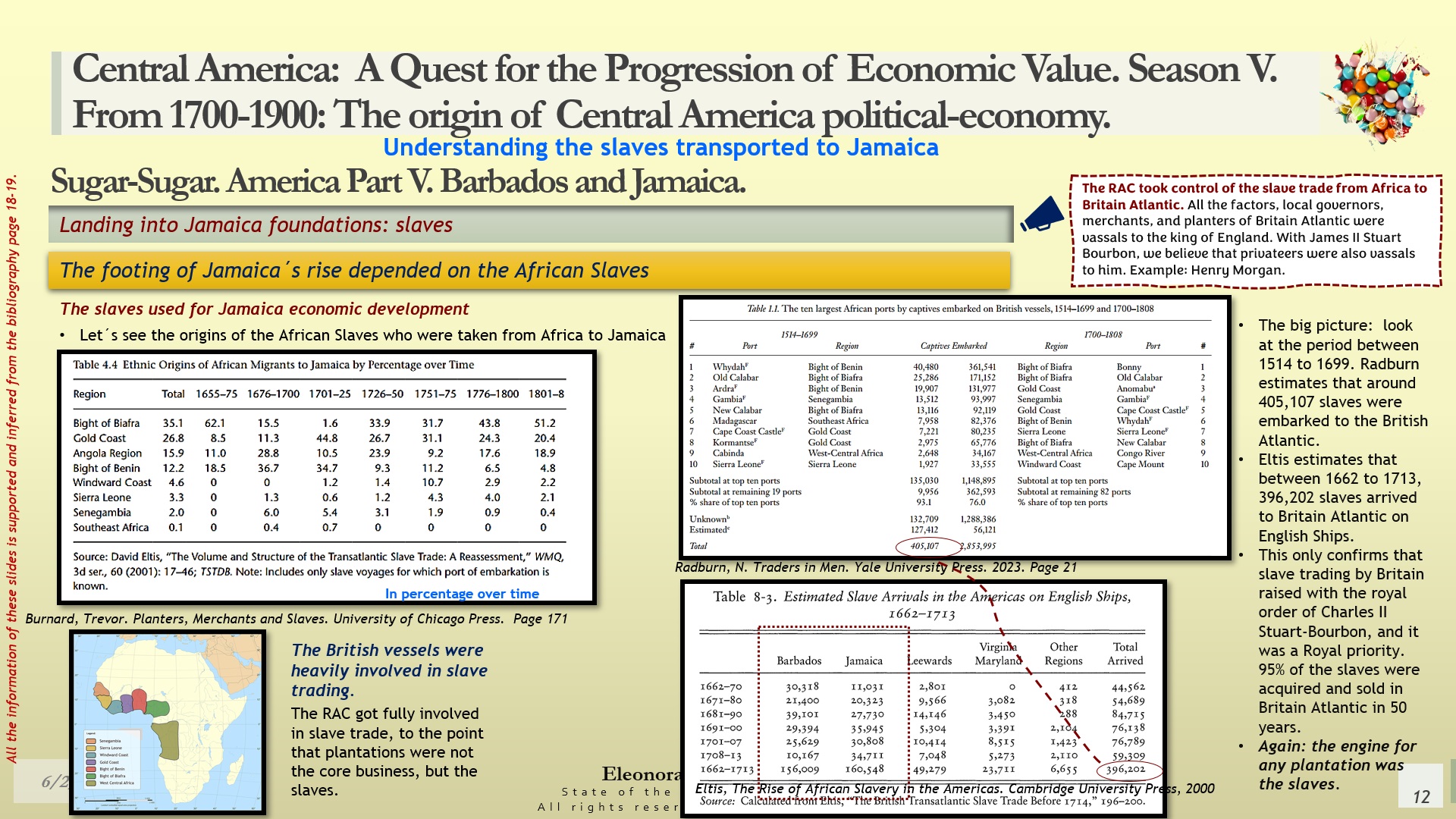
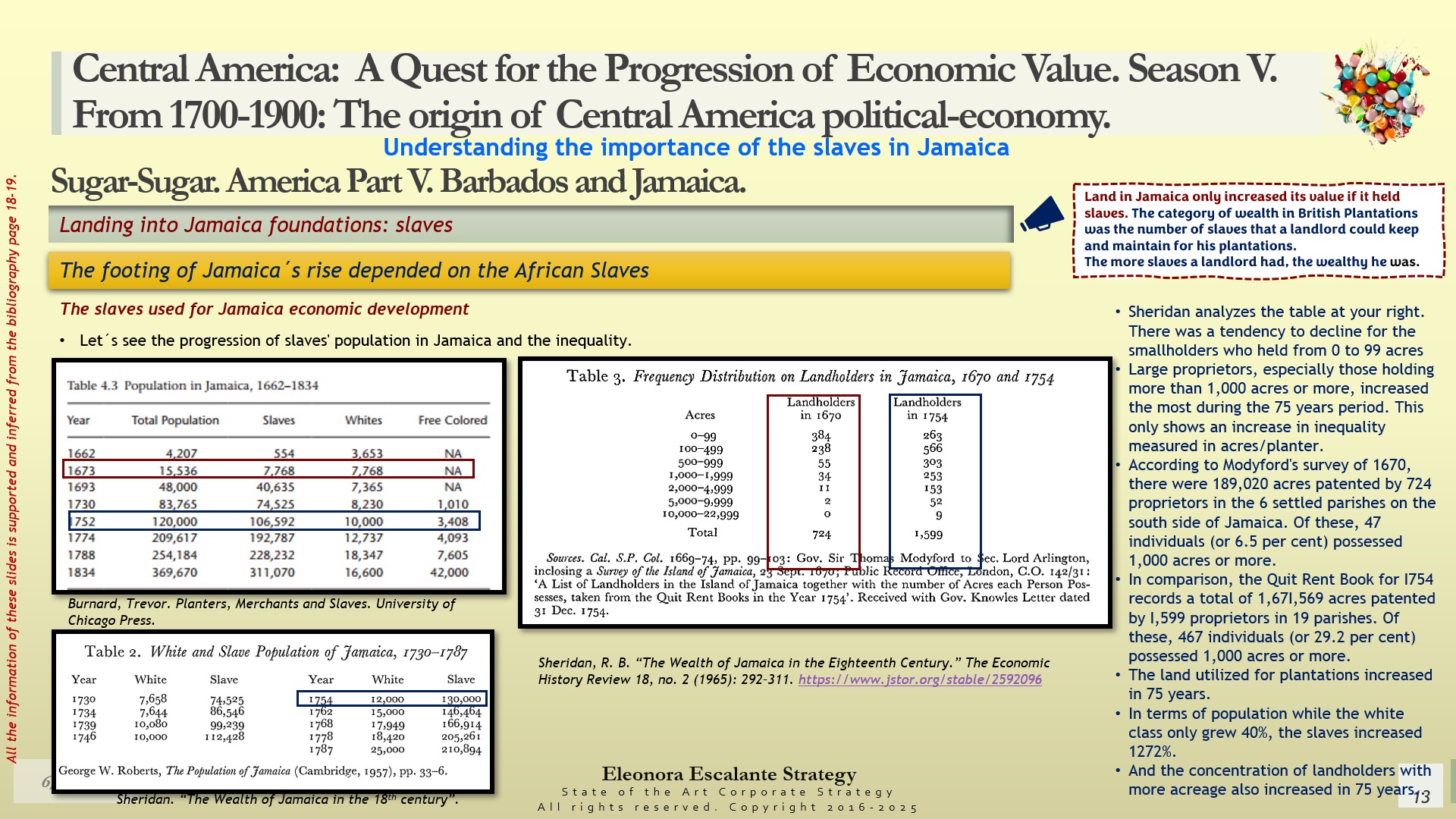
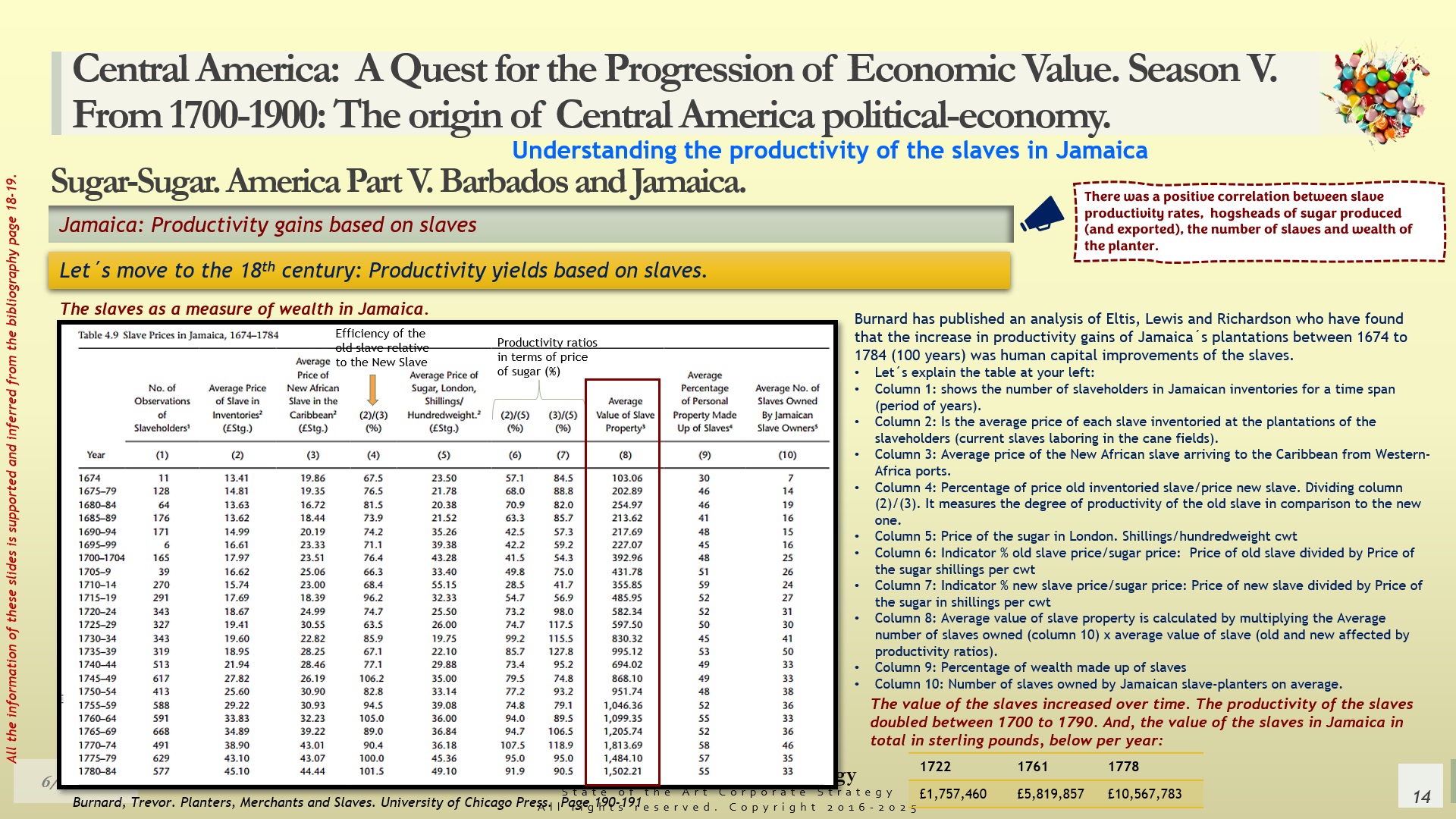
Understanding the slaves transported to Jamaica. Slides 12-14. These three slides are our effort to show you selected shots of the slaves working in Jamaica during the 17th and 18th centuries. Slide 12 shows the ethnic origins of the slaves, mainly the Bight of Biafra, the Gold Coast, Angola, and the Bight of Benin. According to Radburn (5), during the time of the RAC monopoly control of the slave trade to British Atlantic territories (including North American colonies), around 400,000 were shipped in British vessels during the 17th century, but the traffic of slaves increased to 2,854,000 during the 18th century. Jamaica was the main recipient of these slaves. Slide 14 is an effort of Trevor Burnard (6) to bring us a positive correlation between slave productivity rates, volume of sugar produced, and the number of slaves per planter. This slide shows that the measure of wealth of the planters was based on the augmentation of slaves utilizing their workforce to the utmost, while expanding the cultivation of acres. The data collected is between 1674 and 1784.
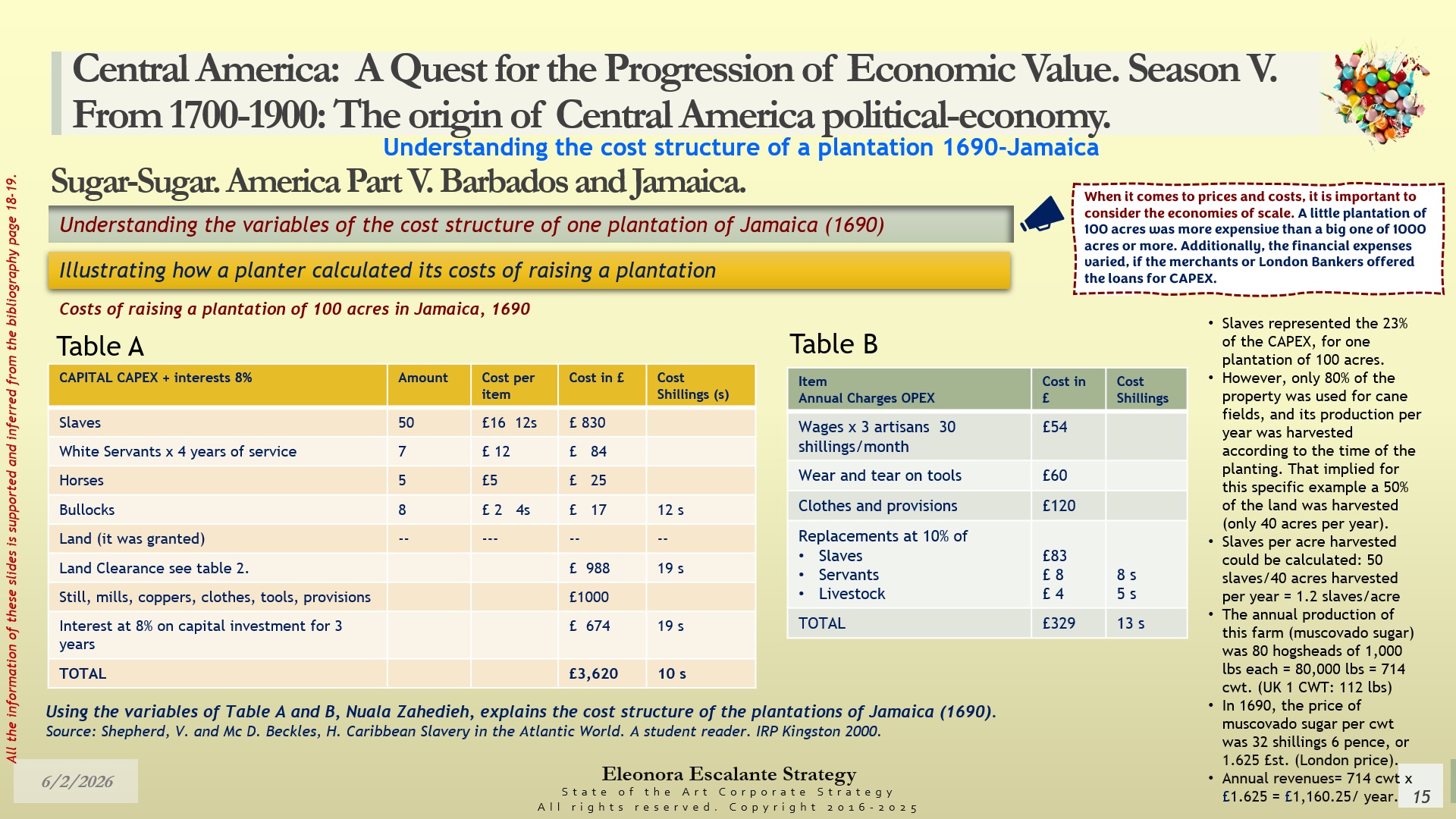
Understanding the cost structure of sugar production in Jamaica and its prices in London. Slides 15 and 16. This slide is merely illustrative. It has been prepared by researcher Zahedieh (7). Using a written report from Dalby Thomas. This property is a little one of 100 acres, but it shows the way in which capital expenditures and annual charges were accounted for per year. It also explains some factors that we perceive are not reliable for larger areas of land. However, we wanted to display how the proportion of the costs was calculated.
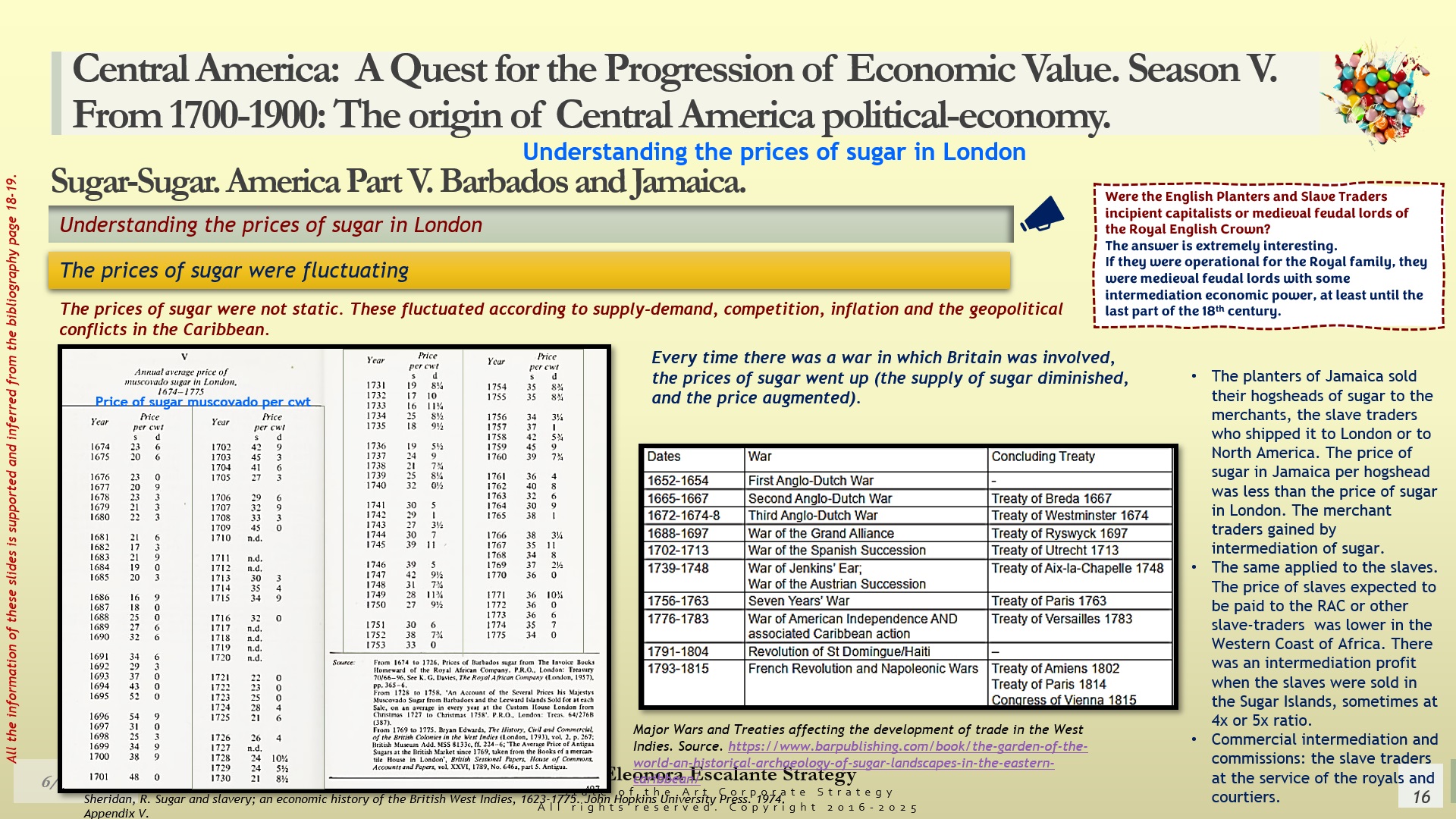
Finally, the prices of sugar were not static. These prices fluctuated according to supply, demand, inflation, and the geopolitical conflicts of the Caribbean. See slide 16.
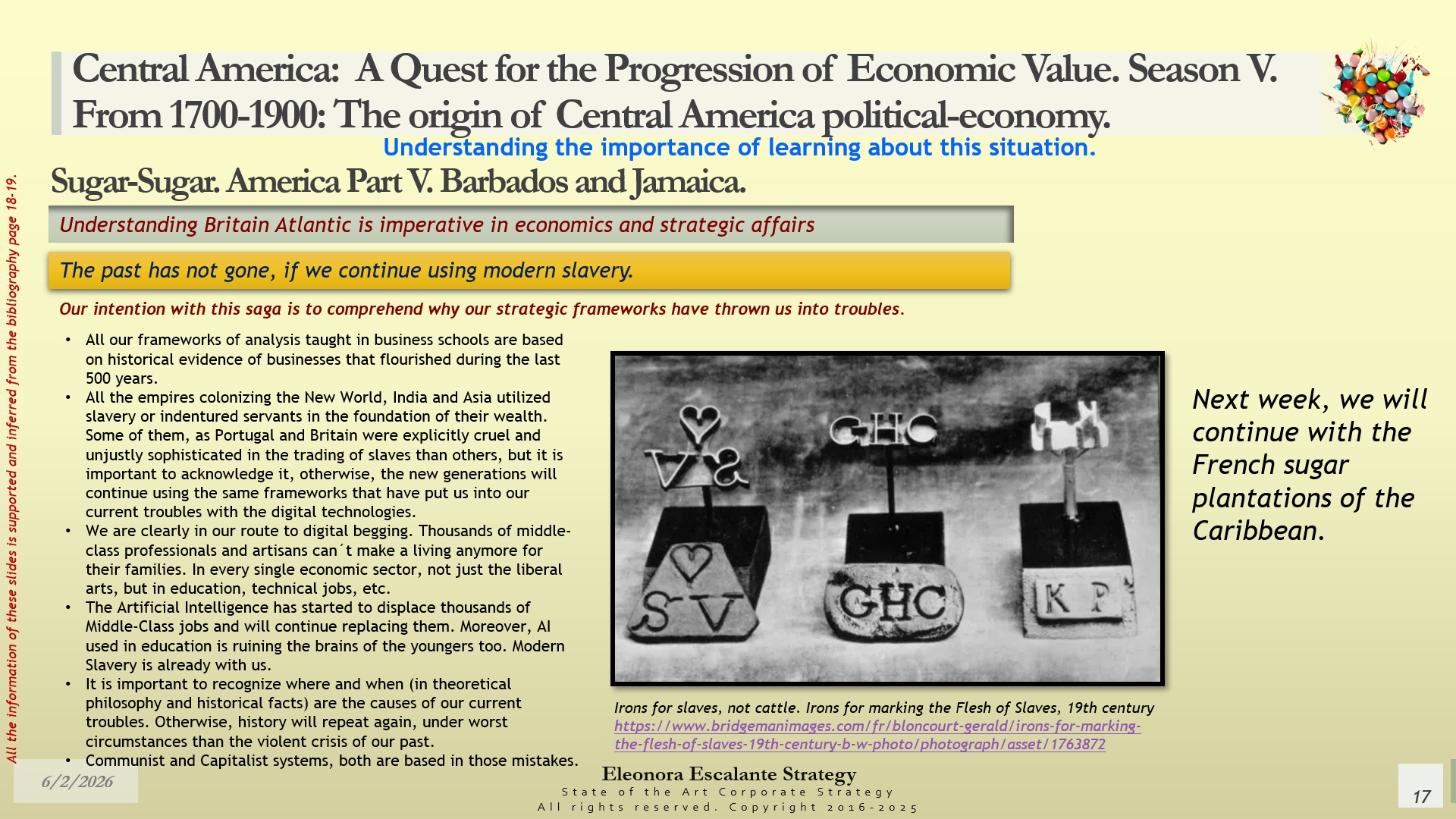
Why does the study and analysis of the origins of sugar plantations matter? Slide 17. This slide is self-explanatory.
Closing words.
This is the last of the episodes of Britain Atlantic Sugar. Read slide 17 again. And again. Please.
Announcement. Next week, we will continue with the last episode of the French Sugar Production Model.
Musical Section.
During our closing bonus season V, we will return to the symphonic, philharmonic, or chamber orchestra compositions. Today, we would like to share the testimony of the Immaculate Conception High School Symphony Orchestra of Jamaica. This is a beautiful concept that can be replicated in many high schools in Latin America. Fantastic music project for teenagers! Enjoy!. https://immaculatehigh.edu.jm/old/music
Thank you for reading http://www.eleonoraescalantestrategy.com. It is a privilege to learn. Blessings.

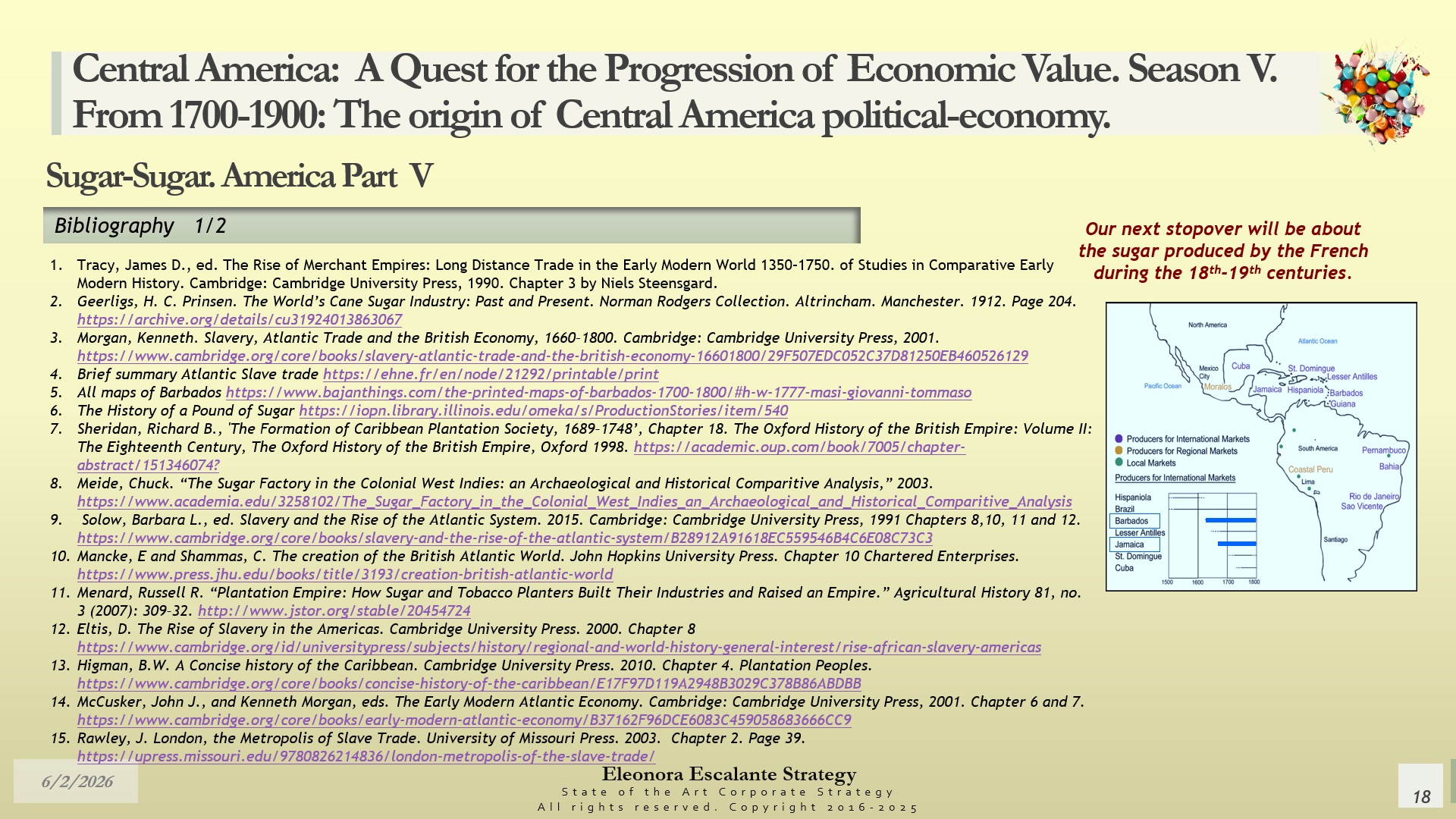
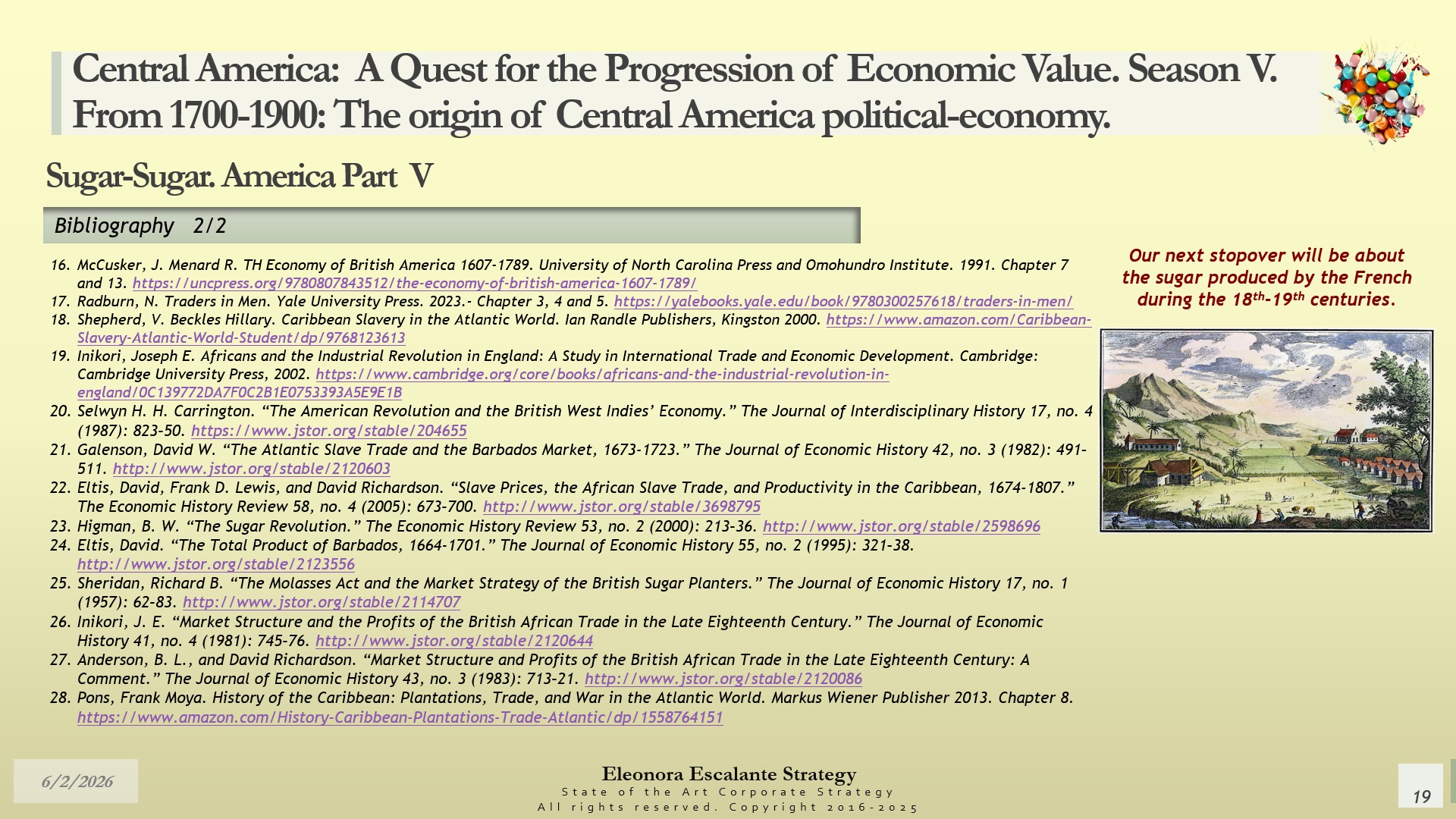
Sources of reference and Bibliography utilized today. All are listed in the slide document. Additional material will be added when we upload the strategic reflections.
(1) https://apollo-magazine.com/emperor-maximilian-i-brand-arts/
(2) Govier, M. THe royal Society, Slavery and the Island of Jamaica: 1660-1700. Notes and Records of the Royal Society of London, May 1999. Vol 53. Pages 203-217. https://www.jstor.org/stable/532206
(3) Zook, G. The Royal Adventurers and the Plantations. The Journal of Negro History. Vol. 4. No. 2. 1919. https://www.jstor.org/stable/2713538
(4) Eltis, D. The rise of African slavery in the Americas. Cambridge U. Press 2000. Chapter 8. The English Plantation Americas in Comparative Perspective.
(5) Radburn, Nicholas. Traders in Men: Merchants and the Transformation of the Transatlantic Slave Trade. New Haven, CT, and London: Yale University Press, 2023. https://yalebooks.yale.edu/book/9780300257618/traders-in-men/
(6) Burnard, T. Planters, Merchants and Slaves. Plantation Societies in British America, 1650-1820. The University of Chicago Press. 2015. Pages 188 to 202. https://press.uchicago.edu/ucp/books/book/chicago/P/bo21163243.html
(7) Shepperd, V.; McD. Beckles, H. Caribbean Slavery in the Atlantic World. Chapter 14. Nuala Zahedieh. Trade, Plunder and Economic Development in Early English Jamaica, 1655-89.
Disclaimer: Eleonora Escalante paints Illustrations in Watercolor. Other types of illustrations or videos (which are not mine) are used for educational purposes ONLY. All are used as Illustrative and non-commercial images. Utilized only informatively for the public good. Nevertheless, most of this blog’s pictures, images, and videos are not mine. Unless otherwise stated, I do not own any lovely photos or images.
 Eleonora Escalante Strategy - Strategic Reflections Think Tank