

Central America: A Quest for the Progression of Economic Value. Bonus-Season V. Episode 8. Sugar-Sugar America. Part 8. La señorita Cuba 18th-19th centuries.
Dear incredible readers, our masterclass today is learning about the whereabouts of Cuba, starting in the 1750s, until the 1900s. Our goal is to understand what was occurring on the lovely island of Juana Aragón-Castilla. Cuba was discovered by Christopher Columbus in 1492. It is a lovely archipelago of more than 1,600 islands, islets, and cays, with the honor of being the largest island of the Antilles. From the start, the Spaniards used the island of Cuba as a temporary sejourn, before moving into New Spain. As a port of entrance to the Caribbean, Cuba kept its position of a garrison fortification complex, a meeting place of armed fleets to protect the rest of the Spanish Atlantic territories from pirates, enemies, and unwelcome smugglers. Most of the Spanish ships leaving Veracruz, or coming from Sevilla, anchored and stocked in Cuba before moving forward to their final destination.
Cuba was part of the Spanish Empire from 1492 to 1898. Until the 1750s, the island was basically a provisional port, with the only job of meeting the port´s demands (Havana and Santiago de Cuba). Those Spaniards who resided there were probably the descendants of the military orders of the 16th century kings of Spain and considerable Dominicans. The main economic activities were livestock, ranching, tannery, and agriculture for survival. However, Cuba was a perfect place for illegal intermediary trade activities on a short-term basis. The Spanish Habsburg kings kept Cuba out of agriculturally relevant commerce until the arrival of the Bourbon kings, who changed everything with the reign of King Charles III Bourbon. Sugar became a privileged crop when French Saint Domingue was disrupted by the Slave Rebellion: Cuba took the sugar spotlight in replacing Saint Domingue´s production with a significant impetus, never seen before in any Spanish territory since the Discovery of America.
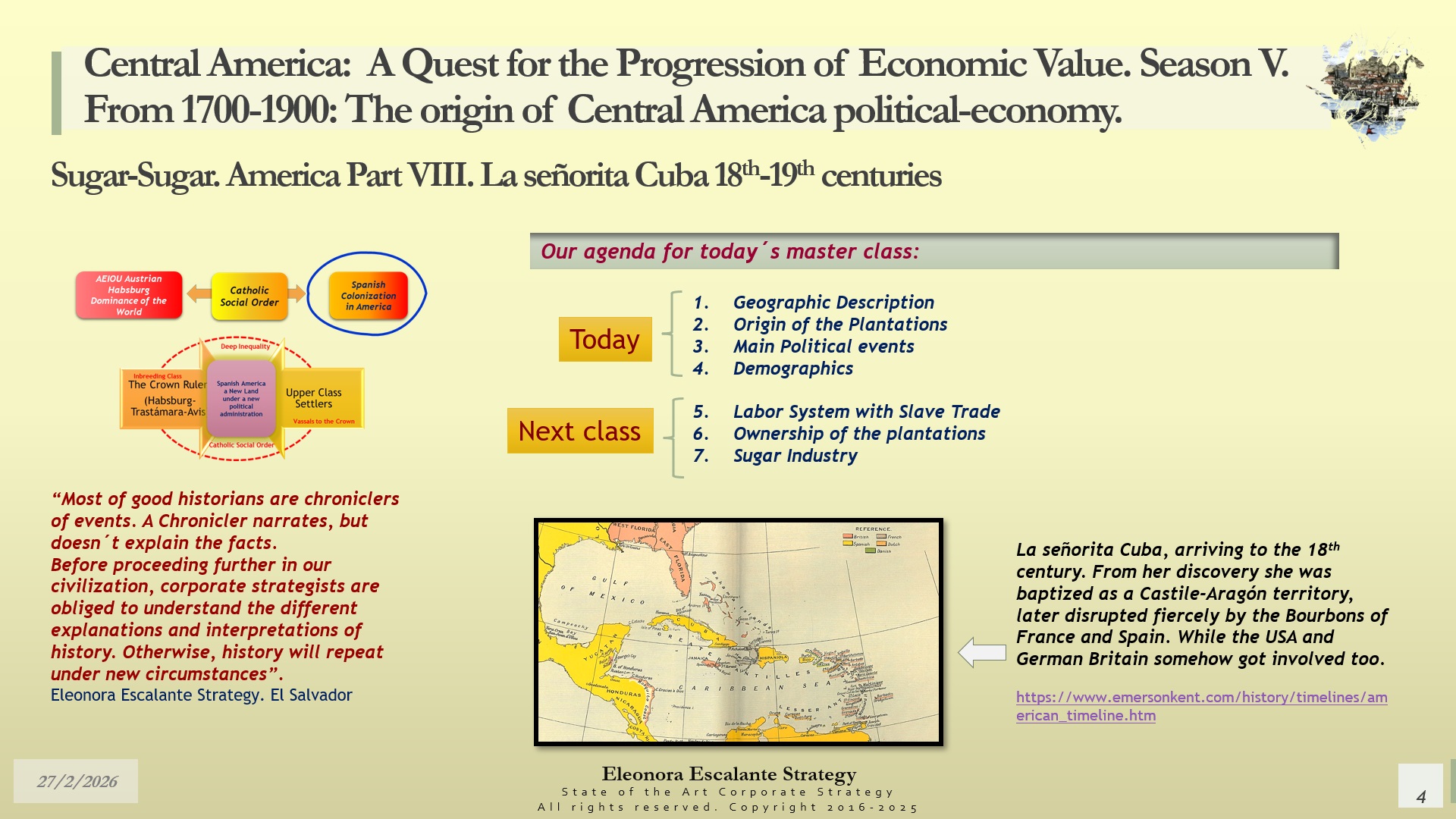
Following the latter historical background, that is how we begin our Cuban masterclass. The agenda for today is shown below:
La señorita Cuba de los siglos 18 y 19.
1. Geographic Description
2. Origin of the Plantations
3. Main Political Events
4. Demographics
5. About the slave trade to Cuba
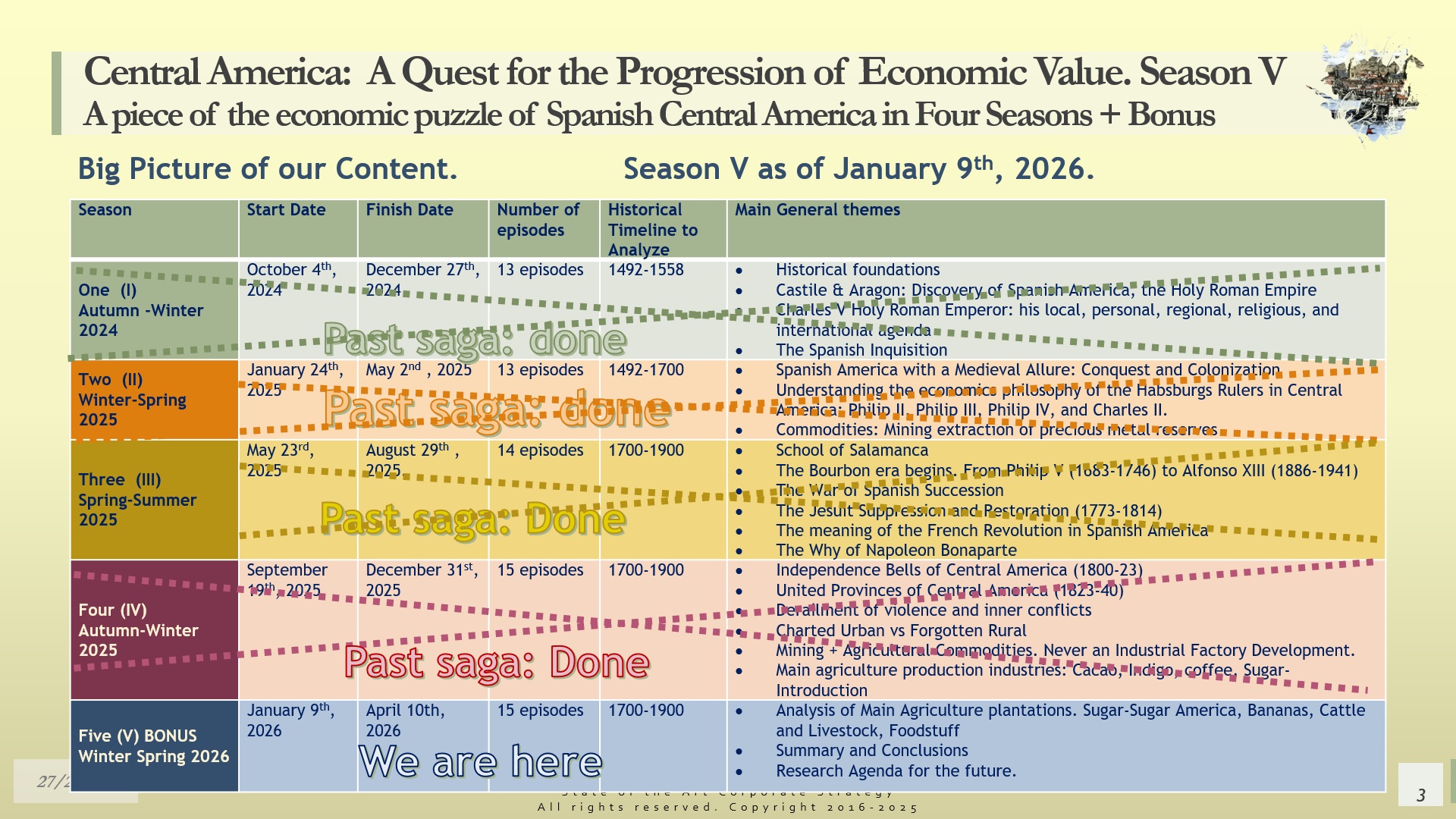
Our material of reference, previous to the reading of the strategic reflections, is shared below. As usual, we encourage you to print the material, read it, and take notes. Prepare yourself better by chasing more information related to our bibliography on the last pages of the slides. Share this material with your friends, colleagues, peers, family members, bosses, and/or employees. It is an honor to learn together with your loved ones.
We kindly ask that you return next Monday, March 2nd, 2026, to review our extra strategic reflections on this chapter.
We encourage our readers to familiarize themselves with our Friday master class by reviewing the slides over the weekend. We expect you to create ideas that are or are not strategic reflections. Every Monday, we upload our strategic inferences below. These will be discussed in the next paragraph. Only then will you be able to compare your own reflections with our introspection. We always give our students a couple of days to prepare well before our final reflection.
Additional strategic reflections on this episode. These will be in the section below on Monday, March 2nd, 2026.
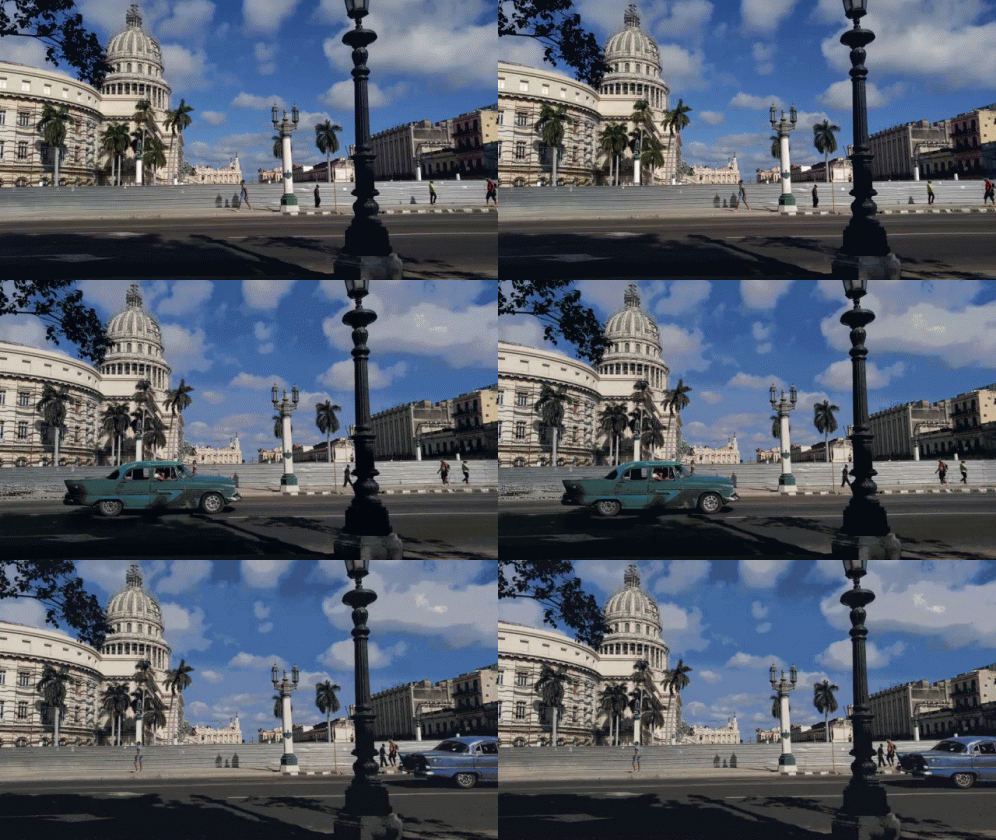
Public domain. Illustrative and non-commercial GIF image. Used for educational purposes. Used only for the public good, informative for this class.
Strategic Reflections on “Central America: A quest for the progression of economic value. Bonus Season V. Episode 8. Sugar-Sugar America Part 8. La Señorita Cuba 18th-19th centuries.
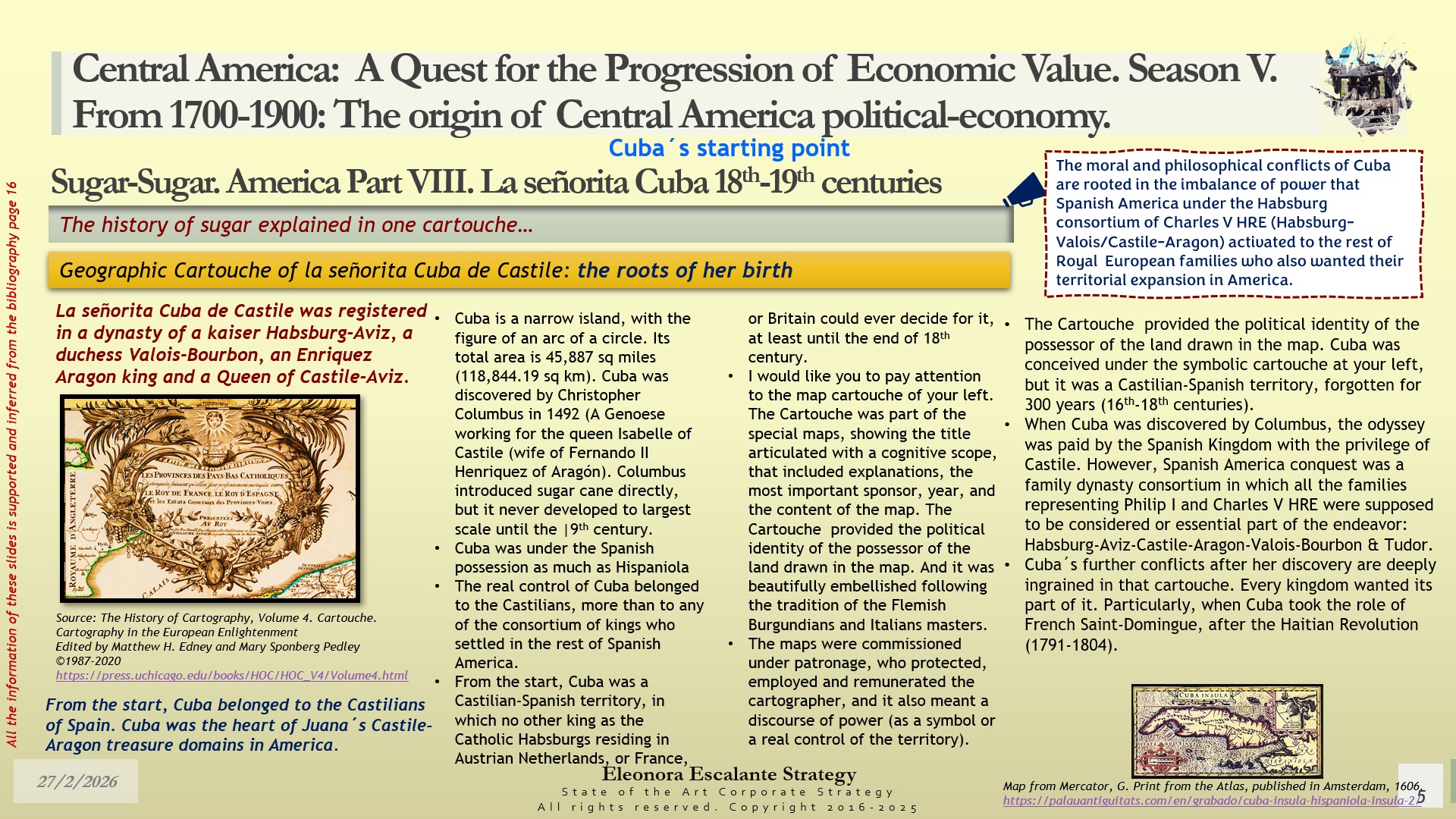
The meaning of a Geographic Cartouche. Slide 5.
Nowadays, the beauty of studying historical geography has been abolished for two generations. Since the 1990s, most schools and universities have barred this subject from their curricula for unexplained justifications, rather than to give Google Maps a green pass. It is, of course, a mistake. All the citizens of the world should be granted a course called Geographical history, with a subject named the history of cartography. Historical maps are a beautiful source of information. These maps were uniquely sponsored by rulers, monarchs, rich merchants, emperors, and kings. In consequence, most of the original ancient maps are well-grounded, treasured sources of information. When it comes to learning about the whereabouts of what happened during the 18th-19th centuries in the Greater Antilles, a good map brings excellent rooting.
The island of Cuba was discovered by a Genoese paid by the Spanish Crown of two Catholic monarchs who represented a dynastic consortium: an Enriquez-Trastámara king of Aragón with a link to the royal house of Naples; and a Castile-Aviz queen of Castilla with heraldry linked to a two-headed eagle. Thereafter, a kaiser orphan son of the house of Habsburg-Burgundy (Habsburg-Aviz-Valois-Bourbon), and his mother, the crazy Joanna, a Castile-Enriquez-Aragon widow from Spain, continued with the Spanish Habsburg endeavor in America. The descendants of these royal families trapped the colonization of America under a lock. And the key was hidden, not opened to outsiders for several centuries.
The cartouche of a map has always been considered by geographers as an ID decorative ornament in map-making. It includes a title, an inscription, a coat of arms, a narrative, description notes, symbols, and a comprehensive identification of the territory represented in the map. However, according to the History of Cartography project of the University of Chicago (1), the cartouche also involves a societal and power function: it contains the name of the sponsor of the map. The one who paid the cartographers. The higher the difficulty of the mapping, the more privileged was the dedication to the crown sponsors. By including them in the cartouche, the cartographers legitimized the practice of commitment to them, a key dominant factor in the economy of patronage.
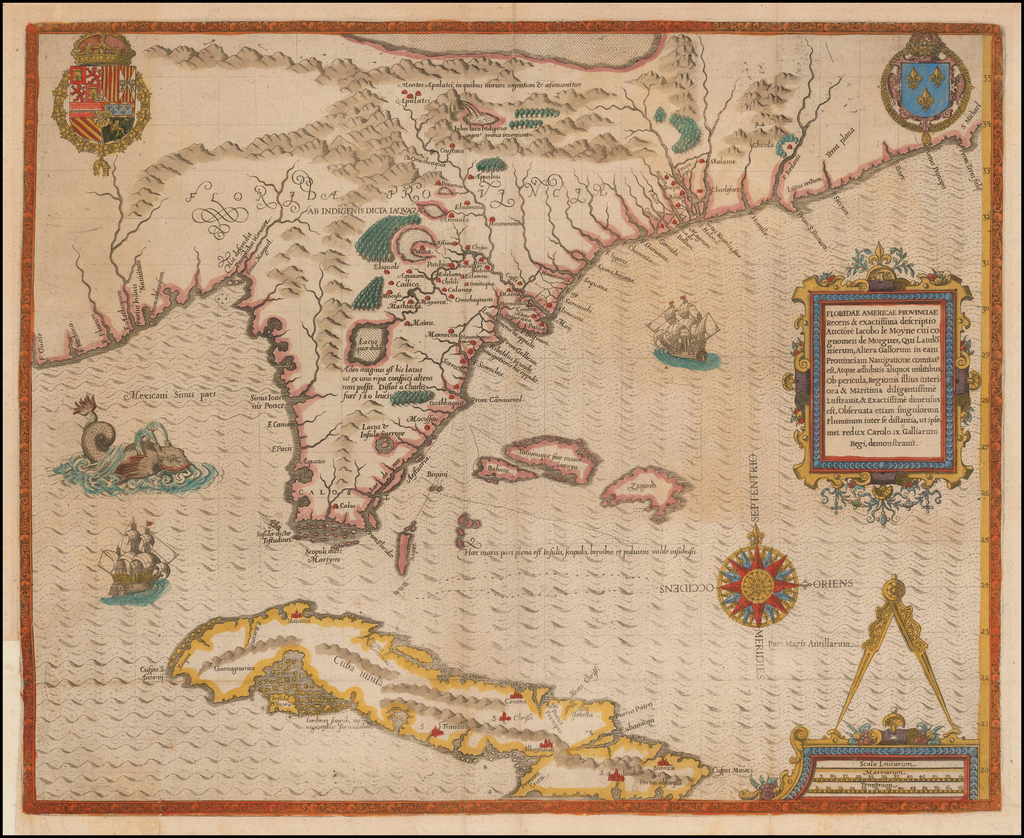
During this week, we have spent several hours observing the cartouches of all the historical maps of Cuba we could find that look dependable. Maps of Cuba from the 16th to the 19th century. We discovered the engraving of the cartouches, dedicated to the coat of arms of Spain and France, well before the arrival of the Bourbons to power (1700s). Why were the Bourbons mentioned in a 16th-century map of Cuba? England was not even mentioned in any of them. We asked ourselves, why was the French coat of arms included? This was the time of the French King Henry IV Bourbon (married to a Medici). In some maps, we also recognize Venetian-Naples’s heraldry, but that is understandable, given the connection of Naples to the Spanish Crown. Then there is a huge silence of cartouches in the maps of Cuba during the 18th century. Afterward, we have found information on Cuba maps and cartouches linked to Genoa and Venezuela, and, as of the 19th century, a large number of Cuban maps were produced by the USA. The American maps of Cuba were prepared by the Union (USA), linked to high-caliber personalities of Louisiana (or under French supervision), Rhode Island, or New York.
Despite Cuba being the territorial pearl given to the Spanish Trastámara descendants and supporters, the island was never a priority for the next Habsburgs after Charles V, HRE. It looks like the Habsburgs and all their relatives, as of the 16th century, excluded themselves from doing something there until the Bourbons arrived at power.
The Spanish Habsburg kings prohibited any non-Spanish from penetrating Cuba (2). As of 1535, Charles V HRE prohibited the English, French, and Portuguese from entering New Spain, Perú, and its Spanish West Indies territories. Any non-Spanish subject was banned from traveling to the Antilles. In the specific case of Cuba, this prohibition of foreigners continued until 1762 (when the island was occupied by the British by force). Because of this, King Charles III of Bourbon authorized a massive protection plan for Cuba, starting with the construction of the Castillo del Príncipe (Castle of the Prince) in Havana.
“Apparently,” we have acknowledged that la señorita Cuba was a deemed and respected island fortification under Castilian territorial possession of premium wingspan, but it was left as a side dish, never a priority for the Spanish Kings. That is how we arrive at the 18th century, a backward Cuba, not producing any economic growth, nor wealthy, lacking merchandise to participate in the international emerging commerce.
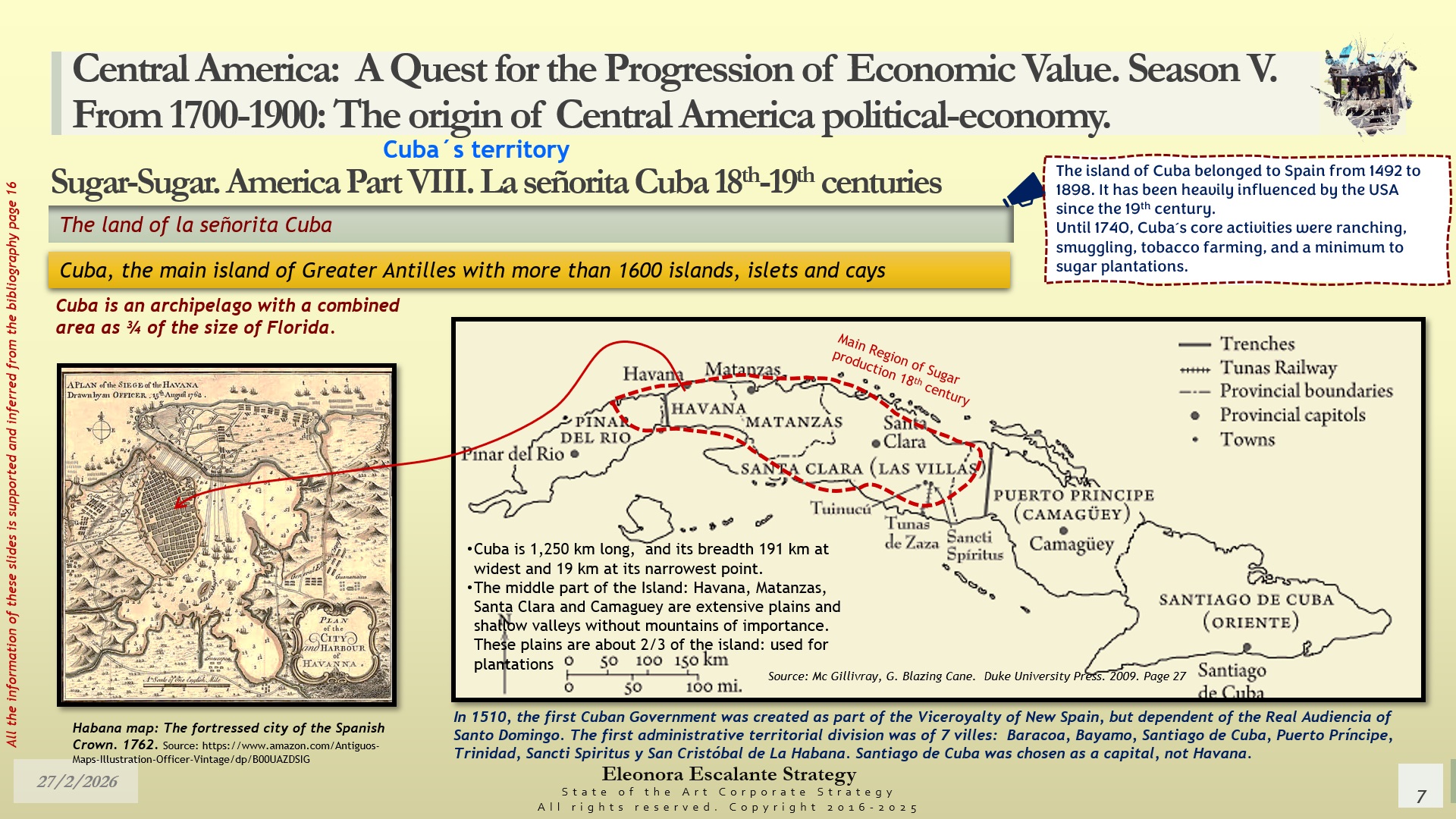
Cuba´s territory. Slides 5 to 7.
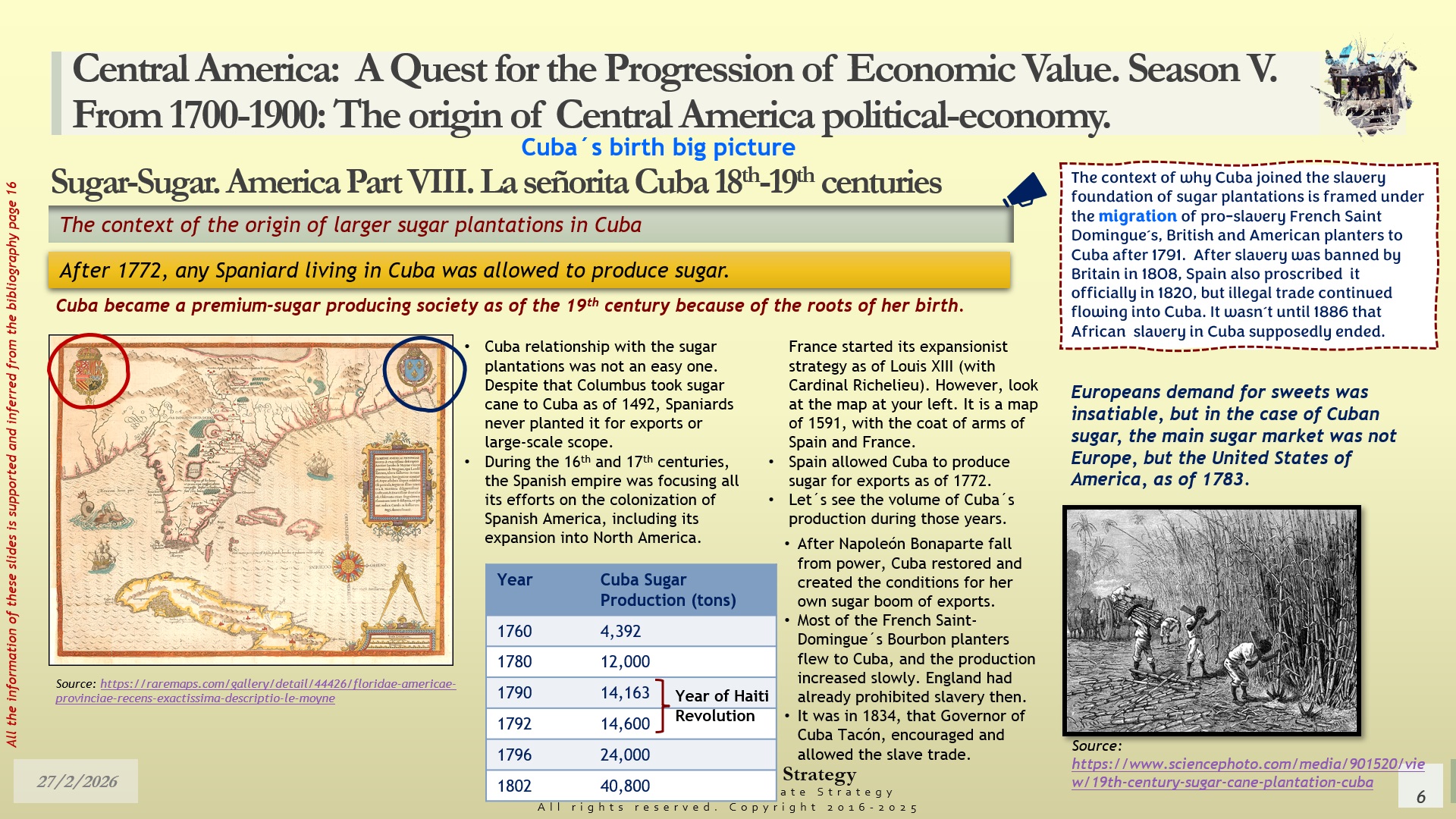
Geographically, the island was the first Atlantic enclave for the kingdom of Spain (with preference to Castilians). As mentioned previously, because of the king’s prohibition on foreigners, in Cuba, not even the Portuguese could enter without a license. By the way, this license was an exceedingly difficult one to obtain. With the arrival of the Bourbons, after 1772, King Charles III allowed any Spaniard living in Cuba to plant and produce sugar; consequently, it wasn´t until the last quarter of the 18th century that sugar cane made its entrance as an economic key industry. This period coincides with the French Revolution. At that time, the island extension of 118,844 sq km was in certain areas not just inhospitable, but it also showed a pristine virginity, never seeded to any plantation on a larger scale, and it was kept as such until the year of the Haitian revolution. Read slides 6 and 7 for self-explanatory information.
According to official history, the island of Cuba was under Castilian custody after its discovery. Most of the immigrants used the port (mainly Habana) only as a stopover to replenish during a tarry short-term sojourn, while continuing their journey to other territories. If Cuba was designed as a short-term stopover for silver convoys coming from Mexico to Sevilla, why was Cuba left behind New Spain and Peru’s economic development? If Cuba was a port of call for silver, why was it kept dormant for more than 200 years? Moreover, Cuba would have never been important for the Bourbons if the Haitian Revolution had never taken place. The sugar plantations did not flourish because of the Bourbon Reforms of Charles III, nor because of the short occupation of Britain in 1762. The sugar plantations of Cuba were established as a reaction to the loss of French Saint-Domingue. Why was the forgotten Cuba so suddenly important for all these new hubs of development then? The Bourbon Spanish Crown was already gone from its colonies in Latin America. Cuba and Puerto Rico were the only two colonies in the hands of the Bourbons. Was Cuba planned to be transformed into the equivalent of French Saint-Domingue? On purpose? or by accident?
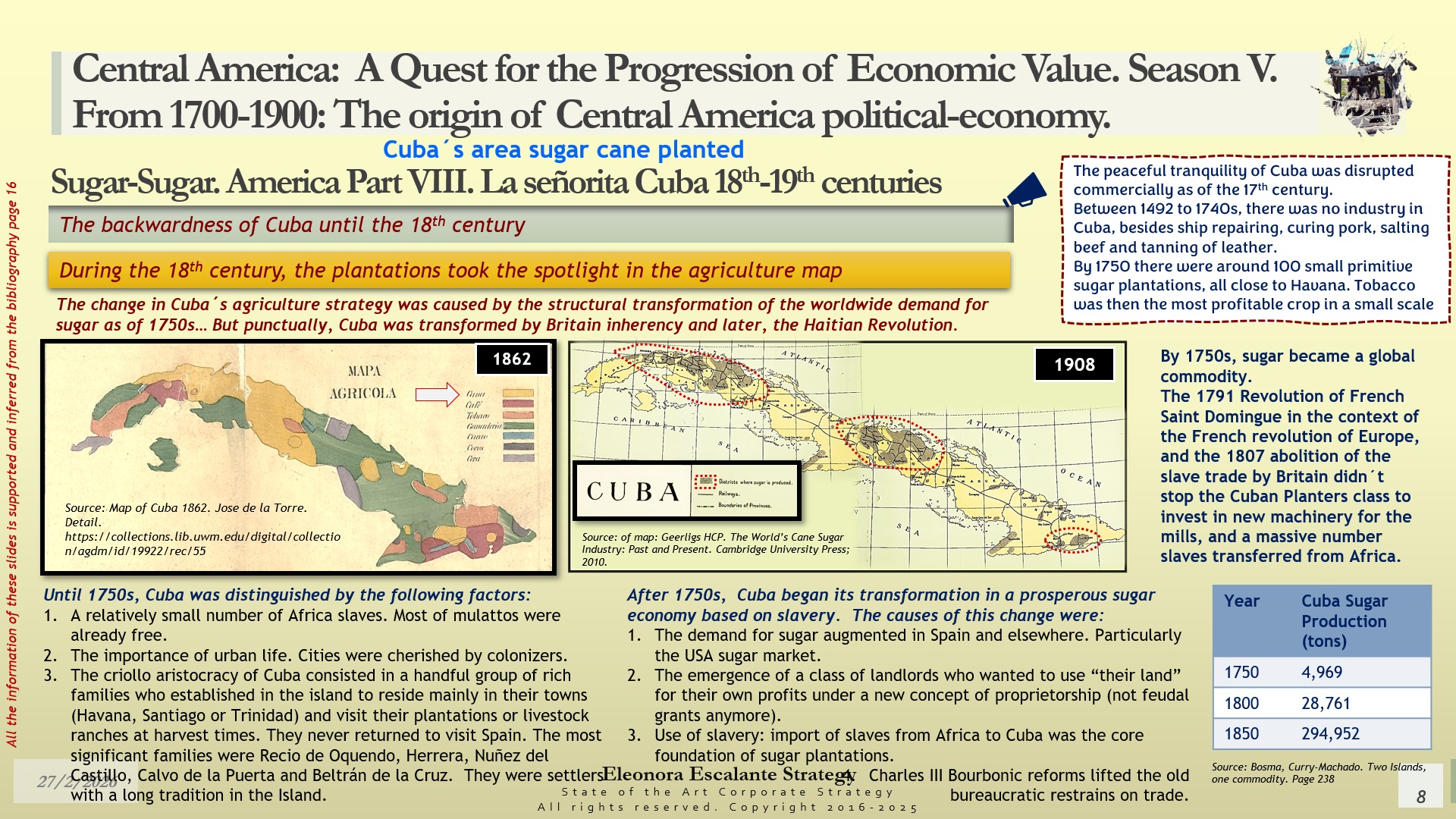
As of the 1770s, the plantations began taking the spotlight in the agriculture map. See slide 8.
When the Haitian Revolution closed the sugar production to France, most of the French planters and technicians escaped and traveled to Cuba. This migration shifted the hegemony of Spanish peninsulares and criollos to a French one. The Castilians were not going to be alone anymore. The French sugar model of production used in Saint Domingue was replicated entirely in Cuba. With so much impetus, this model was copied to insane levels, to the point that the expansion of sugar plantations took almost half of the island in less than 50 years. Before the technological development of the mills, the planters understood that the crucial key factor for growth was the extension of land planted with a robust sugar cane species, using different timings for planting (under a ratoon scheme), which extended the harvesting production year over year. Without sugar cane coming out of the plantations, any high-tech sugar mill is turned off.
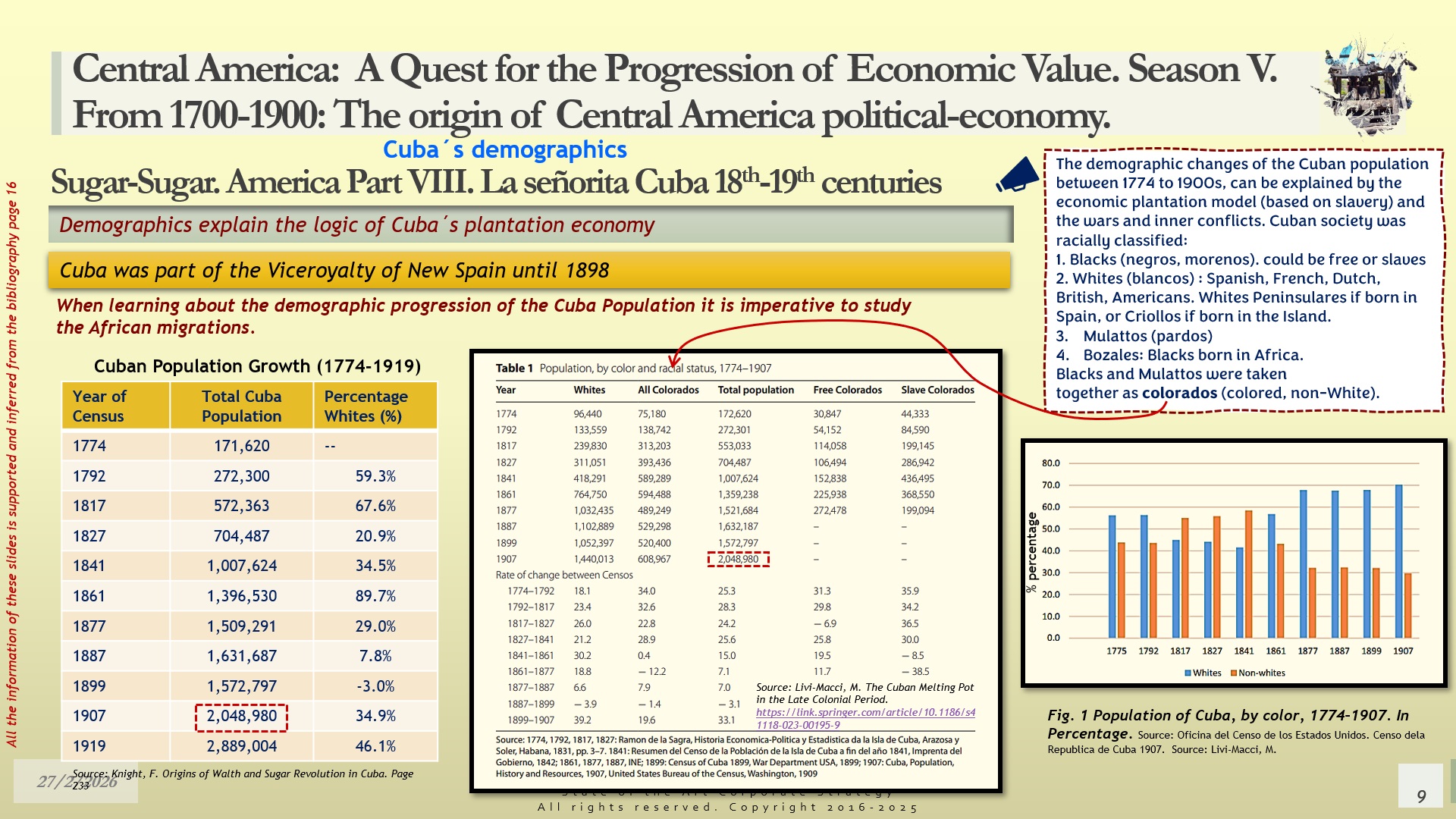
A plantation society with an economic foundation in slavery. And this time under the direct responsibility of the Bourbon Spanish crown in Cuba. Slides 9 and 12. This slide is demographically revealing. According to different official censuses organized by the Captaincy General bureau of La Habana, when migration to Cuba was opened to the French, it also invited migration from the newly formed United States of America. Since the land was under the property of the Spanish Crown, we suggest that the Spanish Crown reserved its right to grant the property under concessions to new landholders. Between 1774 and 1919, and even after the colossal fear caused by the Haitian Revolution, the Spanish Crown augmented the establishment of the “colorados” (African blacks + mulattos) population on the Cuban plantations. Between the 1820s and the 1850s, there was a higher proportion of blacks in comparison to whites, with a ratio between 1.3 to 1.4 “colorados” per 1 white. This proportion was reversed right after the Ten years war (1867-78), with a ratio of 2 whites per 1 Colorado. The “Ten Years War” occurred right after the American Civil War, which lasted until 1865, restraining the utilization of African Slavery in the USA. We have discovered that during this century, for each African incoming Cuba, there was one white arriving too, however at separate times. After the Little War of Cuba, there was a huge influx of Spanish immigrants to the island (about 709,000 arrived between 1868 and 1894), which is equally comparable to the total amount of 778,000 Africans transferred to Cuba, mainly from West Central Africa and the Bight of Biafra, some decades before.
Once Cuba became a creator of wealth with its main sugar market located in the USA, then and just then, Cuba was able to charm geopolitical relations with the USA that attracted direct commercial investments in the industry. Since historical times, it is important to understand that there have always been two types of pursuits when it comes to establish relations between empires: (1) Geopolitical relations based on dynastic marriages or convenient strategic alliances for territorial or defensive expansion; and (2) Economic relations based on the possibilities of business commercial endeavors; in which one, or the other, or both empires could increase the wealth of their respective kingdoms. Cuba illustrates the exact moment in time, in which Bourbon Spain was totally delegitimized after the Bonaparte´s spell. So, the geopolitical dynastic relations were not powerful enough in favor of the Spanish Crown. Spain was crumbling in political revolts and post-Carlist uncertainty. And, given that helpless situation, already known by the Cuban planters, it was logical for them to look for support from the USA to attain their independence. More than five USA presidents, in conjunction with some Cuban ancient traditional sugar planters, tried to appropriate the island: Jefferson (1808), Jackson (1823), Polk (1848), Pierce (1854), Buchanan (1858), McKinley (1897), and Grant (1877). The USA’s appropriation of Cuba took more than 100 years to occur. And it ensued because of a commercial value proposition based on sugar exports. The USA (legally or not) considered or tried to buy, invade, or negotiate in secret for a takeover of the island.
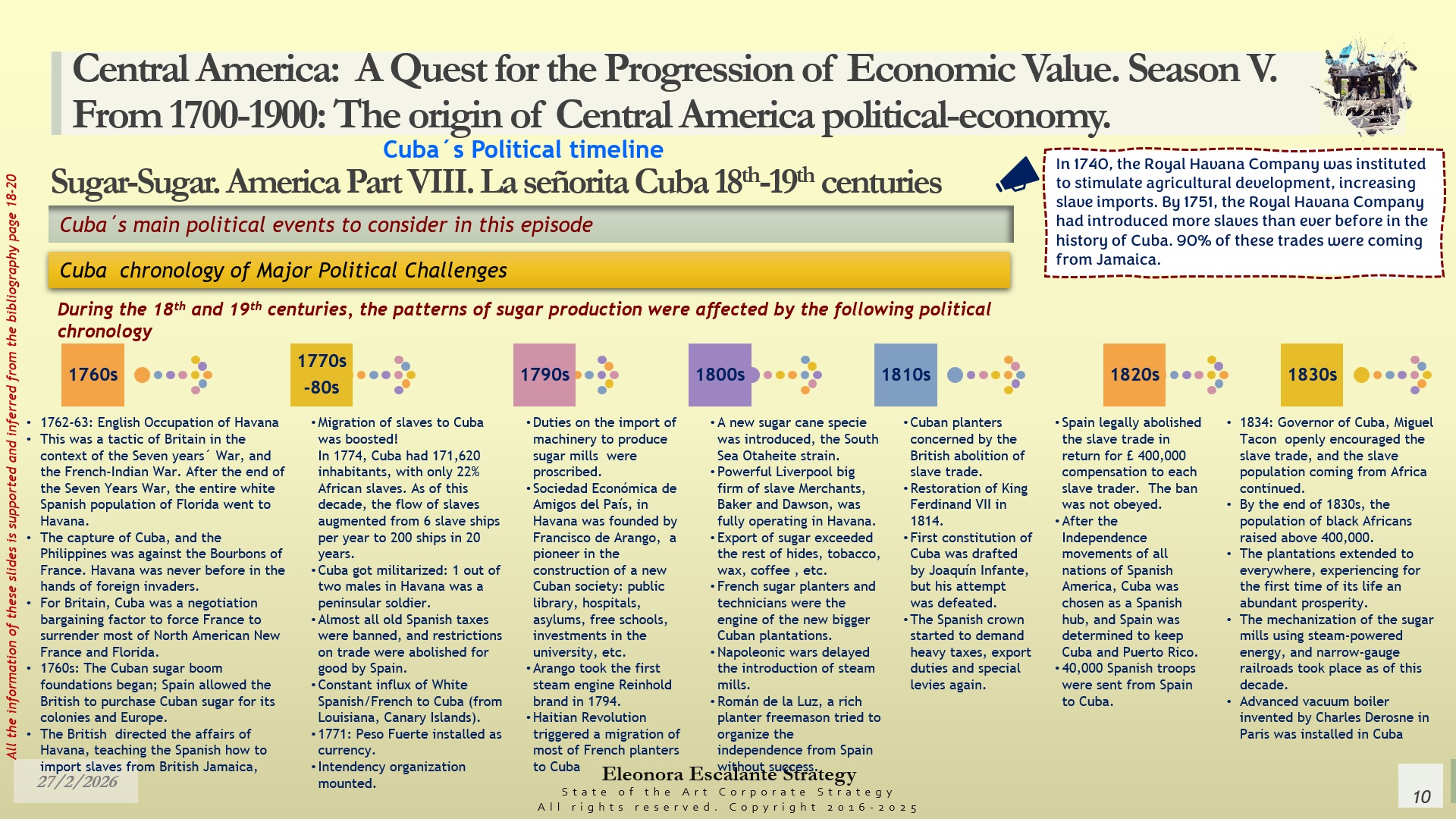
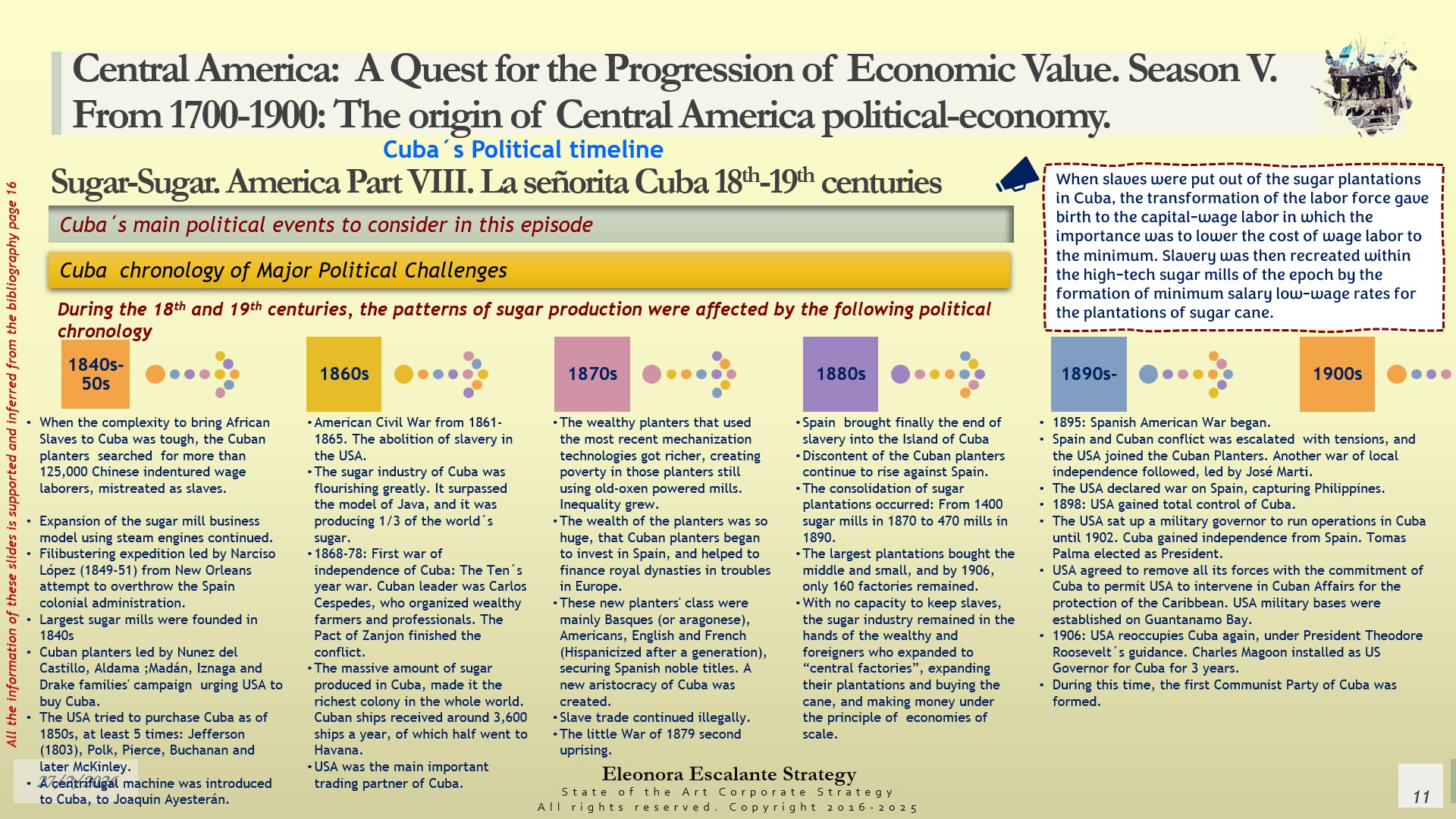
Cuba chronology of Major political Challenges (1760s to 1900s) Slides 10-11.
We have prepared a chronological succession of political and relevant events of Cuba between the decade of 1760 and 1900. These two slides are self-explanatory. Cuba tried to gain its independence from Spain several times during this century, using different possibilities and commercial bonds between the Cuban planters and their American sugar clients. Their attempts were controlled by the massive number of recurrent convoys of Spanish troops sent to the island. Let´s grasp an idea of the number of soldiers sent from Spain in 1895-96 to Cuba: more than 192,800 militaries.(3) Why?
By 1894, 90% of all the raw-sugar exports went to the USA, and this economic codependence on North America created the weakest existing geopolitical point in which a Spanish colony could ever be: Cuba was not anymore tied to the economic interests of Spain, but to the USA. In consequence, the new republic (after its independence from Spain) officialized a state of deepest economic reliance on the USA, very similar to a kind of digital addiction of all of us with the current digital media techies of the USA. However, in the context of Cuba in the 19th century, it is reasonable to consider that further conflicts after the independence from Spain were imminent, affecting the new “corporate decision making” of the planters’ community. Three conflicts shattered and restructured the Cuban sugar economy by the end of the 19th century:
- Cuban War for Independence from Spain (1895-98)
- The Spanish-American War, with further USA intervention and occupation of Cuba (1898-1902), led to the Platt Amendment resolution and the first USA-Cuban reciprocity treaty.
- A new USA military intervention and Occupation of Cuba (1906-09).
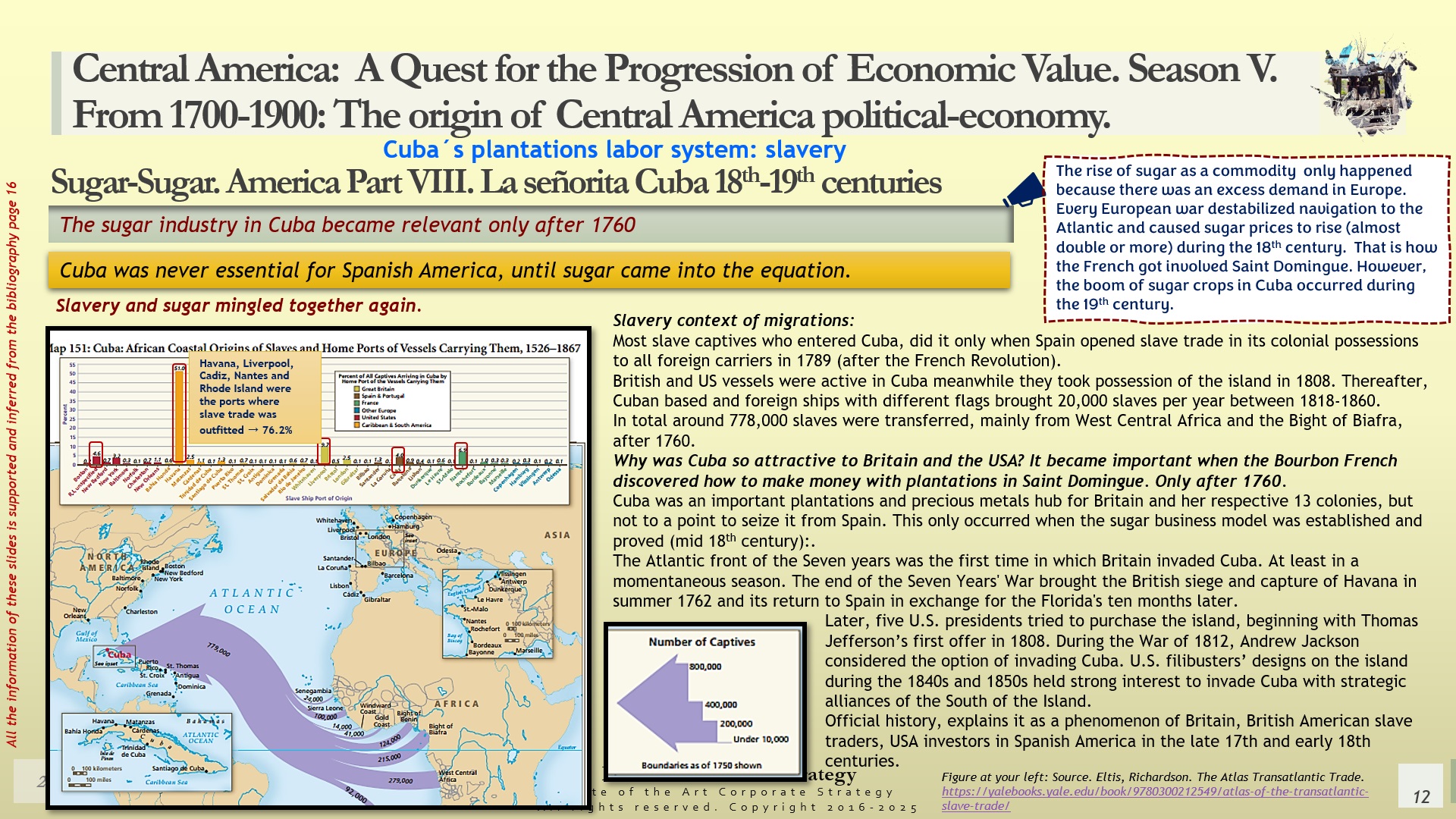
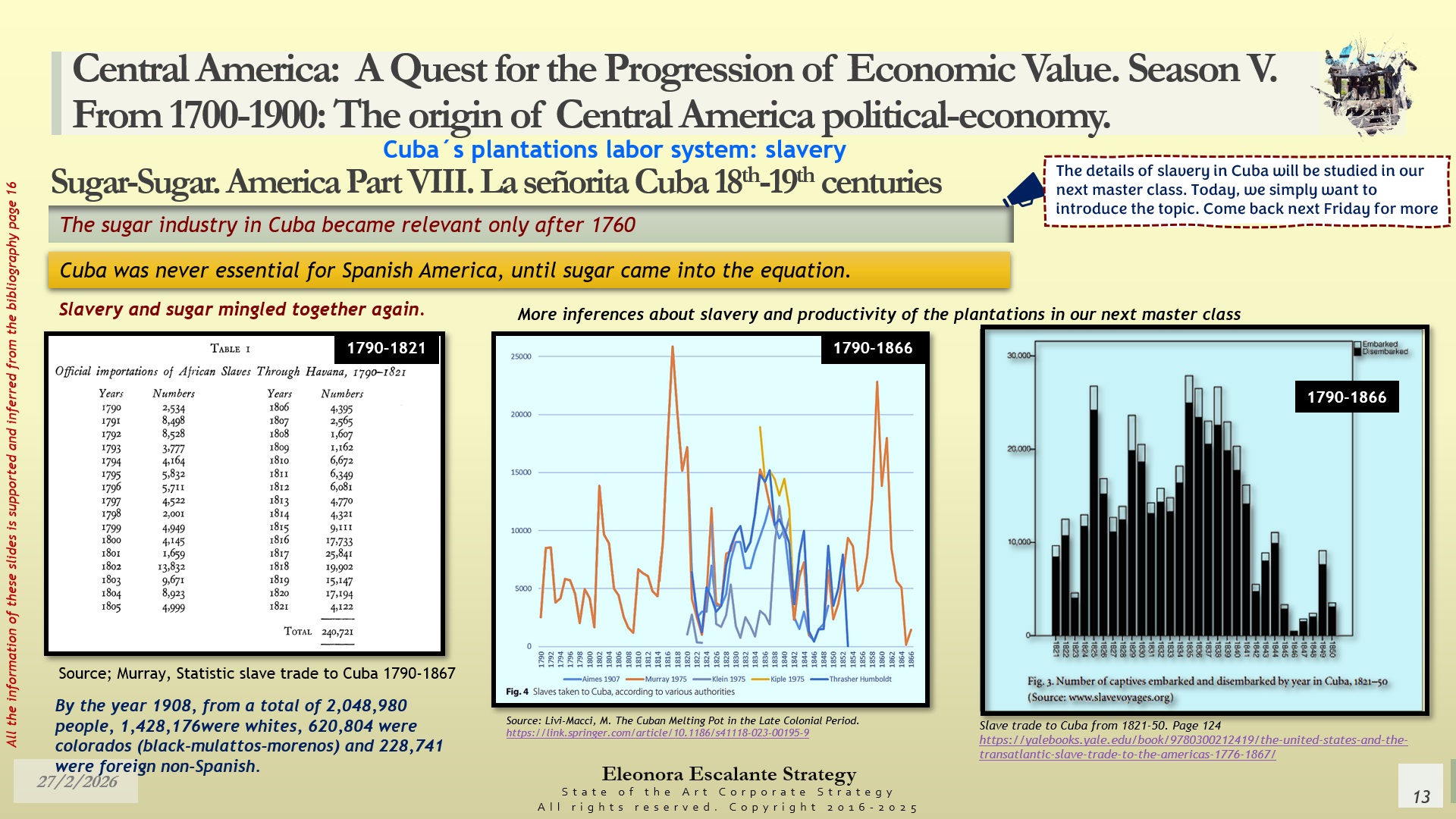
Cuba´s plantation labor system: Slavery. Slides 13-14.
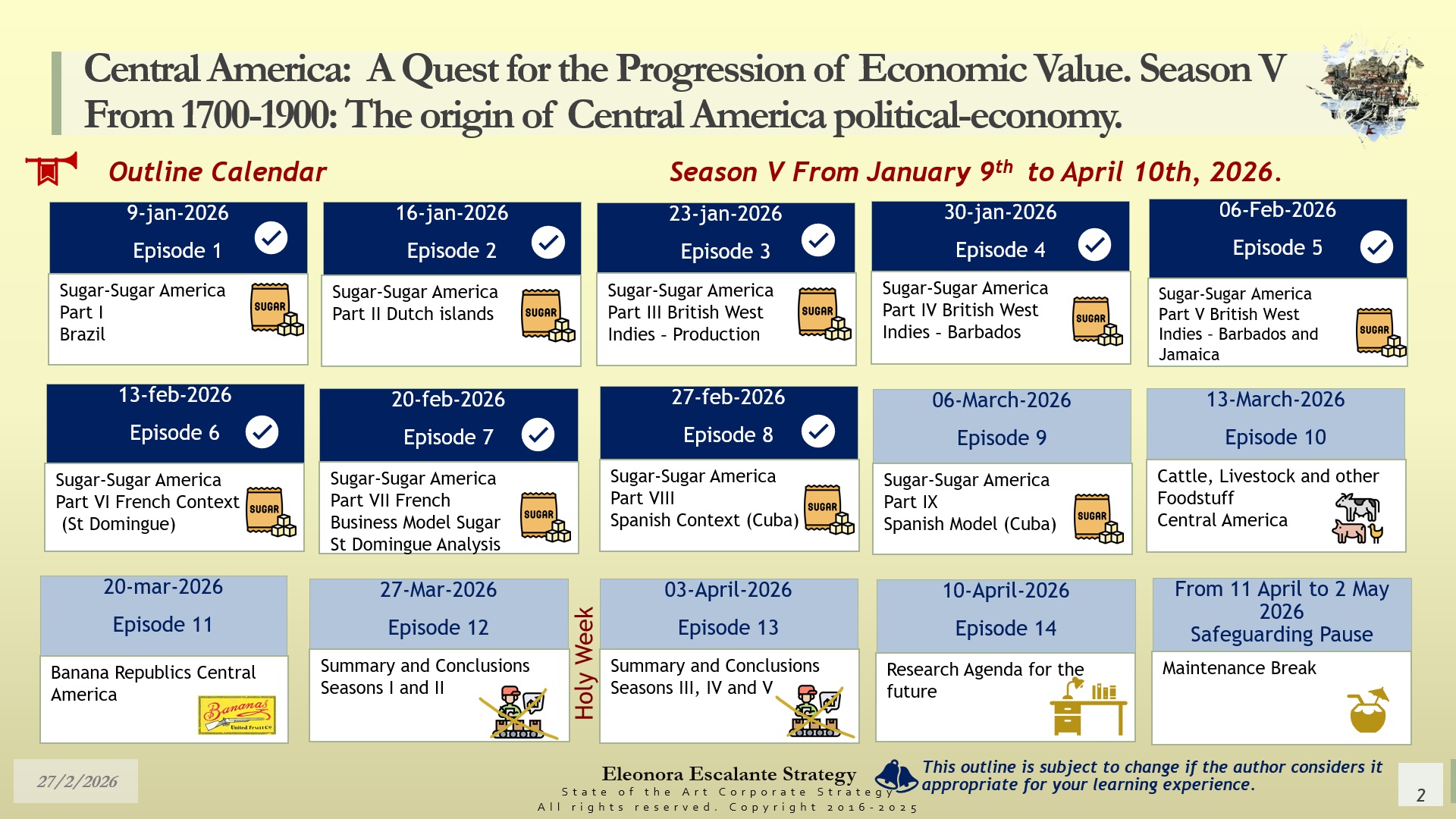
This topic is the starting point of the next episode. We have compared different research sources in our quest to understand the flow of African slaves per year.
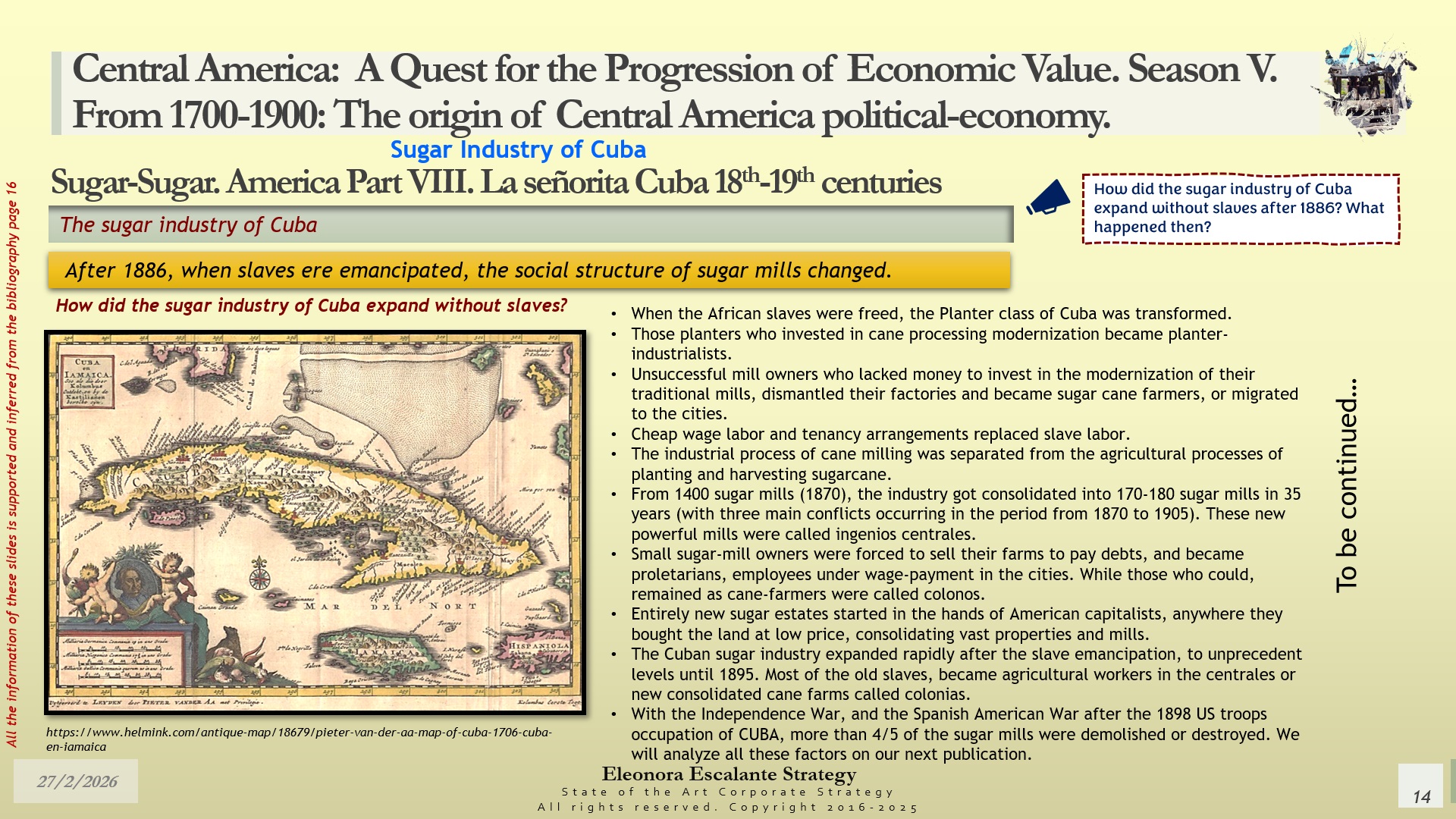
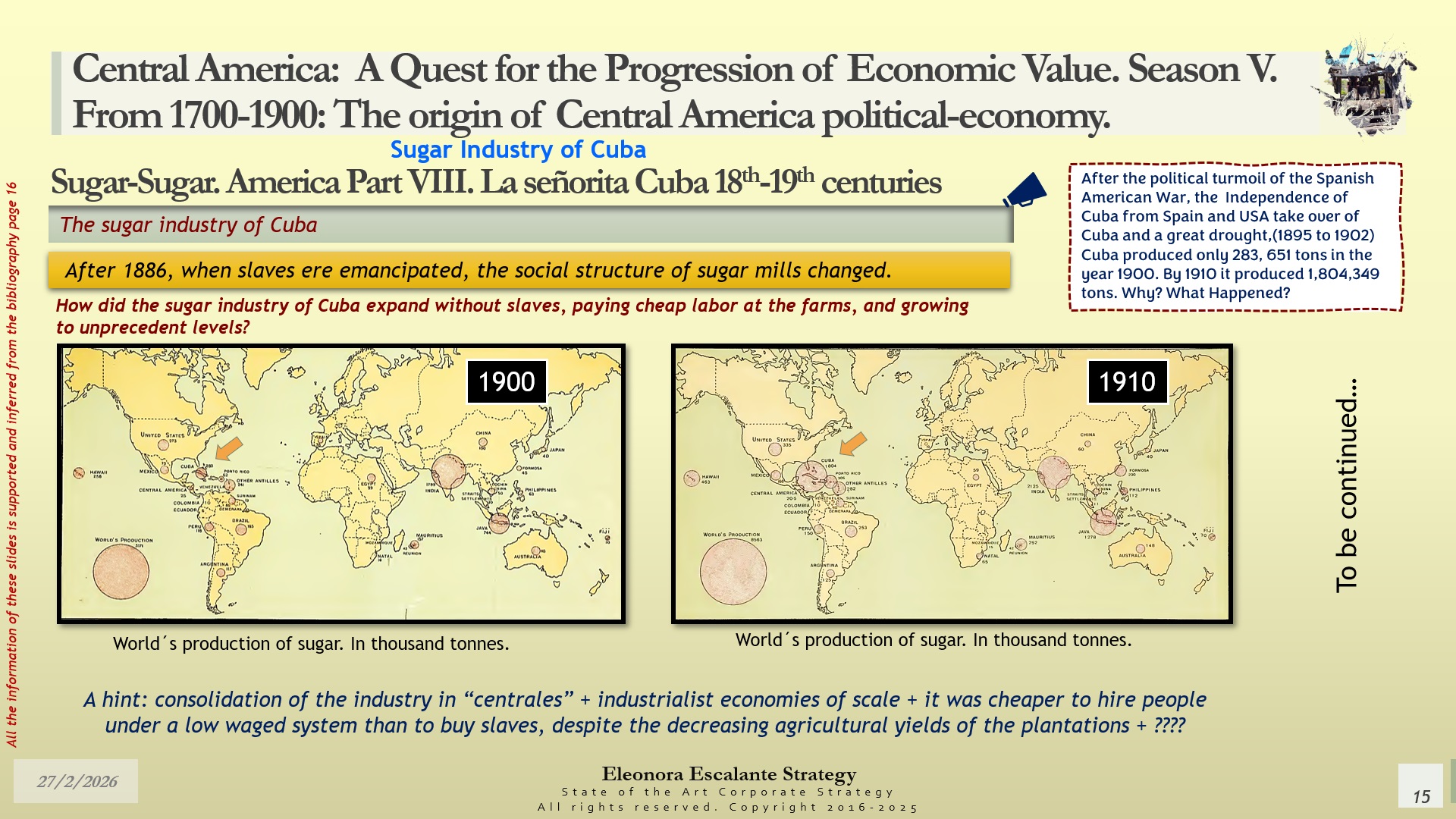
We close our masterclass publication with slides 14 and 15.
The social structure of the sugar mills changed not just with the geopolitical conflicts, but also was affected organically by substantial technological industrialist modifications of the value chain. The planting and harvesting side of the value chain was separated from the boiling, milling, muscovado drying, and refinery. The sugar mill operations were the only portion affected by industrialization, while the planting-harvesting remained the same under low-wage free “colorados”. Economically, the planters who were able to survive not only got involved with new financial partners, but they also acknowledged that it was cheaper to hire people under a super low-waged system (replicating the proletarian model of industries from Europe) than to pay for an illegal slave workforce, which involved numerous commissions and corruption fees shared in the illegitimate slave trade. Let´s remember that Britain, France, and the USA abolished slavery before. Additionally, the fragmented, numerous small and mid-size sugar mills (1400 in total, before the Spanish-American War) were consolidated into 181 sugar factories by 1906, most of them owned by powerful capitalist companies of foreign nature. How did the sugar production of Cuba expand without slaves, but grow to unprecedented levels in less than 25 years after 1898? What happened? Do you really think that the new mechanization of the mills created the Cuban sugar industry boom of the 20th century? Do you still believe it was only because of the new huge centrales azucareras using the innovative technology of the mills?
To be continued…
Closing words.
With the study of Cuba´s sugar model, we are almost ready to deliver without any doubt, where we are going with our digital shift into a giga-internet massive NAIQI technological global. (NAIQI is the acronym of Nanotechnologies-Artificial Intelligence- Quantum tech-and the Internet). Today, we are reflecting on the context of Cuba during the 18th and 19th centuries. Next week, we will dig deeper into the structure of the sugar industry and its further consequences. To this day, Cuba has not been able to leave its poverty condition, after a tormentuous, agonizing 20th century. However, since our objective is to study the historical context of the Cuban sugar plantations, we suggest that our readers connect the dots of history with the current crisis of this beautiful island. Once you learn the foundations of a country´s current conflicts, you will never analyze things lightly.
Announcement. Next week, we will continue with the second episode about the sugar plantations of Cuba. It will be an economic analysis of the sugar industry, and why this case is so important to acknowledge right now. With this coming analysis, you will comprehend why our strategy house is against the rollout of the AI. It will hurt us so much, as much as Cuba´s economy has been damaged during the last century. Blessings.
Musical Section.
During our closing bonus season V, we will return to the symphonic, philharmonic, or chamber orchestra compositions. Today we have chosen Camerata Romeu. A lovely concert was played by the first all-female string orchestra in Latin America, in celebration of Cuba’s National Culture Day. The location of the concert was the Museo de la Ciudad de La Habana. The director is Zenaida Romeu. We invite you to visit their website for more information about their concerts and artists. Enjoy!
Thank you for reading http://www.eleonoraescalantestrategy.com. It is a privilege to learn. Blessings.

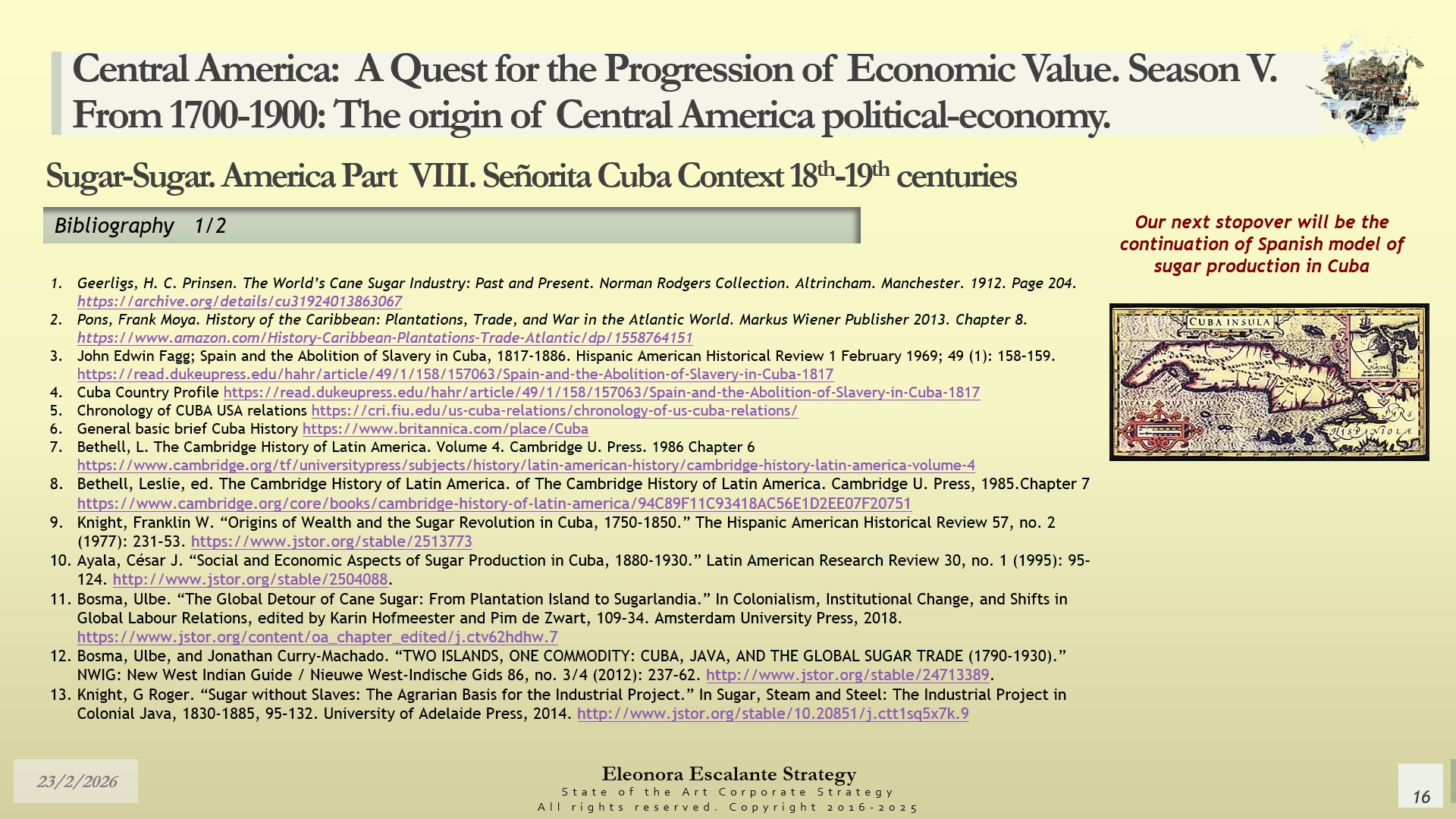
Sources of reference and Bibliography utilized today. All are listed in the slide document. Additional material will be added when we upload the strategic reflections.
(1) The History of Cartography website. https://press.uchicago.edu/books/HOC/index.html
(2) Salamanca, B. Prohibited journeys: power, mobility and resistance in early-modern Spain and Spanish America. Mobilities 20 (1): 193–206. https://www.tandfonline.com/doi/citedby/10.1080/17450101.2024.2394526
(3) Perez Jr., Louis Colonial Reckoning: Race and Revolution in the Nineteenth Century. Duke University Press. 2023. Chapter 3, page 103. https://www.dukeupress.edu/colonial-reckoning
Disclaimer: Eleonora Escalante paints Illustrations in Watercolor. Other types of illustrations or videos (which are not mine) are used for educational purposes ONLY. All are used as Illustrative and non-commercial images. Utilized only informatively for the public good. Nevertheless, most of this blog’s pictures, images, and videos are not mine. Unless otherwise stated, I do not own any lovely photos or images.
 Eleonora Escalante Strategy - Strategic Reflections Think Tank