
Central America: A Quest for the Progression of Economic Value. Bonus-Season V. Episode 10. Sugar-Sugar America. Part 10. Cuban Sugar Tycoons
Dear awesome students and readers:
This is the last chapter about sugar in the Caribbean. It has been a huge undertaking to finish a historical industry analysis of the sugar plantations of the Atlantic during the 18th and 19th centuries. We have covered the shifts in agricultural decision-making regarding sugar production across 5 empires (the Netherlands, Portugal, Britain, France, and Spain-Cuba). We have enfolded the main centers of sugar production of Brazil, Suriname, Barbados, Jamaica, Saint-Domingue, and Cuba. We have analyzed the geopolitical particularities and the African slavery of these two centuries in the Atlantic, and we have linked the main events in Europe and the USA to the circumstances of each island plantation, with distinct ownership structures, land tenure, and access to capital. We have surpassed our expectations by covering material that is usually taught in 6 months in 10 weeks. I wish to congratulate you with all my heart. These industrial historical topics are not easy, and we have all accomplished an impossible goal in record time.
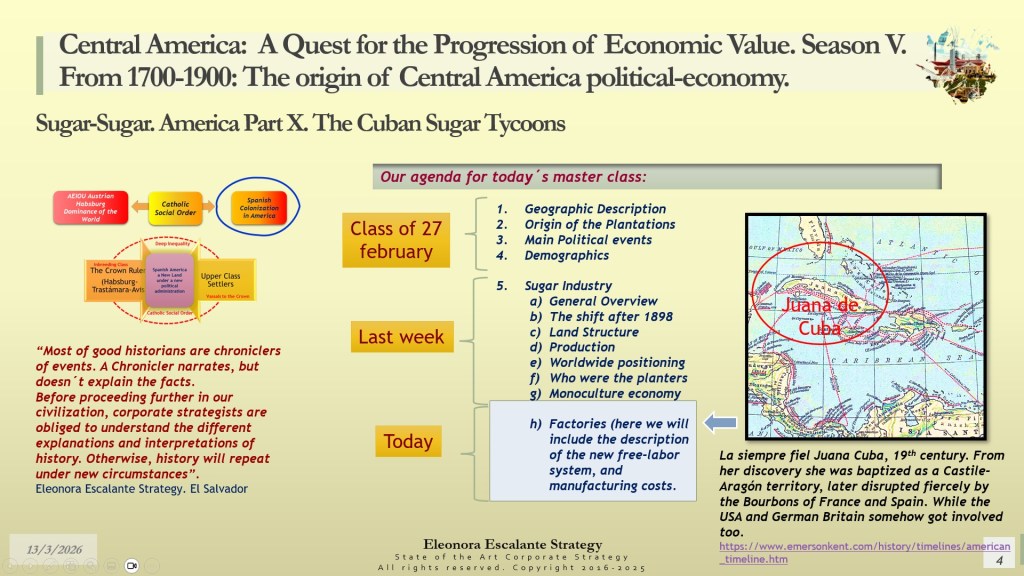
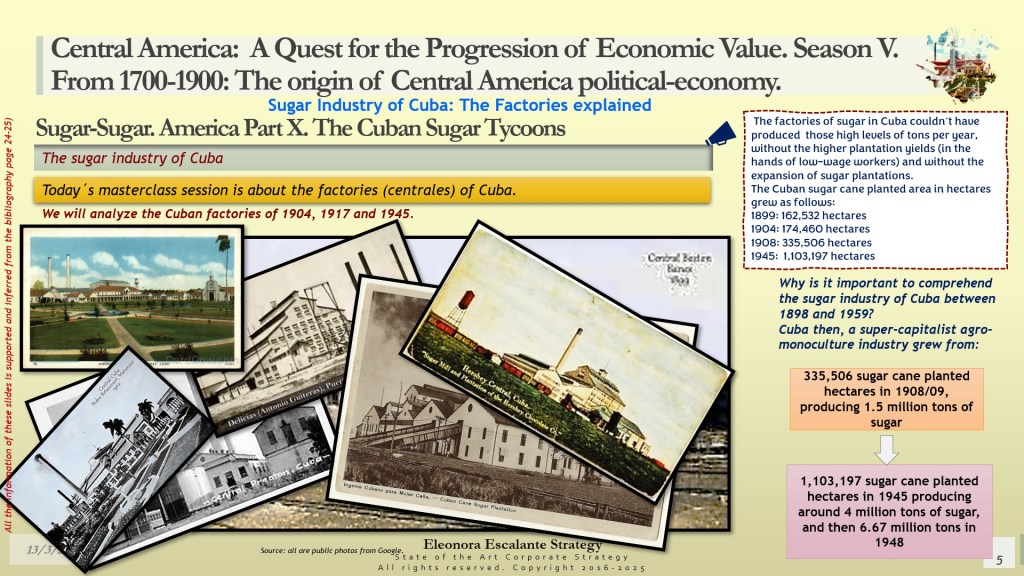
Today, our agenda is to understand the factories (centrales azucareras) in extreme detail.
We have re-created a data analysis that will provide a reliable indication of what was happening in Cuba just before Fidel Castro took power. My intention is to show you the historical roots of how sugar gradually became Cuba’s core business, and how quickly it was consolidated after the USA’s intervention. This industry will help us understand why the digital economy will create greater inequality than that experienced in Cuba during the first 50 years of the past century. If we do not stop our digital-begging giga AI economy, be sure that the uneven imbalance will be so high in every economy of the world that the whole world will end up worse than Cuba after Fidel Castro. Cuba has the best talent in the world (highly educated professionals in Cuban universities) who work as drivers or in the tourism industry’s low-wage jobs. These roles often include service-sector jobs, such as retail, logistics, hospitality, food preparation, maintenance, cleaning, and caregiving. By 2030, with the advent of generative AI and its associated technologies, many high-paid professional jobs are at risk of being replaced or partially automated. In anguish and desperation, when people are hungry, without income opportunities, or without the fulfillment of middle-class status, civil rebellions, wars, and internal conflicts will emerge. And that is what awaits us, sooner or later.
Let´s study the centrales azucareras de Cuba (from 1898 to 1945). Feel free to share the following presentation with your loved ones. Print the document, read it, and pursue the bibliography that we have shared at the end of the slides.
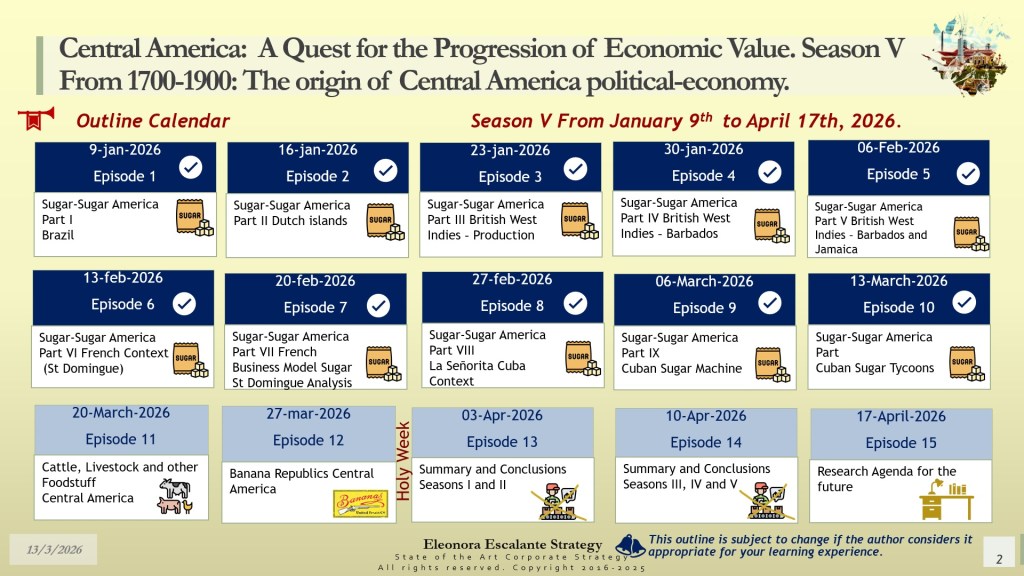
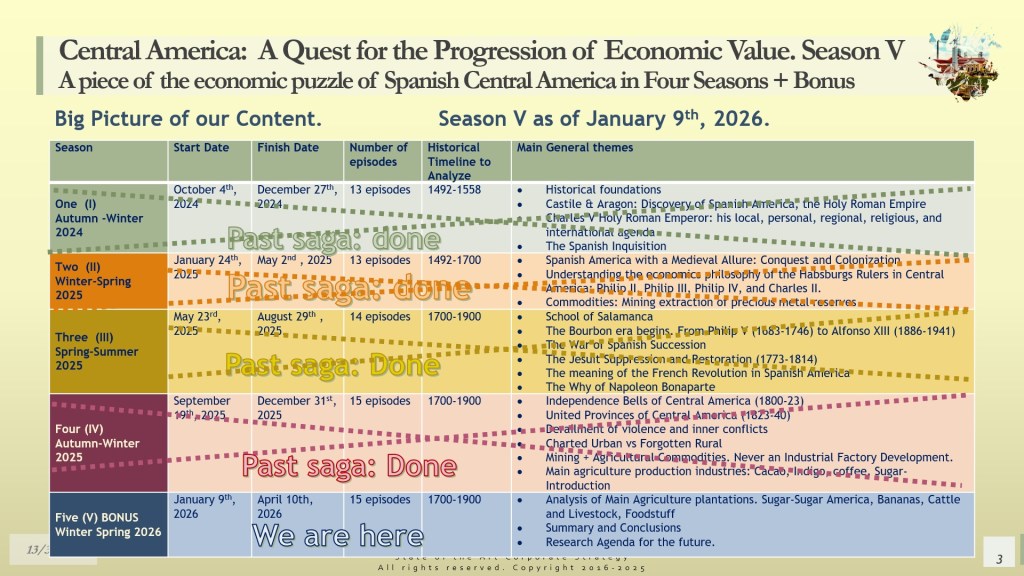
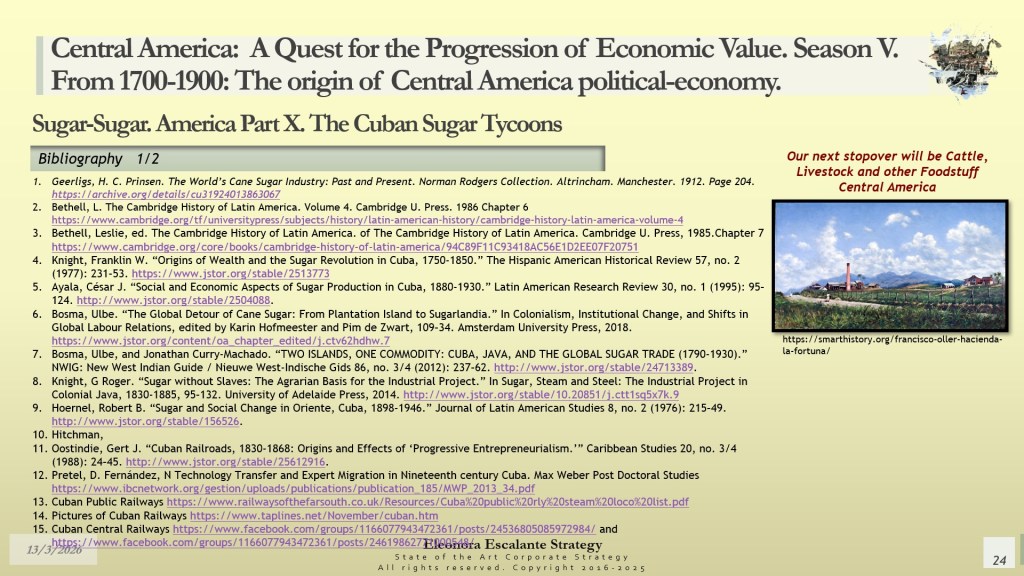
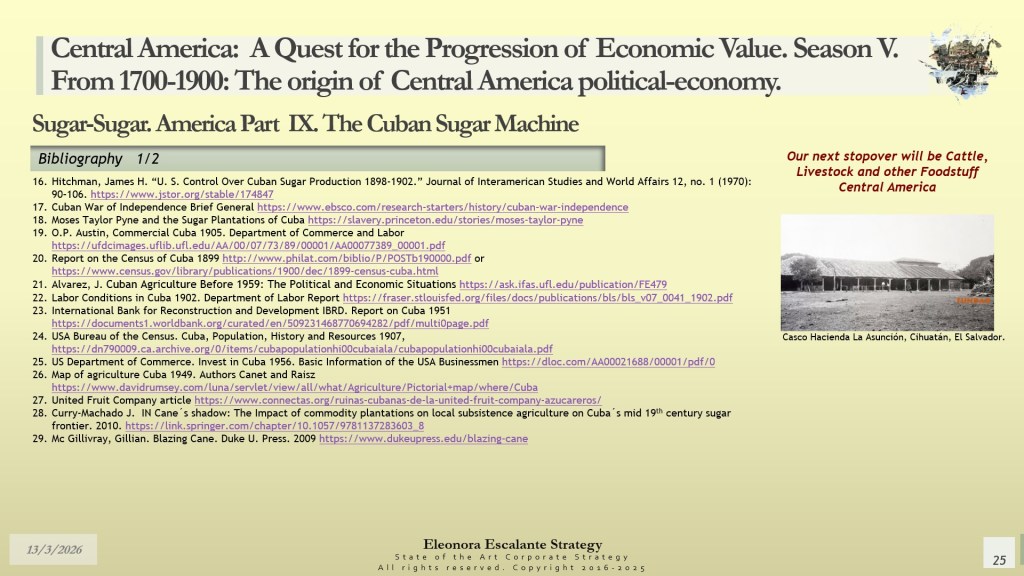
We kindly ask that you return next Monday, the 16th of March, 2026, to review our extra strategic reflections on this chapter.
We encourage our readers to familiarize themselves with our Friday master class by reviewing the slides over the weekend. We expect you to create ideas that are or are not strategic reflections. Every Monday, we upload our strategic inferences below. These will be discussed in the next paragraph. Only then will you be able to compare your own reflections with our introspection. We always give our students a couple of days to prepare well before our final reflection.
Additional strategic reflections on this episode. These will be in the section below on Monday, the 16th of March, 2026.
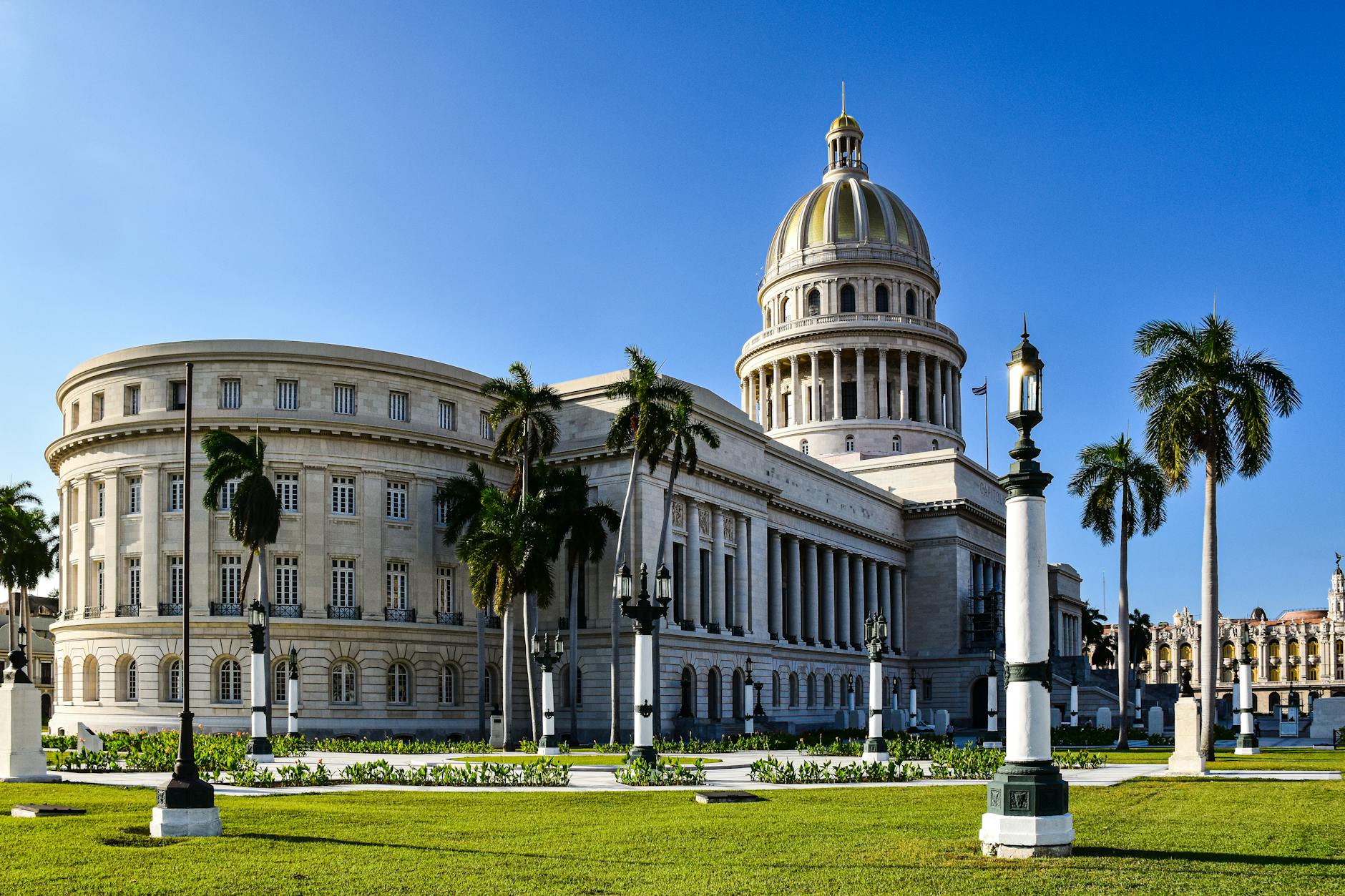
Public domain. Illustrative and non-commercial GIF image. Used for educational purposes. Used only for the public good, informative for this class. Photo by AXP Photography on Pexels.com
Strategic Reflections on A Quest for the Progression of Economic Value. Bonus-Season V. Episode 10 Sugar-Sugar America. Part 10. The Cuban Sugar Tycoons.
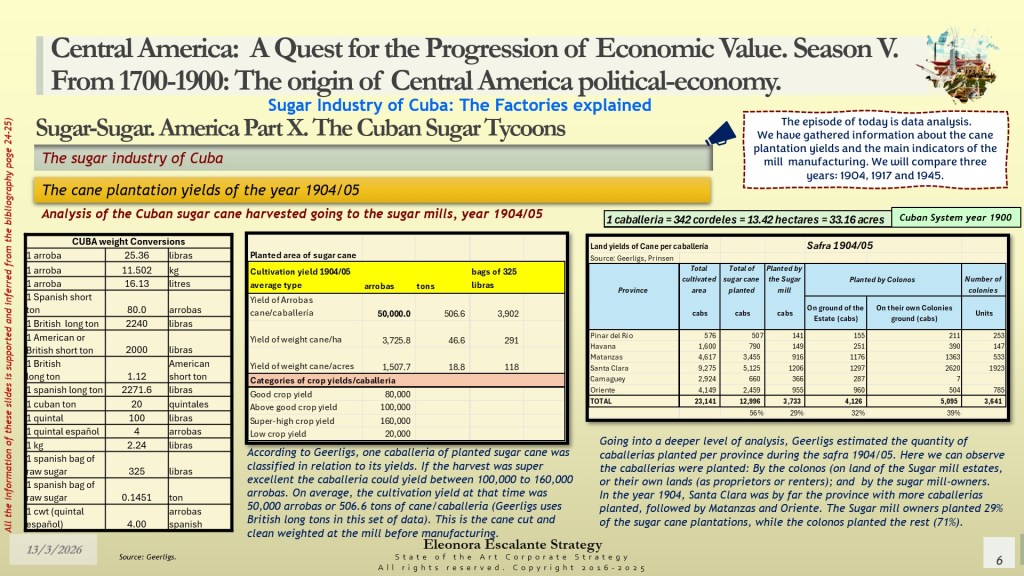
Last week, in chapter 9, “ The Cuban Sugar Machine”, we focused our attention on general aspects of the Cuban industry at the end of the 19th century. At the same time, the USA intervened on the island with the main aim of protecting the economic interests of the planters and sugar refiners (the industry’s main clients in the Northeast of the USA). We analyzed and compared the main economic elements of sugar plantations before and after 1880, and we provided a conceptual background for the unit measures of land used in Cuba as a legacy of Spanish medieval practice. The caballeria was the land granted to the military order knights of the Spanish Crown in Cuba, and it was the land assessment unit used at that time (1 caballeria = 342 cordels = 13.42 hectares = 33.16 acres). We have added a table of Cuban-Spanish and other weight conversions used in this chapter on slide 6.
Cane Plantation yields for a Cost Analysis 1904, 1910. Slides 6 to 9.
We begin our analysis today with an instruction that helps our readers understand the Cuban land cane yields in 1904. See slide 6. The yield of cane produced per unit of land is crucial for understanding how good or mediocre the harvest was for that plantation. We have based our analysis on data from the Dutch researcher H. C. Prinsen Geerligs (1864-1953), the sugar expert who was the Director of the Sugar Cane Experiment Station in Pekalongan, Java, Indonesia. According to Geerligs, if the Cuban land crop were super excellent that specific year, one caballeria could yield up to 160,000 arrobas. If the harvest was low, the yield was 20,000 arrobas/caballeria. A satisfactory crop yield was between 50,000 and 100,000 arrobas/caballeria. See slide 6. Geerligs estimated that with the safra of 1904/05, the land of the plantations was planted and harvested in three ways: (1) planted by the owners and landholders of the mills; (2) planted by colonos on the mill estates (by administration or rented); and (3) planted by colonos on their own grounds. The proportion of land planted in each category with respect to the area cultivated was in the same order 29%, 32% and 39% on average for this specific year.
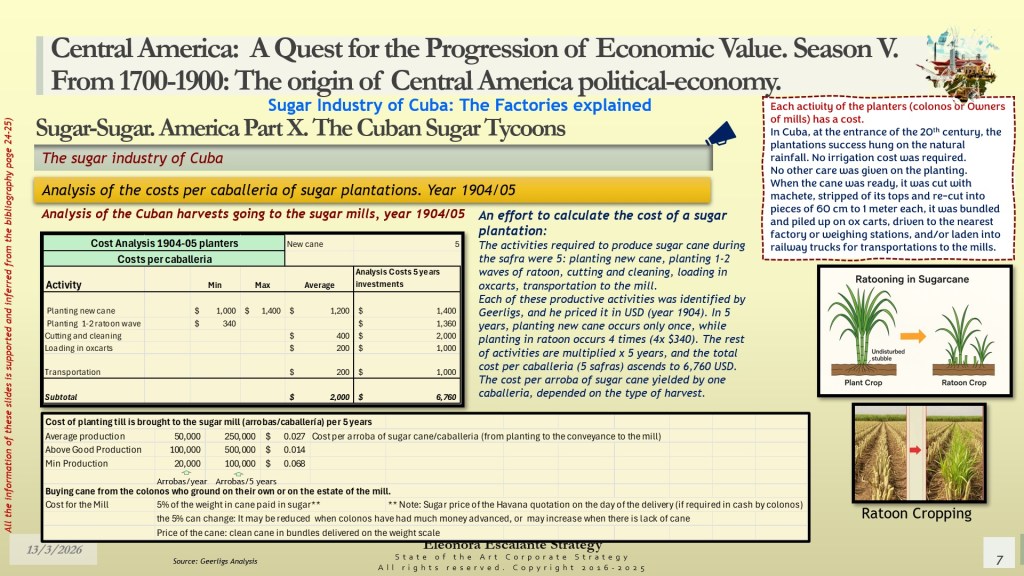
The cost analysis made by Geerligs in the same year is on slide 7. This is a remarkably interesting calculation because, at that time, Geerligs was living in Java, and most of the cane planted in Cuba was Batavian type (89%) until the 1930s. The Batavian cane known as crystalline was the queen of acreage then, and the Cuban planters were relying on testing other varieties, such as POJ 2878 (taken from the East-Java experiment station) in Cuba since its introduction in 1927 (1). During the golden years of Cuban high yields, the Cuban government never invested in an effective national research program to improve cane varieties, and this caused the yields of sugar extracted from sugar cane to stagnate over the years.
How was the cost analysis calculated from the moment of planting until it was brought to the mill? Year 1904-05. See slide 7. The costs were estimated using a caballeria unit over a period of 5 years. The main activities were: planting new cane, planting 1-2 waves of ratoon, cutting and cleaning the cane (stripped of its top leaves, cut into pieces of 60 cm to 1 mt and furl into bundles), loading and piling up on ox carts, and then transported to the weighing stations, where they were weighed and laden into railways handling trucks for transportation to the mills. The analysis estimated costs over 5 years, and the total was $6,760 per caballeria. To calculate the cost per arroba of sugar cane/caballeria (from the planting to the mill), we simply divide $ 6,760 US dollars by all the cane weighted in arrobas x 5 years for that specific plantation. For this specific exercise, the costs varied according to the yield of cane produced per caballeria: 1.352 cents/arroba for an above-average production of 100,000 arrobas/caballeria; $2.704 for an average production of 50,000 arrobas/caballeria; and $6.76 for a low production of 20,000 arrobas/caballeria per safra. To calculate the cost per libra (pound) of the cane from planting to the mill, the owner of the central or the colono simply divided the cost per caballeria between 25 libras (1 arroba=25 libras).
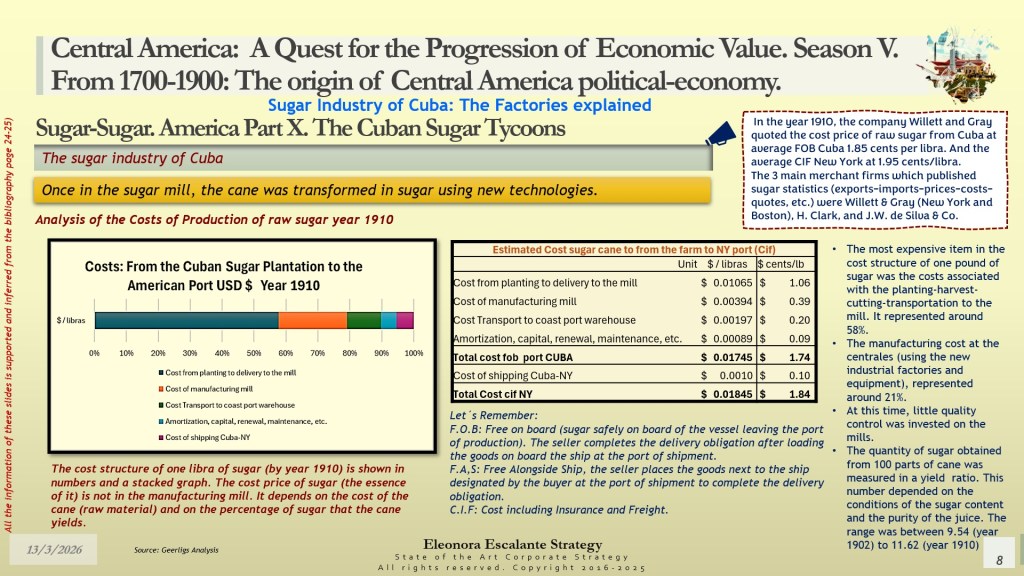
Let´s go to the safra 1910/11. Geerligs calculated the estimated cost of sugar cane from the plantation to NYC. Slide 8. This slide takes a step forward in calculating costs. The cost from planting to delivery to the mill was sold to the factory owner with a profit margin for the colonos. The central had to pay it to the colonos or administrators. Then, additional costs must be accounted for: the cost of manufacturing the mill, the cost of packing it in 325-pound sacks, and the cost of transporting it from the mill to the port warehouse, where it was loaded onto ships. Another final cost was amortization (interest and capital), as well as the renewal of mill parts, repairs, maintenance, etc. The sum of these aggregated cost portions was the final cost for the mill owner, who then added his profit margin. This was the F.O.B. price of the mill owner, who was paid a negotiated FOB price, or when the sugar was free on board: the seller fulfilled the delivery obligation after loading the sugar on board the ship at the port of shipping. When adding insurance and freight costs to the final port of delivery, only then are we talking about C.I.F.: Cost, including Insurance and Freight. This CIF cost at the port of delivery (New York in the example) is the cost paid by the refineries plus the entry duty.
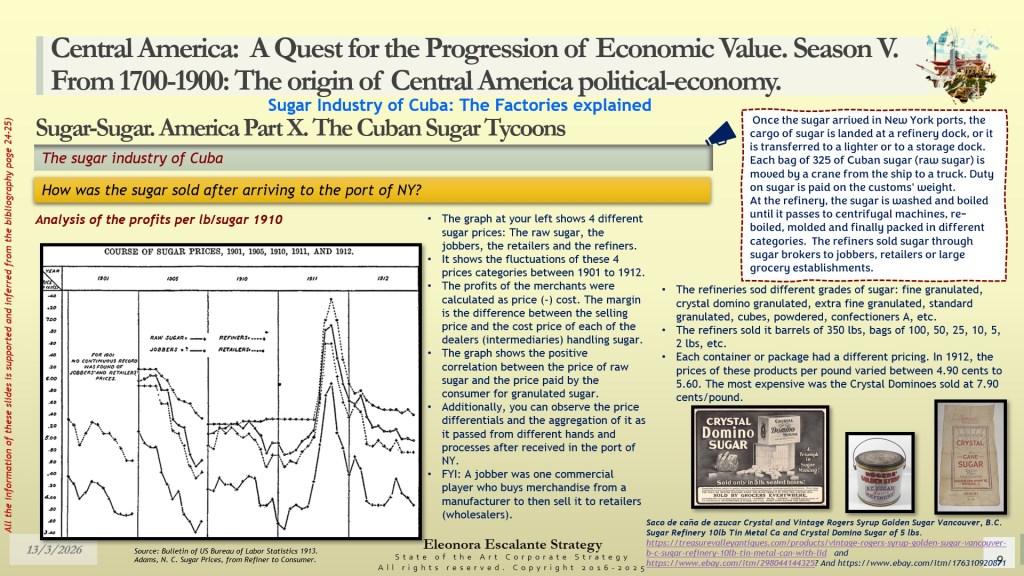
The Cuban industry was tied to the overseas refining interests of the Northeast corporations of the USA. The Cuban American planters were captive to the Northeast refiners. The refiners kept most of the profits, while the jobbers (wholesalers) had the lowest profits of all the value chain players in NY. Look at slide 9.
The main refiners in the Northeast were led by the German descendants of the Havemeyer family in NY (2). On the west side of the USA, Claus Spreckels in California controlled half of Hawaii´s sugar harvest refining business. Before the USA intervened in Cuba, the American Sugar Refining Company (ASRC) was the conglomerate that brought together all the leading refining players. This conglomerate, or Sugar Trust, controlled 17 of the 23 refineries in the USA, including the California Oxnard Brothers Refining Company. Havemeyer, Oxnard, and Spreckels joined forces to lobby for protectionist measures of the nascent beet sugar industry, to stop the beet sugar imports coming from Germany, while keeping the duties low for Cuban and other Caribbean sugar (through the Dingley Act of 1897). When Henry O. Havemeyer died in 1907, Spreckels passed away a year later. Their descendants and new players accelerated the building and buying of new centrales in Cuba and Puerto Rico. The emergence of the refining industrial block under “The American Sugar Kingdom” created a favored setting for the refineries of the Sugar Trust of the Northeast, in such a way that the Sugar Trust was able to import under a regime of low import tariffs and then sell at relevant profits. It is in this context that James Howell Post and Thomas Andrews Howell reorganized the National Sugar Refining Company (NSRC) of New Jersey and joined the Cuban sugar plantations and Interests Trust. During WWI, the Sugar Trust, the Howell NSRC, and the United Fruit Company (UFC from Boston) invested in centrales azucareras and bought extensive tracts of land, clearing massive areas of forests to plant sugar cane. Coincidentally, it was during this period that wealthy Spanish and Cuban colonial sugar planters in exile (because of the War of Independence) clustered under the wings of Wall Street firms to return to Cuba or reinvest in sugar interests. Manuel Rionda Polledo (1854-1953), a Spaniard from Asturias, was one of them. Rionda was the symbol of the largest sugar broker and well-connected sugar industrialist of Cuba in New Jersey. Several investment firms in New York backed the operations and capital structures of all these returners and new entrepreneurs on the Island. By 1924, Americans of Cuban origin and New York bankers owned 62.5% of the island’s sugar production, and, coincidentally, the American share was dominated by the Sugar Trust, with 40% held by E. Atkins and the Howell Brothers.
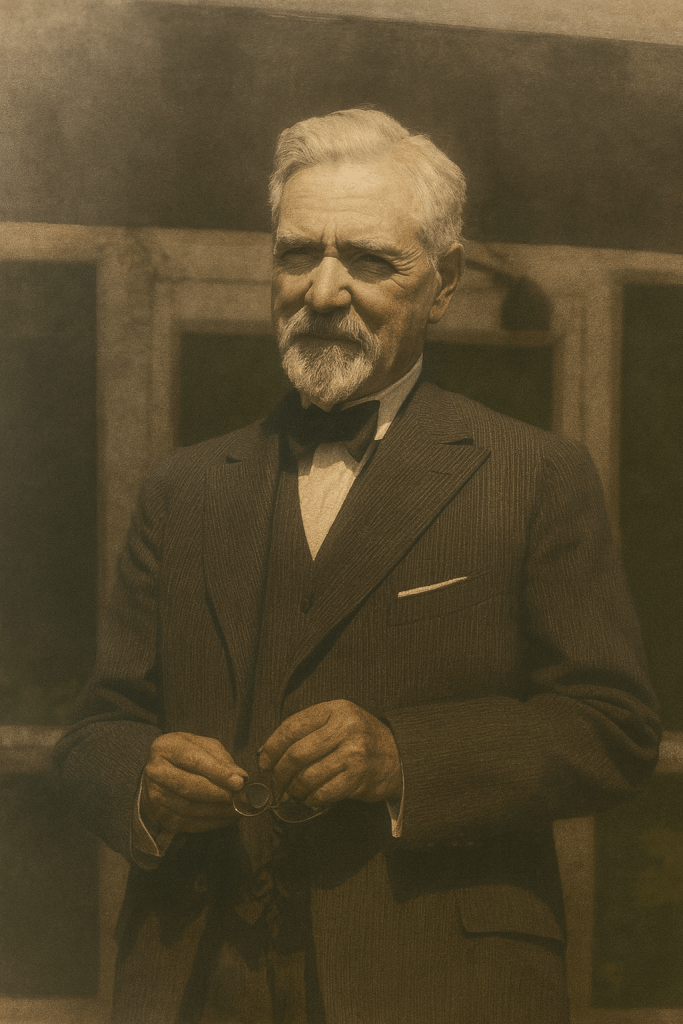
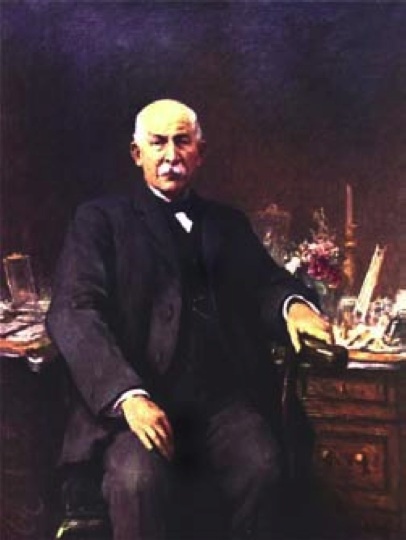
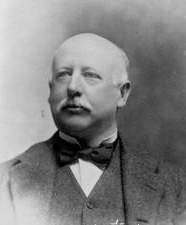
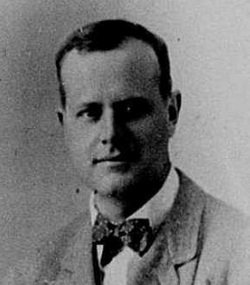
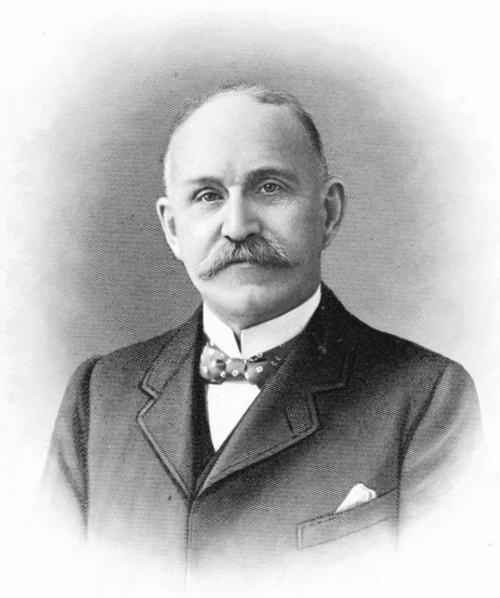
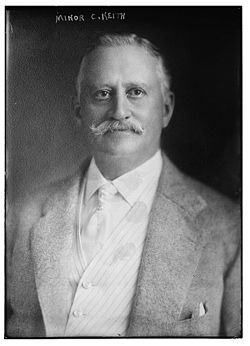
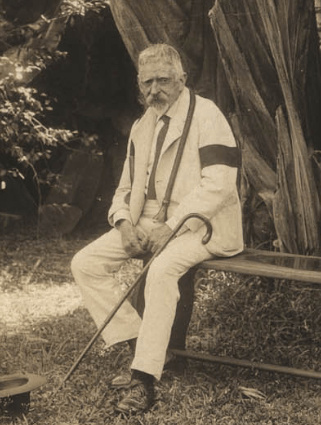

Some of the Cuban Sugar Barons. Public Photos found on Google. Used only for educational purposes. Used only for the public good, informative for this class.
The Czarnikow-Rionda firm was a Prussian-Spanish establishment from Hamburg that invested heavily in Cuba’s railway system during the 19th century. Manuel Rionda joined the firm after Czarnikow opened an office in New York in 1891. By 1909, Rionda became Czarnikow’s firm president. By 1914, Rionda´s firm was selling 40% of all sugar from Cuba in New York and had invested in multiple businesses related to the Cuban sugar industry and its value chain. Rionda established the Cuba Cane Sugar Corporation in 1915, buying 17 sugar factories in Cuba and involving the descendants of the Havemeyer and Spreckels families. Another American pioneer who integrated the value chain of his products adventured into Cuba. His name is Milton Snavely Hershey. Hershey put his eyes in Cuba, buying his own hacienda in 1916, and building a unique city around his sugar mill. By the time of Hershey´s presence in Cuba, the island was a pleasure tourist destination for top American government officials and millionaires, including Henry Ford. When the sugar prices collapsed in 1921, Hershey´s possessions in Cuba and Pennsylvania were seized by the National City Bank of New York. This was the decade in which most of New York’s banks became directly involved in the island and Central America.
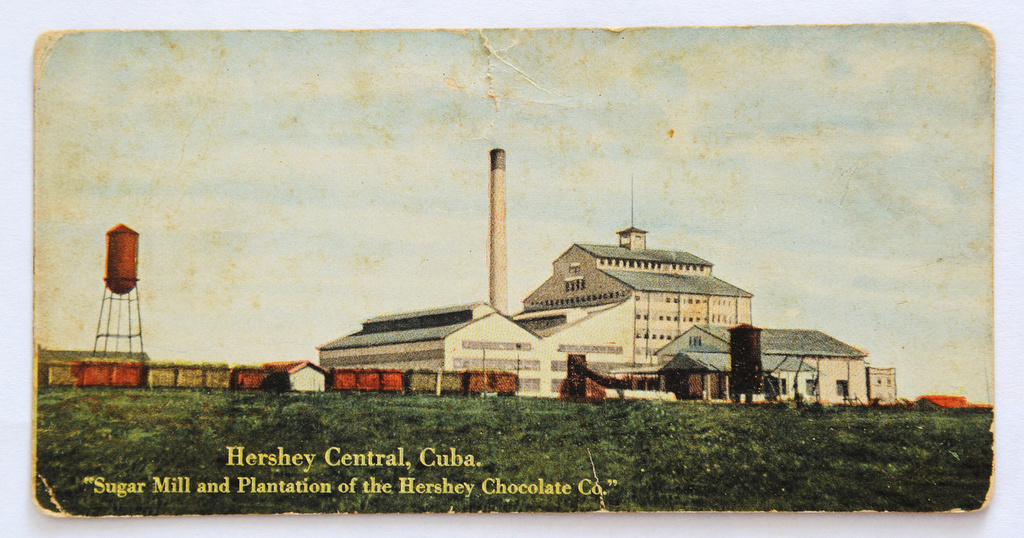
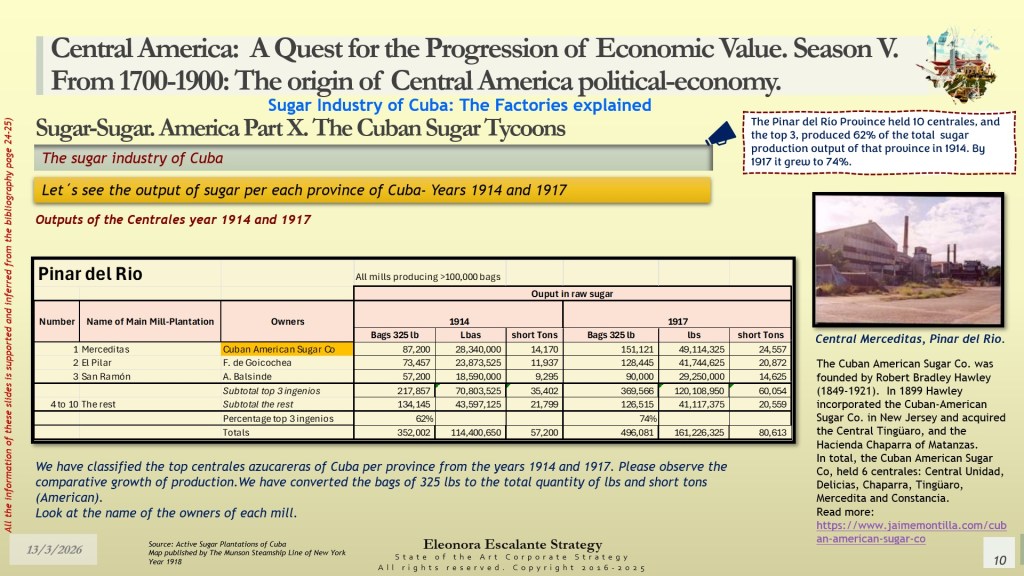
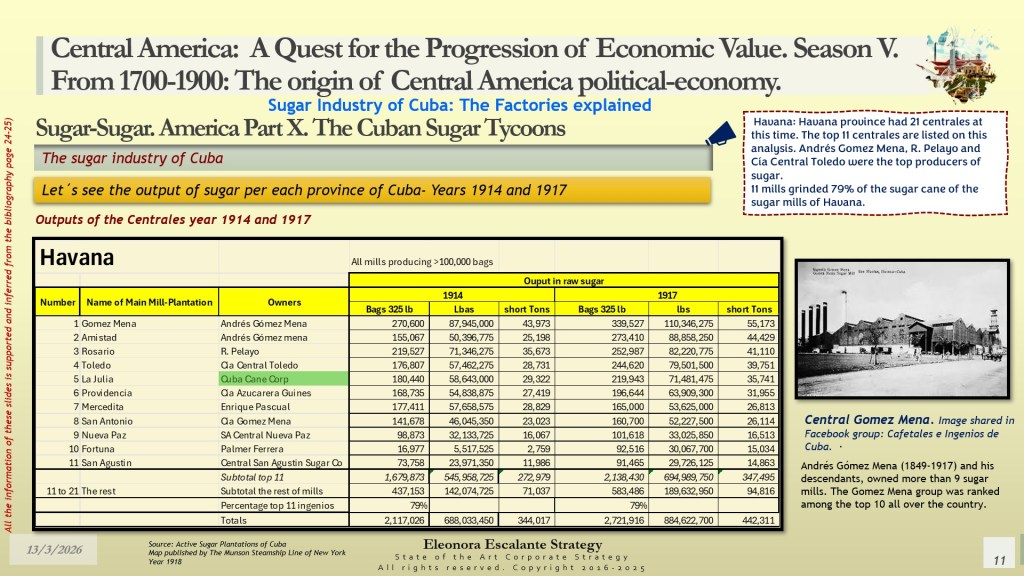
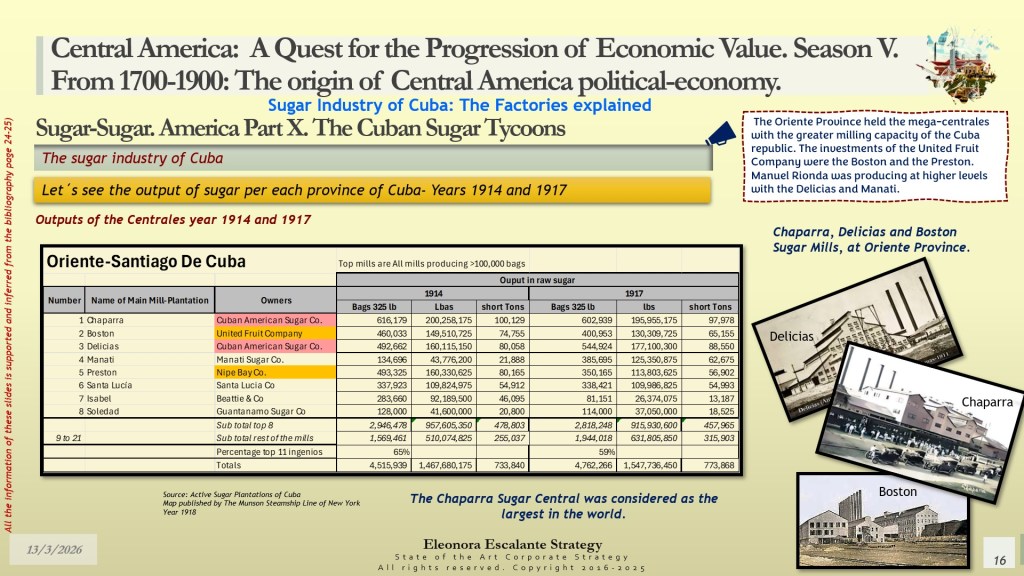
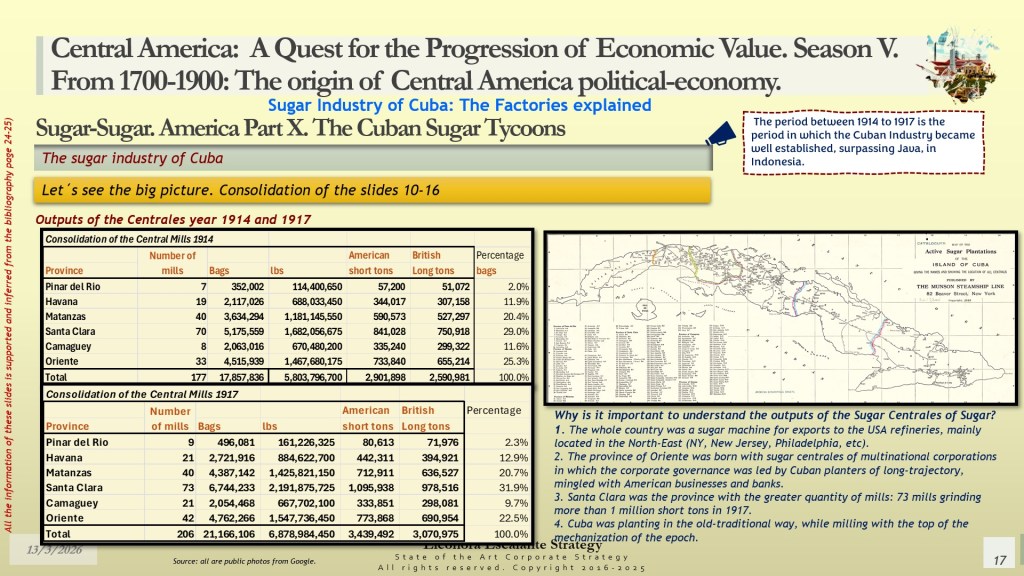
Sugar output for each province of Cuba: Years 1914 and 1917. Slides 10 to 17.
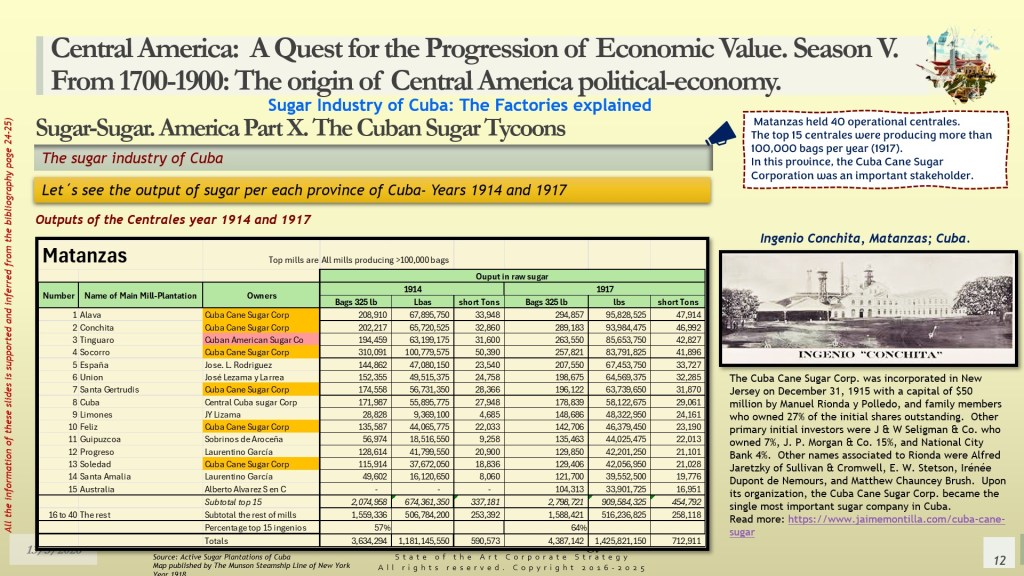
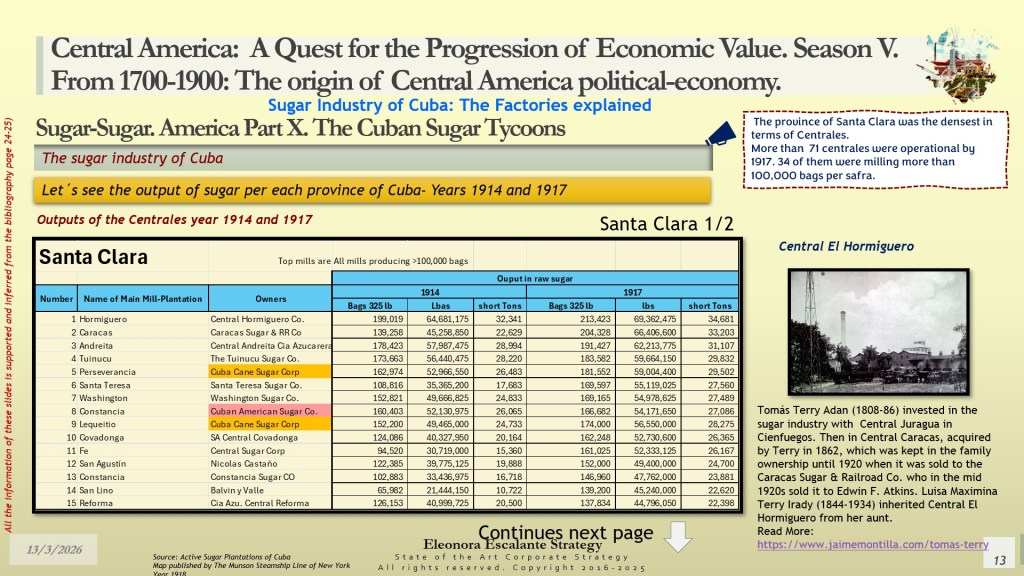
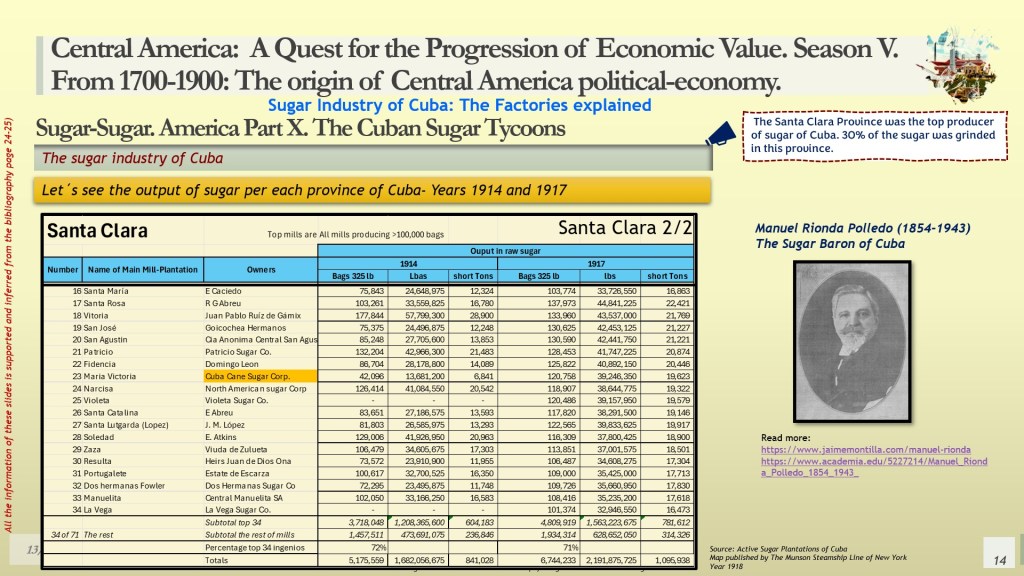
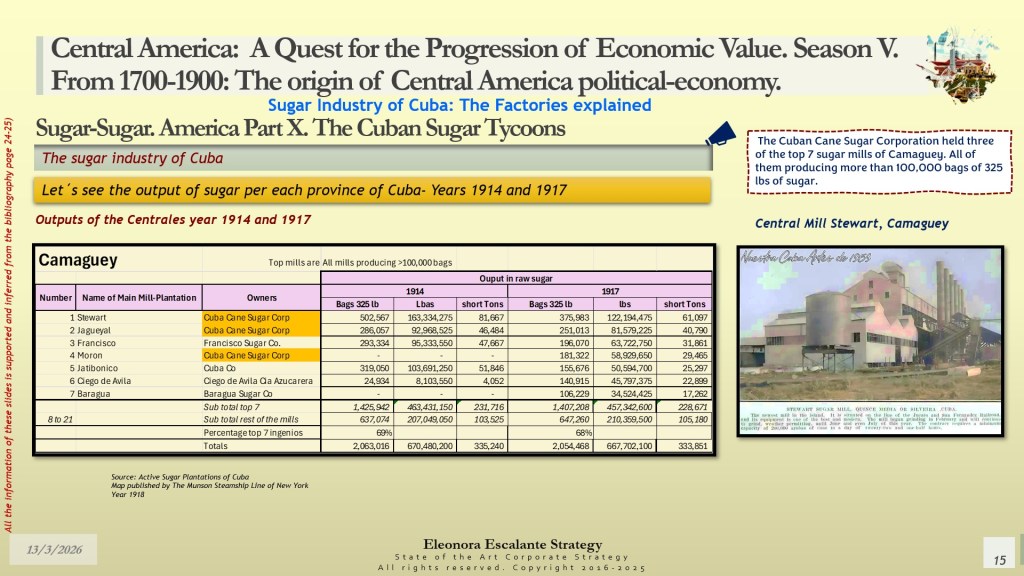
In our effort to identify the sugar tycoons of Cuba, we mapped all the existing mills and centrales per province for two years (1914 and 1917). We first tried to apply the Pareto principle to identify the top sugar producers by province, but not all provinces fit that pattern. So, we decided to sort all the mills that produced at least 100,000 bags of 325 libras or more. That is how we arrived at the results shown from slides 10 to 17. Our data comes from The Munson Steamship Line map of the active sugar plantations of 1918 and McGillivray’s book, Blazing Cane. All our observations are included in these 7 slides and are self-explanatory. On each slide, you can identify the sugar tycoons operating in each province and the level of production achieved in the second decade of the 20th century. It was through sugar that the shift from colonial commercial ventures to Cuban American multinational corporations occurred. It was through sugar that industrial capitalism arrived in the Caribbean. And it was through sugar that the American sugar kingdom, led by American refiners and Wall Street banks (3), became intertwined with other interconnected industries, either as competitors or as adjacent ones, including beverages, candy, foodstuff farms, transportation systems, jute bags, insurance, cargo services, etc. The financial development of the New York sugar-refining industry pushed the innovation of new capital financing structures of bi-national nature (Cuba-America), in which the capital firms of America became the direct owners of the Sugar industry over time. If you wish to learn more about the life of Manuel Rionda, we encourage you to read the book written by Muriel McAvoy, “Sugar Baron: Manuel Rionda and the Fortunes of Pre-Castro Cuba”. University Press of Florida. 2025 (4).
Painfully, history tends to repeat itself under new circumstances. Any similarity today with crypto-money investors in Central America goes beyond a mere coincidence.
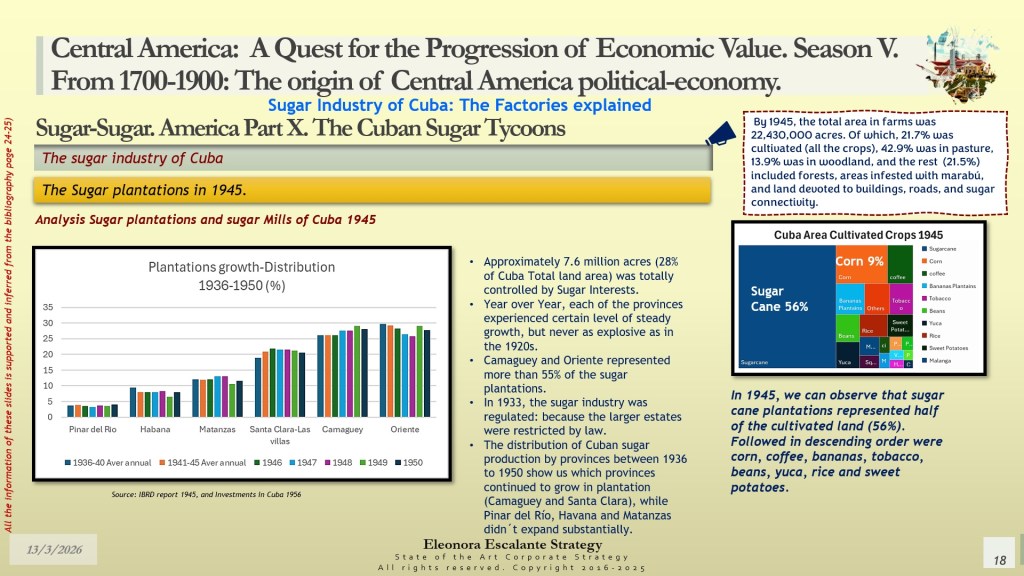
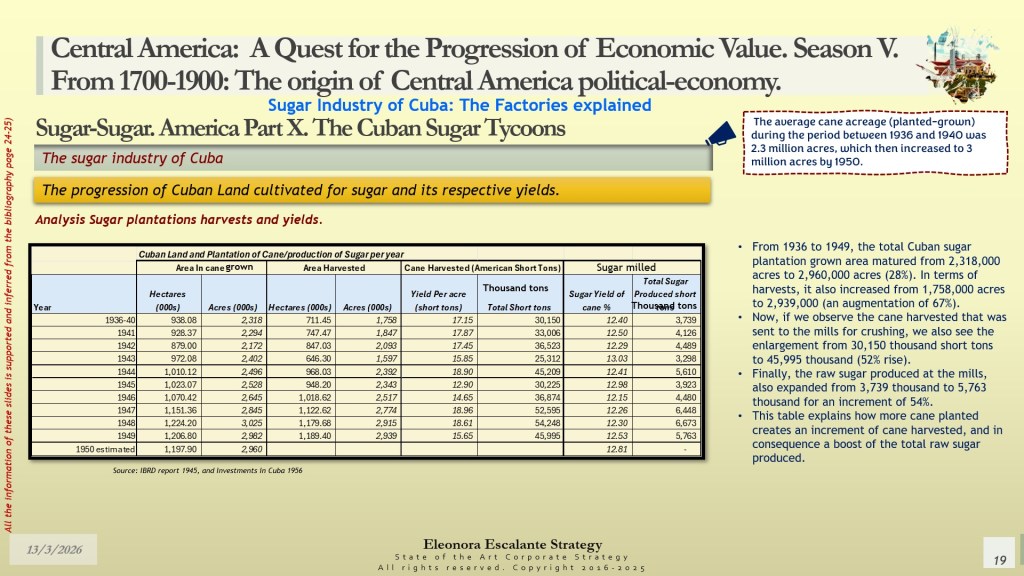
The Cuban sugar plantations and factories in 1945. Slides 18 to 23. We have gathered information on how cane plantations grew between 1936 and 1950. Analyzing each province, growth was not explosive, as in the 1920s. It looks stagnant or even decreasing (as in the case of Oriente). The sugar cane planted remained in 56% of all the cultivated crops. See slide 18.
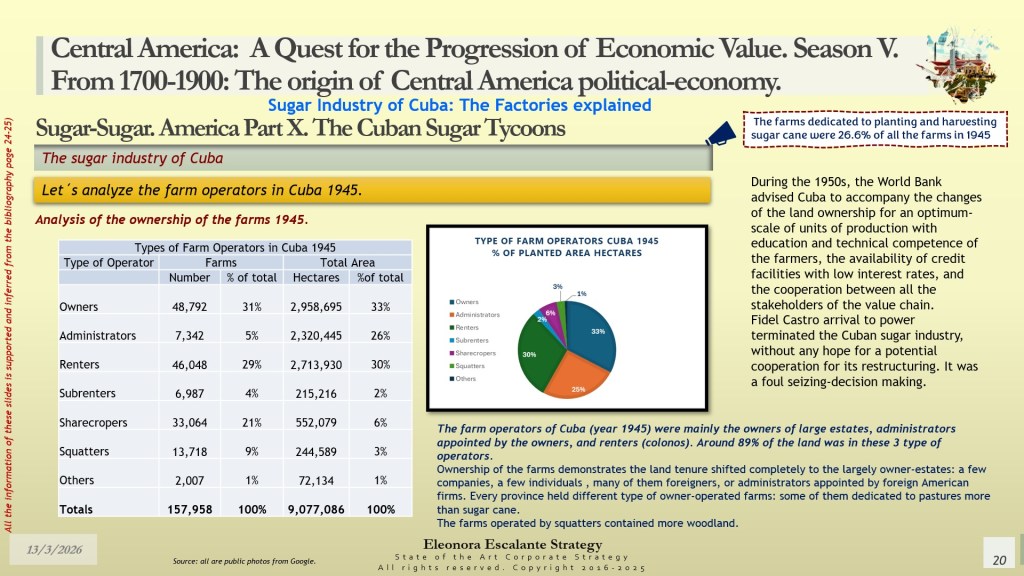
Slide 19 shows us the yields per acre of cane harvested: a minimum of 12.90 and a maximum of 18.96 short tons/acre. In relation to the sugar milled at the centrales, the sugar yield was 12.81% per 100 parts of cane on average for the same period. By the end of WWII, farm operators in Cuba were in the hands of mill owners (33%), Administrators to the large estate mill owners (26%), and renters (30%). If you sum up these three segments, 89.3% of the land was totally owned by the mill owners, because administrators and renters were not planting on their own land, but on the larger estates. See slide 20. The distribution of the farms of Cuba was in the hands of the mill owners, not the cane planters, anymore. This specific land-tenure situation triggered the Fidel Castro phenomenon in 1959. The World Bank advised Cuban Planters about the high risks of this land-inequality structure; however, the Cuban milling machine did not listen to the World Bank’s advice. It took less than 15 years to ferment into the destruction of the Industry after Castro´s arrival into power. The American Sugar Kingdom, in the hands of the American Refiners and Wall Street, was terminated after Fidel Castro’s Cuban Revolution, and the entire Cuban planter class moved to Florida.
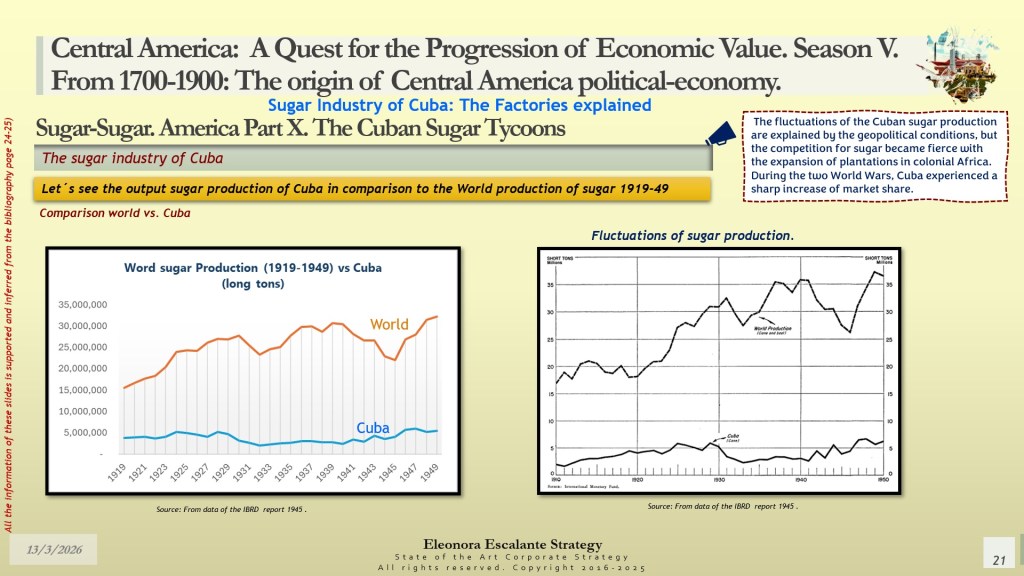
Slide 21 is just the same graph, one has been made by us, and the other one was taken from the World Bank report on Cuba prepared by the International Bank for Reconstruction and Development in 1951. Both graphs matched. On these graphs, we can see how the production of Cuba was at its lowest levels in the 1930s. Guess why? The Hawley-Smoot Act of 1930 raised the duty on sugar imports entering the United States: Cuban raw sugar had to pay 2 cents per pound, and this new policy was applied rigorously. This is an example of how a rise in tariffs can ruin a monoculture industry of a nation that depended almost completely on the American refiners. The Jones-Costigan Act established a system of sugar quotas in 1934, reducing the duty on Cuban raw sugar to 0.9 cents per pound (5). Despite the increase in exports from Cuba to the USA, the graph shows that other world regions of sugar production were growing, but not Cuba. During the period of the WWII, the sugar exports augmented again.
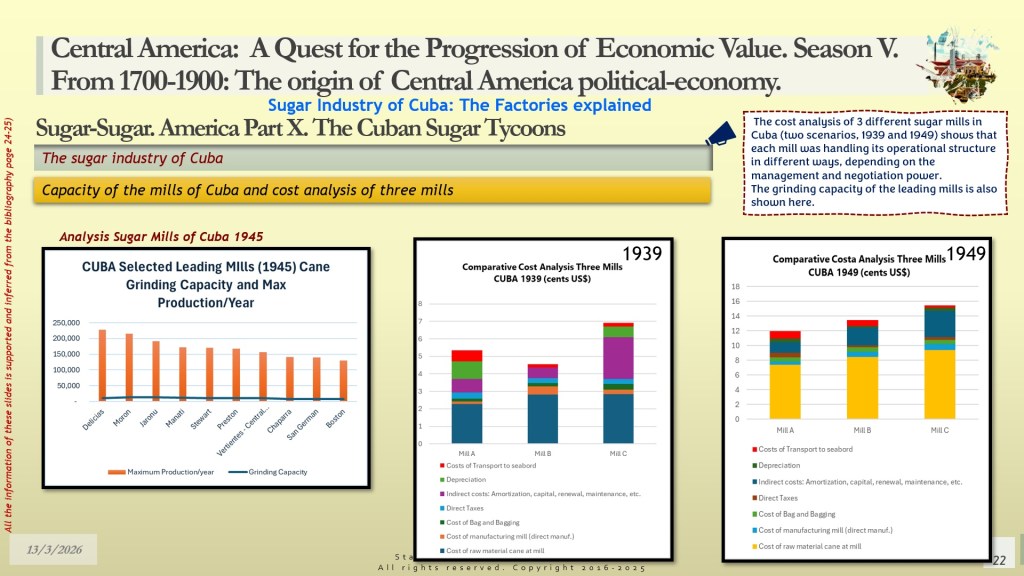
Finally, we have prepared a comparative cost analysis of three mills in two different years: 1939 and 1949. I would like you to observe the cost of the vertical towers per mill. See slide 22. As you already learned, the cost of the raw material (from planting to the mill) is always the greater one, followed by indirect costs. The sum of these two costs exceeds 70%. Each mill had a different cost structure, despite the external conditions of trade. The cost of the raw material at the gate of the mill was and will always be higher in this industry. The rest of the expenditure may vary depending on management, financial expenses, and the best manufacturing operational practices at the mills. Each mill had a grinding capacity that diminished over time if the factory was not properly maintained or not renewed. After 1929, it seems that no new mega-mills were built in Cuba.
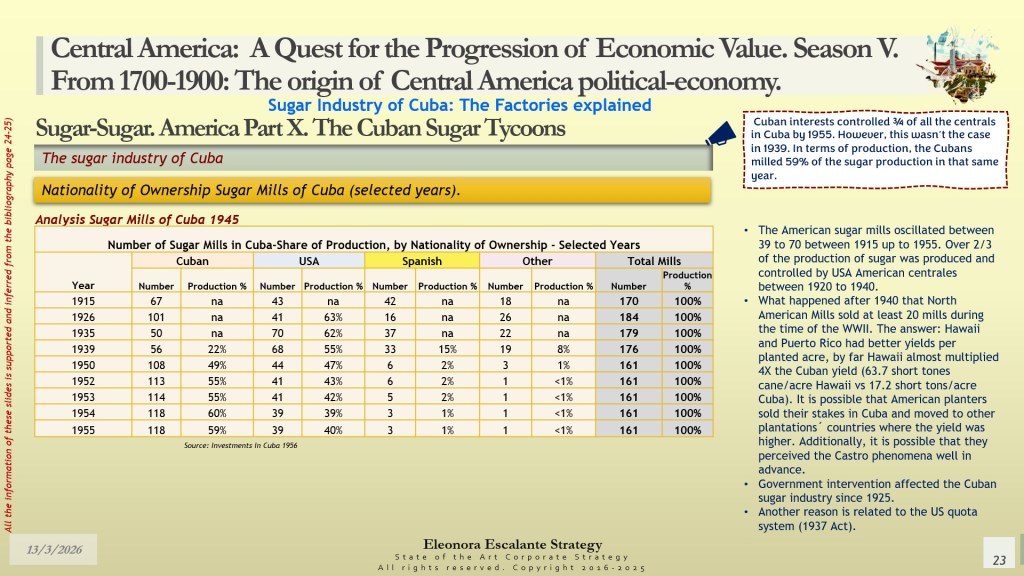
Our last slide (slide 23) shows the nationality of ownership of the sugar mills. We can observe the proportion of Cuban mills relative to American factories and the corresponding percentages of production. Despite the fact that, over time, American factories were bought by Cubans after 1950, the transfer of ownership did not change the land ownership structure. The inequality created by sugar plantations set a pattern of recurring dissatisfaction among the popular masses, who only needed the appearance of one leader like Castro to repeat the history of the French and Haitian Revolutions. Nowadays, Cuba is still suffering, and it doesn´t have enough electricity to power its nation.
Closing words.
We can only argue that any economic system that arises after a violent revolution, trying to fix an unequal past, causes more damage and does not solve the previous erroneous one. Land has always been the premium asset in the past, and it still remains the most important asset. However, a new class of intangible assets, the digital assets, has been born under unequal circumstances, and this is also creating additional chaos amid inherited patterns. A system that doesn´t resolve the issues of the past but creates new additional problems (as digital begging, brainiac damage, faked news with generative AI, abuse of power from the main top big tech, etc.), is not going to heal us, but it is causing additional problems to the existing ones that have not even been decoded.
Announcement. Next week, we will continue with Central America again. It is time to analyze cattle, livestock, and basic foodstuffs for subsistence between 1700 and 1900.
Musical Section.
During our closing bonus season V, we will return to the symphonic, philharmonic, or chamber orchestra compositions. However, I would like you to consider the following interpretation of a famous song released in 2011. The version is played without Enrique Iglesias. I hope you can understand the choreographer’s gracious, hidden economic message in the context of today’s Cuban thrift society. Try to see the heritage of sugar in the context of the setting. Enjoy!
The video’s production was in the hands of Alejandro Perez. The singers: Descemer Bueno, Gente de Zona. The dancing by: Ballet Lizt Alfonso Dance Cuba, and the Escuela Nacional de Danza of Cuba. Choreographers: Diana Fernández, Indira Álvarez y Roclan.
Thank you for reading http://www.eleonoraescalantestrategy.com. It is a privilege to learn. Blessings.

Sources of reference and Bibliography utilized today. All are listed in the slide document. Additional material will be added when we upload the strategic reflections.
(1) Truslow, F. Report on Cuba. Findings and Recommendations of an Economic and Technical Mission of the IBRD. World Bank Publication. 1951. https://documents1.worldbank.org/curated/en/509231468770694282/pdf/multi0page.pdf
(2) Bosma, U. The World of Sugar: How the Sweet Stuff Transformed Our Politics, Health, and Environment over 2,000 Years. Harvard University Press. 2023. Chapter 9. https://www.hup.harvard.edu/books/9780674279391
(3) Doyle, William M. “Capital Structure and the Financial Development of the U.S. Sugar-Refining Industry, 1875-1905.” The Journal of Economic History 60, no. 1 (2000): 190–215. http://www.jstor.org/stable/2566802
(4) McAvoy, Muriel. Sugar Baron: Manuel Rionda and the Fortunes of Pre-Castro Cuba. University Press of Florida. 2025. https://www.everand.com/book/877420152/Sugar-Baron-Manuel-Rionda-and-the-Fortunes-of-Pre-Castro-Cuba
(5) Guerra, Ramiro. “Sugar: Index of Cuban-American Coöperation.” Foreign Affairs 20, no. 4 (1942): 743–56. https://www.jstor.org/stable/20029190
Disclaimer: Eleonora Escalante paints Illustrations in Watercolor. Other types of illustrations or videos (which are not mine) are used for educational purposes ONLY. All are used as Illustrative and non-commercial images. Utilized only informatively for the public good. Nevertheless, most of this blog’s pictures, images, and videos are not mine. Unless otherwise stated, I do not own any lovely photos or images.
 Eleonora Escalante Strategy - Strategic Reflections Think Tank