
From the Enlightenment to Business Models. Season II. Episode 6. Voltaire Pro-royalism
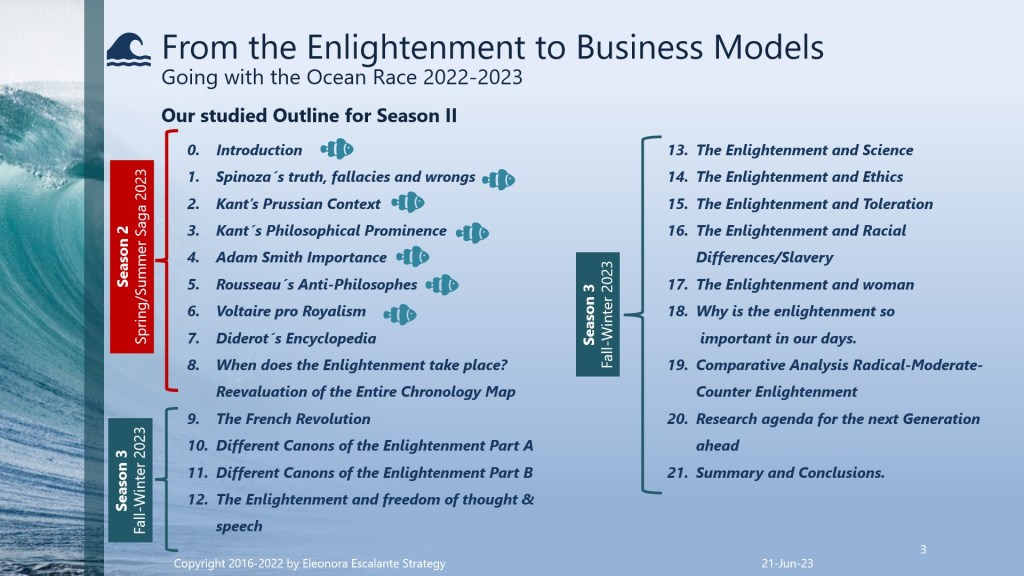
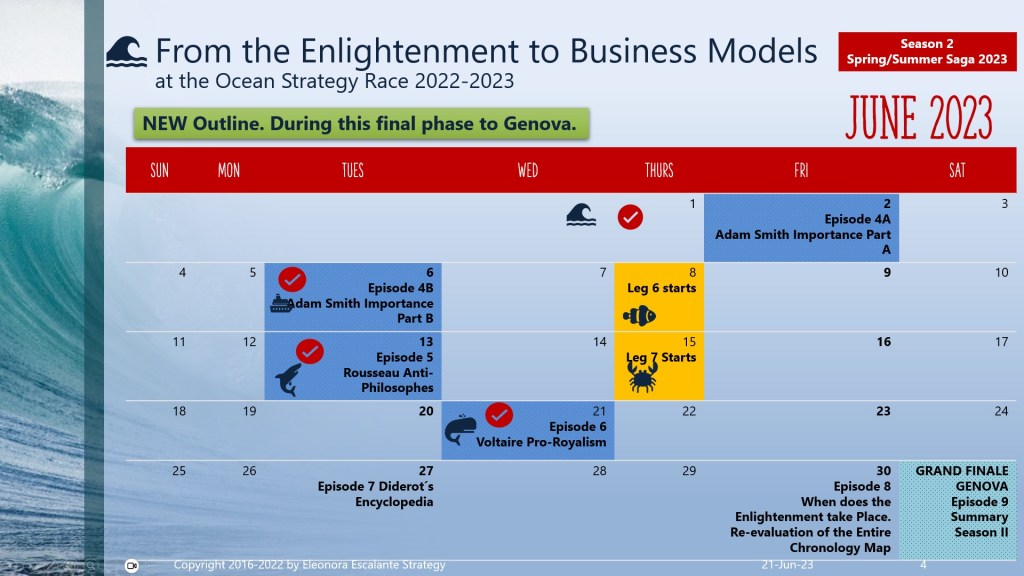
Have a beautiful night. I have a lot to share, so let´s begin. Find below the slides carefully prepared for you. Download them and print them, as usual. These slides are your frame of reference for today´s content.







The Life of Voltaire.
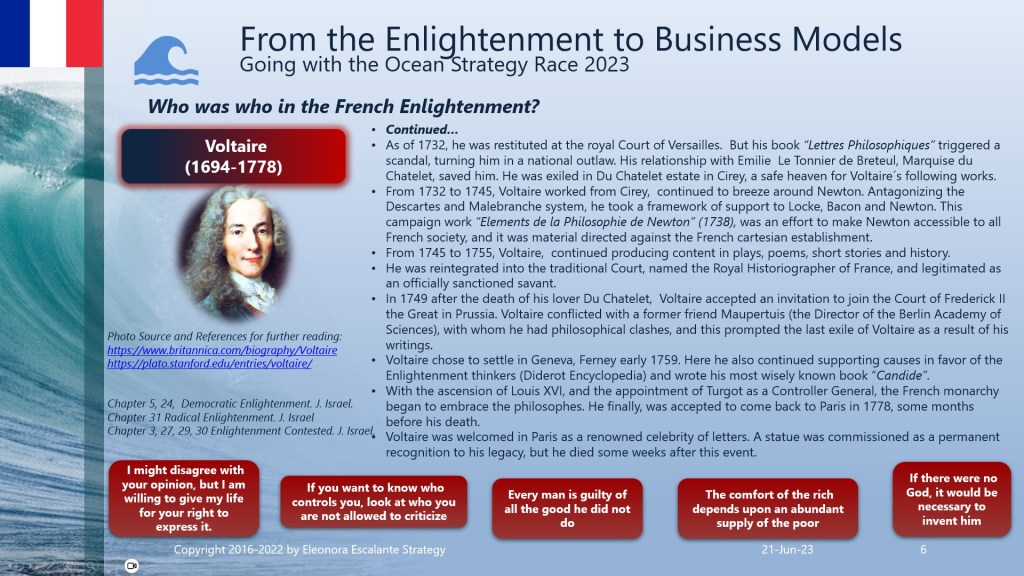
In season I, we prepared a condensed summary of Francois Marie d´Arouet, the real name of Voltaire. His resounding impact on the 18th-century movers and shakers of 6 European houses of rulers, wasn´t a coincidence. Voltaire had a scenic railway of ups and downs. Since his birth in Paris; his education in the Jesuit college of Louis-le-Grand; his innumerable voyages abroad in Europe; his option to become a writer of witty critical satires and tragedies; his hostility towards Christianism (particularly against the Catholic Church tied to the State and against Radical Protestantism); his two trips to the Bastille prison; his early triumphs in theatrical artworks which gained fame and recognition towards him; his immeasurable good luck by earning financial independence with the lottery; his scurry escapes from censorship and persecution; his forced expatriation to England; his lovers (Madame Du Chatelet, Madame Denis); his short period ascents to the French Royal Court; his nomination as a Royal Historiographer in 1745; his polemical publications of philosophy pro-Locke/Newton support in times of Descartes; his election to the French Academy, appointed as a “gentil-homme ordinaire de la chambre of Louis XV”; his decision to join the court of King Frederick II of Prussia for a few years in Potsdam and Berlin; his further quarrels with the Academy of Berlin; his diplomatic roles in the middle of the Seven Years War, including a spy job in favor of France; his connections with all the main Enlightenment Profiles of his era; his choice to purchase a couple of states in Geneva, his settlement in Ferney during the last 25 years of his life, and finally his continuum preparation, non-ending studies and production of ideas, which never ceased to taunt him during his 84 years span length. See slides 5 and 6.
It amazes me the process of Voltaire’s evolution, transformation, and his hard work.
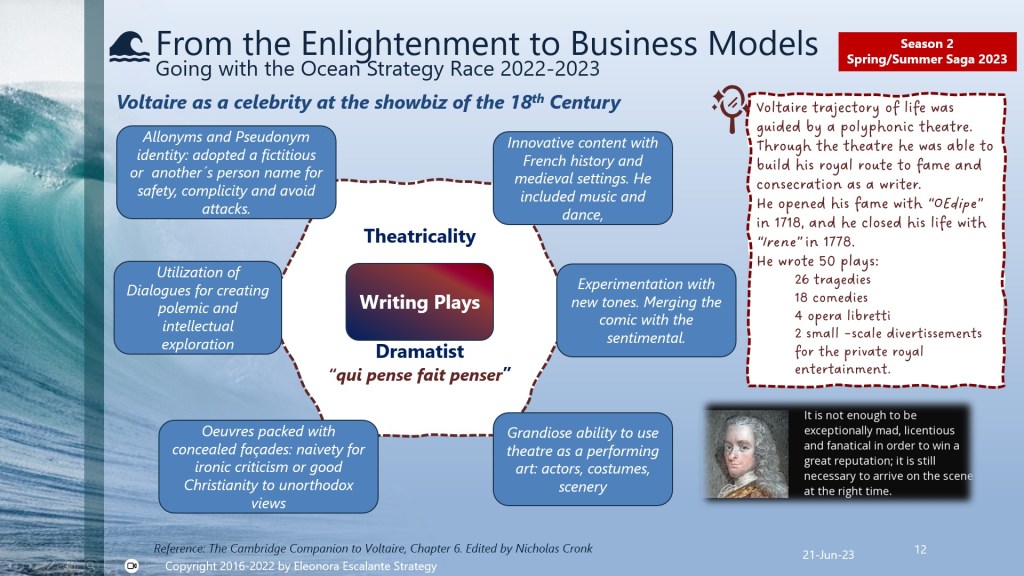
He sorted out how to survive in the midpoint of oppression from religious leaders and courts. He chose theatre as his core basic modus operandi. Since the beginning of his career, he never ceased to write theatrical plays of multiple genres (tragedies, comedies, operas), the plays that protected him in the eyes of his beloved public, the plays that gained the favor of the royal courts, and the plays that safeguarded him from his enemies. With time he evolved to explore the scientific theory that dethroned Descartes. He never stopped writing letters to more than 1,800 correspondents; letters that paved for him a branding trendsetter of his ideas and responses to other´s letters. Voltaire held a huge network of people in the political, religious, artistic, and intellectual elites of European domains. He converted himself from a French Entertainer for the Royals, then to a Royal Historiographer, and next to a philosopher advisor for another Prussian king in Berlin. In less than 25 years his metamorphosis occurred.
The land where Voltaire traveled
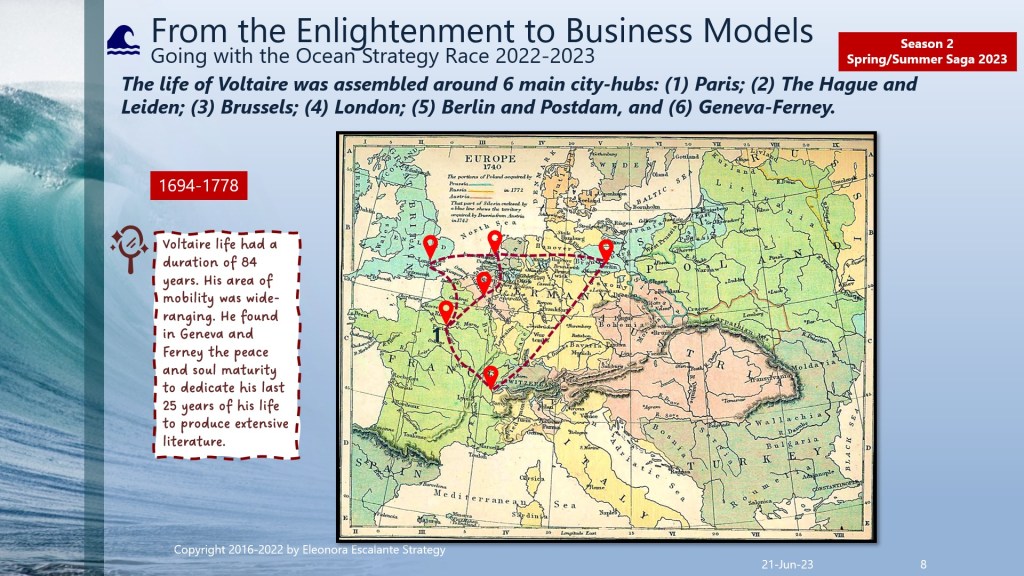
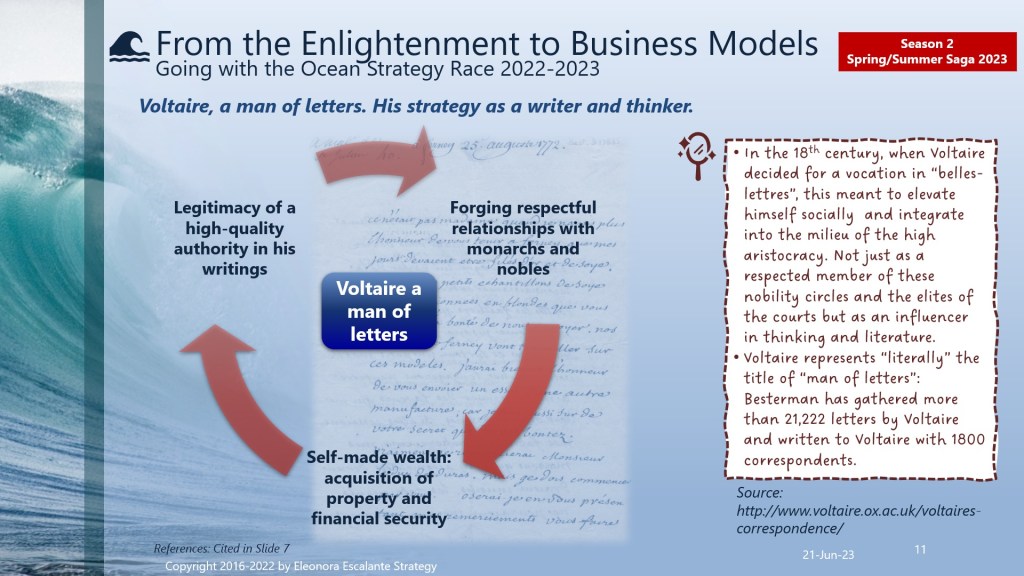
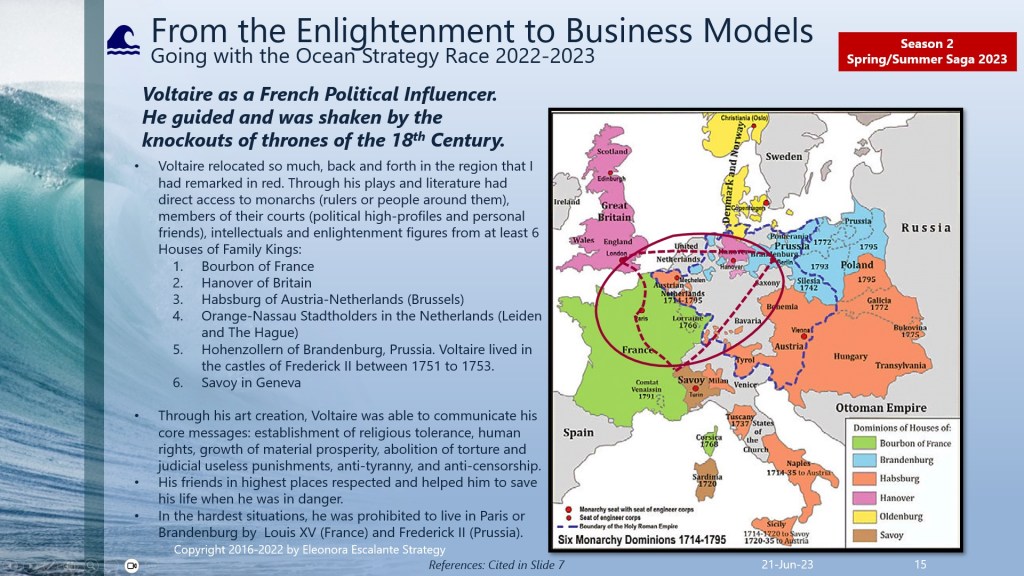
When I was preparing the slides for this publication, the first observation of my research was to understand the paths and the mobility of Voltaire in the maps. The life of Voltaire was assembled around 6 main city-hubs: (1) Of course Paris, France; (2) The Hague and Leiden, The Netherlands; (3) Brussels, at that time Austrian-Netherlands; (4) London, Britain; (5) Berlin and Potsdam, Prussia; and (6) Geneva and Ferney. This mélange of locations can´t be seen superficially. See slides 8 and 9. When Voltaire decided to become a “man of letters”, he also meant to elevate himself socially in such a way that he didn´t want to become a public server by employment; but to become a respected independent author and philosophe, that could earn a living without the patron model of his epoch. After his two voyages to the Bastille prison, he acknowledged that his own legitimacy as a free-thinker of letters could only be reached if he was able to become a “self-made” noble of letters, by the recognition of his literature and plays, and by the acquisition of his own real-estate.
Through his travels, his fame, his expulsions from Paris, and his solid intellectual connections acquired since he studied at the Jesuit School of Paris, Voltaire was able to knit a rock-hard network of ties that allowed him to open doors with 6 houses of kings and its respective courts: the House of Bourbon in France, the Orange-Nassau Stadtholders in the Netherlands, the House of Habsburg of Austria-Netherlands (Brussels), the House of Hanover in Britain, the House of Hohenzollern in Prussia, and finally the Savoy’s from Geneva. His letters extended to Russia with Catherine II the Great, Gustave III of Sweden, and many others. I discovered this by linking the routes and mobility voyages of Voltaire during his 84 years of life (see slides 8 and 9, and 15).
Also, Dan Edelstein from Stanford University has made an outstanding effort to map the letters of Voltaire in an interactive visualization. See it here by clicking the following link: http://republicofletters.stanford.edu/publications/voltaire/letters/ (2).
Nevertheless, be aware that it is estimated that more than 50% of Voltaire’s letters have been destroyed or are lost forever. Still, the Voltaire Foundation (3) has gathered 21,222 letters, of which 90% have been written by Voltaire, and the rest are the responses from other correspondents to him.

Voltaire financial autonomy.
It is very fascinating to find out that Voltaire focused in the 1730s decade, to earn money through the French National Lottery. He partnered with Charles-Marie de la Condamine, a mathematician who studied with him at the college Louis-Le-Grand. Voltaire won “enormous pay-offs” by studying the lottery rules and exploiting loopholes that they discovered in the system” (1). Voltaire and La Condamine were able to pull out between 5 to 6 million French livres a month. Voltaire also put money into several investment opportunities in the context of French commerce, bank transactions, and international trading. At the age of 41, Voltaire was immensely rich, and once he became financially independent, he was able to publish under his own terms. See slide 11.
Voltaire´s option for greatness.
It is clear to us that Voltaire was deeply and passionately in love with his authorship vocation. He didn´t allow his father pressure to rule his profession (Voltaire refused to study law), not the Bastille either. Voltaire´s option for writing theatre plays, allowed him to frame a perfect defensive strategy against his intellectual detractors and censorship persecutors. His voyages, paved with intellectual cleverness, linked him with the greater of each society he interacted with. His short-term appointments in service to the court of France, and his friendships with high-elite women around the courts (including Queen Marie Leszczynska the wife of the king, and Madame de Pompadour, lover of Louis XV) granted him ways to save himself every time he was in danger and at risk of harm. His romantic partnerships were industrious to his objectives too.
Additionally, Voltaire´s elevated network couldn´t be present in his life if he didn´t support it with his continuous flow of publications, theatrical plays, and letters. See slide 10.
Voltaire´s waves. His essence.
We have tried to summarize the essence of Voltaire: His spirit was born to become the most preeminent author with innumerable facades, to make an impact on the high elites of Europe, without losing his foundation in his public (those who could access his plays performances and his readers). See slide 17.
All his artwork and literature transmitted a critique and influenced in implicit manners, the importance of the establishment of religious tolerance, respect for human rights, justice, freedom of thought, freedom of speech, and the opening of prosperity through commerce and trading. His literature production included theater plays in satirical-critique modes, with comedies and tragedies; epigrams; epics; short-fiction; essays; compendiums of history; poetry; prose; contes; research scientific reports; clandestine manuscripts; and thousands of letters. See slides 10 and 12.

Strategic Reflections on Voltaire.
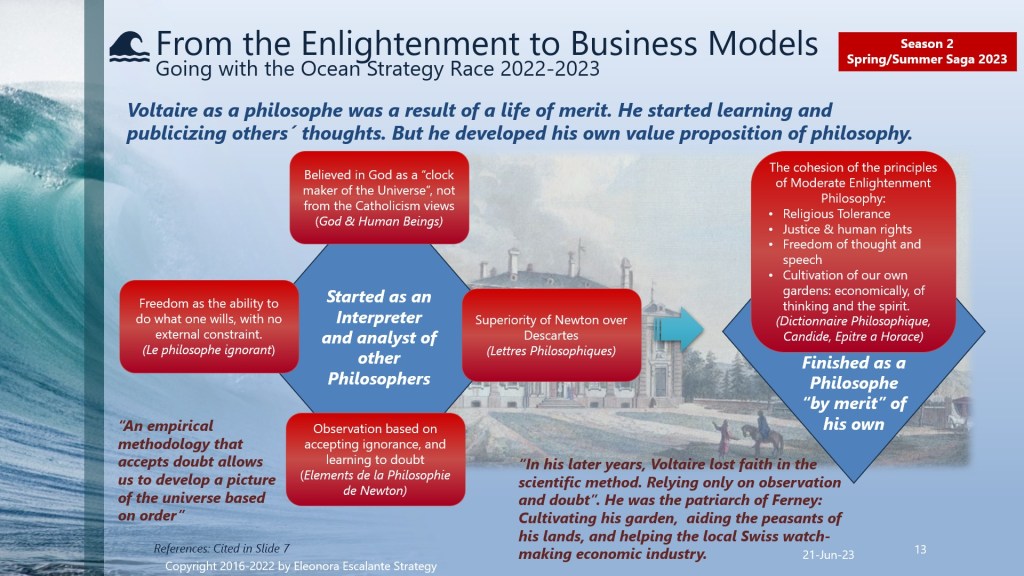
The recognition of Voltaire as a philosophe was a result of a life of dedication and merit. It wasn´t automatic. He started analyzing and diffusing the philosophy of other philosophers, and little by little, he took all his ethical messages which were immersed in his plays and literature, to create a cohesive value proposition of philosophy that can be summarized as you can read in slide 13: He used his literature as a tool to transmit the Moderate Enlightenment expression (see slide 13).
As a historian, Voltaire “wrote history to proclaim” (4) and raise again “the dignity of history, and by role modeling with his own history books, what are the role and the duties of a Historian”. He taught us through his history production, how to formulate the philosophy of history. See slide 14.
Finally, as an undercover avant-garde author, Voltaire was able to become an Influencer to many. His messages as a disruptor, as a denunciator against the injustices of the Status-quo, as a spy, and as a pro-royalist; convened to demonstrate to all of us, that despite the persecution that he suffered, his financial independence was crucial to swell his literature all over Europe and beyond. When he decided to settle as the Lord and Patriarch of Ferney, he was simply showing us that it is possible to make a living as a writer and author and that his prosperity was based on staggering non-stop hard work. He displayed 4 key fundamental roadmap factors for his success: financial independence, a robust network with people at high places, golden friendships, and a crucial need for an undercover identity. Voltaire excelled as a champion of concealing his polemical works, under-covered numerous pseudonyms and allonyms. Even his most controversial critical messages which made waves in the context of the 6 kingdoms that surrounded him; persisted to be broadcasted, using the covert strategy that allowed him to be safe. Without that hidden strategic security, I wouldn´t be here writing about Voltaire.
“Every man is guilty of all the good he did not do.”
Voltaire
Consciously, I have omitted to touch on the religious points of Voltaire. The spirit of his “anti-church” attitudes was beyond our own understanding in these current times. “His biblical criticism was negative, partisan, and worthless” (5). Nevertheless, Voltaire truly believed in God, but he didn´t trust the religious establishment that affected the 18th century and beyond.
Announcement.
This week we will proceed with our study about Diderot´s life. We expect to publish about him on Tuesday 27th. Do not forget to continue reading our compulsory bibliography (the 4 books of Jonathan Israel).
Ocean Musical Section
Nothing is certain, even for the winners.
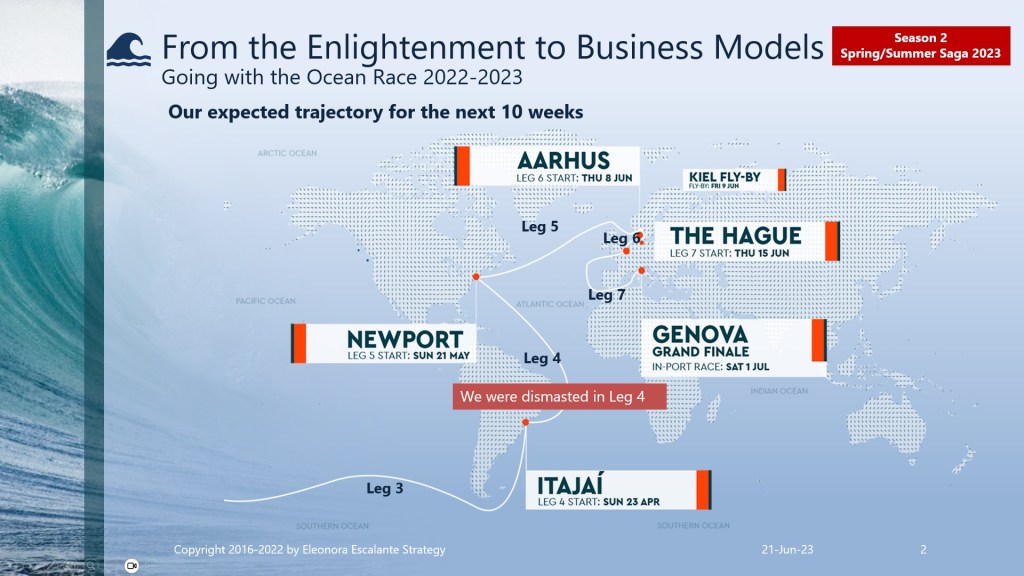
Since our last publication two main relevant situations have occurred in Leg 7 (from the Hague to Genova). The first one happened 15 minutes after Leg 7 began: Guyot Environment Team collided dramatically with the current winner of the race, 11th Hour Racing. Both teams were forced to retire from the race. The American team returned to The Hague Port and immediately repaired its vessel.
Since this leg includes both types of boats (IMOCA and VO65), the fleets are turning to the east towards the Strait of Gibraltar and the Mediterranean Sea. The winner of the Vasco da Gama Mirpuri Foundation Prize has been the VO65 boat Wind Whisper Racing Team. Meanwhile, at this moment, “the GUYOT team is sailing to its home port in France, while the 11th Hour Racing Team made repairs to its IMOCA and is heading towards Genova intending to race the last In-Port race of this edition on 1st July”(6). There are still more than 1000 nautical miles to cover before arriving at the finish line, and the light climate is not going to make it easy for the sailors.
Winners are always sailing in uncertainty. Even the most experienced and recognized talent in all disciplines are faced with disaster. But what matters is not the calamity, but how can we repair the damage, overcome the difficulties, stand up, change what is wrong, and commit to protecting ourselves better for next time. Next, it is our duty to continue again.
Find below the last video from the Ocean Race official reports, and next to it, our selection of music for today. It is music compiled by Earth Relaxation, flying over France.
Thank you for your consideration and for waiting for this publication. Trust me, we are doing all that we can under the extreme conditions of our new studio. Blessings and thank you for reading to me.
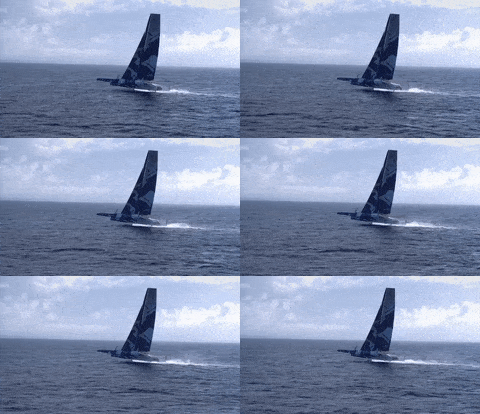
Leg 7 is leading us to Genova, our final stop-over. Photo Source: https://gfycat.com/gifs/search/volvo+ocean+race+extreme
Sources of reference are utilized today. All are listed on the slides. The following references are utilized in this text.
- https://www.cambridge.org/core/books/cambridge-companion-to-voltaire/110DFCB14231EAC26A998DC5AF672820
- http://republicofletters.stanford.edu/publications/voltaire/letters/
- http://www.voltaire.ox.ac.uk/
- https://www.cambridge.org/core/books/cambridge-companion-to-voltaire/110DFCB14231EAC26A998DC5AF672820
- https://www.cambridge.org/core/books/cambridge-companion-to-voltaire/110DFCB14231EAC26A998DC5AF672820 Chapter 13
- https://www.theoceanrace.com/en/news/14442_11th-Hour-Racing-Team-Redress-hearing-will-be-on-29-June-in-Genova
Disclaimer: Illustrations in Watercolor are painted by Eleonora Escalante. Other types of illustrations or videos (which are not mine) are used for educational purposes ONLY. All are used as Illustrative and non-commercial images. Utilized only informatively for the public good. Nevertheless, most of this blog’s pictures, images, or videos are not mine. I do not own any of the lovely photos or images posted unless otherwise stated.
 Eleonora Escalante Strategy - Strategic Reflections Think Tank