
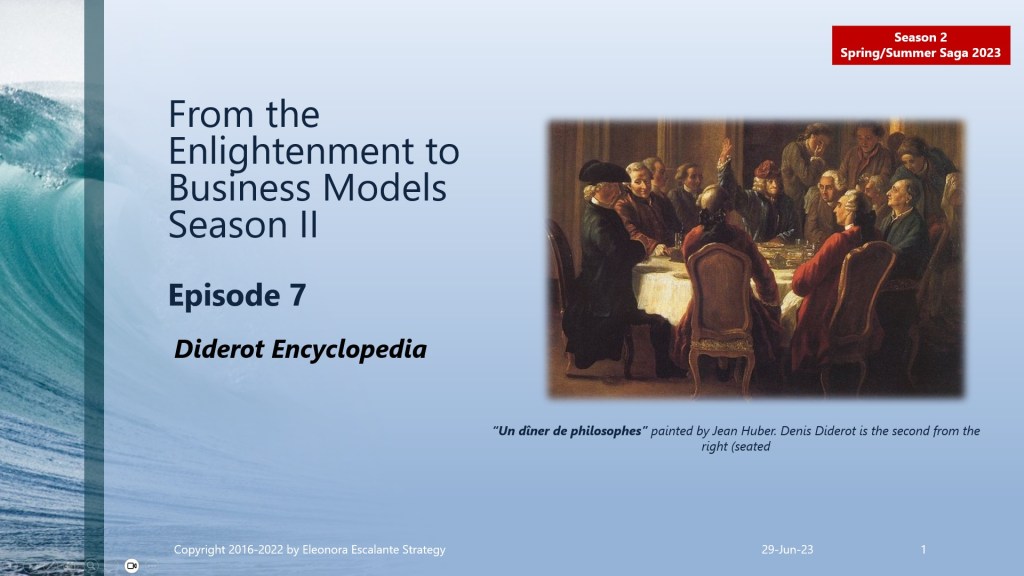
From the Enlightenment to Business Models. Season II. Episode 7. Diderot Encyclopedia.
Good night to all.
The importance of Diderot´s legacy in this saga, has nothing to do with his struggles, his phases of thought development, his public leadership in the circles of intellectuals or Paris Salons, or his eventual contributions regarding his radicalization in empiricism, materialism, and atheist ethics, or his subsequent fights within his circle of philosophers, which he was able to dwell during his lifetime of 71 years. We certainly believe that Diderot´s lifetime was guided by an ambition to transcend in one specific educational initiative: to build an encyclopedia under certain parameters of quality and standards of grueling, in a moment of time, in which those canons weren´t so clear (sometimes with antagonism too). According to our sources of bibliography, the Encyclopedia of Diderot was completed only because God wanted it. Literally. It was an ambitious and grand project that was executed under so many odds. Even if its contributors made it possible, this project was running in times of censorship. The content of the encyclopedia wasn’t executed uniquely by Diderot, but it was pulled in by Diderot from other creators. Of course, Diderot accomplished some of the entries for the Encyclopedia, as much as other philosophes, doctors, erudite, priests, and scientists. In addition, we also have a specific set of inquiries to resolve during our publication today:
- Why did Diderot decide to become an editor project leader of an Encyclopedia, managing around 140 contributors (with different backgrounds and schools of thought) in the context of an absolutist France with prime censorship and potential repression, and particularly after being imprisoned in 1749 (with 36 years old)?
- Why did Diderot seem to appear to radicalize himself after his first moderate phase as a writer, instead of securing a middle ground as many of the other moderate Enlightenment profiles we have studied in this saga? Then, why was Diderot perceived as a radical enlightenment representative, if by the 1760s his radicalization wasn´t outstanding anymore, in any of his literary works? Moreover, his success was internationally recognized, and he was able to enjoy an ascendant economic prosperity. Why no one noticed his change, and if perceived, he continued being seen as a radical.
- To what extent did Diderot bifurcate from radicalism through his literary production after finishing the Encyclopedia?
- Why do we need to study Diderot to comprehend the roots of business modeling today? What is Diderot’s essence in our times?
After checking some details from a couple of chapters of Diderot´s philosophical contribution, I proceed to upload the material that is utilized as a frame of reference for today. Feel free to save it for your future reference or print it.

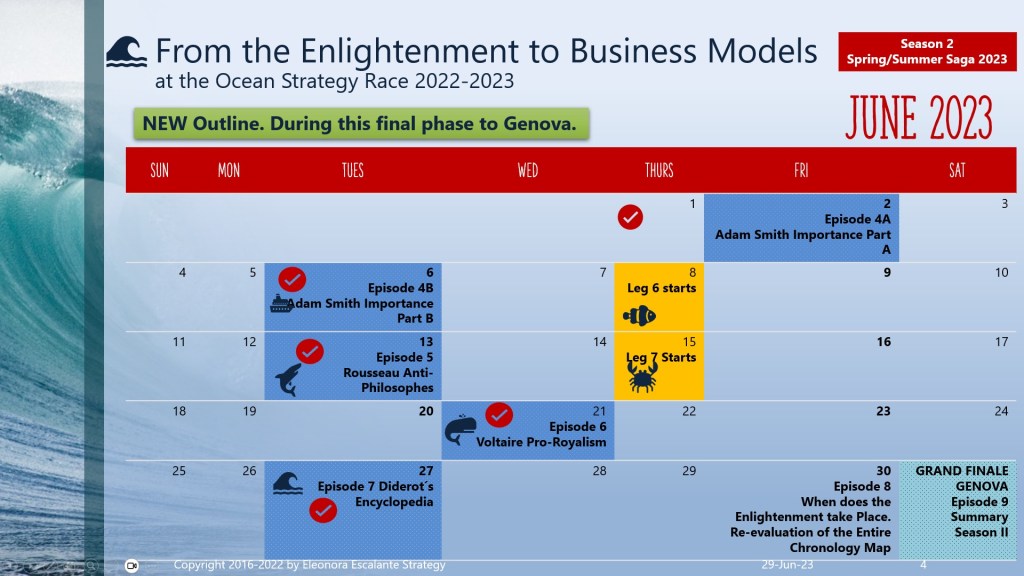
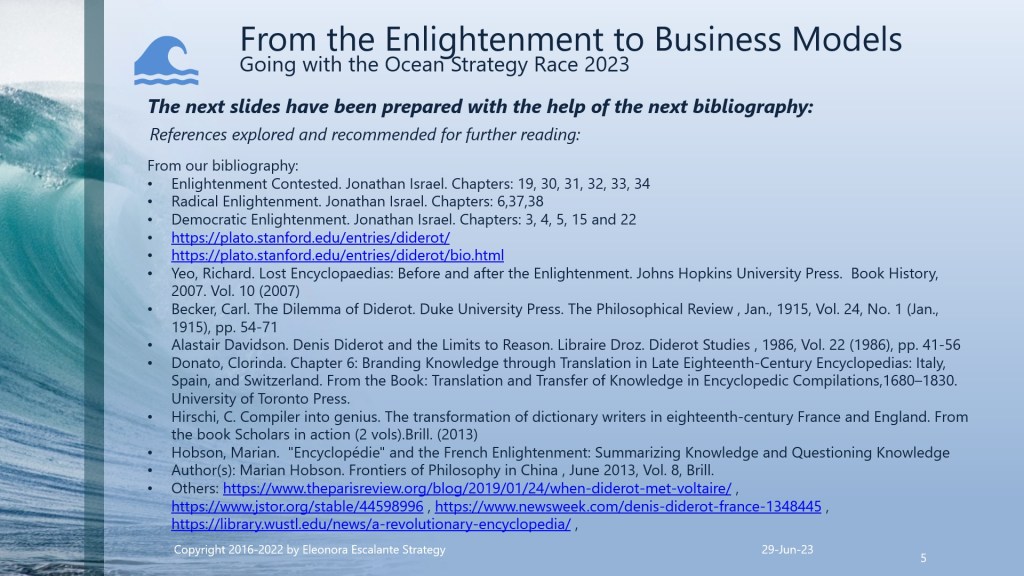
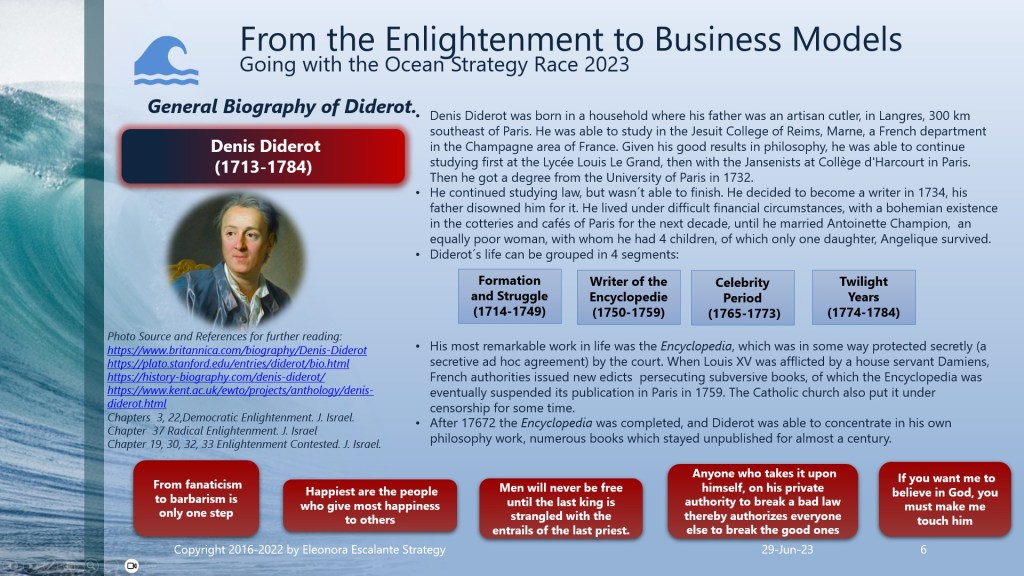
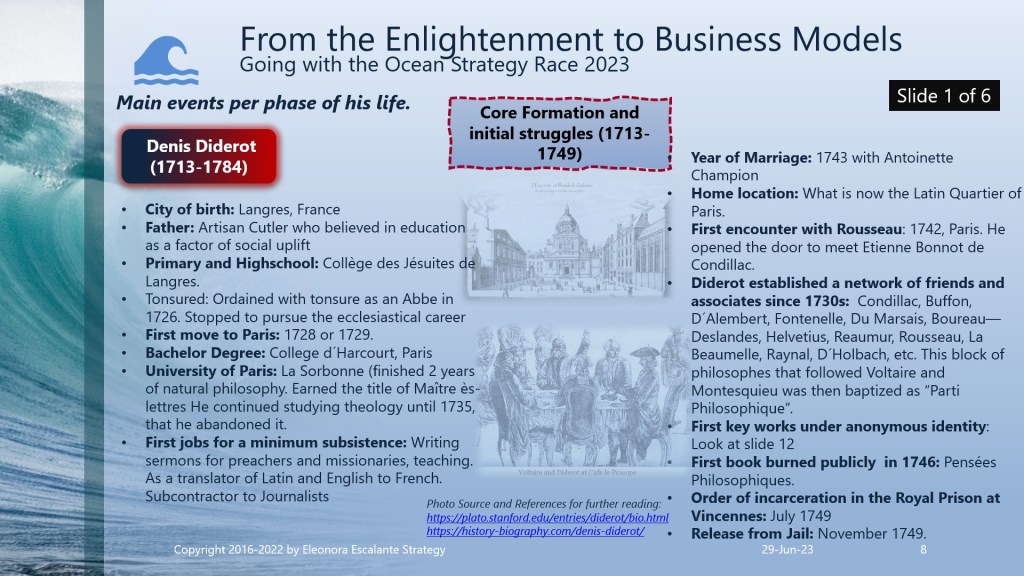
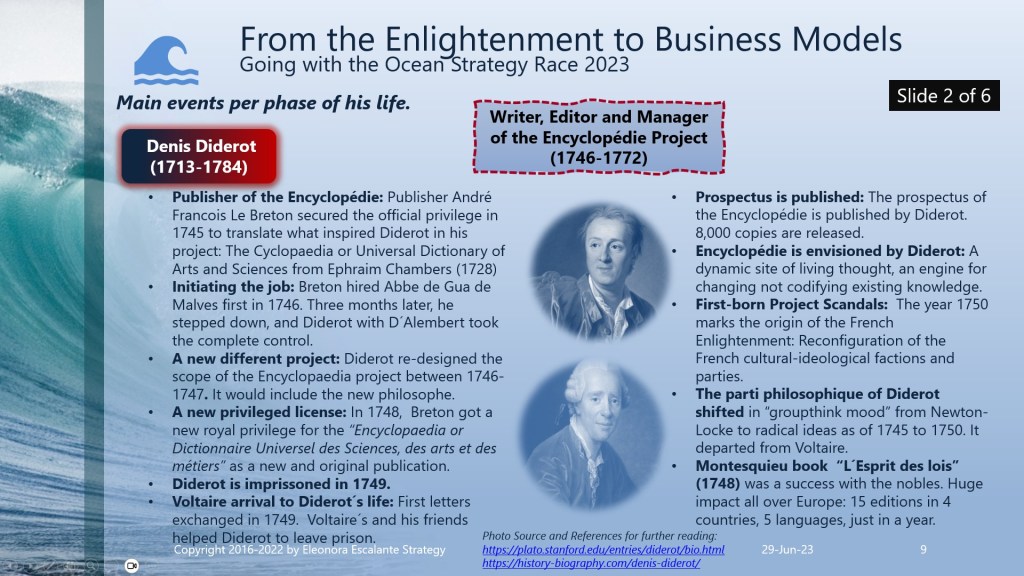
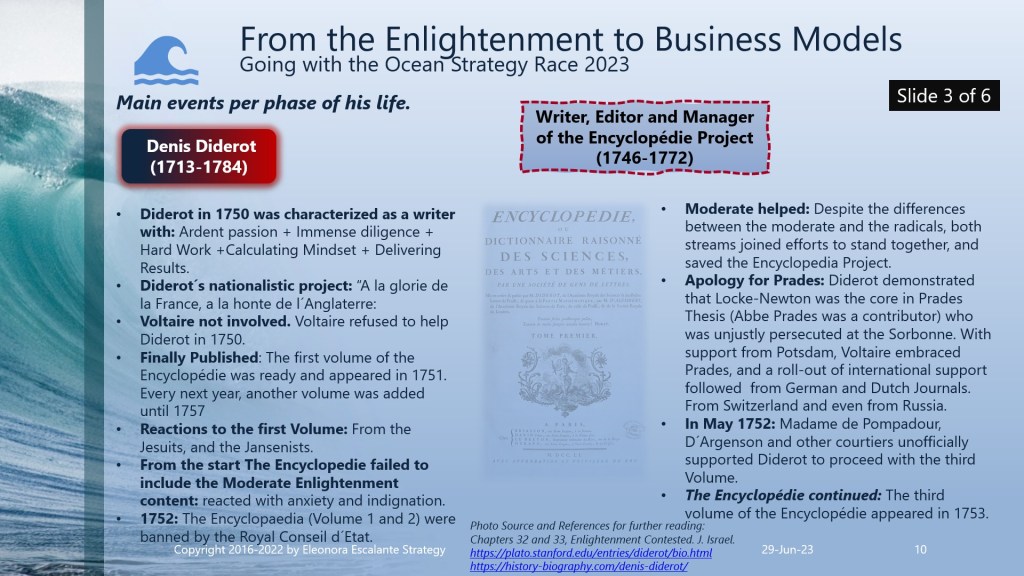
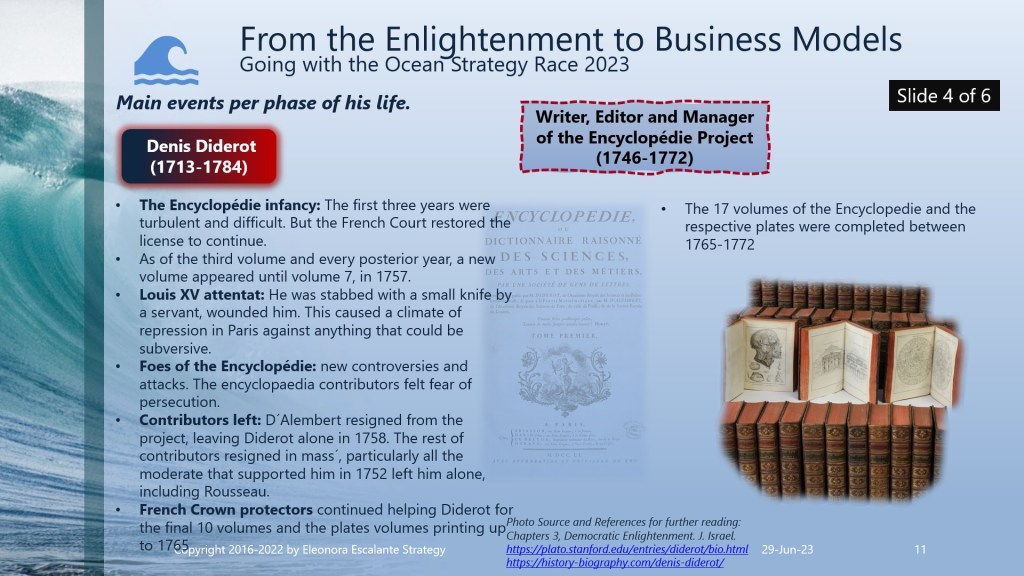
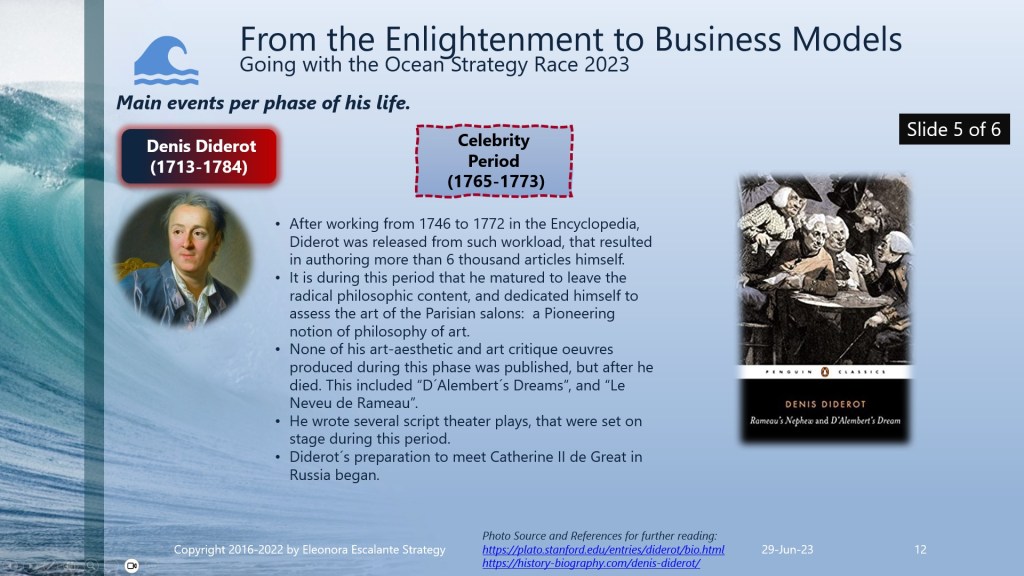
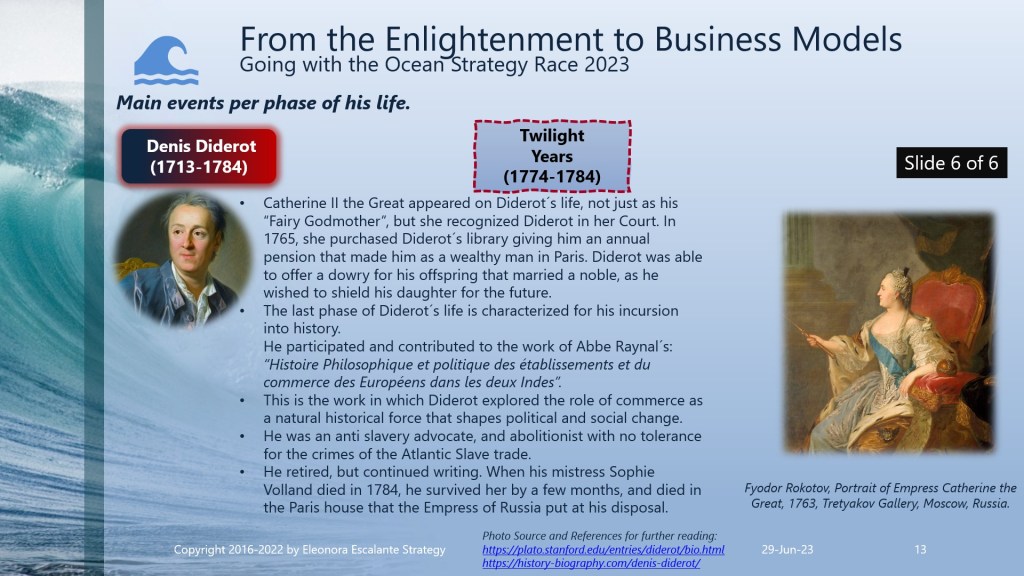

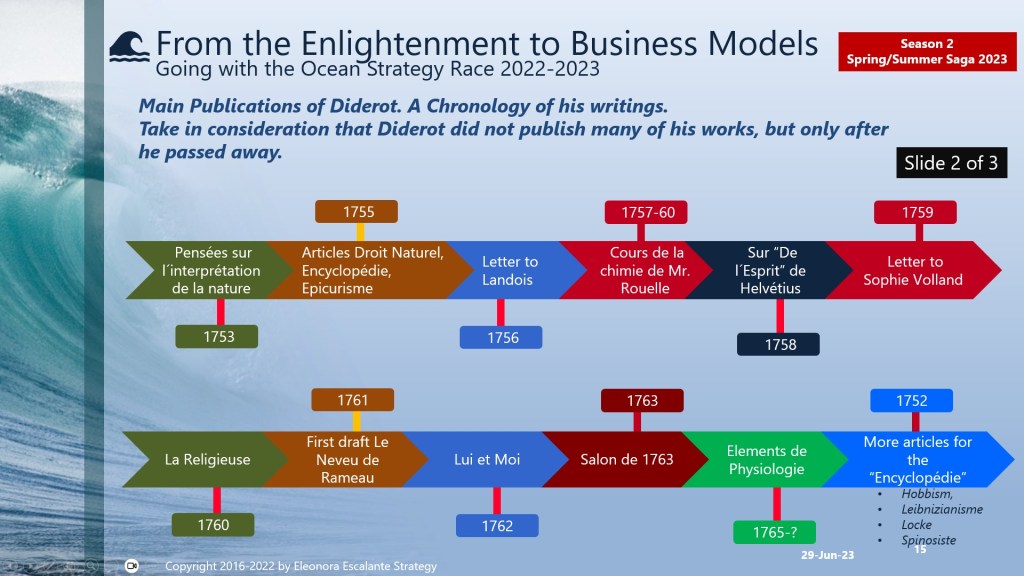
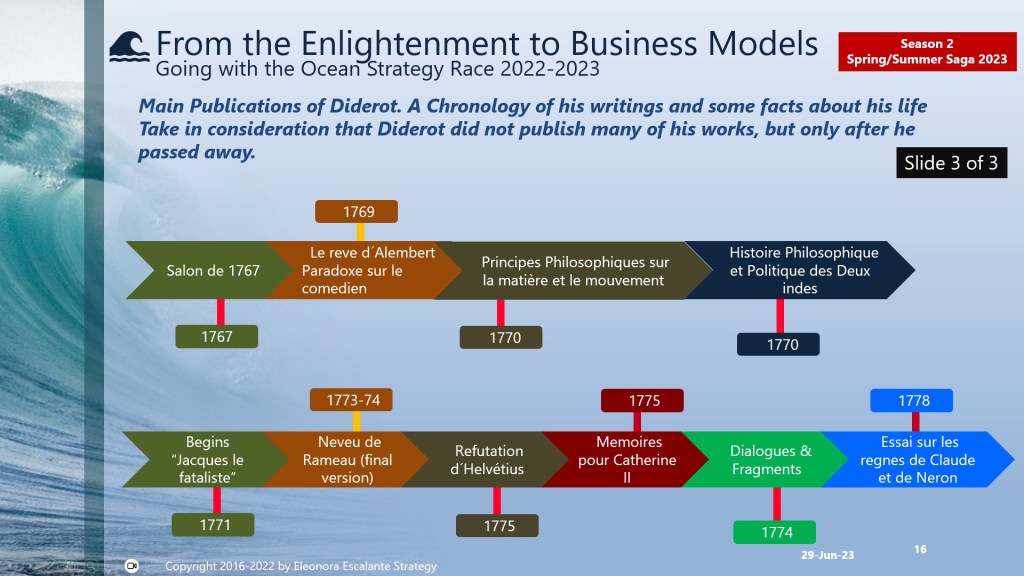
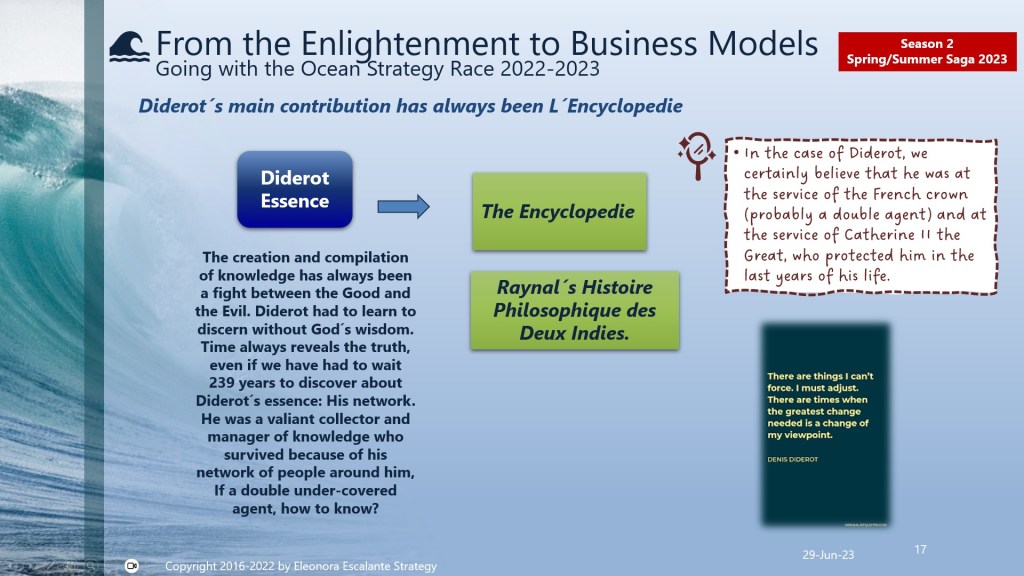

Diderot´s life.
For this section, I invite you to visit our slides. These are self-explanatory.
Encyclopedia preparation and scandals.
Paris was the location of the French Enlightenment in the context of the superb nation that was the center of royal absolutism in Europe. The royal court of France, in the hands of the Bourbons, was having troubles with the Intellectual class. In the first 50 years of the 18th century in Paris, there was a unique convulsion of intellectual development ignited by Bayle, Fontenelle, Boulainvilliers, Fréret, and Boureau-Deslandes that originated this new idea of “l´histoire de l´esprit humain”, which was completely pioneering in whole Europe. And is in this novel context of thought that Diderot found himself trapped once he left the Sorbonne. The naturalist philosophical historical tradition from Bayle to Fontenelle influenced young Diderot, and it was a slow process of assimilation of them in Diderot´s brain. The preparation of the frame of mind that Diderot supported during his lifetime, together with his predilection for ancient Greek materialism, as well as some elements of Spinozism wasn´t automatic. Diderot started under catholicism, then moved to deism, then to atheism, and finally for some, he was a neo-spinoziste too. When the radical enlightenment figures who influenced Diderot tied the knot of this new concept of “histoire de l´esprit humain” and the history of philosophy, then the core of the radical French enlightenment was set in a unique way, even more, authoritative than Spinozism, and this hit the core mindset development of Diderot. Particularly, during the period of life in which he was hardly making a living as a translator.
A friend can change the world for us.
When Diderot met Rousseau in 1742, that was the beginning of a strong friendship that changed Diderot´s life forever. Not just Rousseau shared a true amitié with Diderot, but he also introduced Diderot into a circle of influence beyond France. A year after, Diderot married Antoinette Champion, so Diderot was not the single flamboyant sans family anymore. In addition, Diderot held other extramarital relationships shortly after his marriage. At the beginning of his career, Diderot’s origins were not radical but restricted to mainstream moderate enlightenment. But something happened that altered his frameworks. Exactly when he began his job of the Encyclopédie (the license was obtained in 1746), and precisely when he was at the cusp of gaining the favor of the first contributors to it.
Another report of a friendship in Diderot´s life and his daughter’s prosperity was the support of Catherine II The Great of Russia. This occurred a long time after he met Rousseau. She sponsored Diderot in 1765. His financial burdens forced him to sell his library to her. The books remained in Paris, but Diderot received an annual pension for life.
Diderot´s Encyclopedia organizational network.
Believe it or not, as we have described above, the most relevant artwork of Diderot, “The Encyclopédie or the Reasoned Dictionary of the Arts, Sciences and Trades”, was not the one in which Diderot´s mindset was mirrored fully. But it was his sounding boom box that signed his name for posterity. His role as a main editor of “third-party” articles, definitions, concepts, and opinions; was a function of organizational relevance, but mainly because he was leading a compilation of external work from others, and he was managing structural, logistic, and operational layouts for his publisher. His work, all together with D´Alembert´s shared co-editors position was first the attainment of an idea of translating Ephraim Chambers’ efforts, the Cyclopaedia of 1728, which was written in English. Let´s remember that in the 1740s decade, Diderot was hired as a translator of some oeuvres, so his gained English to French efficiency helped him to be hired for “Chambers’ translation”, and later when Diderot and D´Alembert took the job, both sketched a new scope for the Encyclopedia. Diderot transformed himself into a compilation superintendent of notions and third-party articles. He was capable to shape multiple authors´ content and deliver as many volumes as these were completed, no matter what type of restrictions, scandals, or censorships were thrown against his project by the French authorities and/or the ecclesiastic representatives. We also can´t understand his project without comprehending that it was his publisher who got royal authorization to proceed with it, and it was Diderot’s network of wisemen and astute women, all connected in between with the members of the noble class at the service of Louis XV that shielded Diderot´s project for more than 25 years.
Our reflection on this matter is about 3 aspects:
- In the art of organizing third-party content, and in the context of Diderot´s epoch (18th century) without the Internet, and “sans le flux d´information vite et immédiat” that we hold nowadays; the labor of Diderot and D´Alembert was beyond treasured lyrics. I truly doubt that any of us could manage what Diderot and D´Alembert accomplished in a few years without the Internet, without digital tools to draw, and with the excellent quality that we can observe in the plates of the Encyclopedie that are still available in many university libraries and institutions. In addition, I also have my profound reservations that any of us and the younger generation of artists – who are fully devoted to digital production and publishing- could draw by hand and then print one volume of Encyclopedia in a year with the tools used by André-Francois Le Breton Publishers and Diderot´s his staff of illustrators. I bet that if today, we remove all the Internet, and our digital devices, tablets, software to sketch and draw, computers, or machines; not even the best of our current civilization young hand-made illustrators would assert to do what these ancient editors managed to supervise, mainly with paper and ink. In addition, I also bet a million dollars, that no publisher today using the equipment of Le Breton, could accomplish what they did in 1750.
- Diderot and D´Alembert started to work “officially” on the Encyclopedie project in 1746. But informally, they started to work on it since they participated in the meeting places of debate, mainly cafés patronized by Fontenelle a decade before that. Diderot was an assiduous partaker of these places, before and after he finished his studies at the Sorbonne. It was in these cafés of Paris (he lived in the Latin Quartier before his marriage) that Diderot met most freethinkers, including Rousseau. By the time in which he became the editor-in-chief of The Encyclopédie, I also bet that Diderot already met in person many of his contributors and he -directly- built a network of indirect and thru supporters who attended the debate coteries. In 1750, Le Breton released 8 thousand copies of Diderot´s “Prospectus”, to do marketing and obtain advanced subscriptions for the compendium. In the Prospectus, Diderot anticipated that this project wasn´t a translation of other´s works, but a never-ending mission, a dynamic collection of living thought, an engine designed to “change” existing “wrong” knowledge, with the purpose to create debate in those readers that curiously may inquisitively continue thinking about each and all the subjects categorized by the alphabet.
- The Hopscotch style of Diderot. For those who have read the book Rayuela (Hopscotch) by the Argentinean-Belgian author Cortázar, I am sure you will immediately understand what Diderot pursued with the Encyclopedia. Cortázar by coincidence wrote this oeuvre in Paris. “The general idea behind the Hopscotch of Cortázar, you see, is the proof of a failure and the hope of a victory. But the book doesn’t propose any solution; it simply limits itself to showing the possible paths one can take to knock down the wall, to see what’s on the other side.” (Interview from Evelyn Picon Garfield to Cortázar in 1978). Diderot and D´Alembert were genius masterminds to offer multiple doors to one definition or concept or topic or theoretical framework, by linking each of them to other authors, or other views in different contexts.
The branding of radicalization and further shadows in Diderot
Diderot´s life started his path to radicalization (in theory) in the decade of 1730 when he was studying in Paris. It was a long process. But don´t forget he was molded to become a priest. In his early years in Langres, where he was born, he obtained the Abbé tonsure in 1726. By 1729 his family supported his decision to move from Langres to Paris. His education passed first to the Jesuit Lycée Louis Le Grand, then to the Jansenist College D´Harcourt, graduating as Magister Artium. Later he completed his studies at the Sorbonne, studying natural philosophy and theology. With such a traditional, conservative religious formation, it is insane to think that Diderot could end up with a radical neo-Spinozism enlightenment profile as it is being characterized. Under the influence or interaction with other freethinkers in the cafés of Paris, during the same period when he learned English and Italian. It was from 1735 to 1746 that Diderot fully dedicated his time to perfecting English and making a living as a translator. But as I mentioned above, Diderot got trapped in that radicalization process between 1748 to 1752. Why? Why did this happen?
By 1742, Diderot earned his path to fame with his “parti philosophique” by associating himself with the radicals that frequented the cafés and the Parisian Salons for debating. For example, La Mettrie. It also coincides that during this decade, Diderot was facing big economic struggles. Was Diderot really a radical, or was he using a mask of a radical?
Such branding of radicalism is very confusing to me. Initially, he followed Voltaire´s role model, and it seems to me that Diderot, was pursuing a moderate image, but at the same time, he was influenced by radical thinkers. When he published (anonymously) his first original oeuvre: Pensées Philosophiques (1746), and later “The Letter sur les aveugles” in 1749, he ended up in prison for a few months in Vincennes.
What happened to Diderot between 1748 to 1752?
The power of simultaneous controversies in the circle of Diderot.
According to Jonathan Israel (1) between 1748 to 1752, there were 4 main simultaneous controversies that made a remarkable impact on all the members of Diderot´s closest circle of acquaintances and friends: Apart from Voltaire, Rousseau, and Montesquieu, we certainly require that you remember these last-names: Condillac, Buffon, d´Alembert, Fontenelle, Du Marsais, Boureau-Deslandes, Helvétius, Reaumur, Mably, La Beaumelle, Raynal, D´Holbach, and Grimm. All these freethinkers decided as a block to don´t reinforce the Anglomanie of Locke and Newton. The 4 controversies were:
- The scandal of La Mettrie´s book “L´Homme Machine”.
- The furor quarrel caused by Montesquieu with his “L´Esprit des Lois”.
- The opening battles surrounding the “Encyclopedie”.
- The disputes about biology were triggered by Buffon´s “Histoire Naturelle”.
Then, remember that as of 1746, Diderot was not seen as a translator of a low category. With his numerous lists of acquaintances during the last 10 years in the Salons of Paris, he continued participating constantly in radical debates in places such as Café Procope, Café de la Regence, and the tavern Panier Fleuri. Now not as an individual. He was the manager of the Encyclopédie. The power of these controversies was reflected in Diderot’s works (see slides ) and that is how he ended up in prison confinement in 1749. Diderot´s case is the perfect example: “Tell me who your friends are, and I’ll tell you who you are”.
Bifurcation from Radicalization to a literature production
The prison left Diderot with such a remarkable lesson for the rest of his life: he was released, in exchange for not publishing again any religious content that could alter the status quo of the Paris authorities and the Catholic ecclesiastic establishment. What transpired between 1748 and 1752 to Diderot´s “parti philosophique” can only be explained as a “group think” situation. According to Psychology Today: “Groupthink is a phenomenon that occurs when a group of well-intentioned people makes irrational or non-optimal decisions spurred by the urge to conform or the belief that dissent is impossible”. “Even in minor cases, groupthink triggers decisions that aren’t ideal or that ignore critical information. In highly consequential domains—like politics or the military—groupthink can have much worse consequences, leading groups to ignore ethics or morals, prioritize one specific goal while ignoring countless collateral consequences, or, at worst, instigate death, crimes, and destruction” (2)
Once Diderot got trapped in the “group think” phenomenon of the radicals, he couldn´t protect himself from it. And this is the reason why he published with a “radical allure”. Further, we also are required to see the geopolitical aspects of France in the middle of the 18th century. “France’s overseas expansion always came second to the competition with Britain”. All the French free-thinkers knew this. And they also realized that if they supported Newton-Locke´s views for their own French Enlightenment, they probably were going to lose their predominant own theories for economic development that were crucial for Louis XV (the king).
Let´s recall that King Louis XV was always advised by Cardinal de Fleury, and the king’s marriage with Marie Leszczynska (daughter of the dethroned king Stanislaw I of Poland), forced France to go to war against Austria and Russia in the War of Polish Succession (1733-38). When de Fleury died in 1744, Louis XV decided to take international affairs into his own hands, by sending French secret agents (playing the role of radicals or anti-status quo in Paris and other cities such as Varsovie, Constantinople, Saint-Pétersbourg, and Stockholm). This operation was called “Le secret du roi” (3). Since Louis XV’s mistresses and public officers were linked to Diderot´s network, I believe that they as a block must have been aware of something, that made them reject Newton-Locke’s moderate flag, and this happened in the years of 1748-1752. Still, I am not sure if Diderot was a double agent for Russia and King Louis XV (after assuming his months of prison). Otherwise, I can´t explain why he received economic support from Catherine II of Russia a few years later. When Diderot was called to Saint Pétersbourg in 1773, he already supported his only beloved daughter’s marriage to Francois Nicolas de Vandeul, a noble, so a dowry was required. When he sold his library (his most cherished treasure) to the empress of Russia, that action was seen by the rest of his Enlightenment network as the undercovered history that explained why was he linked later to Empress Catherine II’s demanded voyages. But no one knows exactly to what extent was Diderot connected as a French double Agent to the rulers of his time.
Diderot´s essence applied to our times.
From the text of this article, it is your homework to write the essence of this author in 5 lines. I already wrote what we believe is the essence of Diderot: His network of people. His friends, his protectors, his professors, his acquaintances, his contributors, and his contacts inside the French Royal Court, and in International Courts. He made it through the end because of his connections and links to people who all together saved him.
The creation and compilation of knowledge has always been a fight between the Good and the Evil. Diderot had to learn to discern without God´s wisdom. Time always reveals the truth, even if we have had to wait 239 years to discover about Diderot´s essence: His network. He was a valiant collector and manager of knowledge who survived because of his network of people around him. If his ultimate purpose was below an umbrella of a double undercovered agent for France and Russia, how to know?
Announcement.
As soon as I finish editing Diderot´s slides that are utilized as a frame of reference for today, I will proceed to update this post. Our next deadline is Friday 30th.
Ocean Musical Section
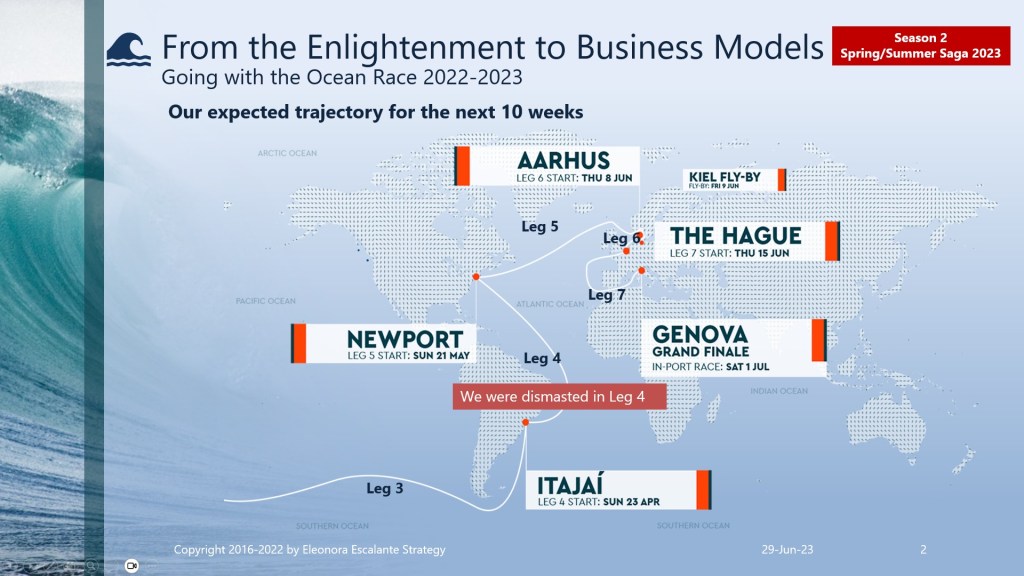
Leg 7 is finished. We are in Genova, Italy.
The first place in the IMOCA Boats category went to Team Malizia. The second was Biotherm and the last one was Team Holcim-PRB. In the VO65 Boats category, the first place was for team Wind Whisperer, followed by Team Jajo and the next one was the Austrian team. For an overview of the scoreboard, I invite you to visit https://www.theoceanrace.com/en/scoreboard. Congratulations to all. We finished Leg 7.
Our piece of music for today belongs to the 250th anniversary of Beethoven’s birthday, featuring a 10,000 members chorus, “the largest chorus to ever perform this piece that we are aware of, singing the fourth movement of Beethoven’s 9th Symphony guided by Schiller’s immortal poem Ode to Joy”. Enjoy your freedom, please.
Leg 7 is over. Photo Source: https://gfycat.com/gifs/search/volvo+ocean+race+extreme
Sources of reference are utilized today. All are listed on the slides.
(1). Israel, Jonathan. Enlightenment Contested: Philosophy, Modernity, and the Emancipation of Man 1670-1752. Chapter 19
(2) https://www.psychologytoday.com/intl/basics/groupthink
(3) Gaxote, Pierre. “Le Secret du Roi”. Revue des Deux Mondes. 1956. pp 639-645
Disclaimer: Illustrations in Watercolor are painted by Eleonora Escalante. Other types of illustrations or videos (which are not mine) are used for educational purposes ONLY. All are used as Illustrative and non-commercial images. Utilized only informatively for the public good. Nevertheless, most of this blog’s pictures, images, or videos are not mine. I do not own any of the lovely photos or images posted unless otherwise stated.
 Eleonora Escalante Strategy - Strategic Reflections Think Tank