
From the Enlightenment to Business Models. Season III. Episode 1. Introduction
Let´s begin.
“From the Enlightenment to Business Models, Season III” grand opening session commences today. This season will be written in a climate of transition mood from global heatwaves to autumn and then winter. Besides the weather that awaits us, we are so curious about all the discoveries that we will share with you, mainly related to our role as generators of our theoretical opinions and state-of-the-art corporate strategy reflections. As an explorer of the past that is doing the connections with our business theories of today, I am overjoyed and over the moon to produce our outline for the next 20 weeks, and its respective 20 episodes. To make our content a bit brighter, we have decided to publish only on Fridays as of this saga, and for the rest of 2023 and for the future. Let´s officially welcome our third saga of the year 2023.

Our work of 2023 has been to prepare you for Season III.
The first and second seasons of “From the Enlightenment to Business Models” have provided certain important elements, discussion material, maps, a general historical background, around 500 pages of PowerPoint slides, and a foundation consistent draft (that is subject to improvement) of what was the context of the Enlightenment centuries. We have focused on providing a detailed description of what was occurring in Europe in the 17th and 18th centuries. We have sketched out our best mapping to show you the contextual analysis of the main royal families (and court advisors) as the main characters who led the role of corporate strategists of that epoch. Merchants were not leading these two centuries, but the royal families. Some families who got involved in maritime trade were getting rich and were competing with economic power against the nobility class, but these weren´t decision-makers. For many of the immigrants from Europe to the New World, the opportunity to grow in a new territory that allowed freedom is the best proof of evidence of it. In the Enlightenment period, the knockouts of thrones were being performed with one unique value proposition: the settlement of newly conquered lands outside of Continental Europe, and how to defend those new territorial resources from other monarchies and their respective court members who wished to mobilize from the old to the new, and its respective governments. Voltaire’s voyages indicated to us the predominant role of the Bourbons of France-Spain, the Hanovers of Britain, the Habsburg of Austria and the Belgium-Netherlands, the Orange-Nassau Stadtholders in the Netherlands, the Holy-Roman Emperors of the German Lands, the Hohenzollerns of Prussia, the Savoy of Geneva and the Venetian and Genova doges, without forgetting the Russian Romanov´s emperors and tsarinas. The Ottoman Empire is not ignored either, even though I have not dedicated any episode to Russia or to the Danish-Swedish royal houses of authority. But it is impossible not to cite them either.
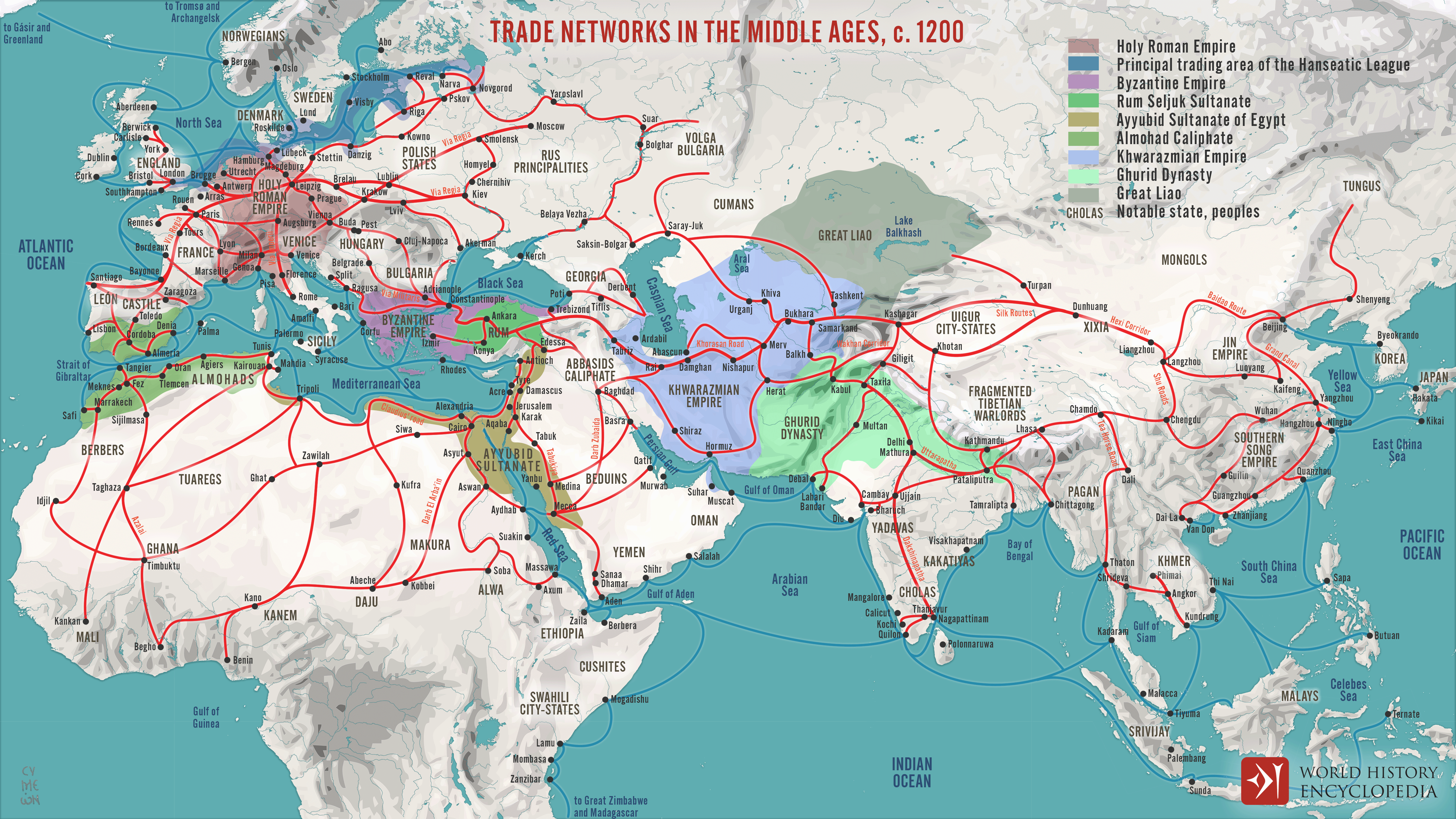
All the smashes of wars in Europe in the 1600s and 1700s were occurring in parallel to the mastery of settlement and corporate strategy for growth in America, the Caribbean, and the Colonies’ establishments in Asia. The international historic trade land routes between Asia and Europe (crossing the Middle East territories and the Ottoman´s domains) reached closure in the late 15th century, and later when the Dutch and British completely substituted them, privileging the marine routes instead. Compare the two images below (From the World History Encyclopedia).

The whole international trade economic system as we know it today was implanted by this shift in the Enlightenment period, and we are reaping the consequences of it. For better or for worst. The foundational premises of the Multinational Corporations of today (MNCs) go back in time to Adam Smith (1723-1790) and David Ricardo (1772-1823) who developed the doctrine of comparative advantage, in which each nation should specialize in the production and export of those goods that it can produce with highest relative efficiency; and import those goods that other countries can produce relatively more efficiently.
The classical theory of international trade was born during the Enlightenment.
Most modern economists will explain to you that the classical trade theory of Smith and Ricardo is irrelevant to what we do today. I don´t see it that way. To me, it is imperative and essential to observe that the rise of the MNCs of today (who produce and sell goods or services in more than one country, now using the Internet marketplaces) is linked to the Enlightenment age. During the 20th and 21st centuries, business modeling of enterprises and strategic management were taught in business schools. Corporations of all industries and those MNCs dedicated to modern communications accelerated with the Internet, transportation synergies, automation and robotics, artificial intelligence, economies of scale, and cost-efficiency quests, were built with the utilization of all the courses taught in business schools. Our corporate strategy theories, cases, and university courses of today show us what we have done since Adam Smith. And China´s case is an example of the implementation of all those premises. The current imbalance of our world, inequality, poverty, the weakness of the middle class, the insanity of the new disruptive technologies (including generative artificial intelligence), and the natural resources depletion can´t be ignored. Something must not be correct. There is something wrong that is not helping us to be better human beings. All our imbalance factors are here, to shake us to reconsider the premises of capitalism which was born during the Enlightenment. Capitalism needs to be transformed (from the inside out), Companies must be created for the purpose of helping others, not for making money out of it. In the current context, business models with technologies (as a backbone for profits) are affecting the human stability required for labor perfection and specialized human competencies or skills that are being substituted by machines. At the end of the day, reviewing and transforming how we do strategy and business modeling today means a deep preoccupation with fixing our ancestors´ theoretical mistakes. A sincere preoccupation with the well-being of the people who can´t and will never be able to compete against the existing and future disruptive technologies anymore.
The philosophical framework of the Enlightenment of the 17th and 18th centuries (which in reality started in the Renaissance period) began to flow as of Smith and Ricardo times and continued flowing to our days. From the Enlightenment, our business theories and international trade shaped and triggered the current philosophical framework of business modeling today. As it was instructed to me (at the end of the 1990s), and as it is being taught today by all top business schools in the world. Our trade, commerce, corporate strategy, and business modeling principles and management foundations require a philosophical adjustment first, otherwise, we will continue (as a human civilization) inventing disasters to produce and sell, in the current spanking and global pool of technologically connected global marketplaces without regulations and boundaries.
An example of what might come if we don´t change our business and strategic management premises: Biometric technology payments.
Today, during breakfast I was speaking with one of my nephews about prime news released yesterday. “The company Whole Foods Supermarket Chain plans to bring the Amazon One palm recognition and payment system to all its more than 500 stores by the end of 2023. Now, the biometric service is currently in place at over 200 Whole Foods locations in 20 states” (1). Look at all the elements in place in the self-explanatory video below
Source: https://www.aboutamazon.com/news/retail/amazon-one-whole-foods-market-palm-scanning
If you observe carefully this little Amazon One Palm Payment video, anyone can pay at the supermarket using biometric recognition (it could be your palm hands, your eye´s iris, or your face). In the video, we can observe 3 elements for a transaction: a Smartphone number, credit or debit card (that has the microchip), and the palm of both hands (it could be your face or eyes). Once you mix these components, we are on the verge of using and massively implementing the use of human microchip implants (2).
Since 2018, Sweden has been testing the human microchip implant as the cutting-edge technology to come. Around the size of a grain of rice, “the micro-chips typically are inserted into the skin just above the user’s thumb, using a syringe-like that is used for giving vaccinations. Once embedded, the chips are typically read by an external scanner, also known as a reader, that picks up the electromagnetic field emitted by a small antenna coil inside the implanted chip. This type of subdermal implant usually contains a unique ID number that can be linked to information contained in an external database and can contain data such as one’s personal identification, encounters with law enforcement, medical history, medications, allergies, and contact information”.
When Amazon releases news like this, that is serious. We are closest to using human microchip implants in a massive way, but not just for payments. If people accept the utilization of biometric recognition in supermarkets and then Amazon marketplace, that is the first step to opening a new door: weak governments may be constrained by powerful multinational corporations (such as Amazon) to promote laws for the insertion of these irrational technologies, and then microchips implants in hospitals, after the delivery of newborn babies, who will be enforced to use them as a country ID to do everything. Instead of a passport or a license or an Identification Document, the ID will be used not just for payments, but for monitoring and control, traveling (as a passport), being hired by employers, voting, getting married or divorced, registering all your transactions, enrolling in schools or universities, paying taxes, opening bank accounts, doing any type of arrangement as a citizen with the government bureaus, processing legal resolutions, etc.
To accept and utilize a microchip with a payment system included (credit or debit card) linked to a Smartphone number PLUS hand´s palms biometric recognition technologies is equivalent to losing your freedom as a citizen, and it is also a process to give up your basic human rights as privacy, independence, and financial autonomy. By using these Amazon One technologies, citizens concede to global MNCs (such as Amazon, for example) and their government allies, the power of monitoring and surveillance or inspection of matters without a formal authorization request from the authorities to the citizens. Please read the versicle of the Apocalypse, Revelation 13:17 (3). It is up to you to discern where are we going. Please react and wake up. After reading this paragraph, it is up to you to be dumb enough to accept these payment technologies. The dangers or perils associated with these technological applications are enormous for us. And for the next generations ahead.
17 And that no man might buy or sell, save he that had the mark, or the name of the beast, or the number of his name.
Revelation 13:17 — King James Version (KJV 1900)
“From the Enlightenment to Business Models” Season III is about linking it all. As I mentioned in our last episode of season II, as of today I will dedicate the rest of the year to tying all the knots. Our purpose is to trigger in all our readers the blessing of exploration and more research to design, roll out, and solve all our strategic inquiries. Be confident that all our corporate strategy and business strategy theories and actions, even the theory of blue ocean strategy have a connection with the Enlightenment philosophy of trade. I invite you to continue learning with me during this season.
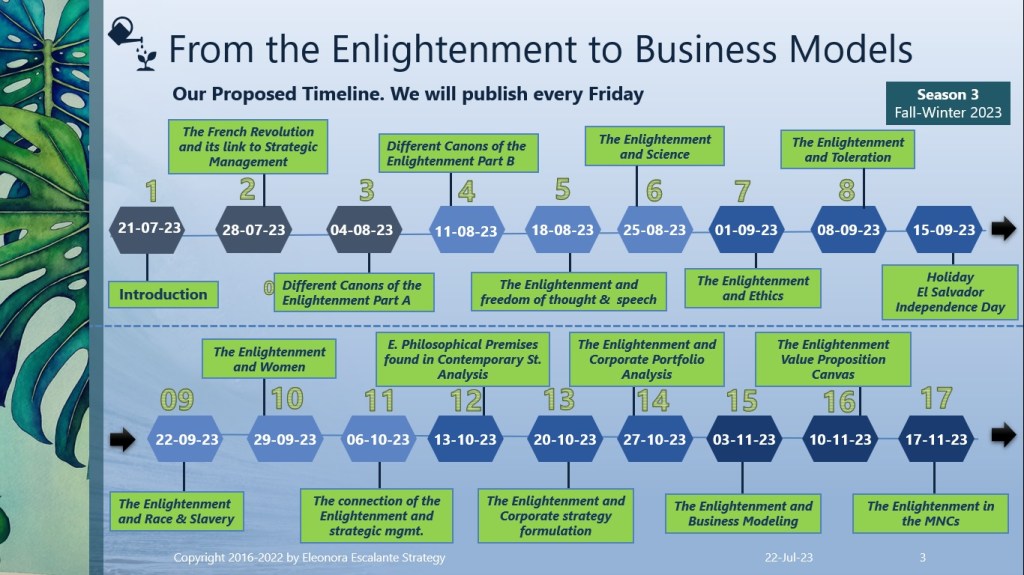
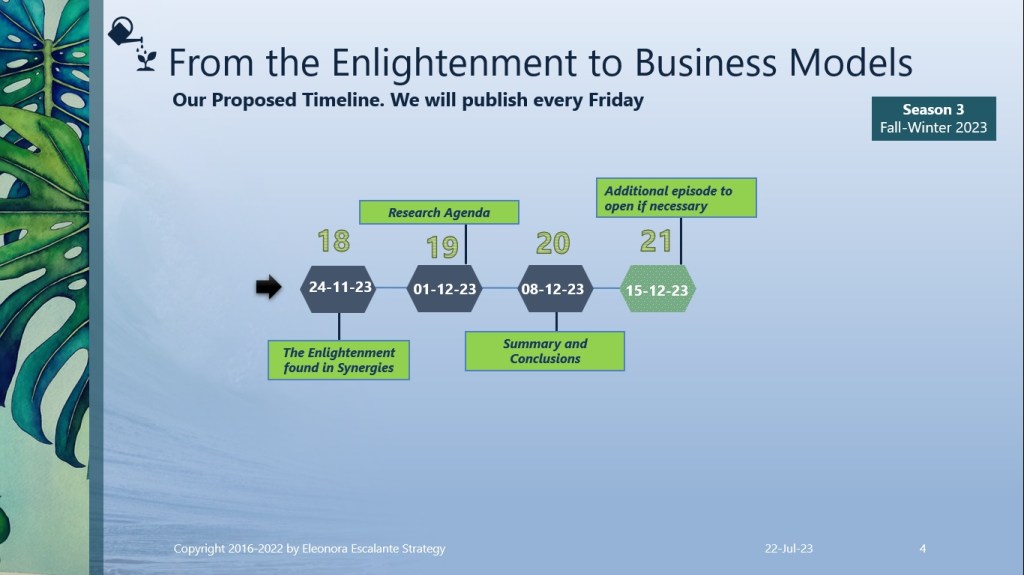
“From the Enlightenment to Business Models Season III” outline.

Announcement.
Our next publication will be next Friday 28th. We will perform an analysis of the French Revolution and its connection to the history of business (with specific details on corporate strategy). Blessings and thank you. Let´s welcome the Season III of the beautiful saga “From the Enlightenment to Business Models”.
Musical Section
We have decided to continue sharing classical music that was composed, released, or performed between the 17th and 18th centuries, to accompany your readings.
Today we have chosen this lovely collection of music from the youtube channel HarpsichordA6, Baroque Music from The Netherlands. Enjoy!
Sources of reference are utilized today.
(1) https://www.aboutamazon.com/news/retail/amazon-one-whole-foods-market-palm-scanning
(3) https://biblia.com/bible/esv/revelation/13/17
Disclaimer: Illustrations in Watercolor are painted by Eleonora Escalante. Other types of illustrations or videos (which are not mine) are used for educational purposes ONLY. All are used as Illustrative and non-commercial images. Utilized only informatively for the public good. Nevertheless, most of this blog’s pictures, images, or videos are not mine. I do not own any of the lovely photos or images posted unless otherwise stated.
 Eleonora Escalante Strategy - Strategic Reflections Think Tank