
From the Enlightenment to Business Models. Season III. Episode 3. Different Canons of the Enlightenment Part A
Working on Holidays.
Today is our turn to start landing into our conceptual frameworks and definitions that will settle the whole panorama of the Enlightenment. If you are a keen observer of what we have been sharing with you since January, I have been contextualizing our readers and studious bibliophiles in the 17th and 18th centuries. I spent around 7 months doing it. If I didn´t spend time on it, whatever I am writing now, wouldn´t have been comprehended wholly. Now I can dive into the deep waters of our discoveries with you. San Salvador’s yearly holidays in remembrance of Christ, the Divine Saviour of the World have taken place over the week. I decided to work all these days, and here we are delivering for your delight.
The Enlightenment as a canon quartet (4 different ways).
Before continuing reading, I invite you to scroll down and click on the Pachelbel Canon D Versions below. Then go up again to this paragraph and proceed to learn what is a Canon.

A Canon is nothing else than a piece of a song, in which the same melody is repeated by one or more instruments (or voices), overlapping every number of seconds in the same or a related harmonical note. Canons in music are truly delightful. Its exquisiteness resides in the movement, the flow of the melody that touches up as waves, it goes up or down intertwined in different moments, by distinct musical instruments or vocal sounds. The essence of a perfect execution of a canon dwells in the perfect timing for playing or singing the keynotes simultaneously. The Canon of Pachelbel is the metaphor, of a musical perfect example of what is the Enlightenment.
The Enlightenment started as of the Renaissance, but it went through a philosophic stage first (intellectually produced) to then permeate social and cultural aspects of the European monarchical countries in different formats or canons. First in a radical voice as of the mid-17th century, and it continued over and over in three other compositions: moderate, enlightened despotism, and counter-enlightenment.
Our view about the canons of the Enlightenment has continued to our days. We still inhabit a world that has the 4 canons alive (all from the same family of harmony):
- Radical Enlightenment
- Moderate Enlightenment
- Enlightened Despotism
- Counter-Enlightenment
Today we will cover the first two canons: Radical and Moderate. And next week we will proceed to check out the Enlightened Despotism and the Counter-Enlightenment.
The philosophical views of each of these quartet of canons have not disappeared in the 21st century. It has evolved and changed over and over again. The philosophical background of each canon has changed a brand name or a name tag. It has used different make-ups. It has been perpetuated from clandestine status (underground) to open exposure (wide visible uprated) with certain modifications. Sometimes it has operated a mysterious mask using veiled organizations such as the Freemasonry, Rosicrucian, Illuminati, or even the Deutsche Union; and simultaneously it is clearly detected in several Christian denominations with roots in the 17th and 18th century that do not cherish the Catholic church. Nowadays, it is funny, but even some Catholic rituals and catholic denominations express one or more of the 4 canons of the Enlightenment. Every single entity that you can name in this world has elements of these canons. Nations, multinational corporations, religious organizations, and international cooperation agencies respond to several elements of these canons. In the case of countries, in our current times, it is hard to find pure canons, but hybrid regimes. No matter if a hybrid of a Totalitarian state or a Representative Democracy, a State-Monarchy, or a Dictatorship, all of them can be positioned in this graph. The quartet of Enlightenment canons can be measured and monitored through its economic systems, which hold industrial policies and businesses’ ways of doing trade all over our nations.
I invite you to learn the definitions and differences of the Enlightenment quartet of compositions that are still outstanding, and you will truly comprehend why is more decisive than ever to go back to the past and find out from where are we living all this mess, today. Every canon that I will describe today and in our next publication is clearly reflected in business, economics, and corporate strategy. Probably you will find hybrids of the philosophical roots of any of these canons, but the Enlightenment is far from being finished. At least meanwhile human beings still work under free market mechanisms and private ownership, the Enlightenment is omnipresent, and we are required to understand it.
Find below our presentation slides prepared for you. You can download them and/or print them in PDF format.

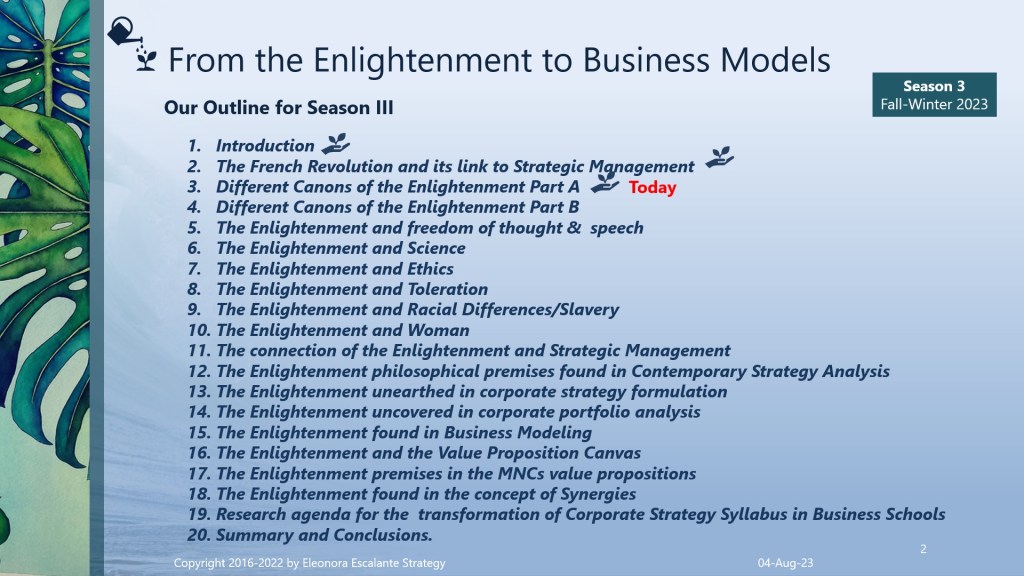


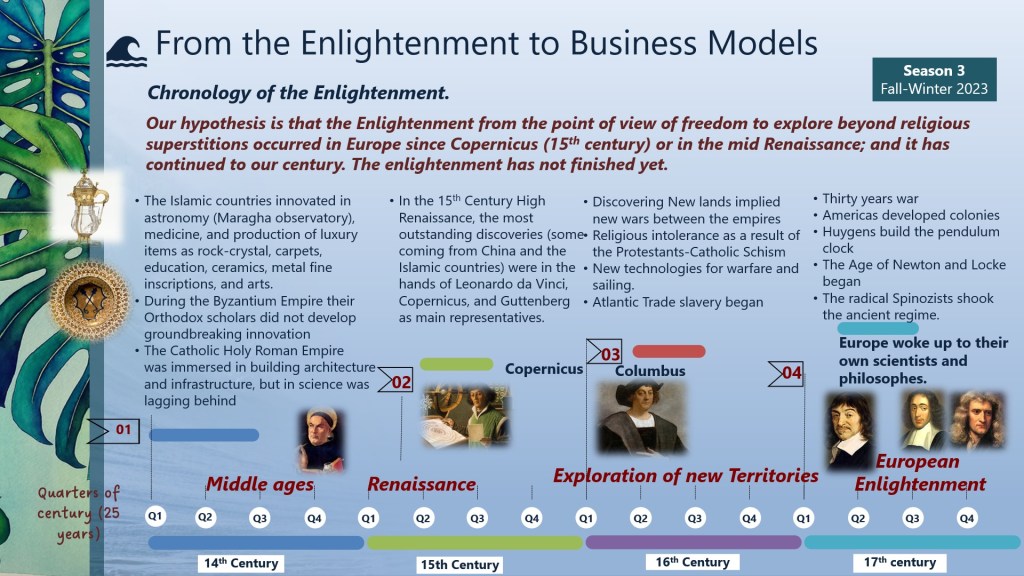


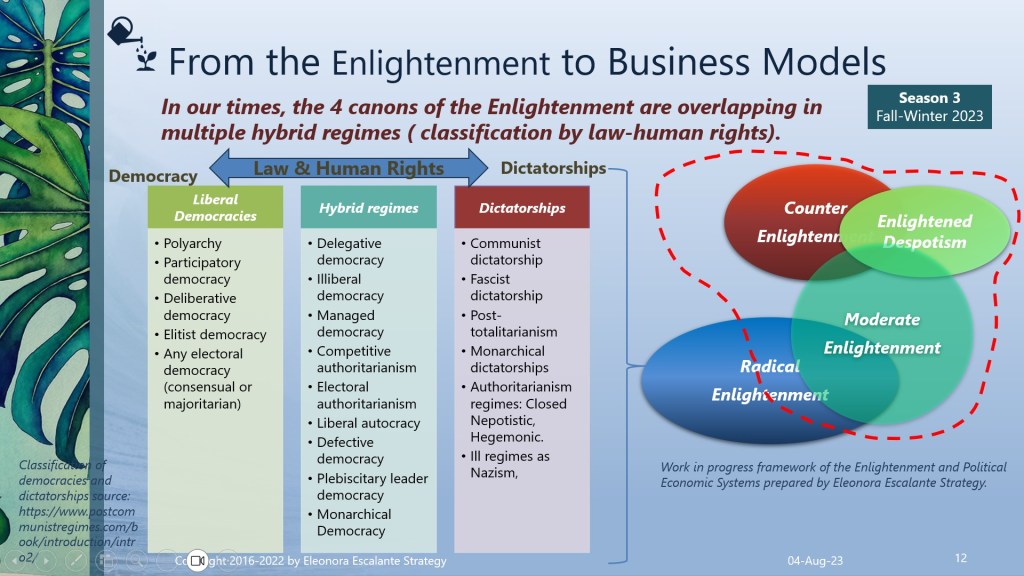


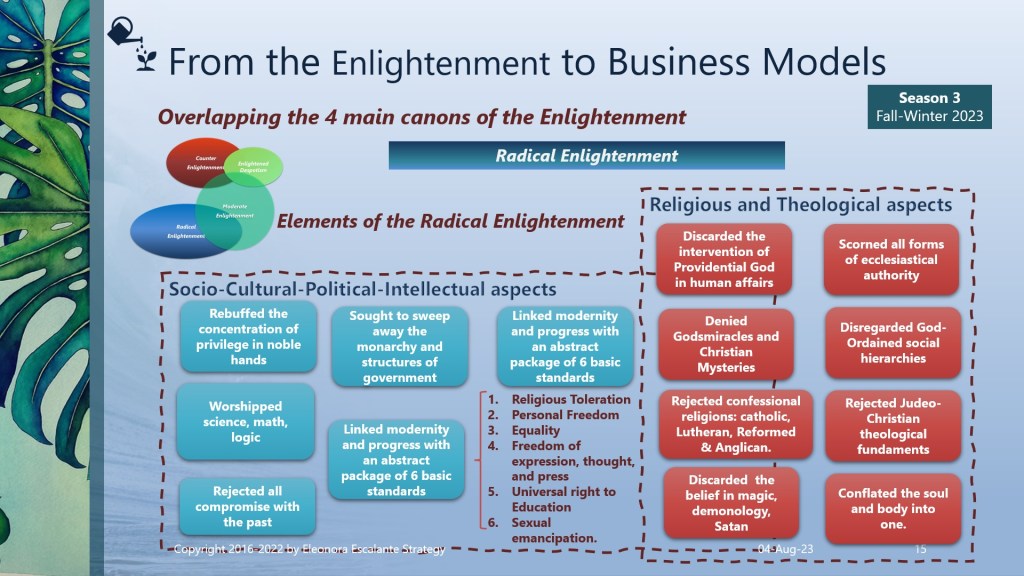

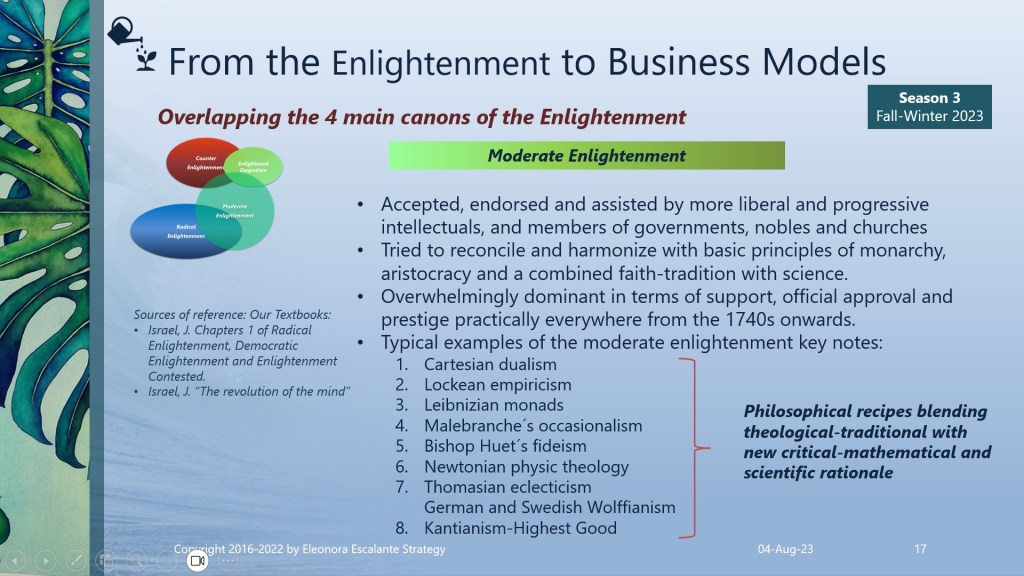


Overlapping the 4 main canons of the Enlightenment.
Let´s initiate our abstraction of the positioning of these 4 canons. Again, this is our first breakthrough approximation. I am taking the risk to share it but it is subject to change and improvement. It truly helps as a starting point for our analysis. Go to slide 10, please.
We drafted a simple Venn graph. Each imperfect elliptical circle represents each canon, and I have situated the positions of the radical canon overlapped with the moderate in certain things, but never with counter-enlightenment or enlightened despotism. The figure is very clear. All the circles are clearly identified: moderate, enlightened despotism, and counter-enlightenment shared certain aspects but were clearly differentiated. I have wrapped them up together using a red dotted line. The one that started first was the radical canon, its immediate counter-response was the counter-enlightenment. In between these two, moderate and enlightened despotism came to fill the antagonistic gap, making it a family of different canons in the process of growth or development. The radical Enlightenment has a second small elliptical circle positioned on the upper left side, which represents the dictatorial regimes under the communism that arose at the beginning of the 20th century. The first of these left-wing dictatorships was led by Vladimir Lenin and the Bolsheviks with the establishment of Communist Soviet Russia during the Russian Revolution in 1917. East Germany also had a dictatorial regime of this type called the German Democratic Republic between 1949 to 1990. Moreover, the China of Mao Ze-Dong can be mapped in this second small circle of Radical Enlightenment nations, but we can´t situate the China of today in that small radical ellipse, because it is a hybrid regime between Radical and Moderate nowadays. The China of the 21st century is a state-directed economy.
In addition, we have placed this graph over 4 quadrants with a vertical and horizontal axis. These quadrants are consequences of Enlightenment canons. All are posterior to the French Revolution. The vertical axis represents the law-human rights condition of the government, ranging from democracies (bottom-left position) to dictatorships (upper-left side). We have also procured an auxiliary vertical axis that shows the economic system ranging from a free-market economy (bottom-right position) to command economies (upper-right positioning). The horizontal axis represents the political system (from the left wing to the right wing). This map shows us a very interesting discovery. By looking at the political-economic systems, we also can understand why are so many hybrids between democracies and dictatorships (see slide 12). The different canons were overlapping in between. The different post-communist political-economic systems that exist today hold different philosophies too. Each of them had common grounds, in distinct but specific moments of time. This was possible because of the books (the written material that was left as a legacy by the representatives of each canon), and it has been possible because something was causing intellectuals to search for these books. There was a curious mind trying to find answers. There is always someone who is a problem solver, trying to find a solution to inequality and economic troubles. Each Enlightenment canon from our past, had a clear and specific goal. But the shadows-overlapping areas allowed them to continue to our days. And we can clearly see them in each and all of the existing political-economic systems of today.
Radical Enlightenment
The radical canon was the foundation of the French Revolution. It went hidden through decades, in clandestine sharing forums, probably under the darkness of some outlier nobilities that knew that feudalism and the monarchies were required to change. All the main points of radical enlightenment are described on slides 14 to 16 and are self-explanatory. I won´t explain it here, because the slides are truly complete.
Moderate Enlightenment
The moderate enlightenment was clearly the middle-ground, the mainstream that won over the 17th century in the heart and mind of the approval of the nobility class. See slides 17 to 19. However, I always wondered why did the French Revolution (1789) use radical considerations? And the answer is clear to us. It wasn´t because the radical representatives evangelized to raise against their oppressors using weapons and militancy. Not at all. It was because of massive fury. It was a strong emotion that took over the spotlight. I explained this factor in our last publication. Now imagine, what could happen in our days, if fury is ignited through social media and the Internet? If a French Revolution occurred with so much fury in a time of rustic and archaic communications, what gigantic global event may happen if we misuse the current technological advances?.
When people are furious, they are unable to think properly. The worst difficulties of our civilization (including crimes and injustices) come out of rage emotions, not out of poverty. Inequality may and will always exist in some way or another. Even an abysmal gap between the rich and the poor is even forgiven by the poor if they feel (emotion) that there is hope for their kids on the horizon. Also, the low class can forgive inequality, if there is a merit for the rich to hold his or her assets. When there is hard work and studious demanding years that catapult economic success, there is no possibility for fury. The low class (which represents 86% of the global population today) admires the cause-and-effect histories of hard-work and success. Unless envy exists. When envy enters the door of ignorance, and there is no God around us, humans are unable to tame hatred and jealousy. The accumulation of these feelings causes fury, and visceral reactions (non-explainable). It doesn´t matter the theories, business schools, industry analysis or mergers/acquisitions, or joint-ventures, or whatever is being taught to us at the intellect level. The bottom line of revolutions is the manipulation of the emotions and feelings of the majority, in the hands of a little tiny minority that wishes to eradicate those who are in power. A tiny minority that only cares to barren anyone who hinders them to reach their own economic or political or social interests. A tiny envious minority that is able to influence and maneuver the majorities through emotions of fury and revenge.
What is the relationship between radical and moderate enlightenment and corporate strategy?
Slide 13 gives the answer. In the 17th and 18th centuries, the monarchs (kings, queens) and the nobles (dukes, counts, princes, etc.) were the corporate strategists of their nations. When the French Revolution wiped them out of France, a new group of “revolutionaries” accompanied by the theories of the Enlightened gurus, weren´t interested in installing capitalism. But to kick out those who were in power. The new leaders only began to explore capitalism and its theories (Adam Smith), around 100 years later. By 1848, the Communist Manifesto of Karl Marx and Friedrich Engels was publicly released. Then, Marxism joined the 4 canons of the Enlightenment philosophes, arguing that Scottish-British capitalism was inherently flawed and was going to fail. Ironically, guess where was Karl Marx born? He was from Prussia, the land of Kant, the same land of the Frederick Kings. The battle on the ground evolved into a battle of the mind. And in the meantime, our transactions of products and services continued, without a pinch of true love and care for our communities, but to maximize shareholder value.
Have you started to understand why we need to study our history with the most careful reckoning? Can you perceive why do we need to comprehend the roots of our business theories? Would you mind catching us, and grasping the true importance of this saga? All we are and do is interconnected with our past. And even if I could travel to Voltaire or Kant or Rousseau´s epoch, what I can share with you is just a little percentage of the truth, because I don´t hold all the bits and pieces of our past. All I am stating is that: Our businesses, our corporate strategy theories, and value propositions are linked to the Enlightenment. And we will try to uncover it during the next 18 weeks.
Announcement.
Our next publication will be next Friday 11th of August. We will continue with our journey through the rest two canons of the Enlightenment: Enlightened Despotism and Counter-Enlightenment. Blessings and thank you for reading our episodes.
Musical Section
Today´s selection is the different versions of the Canon D of Pachelbel. The original version is played by Musica Antiqua Köln.
Thank you for reading eleonoraescalantestrategy.com

Sources of reference are utilized today. All are listed on the slides.
Disclaimer: Illustrations in Watercolor are painted by Eleonora Escalante. Other types of illustrations or videos (which are not mine) are used for educational purposes ONLY. All are used as Illustrative and non-commercial images. Utilized only informatively for the public good. Nevertheless, most of this blog’s pictures, images, or videos are not mine. I do not own any of the lovely photos or images posted unless otherwise stated.
 Eleonora Escalante Strategy - Strategic Reflections Think Tank
1 Comment »