
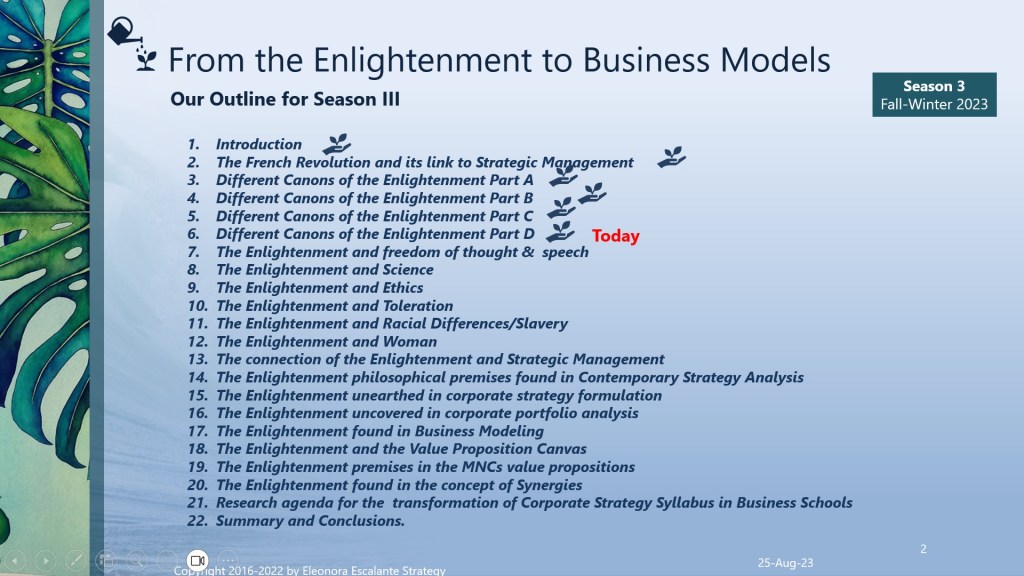
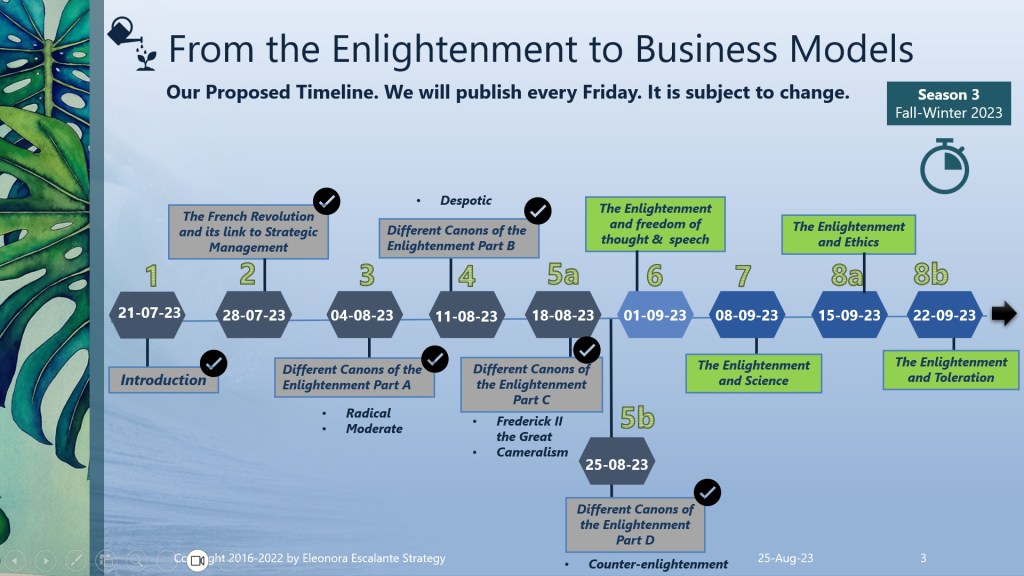
From the Enlightenment to Business Models. Season III. Episode 5b. Different Canons of the Enlightenment Part D. Counter-enlightenment
Let´s begin, this is a long publication made with love for all our amazing readers.
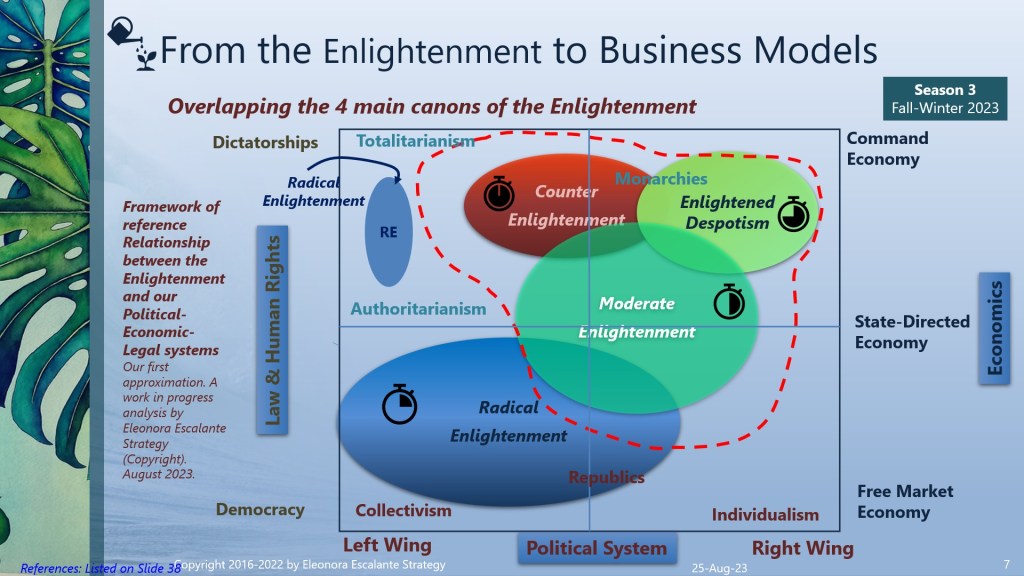
Counter-enlightenment is a remarkable canon that has accompanied us since its summit during the 17th and 18th centuries to our days. The term “counter-enlightenment” has been debated and analyzed by historians, philosophers, and researchers. Historiographers have worked it out for us in their books and scrutiny as well. By learning from them, we have identified publications, groups of people, movements, individuals, decision-makers, religious authorities, and specific campaigns of counter-enlightenment actions clearly directed against the Enlightenment in any of its canons (radical, moderate, or despotic). The counter-enlightenment has always existed in disfavor or disapproval of the pro-Enlightenment main players since the Renaissance up to our days. But what is counter-enlightenment? Why have we separated the counter-enlightenment from the other three canons: radical, moderate, and despotic?
Counter-enlightenment in this saga.
Like everything in the history of our current civilization, the counter-enlightenment has been performed in different formats, against the distinct Enlightenment canons. It took a pinnacle counterpoint stage during the 17th and 18th centuries, but it has continued subsequently. Remarkable gurus of history have even misused the term counter-enlightenment, particularly when they have tried to organize our Enlightenment authors per periods of time and by different schools of thought tags.
For those historians who associate the Enlightenment with modernity, the counter-reactions to the Enlightenment as modernization are measured “a posteriori” of the 18th century, against each of the three main canons that we have explained in our last three publications (radical, moderate, despotic).
Since our saga is situated in the frame period that started around the life of Descartes (1596-1650) and finished with the French Revolution (1789), our analysis of the Counter-Enlightenment is framed under this time bracket. Be aware that there are other authors like Isaiah Berlin (1) and a bunch of Berlin´s studious historian-philosophy followers who have coined and positioned the counter-enlightenment definition beyond, as of the 19th century and further ahead than the French Revolution, which for us is not in our scope of analysis. Nevertheless, since the Enlightenment has not finished yet, we can assume that there have been more than three phases of the Enlightenment since the Renaissance.
The Counter-enlightenment in 3 different phases:
The counter-enlightenment has been played in three phases:
(1) The Counter-Enlightenment before the French Revolution. The first wave of the Enlightenment was a slow association process of the Enlightenment ideas and discoveries to the scientific method and the experimental practice; with its climax development during the 17th and 18th centuries. In consequence, any counter-enlightenment response was a rejection, a counterargument, or defeat or opposition to the radical, moderate, and despotic enlightenment that took place before the year 1789. Remember that our object of affection, here at our epic “From the Enlightenment to Business Models” remains in this period. We are narrowing our current saga by exploring what occurred before 1789. But our readers must be alert that since the Enlightenment has continued to our days, then of course we are required to continue learning after 1789 to our days.
(2) The Counter-Enlightenment after the French Revolution. The second wave of counter-enlightenment has tied the knot with anti-modernity, and anti-modernization. At the same time, it has also been linked to romanticism. Moreover, it is related to any philosophic production or activist movement that is anti-republic, opposite to any type of liberal democracy, and counter-revolutionary. In this phase, we can include Charles Maurras (1868-1652) and anyone who pursues an ideological traditionalism mixed with conservatism that defends the authoritarian rule of hereditary monarchies. This definition of “Counter-enlightenment” is posterior to what we will discuss today, and it arose during the 19th century up to a bit after the first half of the 20th century.
(3) Contemporary Counter-Enlightenment. The third wave of Enlightenment is paired with Generation X’s lifespan, with our current historical existence (which includes the academic research produced after the Cold War finished in 1991), a decade in which the Iron Curtain was demolished.
Jurgen Habermas, the most important German philosopher of the second half of the 20th century, has also written about the risks or perils of seeing the counter-enlightenment as a counter-modernization or counter-westernization(2). If we get confused by associating the term “counter-enlightenment” to counter modernization, then we can slip into a fatal comprehension mistake of the Enlightenment. Habermas has been examined by Professor Thomas Walsh to remind us that the consequences of the Enlightenment excesses in the 19th century and beyond are equally ugly as the legacy of the counter-enlightenment extravagances (2). We will discuss this idea in our last paragraph. Any form of excess or extravagance of the Enlightenment and Counter-Enlightenment is an overindulgent distortion of it.
Towards an approximation of a counter-enlightenment definition.
Let´s position ourselves in the times of the Reformation (16th century). Counter-enlightenment also occurred during that time. If we consider Luther´s reformation as an Enlightenment reform to the religious “status quo”, then a counter-reaction from the Catholic Church was a counter-enlightenment response. The same took place with the scientific basis of the Enlightenment during the 17th and 18th centuries: The discoveries of Francis Bacon (1561–1626), Nicolaus Copernicus (1473–1543), Galileo Galilei (1564–1642), and the mathematical investigations of René Descartes (1596–1650) were the suitable foundations of the first phase of the Enlightenment. And the counter-response, or counterpoint against it was coming from the same Catholic Church, even before the direct pronunciations of the rulers of the time. Once the radical canon composition began in the 17th century, there were numerous counter-enlightenment responses coming from Protestantism too, particularly from the most conservative against the radical extreme Enlightenment wing. But it is also true that the Enlightenment Theology from the Moderate Canon was assimilated and procured in three protestant denominations: Anglicanism, German Lutheranism, and Swedish Lutheranism.
In consequence, the literary production of the enlightened philosophes (radical or moderate) wasn´t attacked first by the monarchies, but by the Catholic Church and sometimes by Pietists or Radical Protestant denominations which did not embrace any of the Enlightenment Canons. The majority of inquisitory efforts of the monarchies to stop the diffusion of the Enlightenment authors came second after the Catholic Church took the censorship flag captured, imprisoned, or burned their books. Jonathan Israel has written a multitude of examples in each of his 4 books about the Counter-Enlightenment situations during these two centuries.
Eleonora Escalante Strategy believes that the first counter-enlightenment canon did not emerge with Rousseau. Contrary to what contemporary historians have written, affirming that the counter-enlightenment started with Rousseau; we don´t agree at all with this view. Rousseau was one of the moderate authors who attacked the Enlightenment from the inside out, after standing next to Diderot and Voltaire, subsequent or after being considered one of them.
In summary, in Europe, I can state without a doubt that the counter-enlightenment emanated from the most important local, national, regional, and international Catholic Church representatives in each and all the countries in which the Enlightenment was being elaborated and enlarged (Holland, France, Britain, Italy, Prussia, etc.). But I also have found counterattacks from the most conservative Protestant Church (in Northern Germany). Let´s focus first on The Catholic Church. The Papal organization ignited counter-enlightenment responses not just against the most Radical enlightenment characters, but then in waves, against the moderate canon. Forty years before the French Revolution, the Catholic Church comprehended (when the monarchs of Europe began to confiscate some of their properties) that the enlightenment of the rulers was also taking place in the orchestra. At least several reforms that affected the Catholic Church organization had already joined the musical arrangement of all canons. When Frederick II The Great of Prussia, Catherine II The Great of Russia, María Theresa and Joseph II of Austria, and Carlos III the Bourbon of Naples commenced to include reforms that touched the structure of the Catholic Church, then and only then, the Catholic church began to consider a Catholic Enlightenment, that could combine tradition and dogma with the new “moderate” currents of thought.
Moreover, the Enlightenment philosophes continued working on their doctrines and research theories, with so much passion, and Locke-Newton helped to tame the counter-response of the Catholic Church through the acceptance of the Enlightenment premises by the traditional faculty professors of the most famous and conservative universities. When the French Revolution occurred, the connotation of the counter-enlightenment gave a turn-around 180 degrees pirouette. The Catholic Church was at its lowest point of credibility, accountability, and power, ever in its history. The eradication of the Jesuits in Europe is an episode, a piece of evidence that at least three Kingdoms of Europe were changing. These three kingdoms (Portugal, Spain, and France) had clear economic interests in the Americas. The Jesuits were expelled from Europe for actions they were performing in the Americas. How could it be that the Jesuits were expelled from Europe if they were the masters of the Counter-Enlightenment defending the different crowns that allowed them to educate in their main schools, colleges, and universities?
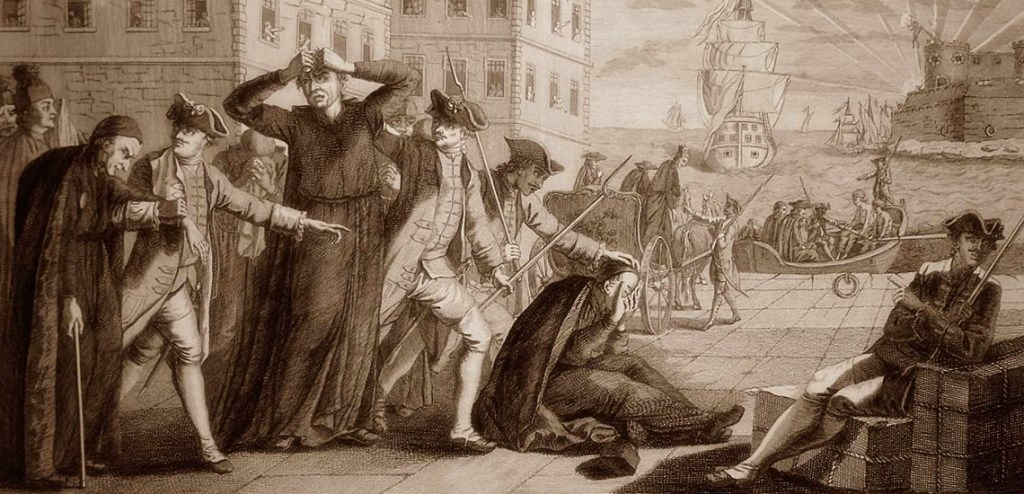
Jesuits were called the schoolmasters of Europe during the 16th, 17th, and 18th centuries, not only because of their schools but also for their pre-eminence as scholars, and scientists and for the thousands of textbooks they composed. More than 700 schools and universities were in the hands of the Jesuits then.
Then suddenly these were all lost in 1773. Pope Clement XIV, yielding to pressure from the Bourbon courts, issued his brief Dominus ac Redemptor suppressing the Society of Jesus. This religious Society of 23,000 men dedicated to the service of the church was disbanded. Source: https://www.jesuits.global/about-us/our-history/
The Counter-enlightenment of the Catholic Church provoked an answer.
The Spanish, French, British, and Portuguese monarchies were busy establishing and maintaining their own power in America. The Spanish and Portuguese asked for help from the Jesuits, particularly in South America. What happened then? “The campaign to suppress the Jesuits was the result of the general anticlerical and antipapal tenor of the times. Hostility to the Jesuits was further inspired by their defense of the Indigenous populations of the Americas against abuses committed by Spanish colonizers and by the strength of the order, which was regarded as an impediment to the establishment of absolute monarchist rule” (3). If you watch carefully, the crowns that expelled the Jesuits were those who were correlated to three dynasties: First, to the Habsburg-Braganza of Portugal, second the Spanish and Italian Bourbons, and third, the French-Bourbons colonies in America. Frederick II “the Great” Hohenzollern of Prussia (protestant) and Empress Catherine II of Russia (Eastern Orthodox) refused to act against the Jesuits. Let´s look at the chronology:
- The Portuguese crown expelled the Jesuits in 1759
- France made them illegal in 1764,
- Spain and the Kingdom of the Two Sicilies took other repressive actions in 1767.
When Clement XIV reigned as a Pope between 1769 to 1774, he suppressed the Society of Jesus, but many of its members took refuge in the Protestant-orthodox countries where the monarchs didn´t care for the Pope’s orders. Keeping a low profile or shadow existence, the Society of Jesus survived until 1814, when Pope Pius VII restored it to full legal legitimacy.
The Jesuits were expelled from Europe for a motive in The Americas. A motive of power and strong connections that the Jesuits held within other empires that weren´t colonizing America. The Spanish-Italian and Portuguese Empires feared that the Jesuits’ power could endanger their own economic roadmap in the New World.
Counter-enlightenment in the Americas.
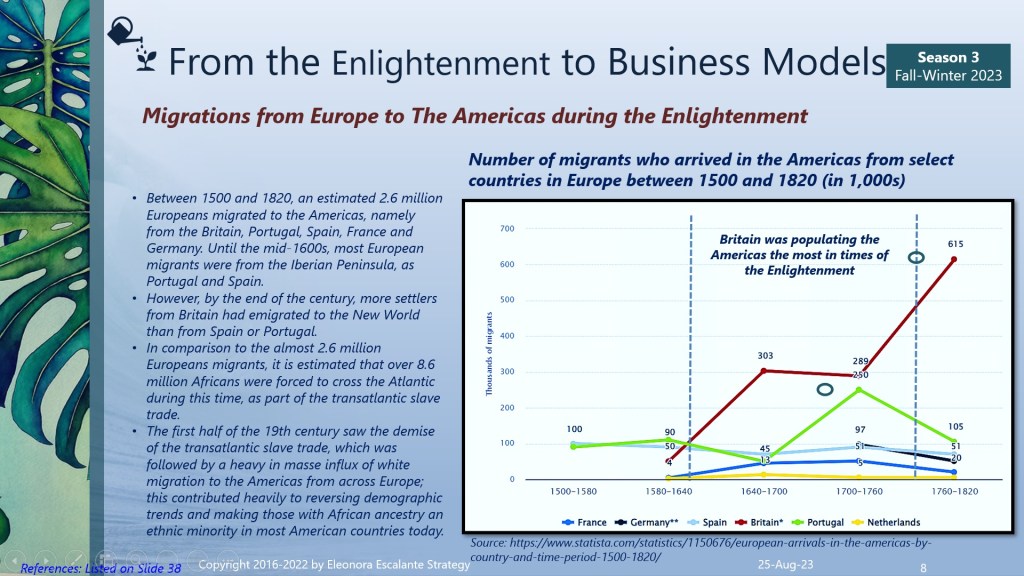
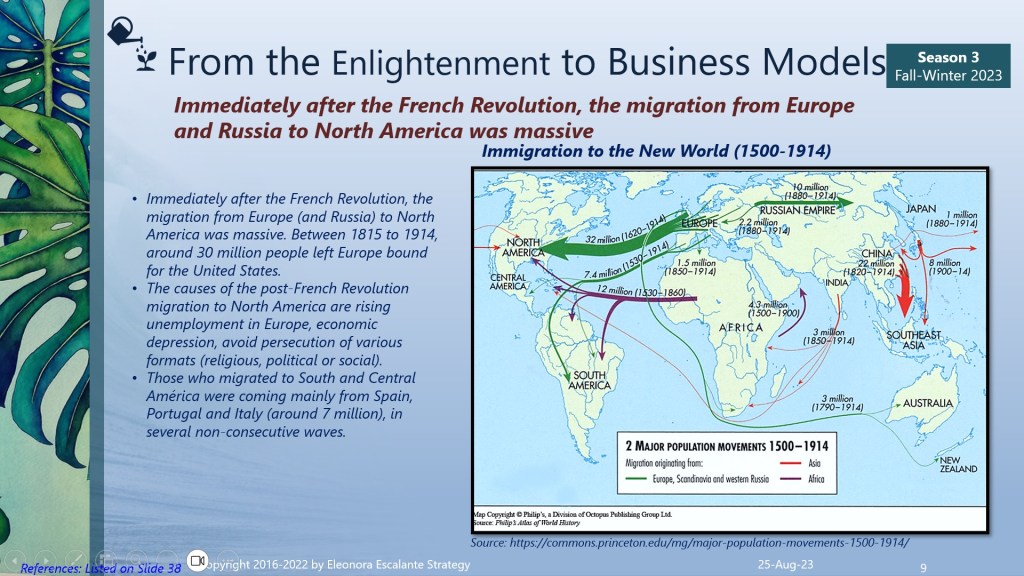
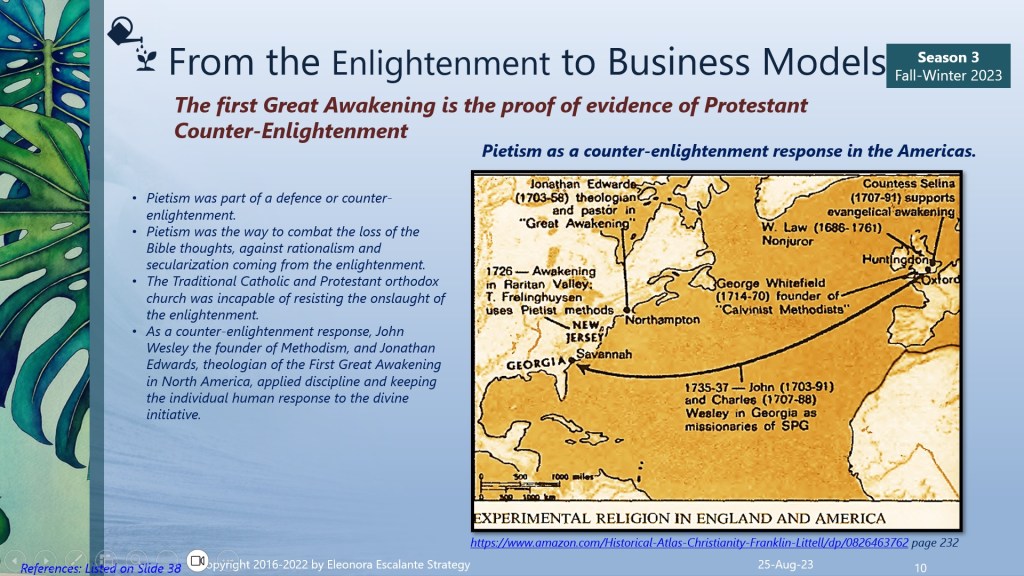
As you can infer from the last section, the first phase of the Enlightenment did not stay in Europe only. It also traveled with the Europeans to the Americas. In the North American region, the Catholic church wasn´t omnipresent. The immigrants who settled in the first half of the 18th century were searching for freedom and religious toleration. The link between Protestant Christianity in North America with the Enlightenment ideas was obvious. During the first waves of immigration (see slide 10), Protestant Christianity was spread by military conquest and political expansion. With pietism, the individual conversion revolutionized the expansion of Christianity. For example, Nikolaus Ludwig, the Count Zinzendorf (1700-60) moved from Herrnhut and founded several Christian Conservative communities in Europe and America (4a). The Pietists from the Protestant part of Germany worked with the American Indians of Pennsylvania and Ohio. Then John Wesley (1703-91) the founder of Methodism and Jonathan Edwards (1703-58) theologian of the Great Awakening joined Massachusetts. George Whitefield (1714-70) also bonded in Georgia and several other states. The 18th-century awakening “clashed fundamentally with both Moderate and Radical Enlightenment in the United States” (5). With these pietists, a new counter-response to the Enlightenment was emerging, in the same cradle of Protestantism. The Great Awakening is the validation and demonstration of the counter-enlightenment in North American Society during the 18th century. The first Great Awakening as a revival of protestant conservatism took place among the Dutch Reformed, Congregationalists, Presbyterians, Baptists, and some Anglicans, all of whom were Calvinists (4). The Great Awakening as a counter-enlightenment apparatus in Colonial North America proliferated in two formats:
- Emotional Evangelicalism
- Conservative Ultra-Protestantism
Max Weber has been diagnosed by other contemporary authors/professors of history as probing that “modern capitalism was based in a particular kind of rationality beyond the Enlightenment but from the experiential soil of Calvinism´s theory of predestination. According to this view, rationality, initially in the Protestant, Christian Western world, divorced itself from traditional value factors” (6). We believe that the counter-enlightenment response from the Pietist or Calvinist Protestant Church came as a consequence of how the same Protestant church assimilated the Enlightenment values.
To summarize this section: The counter-enlightenment religious reactions during the 17th and 18th centuries mainly came from the Catholic Church and from the Protestant Church, not just in continental Europe but also in the Americas. Moreover, the accommodation of Christianity to the Enlightenment ideas occurred first in the protestant world, when the Enlightenment Theology was fully embraced in Britain Anglicanism, German, and Swedish Lutheranism (7).
Elevating the analysis of the foes of the Enlightenment a step further.
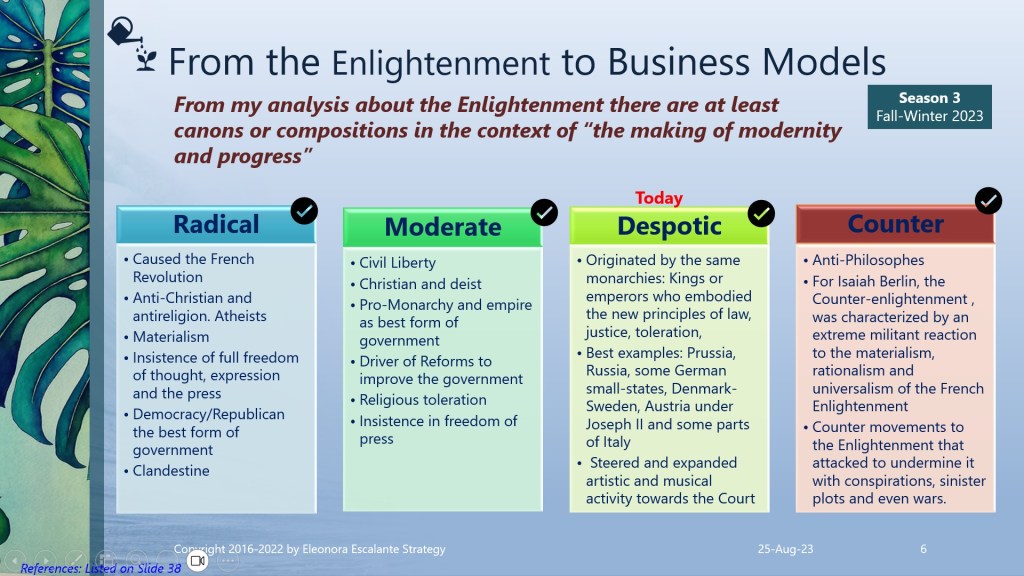
We have already discussed the counter-enlightenment from a religious point of view. Now it is the turn to name the thinkers or philosophers who opposed the Enlightenment. Here in these lists, we can find the following categories or groups:
- The ultra-royalist counter-enlightenment: Defenders of the monarchies and the Catholic Church of their time who were radical and wished to return to the old-ancient regime as it was before the Renaissance. For example: Joseph de Maistre, and Louis De Bonald.
- The Enlightenment Religious Censors: Conservative Religious or traditional Catholic or Protestant personalities that were explicitly against the Enlightenment philosophes. These opponents were religious leaders, priests lecturers, abbe professors, and religious faithful journalists. They dissented with all the philosophes of the Enlightenment no matter what canon. Anti-philosophes were innumerable. I will name the most relevant ones: Laurent Francois (1698-1782), Claude-Marie Guyon (1699-1771), Abbé François-André-Adrien Pluquet (1716-90), Franciscan theologian Jean-Nicolas-Hubert Hayer (1708–1780) and Catholic lawyer Jean Soret (1710–n.d.), Adrien Lamourette (1742-94), the Jansenist Clergyman Guillaume de Maleville (1699-1756), Abbe Gabriel Gauchat (1709-74), Abbe Joseph Camuset (1746-1810), Nicolas Jamin (1711-82), Benedictine Dom Mayeul Chaudon (1737-1817), Thomas Jean Pichon (1731-1812), Abbe Louis Athanase des Balbes de Crillon (1726-1789), Daniel Le Masso des Granges (1706-66), Christian August Crusius (1715–1775), Antoine Sabatier de Castres (1742-1817), Abbe Auguste Barruel (1741-1820), Ex Jesuit Father Aimé Henri Paulian (1722-1802), Guillaume-Francois Berthier (1704-82), Henri Griffet (1698-1771), Louis Antoine Caraccioli (1719-1780), Francois Marie Coger (1723-1780), Stéphanie-Félicité Comtesse de Genlis (1746–1830), Elie Catherine Freron (1718-1776), the poet Jean Jacques Le Franc de Pompignan (1709-1784), and many others.
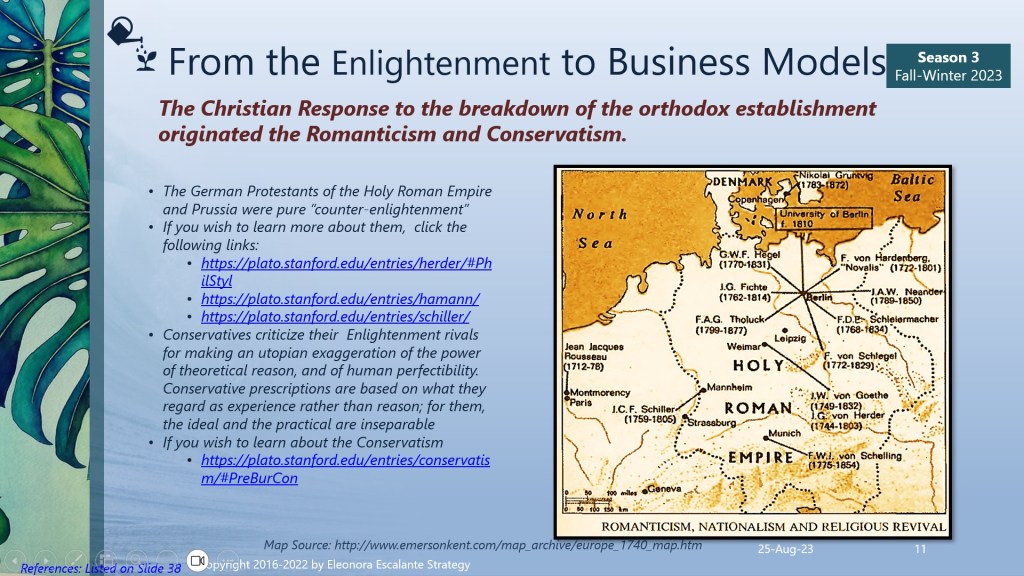
- Philosophes of the Counter-Enlightenment: In this section, I have complemented it with 4 philosophers, who also have been named by Isaiah Berlin. These 4 philosophes were heavyweights in the counter-enlightenment: the East-Prussian Johann Gottfried von Herder (1744–1803), the Italian Neapolitan Giovanni Battista Vico (1668–1744), the Prussian Johann Georg Hamann (1730–1788) and the Swiss Jean-Jacques Rousseau (1712-1778). I would add here J. W. Von Goethe (1749-1832), who is more recognized for his literary works, but he was also a counter-enlightenment representative from Weimar, all together with Johann Christoph Friedrich Schiller (1759–1805). Look at the slide 11. These last 3 philosophers were Christian by faith, and they stressed romanticism, spirituality, poetry, and artistic sensibility as innate human qualities (8). The counter-enlightenment authors who were alive and saw the effects of the French Revolution, took refuge in Romanticism, dedicating their last years to theater and writing plays, poetry, and other abstractions with the deep affirmation of natural human gifts capable of either good or wrong demonic consequences.
There are many other thinkers from the radical canon who criticized the moderate canon and the other way around, but the difference that indicates who was a true counter-enlightenment representative at that time lies in the uncompromising antagonist position, sometimes combative and confrontational. In addition, to be a counter-revolutionary of the Radical Canon of the Enlightenment in the times of the French Revolution was subject to banning, excluding, forbidding, expelling, and expulsing, if not assassination. Several Moderate or Counter-enlightenment personalities in their own territories were in danger, and many of them emigrated to the New World.
The counter-enlightenment caused self-harm to those who embraced it, no matter if mild or strong. After the French Revolution, the trend was to be “equal, fraternal, free”. Anything “counterrevolutionary” was combatted. Through their thoughts, theories, counterattacks, and rival philosophies the Counter-Enlighteners triggered a boomerang for themselves. The most fervent example has been the episode of the Jesuits. In times of chaos, the persecution, suffering, and insecurity were huge. Most of the descendants of the counter-enlightenment escaped and settled in the Americas. Look at slides 8 and 9. Now I am sure you are able to grasp why Latin America still holds elements of a powerful culture of “counter-enlightenment”. And why the majority who suffer from multidimensional poverty (the non-educated base of our population) who have no idea of what I am describing, are objects of deceit by opportunistic leaders who are using the “excesses” of the “counter-enlightenment” to arrive at power.
The legacy of the counter-enlightenment.
In our current times, the Enlightenment failures are categorized as Marxist totalitarianism, liberal indulgent democracies with corruption-despair-greed-decay, science´s technological mastery of disruptive technologies without any control and regulations, selfish neo-liberalism, imbalance of global supply chains, concomitant subversion of our environment, the demise of religion, inclusion of devious sexual content in educational programs, the relativism and permissive aspects of societies without ethics. I would add the pathetic entrepreneurial ecosystems that do not meet the expectations of millions of entrepreneurs all over the planet. Too much freedom generates excesses that have hurt our societies.
On the other hand, the counter-enlightenment sins have been categorized as tribalism, racism, narrow fundamentalism, fascism, Nazism, moral relativism, authoritarianism, religious wars (such as between Islam and Christianity), and cultural imperialism. I would add here, terrorism in real and digital formats. However, our own personal perception is that the counter-enlightenment heritage is not well measured, because the assimilation of the Enlightenment value proposition has permeated almost every single aspect of our societies, including the Catholic and Protestant Churches. We have demonstrated it in this article. In addition, some of the counter-enlightenment elements considered by Habermas are much older than the Enlightenment itself. Most counter-enlightenment extreme lapses are now, not linked to the monarchical old-regimes of the past.
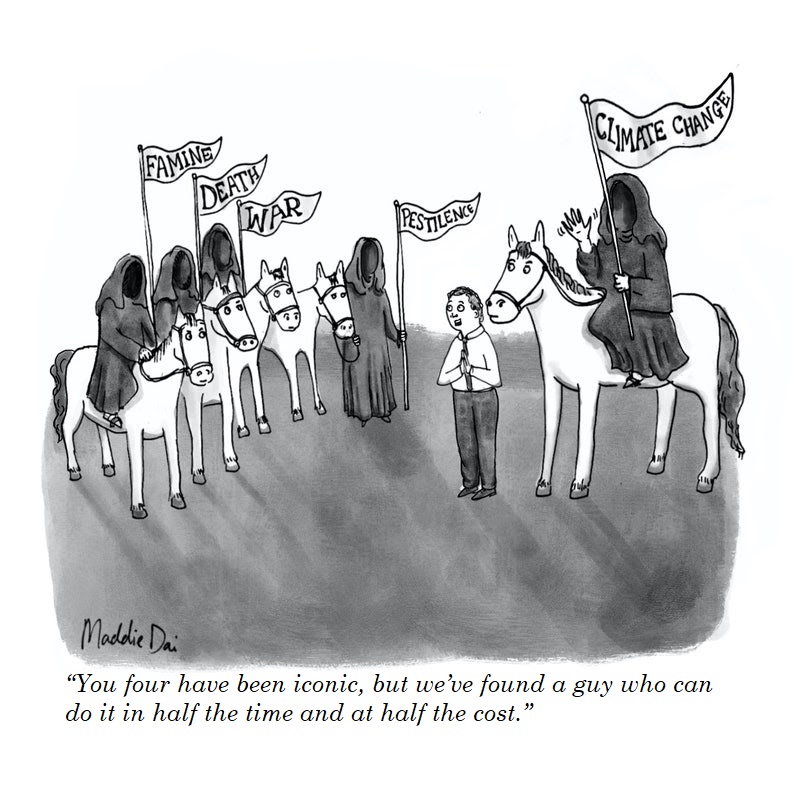
The excesses of the Enlightenment in our current times are not battled “intelligently” by any form of counter-enlightenment. The problems of today caused by the excesses of the Enlightenment application since 1789 which have permeated without control and ethics in everything we create, sell, buy, do, and study, are much greater than the despots of the past. These problems range from our lack of control for massive destruction weapons (as nuclear bombs, chemical and biological armament), to a colossal poor low-class (84% of the global population survives with less than US$28,800/year annual income), to the Artificial Intelligence dangerous effects in our brains and communities, to the lack of health and well-being because of the consumption and utilization of harmful products plus the considerable life-threatening effects of climate change. No counter-enlightenment of the 21st century exists. That is my hypothesis. Our quest to find our own happiness has blinded us. I am convinced that the people who have studied something of history, have understood that the solution is not to counter-react with rage and cruelty. But the fact that we are on the verge of falling down to a worse kind of enemy is more than evident.
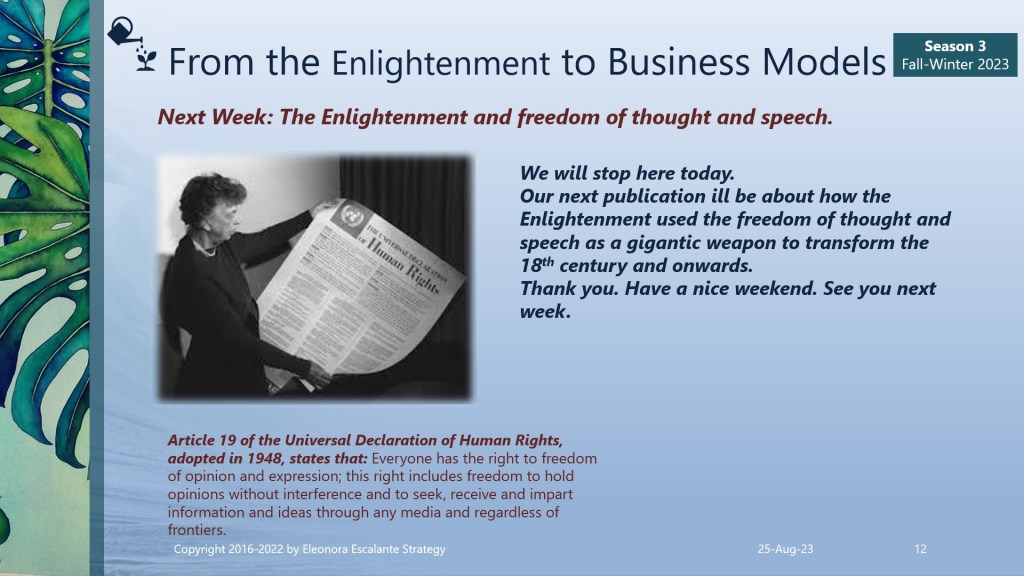
Announcement.
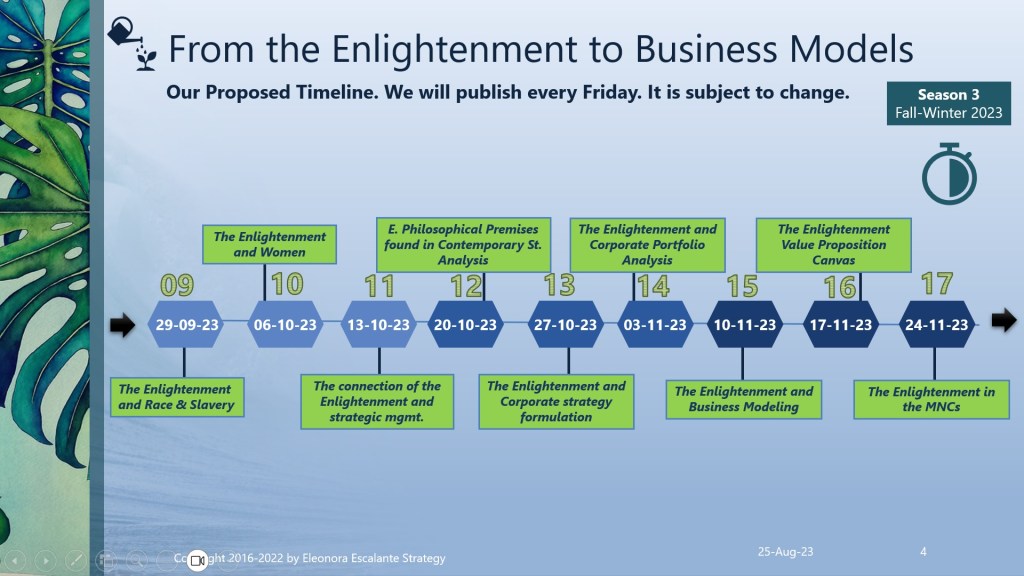
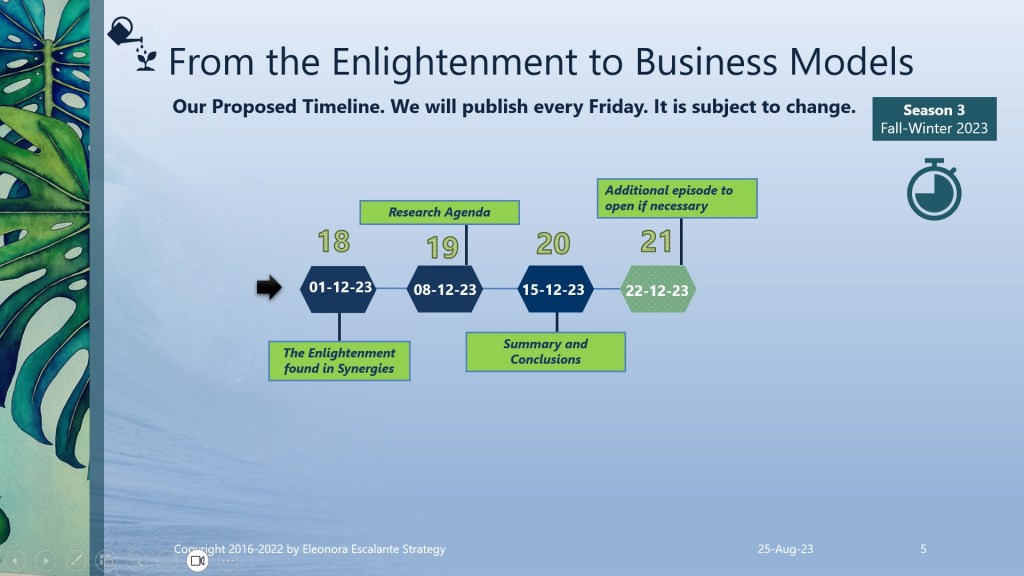
Our next publication will be next Friday 1st of September. We will continue with our journey with the topic: “The Enlightenment and Freedom of Thought and Speech”. Blessings and thank you for reading our episodes.
Musical Section
In this section, we try to select beautiful compositions that might help you to read our episodes. In addition, you can click on them to accompany your studies and reading. Even in your work.
Today we have chosen a recording that presents the complete works for flute and guitar from Mauro Giuliani. The video includes several sets of variations on popular themes from operas, serenades, divertimenti, potpourri, Grand Duos, and Marches, a veritable treasure trove of instrumental brilliance and joie de vivre.
Composer: Mauro Giuliani
Artists: Daniele Ruggieri (flute) & Alberto Mesirca (guitar)
Thank you for reading http://www.eleonoraescalantestrategy.com

Sources of reference utilized today.
1. https://pare lato.stanford.edu/entries/berlin/ and https://press.princeton.edu/books/paperback/9780691157658/three-critics-of-the-enlightenment
2. Walsh, Thomas “Enlightenment, Counter-Enlightenment and Beyond”. International Social Science Review. Spring 1993. Pp 60-71
3. https://www.britannica.com/topic/Roman-Catholicism/Suppression-of-the-Jesuits
4. https://www.britannica.com/event/Great-Awakening
4a. Littell, Franklin. McMillan Historical Atlas of Christianity, Continuum 2d. Edition. 2001
5. Israel, J. Democratic Enlightenment. Chapter 16. https://global.oup.com/academic/product/democratic-enlightenment-9780199668090?cc=us&lang=en&
6. Hollinger, David. “The accommodation of protestant Christianity with the Enlightenment: An old drama still being enacted”. American Academy of Arts & Sciences, 2012.
7. Laitenberger, Henrique. Protestant Enlightenment(s)? The Origins and Dissemination of Enlightenment Theology in Anglicanism, German Lutheranism, and Swedish Lutheranism. PhD Thesis 2021. St John’s College, University of Oxford. https://ora.ox.ac.uk/objects/uuid:8276fb50-c927-4369-b7b8-4d78a34898d1
8. Littell, Franklin. McMillan Historical Atlas of Christianity, Continuum 2d. Edition. 2001
Disclaimer: Eleonora Escalante paints Illustrations in Watercolor. Other types of illustrations or videos (which are not mine) are used for educational purposes ONLY. All are used as Illustrative and non-commercial images. Utilized only informatively for the public good. Nevertheless, most of this blog’s pictures, images, or videos are not mine. I do not own any of the lovely photos or images posted unless otherwise stated.
 Eleonora Escalante Strategy - Strategic Reflections Think Tank