
From the Enlightenment to Business Models. Season III. Episode 8. Enlightenment and Ethics.
Today is the 15th of September, the day in which El Salvador commemorates its independence from Spain.
I should be on holiday, but it is my duty to offer this lovely topic of today, which is related to ethics and the Enlightenment. Ethics is one of the subjects that I have taught in the past, and regardless that I personally like the virtuous Christian approach, it is a privilege for me to show you the roots of our current secular ethical theories. The component of ethics during the 17th and 18th centuries is a singular one. Moral theories have always existed within human communities. But what makes the topic of ethical theories of illustrious importance for us, relies upon the appearance of new frameworks of reference that emerged from the same enlightenment free thinkers that we have studied during this year. In addition, several specialists in the history of the Enlightenment agreed with me that a moral crisis was occurring since the Renaissance. The Enlightenment premises for the European change included not only legal affairs but also political, economic, religious, ethical, and social reconfigurations.
Let´s begin by reading the slides that we have prepared for you during the week. We have tried to synthesize the main relevant points for each of the main Ethical theories or doctrines that were born between the 17th and 18th centuries.
Our presentation slides are from the period between 1600 to 1800. Close your eyes. And for a minute I kindly request, that you travel in time to the year 1789, before the French Revolution. At that time the principal emerging ethical theories came out under 5 ethical approaches which were baptized later with the name of an ample group of posterior theories. I have dismissed other ethical ideas and focused only on the brand-new of the Enlightenment, only on what was a state-of-the-art “neuf” theory during that time. Let´s see which were these emerging moral frameworks produced by the main free-thinkers of the Enlightenment.

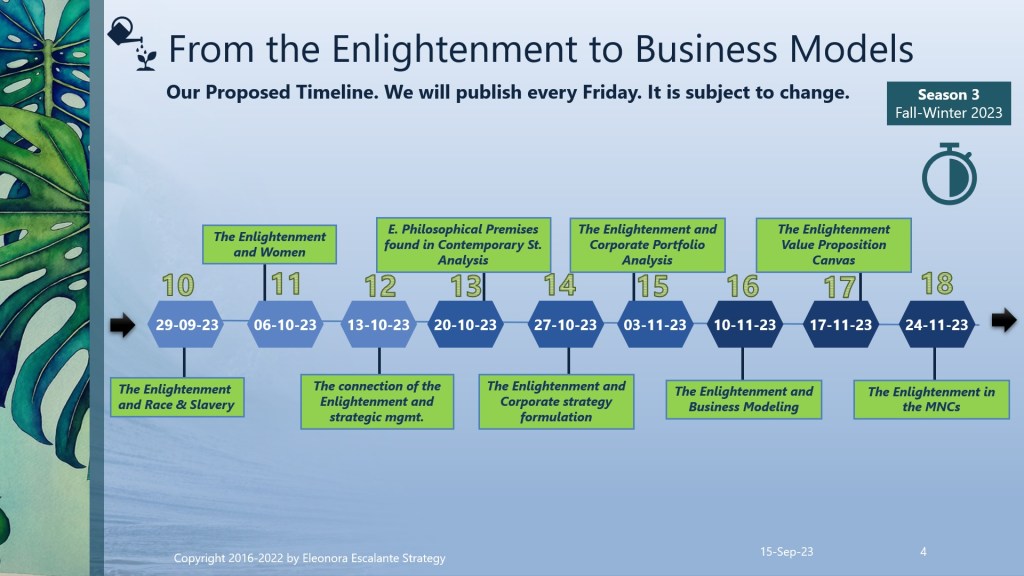
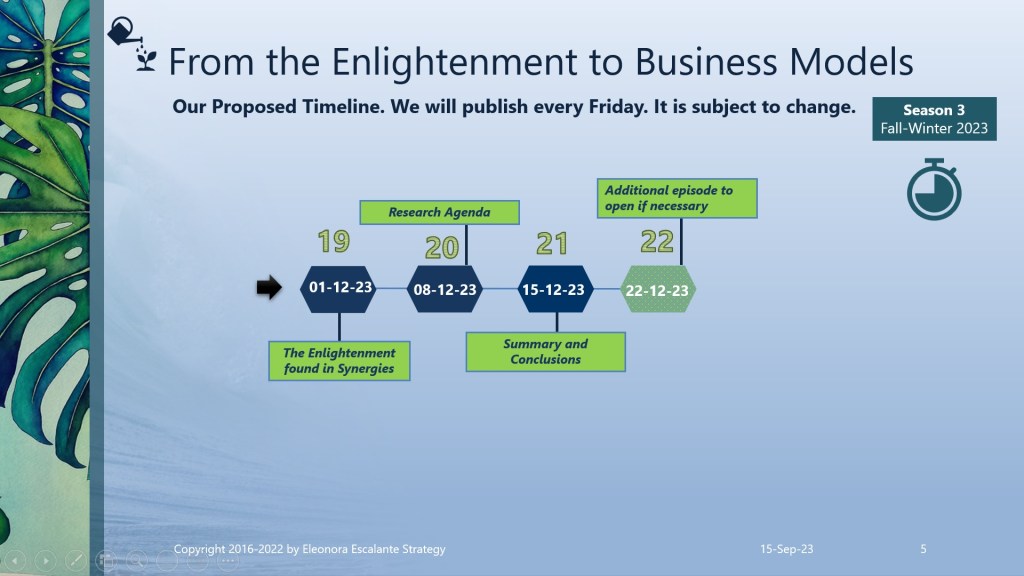
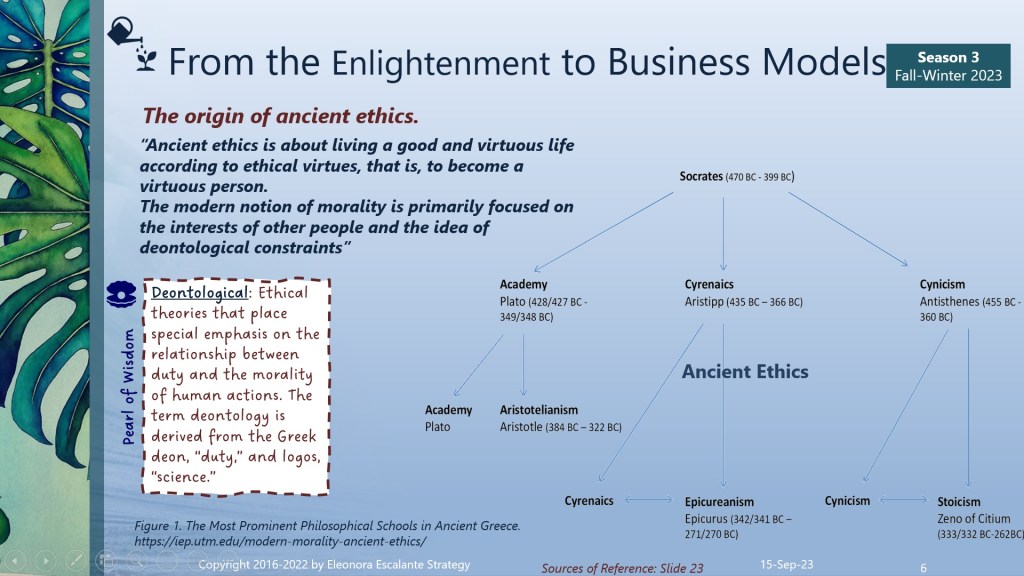
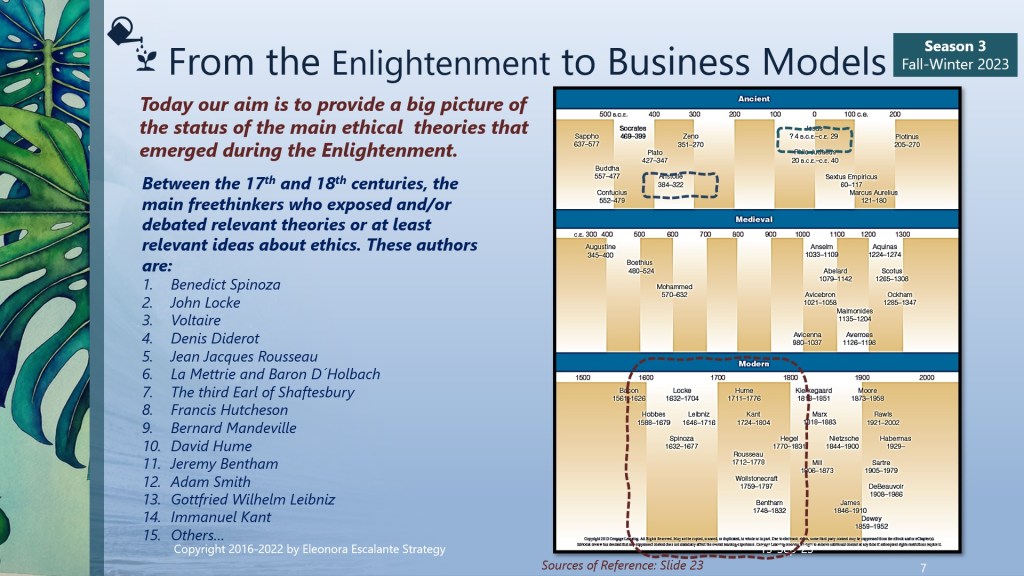
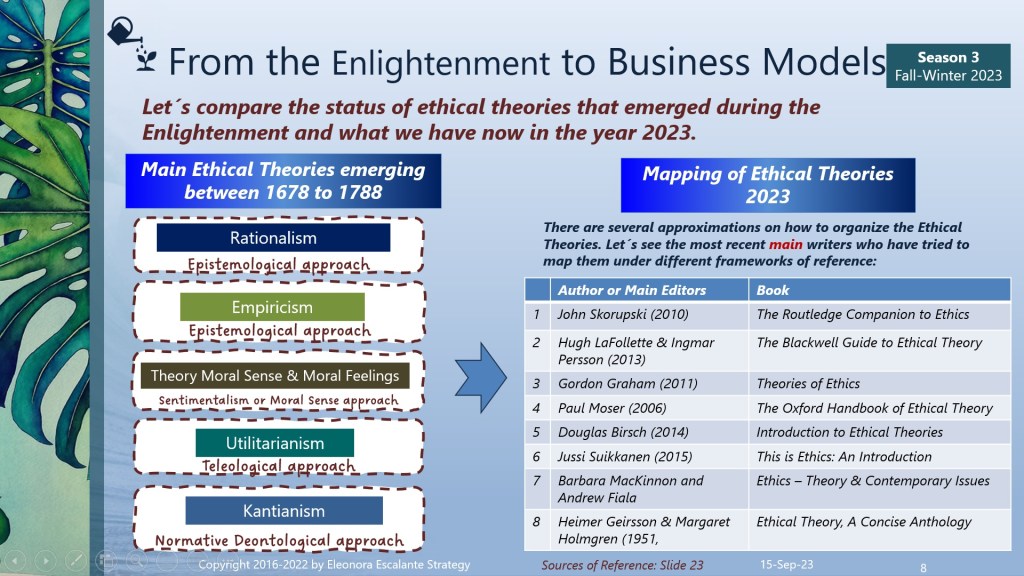
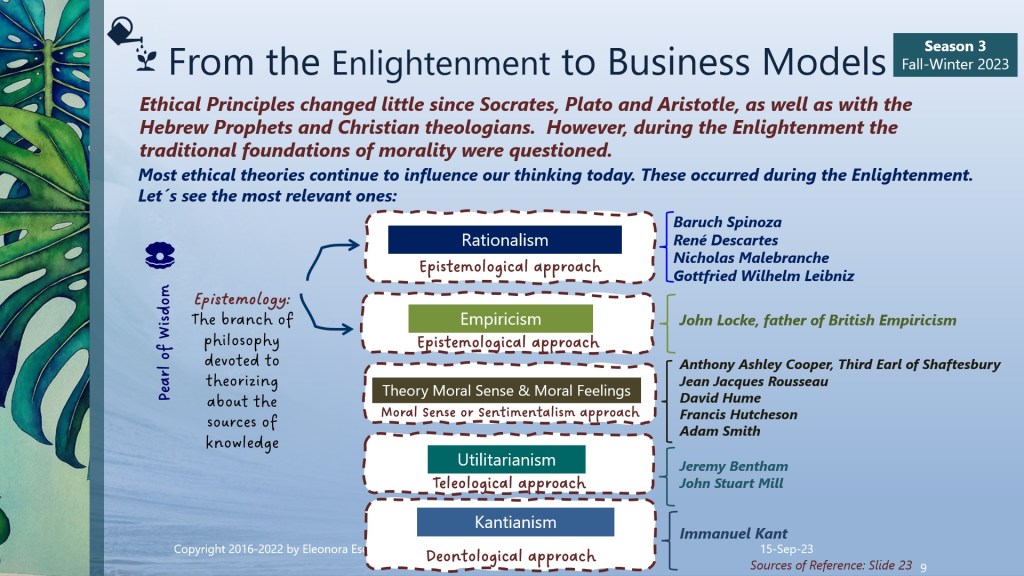

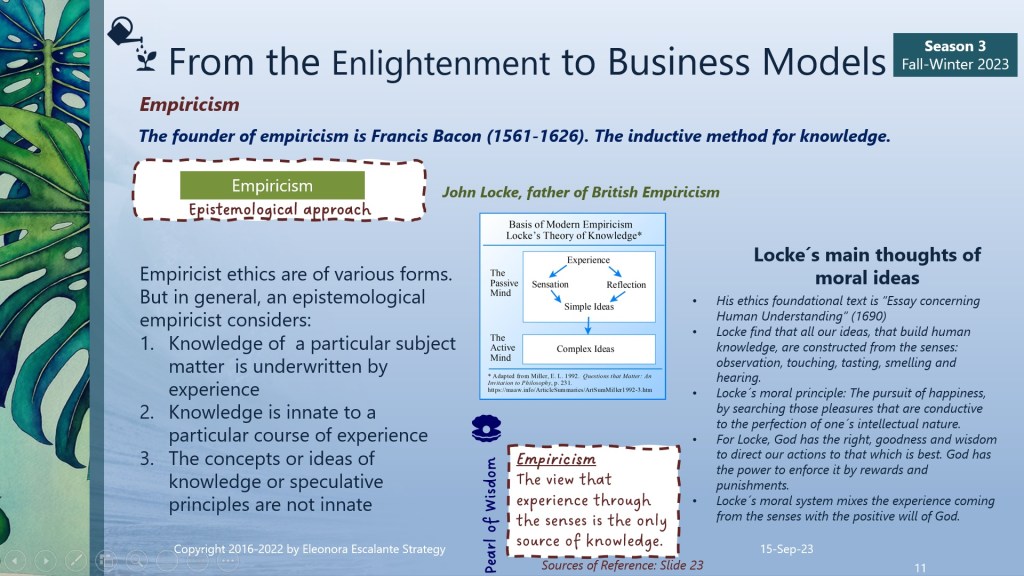
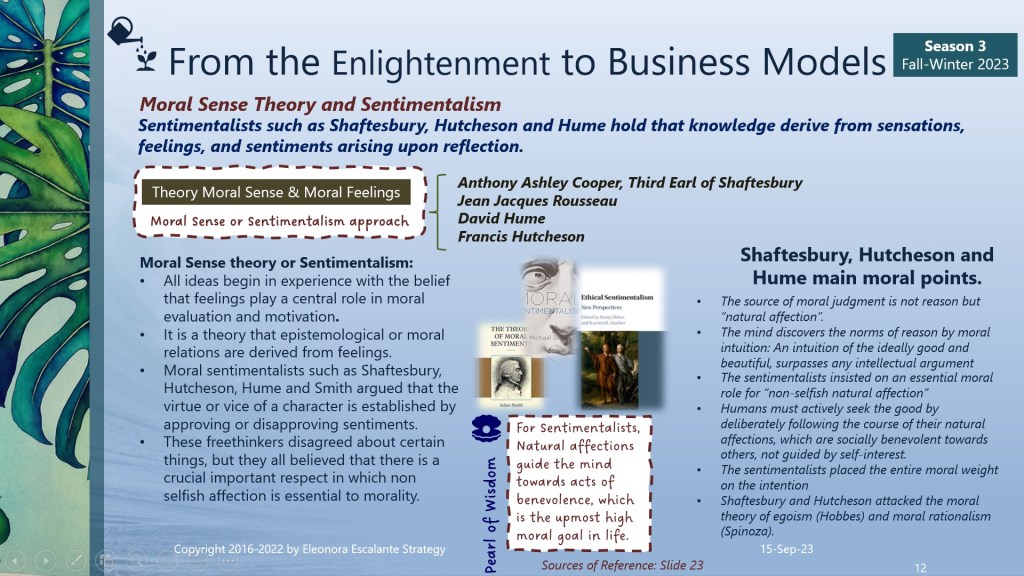
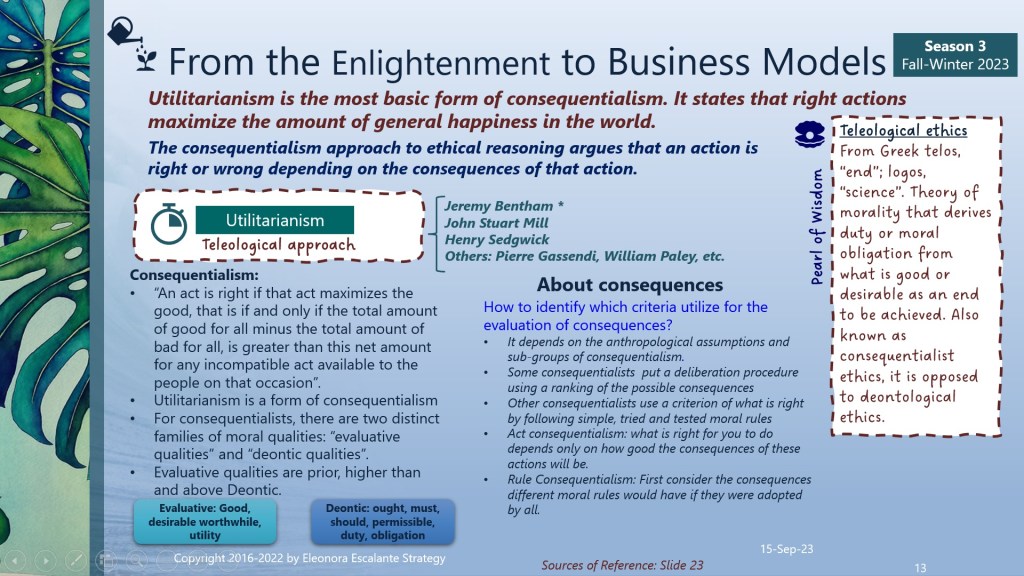


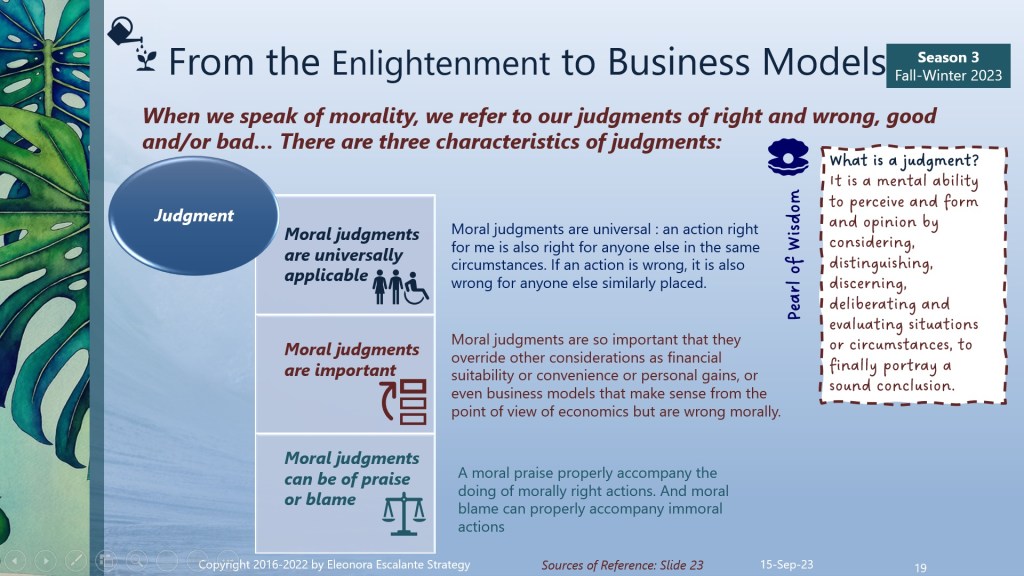



The Main Ethical theories emerging between 1678 to 1788 were:
- Rationalism
- Empiricism
- Theory of Moral Sense and Moral Feelings or Sentimentalism
- Utilitarianism
- Kantianism
The slides are self-explanatory. From Slides 6 to 19, we have been delicate enough to show you the main
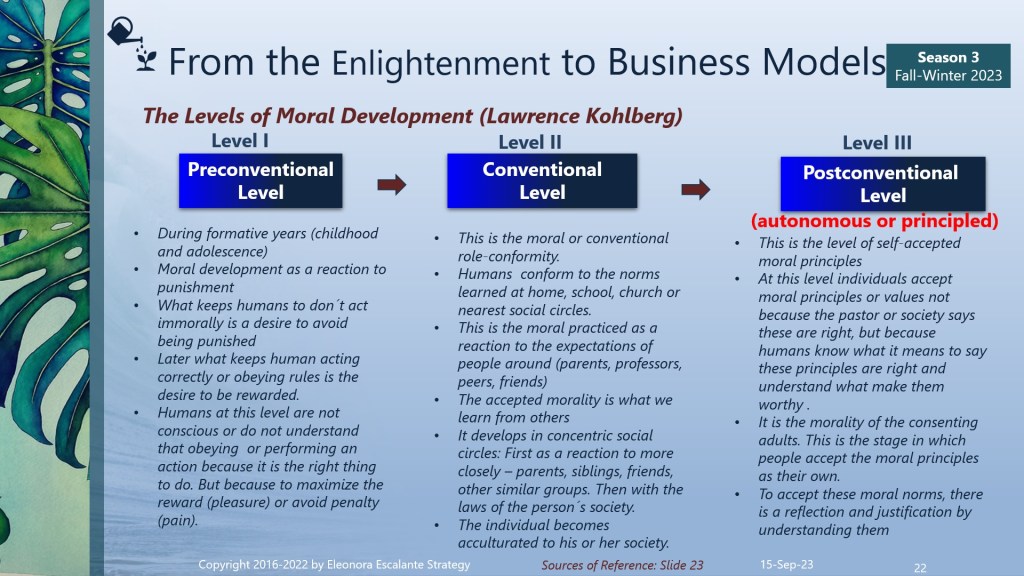
points or fundamental rationale for each ethical theory. We have spent more time explaining Utilitarianism (Jeremy Bentham) because it is used in our times by many corporations and decision-makers. Kantianism has been explained before, during season II, and we encourage you to revisit that publication here: Kant´s Prominence. The last slides (from 20 to 22) are contemporary, and I have added them just for the refreshment of concepts that I might use when teaching in “a university classroom real circumstances”. Do not forget that each of these publications is a summary of a 90-minute class that I can teach to MBA students. Sometimes, meanwhile preparing the material for each publication, I add bonus slides that help me to discuss the topic with the pupils.
Strategic Reflections.
If you were living in 1789, why is it crucial to understand the ethical theories that arose during the Enlightenment centuries?
During the last 200 years before the French Revolution, there were constant back-and-forth debates at the intellectual levels between the 4 canons of the Enlightenment (Radical, Moderate, Counter-Enlightenment, and Enlightened Despotism). In consequence, when the outbreak of the French Revolution impacted the Europeans, in the summer of 1789, no one knew with any degree of certainty what was going to happen with and through the French Revolution. No one became acquainted with the certainty that the Revolutionaries were so inflamed by their poverty and hatred of wealth. No one had any idea that the radicals (Sans-Culottes) demanded the revolutionary government, not just increase wages, fix prices, end food shortages, punish hoarders, and destroy the counter-revolutionaries. No one grasped that the revolutionaries of the new Republic were going non-stop as far as they could in their revenge strategy against the representatives of the Ancien Regime. No one realized that the Reign of Terror was going to occur, and no one foresaw that between 1792 and 1799, the Parisian masses were going to attack the king´s palace, kill hundreds of Swiss Guards, execute the royal family, and then rebel against a weak National Convention that was unable to guide the country. No one acknowledged that Maximilien Robespierre, as the leader of the Committee of Public Safety was going to persecute any person who seemed counterrevolutionary (priests, nobles, aristocrats, the Girondins, etc.). No one knew that Robespierre was going to guillotine a massive amount of people (15,000). No one understood in time to stop Robespierre who was installing a Reign of Terror, a temporary dictatorship with the purpose of saving the recently installed Republic. No one thought that the same Robespierre was going to be executed during the Ninth of Thermidor (in July 1794), and with his death, the radical Jacobins were going to be dismantled from leadership. The new government directory, by 1795, decided to oppose the restoration of the ancien regime as well as the radical popular democracy. Until 1799, France was still at war with the rest of Europe, and ten years after the French Revolution, the French called Napoleon Bonaparte, the new emperor under the name of a Republic.
All ethical theories explained today failed to permeate the masses of French society. The intellectuals were studying, writing, and avoiding being persecuted at a high-superior level… but most of the population was not able to read them yet. Or if they were literate, little comprehension they held towards the ethical theories of the philosophes. Each and all the players of the French Revolution had nothing ethical at all. As I explained in episode 2 of season III, no intellectual theory was more relevant than the emotions of misery (of the 95% of the French Population), the envy of the new merchant bourgeoisie, and the fury of both to change an “ancien regime”.
Despite the emergence of ethical theories during the Enlightenment, the rulers of France were not able to listen, perceive, or at least install the respective changes required in its society “on time”. From the time of Bayle (1647-1706) and John Locke (1632-1704), the royals of Europe had at least 100 years to change, and they didn´t do it. They did not listen. And if they did, the changes were so little, that most of the population did not perceive them on a daily basis. Another French Revolution will occur on a global basis if we don´t do anything now. A global upheaval will also happen again if the rulers of this world don´t realize that we are not heading the right way at the moment with the NAIQIs.
According to our research, the Enlightenment also experienced a period of a profound moral crisis. When a moral crisis occurs, this means that the existing and old moral frameworks for ethical resolution of situations are also under an emergency crisis. Several ethical theories were created to fill this emptiness or to replace the virtuous Ancient ethics frameworks, including the Judeo-Christian one that was taught by Jesus Christ. Can you explain why this moral crisis happened?
A moral crisis always happens because there is a disconnection between the ethical moral frameworks of the society and the application of them in daily or quotidian life. There is a rebellion against the “status quo”. By not behaving according to those ethical frameworks, there is a reaffirmation that something is not aligned between the pre-arranged social norms and moral judgments, and the unfairness of reality. But why does a moral rebellion occur? The answer is simple: There exists injustice, suffering, and misery. Then unhappiness dominates the whole picture. Historians have gathered a multitude of situations described as crises or periods of war, and political, social, or economic unrest. But at the same time, they have gathered the causes of injustice, suffering, and misery. During the Enlightenment, the lack of freedom and misery of the majority of the population was an accumulated process for centuries. The moral crisis simply arose as an aggregated factor too. The Enlightenment created all the conditions to rebel against the ancient existing moral order of the European societies. The religious wars preceding the Enlightenment affected the sense of morality in Europe. The lack of tolerance between different religions created a degree of emptiness in the middle of injustice and misery.
A moral crisis urges philosophers to create new ethical frameworks that can stop the excessive damage of the lack of ethical roadmaps. Why is it that nowadays, the new digital era excesses (with Artificial Intelligence commanding the NAIQIs) have not been reviewed, not stopped by the existing moral frameworks of today, which are numerous in quality and quantity? Remember that NAIQI is the acronym for the combo of disruptive technologies: Nanotech-Artificial Intelligence (Including automation and robotics), Quantum Supremacy, and the Internet.
The NAIQI is a palliative tool with huge expectations. The NAIQI technologies are being pushed irresponsibly by those who are aware and by those who appreciate the existing current moral crisis in the world. The NAIQI tools seem to be the perfect excuse to promise a new portfolio of wealth creation that could mitigate the misery, injustice, and suffering of more than 84% of the global population who earn less than US$3,000 dollars per month (for a family of four). The hope of these technologies seems to be the answer from the technological moguls, “for a hysterical demand of the Western societies, who are used to producing faster than what they can think or regulate. Little do the masses know that the benefits of the digital economy are not for them, who are simply users of the platforms” (1). The uncertainty of the NAIQI world results makes it a seducing value proposition for those who have nothing else on board. But it is too risky to live this way. The positioning of the NAIQI as a promise of progress is in the young population of our societies. Usually, their immaturity, naiveness, and lack of experience are the factors used by the tech moguls to manipulate them accordingly. Post-conventional moral judgment (see slide 22) doesn´t arrive in humans until the 4th decade of adulthood. “Psychologically, emerging adulthood is a stage when an individual’s cognitive abilities increase to reach their peak in their fourth decade and possibly beyond” (2).
Announcement.
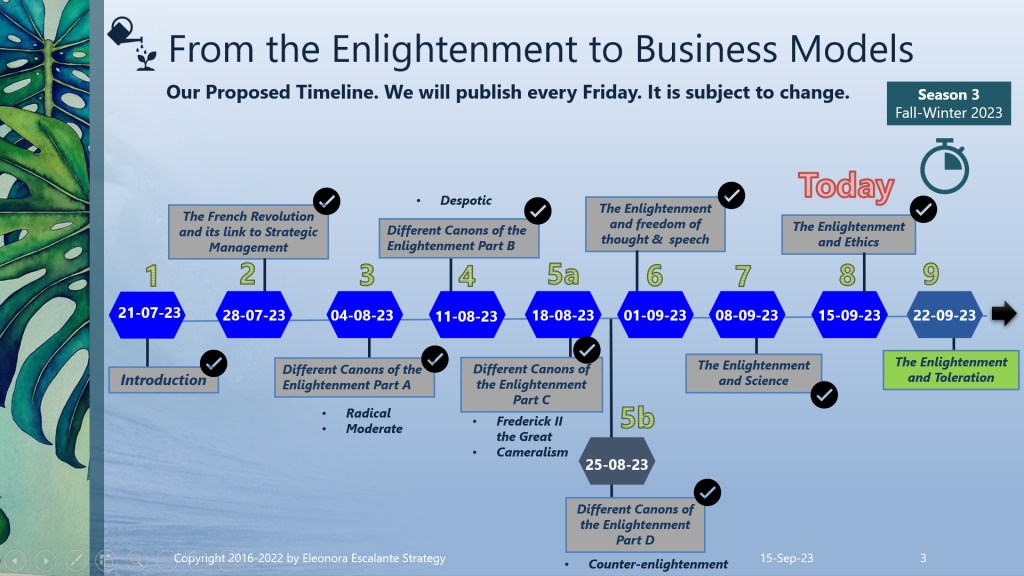
Our next publication will be next Friday 22nd of September. We will continue our journey with the topic: “The Enlightenment and Toleration”. Blessings and thank you for reading our episodes.
Musical Section
This season is dedicated to the wind musical instruments. We have begun with the classical flute magical music that was composed, released, or performed between the 17th and 18th centuries, to accompany your readings.
Today our musical video is the music of Master Giuseppe Cambini (1746-1825), a Neapolitan musician, teacher, and Composer who traveled and settled in Paris by the mid-18th century. His work is interpreted for this occasion by Quartetto DuePiùDue: Stefano Parrino – flute Yamaha 874W (wooden); Francesco Parrino – violin Giuseppe & Antonio Gagliano, Naples circa 1790-1805; Claudio Andriani – viola Arnaldo Morano of Turin 1962; and Alessandro Andriani – cello Franco Simeoni of Treviso 2002. Enjoy!
Thank you for reading http://www.eleonoraescalantestrategy.com

Sources of reference utilized today. All are listed in slide 23.
(1) https://www.lse.ac.uk/ideas/Assets/Documents/reports/LSE-IDEAS-The-Crisis-of-Global-Politics.pdf
(2) https://www.apa.org/monitor/2011/04/mind-midlife
Disclaimer: Eleonora Escalante paints Illustrations in Watercolor. Other types of illustrations or videos (which are not mine) are used for educational purposes ONLY. All are used as Illustrative and non-commercial images. Utilized only informatively for the public good. Nevertheless, most of this blog’s pictures, images, or videos are not mine. I do not own any of the lovely photos or images posted unless otherwise stated.
 Eleonora Escalante Strategy - Strategic Reflections Think Tank