
From the Enlightenment to Business Models. Season III. Episode 13. The Enlightenment and Women.
Contrary to our last episode, we will concentrate today on a general overview. We wish to start the connection of Enlightenment and Strategic management next week. In consequence, we must finish this episode with “avant-premiére” news for January next year.
During this last season of “From the Enlightenment to Business Models”, I was astonished and challenged by two main topics that not only grabbed my attention with quite a remarkable intensity, but I also discovered so many distinct perspectives from professors and researchers who have been working with a value-added mindset for complexity issues, many of them have published beyond academic papers, writing books of several authors. Some have delivered a collection of views in one or more volumes that offer the most ample spectrum of theories and research views. Some of these efforts include skimming archeological evidence. Other authors rely on third-party researchers´ investigations. Subsequently, I have been amused by the number of available books. Nevertheless, this saga is my first approximation to writing a historical perspective of the foundations of trade and commerce. Trade and commerce business models have been in place since Ancient Civilizations. We always start with the Sumerians, because those are the first registered remnants or records of our history that are accessible.
The two main subjects that shocked me during the contextual analysis of the Enlightenment were: First, the discovery of the duality of Slavery and Racism; and second, how women have been treated in our history. The two topics are interrelated in between, and both are crucial for everyone on this planet, not just to study but to comprehend. How to grasp a complete 360-degree understanding of 6000 years of Slavery, Racism, and Women´s mistreatment? In one single episode? That is my goal for today. These topics are all together knitted with warfare. I can´t simply brush them lightly as when we paint a loose wet-on-wet watercolor without details. Also, I can´t be gloomy to retain the sadness of it, but to embrace it to unlock the door of consciousness for all our readers, who are trying to make this world a better place. Given our limitations in providing all the edges and arguments, we have decided that our next saga will be a strategic reflection of these topics. Always connected with business. We will write a future saga in 2025 called “A Glance to the Foundation of Business: Women, Warfare and Slavery.” Consequently, whatever I write today is simply a general introduction to one of our next year’s research strategic work, which we foresee will take a short season.

How to analyze “The Story of Women” and its connection to business in one attempt.
Social and political, the playbook of women in slave societies has been stamped in the organization of the societies for business. A journey to understand the role of women and slaves in at least 6 contexts of time: Ancient civilizations, Medieval ages, Renaissance, Enlightenment, Modern, and the NAIQI age is not a straightforward task. It is a collective effort of those who are experts in slavery, women’s issues, history, economics, and management. As a corporate strategist, what I do is analyze the whole package and weave it in a way that looks easy for anyone to understand. My goal is to unite the complexity of these intellectual cords’ topics, analyze them, and deliver strategic reflections in such easy language for all the CEOs and business owners on earth. Business owners are of an ample range: from entrepreneurs without money, to SMEs, government divisions to big corporations, liberal democratic leaders, and monarchies´ authorities. Our atelier of innovation is at your service to help you consider these human situations before making decisions at your Board of Directors level. The same applies if you are alone, making decisions for your company.
There are crucial hard problems that can´t be solved by moving government policies or the media, but only through a collective effort of every single household and business on earth.
The situation of women is one of these problems. It is tied to 6,000 years of complex decision-making that require immediate attention. Of course, this must happen in parallel to the eradication of modern slavery, the rise of our quality of education, the multidimensional poverty obliteration, and the quest for peace instead of warfare in the context of cultivating new generations that care for the environment.
Several historians and specialists have made tremendous efforts to help us understand the intricacy of women in different periods of civilizations and societies. In the making of our social establishment, we must acknowledge that women are as essential as men. She is so indispensable that if business leaders are not concerned about women, we will continue trying to fix our issues erroneously, with dumb strategies, spending resources without a good compass, and we will carry on societies that won´t function “optimally”.

Women under slavery living in disrespectful societies.
Since the Mesopotamian civilization, passing through the classical Graeco-Roman periods, the medieval ages, the Enlightenment, and our modern era, women have not been respected by men, and this is a basic truth that all of us need to accept. Sadly, women have been disrespected not just by men of their slave societies, but also by the rest of the women around. In a culture of disrespect, the first step is to learn the conscious thesis that women have realized to survive and endure in the middle of incivility. Several situations that emerge today – as proof of evidence – in which women are strongly disrespected and emotionally damaged in our still modern slave societies are: the existence of prostitution, the sale of women by parents or relatives, women trafficking to work under modern slavery in most countries, labor discrimination, inequality of salaries because of gender, household slavery, lack of acceptance of different schedules for working mothers when raising kids, discriminating accusations of “unmarriageable” towards intellectual and well academically prepared women, prejudice and stereotypes attacks towards women who don´t comply with the common standard of beauty, domestic abuse, etc. The forced labor of migrant female workers is especially prevalent in the oil-rich Persian Gulf states of Kuwait, Oman, Qatar, and the United Arab Emirates. Prostitution is a prevalent issue in all countries of the world. It is a disgrace of the highest levels of disrespect that prostitution still exists everywhere, and this social evil occupation must be eradicated as soon as possible, as much as the abusive domestic violence in the households. Any of these flaws, if occurring in any country, only shows a robust lack of respect towards women. And if there is disrespect, that means this society is required to acknowledge the problem first, and then organize itself with a strategic plan for prompt and urgent reparation.
Find our slides for today here. Download them, print them, or share them as you wish.


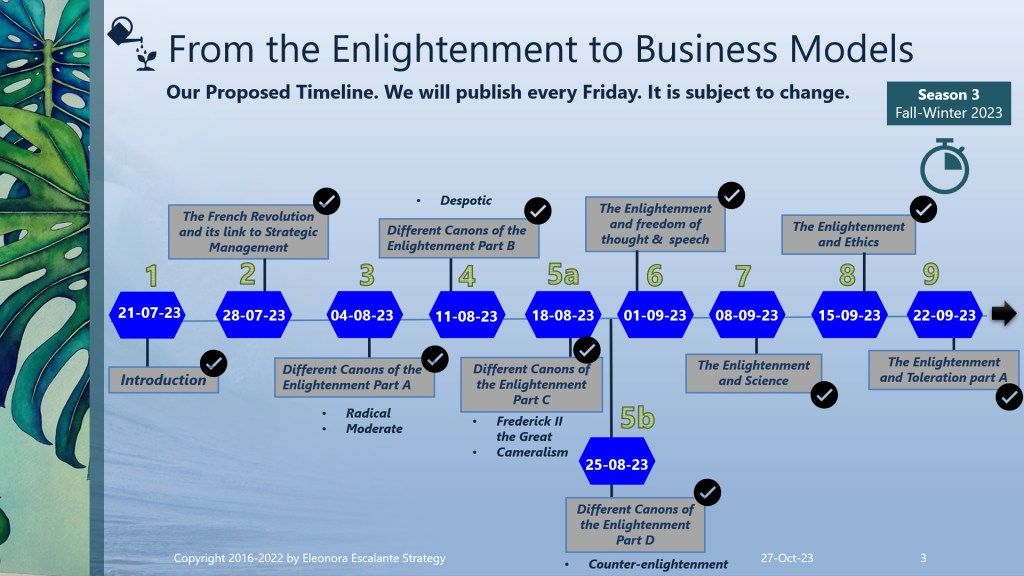
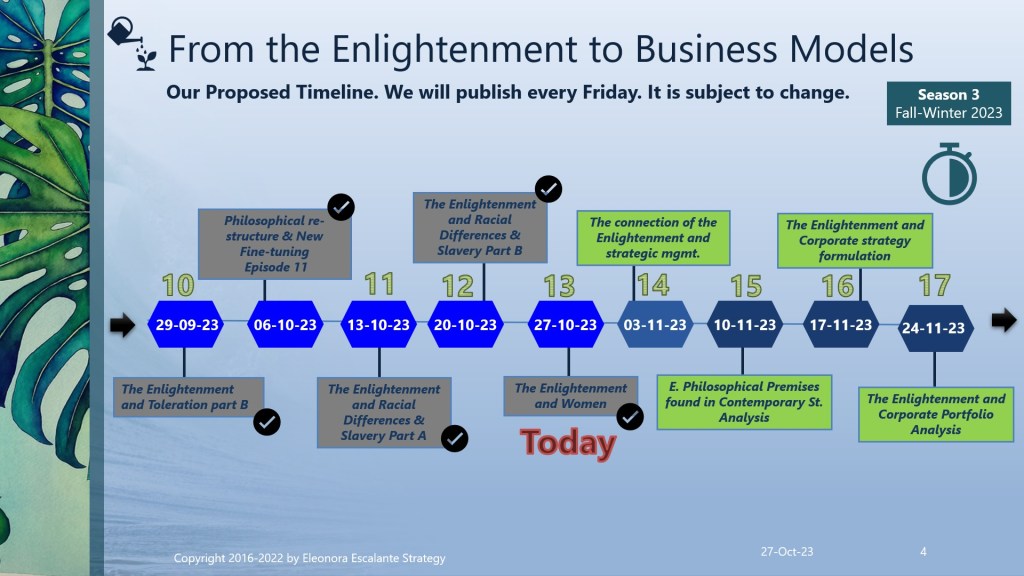
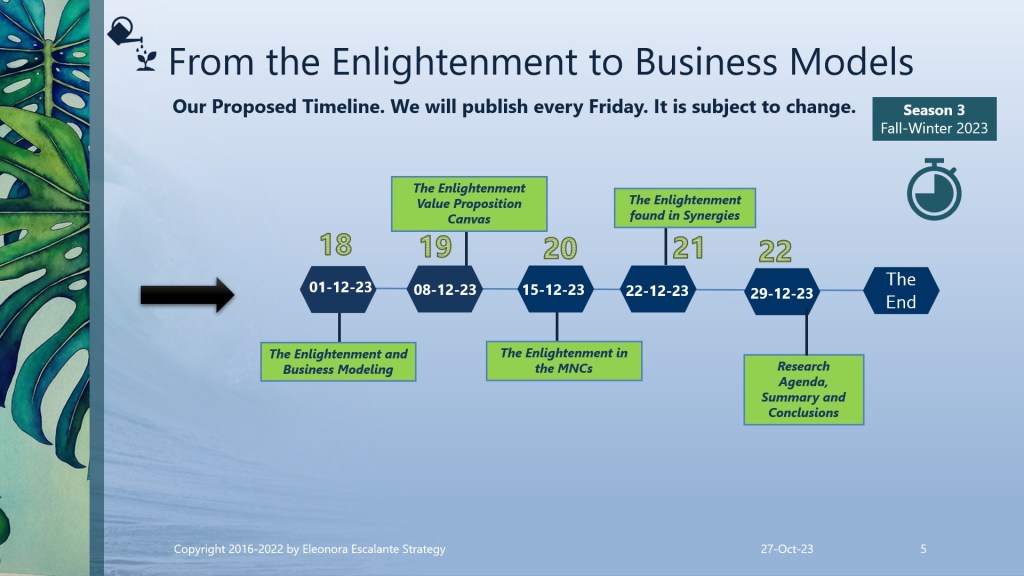

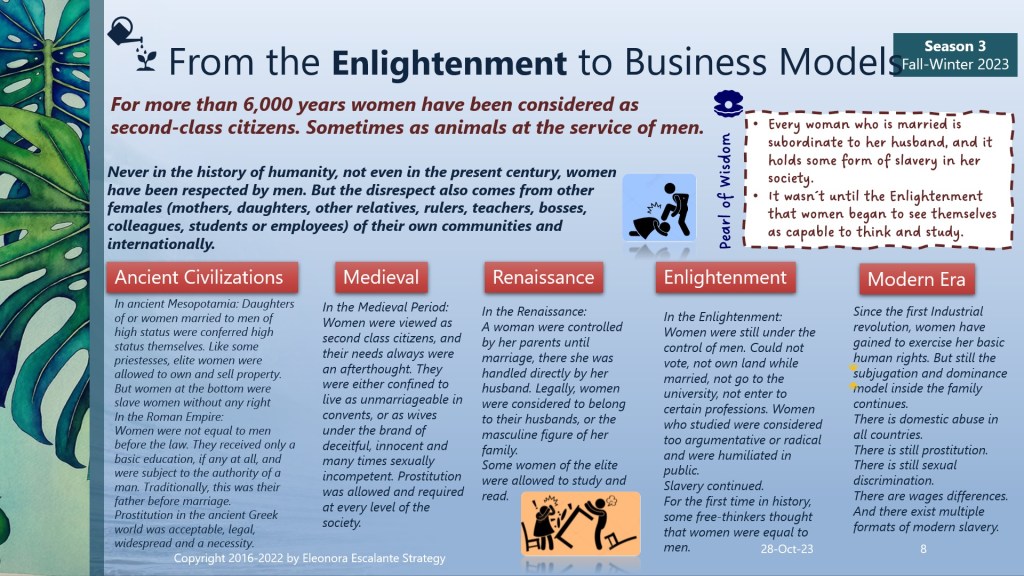


Womanhood has always been valued for her most exquisite biological role: childbearing and motherhood. The core business of women was imposed as such since the Sumerians, with some exceptions concerning leadership in parallel to handling the well-being and raising of the kids. For six thousand years, a woman´s essence has been to manage the needs and wants of her household and her relationships with the members of the household (free and slave). Stories of Childbearing as the top accomplishment for women have been registered since antiquity. Given that humans have always lived in a context of violence and warfare, we can grasp why the ancient civilizations decided to confine women to seclusion at home. Call it protection and security if you wish. However, if men were fighting outside, someone inside the house had to lead the agricultural and domestic activities for the family’s survival. Slaves were an inherent part of the family institution. Meanwhile, men were granted the honor to battle wars and play the strategic public role; their women were prepared to play the role of wife, mother, prostitute, concubine, or slave. Remember that slaves were a standard part of the labor of the household. As Christianity grew, a new profession for women emerged: religious nuns were jailed in the convents. See slide 7. In the Levant region and some Near and Far East cultures, some women were considered goddesses.
The unmarriageable women were condemned to become nuns or to live in monasteries during the medieval ages. Others were sold by the father or her brothers as slaves, as gifts, or as helpers of others´ households. Parents or brothers decided with whom she had to marry, and there was a dowry involved. Women were gifted as objects of sexual desire. And many wars started simply by the fact that one woman was stolen inappropriately against her patriarch’s wishes. Therefore, because warfare and slavery were omnipresent in all the historical phases of women´s history, we can´t discuss women´s issues without studying their slavery situation. We can´t ignore seeing women without their historical roots linked to slavery. The role of women as the child bearers of the family was not enough to place them in a position of respect in the family unit. This disrespect has continued to our days, with certain light modifications or adjustments. We wonder how to cure so much disrespect?
Because of the latter reason, I can’t reflect strategically on the character of what it means to be a woman without considering her double slavery in history: She has been a slave (an inferior being) for a man in the specific social context in which each woman in every social class lived (rich or poor or slave), and she was or has been a slave in the context of the household role that she was condemned to accept. Regardless of whether she was considered the wife of the house, she was still a slave to the man.
The history of women has been a desolate narration of tales of sacrifice, martyrdom, and occasionally happiness. A few exceptions of freedom for women occurred in each slave society, but not all were the Virgin Mary, Joan of Arc, Mary Wollstonecraft, Catherine II of Russia, or some “outlier” princesses who could marry “in love” under the freedom to be adored exclusively by her husbands. At the elite level, women knew in advance that they were going to share their husbands with mistresses or slaves. At the bottom of the social pyramid, in the middle of extreme poverty, the stories of women weren´t that different either. The benefit of being a poor woman was a tradeoff to find a possibility of true love at its best if her enslavement wasn´t as harsh, or in the case of manumission. The rest of the women had to bear the role of prostitutes or harem members.

Women and the European Expansion to the New World.
The Atlantic slave trade started in the Renaissance (mid-15th century). The Portuguese swapped the trade of gold and silver for other commodities as sugar and cotton, required by the European demand. At the beginning of the 16th century, Portuguese vessels carried African Slaves to American Colonies, but also to Asia. African Women and children were transported too. The process of the trans-Atlantic slave trade included brutal practices such as capture, non-hygienic storage, torture, forced labor, sexual exploitation, and rape, the purchase undertaking on ports, and the cruel settings of living/working in the plantations. In this context of European empire expansion, we can´t ignore the sociological and anthropological consequences of such actions in what emerged afterward: A culture of ingrained slavery towards women was undercover as the foundation of trade and commerce, in the context of the nascent economic-political systems of the 19th century and beyond. If you look into the details, the same culture of deep-rooted slavery against women occurred not just in the 5 main ancient civilizations: the Mesopotamian medley, the Greeks, the Romans, the Hebrews, and the Egyptians. During the Middle Ages and the Renaissance, it continued without a glimpse of change.
But what happened during the Enlightenment to European women?
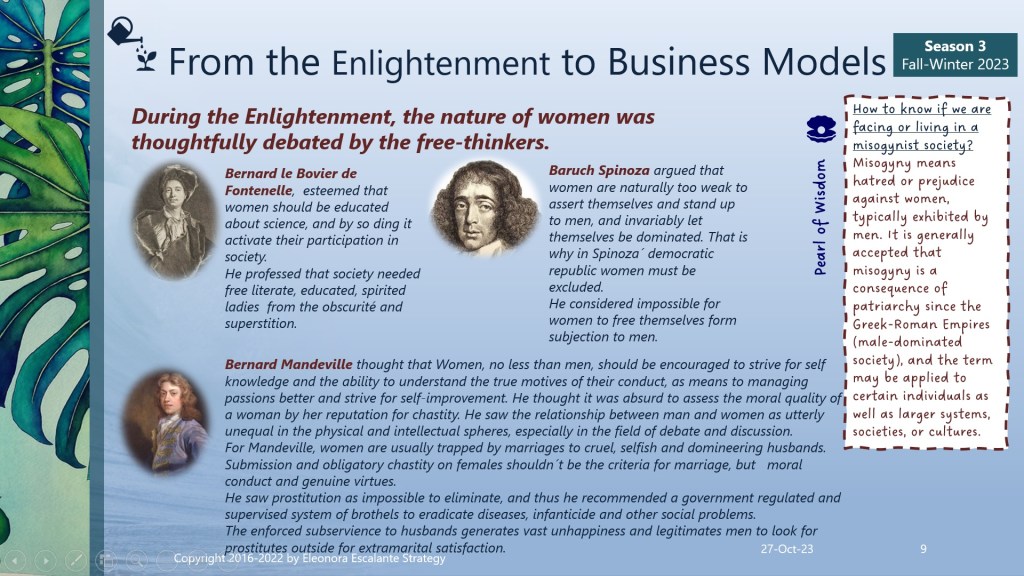
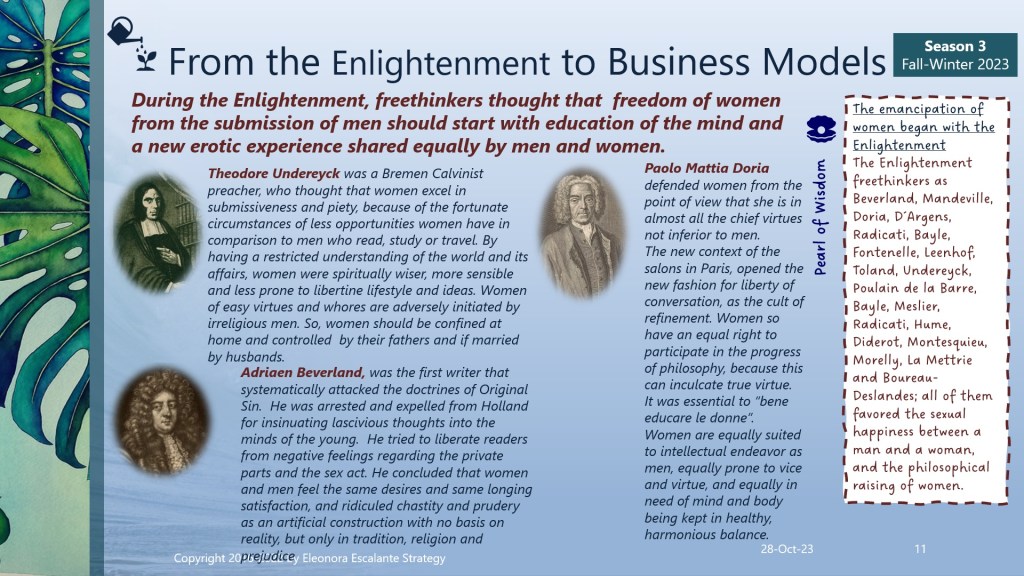
They started to open their eyes to a different reality. Consciousness began, even if the structure towards women didn´t change. Some elite women during the Enlightenment, not only able to read and debate with the philosophers and free thinkers, but they were also allowed to learn to think beyond the Greek and Roman warrior societies. For the first time in history, some women became literate enough, 200 years after the printing press disrupted their societies. Look at what occurred then, in comparison to the legacy of the classics. In Rome, as much as in Greece, women’s functionality was directly correlated to marriage and motherhood. Some exceptional cases have been recorded in which women were aristocratic enough to exercise leadership through other males ( like sons or other pater familias figures ), or only after surviving the death of their powerful husbands.
In Greece as much as in the Roman Empire, women did not have any training beyond the traditional household skills: they were prepared to be spinners, weavers, clothes makers, menders, wet nurses, child’s nannies, kitchen helpers, and cleaning ladies, and in general any domestic service activity was given to the female slaves. Women slaves were given additional sexual responsibilities if they were part of a wealthy family or a member of a mistress’s entourage. Slave women were available for sexual relations with the male master of the house, and/or with the male slaves of the house (with the master´s permission). Employment in the sex trade was always of great profit to the owners of female slaves, either for intercourse or entertainment. In one paragraph, I have tried to summarize the legacy of how women were treated during the Classical Greek-Roman periods of our history.
When the Enlightenment centuries arrived, this was the first time that the elite women of Europe became acquainted with different books or texts that weren´t coming from the Roman Empire’s legacy. Let me recall the names of these powerful ladies, such as Sophie von der Pfalz (1630-1714), wife of Ernst August of Braunschweig-Luneburg; or Voltaire mistress Gabrielle Emilie, marquise du Chatelet (1706-1749); or Caroline Von Hessen of Landgrave Hesse-Darmstadt (1721-1774); or the Empress Maria Therese Habsburg Archduchess of Austria and queen of Hungary and Bohemia (1717-1780) or Sophie Friederike Auguste, princess von Anhalt-Zerbst known as Empress Catherine the Great of Russia (1729-1796).
Regardless of whether these well-positioned women probably did nothing to help other women beyond their own, they were able to become conversationalists and influencers to their husbands or kids. In the Enlightenment society, mistresses were also powerful. Sometimes better and politically effective in impacting rulers or decision-makers than wives. An example was Madame Pompadour, the official chief mistress of King Louis XV from 1745 to 1751, who was probably more influential than anyone in the court of the king of France.
During the Enlightenment, at least in France, the salons, coffee houses, and coteries opened a new culture of interaction between men and women who were able to leave their houses without the paternal figure of protection. As a minority inside these establishments, some women were able to listen, discover, talk, and discuss from their own level of intellectuality. Not all women who attended these places were suited academically for it; sometimes, prostitutes were the accompaniment of men, too, but this was the first time ever in Europe that women from the elites were able to have a place to meet and greet, with other intellectuals and academic professors, or freethinkers. In England, women were not allowed to join the coffee houses, but these spots were where the thinkers came to discuss ideas, science, and chat. Many women from the high class dressed as men just to learn from these debates and discussions.
From the freethinkers’ group, we know little about women who were considered equal to them. I am not sure if Mary Wollstonecraft was considered equivalent or comparable to the philosophers. I truly doubt it. What did this tell us? Women’s troubles won´t be fixed by competing or fighting against men… but only when men are conscious enough to decide by their own will that it is time to respect us and help us. Only respect will cure 6,000 years of disrespect. If men recognize God in the center of their lives, respect towards women is Godly essential. And compulsory.
Announcement. Our next publication will be on Friday, 3rd of November. We are celebrating that we have finished positioning our readers with all the contextual analysis of what was occurring during the Enlightenment. Now it is time to enter a new class of publications. The following subject will be “The Connection of the Enlightenment and Strategic Management”. Blessings, and thank you for reading our episodes.
Musical Section
This is the last musical video of magical flutes from the Baroque. As of November, we will continue sharing more Baroque wind instrument concerts as oboes, clarinets, and saxophones.
Today our musical video has been uploaded to YouTube by Recordare Domine A415. The composer is Johann Joachim Quantz. These concerts are performed by: Die Kölner Akademie orchestra, Des Königs Flötenmeister, Ensemble Sans-Souci Berlin, Arion Baroque Orchestra, and the Akademie für Alte Musik of Berlin.
Thank you for reading http://www.eleonoraescalantestrategy.com. See you next week.

Sources of reference that were utilized today. Look at slide 12 in the package of slides above.
Disclaimer: Eleonora Escalante paints Illustrations in Watercolor. Other types of illustrations or videos (which are not mine) are used for educational purposes ONLY. All are used as Illustrative and non-commercial images. Utilized only informatively for the public good. Nevertheless, most of this blog’s pictures, images, or videos are not mine. I do not own any of the lovely photos or images unless otherwise stated.
 Eleonora Escalante Strategy - Strategic Reflections Think Tank