After several rainy days, we have been blessed with autumn days. At least the cold temperatures here, fused with the chilly air currents have endowed us to wear our sweaters or at least a scarf. This weekend will continue as such, so it is a good idea to wear warm clothing.
Illustrative and non-commercial picture. Used for educational purposes. Utilized only informatively for the public good. Source: Public Domain
As I promised last Friday, today we are updating the content of this episode with our strategic reflections. So, first, let´s proceed to check the slides, please. Find our material below. Feel free to share it, download it in PDF, or save it in your reference material for future study and analysis.
Economic History vs. Business History. There is a modest but powerful difference between economics and business. The definition of business is related to three factors that should appear simultaneously:
An agent that procures the business liaison or is engaged with it (who). There is someone, a person, a group of people, several employees, an enterprise that is meshed in between to manufacture an outcome (artifacts, inventions, goods, etc.)
A dealing with marketable purposes (what). A product, a service, a project, or an endeavor. This dealing involves a transaction between two parties (seller and buyer) and all the intermediaries. The business is produced by the agent who can sell it directly to the buyers, or to an intermediary or representative (distributor). The range of lucrative affairs embedded in a commercial transaction involves multiple parties who are part of the value chain of production of the seller. The differences between products and services are based on different factors, including tangibility, perishability, variability, and heterogeneity. In addition, the goods sold can be end-user or bought by the end-consumer or industrial-oriented.
A process for money-making (how). A business for profit requires positive yield or earnings. In consequence, a solid business strategy is required for the undertakings.
What is Business administration?. It is the science that instructs the agents of business on how to do business properly in all its dimensions and domains. The frameworks for making business correctly should be considered as the most significant and fundamental of our humanity’s development, because every person on earth is linked to business in one way or another, either as the owner of the firm, entrepreneur, or employee helping companies to flourish and prosper for wealth creation.
What is Economics? On the other hand, economics is a science that deals with the theory of economic matters or economic systems. Economics is different from business, even though businesses thrive in a good economic system. If the economy is well designed, then all businesses of a country can or have at least the possibility to produce, develop, and manage its endeavors in a correct manner, without the damage of any economic sector. The purpose of economics is to design, test, and create the correct economic system that may offer a balanced scheme in which all industries and business economic agents may blossom. This applies to the giant multinational corporations as much as the petit entrepreneurs who perform their activities in their house workshops. When economics are wrongly devised, there is an imbalance or favoritism towards one or several economic sectors and their respective players, to the detriment of the rest of the businesses. Societies reap the consequences of those incorrect economic theories that are implemented through political-economic systems. In economics, the government is a main economic player. At the moment there are at least 4 types of economic systems: a free market economy, a command economy, a mixed economy, and a state-directed economy.
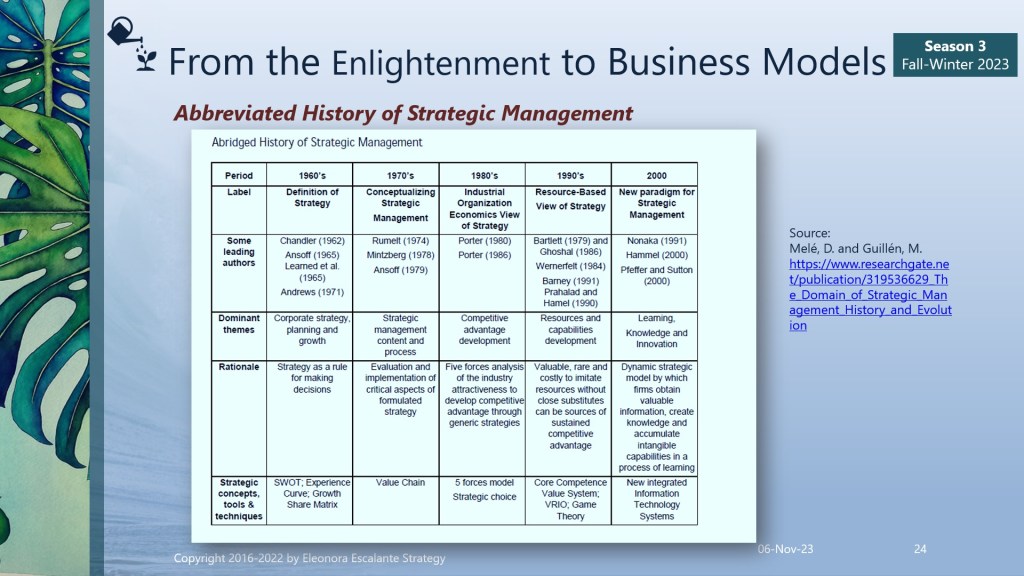
What is strategy? Strategy as far as we can define it, is still a work-in-progress word. Why? It is simple. For more than 6,000 years, the word strategy was linked to warfare. Our past economic systems functioned under the premise of war, and that is why we are currently living with such a diverse connotation of definitions for this word. Professors Manuel Guillén and Dominic Melé from IESE have prepared a lovely table that explains “partially” the history of strategic management as of the 20th century. Look at the slide below:
What is Strategic Management? In the world of business administration programs, any enrolled student is trained in finance, manufacturing total quality management, business control systems, research and development, technology, economics, accounting, marketing, operations, ethics, talent resources, international business, and more recently business analytics. There is also another area that is called strategic management. In the past, it was called business policy. Any MBA and bachelor’s degree in business-related programs get acquainted with courses that teach them the art of business administration. This is how I studied it, and it is still conceived as such in business schools. Nevertheless, strategic management is a science on its own, on top of the rest of business administration areas. Strategic Management agglutinates all the areas of business administration that I have listed above. As a corporate strategist, is impossible to study strategic management before learning the rest of the aspects of business administration. According to my experience, strategic management can only be embraced with all its complexities when the scholar is well instructed in all the aspects of business competencies, in diverse economic sectors or industries. So, it requires an essential education in the classroom, and it demands learning from experience.
Given our current messy context of so many schools of thought about strategy, the domain of strategic management is also blurry or diffused. My argument is solidly established in the multidimensional approach of so many scholars (professors and erudite) from the different business schools that have not arrived at a unique definition of it. Nevertheless, for the sake of educating people in universities, different textbooks have built a general definition of strategic management. For this saga, let me share this meaning that “officially” seems to be the most utilized when professors teach it (by F.R. David):
“Strategic management is defined as the art and science of formulating, implementing, and evaluating cross-functional decisions that enable an organization to achieve its objectives”. The purpose of strategic management is to exploit and create new and different opportunities for enterprise growth, using “long-term range planning”.
From this general definition, strategic planning is the tool utilized in the domain of strategic management to reach the objectives of the firm. Furthermore, according to my own views, strategic management is not strategic planning, because strategic planning is a section or a portion, and a toolkit that helps strategic management purposes.
Illustrative and non-commercial picture. Used for educational purposes. Utilized only informatively for the public good. Source: Public Domain
The link between the Enlightenment and Strategic Management stands in its intrinsic timing.There was a transition of giant dimensions between the Renaissance and the French Revolution. Before the year 1400, the happenings around our existence were explained under a classical (Greek-Roman) legacy framework. It took around 500 years for Europeans to be conscious enough to try to study beyond the classics. It took around 500 years to grasp a new approach to analyze the phenomenon of life. Between the emergence of the University of Bologna (which was the first educational superior center instituted in Europe in 1088), and the first producers of new canons of knowledge, human beings learned to mature their wits enough to create an original comprehension of our living systems. It demanded an average of 5 centuries to groom wise men and produce a new type of brain power that probably had access to some material guarded in the territories of the Byzantines and farther the Levant. Our first European scientists and discoverers began to flourish by the age of the Renaissance. Or at least that is what we have learned. The Renaissance period has given us a list of several remarkable people who developed their brain capacity with a multidimensional perspective. All the scientists who broke the paradigms of the classical ancient theories were men who either studied a formal degree in one or various universities in Europe; or were self-taught men who traveled and had over-the-top capable mentors who taught them everything that they needed to know to catapult their brains higher. In addition, all these scientists weren´t thinking as we do it right now. All of them were polymaths, not specialists: they had a scientific mindset, but they were philosophers, mathematicians, writers, musicians, astronomers, sculptors, painters, physicians, inventors, architects, or engineers, and even members hired by the court of the nobles that sponsored them. I recall Leonardo Davinci, Michelangelo, Johannes Kepler, Nicholas Copernicus, and Galileo Galilei. The reputation of these wise men was beyond the production of their own innovative technologies and theoretical frameworks. They recognized the power of a multidimensional mind between humanity and science, beyond the pre-established boundaries of their own societies. They also suffered religious persecution for going further than the limits instituted by any of the religious authorities of their communities.
Before the Enlightenment, the science of business administration was not as pertinent in comparison to what the scientists and inventors created. But that doesn´t mean that business did not exist. And that doesn´t mean that business administration didn´t happen either. For example, there are archaeological remnants of bookkeeping and grammatical standard construction of contracts. There is mercantile correspondence, and mathematics applied to financial transactions with money. It was flowing back and forth in all the Mediterranean territories, the Levant, Asia, India, and then the newly discovered Americas.
The connection between business administration and the Enlightenment is clearly linked in its inherent timing. It was during this period (the Enlightenment) that the first universities in Europe appointed faculty chairs to teach what was called then “administrative occupation”. For example, in 1727, Germany appointed for the first time ever, several professors in “administration” for the “trade court class”. The same occurred in Sweden in 1750. The first school of commerce, the “Escola de Comercio” was founded in 1755, as the “first purpose-built” school of commerce with the primary goal of training public administrators to manage taxes and disbursements. Richard Cantillon’s “Essai sur la nature du commerce en general” (1755) is considered a major work in the context of the economic literature of the European Enlightenment. “In Brazil, the Court’s Trade Class was instituted by the license of July 15, 1809. Its creation was part of the set of administrative measures of an economic nature taken by d. John VI from 1808, together with the opening of ports to friendly nations, the revocation of the license of January 5, 1785, which prohibited the establishment of factories and manufactures in Brazil, and the foundation of the Royal Board of Commerce, Agriculture, Factories and Navigation” (2). This last example gives us a glimpse that business administration training was required because it was needed to control the businesses occurring between the New Colonies and Europe.
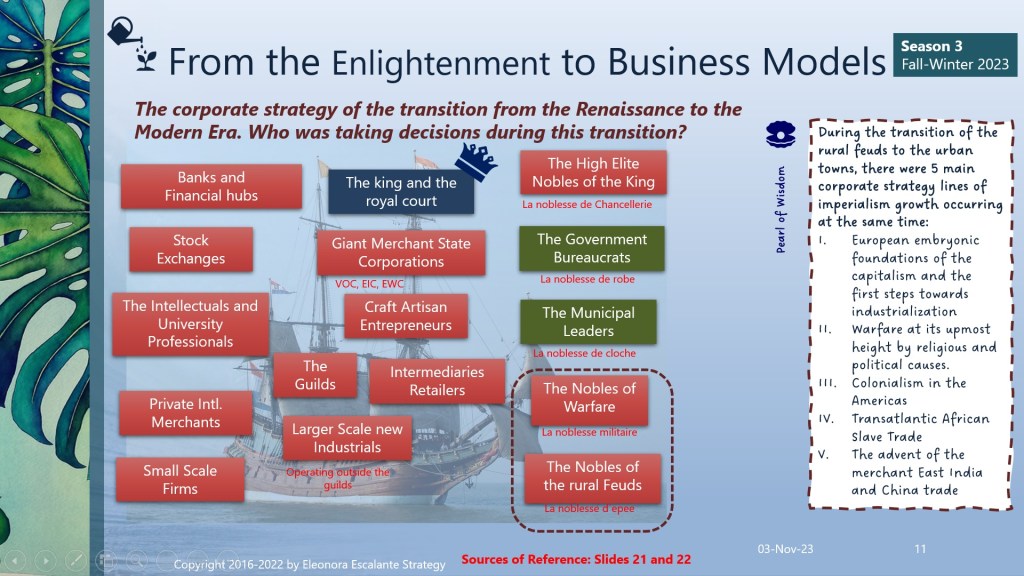
The New European World of the Enlightenment. Just think for a moment about the following idea. If the intellectuals of the Renaissance were the first polymaths under the Catholic Canon who disrupted their societies; and their followers (including Descartes) flourished during the Enlightenment to build a critical mass (200 years later); then a new brainiac class with a strong network emerged slowly. The intellectuals of the Enlightenment, all well-prepared from the best universities, included the nobility in their own societies. Then the needs and wants of freedom for this new class of citizens were imperatively different. It was natural for the new class of intellectuals and university professionals to try to publicize their new paradigms. And they did it through books, salons, the same universities, etc. See slide number 11. In addition, if the studious class was used at the Court and the monarchical new state organization, this new government was the result of the same intellectuals who needed a new structure to comply with the requirements of new societies in metamorphosis. The transition from the rural feuds to the urban towns was hand in hand with 5 corporate strategy lines (in all the empires participating in the expansion of new colonies outside of Europe).
The European embryonic foundations of capitalism and the first steps towards industrialization (read slides 9 and 12).
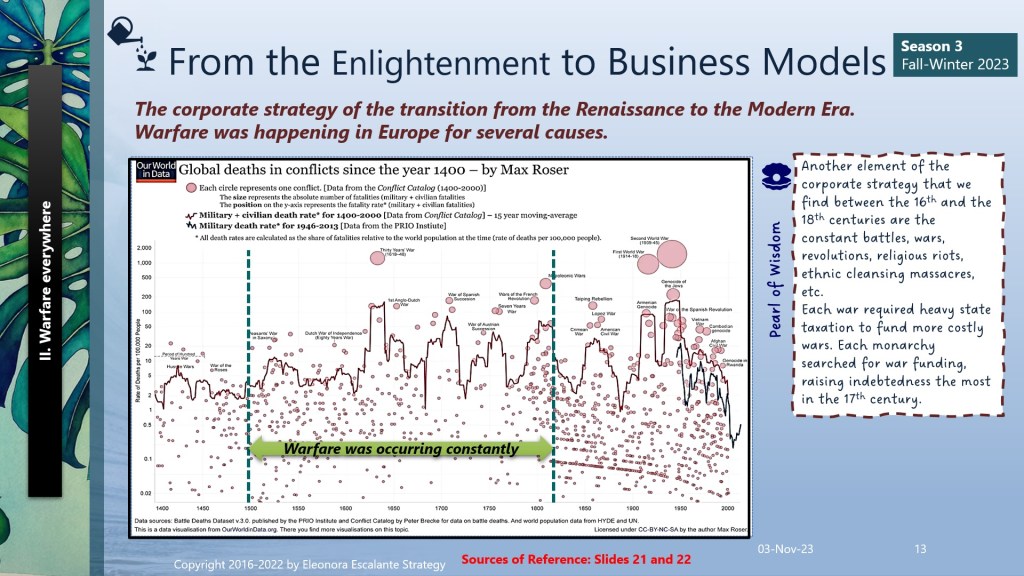
Warfare at its utmost height levels by religious motives and political ones between all the major nations of Europe, including Spain, the United Provinces of the Netherlands, Austria-Hungary, France, Britain, Hanover, Prussia, Russia, the German principalities under the Holy Roman Empire, Sweden, Poland, and the Ottoman empire too. On top of these innumerable wars, the Holy Crusades left a legacy of international warfare missions. When the reformation took place with Luther and when King Henry VIII of England broke relations with the Vatican, a new source of conflicts originated by religion was also in place. The evidence is the numerous religious conflicts and wars that we can observe in slide 13
Colonialism in the Americas. See slide 14.
Transatlantic African slave Trade. See slide 14. We have already explained this factor in other past publications.
The Advent of the merchant East India and China trade. See slide 15.
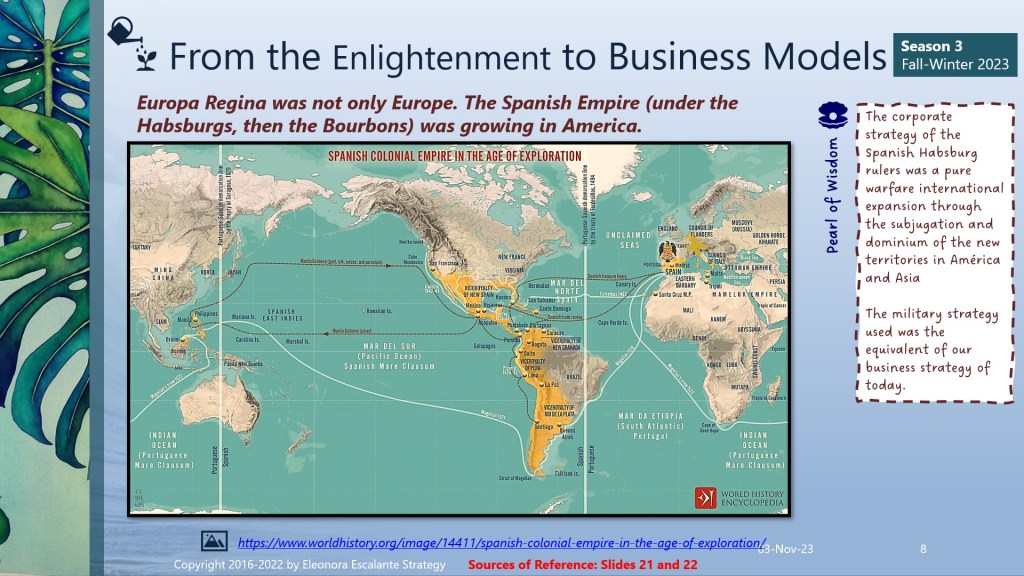
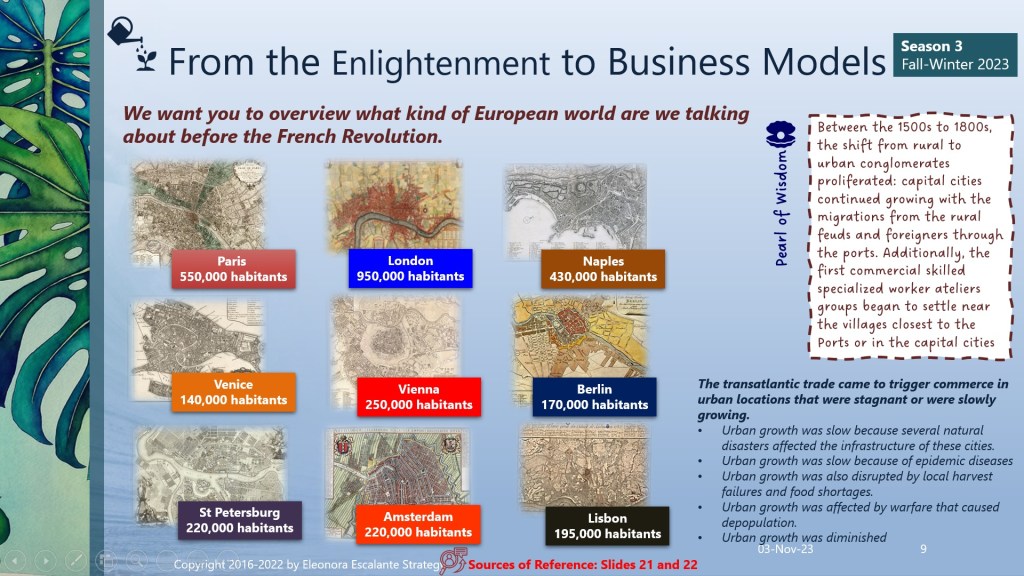
Who was making corporate strategic decisions in this period of transition? These 5 strategic directions were occurring all together at the same time. The urban conglomerates were growing in a disordered manner, migrations from the rural settings to the cities didn´t stop (see slide number 9), and we must ask ourselves? In this context, who was making the decisions for the prosperity of those cities? Do you think the kings or queens and the royal courts? Or was the intellectual group all together with the new merchant class who were involved in the American transatlantic and Asian trade? The treasures of the new world were so attractive for each and all the competitive nations in Europe. To secure the map of Europa Regina (see slide 7) was the Spanish-Habsburg crown game, played formidably, but it was with the purpose of guaranteeing their dominance of the lands in the New World. All the matrimonies that succeeded between monarchs of royal heirs between 1500 to 1800 were driven by the consolidation of the new territories in the New World. Spain was defending its empire (with all the strategies and tactics they could imagine), through strategic alliances of marriage, warfare, and settling colonialism quickly and without non-stop measures. This is why they didn´t care for the indigenous natives as much as the Catholic Jesuits wished. When the Bourbons took the spotlight crown in Spain, France, and Italy, the rest of the Holy Roman Empire were trying to consolidate their positions in Europe to extend it to America. But warfare continued.
Illustrative and non-commercial picture. Used for educational purposes. Utilized only informatively for the public good. Source: Public Domain
Europa Regina was Spain and most of Europe during the Enlightenment (slide 7). The Spanish Empire, under the Habsburgs, began the colonization of America. If we follow the rule “the bigger, the better”, the scope of the Spanish-Austrian domains extended all its splendor in Europe and the Americas as much as they could. Under the papacy bulls, the treaty of Torsedillas was the perfect barrier of entry, established to protect Spanish America from Britain and the United Provinces of the Netherlands’ future claims of the New World. Meanwhile, the papacy and the rest of the catholic church organization were protecting the new Spanish lands that were expanding as of 1500, the rest of the countries in Europe realized that if they wanted a piece of the cake of the Americas, they had to outbreak Catholicism. They couldn´t join claims in the new world, under Catholicism anymore, because the whole Europa Regina with the Spanish crown at the top was undisputably linked with it. My personal view is that Luther´s reform (1522) and the secession of the Church of England in 1534 were also instruments of disruption beyond a change of religion. In addition, look at the context of Spain after the discovery of America. See slide numbers 7 and 8. Queen Isabella of Castile and King Ferdinand of Aragon, the royal investors in the discovery of America, procreated two daughter queens: Katherine of Aragon and Joana of Castile. Katherine of Aragon married Henry VIII, the King Tudor of England for 24 years. Juana of Castile, wife of the Austrian Archduke Philip the Handsome of Burgundy-Netherlands, and mother of the Holy Roman Emperor Charles V, with whom the whole map of Europa Regina was consolidated and assembled under the Spanish Crown.
Later in the 17th century, things started slowly to change. Europa Regina was too much of an absolute empire to handle. When Britain and the United Provinces of the Netherlands realized the size of America, their rulers changed their strategy. As Professor John Merriman states, “Several reasons can be found to explain why Great Britain and the Netherlands did not follow the other major European powers of the seventeenth century in adopting the absolutist rule. Chief among these was the presence of a relatively large middle class, with a vested interest in preserving independence from centralized authority, and national traditions of resistance dating from the English Civil War and the Dutch war for independence from Spain, respectively. In both countries, anti-absolutism formed part of a sense of national identity and was linked to popular anti-Catholicism. The officially Protestant Dutch had a culture of decentralized mercantile activity far removed from the militarism and excess associated with the courts of Louis XIV and Frederick the Great” (3).
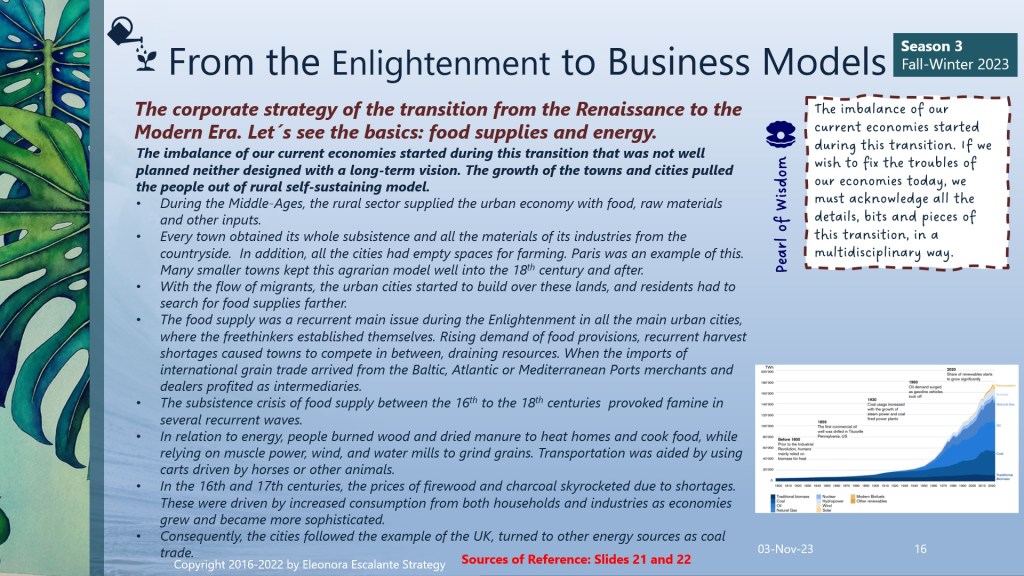
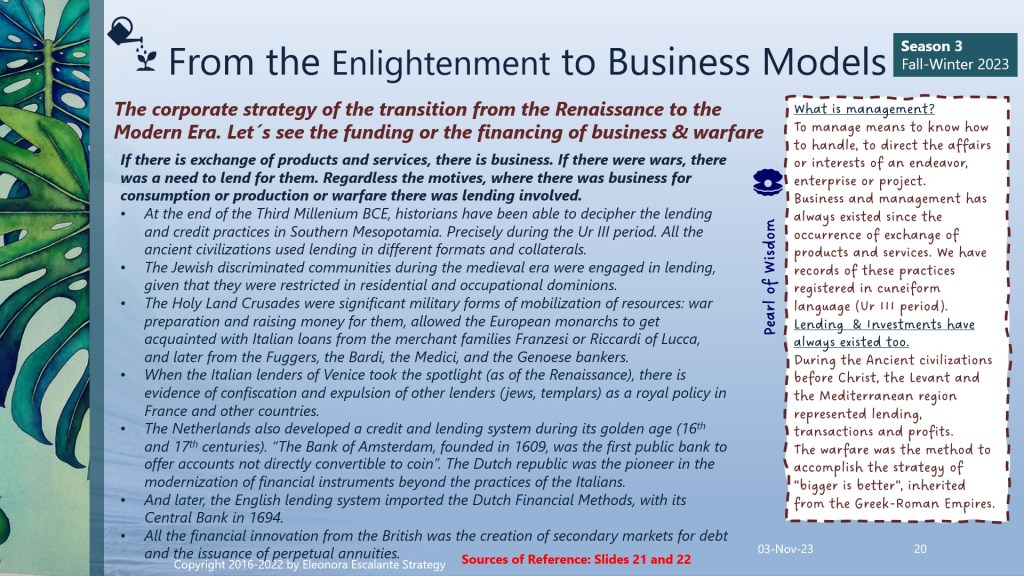
A dynamic transition was stirred between the end of the Medieval Age and the French Revolution. It was during this frame of time that the Enlightenment freethinkers were able to open new ideas on how to organize the countries in a different way than the feudal monarchical states. In this context of transition, the strategic management of the monetization of resources also shifted. But slowly. This change which was uniquely led by the kings and the emperors; began to shift from the “ancient regime of leaders” as the agents of warfare, to a new private emerging merchant class of the urban cities, in which the government-private giants of trading (the first MNCs of our history) distinguished as the top “business” of the epoch. Please read slides from 16 to 20. We explain the corporate strategy of the transition from the Renaissance to the Modern Era, on several levels. First, we overview the sector of food supplies and energy. Famine was a serious repetitive issue in Europe, particularly during the 16th and 17th centuries. In the middle of warfare, and after the War of the Spanish succession, every nation in Europe was fiscally drained. England was trying to sell their own resources to raise money to pay for the warfare, and coal was the prime material of excellence for it. By this time, England was already in possession of most of the land in what is now the United States of America, and the marriage between William III of the United Provinces with Mary II of England, came to reinforce it.
Slide 19 explains with substantial detail the structure of relationships between the government and the population of the urban-rural cities in Europe, and the social problems associated with the migrants. Finally, we also release the aspects of financing and investments taken by the decision-makers during this transition of time. Look at slide 20 for further explanation.
Strategic management has ALWAYS been part of the human mindset. For us today, as corporate strategists writing this saga, without a tiny doubt, we exhort that “it is impossible to study business administration without studying how business has been accomplished since ancient civilizations, or at least since the societies that held business transactions and left us their registered records”. It doesn´t make any sense for us in the 21st century, to show up to business schools and learn strategic management as if the world began after World War II, during the 1960s. To study business requires one to go back to the Sumerians, then the Greeks, the Romans, the Chinese civilization, the Levant region and the Middle-East business affairs and transactions, the Holy Roman Empire of Europe, and later to explore the business history of Western Europe last millennium because businesses (and economics) have existed for more than 6,000 years. The rationale of each transaction for buying and selling goods has always appeared in history, and to continue studying business without learning about business history is a huge mistake.
To continue studying business without learning about business history is a huge mistake. Particularly, I truly believe after this saga, that those MBA professionals, consultants, strategic advisors, and specialists in strategic management (corporate strategy, business strategy, and functional-operational strategy) are compelled to learn about business history as soon as possible. Every year in the United States, there are more than 350,000 students who graduate with a bachelor’s degree related to business, and at least 180,000 new MBAs (4). If there are so many professionals that demand education in business administration, we are better off if we begin to change our theoretical courses, with a more multidisciplinary view, including the history of business and a human-shared value approach, and not out of greed. Only 10% of all business schools in the world hold an AACSB accreditation (5), which means that not all the graduated MBAs hold a minimum benchmark. The Association to Advance Collegiate Schools of Business (AACSB) is an internationally recognized nonprofit organization established in 1916 that independently reviews business schools across the globe. The AACSB must consider business history as a core course in the excellence standard requirements of each business school.
Business History, a pending scholar task. All scholars on the planet would agree with me, that there is a huge gap, a hole of behemoth proportions in the discipline of business administration. We have limited research about business history. In consequence, Ph.D. business scholars are urgently required to study efficiently and professionally all that we can find about business since the Sumerians, Greeks, and Romans. That is a pending massive task that would be required to be completed in the decades to come. It is impossible to go to a business school without learning about the history of business. We will need to study more than 6,000 years of business history, and that will require help from archaeologists, social historians, art historians, social and economist historians, etc. We can´t continue learning business as if business started with the Enlightenment. It is not true. We have to go back beyond that. There are many things that we still don´t know because the history of business has been banished from business schools. If we don´t study our past, we are condemned to repeat the same mistakes that our ancient civilizations did, regardless of the knowledge, the science, or the technologies at our service.
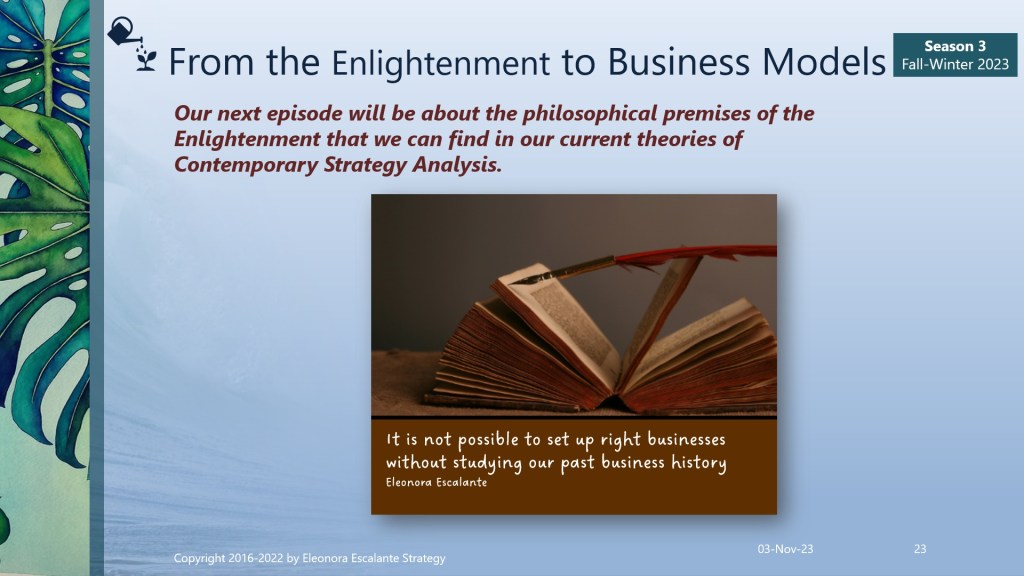
I will leave you for the time being with the following quote:
It is impossible to set up the right businesses without studying our past business history.
Eleonora Escalante
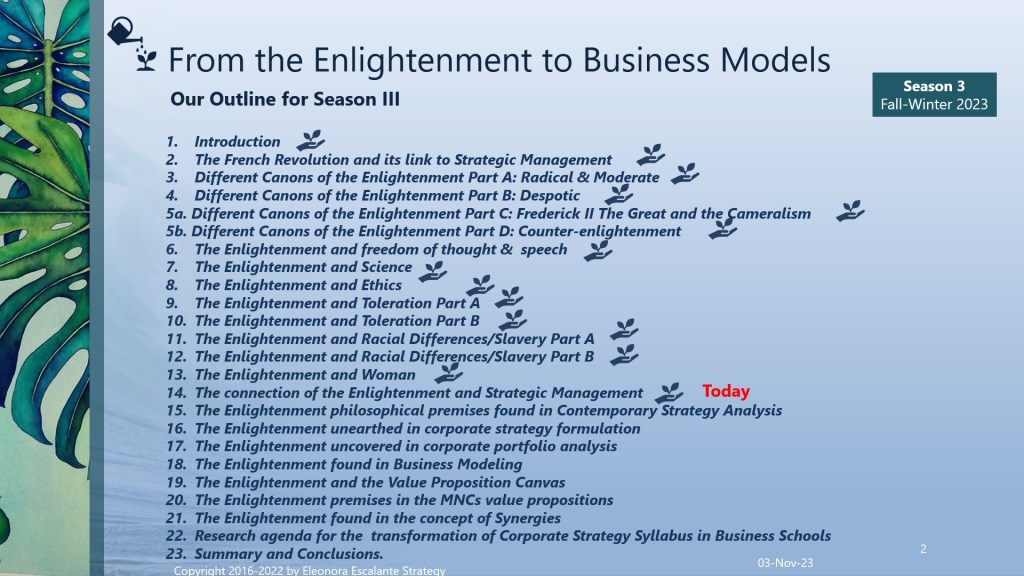
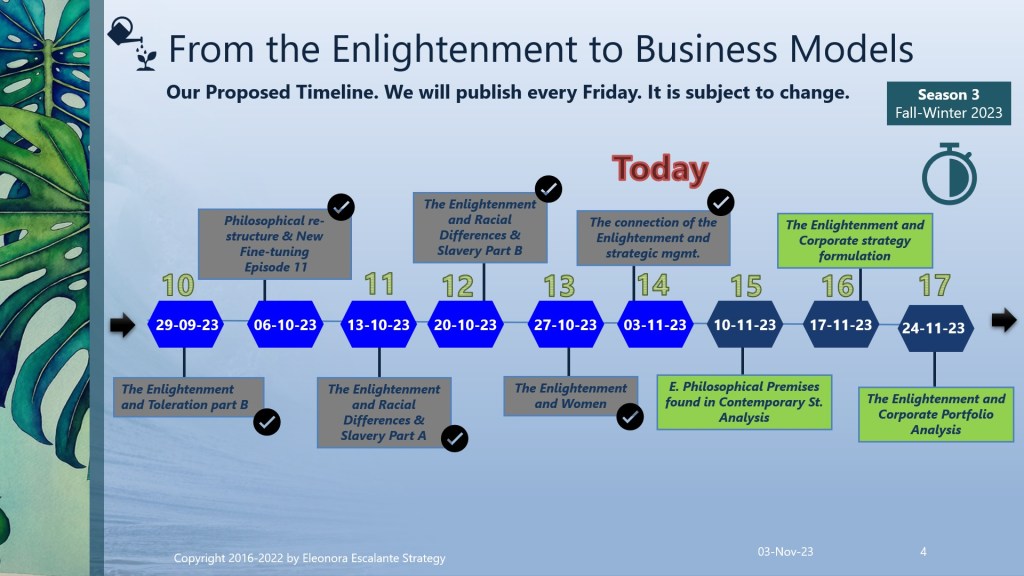
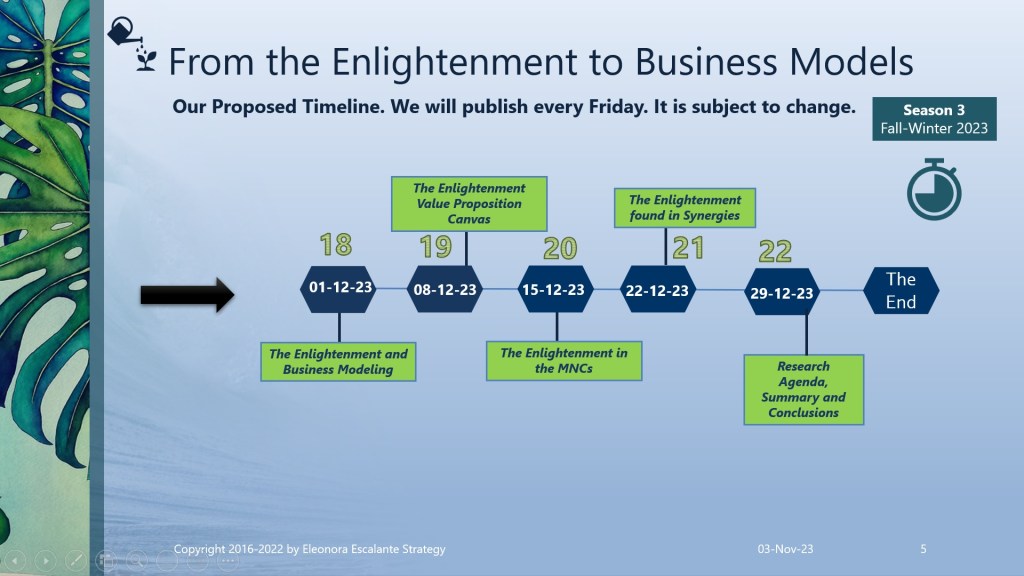
Announcement. We have uploaded the complimentary publication successfully. When I do not publish all the strategic reflections on Fridays, it is because I am considering new content beyond the boundaries of the outline, that requires my attention before publishing. During the weekend, it is important that you read the slides, ask yourself questions, and then search for additional information in our bibliography (slides 21 and 22). Then on Monday, you can compare your reflections with ours. That would be the only way that you will learn to practice. The following episode (to be published next Friday 10th of November) will be “The Enlightenment Philosophical Premises Found in Contemporary Strategy Analysis”. Blessings and thank you for reading our episodes.
Musical Section
As promised last week, as of today we will share a concert of oboes and other wind instruments of the Baroque.
Our music of today has been uploaded by the YouTube channel of Brilliant Classics. It shows 6 concertos recorded on a disc by the composer Georg Philipp Telemann (1681-1767). These concertos recorded are for solo oboe or oboe d’amore. His virtuosity is expressed with a great melodic charm and beauty. The interpretation performance is by Andrius Puskunigis and his Lithuanian ensemble St Christopher Chamber Orchestra conducted by Donatas Katkus.
Disclaimer: Eleonora Escalante paints Illustrations in Watercolor. Other types of illustrations or videos (which are not mine) are used for educational purposes ONLY. All are used as Illustrative and non-commercial images. Utilized only informatively for the public good. Nevertheless, most of this blog’s pictures, images, or videos are not mine. I do not own any of the lovely photos or images unless otherwise stated.
Central America: A Quest for the Progression of Economic Value. Season V is coming…
The closing bonus of Season V will be about "The Origin of Central America political-economy". Our final strategic reflections after more than one year of study and analysis. As of9 Jan 2026
The big day is here.
Our Philosophical Essence: Eleonora Escalante Strategy is a pioneering state-of-the-art corporate strategy endeavor. We produce strategic reflections for the soul. We aim to provoke a deep desire to learn how to think properly, using a multidimensional perspective and a 360-degree approach.
Our educational project creates trailblazing academic literature in strategic management. Consequently, our mission is to provide a delightful place for strategic reflection when analyzing the most complex and outstanding issues affecting business, economics, and education. Moreover, our crispy strategic analysis critically reviews the existing business and management frameworks, with the exclusive purpose of improving them. The result: each of our episodes is nutrition for your brain.
In our quest to find the truth, we are opening a new field in academia: the philosophy of the history of management. "Only by reflecting on the origins of our past can we visualize and improve our future.”
Finally, we aspire to make this world a better place by helping our beloved readers never forget about the love of God and others in everything we do.
If you wish to contact the author, please email eleonoraescalantestrategy@outlook.com to request an interview. Thanks.
Third-party images are illustrative and with non-commercial purposes. Utilized only informatively for the educational public good.
Follow me via E-mail Enter your email address to follow every publication, which is the summary of our Master Classes. Receive notifications of new posts by e-mail
















 Eleonora Escalante Strategy - Strategic Reflections Think Tank