
From the Enlightenment to Business Models. Season III. Episode 16. The Enlightenment unearthed in Corporate Strategy Formulation.
Have a beautiful weekend.
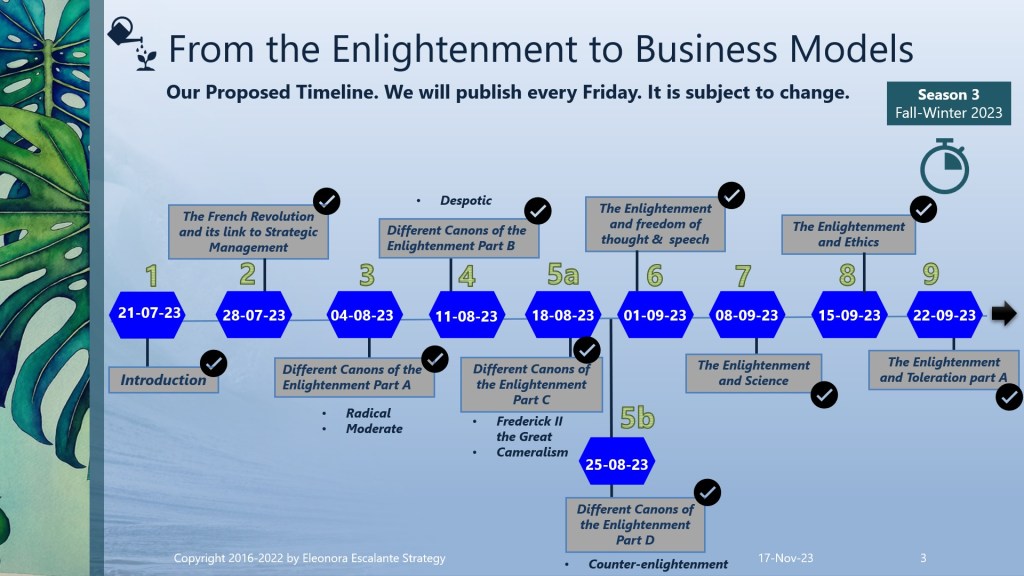
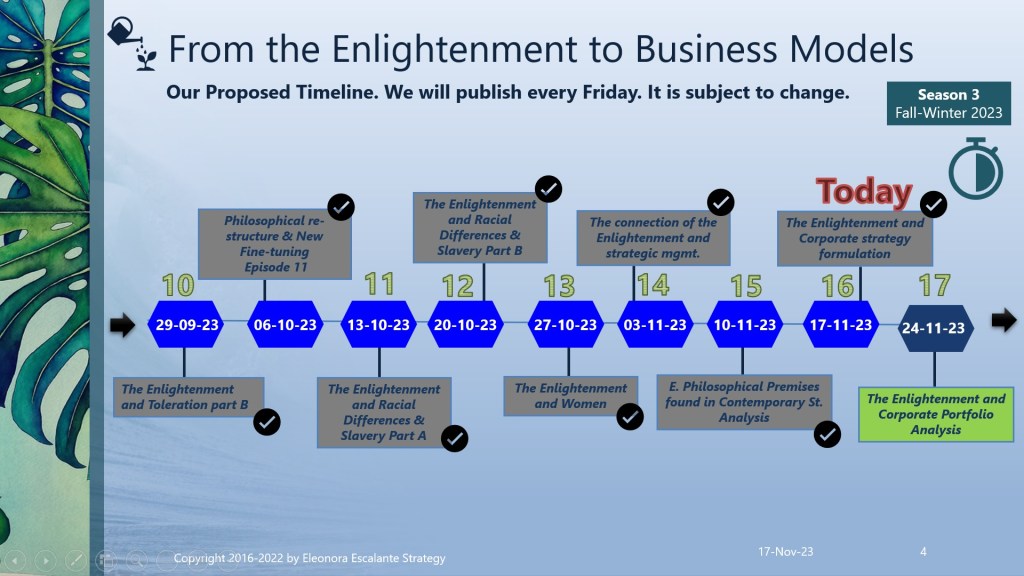
Let´s see our frame of reference. Be gentle enough to pass it on. You can download it, print it, and keep it for your future reference.


Learning to ask questions.
To write this publication, I was compelled to review around 30 books on strategic management that are currently utilized by university faculty professors of management degrees all over the world. My strategic management library is wide and ample. It includes the classics of my field of study, treaties from Sun Tzu, the Bible (it has economic strategic management lessons for everyone, particularly the Proverbs and the Parables of Jesus), management encyclopedias, and all the main strategy textbooks that are used in every university you can think of. As a bibliophile in strategic management, I usually discover different views about the same topics, under different scenarios, distinct understandings, and examples of unalike companies in dissimilar timings.
This saga is academic because it is framed with those who perform academics, and have procured a lifetime of research by writing my “Bibliotheque”. Every time I read a book from my sources of reference; I am humbled by gratefulness. All those books teach me because I ask these authors tons of questions when I am reading them. Don´t be fooled, to read all these authors doesn´t mean that I agree or disagree with their content. It is a partial view within a field of study that is in constant review. The only way I have learned (and I am still learning day by day) to become a strategic thinker is to realize that every single time you get acquainted with a new author, you must start on a “une feuille blanche” and ask him or her questions while studying. Plenty of questions. With that in mind, I have become a state-of-the-art educated person in themes related to corporate strategy, and this mentality gives me the honor to re-evaluate what I read from other authors and create my own logic of theory with certainty for you. Even in the pitiful current context of our digital technological begging era, all that we have explored in relation to strategic management makes me sure of what I am disclosing to you on this website.
This is how I do it. There is no rocket science in what I do. But a lot of training in asking questions. The inquiry mindset is a development process that doesn´t end. It is an accumulated sum of years, a path of figuring out time over time, that allows us to ask even the unthinkable. And mistakes accompany the process. I don´t do it for the sake of fame, or selfish motives. But for contributing to draft an overview of the behemoth trouble that we hold on to our strategic management design, formulation, implementation, and control. I don´t write to please the “strategic management education” industry, and not to entertain any editorial sponsor or audiences for the sake of “making money with my job” either. What I write today is simply the result of years of observations during my studies of many authors who wrote books or papers before me, and have taught me to ask them: questions.

Corporate Strategy Formulation today.
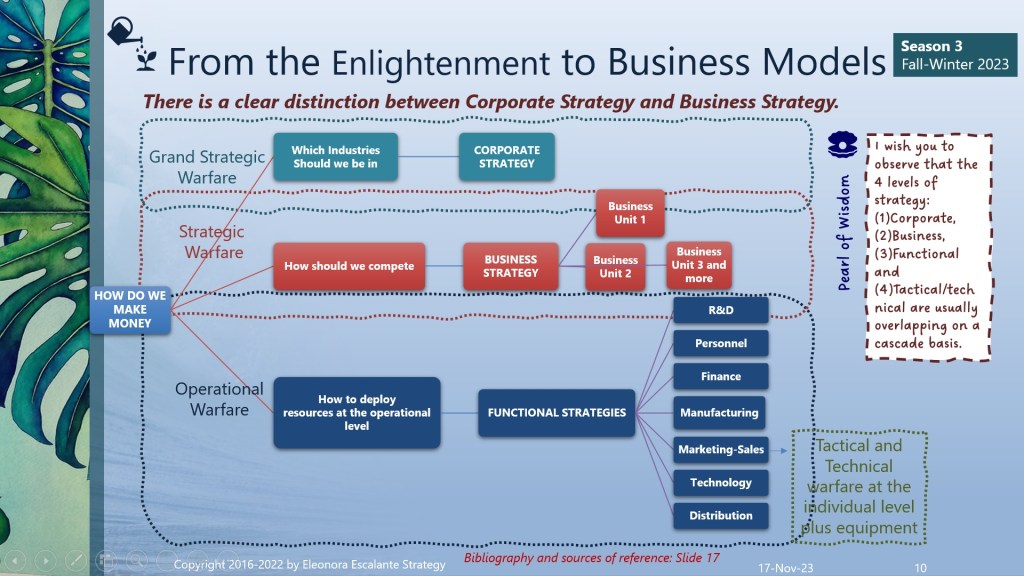
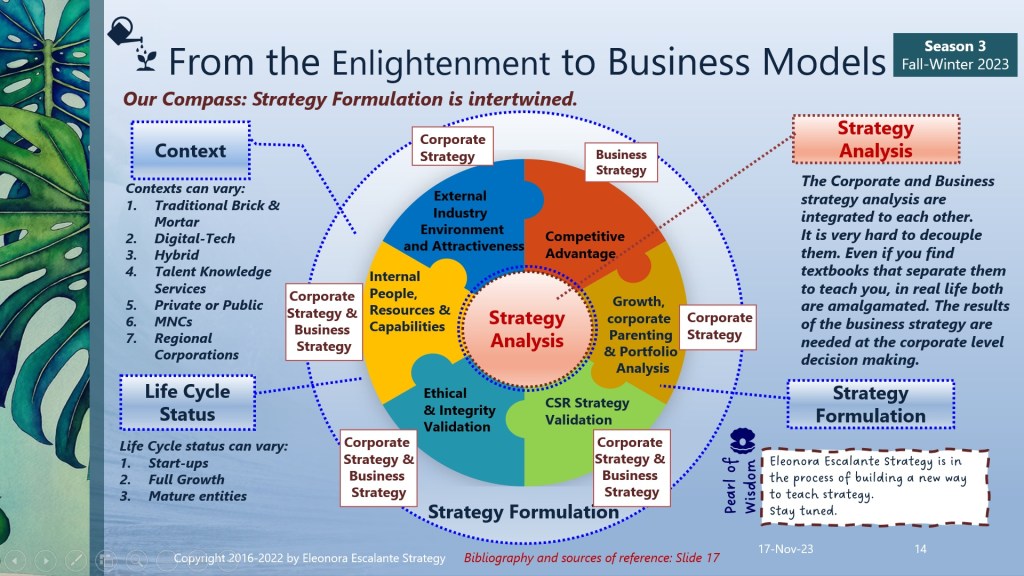
All authors of any good strategic management textbook today have designed their content by separating corporate strategy business strategy and functional strategy. Then once you separate these domains, the strategy formulation at the corporate level is straightforward: what to formulate at the top level of your corporation? Why is it so important to formulate well?
Formulate is a verb of action that comes from the word “formula”. Formulate means to devise or create according to a specified formula or recipe; under a framework of reference that rules or guides our decision making. If you observe this definition, when we formulate something, there are two key notions involved: (1) the belief that there is a formula to follow; and (2) the brackets of boundaries that keep us under a specific scope of decisions.
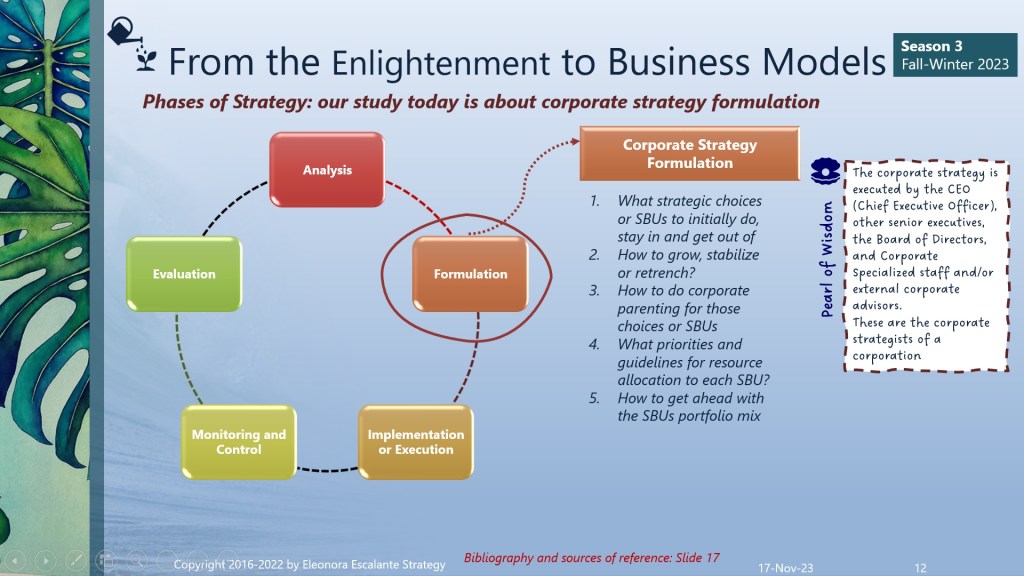
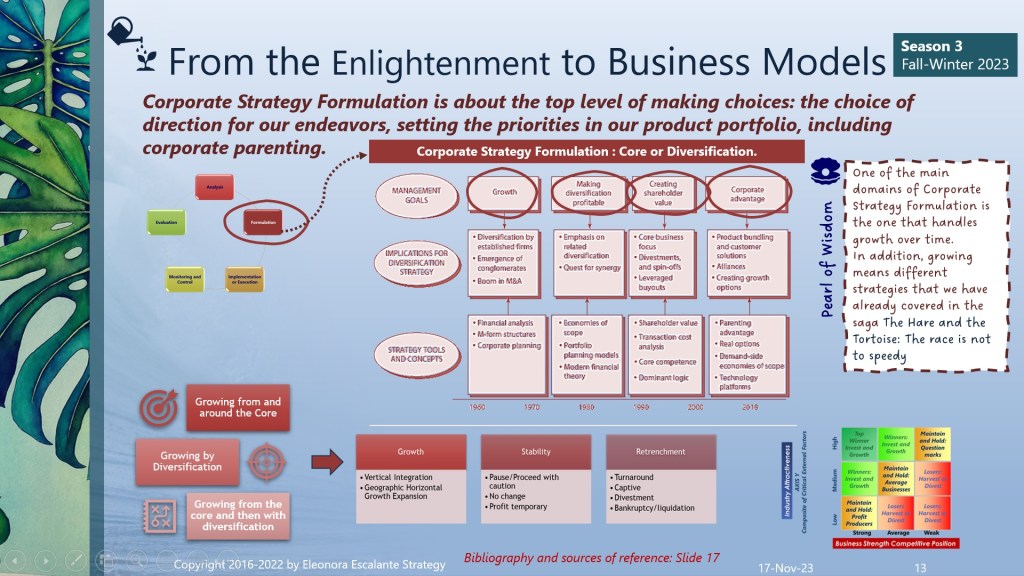
Theoretically, the corporate strategy formulation (based on all these 30 strategic management textbooks) represents two sides of the same coin:
- The art of defining what to do: what choices initially do, stay in, or get out of.
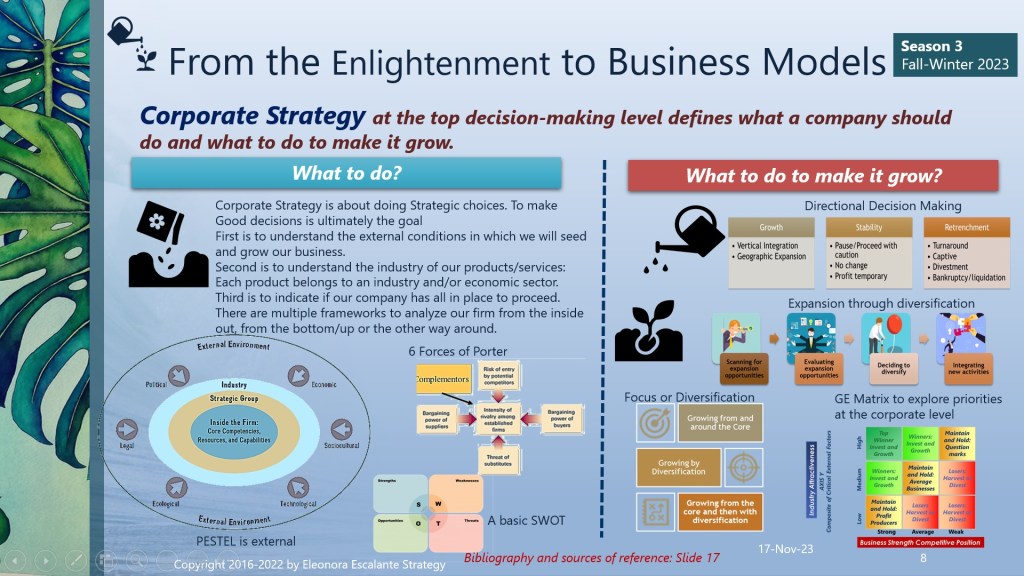
- The art of designing the best formula for the growth of a corporation (growth in terms of economic returns, or a rate of profit above the competitive level), within certain boundaries that are clearly established. When describing growth, we also consider strategies of stability and retrenchment.
Growth has always been guided by a profitable financial measure, and it is formulated and defined in terms of three variables:- Location or Geographical Markets, also called horizontal growth.
- Product Mix: Core, Adjacencies, Diversification, from the Core and then diversification.
- Value Chain Integration: also called vertical growth.
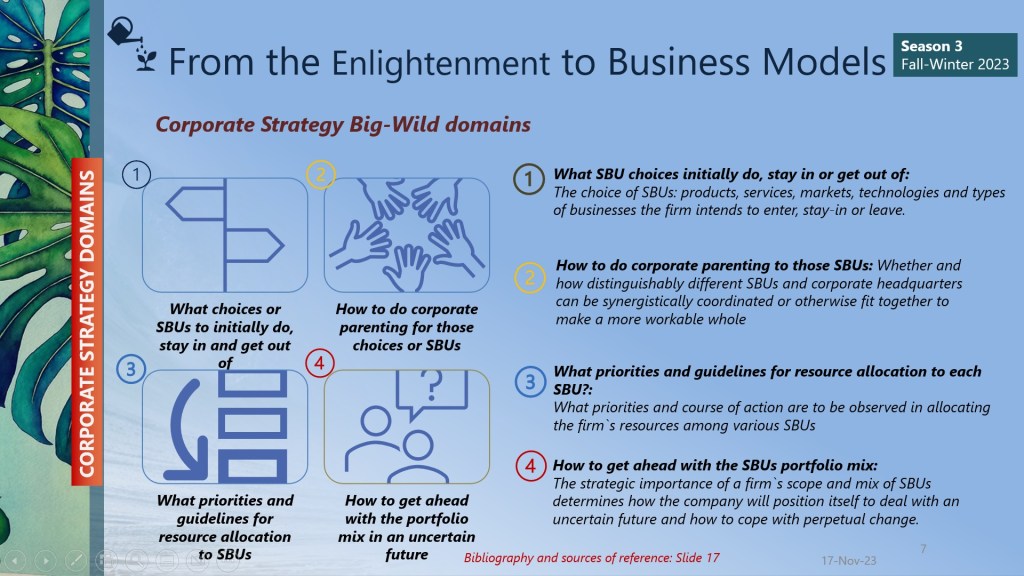
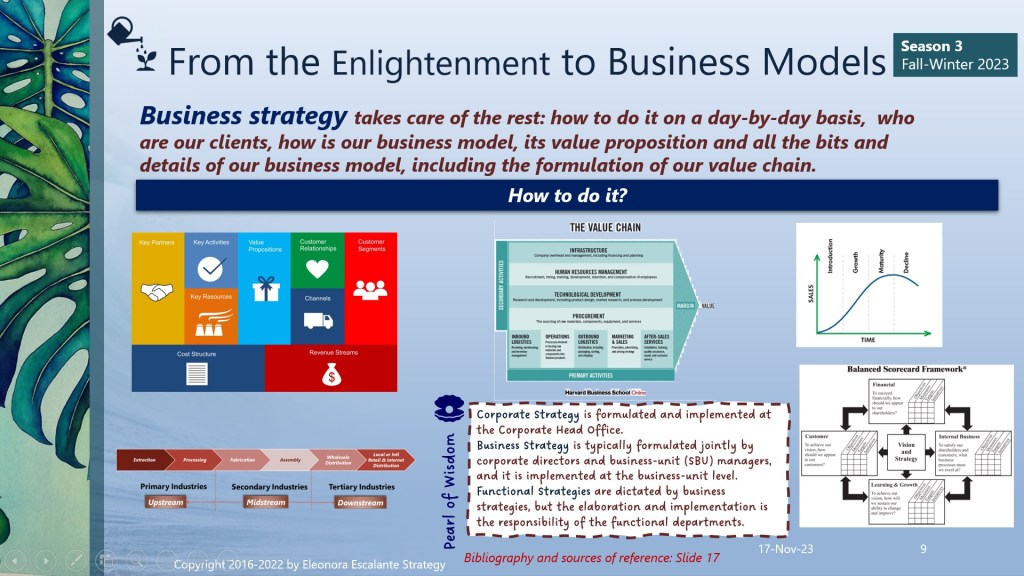
Additionally, corporate strategy formulation includes performing strategic choices of how to get ahead with the products and/or services business units in the format of a portfolio analysis. It also comprises how to pamper or do corporate parenting to those business units, and finally, it embraces decisions on prioritization and guidelines for resource allocation to each business unit. Please look at slides 7 and 8.
To make all these decisions, there are an accumulated number of frameworks that have been invented since the end of World War II, some of these frameworks have been refined and improved, others have been dismissed, and others have been remade under new formats by the same consulting houses that broadened them “officially” to be included in the strategic management textbooks.
I have already written two sagas about corporate strategy which are:
- The Hare and the Tortoise: The race is not to speedy
- Portfolio Analysis: Igniting a long-term spirit in a short-term world.
If you wish to learn the details, we invite you to scroll down on our website and delight yourself in each of our past episodes.
Why is the Enlightenment so crucial when understanding corporate strategy formulation?
It is important because the Enlightenment occurred in the time in which Spain was settling their vast empire in the Americas. Let´s call this mission the colonization of Europa Regina under the Spanish Habsburg´s corporate strategists. The corporation was the “Spanish Habsburg Monarchy A.G.”, and every single action that I have described above when explaining “corporate strategy formulation”, was tested by the monarchs of Spain and their representatives in the Viceroyalties of Spain in America. Everything that I can teach you about corporate strategy, was formulated and implemented by the Spanish Habsburgs between the time of Catherine of Aragon and Joanna the Mad until the last Habsburg monarch (Charles II). This was the first time in history that human beings embarked on such a massive, gigantic adventure of doing corporate strategy in the context of a new paradigm outside the limits of what they knew. It was the first time in history that a little country like Spain, with the help of Portugal, discovered resources of such a size that changed everything: the understanding of humans, and the deliberation of who was human according to race, the foundations of wealth based on the lowest of the inferior thoughts that human could have ever conceived: the idea of using slavery of other human beings as the main tool for creating prosperity. As we have previously studied, slavery has been an accompaniment of human civilization, slavery existed, before the idea of racism took place in our history. However, it was during the Enlightenment that slavery became an essential part of the value chain for the production of riches. Women were also used as objects of desire and canons of growth, stability, or retrenchment, even at the royalty level. Not even Catherine of Russia was truly respected by the rest of European monarchs, and don´t expect the rest of European Princesses or queens to have been considered as fountains of literacy and political empowerment either. During the Renaissance and the Enlightenment periods, women at the corporate level of the monarchies were objects of arranged matrimonies, sometimes used as a defensive tactic to keep the strategy of warfare away between nations. Several royal families arranged the marriage of their princesses, and it was a “match” made to keep Europa Regina and the new colonies safe. Of course, the British and the French crowns were the buccaneers, the pirates against the Spanish Crown territories, these were the followers who arrived second or third accompanied by merchant companies. The idea of the transatlantic trade slave system for the plantations, the strong royal initiatives for making it function, other strategic alliances with other royal houses (for example the Glorious Revolution and the active participation of the United Provinces of the Netherlands in this), and tons of religious migrants who established themselves against the natives, for a successful a growing European presence against Spain.
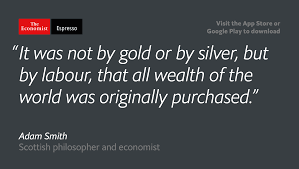
In conclusion, the corporate strategy formulation origins (as we know it right now), proceed to the Enlightenment (a bit before, I would say, as of 1492). The expansion and dominium of Spanish America is a singular key event in the history of strategic management. The roots of how labor was defined, organized, and arranged in the pre-industrial stage between the 15th and 18th centuries by the first Enlightened Italian and Scottish economists modified the course of history as it has been known. All the details of capitalism and socialism as political systems driven by the interests of the merchant class and the existing monarchies of that time can only be explained by the way the Spanish Habsburgs left their mark on the New World. None of the movements of Britain or France in the New World was isolated. They joined the “piñata” of colonization after Spain. Spain threw the first stone. The rest followed and competed for a piece of what Spain discovered. It was a competitive strategy that resulted in a reaction to what the Spanish empire did. So, please, if economists and business strategists do not know all the details of how the new World was conquered and extended, whatever we are doing now, is going to replicate the same premises of 500 years ago, even before capitalism or socialism began. Our corporate strategy formulation requires a deep and serious study of the past, many issues that we still have not explored academically with all our capacities in the history of management. Yet.
How can we humanize and renew the theories of corporate strategy and business strategy for the future? How can we include love, integrity, well-being for people, and caring for the planet?
None of the existing political economic systems was rooted out of love for human beings.
It was a corporate strategy formulation for making money by exploiting other human beings, to deliver funds that could be available to pay for war, and conquests of more resources. It was a formulation in which violence was the norm. Something out of violence is difficult to repair, but it is possible. Out of the darkness, there is always a light of hope. Some countries with higher ethical standards have tried to keep the best out of capitalism, under a human solidarity framework for doing business that allows robust social systems that keep education with higher standards, free amazing medical care, and sharing of profits for the employees. The entrepreneurs in these countries have solid ecosystems that help them thrive. It is not by coincidence that these countries are always caring for the environment. Communism (in my own view) has not been successful because it puts down people and impoverishes those who are trying to rise privately by their own merit, while the “father State” is difficult to control in matters of corruption. In this context I wonder, how could we conceive to conquer the Space, using the same old wrong premises that have created the mess in which we live?
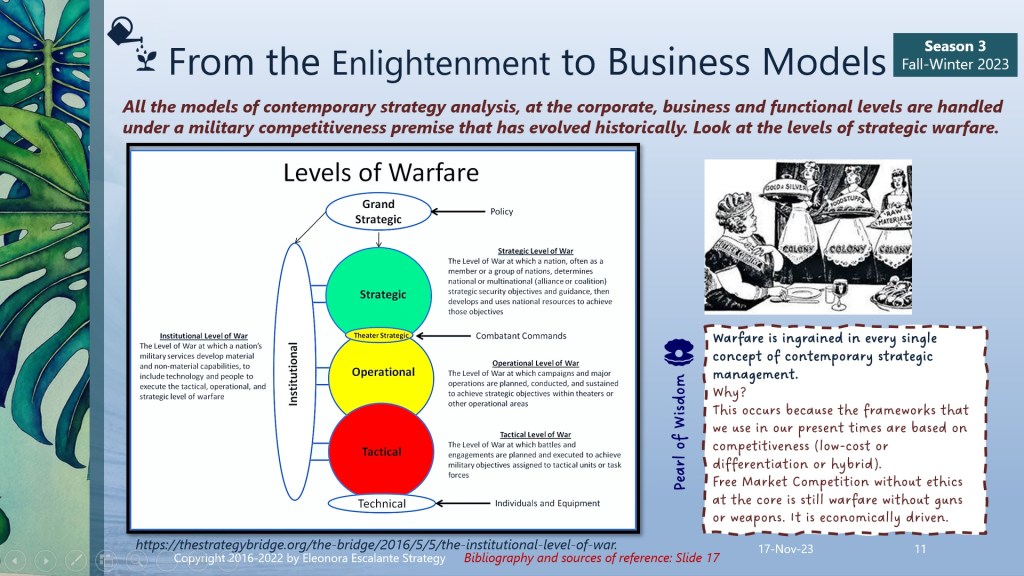
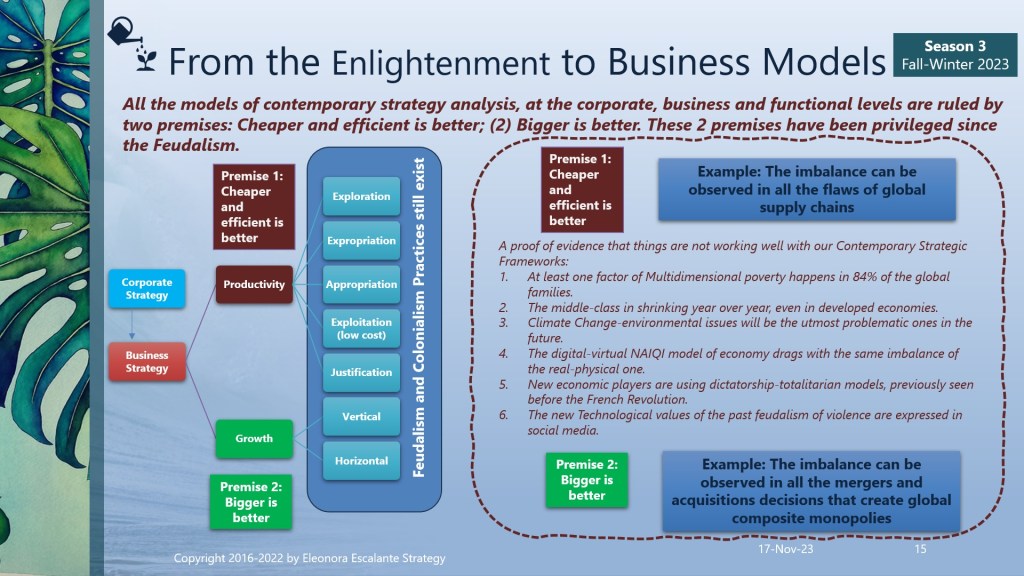
The Spanish America region, Africa, India, and some areas of Asia are still living with features inherited from feudalism and the colonies. Still today. What could be the corporate strategy formulation for the economic development of these regions? I am sure the question mark is open… but what annoys me the most, is not that one side of the world was able to flourish using the competitive advantage of their own warfare. What annoys me the most is that we are going back to feudalism using the business models of the NAIQIs (Nanotech, Artificial Intelligence-including robotics and automation, Quantum power, and the Internet). We are creating a civilization of digital beggars, in which all of us are “content creators” expecting to attract audiences and sponsorships (from advertising fees or merchandise). This new economic model of society is not ethically correct. It is not economically valid. And it is not socially and psychologically accurate either. “Online plea for donations kills the appreciation of our endeavors, it reduces the self-esteem and destroys the confidence and empowerment of the digital beggars, situating them at the same echelon as someone who mendicates for coins on the streets”. An economic system that kindles digital online begging within the intellectuals, the artists, the youth, and the poor is not only totally misleading but unfortunately wrong.

“Online plea for donations kills the appreciation of our endeavors, it reduces the self-esteem and destroys the confidence and empowerment of the digital beggars, situating them at the same echelon as someone who mendicates for coins on the streets”. Eleonora Escalante
Announcement.
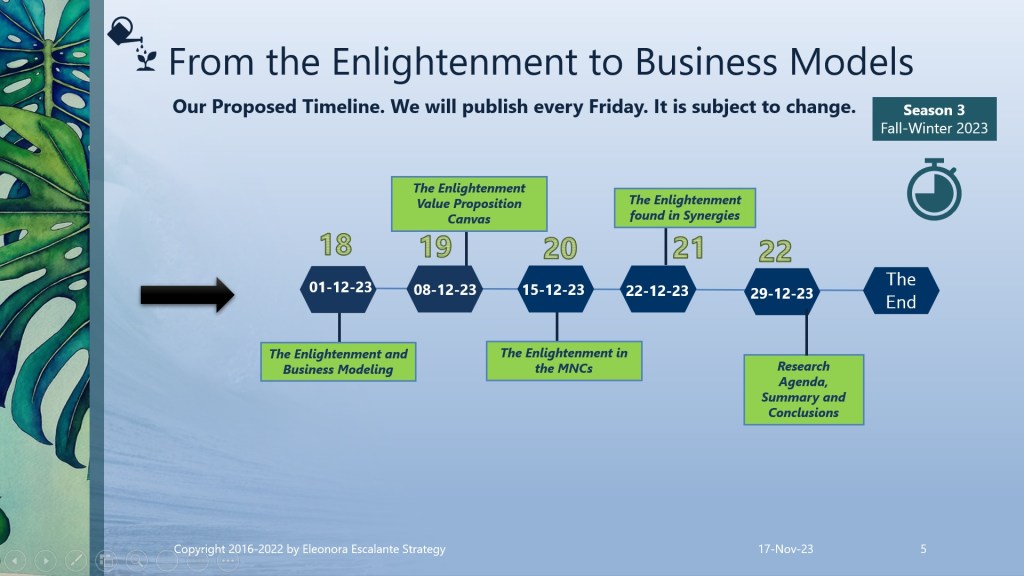
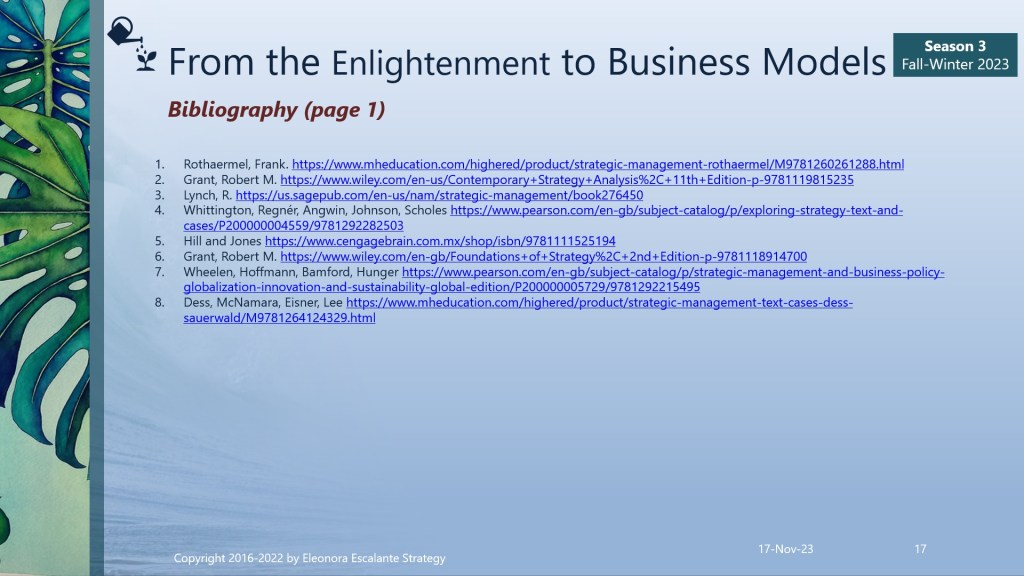
Adorable readers, we appreciate your desire to learn by doing your own strategic reflections over the weekend. When I do not publish the strategic reflections on Fridays, it is because I need a true short interlude because new ideas have inspired me today, beyond the boundaries of the framework of reference (the package of slides). During the weekend, it is important that you read the slides, ask yourself questions, and then search for additional information in our bibliography (slide 17). Then on Monday, you can compare your reflections with ours. That would be the only way that you will learn to practice. The following episode (to be published next Friday 24th of November) will be “The Enlightenment Uncovered in Corporate Portfolio Analysis”. Blessings and thank you for reading our episodes.

Musical Section
This week we will continue with the affable melodies coming from the trumpet winds of the Baroque.
Today´s concerts are from Giuseppe Torelli (1658-1709), an Italian violinist virtuoso who was also a composer. It is a CD from Brilliant Classics uploaded on the YouTube channel DrammapermusicaS. Torelli´s compositions served as an essential link in the evolution of the concerto grosso and “the solo concerto”, for strings and continuo forms. “He was also the most prolific Italian composer for the trumpet, with some three dozen pieces, variously entitled sonata, sinfonia, or concerto, for one, two, or four trumpets. His works were published in eight collections of concertos, sinfonias, and sonatas, all appearing chronologically”. The interpreters are playing in the European Chamber Soloist with Nicol Matt [as conductor], Thomas Hammes [trumpet], and Peter Leiner [trumpet].
Thank you for reading http://www.eleonoraescalantestrategy.com. See you next week.

Sources of reference that were utilized today. Look at slide 17.
Disclaimer: Eleonora Escalante paints Illustrations in Watercolor. Other types of illustrations or videos (which are not mine) are used for educational purposes ONLY. All are used as Illustrative and non-commercial images. Utilized only informatively for the public good. Nevertheless, most of this blog’s pictures, images, or videos are not mine. I do not own any of the lovely photos or images unless otherwise stated.
 Eleonora Escalante Strategy - Strategic Reflections Think Tank