
From the Enlightenment to Business Models. Season III. Episode 18. The Enlightenment found in the Business Modeling Canvas and the Value Proposition
A new December month has arrived in our lives. We welcome this advent epoch with a cherished attitude and positive emotions. Christmas is coming and it is a motive of delightful rejoicing.

Our weekly work for today´s publication is synthesized in the following slides. Please look at them. Share, print, or download this material as a framework for further analysis.

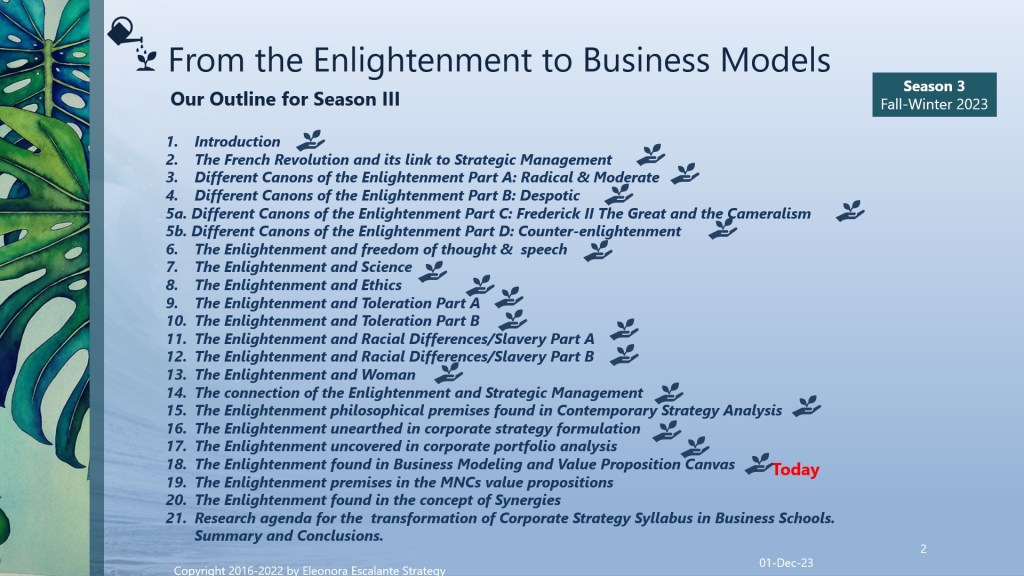
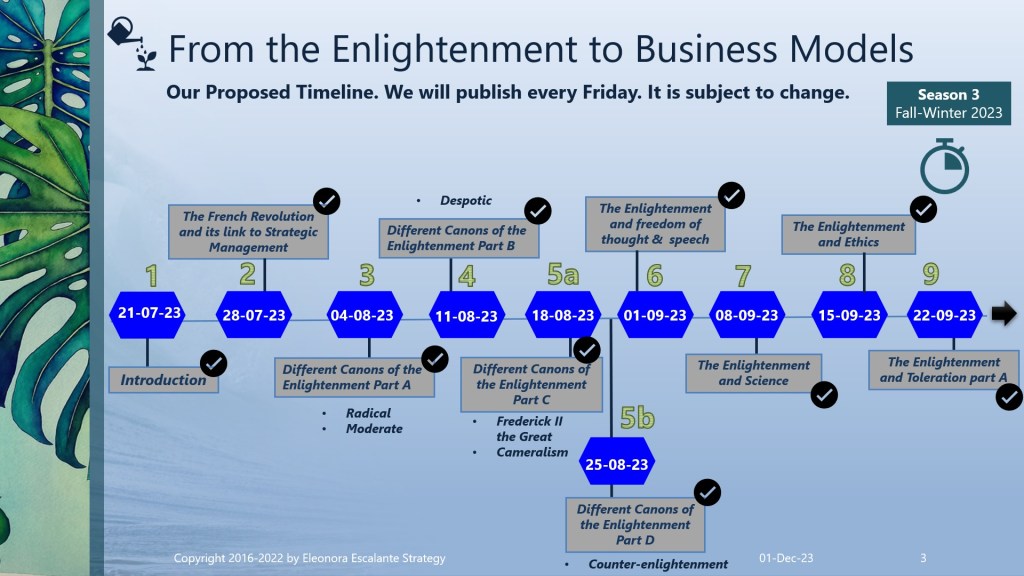
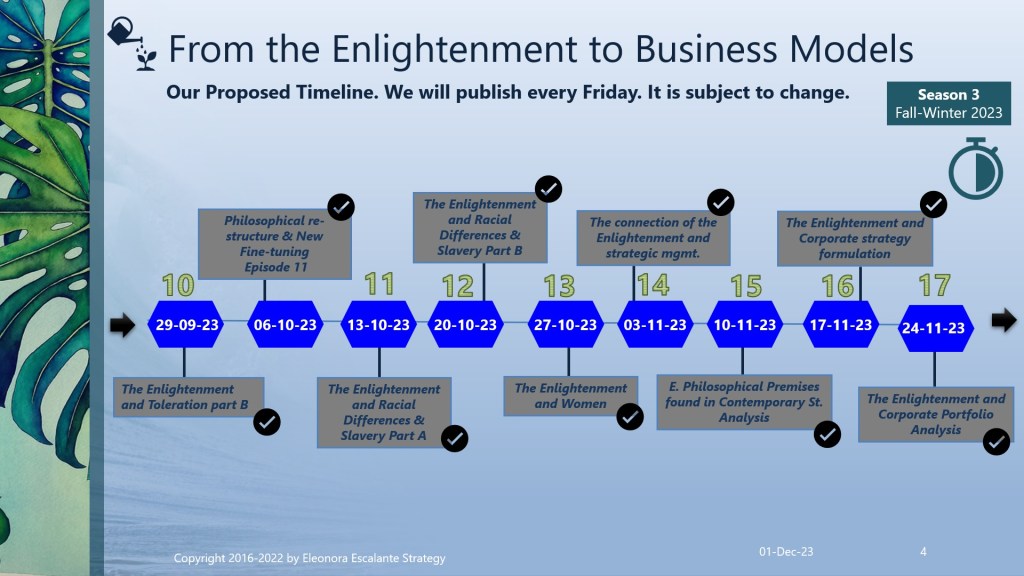


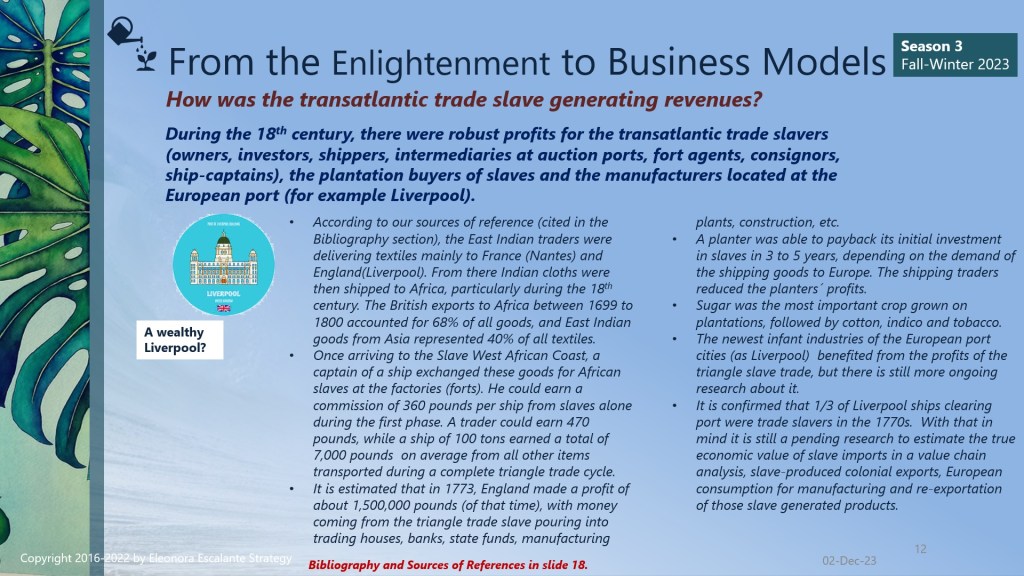
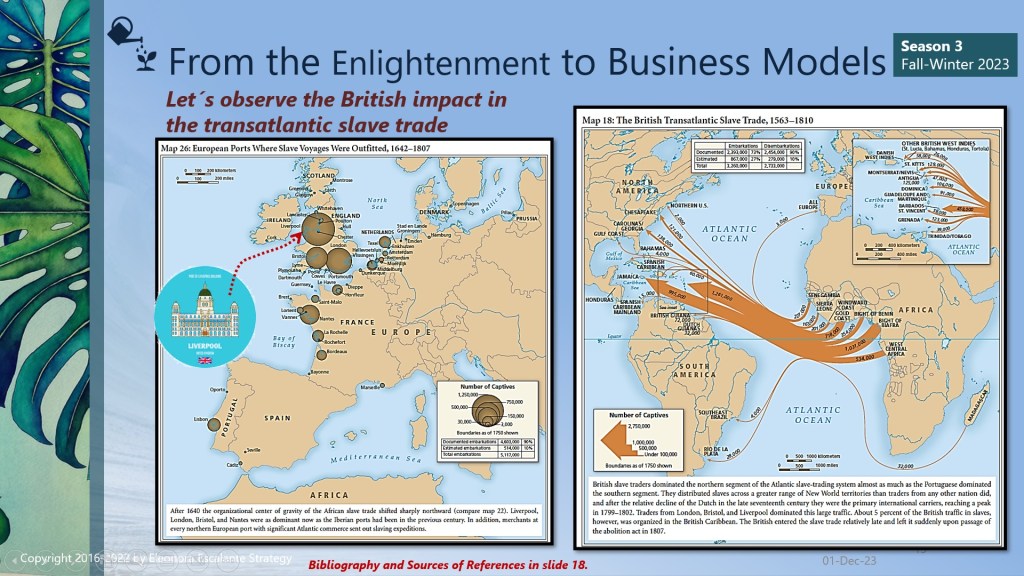
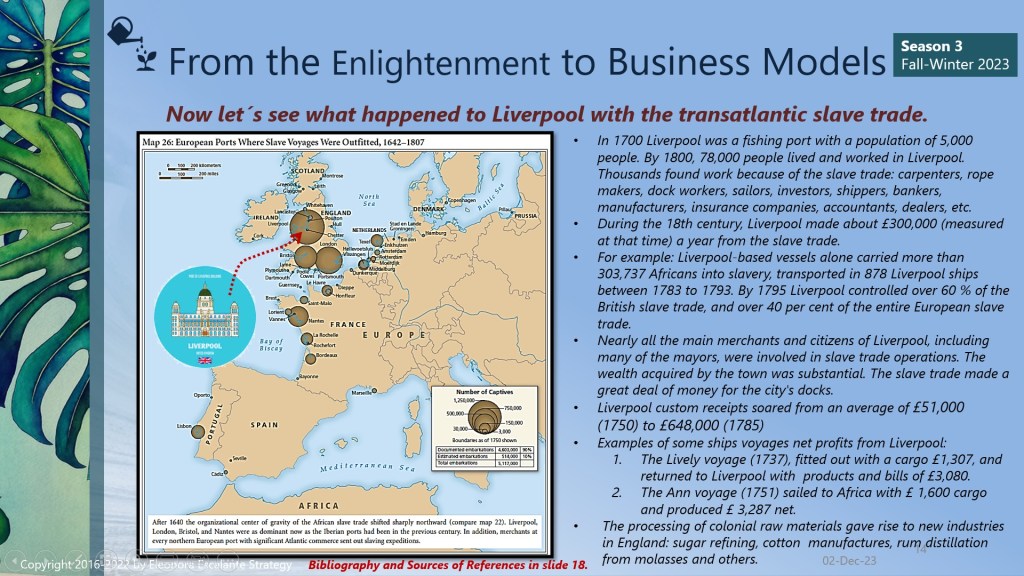
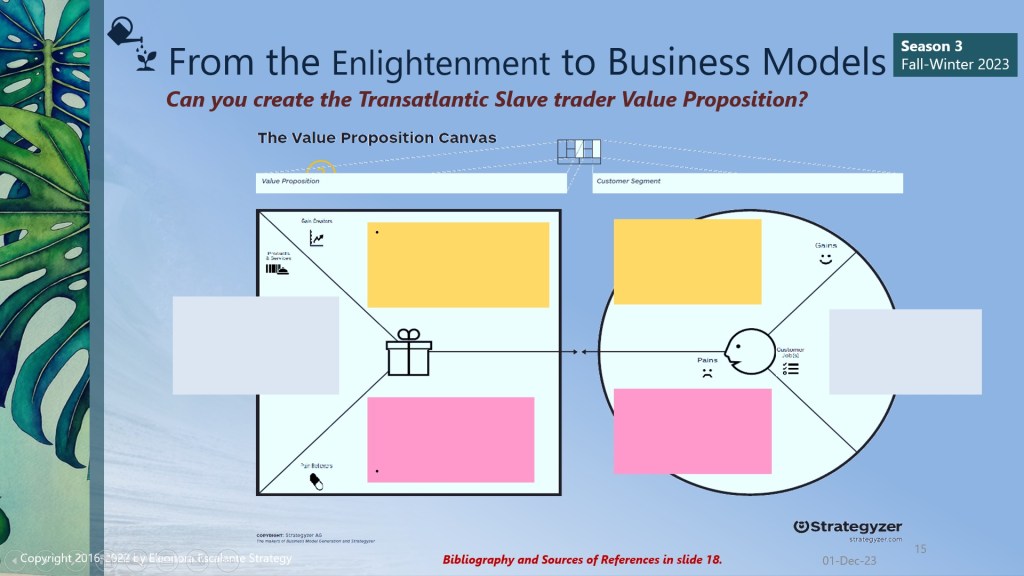
The cradle of business modeling is positioned in the Enlightenment period.
The business model canvas framework is a strategic management tool that has already been covered in our past publications. I dedicated several weeks to developing a component of the business modeling canvas, the essential “Value Proposition”, which was the first saga I wrote in the year 2017 when I started with the efforts of Eleonora Escalante Strategy. If you wish to do a reminiscence of it, I encourage you to visit the first episode of 15 publications and follow through our website:
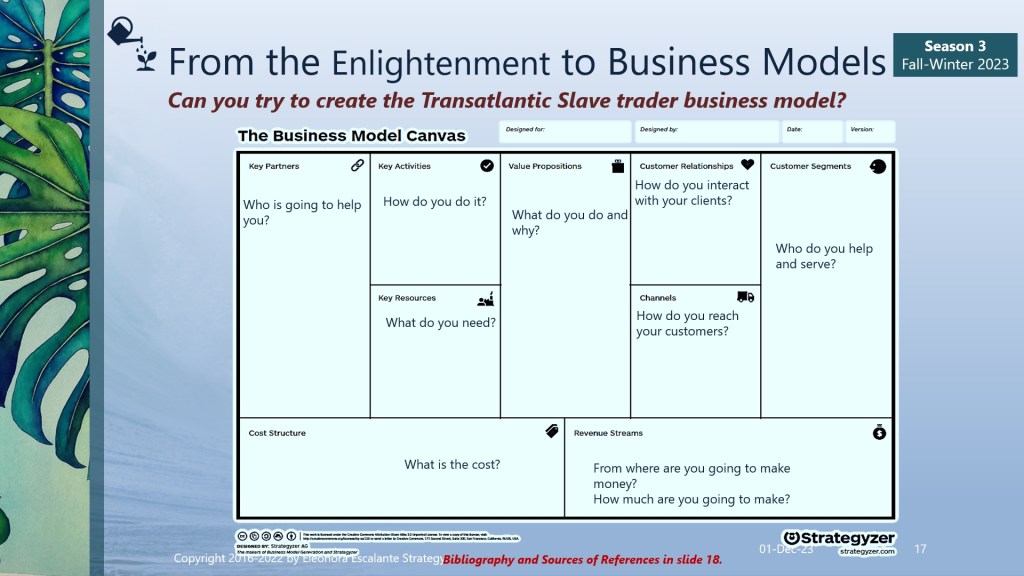
The framework of the business modeling canvas is defined by Osterwalder & Pigneur (2010), as “the rationale of how an organization creates, delivers and captures value”. It captures the essential elements that every strategist should contemplate when asking the question of how to deliver value to clients with an innovative approach.
Now let´s go back in time to the end of the 16th century, when slavery began to flourish in such a way that was tied as a key resource for the whole stakeholders´ chain of transatlantic slave traders, by the merchants, by the plantation business owners, by the royal houses of Europe, and by most of the new industrialists who were directly involved to use slave labor force as a competitive advantage to create prosperity and wealth for their nations. The reason why we have chosen the transatlantic slave trade has two nuances:
- It was the first time in history, that the European societies decided to use the discovery of new territories for global trade. According to Adam Smith, in his own words, “The discovery of America and the Cape route to India were the two greatest and most important events recorded in the history of mankind”. For Smith “the trade raised the mercantile system to a degree of splendor and glory which it could never otherwise have attained”.
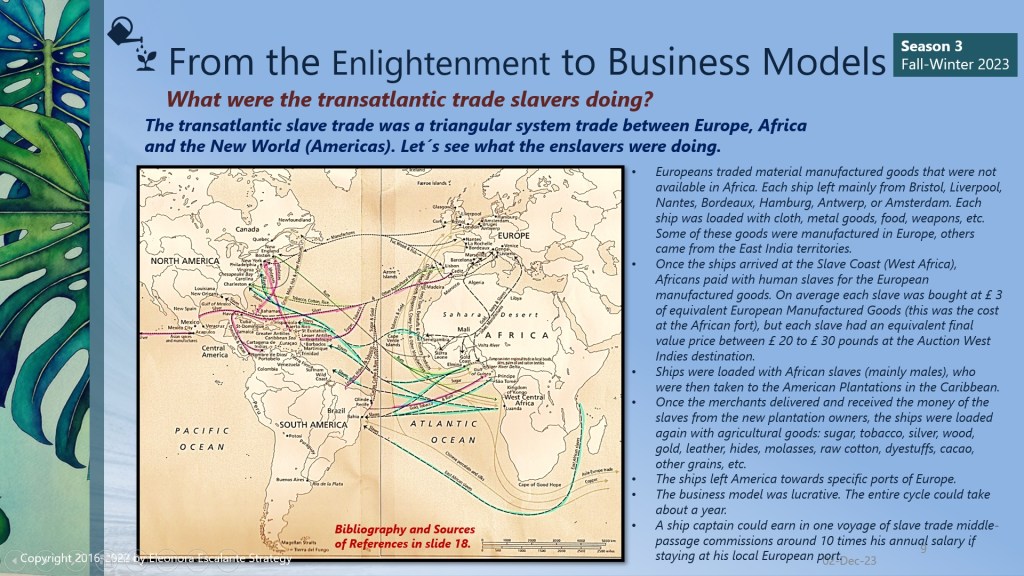
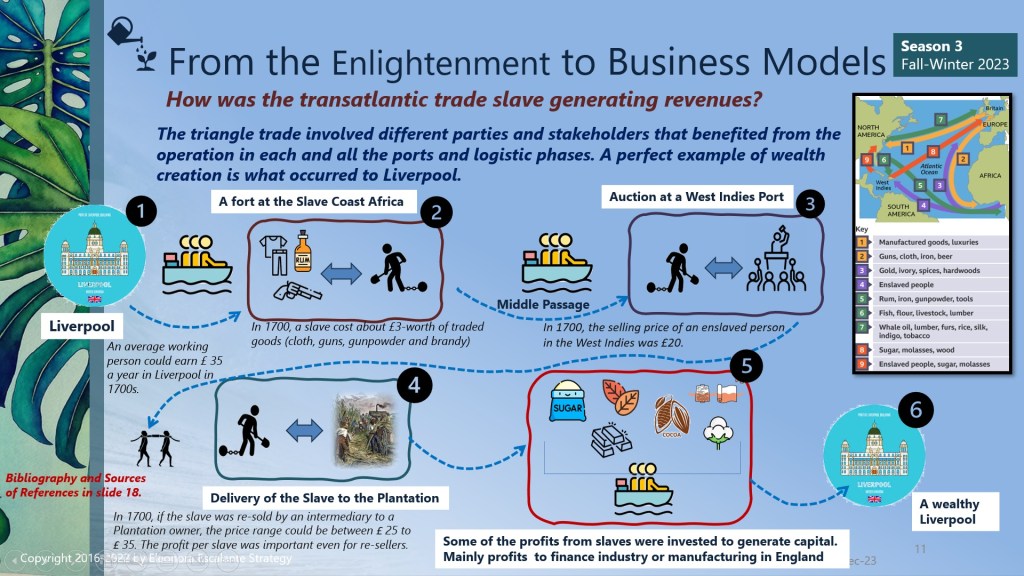
- The second distinction is directly devised as intrinsic (or fundamental) to the success of the merchants’ international trade of the English, Dutch, Portuguese, Spanish, and French during the Enlightenment period. All the businesses created during these centuries were linked to the transatlantic trade system. For example: the plantations in the New World relied on enslaved labor (with an advantageous cost structure) that allowed them to minimize costs and generate more profits for the European traders. Slavery was the fundamental factor that disrupted the whole economic cosmovision of the epoch, supported not just by the Royal administrations, but also used by independent slave traders, merchants, buccaneers, and opportunistic smugglers for more than 400 years. The conceptualization of massive labor industries at low cost was executed in the Americas with several agricultural or mining products: cocoa, sugar cane, cotton, wood, silver, gold, copper, wood, dyestuffs, other grains, etc. This was the first time that Europeans could handle profitable endeavors with large-scale and massive slave labor. The cycle of logistics was working phenomenally (see slide 11). Slavery as a key differentiation variable for reducing production costs was the goal. This corporate strategy was clearly settled during the 17th century in North America, even though in the Caribbean and Brazil, the method was already designed, implemented, corrected, and proven 2 centuries before. Remember: the first sugarcane plantations were founded in 1503 in the Caribbean, what is now Venezuela and Northern Brazil; because the climate and location were privileged. The plantation society began then. So when Britain penetrated fully during the 18th century, the business model was already completely proven by the rest of the empires.
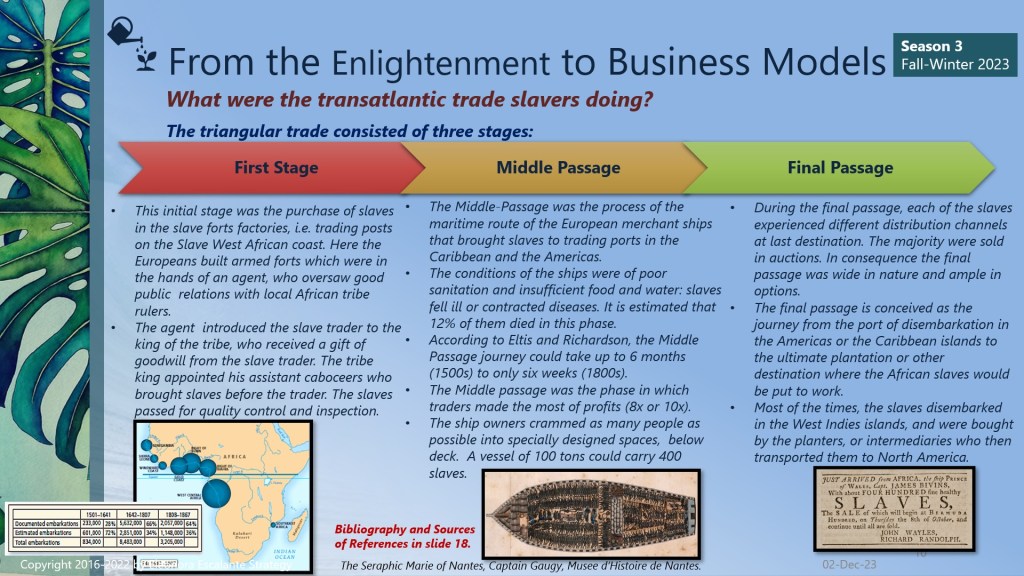
In summary, colonies in Spanish and Portuguese America developed the most profitable low-cost production business model with large-scale plantations using enormous volumes of slave labor. Please take a look at the amount of slaves transported for these plantations (1) in the table below. Regardless of these absolute numbers (it could be more or less), we want you to remember that it was during the 18th century that most of the slaves from Africa were traded and transported to America (7.5 million of a grand final total of 12.5 million). See slide number 10.
| Colonies Region | Number of Slaves Transported | Enslaver European Country |
|---|---|---|
| Jamaica and Barbados | 2,763,000 | Britain |
| Brazil | 5,530,000 | Portugal |
| French Caribbean Islands | 1,328,000 | France |
| North America | 500,000 | Britain and France |
| Spanish America | 1,591,000 | Spain |
The transatlantic slave trading system.
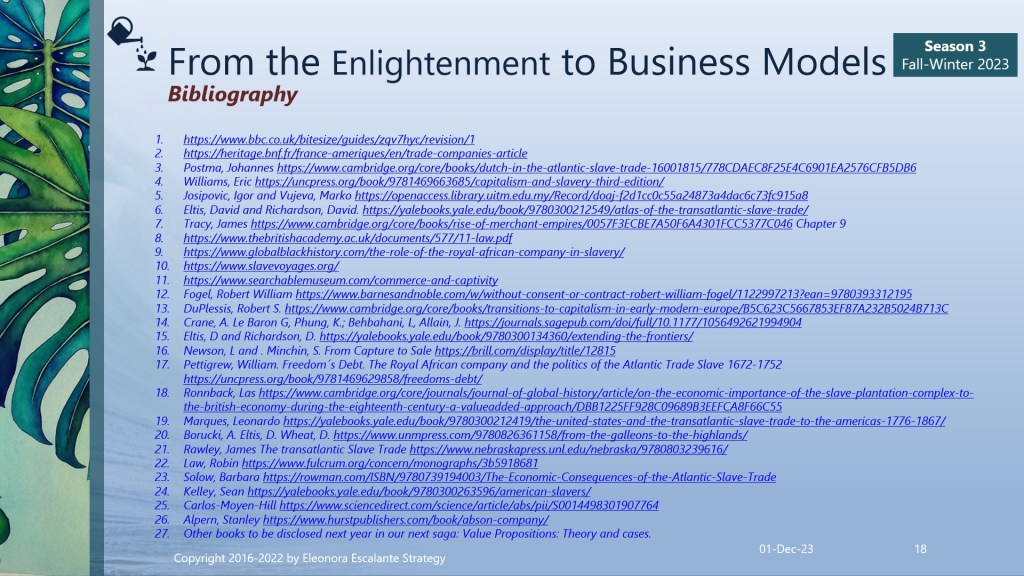
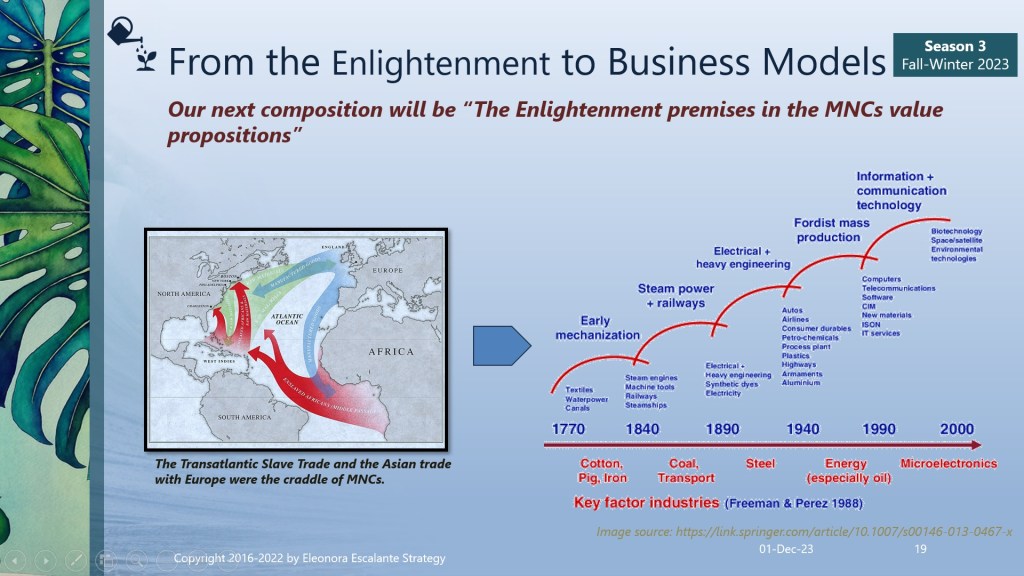
Given that the transatlantic slave trade studies have been an enormous task for academic researchers during the last 30 to 40 years, the piles of literature (books and academic papers) are also of behemoth proportions. We have only selected 30 books (see slide number 18), those references that we perceive to be the most relevant ones: Be aware there are at least three times more bibliographic sources that deserve to be read with careful consideration. Our first observation: the transatlantic triangle slave trade is not so triangular. It can´t be studied in isolation from what was occurring in Asia, when all the empires were trading with India, China, and the rest of the Asian countries. The Dutch, French, and British were busy in Asia while they were trading slaves from Africa in the Atlantic. These empires were able to work globally using the East imported product revenues, to then trade slaves with the West.

The analysis of the business model (and value proposition) for the transatlantic slave merchant traders businesses.
Last Sunday, we decided to make a public announcement: we will produce a new saga about value propositions for the Spring Season of 2024. At the same time, we will elaborate our outline considering a different approach on how to learn the art of designing value propositions. We have decided to use the transatlantic slave trade as the kicking-off example of the theoretical explanation of how to develop value propositions and business modeling. We will also provide plenty of current examples of the 21st century, and we are delighted with how is going to be. Since we have already promised a chronicle of “A Glance to the Foundation of Business: Women, Warfare and Slavery”, we decided to include some of these views or elements in the first example of the value proposition about the transatlantic slave trade. So, there is amazing content coming for you.
So, the transatlantic slave trade value proposition will be the initial case for the theoretical depiction of the next saga: “Value Propositions: Theory and Cases”. Please wait for the outline that will be shared on the 22nd of January 2024. You will grasp the beauty of understanding how to do value propositions with a historical case of the 18th century, and then we will create at least 7 more value propositions of different existing companies from distinct economic sectors/industries of the 21st century. As usual, expect the unpredictable.
The Enlightenment Premises of Trade and Commerce.
Finally, since we are approaching the end of season III of “From the Enlightenment to Business Models”, we can´t close this saga without mentioning that every single element of how we do business modeling today has its origins or is linked to the philosophy of trade that was installed in our civilization brains during the Enlightenment. The merchants of the ports of Amsterdam, Liverpool, Nantes, London, Bristol, Lisbon, Habana, La Rochelle, Recife, Le Havre, Bordeaux, Rhode Island, Middelburg, Seville, St. Malo, and Cadiz, and the Brazilian Rio de Janeiro and Salvador da Bahia; are the proofs of evidence or the verifications of how the slave-trading voyages were organized between 1501 to 1867. Our mentality of doing business today has been encouraged using the rationale of that epoch. Certain aspects have evolved for the better, but still, millions of people are working under “modern slavery” terms.
Slavery relates to “societies based on slave labor. In a slave society, a slave is a person owned by a slave owner and forced to work for him for no payment in return. The state of deprivation of personal freedom is total, and the person is completely dependent on the slave owner, losing personal sovereignty (1). A slave is not able to fulfill his or her personal dreams because his/her life belongs to the slave owner’s priorities and agenda, and that is the lack of freedom we are talking about. Economically, the forfeiture of a slave life is worse than evil, it is madness!

The utilization of slave labor was the most radical of the key resources used since the Spaniards and Portuguese discovered the New World.
But the cherry on top of the ice cream, in terms of slavery, arrived with the strategic economic decision-making taken by the Stuart monarchy, in England, when the the royal family allowed and chartered the slave trade foundation of commerce for the Company of Royal Adventurers, which initiated operations in 1663. This company was “the model to advance the trade of England with that of any other company even that of the East Indies”. After several conflicts with the Dutch, the British Company of Royal Adventurers trading to Africa evolved to become the “Royal African Company” (RAC) in 1672. According to the site http://www.slavevoyages.org, the two most important trade companies of African Slaves were the British latter one, and the Dutch Nieuw West Indische Compagnie (With the Acronym GWC or Geoctroyeerde Westindische Compagnie), followed by the British South Sea Company. See slide number 8.
The British RAC and the Dutch GWC were the two major slave-trading enterprises in our history. However, the Portuguese were the pioneers of the slave trade of the 16th century, when they established sugar plantations in Brazil, using enslaved Africans too. All the statistics will be carefully reviewed by us during the following months, to offer you a complete analysis of the transatlantic slave trade business modeling next year.
This is it for today. We hope you are now more curious than ever to continue reading our work during the subsequent year.
Announcement.
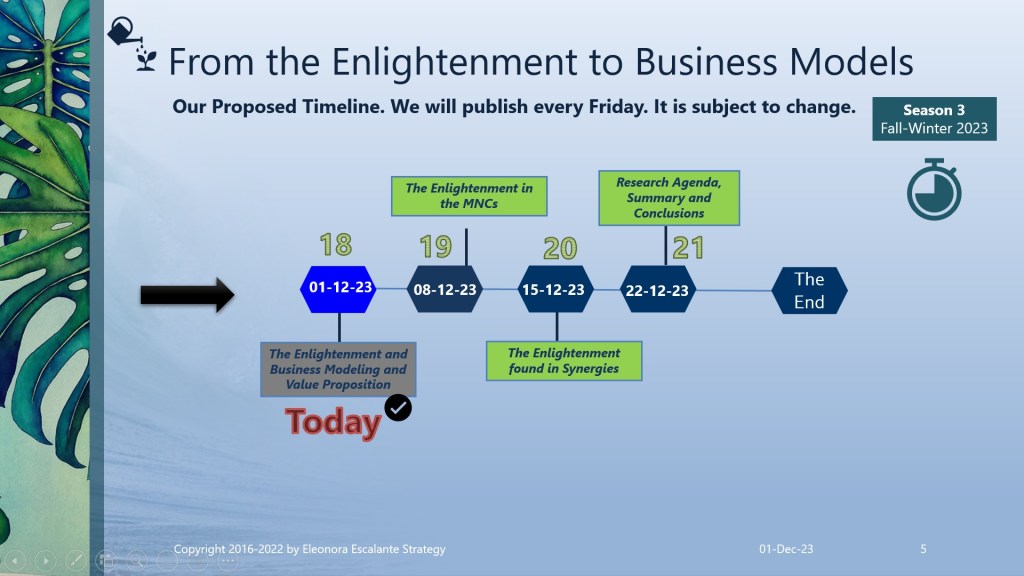
Adorable readers, we appreciate your desire to learn by doing your own strategic reflections with us. This weekend and the next two are the last ones of this saga. So I won´t leave you with homework for the rest of 2023. The following episode (to be published next Friday 8th of December ) will be “The Enlightenment Premises in the MNCs value propositions“. Blessings and thank you for reading our episodes.
Additionally, we announce our next saga of Spring 2024: “Value Propositions: Theory and Cases”.

Musical Section
This week we will continue with more oboe from the Baroque period.
Today´s concert was composed by Johann Sebastian Bach. The Artists: Andrius Puskunigis (oboe and oboe d’amore), Simona Venslovaite (violin), Saint Christopher Chamber Orchestra. Donatas Katkus (conductor). The video has been uploaded by the Brilliant Classics YouTube channel.
Thank you for reading http://www.eleonoraescalantestrategy.com. See you next week.

Sources of reference that were utilized today. Look at slide 18.
(1) Josipovic, Igor and Vujeva, Marko https://openaccess.library.uitm.edu.my/Record/doaj-f2d1cc0c55a24873a4dac6c73fc915a8
Disclaimer: Eleonora Escalante paints Illustrations in Watercolor. Other types of illustrations or videos (which are not mine) are used for educational purposes ONLY. All are used as Illustrative and non-commercial images. Utilized only informatively for the public good. Nevertheless, most of this blog’s pictures, images, or videos are not mine. I do not own any of the lovely photos or images unless otherwise stated.
 Eleonora Escalante Strategy - Strategic Reflections Think Tank