
From the Enlightenment to Business Models. Season III. Episode 19.The Enlightenment Premises in the MNCs’ value propositions
A lovely weekend of December is unfolding. Joyous advent winds of happiness for all. We have prepared our guideline material for this 19th lesson. Let´s see the following slides. You can share, download, and print them if you wish.




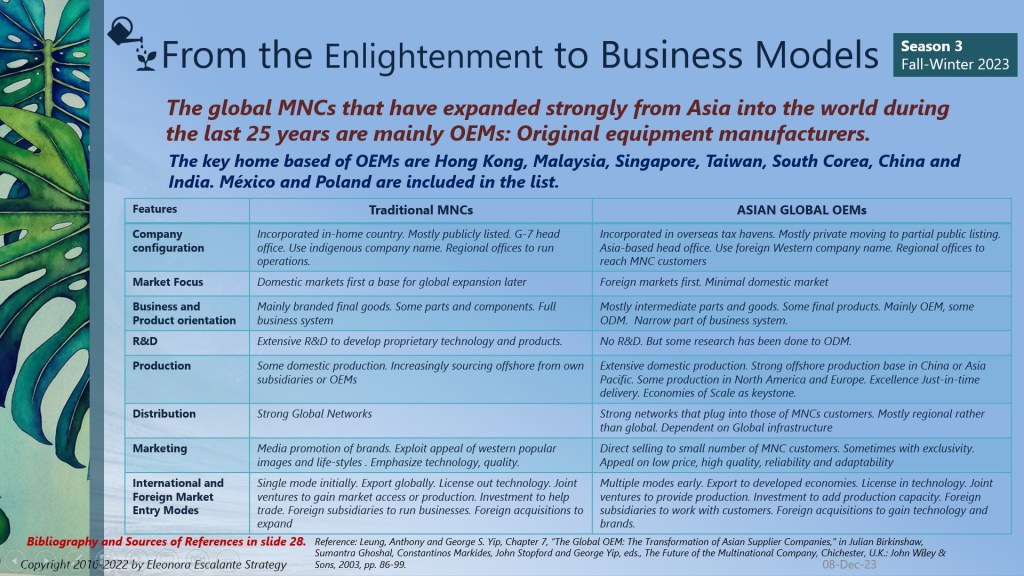
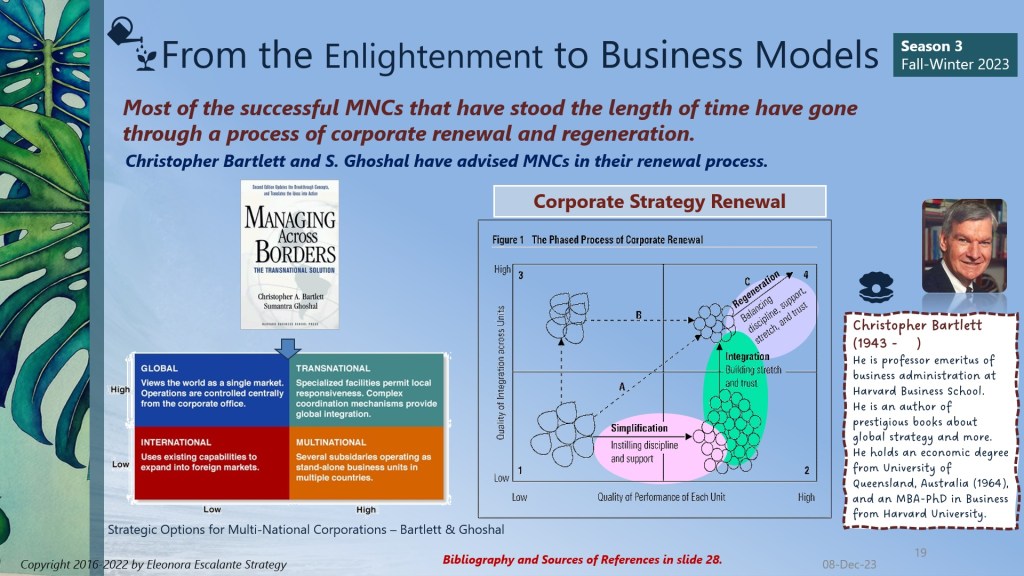
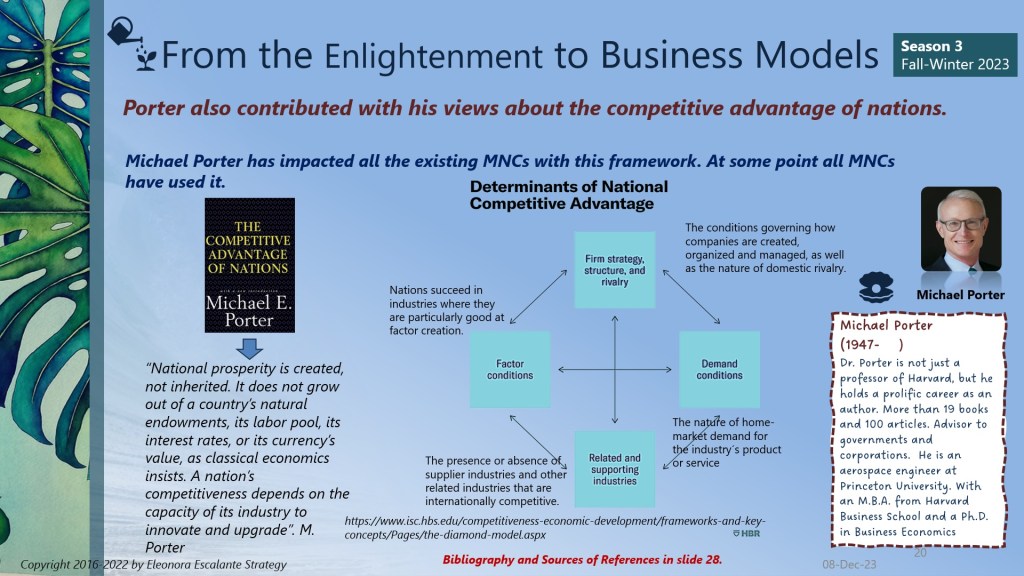



On point.
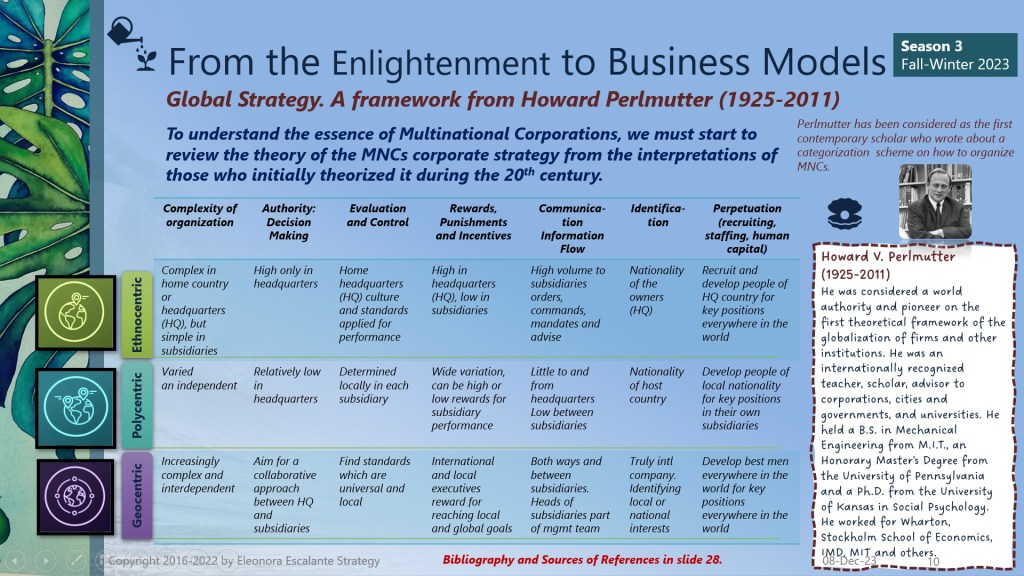
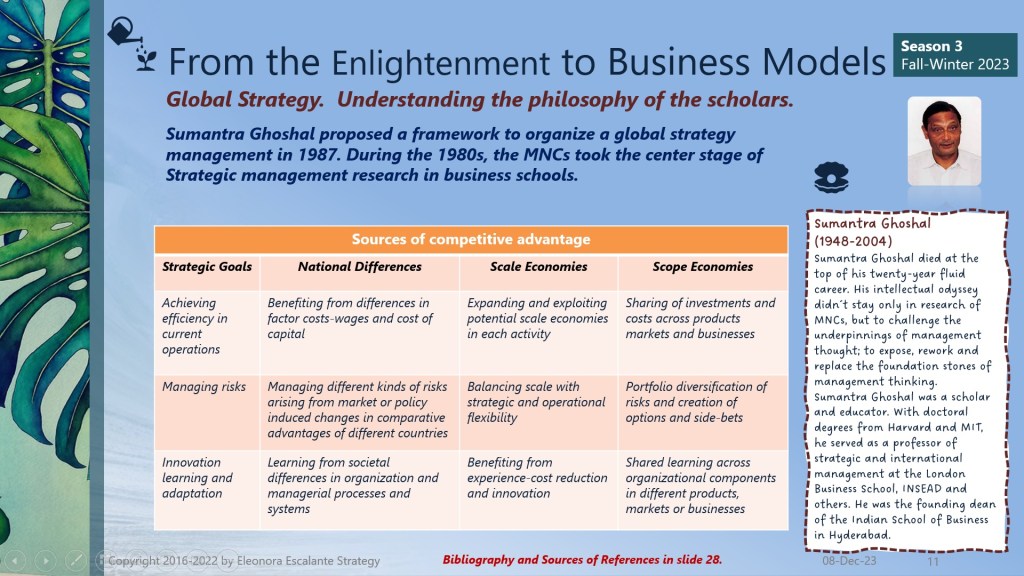
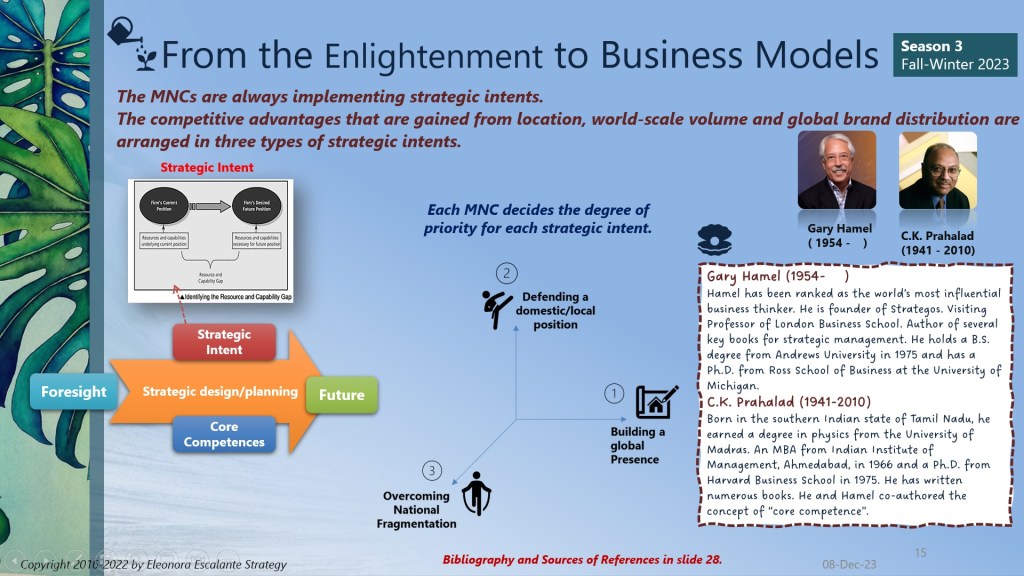
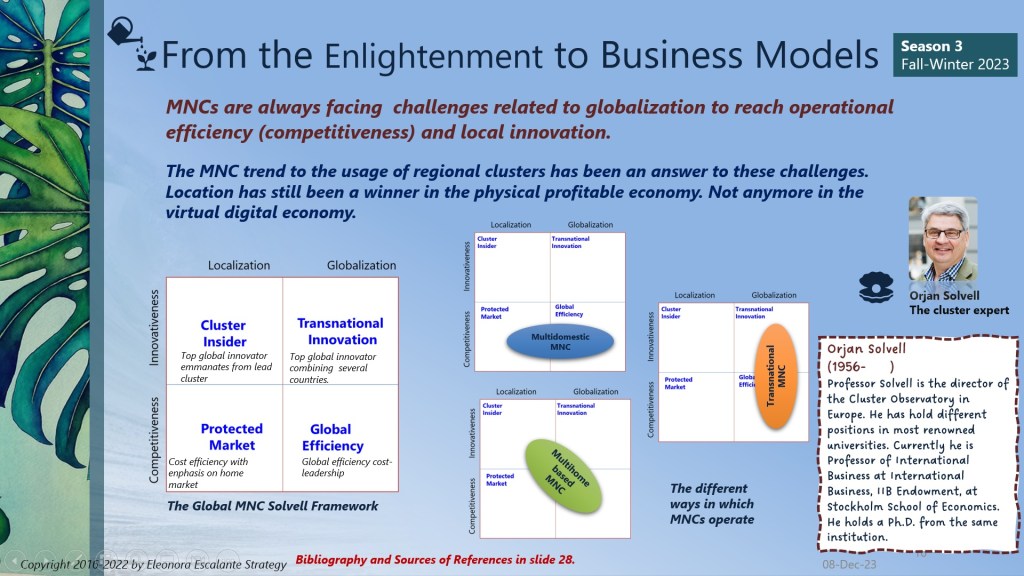
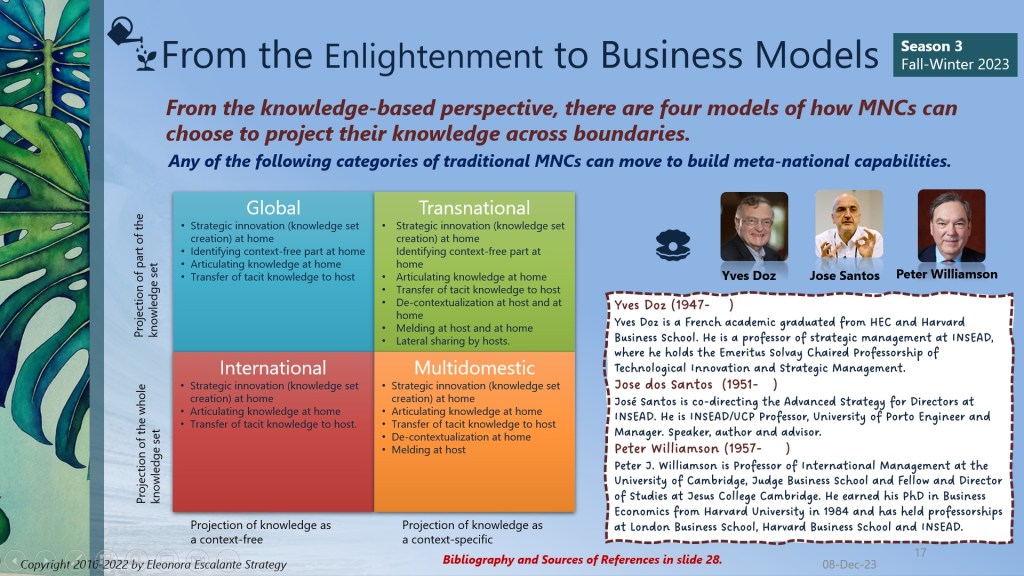
We have tried to offer you the main and most important global strategy frameworks that have resulted from years of studies and observations from several scholars. The MNCs as a subject of study took the strategic management field like a storm during the 1980s. In the quest for prosperity, the recipe for successful growth was horizontal expansion, which means to go across borders, geographically. Slides from 9 to 20 summarize the key relevant theories and frameworks that we all need to know when speaking about multinational corporations.
Our strategic reflections.
From slides 21 to 27 we have written our strategic reflections in the slides. All are self-explanatory. With specific wake-up call messages for all of us who are trying to make this world a better place. The message is clear and right to the point to all professors, corporate strategy scholars (my peers), business owners, CEOs, government leaders, and representatives of the supranational organizations. Over the weekend I will summarize and add some further thoughts here, but for the sake of not being repetitive, I have preferred to take a pause, and it has been meritorious. So here we go. Let´s infer all.
The cradle of the MNCs is situated in the experiment of the transatlantic slave trade.
Our model of industrialization and manufacturing began with the discovery of America. When the Spanish and Portuguese crowns resolved to colonize the New World, the philosophical seed of creating a business model for wealth creation was initiated. As we have learned in past episodes, between 1500 to 1700 (when the last Spanish Habsburg king, Charles II died) the corporate strategic goal for the Austrian-Spanish Empire was indirectly tangled with England (by marriage strategic alliances), and also with what later was called the Dutch Republic (Habsburg Netherlands prevailed between 1482 to 1795).
We have already analyzed that all the empires of Europe were trying to find ways (different options) to raise money to pay for the constant wars in which they were involved. The Spanish empire was making a deal by utilizing the bullionism formula by pulling the noble metals (gold, silver mainly) out of the mines of America. Meanwhile, the Portuguese were dedicating their resources to building the business model of sugar plantations in what is now Brazil. The West Antilles, with all the beauty of each Caribbean island, in parallel, were chosen to plant sugar as a legacy of Christopher Columbus. In fact, if we are keen observers of the industrialization of our manufacturing processes, the sugar business model was the sweet beginning of a monumental historical shift: the initial deployment of what later was called the first industrial revolution. The business model of high productivity using low-cost resources started with sugar, gold, and silver, and later it was replicated with cotton and tobacco.
“Sugar, sugar. Pour a little sugar on it, honey“.
What matters to recall here is that the priority for all the empires in America was to establish large farms and build factories for these products using “African slave labor” as the main source of the workforce. Because slavery has existed since our oldest written records, what occurred was that in the quest to use human labor to work in the cane fields, the easy way was to go to Africa, buy or raid for slaves, transport them, and later use them in the Caribbean. The Portuguese Brazilian sugar industry competed fiercely in price with the Spanish-controlled areas of Santo Domingo, Cuba, and Puerto Rico, just to finally surrender its dominion with British Jamaica. The Dutch also piled their own success by using their outstanding shipping capabilities to transport goods and slaves to and from the islands. Rum and molasses were byproducts of sugar, so since then, the famous concept of adjacencies developed. Even if the Dutch were not primarily powerful in sugar production in the Caribbean, they were key players in the logistic value chain, ferrying everything back and forth between Europe and the New World. The Dutch later (during the 19th century) opted for Java and Indonesia, where they could successfully settle to produce much better (in terms of efficiencies) using the plantations’ improved business model too.
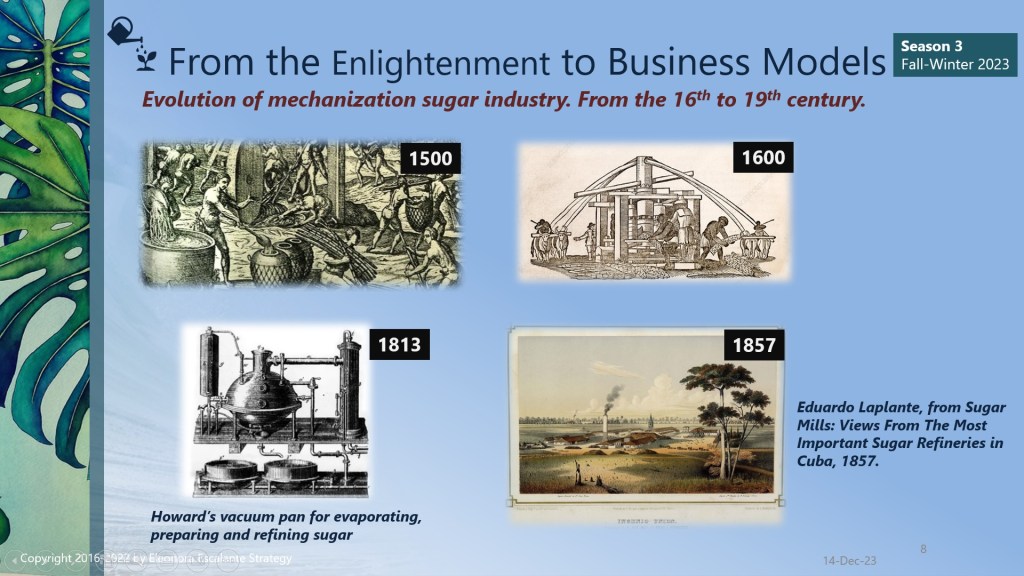
The sugar industry origins are the key example of the early mechanization of man production. This occurred in the 18th century, see slide number 9. The utilization of the first primitive machines to manufacture at a larger scale was later transferred to cotton, textiles, food, and infrastructure or energy (waterpower, canals, etc). Before these machines, everything was made by people (from cultivation to refining). During the 19th century, steam power and railways got the priority. This happened at the same time that Karl Marx was building his theories in England. Europe and the New World couldn’t even think about Marx, because it was not relevant then.
The utilization of a cheaper workforce continued in manufacturing and construction, and of course, wealth creation flourished enormously for those who were investors, and for those who were lucky enough to own businesses related to the most modern industries of that time. When electricity became ubiquitous, the next phase of human development became the modern steel era of heavy engineering, monumental edifices, roads, cable electricity transmission and distribution works, water systems, city construction, etc. And here we are again: when the “communist order” took the spotlight, the First World War was already doing its damage in Europe; but the constant evolution of our inventions allowed the mass production of a new toy, the automobile. The Ford Revolution opened the door to a new mass-production manufacturing business model. The 20th century unfolded the sophistication of the industrial manufacturing of weapons, and with the Second World War, this violent conflict pushed us to demonstrate a new model of transportation: the era of planes and airlines was established. The same occurred later with consumer durables, petrochemicals, plastics, aluminum products, infrastructure (again), and armaments. By the end of the past century, humans also conceived that information and communication technologies were the way to go. And here we are, “almost a quarter of a century later”, shifting again to a new scary path: the NAIQI era (Nanotechnology, Artificial Intelligence-including robotics and automation, Quantum prevalence, and the Internet).
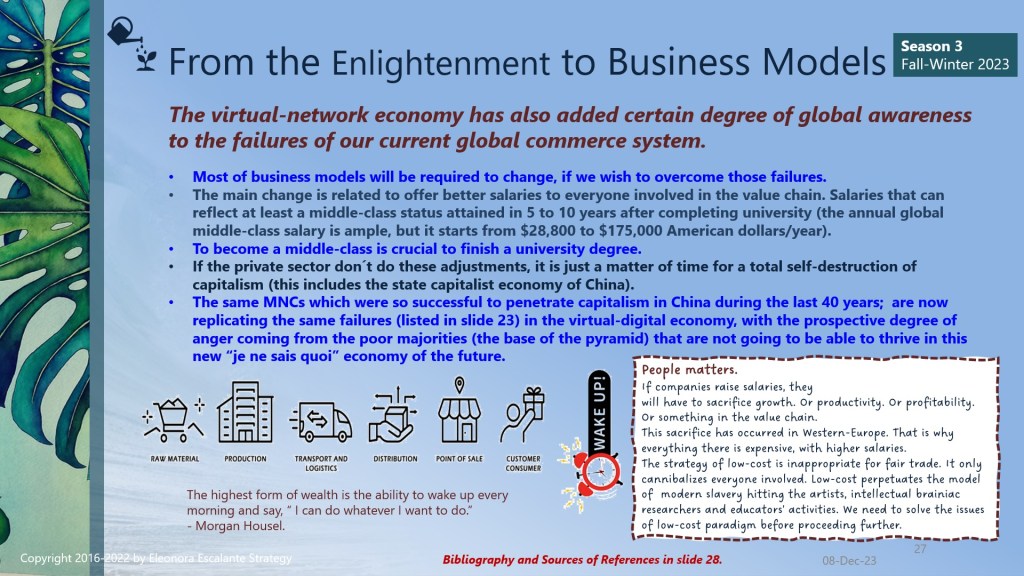
The utilization of a cheaper workforce is the foundation of the “low-cost” strategy. It is impossible to deliver commodities such as sugar, textiles, or ensembled goods, without a cheap workforce. It is understandable that now, humans want to use artificial intelligence (that includes robotics and automation) to proceed forward, in an attempt to avoid paying human labor in factories. In this way, corporations can continue selling cheap goods to all of us. Nevertheless, we are still in the same cradle of the MNCs, the same context of Enlightenment mercantilism. Nothing has changed in our business models if we privilege the “low-cost” strategy using the foundations of paying a minimum salary to laborers who can´t make a living of a middle-class consumer (salaries range per year between $28,800 to $175,000).
If you observe what has been the trend of our manufacturing industry history since the initial implementation of the sugar plantations, every single machine has replaced people. Ejected people are forced to find another source of income. And that affected mainly anyone who was not educated enough to make a living as a middle-class citizen. Now the displacement not only affects the base of the pyramid, the low class but also the most educated (who attained the laurels of a middle-class status family during the last century). The middle class is going to be replaced by artificial intelligence tools. This began with the destruction of all independent newspapers and local domestic press. The most difficult brainiac activity of a human is to teach, do research, write books that help others, and create difficult art. All these activities have been hit by disruptive technologies because of the virtual digital business model that has been deployed during the last quarter of the century. We are convinced that our models of globalization and theories composed during the 1980s, and implemented by the MNCs during the last 40 years have created wealth and prosperity, but the salaries of the non-educated majorities have continued to be as low, equivalent to the stipend of a poor room and board that the slaves of the transatlantic trade received during the 18th century as well.

Every quarter of a century.
All the research produced for globalization is properly well done. What Professors Perlmutter, Ghoshal, Yip, Hamel, Prahalad, Solvell, Doz, Santos, Williamson, Bartlett, and Porter created for MNCs works. In theory, it works. In applicability, it works. Look at China. It works. However, it works only for the owners of the MNCs and the big global corporations. It also works for China because it has established “dumping” in all industries and economic sectors with cheap hats. But at what expense? It works under the model of globalization that started between the 16th and 18th centuries. But at that time (1800), our population was merely 1 billion worldwide. Now we are almost 8 billion. Adam Smith was a clever demographical erudite. He knew the system from then, was not going to operate with an exponential population of today. Karl Marx also comprehended that his system was not going to function with the population of today either. Both systems have troubles and deficiencies. Both systems have had crises taking the majority of people out of poverty. But somehow, I trust capitalism much more, because I also see that when the private sector (Big corporations, MNCs, SMEs) wishes to change, we all together can modify the course of history. After all, we have demonstrated that we can make it happen before. All business owners can and have demonstrated that by embracing the issues, we all can work together to change them. See slide number 8.
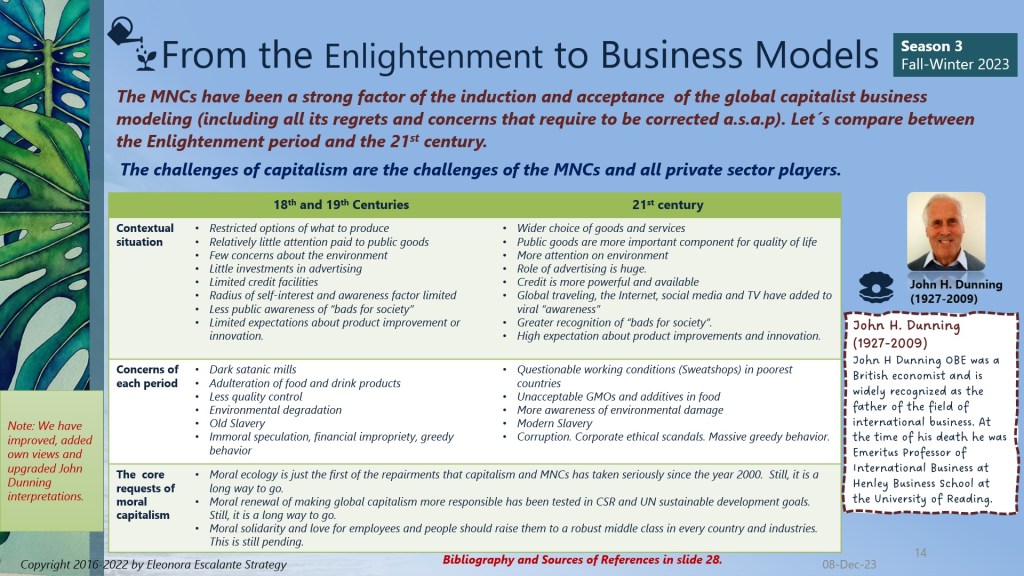
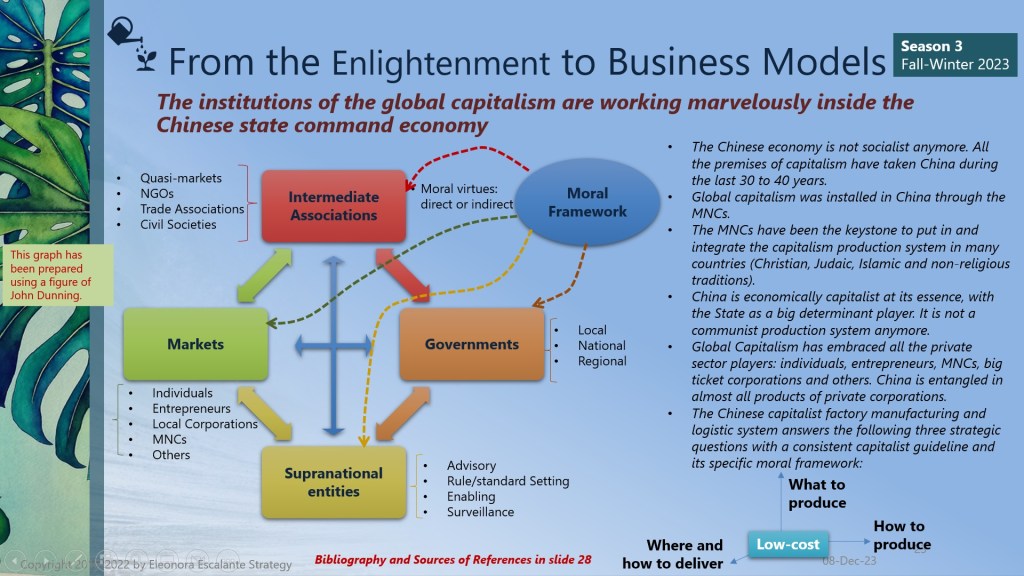
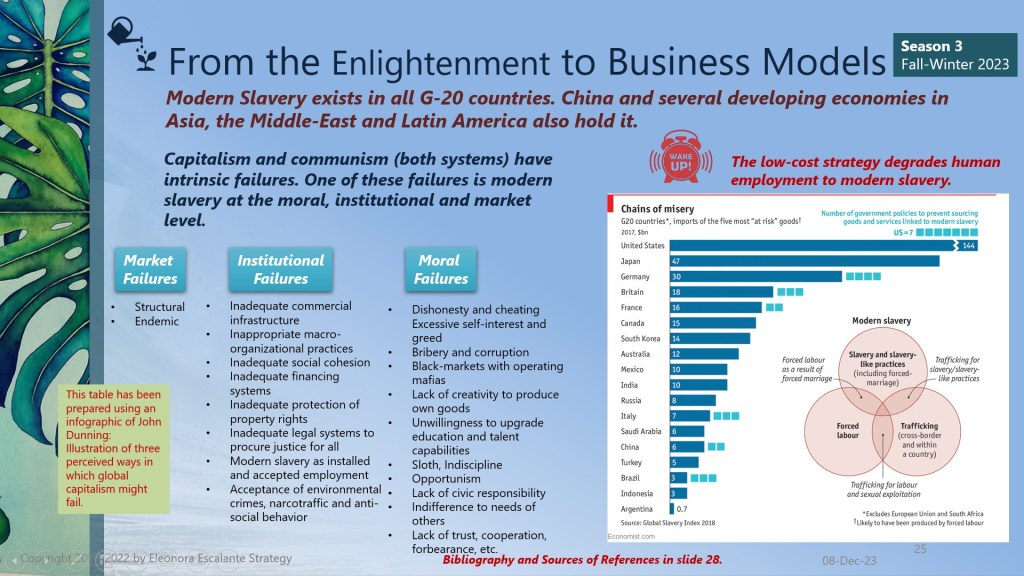
However, if we focus a bit, on what has worked for the MNCs that are involved in the information and telecommunication industries. Is not working fine anymore. What is happening? The core requests of our political economic systems to the MNCs operating during the Enlightenment period and the MNCs operating now are basically the same. Professor John Dunning wrote a wonderful chapter “The Moral Response to Capitalism: Can we Learn from the Victorians?” (1). I interpreted his thoughts and prepared slides 13, 14, and 25, updating them to our year 2023. Please read them thoroughly.
The coming “je ne sais quoi” new quarter of a century.
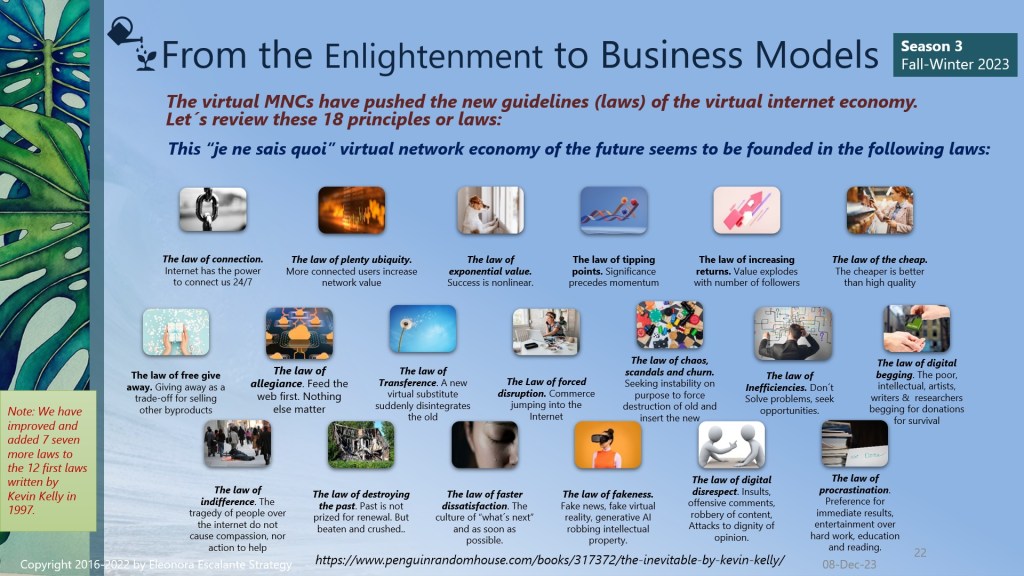
It is called the digital, virtual, giga-economy, NAIQI era. Seriously, not even the top of my strategy professors know exactly where are we going. That is why I have named it “je ne sais quoi” or its meaning in English “I don´t know”. Slide 22 shows us the first 12 guidelines that were prepared by Kevin Kelly before the Y2K (2). Now, I have added 7 new laws to his work: the Law of digital begging, the law of indifference, the law of destroying the past, the law of faster dissatisfaction, the law of fakeness, the law of digital disrespect, and the law of procrastination. Please read slide 22 for further explanation.
What is China?
The capitalist model was inserted in China through the MNCs during the last 40 years. See slide number 23. I can´t perceive the state-command socialist economy of China, without a capitalist political economy. Slides 24 and 25 are explicitly clear about this. China also has dragged its own communist sins, but structurally, China sometimes looks more capitalist than the same Western-capitalist pseudo-socialist economies.
In summary.
Slide number 27 captures the spirit of our reflections for today. Before taking the next abysmal step towards a radical technological change like the one that we have been trying to implement since the year 2000, it is better to pause. To step back and take it easy. If we still have market, institutional, and moral failures in each of the previous technological stages that we have lived in since the 1700s, it is best to go slowly. Look at slide number 25 too. This is a very important slide. If we are not aware, and we don´t begin to change all the failures that we are rolling out again and again, with each quarter of a century, we are simply not just fools, but ignorant of the pain that we cause to the next generations ahead. Even if the global MNC wealth creation is proof of evidence that our global strategy theories work, these don´t work for the majority of the population. 84% of the global population suffers from at least a factor of multidimensional poverty, earning less than US$28,800 per year. If we don´t start to change those failures now, those same disappointments will be dragged into each technological new era. With or without the internet and NAIQIs, a cultural social change takes up to 5 generations (that´s around 100 to 150 years). The assimilation of the awareness of what I write will take a while. Then, the implementation of the changes will take at least another 100 years. If we still live with modern slavery all around us, be sure that some changes take more than 500 years to materialize.
Our core message of this chapter. All the erudite global business strategies and experts in MNCs failed to see that the low-cost strategy and its cheaper workforce remained untouched after slavery was abolished. Without knowing, the aspiration of going out of poverty only remains a dream if we keep this model intact. It doesn´t matter what type of new technology is arising or will ascend. Meanwhile, our corporate strategists don´t see that people and our environment matter first and should be the foremost priority, we will continue doing things wrong. People and nature matter more, even before maximizing shareholder value. Still, if we are conscious business owners, with the disposition to transform our companies, to the point of being intended enough to implement the United Nations SDGs or the Shared Value Initiative at the highest level possible… if we still keep people earning below a middle-class range, we are not doing anything relevant to help them to get out of poverty, yet. An integral corporate strategy is required.

Announcement.
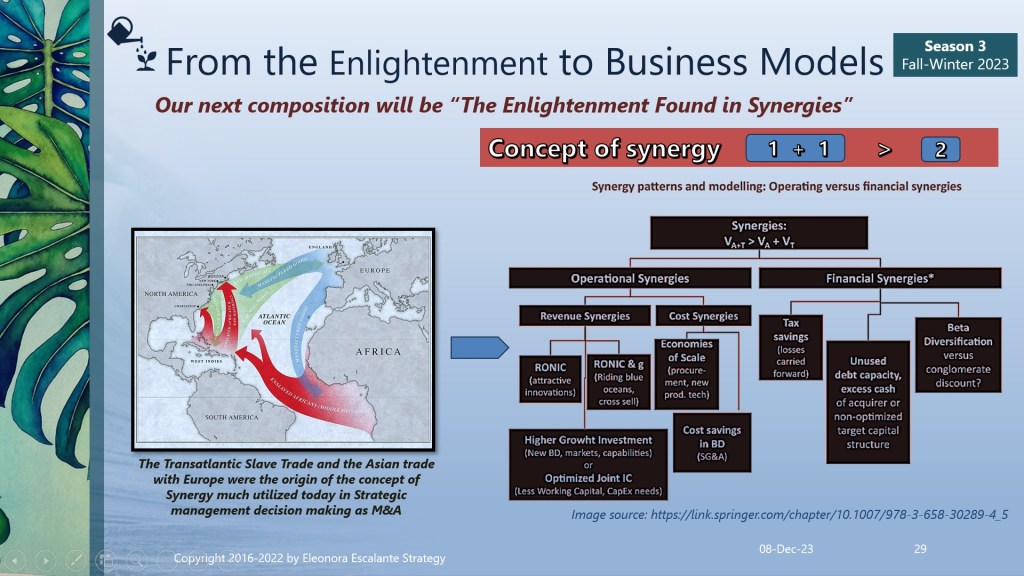
Adorable readers, we appreciate the patience that you had with us during the year 2023. It was a hard one for us. But we always deliver our promises to all of you. I am overjoyed with gratitude to all of you, for staying with us for three consecutive seasons. We have almost finished our discovery journey. The following episode (to be published next Friday 15th of December ) will be “The Enlightenment Found in Synergies“. Blessings and thank you for reading all our episodes.
Additionally, we announce our next saga of Spring 2024: “Value Propositions: Theory and Cases”.

Musical Section
During the weeks before the end of this saga, we will dedicate this section to Classical Christmas Carols and Christmas classic music composed during the Enlightenment and afterward.
Today´s video has been uploaded by Halidon Music. All the festive pieces are traditional adorable Christmas music that will ignite the holiday spirit in your life.
Thank you for reading http://www.eleonoraescalantestrategy.com. See you next week.

Sources of reference that were utilized today. Look at slide 28.
In this text:
(1) Chapter 2 by John Dunning. https://www.wiley.com/en-us/The+Future+of+the+Multinational+Company-p-9780470850657
(2) https://www.penguinrandomhouse.com/books/317372/the-inevitable-by-kevin-kelly/
Disclaimer: Eleonora Escalante paints Illustrations in Watercolor. Other types of illustrations or videos (which are not mine) are used for educational purposes ONLY. All are used as Illustrative and non-commercial images. Utilized only informatively for the public good. Nevertheless, most of this blog’s pictures, images, or videos are not mine. I do not own any of the lovely photos or images unless otherwise stated.
 Eleonora Escalante Strategy - Strategic Reflections Think Tank