
From the Enlightenment to Business Models. Season III. Episode 20. The Enlightenment found in Synergies.
A loving Christmas time to all of you.

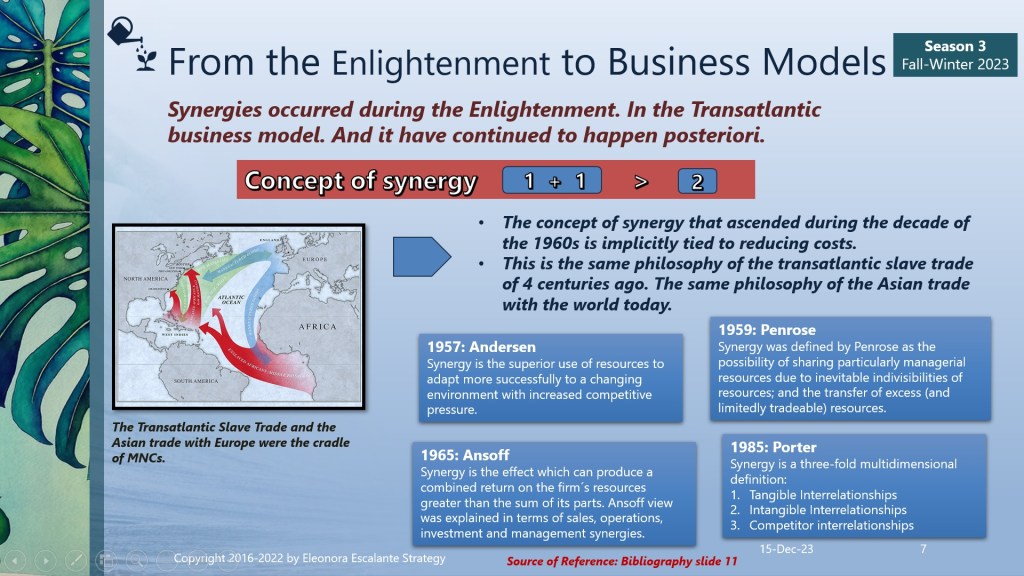
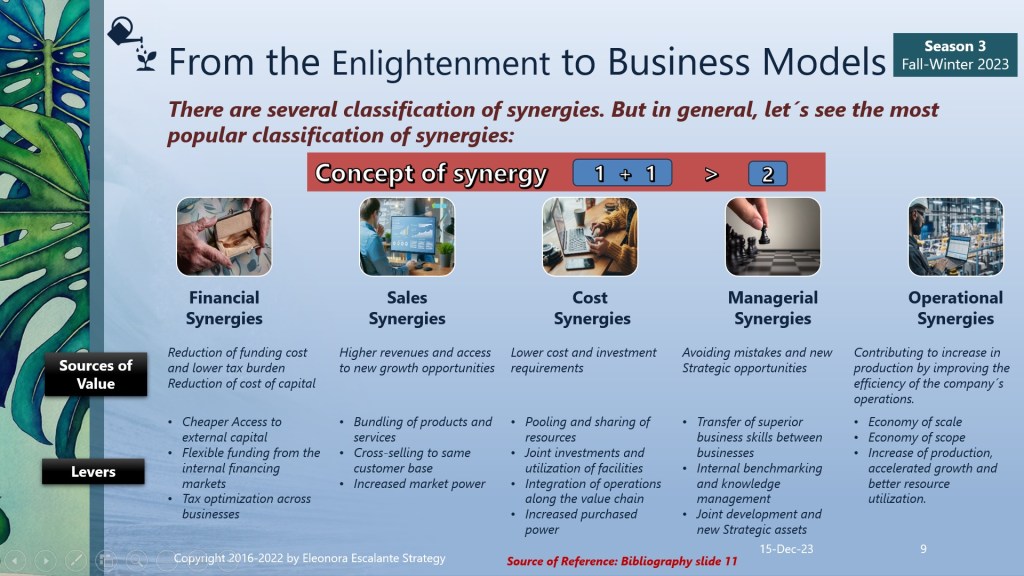
The concept of synergies is one of the most mistaken in the field of strategic management. On a popular basis, synergy comes from the Greek word “Sunergia” which means cooperation, or “sunergos”, which denotes “working together”. The common definition of synergy is described by a metaphorical equation outcome: “2+2=5”, or “1+1 > 2”. That is why it has been used mainly in the segment of mergers and acquisitions.
However, synergy is a word that is used not just in business, but also to explain the why of a marriage, for example. It has also been utilized in medicine, pharmaceuticals, manufacturing, biology, genomics, psychology, politics, social epistemology, technology, philanthropy, philosophy, and almost every technical aspect of our lives. Believe it or not, synergy also occurs in our faithful spirituality with God. Synergy has been extensively used in different contexts and scenarios. The bottom line: the word synergy is well above businesses.
For the sake of our domain of action, any corporate strategist will always clap hands linking the term synergy with mergers and acquisitions, one of the ways companies can grow. Once we hit the value proposition of adding two companies to reach synergies, then we immediately take a step into the “show me the money” ground, the premise that has accompanied us since the instance of building networks of commerce, an endeavor that has existed since more than 6,000 years ago. The world of trade and commerce was always around the Levant region, back and forth with the Mediterranean coast countries. It also extended its roads to China, passing through India. However, after 1492, it walked up in extension and distance: the first global endeavor of what we know as the transatlantic trade began. This business model included African slavery as the cheapest resource for the management of the extraction of the riches of America.
Dear readers, I have been wondering during the last three days about a unique inquiry: I have been trying to answer the following question: how was the concept of synergy emerging in human history? Synergy occurred when Isabella of Castille and Fernando of Aragón joined their efforts and supported Christopher Columbus. Synergy occurred at the operational, financial, investment, and marketing levels when the Habsburgs of Burgundy began the alliance with Spain, the growth of their territories positioned this house of power as the greatest supremacy of Europe. The Europa Regina, with its Holy Roman Empire wings, was in their hands, hunting for the possessions and assets of America.
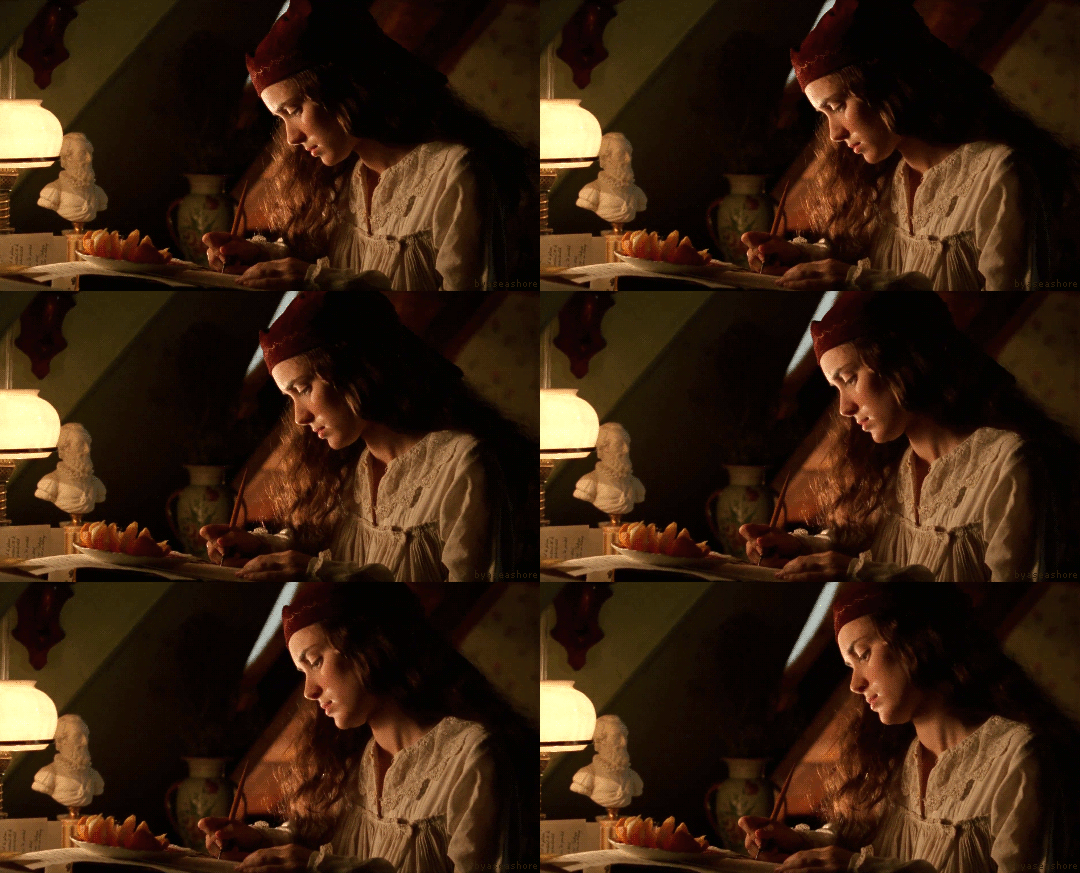
Descartes Synergy.
Synergy existed when Descartes alone realized that his own world of mathematics was not only relevant, but his rule of life was pivotal to the ambitious seeking of truth, concerning where to start and how to work and open the mind to greater things. The Descartes synergy is well expressed in this rule: “To acquire discernment we should exercise our intelligence by investigating what others have already discovered, and methodically survey even the most insignificant products of human skill, especially those which display order” (1). Descartes’s logical capabilities were hanging around the idea of cause and effect. He also observed the relationships between different matters. His added synergies value is clearly established in his interpretations of the eternal truth about matters that join or work together beyond what is 2+3>5. Descartes believed that our “conceptual capacity is limited to the innate ideas that God has implanted in us, and these reflect the actual truths that God has created. God creates the eternal truths (concerning logic, mathematics, the nature of the good, the essences of mind and matter), and he creates the human mind and provisions it with innate ideas that correspond to those truths” (1).
After Descartes, the synergy concept is also a repetitive idea in several of the Enlightenment thinkers. If you read the texts of the following free-thinkers and ask yourself where is the concept of synergy, what immediately comes to my mind are Hume, Smith, Locke, Voltaire, Montesquieu, Ferguson, Kant, Leibniz, and Wolff. Nevertheless, even Hobbes, Spinoza, and Bayle’s main concerns were pivotal to “working together for progressing the thinking of people that could lead the improvement of the human existence”. All the Enlightenment profiles that we have studied here, country by country, were trying, to give us an example of synergy. The Republic of Letters specialists weren´t even contemplating mergers or acquisitions as Ansoff did in 1965. The synergy that our Enlightenment erudite evangelized was sort of well hidden in all their messages: “Let´s work together to advance and improve humanity”. Let´s leave the religious fanaticism, the superstition, the lack of education, and the excesses of the monarchical system. Let´s use the recent potential of trading to create wealth and prosperity for all. Despite the canons of each Enlightenment philosopher that we have studied this year (radical, moderate, absolutist/despotic, and counter-enlightenment), the concept of synergy is discretely found all over the 17th and 18th centuries.
The spirit of the word synergy.
Philosophically, synergy also denotes a thoughtful expression of the addition of two things or two situations two businesses or two people (as a matrimony) or two substances. These two objects or units had a value creation potential together that is greater than (measured in quantity, size, or an amount of a financial number, or a magnitude of its significance) standing alone. When these 2 matters get together or merge jointly, then the power of that new union creates something bigger than the two substances measured separately. The combination of two units joining and organized collectively generates a grandeur that each of them can’t reach alone. This is the spirit of the word synergy. The dictionary defines synergy as “The interaction of two or more agents or forces so that their combined effect is greater than the sum of their individual effects” (2).
To synergy realization, there should be a potential for synergy first. In addition, synergy is not measured in absolute terms, but in a cascade of different levels. Or through hybrid blended ratios that depend very much on what are you trying to merge.
The rhetoric of the “synergy” term used during the Enlightenment period has an ample umbrella, in implicit terms, that ranges from an abstract definition to the smallness of the technical synergies that are used today to measure the value of a merger or an acquisition. I want to be boldly clear. Synergy today, in strategic management, in the year 2023, has been narrowed to an undersized narrow line. Consequently, I wish to express that the concept of synergy coming out of our domain is small and slim. In addition, I do not want to enter into the explanation of the application of this term in the mergers and acquisitions theories, because my goal has been to show you the connection of the Enlightenment with what we do now. See slide 12.
What is synergy in the current sphere of strategic management?
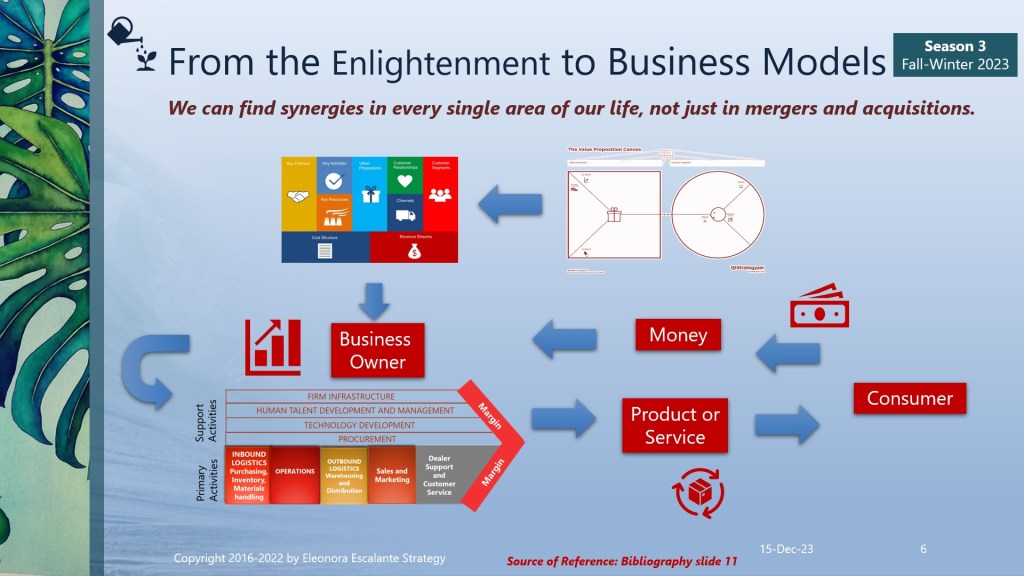
I would like you to visit the following slides. All are self-explanatory. I have tried to summarize the main aspects of how synergy is viewed. Feel free to download, print, and share the following material.
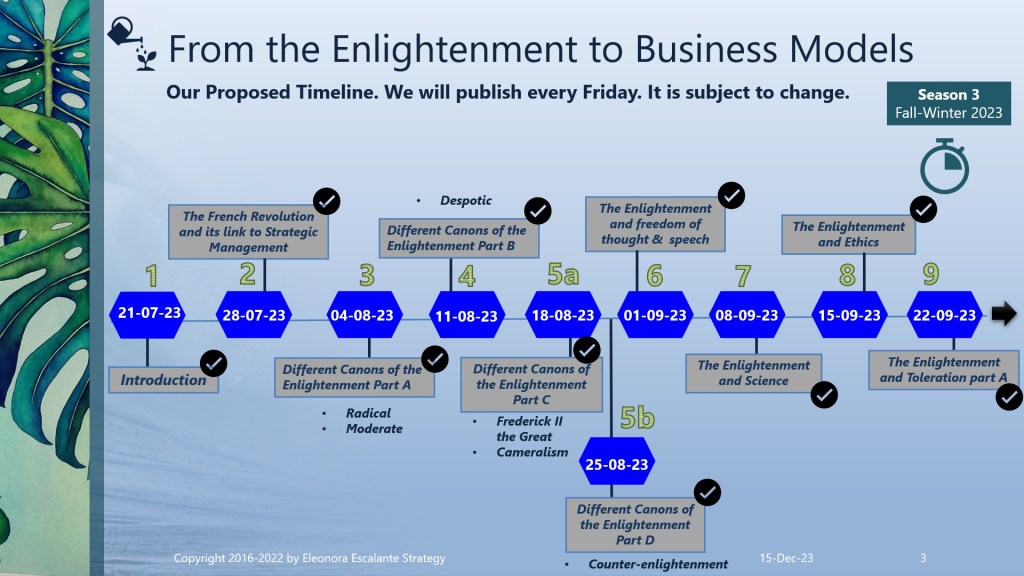

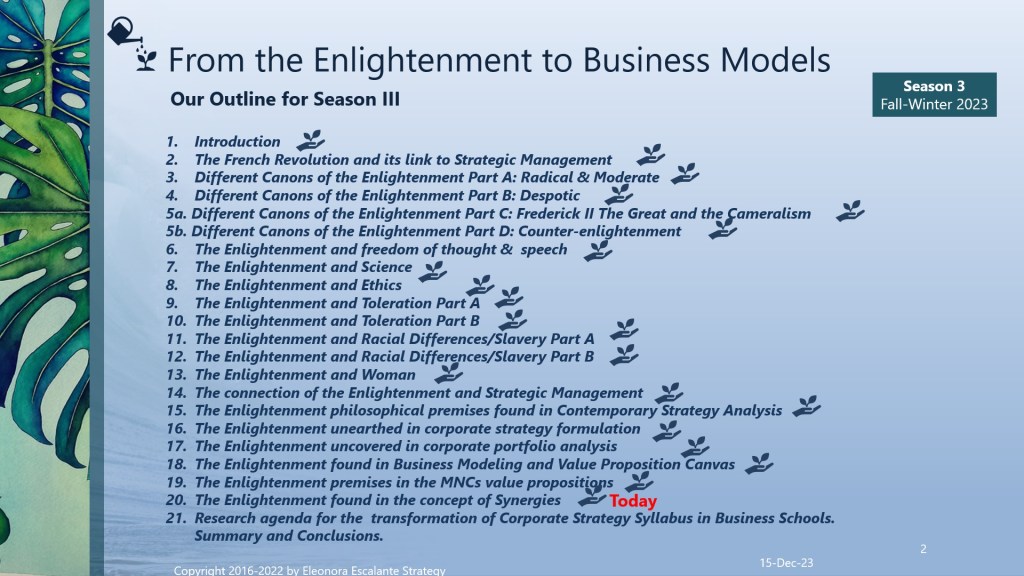


Announcement.
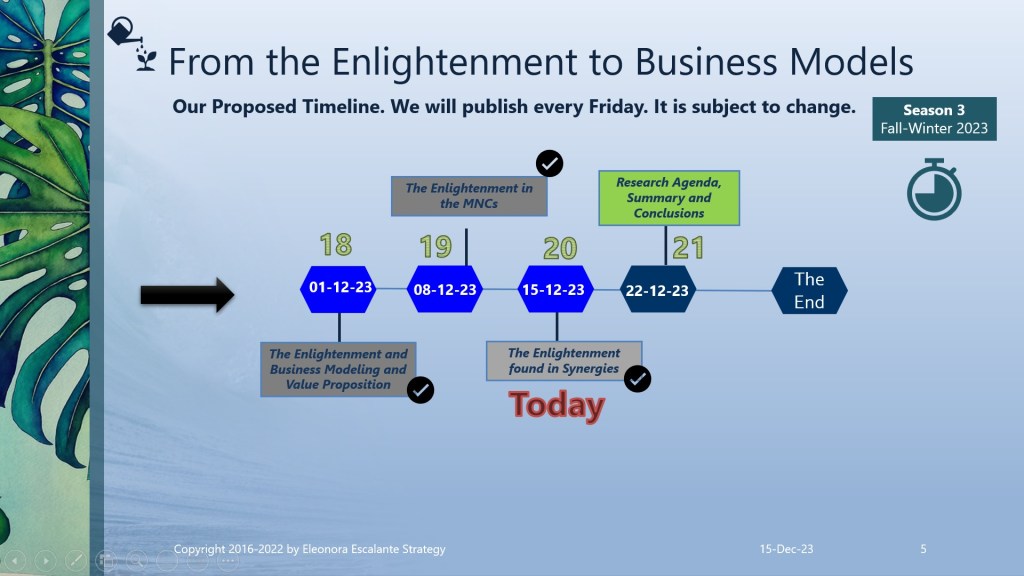
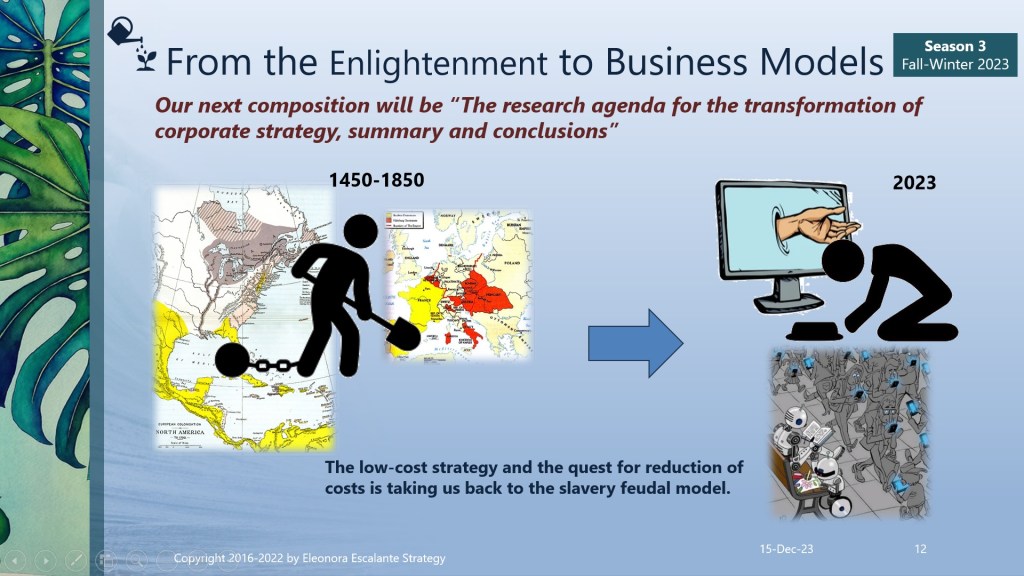
Adorable readers, we appreciate the patience that you had with us during the year 2023. It was a hard one for us. But we always deliver our promises to all of you. I am overjoyed with gratitude to all of you, for staying with us for three consecutive seasons. We have almost finished our discovery journey. The following episode (to be published next Friday 22nd of December) will be “Research agenda for the transformation of corporate strategy syllabus in Business Schools. Summary and Conclusions“. Blessings and thank you for reading all our episodes.
Additionally, we announce our next saga of Spring 2024: “Value Propositions: Theory and Cases”.

Musical Section
We are almost done with our production of 2023. This section is dedicated to Classical Christmas Carols and Christmas classic music composed during the Enlightenment and afterward.
Today´s video has been uploaded by Halidon Music. All the festive pieces are traditional adorable Christmas music that will ignite the holiday spirit in your life.
Thank you for reading http://www.eleonoraescalantestrategy.com. See you next week.

Sources of reference that were utilized today. Look at slide 28. In this text:
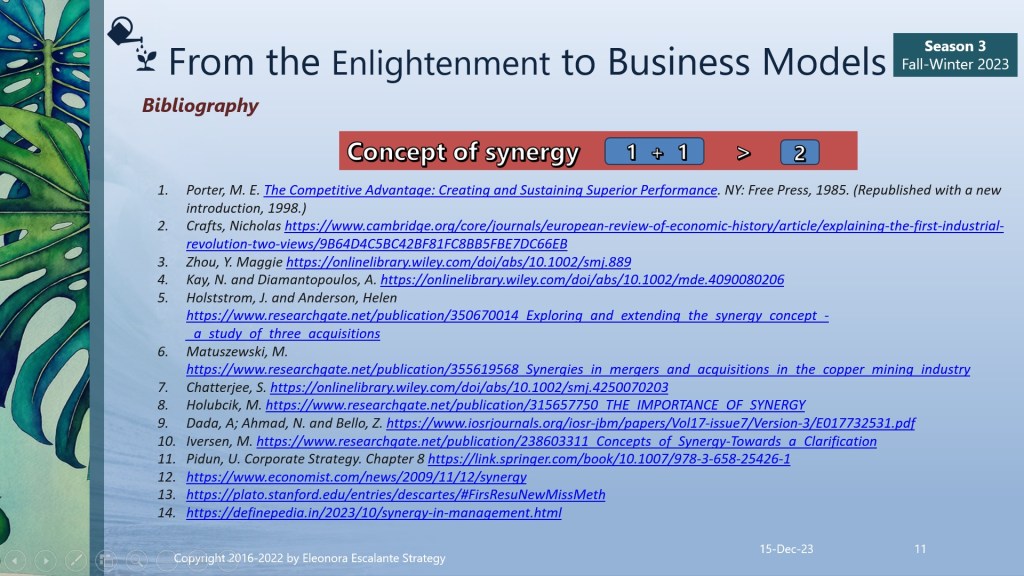
(1). https://plato.stanford.edu/entries/descartes/#FirsResuNewMissMeth
(2). https://ahdictionary.com/word/search.html?q=synergy
Disclaimer: Eleonora Escalante paints Illustrations in Watercolor. Other types of illustrations or videos (which are not mine) are used for educational purposes ONLY. All are used as Illustrative and non-commercial images. Utilized only informatively for the public good. Nevertheless, most of this blog’s pictures, images, or videos are not mine. I do not own any of the lovely photos or images unless otherwise stated.
 Eleonora Escalante Strategy - Strategic Reflections Think Tank