
Value propositions: Theory and Cases. Episode 3. What is a value proposition?
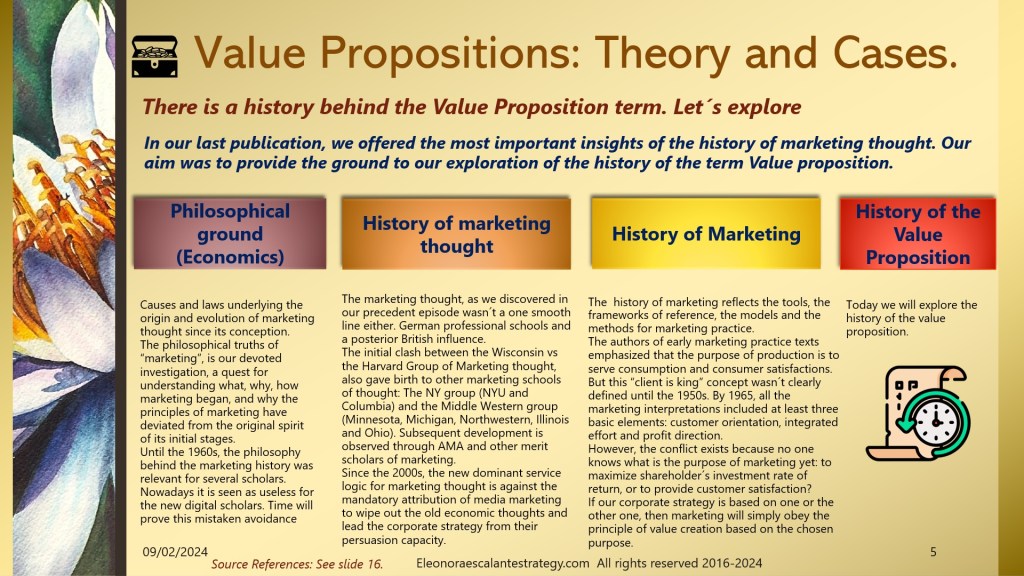
Adorable readers: Our last publication was a brush about the history of marketing thought. We envisioned it as extremely meaningful for you to read before today´s content.
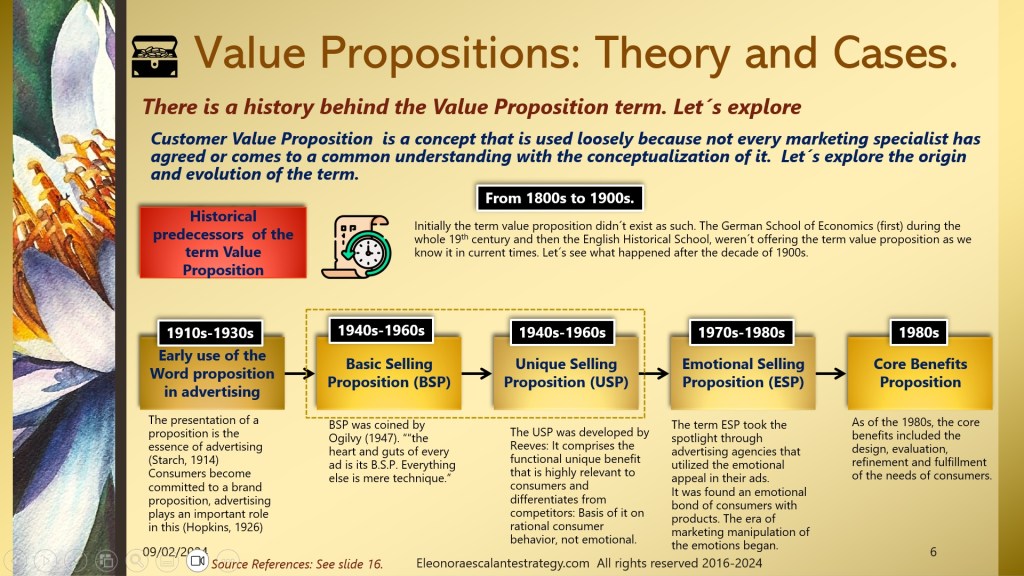
I have prepared a set of 17 slides that will help all of us understand the diversity of contexts, perspectives, and rationale of more than 12 definitions of the term value proposition, which I have matched to the acronym CVP (Customer Value Proposition).
I encourage you to read the following class during the weekend. Take notes, ask yourself questions, explore the bibliography that I have shared on slide 16, and look for the meaning of collusion, please. Feel free to download, print, and share the following slides. All the following material is self-explanatory.



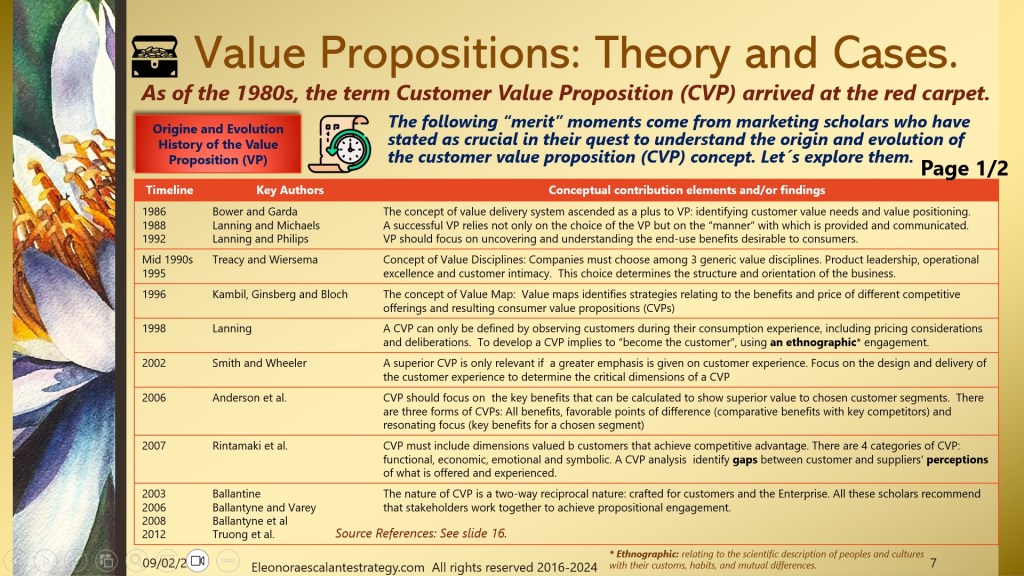
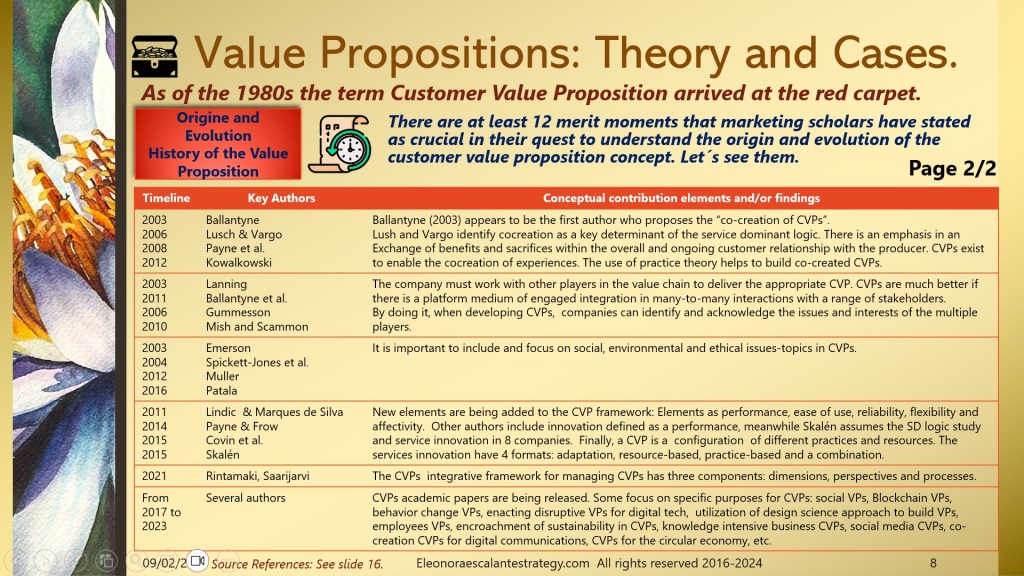


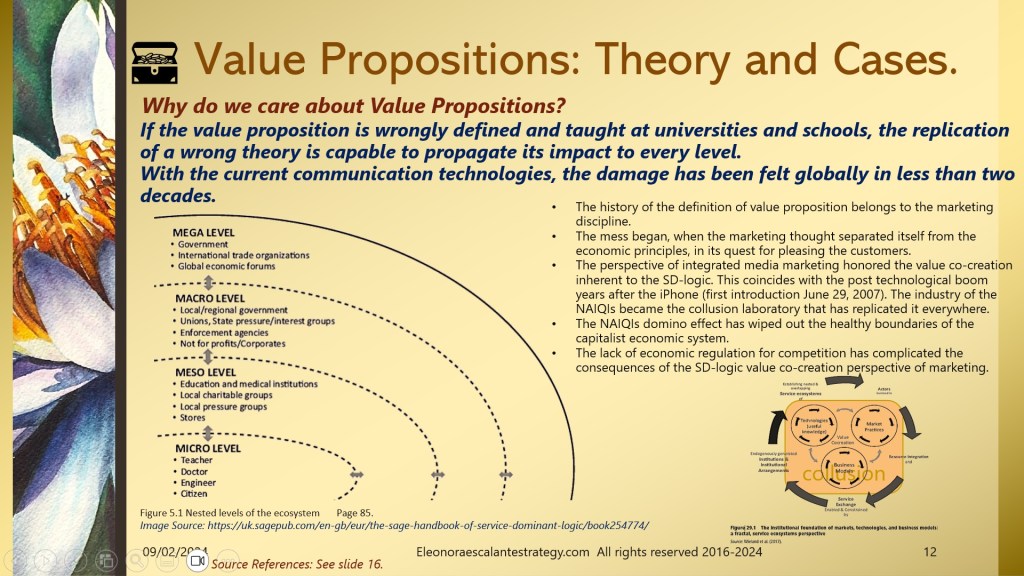


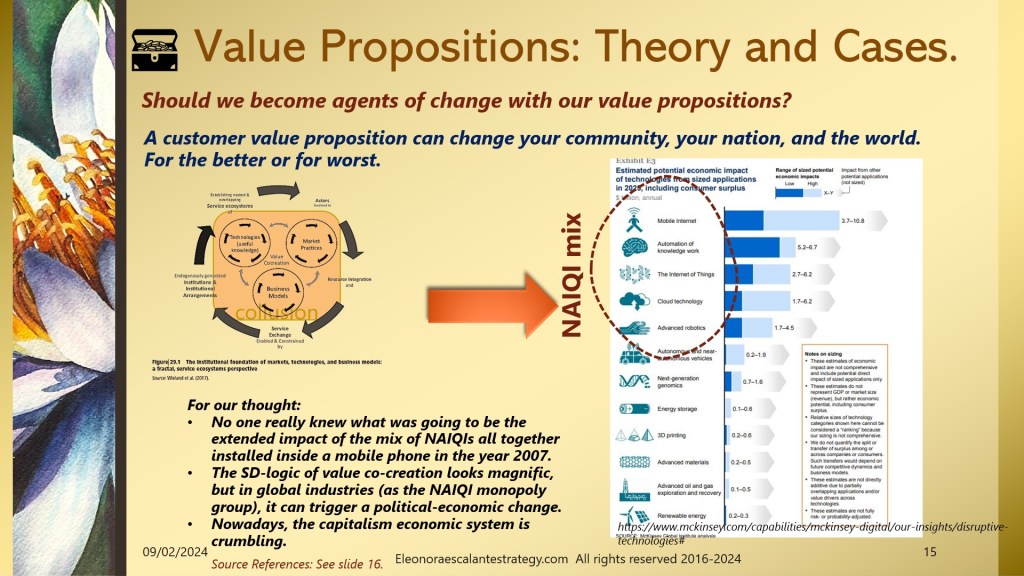

I will come back to write some additional strategic reflections next Tuesday.
The study of value propositions is a revealing understanding of marketing thought. An important notice is to state that none of the academic authors/researchers that we have explored today is responsible for the current chaos of the economic premises of capitalism. Our history is a trial-and-error canvas. What might work in certain industries, of lesser scale, is different when we apply our current frameworks for business modeling of industries of ubiquitous dynamics. What I am trying to communicate is that a value proposition defined under the company-supplier perspective will be different than a customer value proposition and it will be different than a co-created value proposition. The perspectives are diverse, as much as the different value propositions.
The academic world requires an enduring immersion between theory and practice. There are elements of the original historical schools of economics of the 19th century, that have been lost during the last 180 years. There are certain good methods of historical economics, methodologies, and good practices before the times of the conflict between socialism and the classical capitalist economics associated with Smith and Ricardo, that have been forgotten. Marketing is not separated from economics. Marketing is not the panacea for all the strategic management troubles either. It is irrational to believe that marketing alone without a strong core economic foundation can fix the issues of strategic management without economics too. In our quest for releasing innovation, marketing, and strategic management have not taken the time to learn. The cycles of learning from mistakes are the different loops of a design-based research methodology, which seem to have been overlooked during the last 75 years.
The theoretical frameworks are many times dismissed by the practitioners in their quest for profits. For example, the service dominant logic (SD-Logic) is clearly explained by Vargo and Lusch (with all its negative and positive implications). In consequence, it is not possible to ignore the consequences of jumping to apply the co-created value propositions, without considering that before releasing the product or service, there are many loops of testing required. The philosophy and the theory behind the practice should help the corporate strategist, or the business owner, to realize the importance of the DBR methodology at the level of value proposition design, to avoid the implementation of business models that later will require radical adjustments. Otherwise, with certain industries such as the media, information, and communications technologies, where oligopolies (if not a monopoly) exist; if the product is released without testing as many times as possible, we might end up destroying a good or mediocre political-economic system that will be replaced by a worst one. We might go back to feudalism without noticing it.
My personal opinion is well-drafted in the slides. It is an attempt to understand why the current economics of digital innovation technologies are not well designed, and why are we all called to try to fix this, instead of continuing with the wrong value proposition that is reflected in the incorrect business model. Again, I will return to update this post, to ensure that all our strategic inferences will be written in this text. In the meantime, please take some time to draft what analytical thoughts come to your mind after reading our slides.

Announcement.
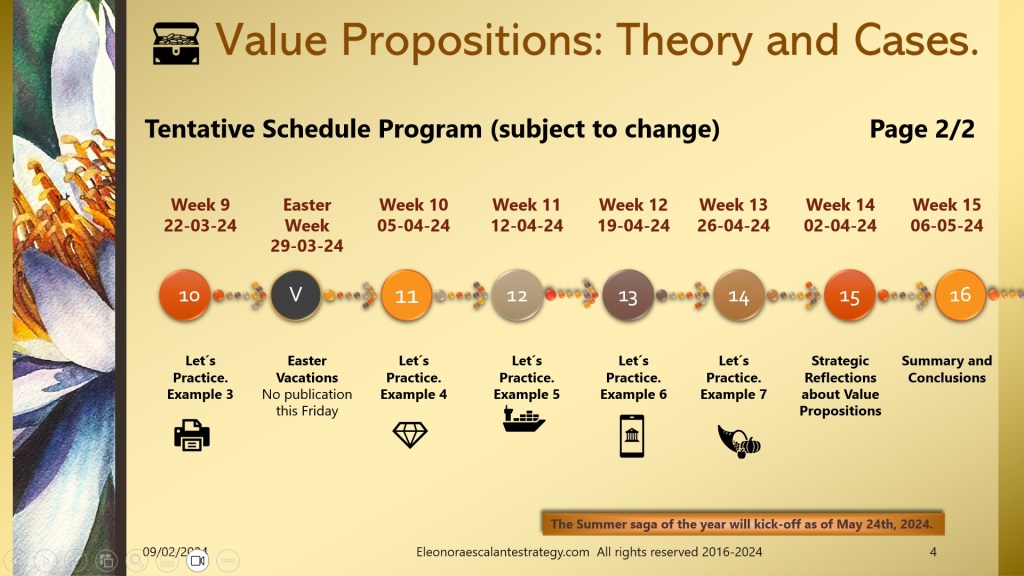
This spring saga will last 16 episodes plus the grand finale, from January 22nd to May 6th. We will publish only on Fridays (occasionally, if required we will add more additional episodes on Tuesdays), at the latest before 11:59 pm (CST). Our next episode will be solely about the definition of “problem-solving in the context of value propositions”.
Musical section.
This saga is about improvement, amelioration, upgrading, and advancement much required in the theory and practice of value propositions. Value propositions are the first step in our business modeling frameworks. If the value proposition is improper, then our business model is mistaken. Therefore, we will also share the music of classical progress that marked a before and after in the composer´s headway. Today we are sharing a vibrant melody that all of you already know: “Single Ladies” from Beyonce, but in a medieval-style instrumental manner. This song, in its original format, explores men´s unwillingness to commit. “Single Ladies” was the breakthrough of the interpreter, that launched her career to a global ground for several generations, after the dissolution of her former trio “Destiny´s Child”. This version of “Single Ladies” tells us that we are not too far from where we were if we don´t fix all this theoretical mess, or if we continue leading our CVPs in the same direction that we have done during the last 25 years.
Thank you for reading http://www.eleonoraescalantestrategy.com. Blessings see you on our next episode.

Sources of reference and Bibliography utilized today. All are written in slide 16.
Disclaimer: Eleonora Escalante paints Illustrations in Watercolor. Other types of illustrations or videos (which are not mine) are used for educational purposes ONLY. All are used as Illustrative and non-commercial images. Utilized only informatively for the public good. Nevertheless, most of this blog’s pictures, images, or videos are not mine. I do not own any of the lovely photos or images unless otherwise stated.
 Eleonora Escalante Strategy - Strategic Reflections Think Tank