
Value propositions: Theory and Cases. Episode 5. The economic philosophy behind the Osterwalder Canvas
Have a gorgeous weekend. Today we will post the presentation slides that correspond to the journey of the schools of economic thought that are supporting the framework of the Osterwalder-Pigneur Business Modeling generation canvas.

Strategic reflections are below. As an author, I am learning that it is good to leave things on hold for a couple of days before retaking our work. Today I am here with a grateful heart, thanking for your patience, because it is much better for all of us to think slowly to reevaluate again, and finally add the best of me for your wisdom. I always try to pursue some kind of balance. Extremes don´t help anyone, nor in politics, and never in business and economics. And never when building theoretical frameworks of reference for the public that aims to do things correctly. In consequence, find our final strategic assessment below.
Feel free to download the following material, share it, and print it. Once you begin to explore this document of 26 slides, write your ideas on your printouts. Look for more information in the bibliography that has been shared for your complementary educational background. We always expect your personal reflections about our content, so don´t lose the opportunity to learn to build your own criteria and stretch the boundaries of your own knowledge about these topics.











Strategic Assessment.
The methodology for business modeling (and its method for customer value propositions or CVPs) that has been proposed by Osterwalder-Pigneur has been a hit for the globe during the last decade. It was taught at top universities all over the world, and it is still being rolled out to almost everyone on earth who decides to pursue an MBA or a Master’s related to business affairs. In addition, Osterwalder´s undergraduate background is in information systems, and that fact gave him a competitive advantage to speak in the same language and influence the technological sector. Given this framework’s relevance to the practitioner world, it is worthwhile to understand its economic philosophy. Somehow, as usual, we always start our journey by going to the source of everything, it always takes us back to the past, to the 18th century, to the moment in time when our “birth” of business modeling began. The cradle of the initiation of business modeling as we know it today is situated during the Enlightenment period, and a bit thereafter. Several different empires with completely unlike and dissimilar philosophical views on how to raise money, augment their riches, and manufacture the resources for their own corporate strategies were trying to find a theoretical mindset that could help them solve their most difficult economic troubles. All the empires of the Victorian era (let´s get positioned during the 19th century) are listed here: The Spanish Austrian (Bourbon-Habsburgs), the British (Saxe-Coburg Gotha), the German-Prussian Empire (Hohenzollern-Brunswick-Mecklenburg), the Russian Empire (Romanov) and of course the maimed French Empire (Bourbon-Orleans). We are only concentrating on European empires, given their predominant role from the West to all our civilizations.
These 5 main royal houses of Europe were expanding into the new world of America, Africa, and Asia. All of them were expecting not just to grow in assets and wealth, but also attempting to find methods, formulas of success, and wise academic theories coming out of the universities that could help them to support their new industrialization. The 5 royal empires listed above, not only invested heavily in these centers of superior research since the 13th century, but their leaders subsidized the formation of brain power to create erudite or studious researchers, that could help them to find solutions coming out of the academic world. In addition, European top personnel at their Courts or incipient governments were more and more required to get educated. For the first time in history, “economics” began to matter. Finding new Economics theory was cherished and its success was tied to practice. These new standards were examined in practice in Britain first. The rest of the European empires observed, tracked, and followed the British powerful nation too. Studying at a University was the prerequisite for the newly recruited bureau public servants, and the university was imperative to align them under a “framework” of an efficient state administration frame of mind, or for doing accounting and administrative activities in trading-commerce that would allow the new merchant class empires to strengthen their efficiency. For example, at that time, each of the heads of tax collection, minting, economic production, industrialization, etc; particularly in Prussia; were commanded to attend university and study what was needed (law, history, etc.) to perform a good institutional role at the state or with the rich merchants/manufacturers. It was a transition from the medieval Court administration to a monarchical efficient government. Each empire mentioned above was trying to find a hocus pocus recipe for success, a best alternative frame of mind that might help their incipient governments to solve poverty and the troubles of living in urban dwellings with food shortages and continuous wars. The idea of using well the resources of each nation began. The academic formula for economic development that could be the foundation of what we have now in the XXI century started with bullionism, then mercantilism, and finally as of the 18th century at the cradle of capitalism in England & Scotland.
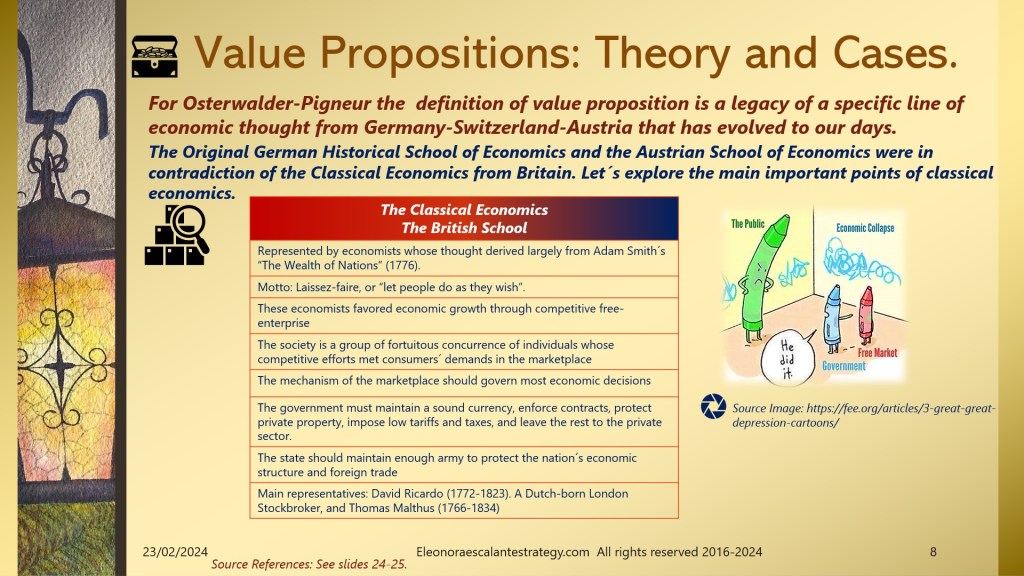
After the French Revolution period (including the period of the Napoleonic wars), Britain decided to believe in the economic frameworks of these university researchers, by setting the table and approving their own classical economists that followed Adam Smith’s legacy: David Ricardo (1772-1823), and Thomas Malthus (1766-1834). Britain was starting to boom with Smith´s model. It grew immensely during the reign of Queen Victoria (Saxe Coburg-Saafield) who married her cousin Albert (Saxe Coburg-Gotha).
Let me ask you what would you do if you were positioned in the shoes of these emperors (or their appointed leaders)? Their expansion motif was to pursue exploration, conquering (through wars), and domination of other territories (in America, Asia; Africa, and in the same Europe). These games of thrones weren´t only in the fields of warfare, they were performed at the intellectual level (proof of evidence is the Enlightenment period) and were played in the newly occupied zones. Trading was effectively done by the empire´s administration and additionally was pulled by the “middle-men”, or merchants.
Slavery was used for production and manufacturing as cheap labor, and despite that slavery was abolished during the Victorian Era, the mindset of a servitude model with a salary continued everywhere. The extraction of new industrial goods and raw materials perfectionated more and then more, and the incipient “value chains” of production began to offer economic returns not just for the public sector, but also for the new merchant communities. The guilds, the artists, and the artisans were sadly dismissed in this new economic model. Other types of entrepreneurs were valued most, particularly if a manufacturing plant was involved. Industrialization also ignited the banking sector, in private and Central bank formats, and the specialization of different manufacturing processes tied to innovation, patents, and discoveries from the universities instigated a commercial race that has never stopped to our days.
In this context of the capitalist initiation of commerce, financing, and industrialization of many industries; it was imperative for any of the empire leaders of the 19th century to look for a framework to solve issues that were popping up in the process. Those issues were as simple as finding a simple way to produce electricity and bring light to the communities; and, as complex as finding new inventions to communicate between the new and the old world as the telegraph. Every new endeavor that our ancestors invented, had its remarkable issues and its profitable benefits. Who was helping these middlemen and emperors to theorize these efforts? The answer: the new emerging economists and their new theoretical findings. Four powerful sources of theoretical support and economic background structures materialized during the Victorian era (the 19th century):
- British Classical Economics was the hegemonic provider of these new economic and business frameworks of reference. There is no doubt that the conception of this school of thought began with Smith´s The Wealth of Nations, lasting from 1750 to the beginning of the 20th century. Its hegemony ended with the marginal revolution of the trio of Jevons (British), Menger (Austrian) and Walras (Lausanne). See slide number 8. This route of thought was also supported by David Ricardo (1772-1836), Jeremy Bentham (1748-1832), James Mill (1773-1836), John Stuart Mill (1806-1873), Alfred Marshall (1842-1924), and then by John Maynard Keynes (1883-1946) and his Bloomsbury group.
- The German Historical School of Economics, on the other side, rejected economics as practiced by the British Classical School. It commenced from three separate university centers from Germany: Leipzig with Wilhelm Roscher ( 1847-1894), Heidelberg with Karl Knies (1821-1898), and Jena with Bruno Hildebrand (1812-1878). For these historian-economists, the economic behavior and “laws” were contingent upon the historical, social, and institutional context of each nation. They observed that what was working for Britain, couldn´t be applied to Prussia-Germany territories, because both societies had different territories, resources, and growth strategies. The State involvement in policy-making and industry development was very appropriate for the Germans, and in consequence, they couldn´t pursue the same line of thought as the Classical British School. See slides 10 and 12.
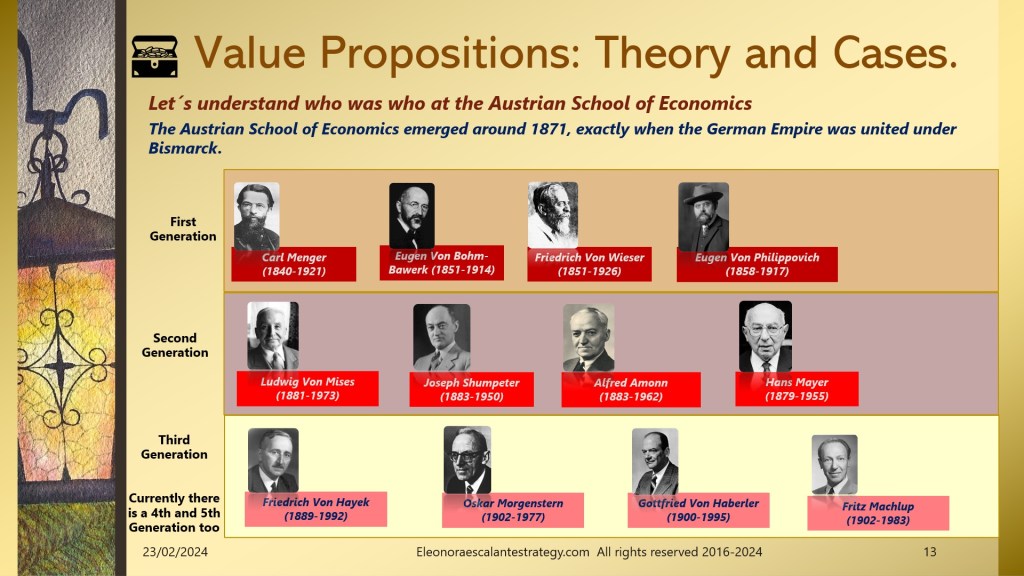
- The Austrian School of Economics: See slides 9 and 13, please. The pioneers of this economic school of thought are also called the Vienna School. The founder of this new framework of thought was Carl Menger (1840-1921), followed in parallel by Eugen Von Bohm-Bawerk (1851-1914) and Friedrich Von Wieser (1851-1926). These last two spread the Austrian school gospel not only throughout the Austro-Hungarian Empire but internationally. The importance of Menger´s work in this episode relates to the distinctive theoretical observation that he stated: People rank-ordered their needs. First people obtain the most urgent ones and then continue acquiring successive units of goods to satisfy less and less urgent needs. Menger was the first one who coined the definition of the “value of a good” in the latter terms. Please notice that “a good or a product A will be consumed to the point where the further consumption of a unit of that product A will satisfy a less urgent need than the consumption of another product B which this person could have bought instead”. This is the base of the concept of marginal utility of two goods when are equal relative to their price. The Austrian School is well known as the neo-classical school of economics. The second generation: Von Mises, and Schumpeter were trained during the golden age for the Austrian School. The London School of Economics (LSE) was highly influenced by the Austrian School through Von Hayek, Robbins, and others.
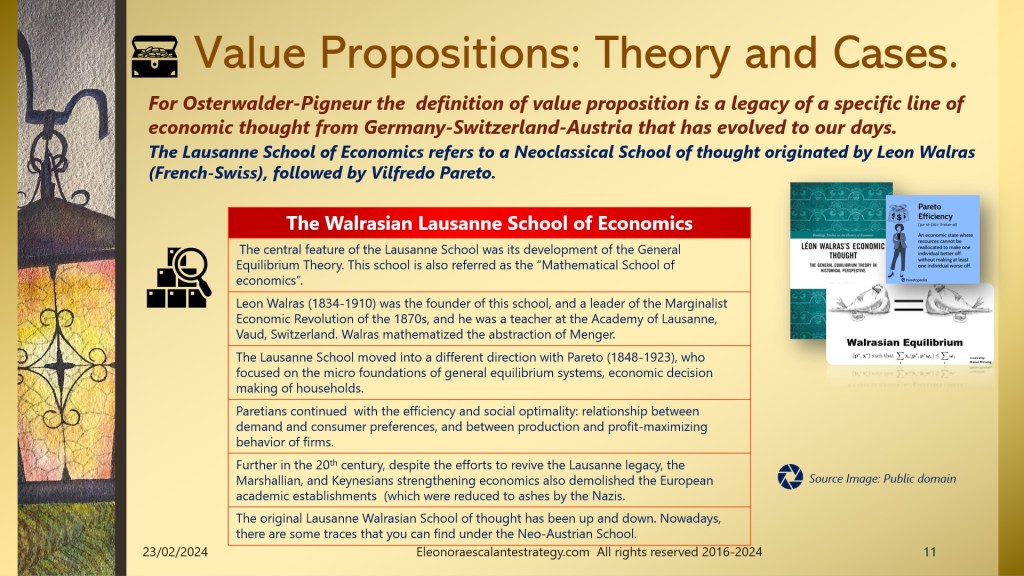
- The Lausanne School of Walras: The Lausanne School is categorized as a Neoclassical too. The founders were Leon Walras (1834-1910) and Vilfredo Pareto (1848-1923). See slide 11. For Walras, his themes were: “the existence of an equilibrium solution to a system of simultaneous market demand and supply equations, and the stability of that equilibrium; the incorporation of capital and growth and the introduction of money”. This school didn´t gain so much fame because the British Classical Marshallian supremacy of that time inundated the economic spectrum. At the same time, in the USA, the Older German historical school (first generation) had begun to manifest its first crops of hybrid ideas of research in celebrated universities such as John Hopkins, Wisconsin, Ohio State, and even Harvard. The University of Chicago built its future economists with a flavor touch of the original German Historical School of Economics.
The context of the origins of the Older German Historical School and the Austrian School of Economics.
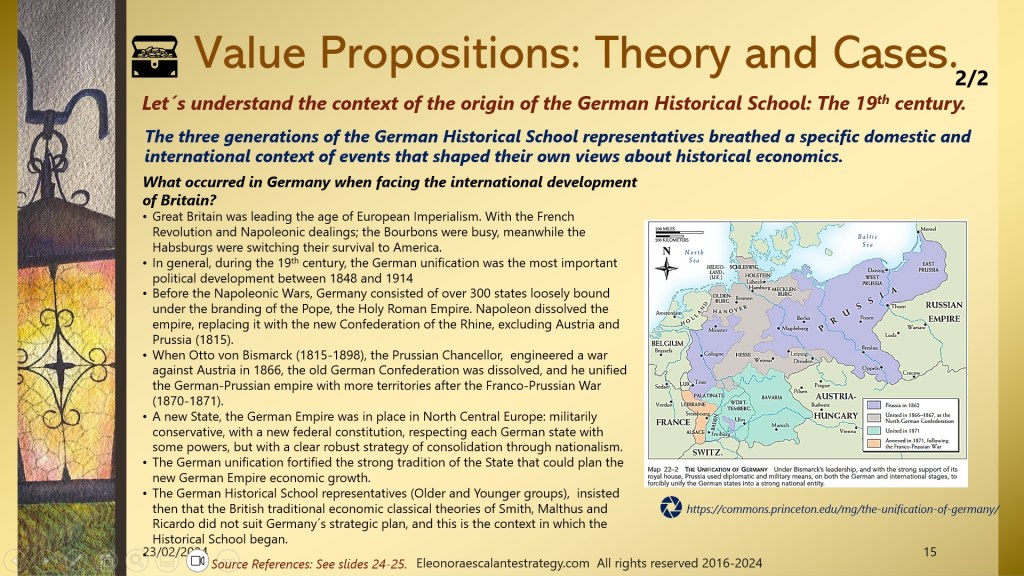
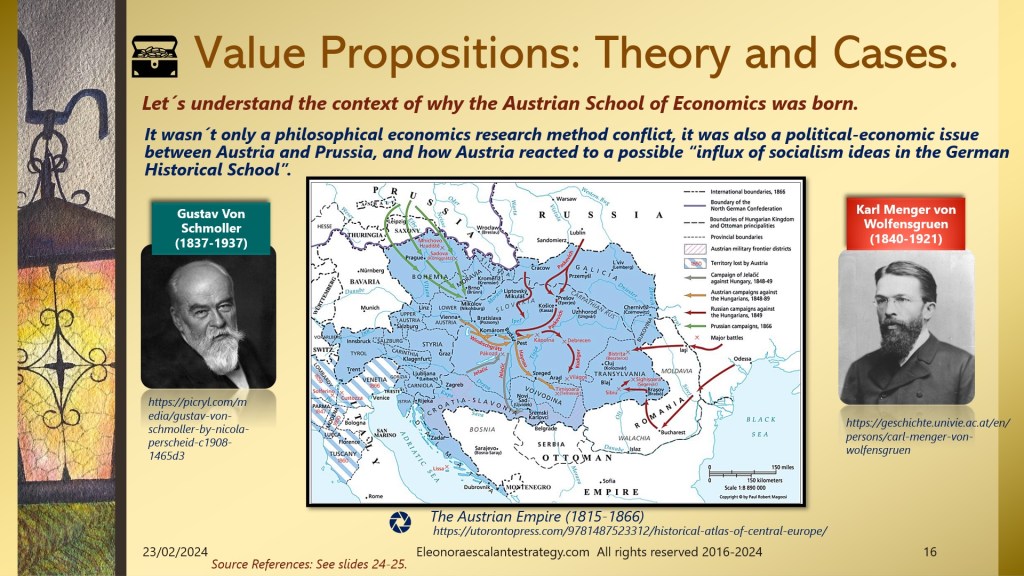
Slides 14, 15, 16, and 17 explain in detail what was occurring in Germany, Austria, Hungary and Prussia. We have tried to provide a main brushing of the list of situations in the geopolitical context of these nations, facing the growth of Britain during the Victorian Era. I encourage you to read these 4 slides with patience, observing the maps included.
The Methodenstreit occurred in this context.
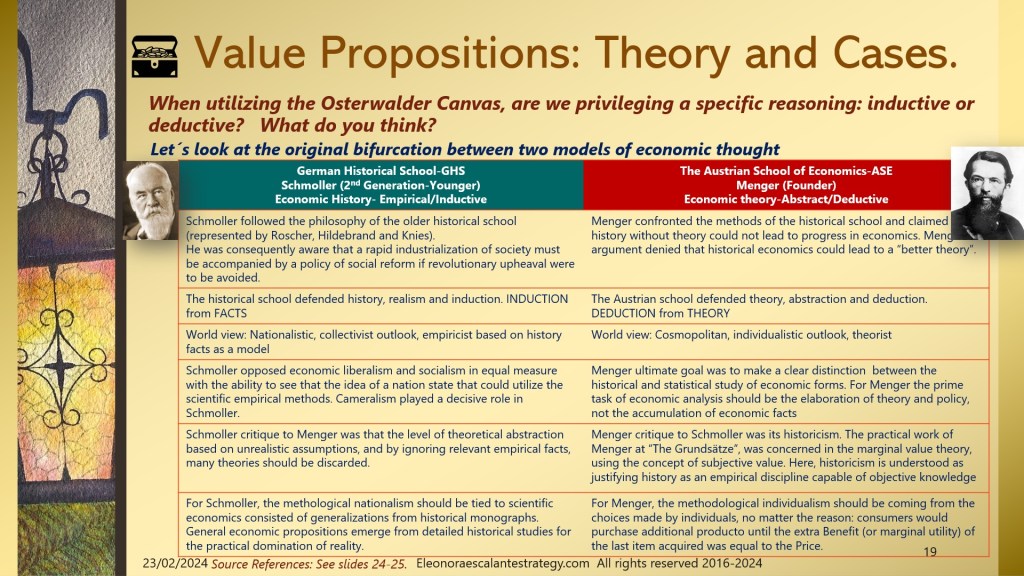
The “methodenstreit” is a German word that signifies “method dispute”. Carl Menger of the Austrian School engaged in a polemical intellectual debate and disagreement with Gustav Schmoller (a German professor, categorized in the 2nd generation of the Younger German Historical School) who was not only dealing with setting up this theoretical framework as much better than the Marxian one, but also this line of thought was much radical in nationalism ideas. When Chancellor Bismarck reunited the German Empire, Schmoller and others (Wagner, Brentano) believed strongly that the economics role should be to provide toolkits, recipes, and frameworks for the use of policymakers and businessmen, in such a way that the German Government could take a leading effort to industrialize and guide the success for its new Imperial economy. See slide 19. I have prepared a comparison of Schmoller’s position against Menger there.
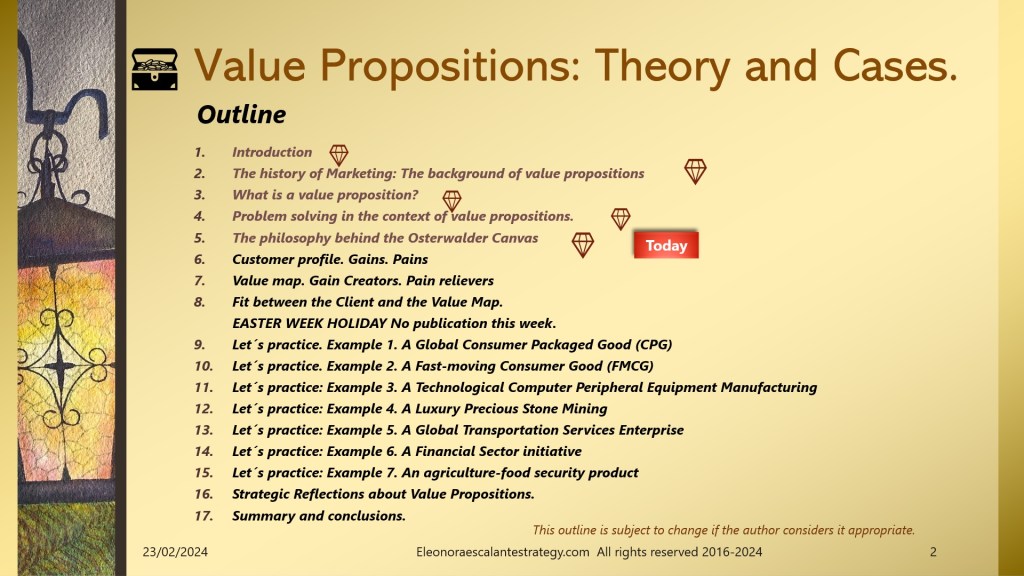
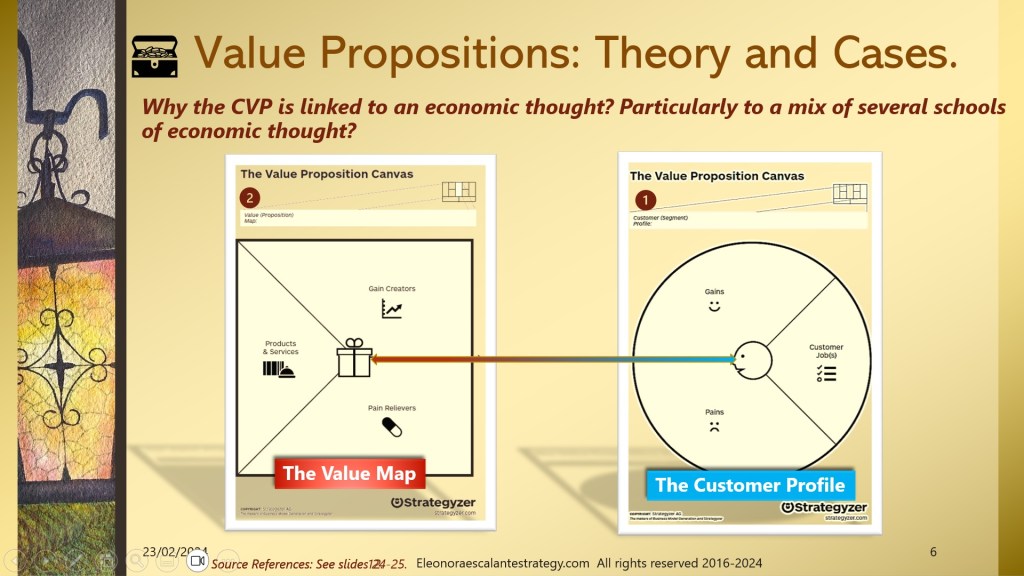
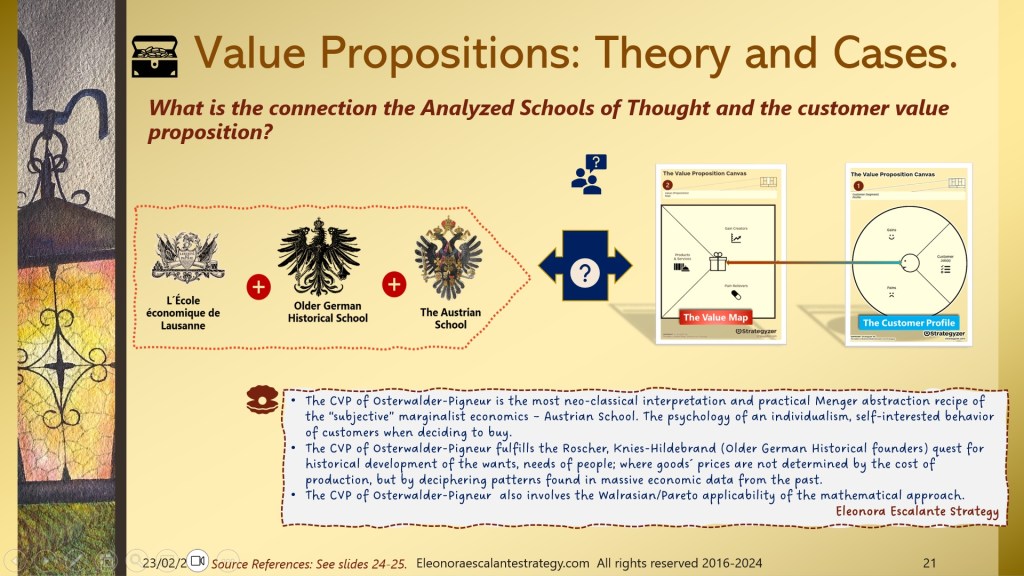
What is the relationship between these three “original” schools of economics and the Customer Value Proposition of Osterwalder-Pigneur?
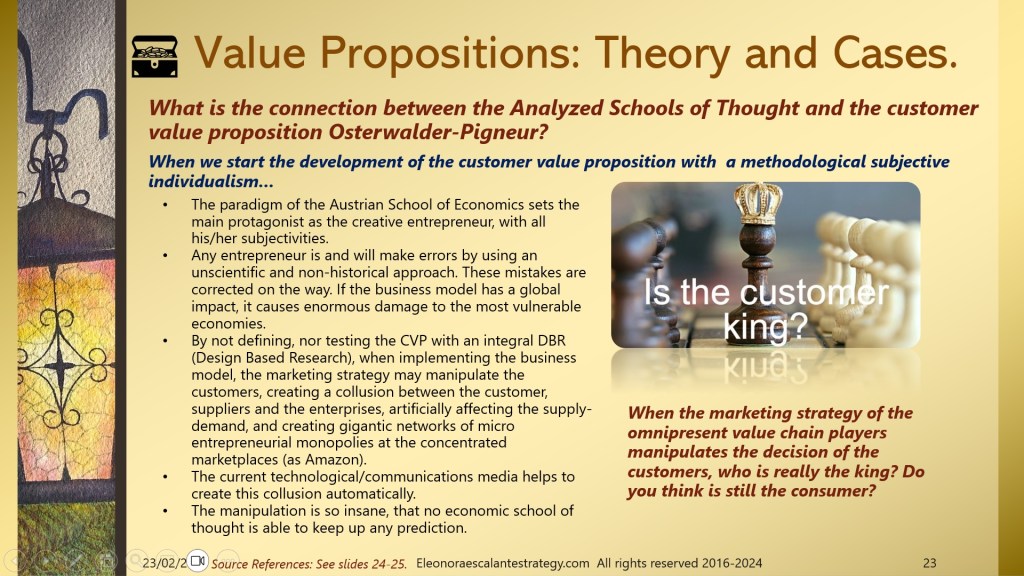
The German Historical School (in the times of Schmoller), the Austrian School (in the hands of Menger, Von Bohm-Bawerk, and Von Wieser), and the Lausanne Walras School are all interconnected and partially taken in the definition and contextual analysis of the Customer Value Proposition that has been framed by Osterwalder-Pigneur. Slide 21 provides a very specific answer in technical terms. Meanwhile slides 22 and 23 emerged from my own strategic observations and reflections.
I think, probably, that the answer to the last question is found in the series of events that occurred during the first quarter of the 20th century: particularly the Bolshevik Revolution and World War I. Once German Chancellor Von Bismarck departed his role as the leader of the confederation of the German Prussian empire, Britain leaders (including its classical and neoclassical economists) observed how the Russian Empire was disarrayed by the Bolshevik Vladimir Lenin, a far-left faction of the Marxist Russian Social Democratic Labour Party (RSDLP). This event was like the repetition of the French Revolution, but now in Russia, and now with a Marxian economic theory. This wasn´t available for the French revolutionaries in 1789. In consequence, this was going to be the first time in history that a disruption of the Russian Empire, would take place with a new economic model, that was dissimilar to the British one.
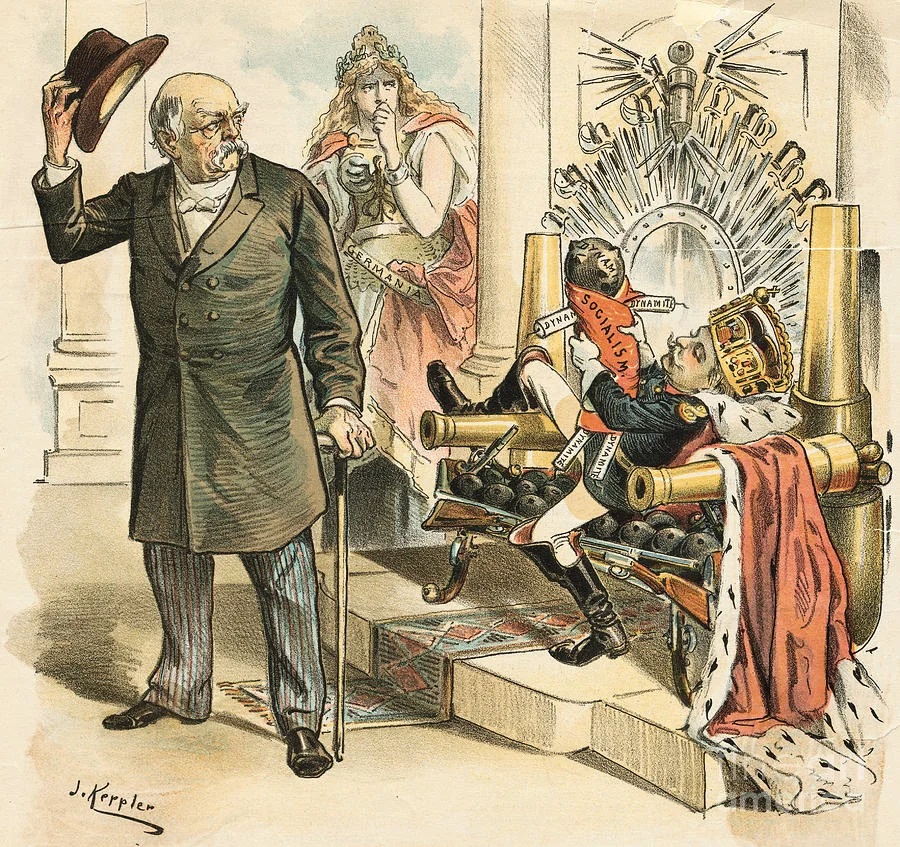
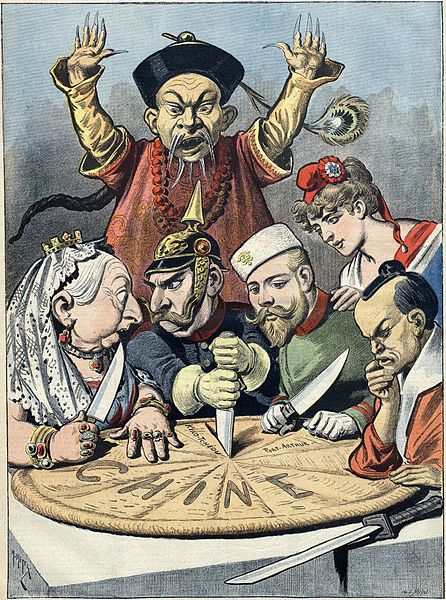
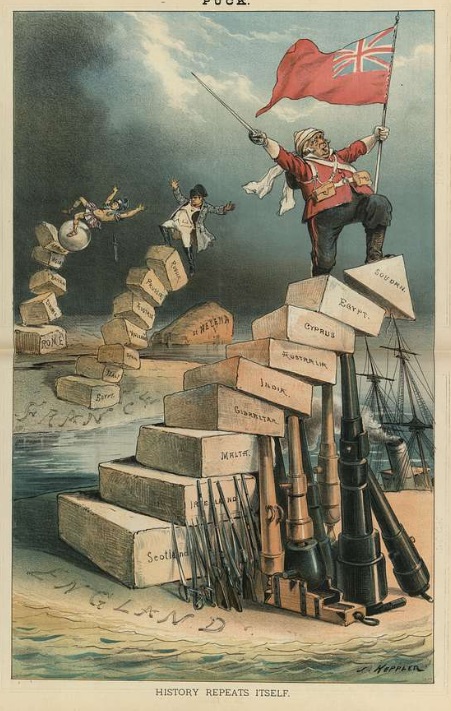
On top, by the beginning of the 20th century, the German Empire was related to Britain. The Hohenzollern Frederick III (Prussia) was linked to the Saxo-Coburg Gotha Princess Victoria (the eldest daughter of Queen Victoria). In addition, the Triple Alliance of Germany, Austria-Hungary, and Italy was attaching everything… it was the moment in time in which Britain was able to control Europe, almost totally, a place that just the Habsburgs were able to do that, 200 years before. There was a clear sign that something bigger was manifesting. All the Latin American countries of the former Spanish America Habsburg Empire were too much of a gemstone to lose under Britain’s decision-making and its new ally Prussia. Where were the remains of the old Germania of 300 princes of the Holy Roman Empire? Finally, the new model for business/economics in the hands of Lenin (in Russia) was not only in juxtaposition to the laissez-faire of the Marshallian and Austrian neoclassical schools. What occurred next? World War I.
Let´s finally try to give an answer to this question with the following 4 cartoon illustrations. The images explain everything in more than a thousand words. All these cartoons were drawn before WWI. Source: Public domain.



Negative Outcomes of Utilizing the Osterwalder-Pigneur Business Modeling Canvas.
- The Austrian-neoclassical “Laissez-faire” has also negative intentions: Humans don´t know how to stop harm to society with tech inventions. This situation applies to whatever our civilization has innovated particularly in the application of artificial means to natural processes. It applies to anything that is manufactured and hurts humans well being: Industries such as food and agriculture have been affected, information systems (with the excessive NAIQI or the technologies that hold a combo of nanotechnology, Artificial Intelligence – Robotics, and automation included-, Quantum supremacy and the Internet), transportation, plastics, chemistry, and financing.
- CVP is the basis for marketing manipulation through mega-monopolies that trigger cannibalization in their value chains and with their competitors. Many strategists have chased the Blue Ocean strategy, and by pursuing new markets and services, this quest has demolished the good things of the traditional old models.
- CVPs are usually not conceived with a DBR practice (Design-based research) but with a fast-track approach. See slide 23. When the marketing strategy manipulates the customers, the entrepreneur is also able to influence the value chain members (suppliers, distributors), creating internal and external collusion. When communications play its role in executing the marketing strategy, there is a domino effect of gigantic proportions: a behemothic monopoly of micro-entrepreneurial companies that are directly codependent on the concentrated internet marketplaces (for example Amazon.com, Facebook marketplace, or Instagram). This collusion occurs automatically and it can gain a viral dimension in a matter of hours.
- The manipulation of the outcomes of using this business model framework is so insane, that no economic school of thought can keep up any prediction. Be aware that the framework lacks certain elements that will only be present if the governments apply certain types of proper procedures of law or regulation since the DBR phase of its CVP design. Any framework that doesn´t allow entrepreneurs to design properly (considering the consequences for the long run to humanity) is required to be adjusted.
- Other outcomes will be discovered during our journey when we dedicate time to practice how to do CVPs, in the following weeks.
Announcement.
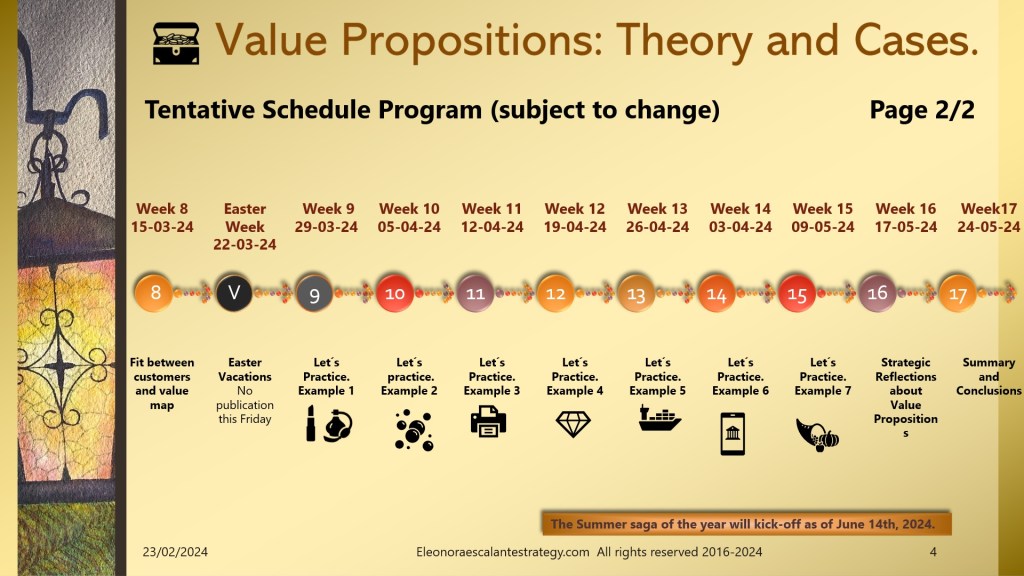
This spring saga has been extended a couple of weeks more. It will last until the 24th of May. Sorry for this last change, but I had to show you the economic philosophical background of the frameworks that we utilize in our current times. This ground is so relevant, and no one explains it fully. I have taken the time to show you the whole picture, something that is not cleverly done at Business Schools. I took a couple of weeks to prepare it, and include it on the table of this saga.
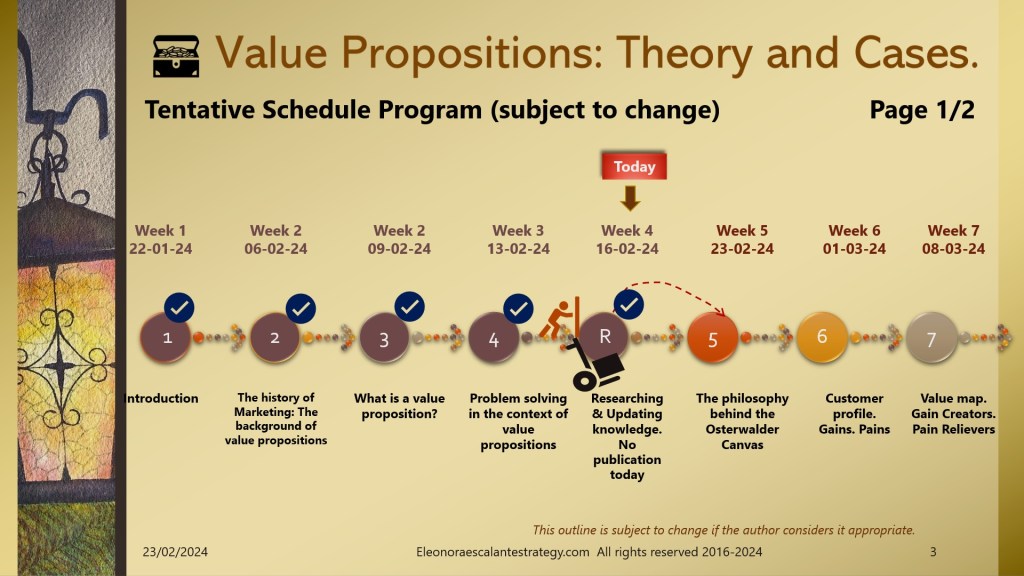
We will publish only on Fridays (occasionally, if required we will add more additional episodes on Tuesdays), at the latest before 11:59 pm (CST). Our next episode will be the beginning of the theoretical explanation of the value proposition canvas. We will explore the section of the customer profile, Gains, and pains.
Musical Section.
This saga is about improvement, amelioration, upgrading, and the advancement required in the theory and practice of value propositions. Value propositions are the first step in our business modeling frameworks. If the value proposition is improper, then our business model is mistaken. Therefore, we will also share the music of classical progress that marked a before and after in the history of music.
I am infatuated with the sounds of the lutes. An instrument that has almost been lost. The interpreters of our musical relaxing video are Oleg Timofeyev, Quartetto di Liuti da Milano, and Bernhard Hofstötter. The channel is from Brilliant Classics.
Thank you for reading http://www.eleonoraescalantestrategy.com. Blessings see you on our next episode.

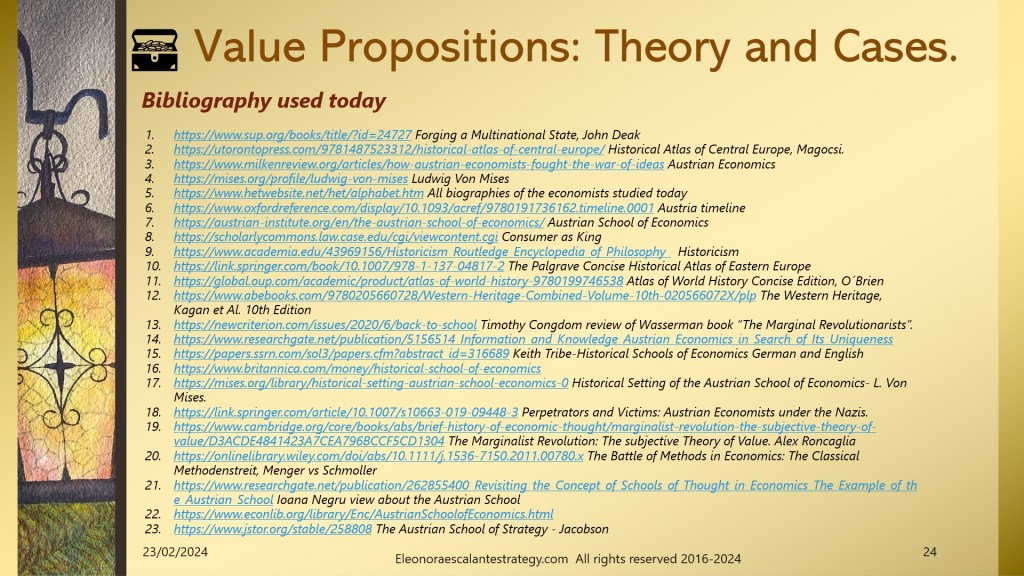
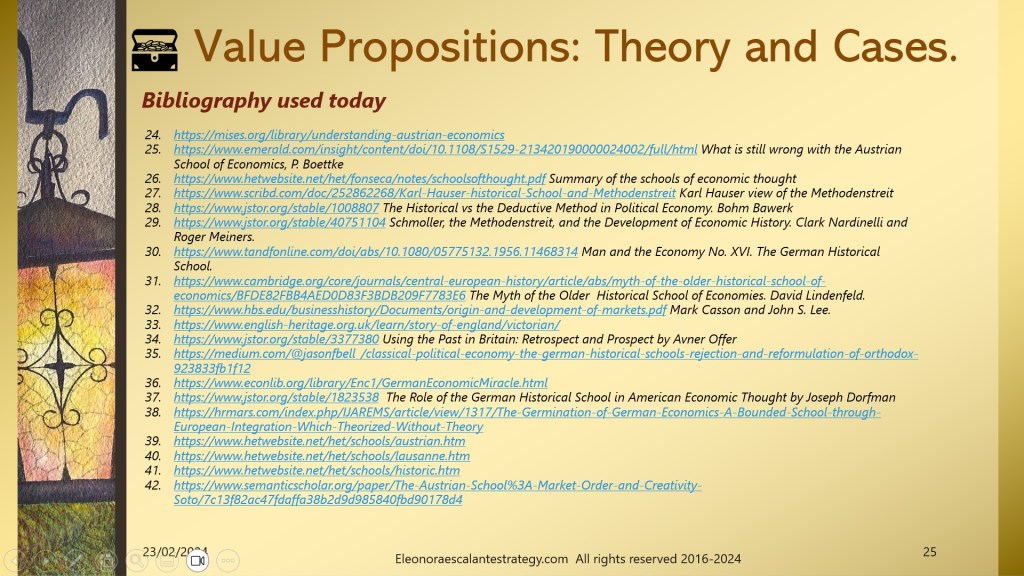
Sources of reference and Bibliography utilized today. All are written in slides 24-25.
Disclaimer: Eleonora Escalante paints Illustrations in Watercolor. Other types of illustrations or videos (which are not mine) are used for educational purposes ONLY. All are used as Illustrative and non-commercial images. Utilized only informatively for the public good. Nevertheless, most of this blog’s pictures, images, or videos are not mine. I do not own any of the lovely photos or images unless otherwise stated.
 Eleonora Escalante Strategy - Strategic Reflections Think Tank