

Value propositions: Theory and Cases. Episode 6. Customer Profile. Gains. Pains.
Let´s welcome this exquisite month of March. Today we will continue our journey toward understanding the theoretical background of the Customer Value Proposition (CVP) as it is designed and explained by Osterwalder-Pigneur.
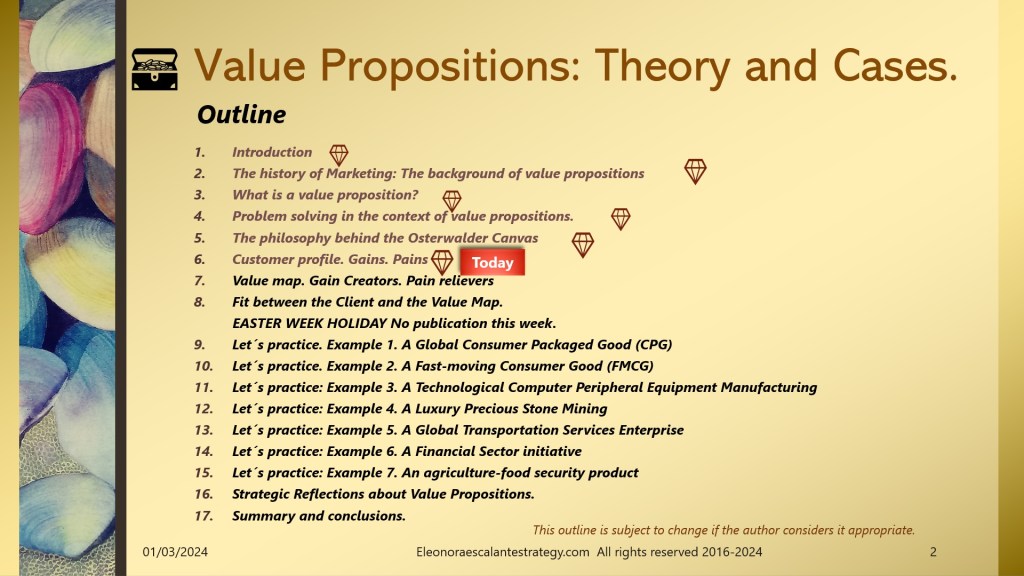
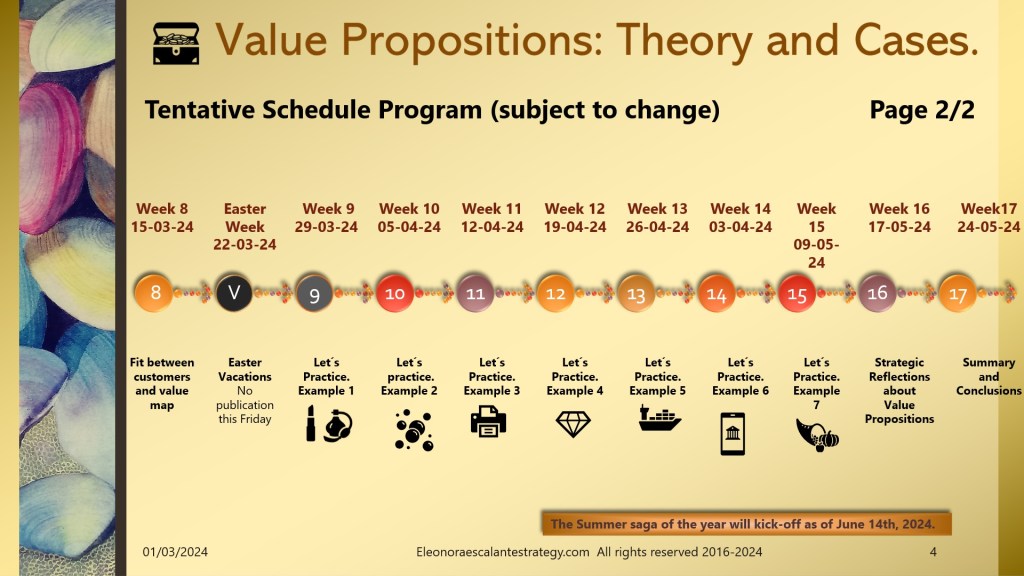
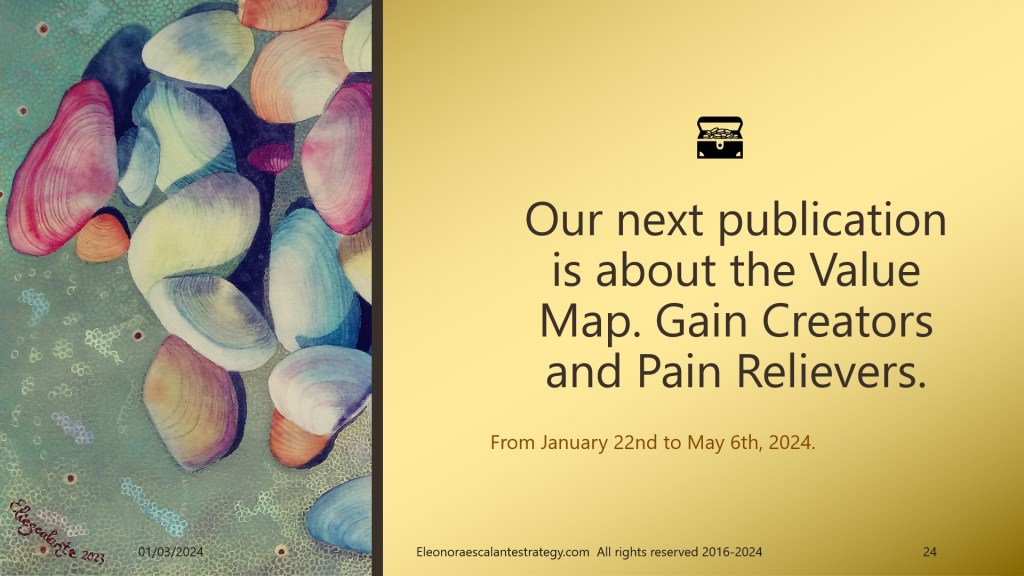
As usual, we have prepared a set of 24 slides that summarize the content of the book “Value Proposition Design”, by Osterwalder et al. Let´s see the following material, please. Feel free to download it, print it, and share it.


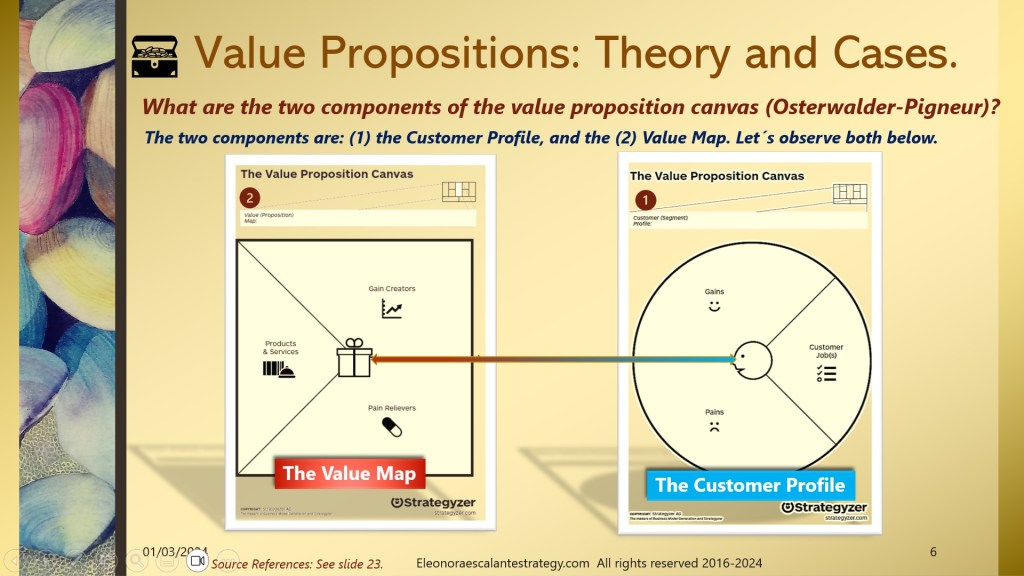


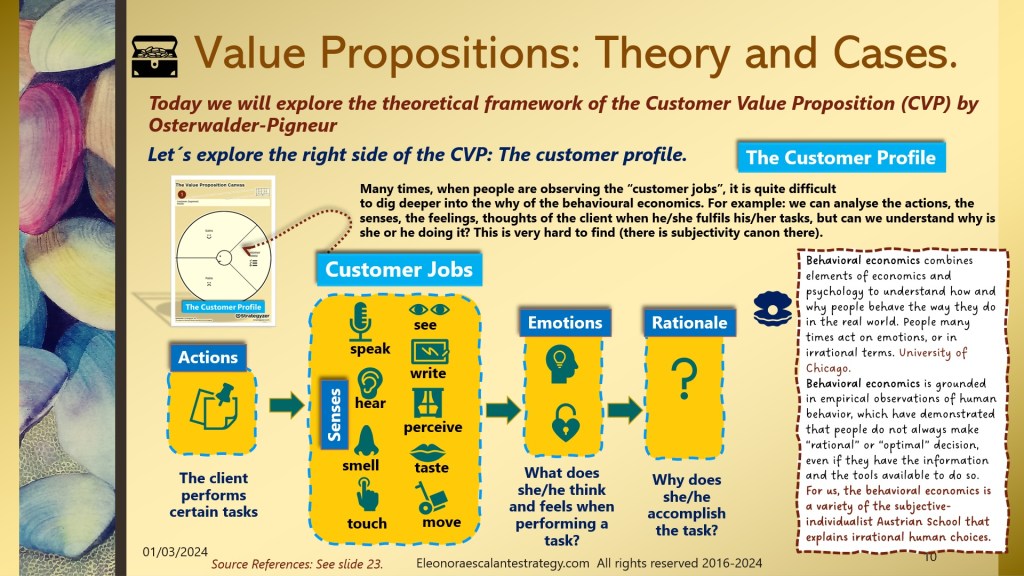
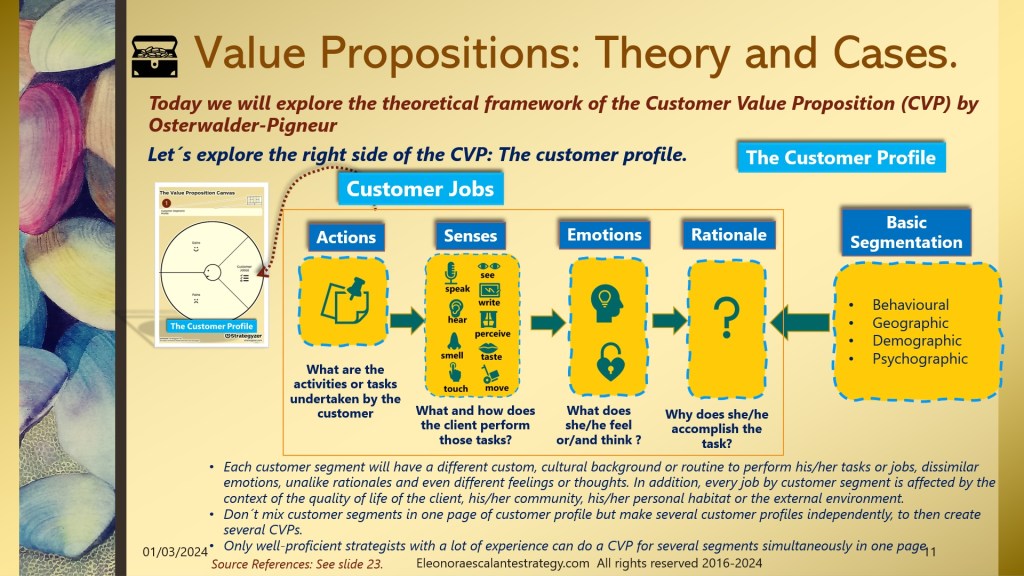

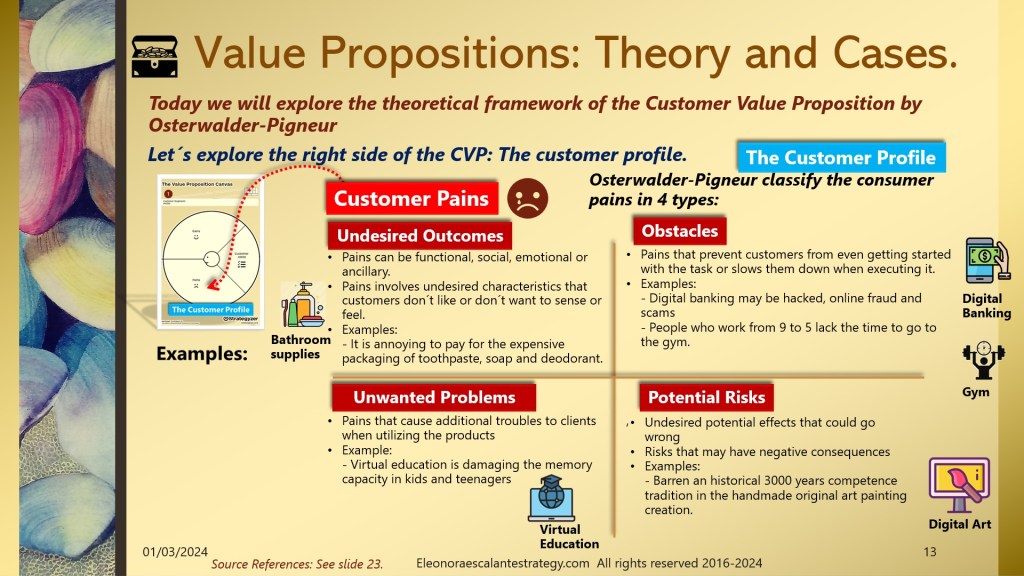
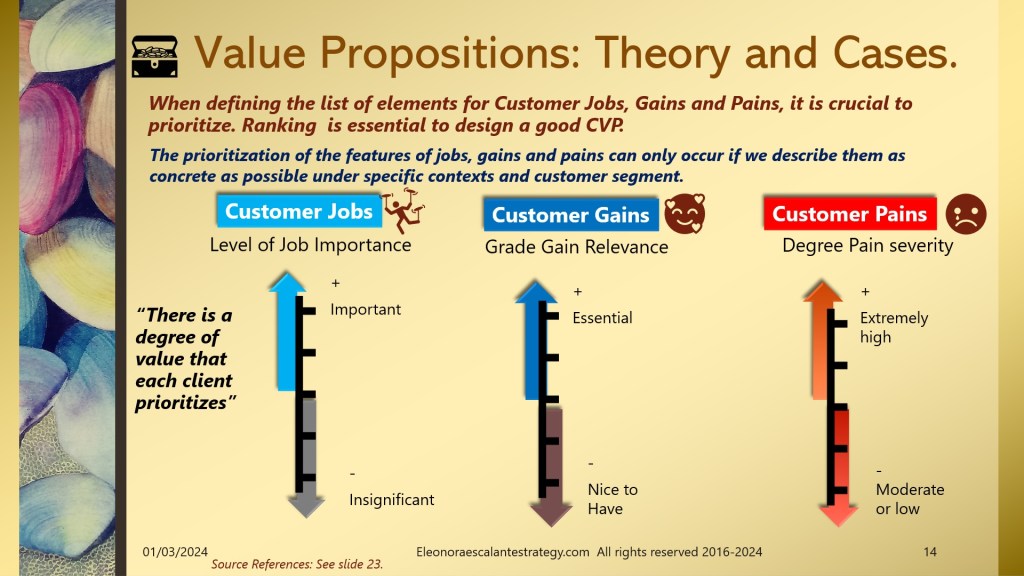
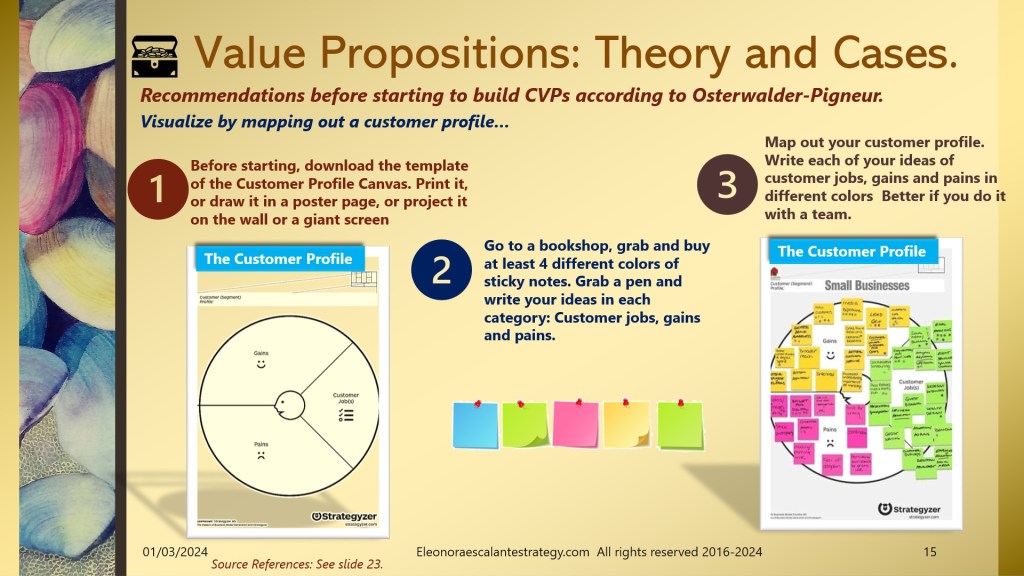
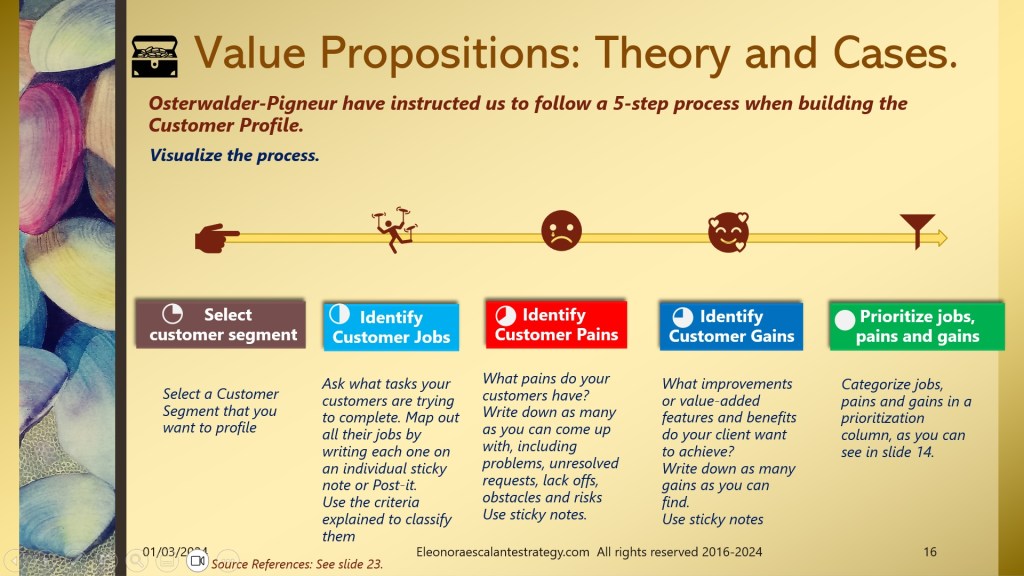
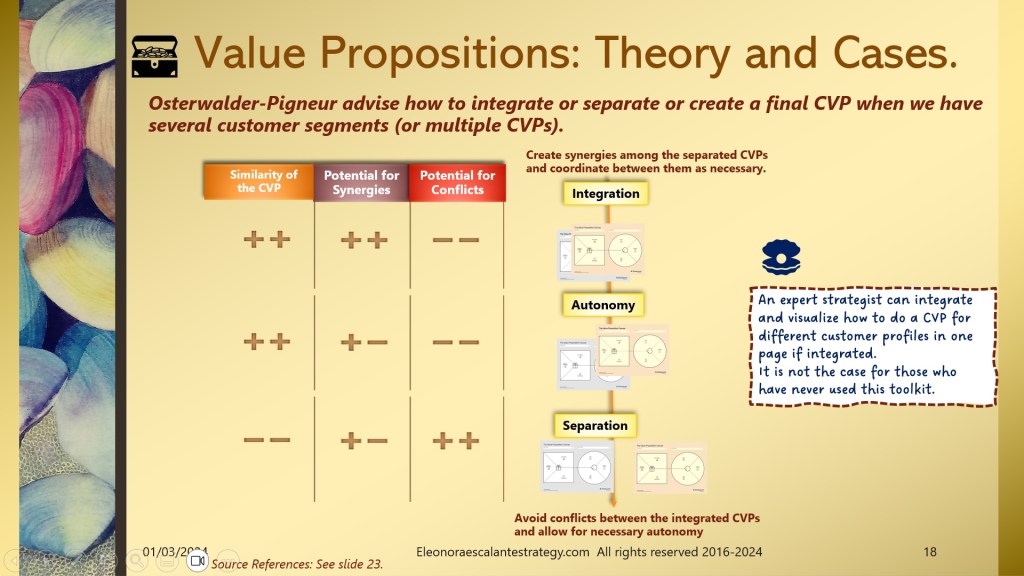

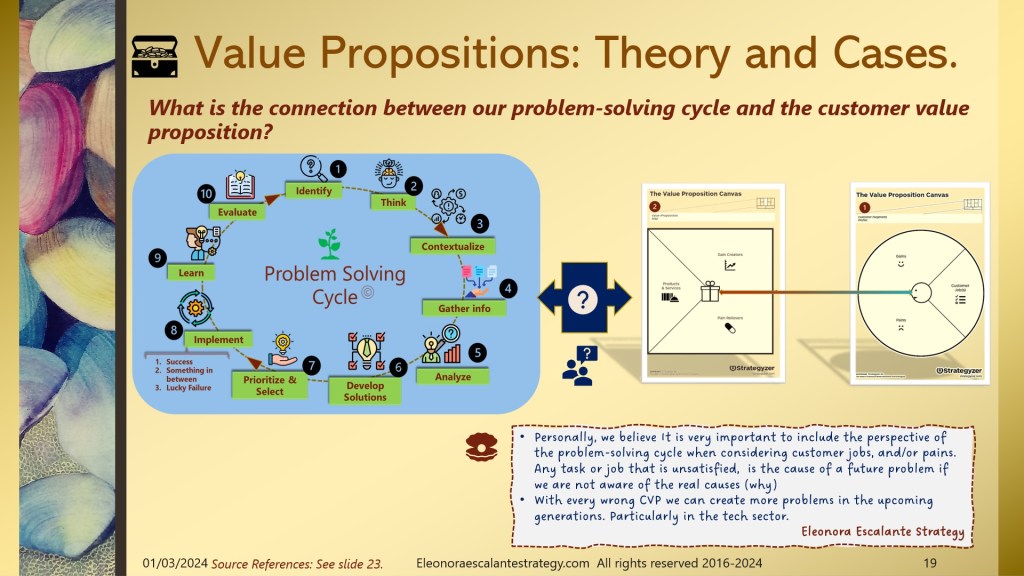
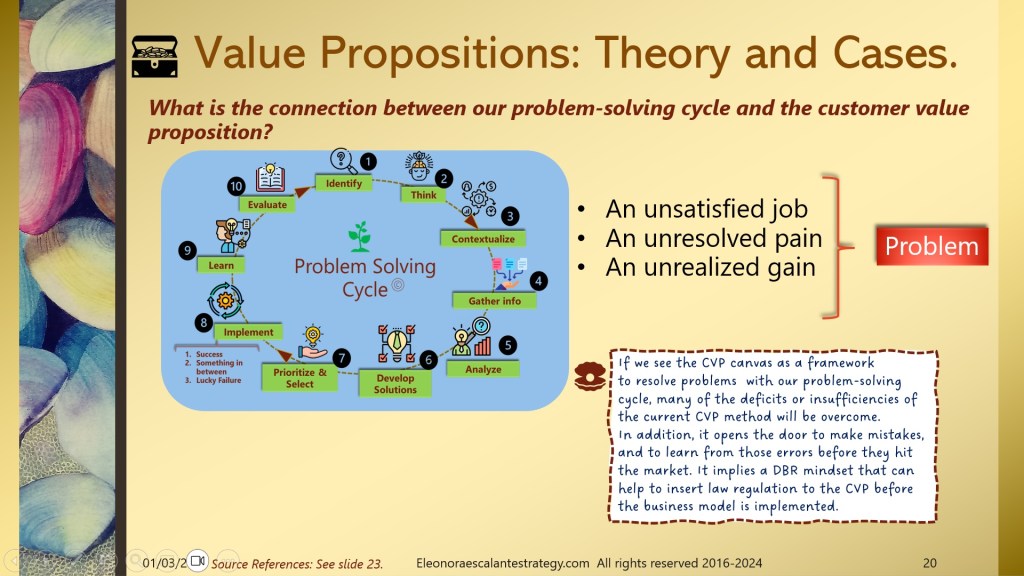


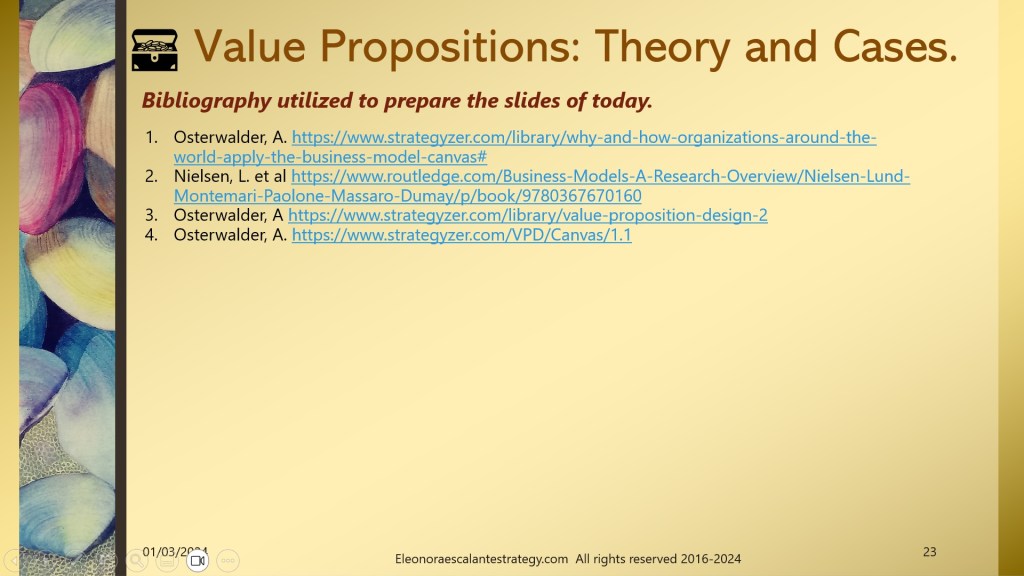
As usual, I would like you to take your time to read these slides in parallel to watch the following video prepared by Strategyzer.com (the advisory firm of Osterwalder-Pigneur). I share it below:
For the time being, I will leave you with homework. Read the slides, and make a list of questions that you have when reading our material. I always fulfill the promise to come back every Monday to fill in the strategic reflections that accompany Friday´s publication. I am convinced that the only way to help you think strategically is by leaving you to create your own inquiries first. As far as this framework is concerned, the most difficult part is to comprehend the relative difference between a need and a want, because each customer has a different perspective and personal scheme of reference. For example, the term “need” for an agriculture farm laborer earning $300 per month from Sierra de los Cuchumatanes in Guatemala, who dedicates his life to growing potatoes and raising sheep; will be completely different than a “need” for a middle-class tech employee who works for Google, and earns US$30,000 per month in Palo Alto, California.


When in doubt, read more.
Once you are clever enough to write your observations by reading the slides (something that doesn´t occur when you watch a video) you will have innumerable doubts. And that is the purpose of leaving you with a reading assignment over the weekend. If you are a keen observer of this methodology when building customer jobs, tasks, or activities; customer gains or customer gains; you will probably feel insecure on how to identify them well. There are several levels on how to differentiate or categorize your discernment about the value of each customer’s job, pain, or gain. The subjectivity-individualism for each segment or client that you can observe, leaves us with several levels in which abstraction is the only suited path to arrive at a conclusion. And that is what makes this framework so stirring (sometimes irrational) too. It is challenging to do it if you are planning ahead with products or services that are cutting the edge of our brainiac domain, such as Google Classrooms product for education for example. Finally do not worry if you don´t understand a piece of this episode, we will have a lot of examples as of the week after Easter, and you will enjoy each of them. I expect you to ask me questions, I am always here to help you.
During the weekend I reviewed the slides that I prepared last week, and we will proceed to the value map elements this Friday. Keep your notes about the “customer profile section” for a few days, the majority of your questions will be solved with our next publication.
Some strategic reflection on Behavioral Economics, nudging, and availability heuristic.
I have prepared a couple of supplementary slides about this topic. These are below this section, please read these two additional slides (slides 25 and 26). Behavioral Economics, explained by Doctor Richard Thaler, the Economics Nobel Prize of 2017, has been mistakenly taken as a burgee pennant to reject the neoclassical economics rational dilemmas. Doctor Thaler explains “It is a misreading to consider the rise of behavioral economics as a kind of paradigm-shifting revolution within economics…”. For Thaler and his group of followers, “A key factor of Nudge Theory is the ability for an individual to maintain freedom of choice and to feel in control of the decisions they make”. But that is not the case anymore. What started as an understanding of economic irrational decisions, has converted itself into an approach that supports the digital marketing essence in all its flavors and formats. To influence for the sake of helping people’s welfare has been remade into a chaotic behemothic marketing strategy used by marketers as “the most normal thing in the universe”. Libertarian paternalism has slowly converted into coercive oppression in which the consumer simply follows more irrational decision-making than before the advent of the iPhone (2008). During the last 20 years, behavioral economics concepts have gone away from the initial spirit of the ones who discovered these observations, as Thaler and his group; and are now manipulated by practitioners, twisted by marketing specialists, and contorted by corporate strategists in such a way that we all of us believe in the art of “becoming masters in irrational decision-making”. Between the Historical-Multidisciplinary School of Economics and the Neoclassical Austrian School, to opt for the behavioral economics as a replacement of the latter two; I don´t think is a good idea at all. Nowadays, we are watching the extreme consequences of using coercive digital nudging in our daily “laissez-faire” lives. That is why I didn´t include “behavioral economics” on the list of economic schools of thought this past week. I can´t accept Behavioral Economics as a school of thought, because it is simply irrational to use it without any control, it is damaging people. If our CVPs (Customer Value Propositions) frameworks are built using the premises of Behavioral Economics “only”, that is the “ahhhh” justification as to why all this mess with NAIQIs (combo of Nanotechnology, Artificial Intelligence – robotics, and automation included -, Quantum tech, and the Internet).
To accept “behavioral economics” as a Bible for CVPs can make us sprint erratically towards wrong CVP designs, not because of lack of compliance toward the customer, but because we are using standards that can be abused or controlled (likes, number of subscribers, fake customer reviews, etc). In addition, there is a vicious cycle of “manipulated clients”, or clients who are “being influenced to make irrational choices: customers affected by digital pressure biases, heightened emotions, mental fatigue, loss aversion, subjective addictions, mistaken codependencies, foolish non-consideration or disrespect toward others, different nation´s contexts of development, and prejudiced situational framing” (1). In one phrase: If we observe manipulated customer jobs, our value map will be also nudged.

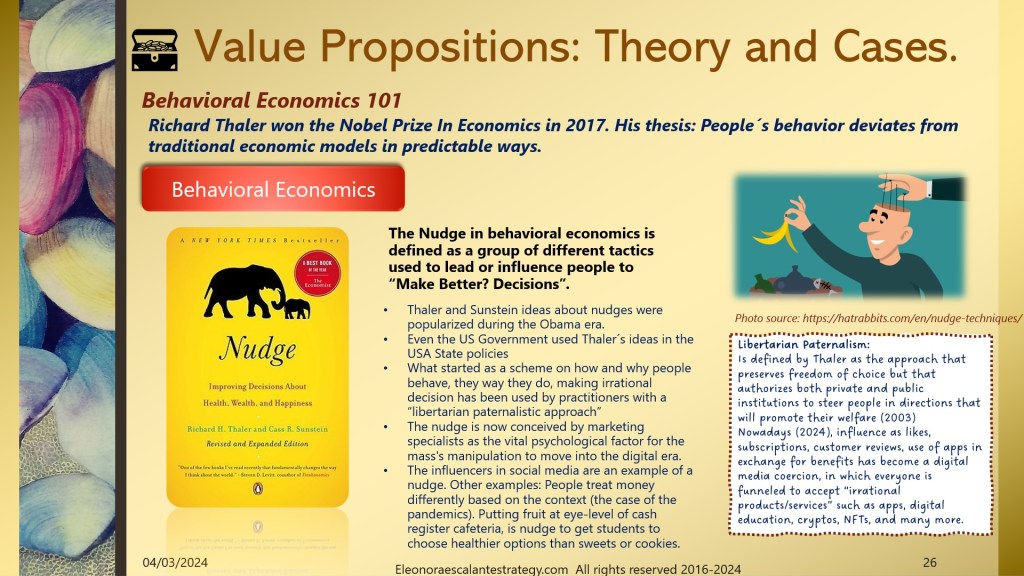
Finally, let me explain the term “availability heuristic“. This term refers to the idea that people often rely on easily recalled information, rather than actual data, particularly when evaluating the likelihood of a particular outcome (2).
Announcement.
This spring saga has been extended a couple of weeks more. It will last until the 24th of May. Please remember that we publish only on Fridays, and we upload our strategic reflections on Mondays. Occasionally, if required we will add more additional episodes on Tuesdays. We always publish at the latest before 11:59 pm (CST). Our next episode will be about the second part of the Value Proposition Canvas. This section is called Value Map and includes pain relievers and gain creators.
Musical Section.
This saga is about improvement, amelioration, upgrading, and the advancement required in the theory and practice of value propositions. Value propositions are the first step in our business modeling frameworks. If the value proposition is improper, then our business model is mistaken. Therefore, we will also share the music of classical progress that marked a before and after in the history of music. The instrument of today is the horn. Horns catapulted the sound of an orchestra with a strong impact. “Beethoven was the first to expand beyond two horns in a symphonic work, and the result is what you can listen to in his Ninth Symphony”.
Today is the turn of the Mozart Concerts prepared for the Horn instrument. The album is named Mozart: Horn Concerts. Produced in 1991 by Collins Classics. The interpreter of the horn is Barry Tuckwell accompanied by the Philharmonia Orchestra. Barry Emmanuel Tuckwell (1931-2020), was an Australian virtuoso horn player and conductor.
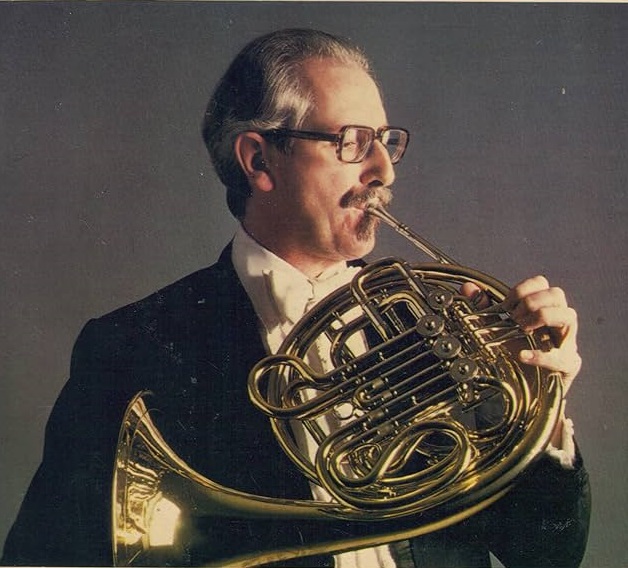
Illustrative and non-commercial picture. Used for educational purposes. Utilized only informatively for the public good. Source: Public Domain
Thank you for reading http://www.eleonoraescalantestrategy.com. Blessings see you on our next episode.

Sources of reference and Bibliography utilized today. All are written in slides 24.
(1) https://www.psychologytoday.com/us/basics/behavioral-economics
(2) https://news.uchicago.edu/explainer/what-is-behavioral-economics
Disclaimer: Eleonora Escalante paints Illustrations in Watercolor. Other types of illustrations or videos (which are not mine) are used for educational purposes ONLY. All are used as Illustrative and non-commercial images. Utilized only informatively for the public good. Nevertheless, most of this blog’s pictures, images, or videos are not mine. I do not own any of the lovely photos or images unless otherwise stated.
 Eleonora Escalante Strategy - Strategic Reflections Think Tank