
Value propositions: Theory and Cases. Episode 7. Value Map. Gain Creators. Pain Relievers
Happy International Women´s Day!. A great thankful appreciation to all of us who are doing the future, who are making the best at home and at work, who are lovingly helping our partners, and who are teaching the next cohort of youngsters and kids, how exquisite it is to include the word “pure love” to God, love others, love ourselves, and love the planet in everything we do.
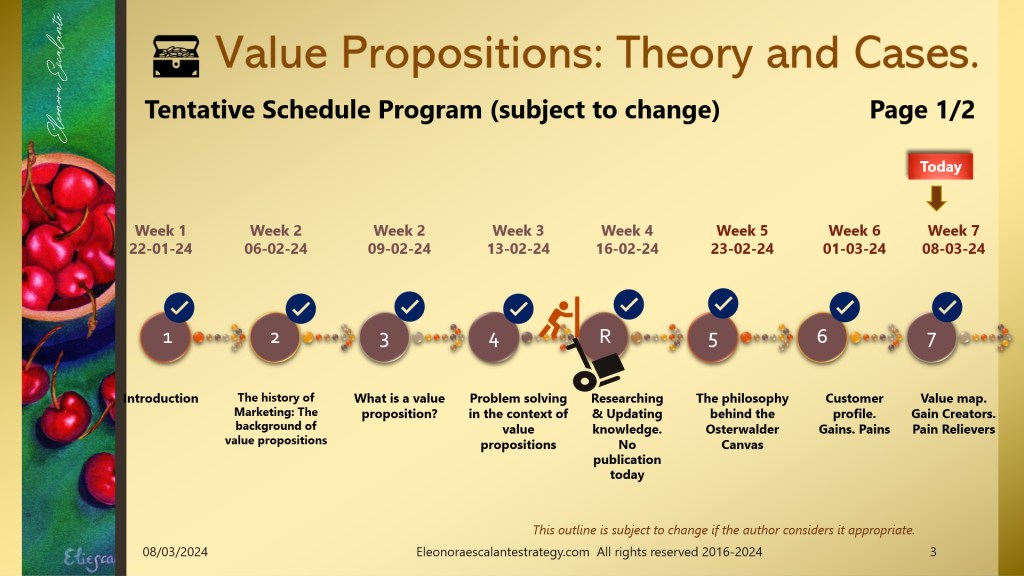
Today´s class is about the basic theoretical material that is linked to the second section or component of the Customer Value Proposition. Osterwalder-Pigneur has baptized it as the Value Map. We are studying this methodology or technique to appropriately assess, define, and design the products and services of our business models. We have chosen the Osterwalder-Pigneur technique because it has been remarkably utilized since its birth, around the year 2005.
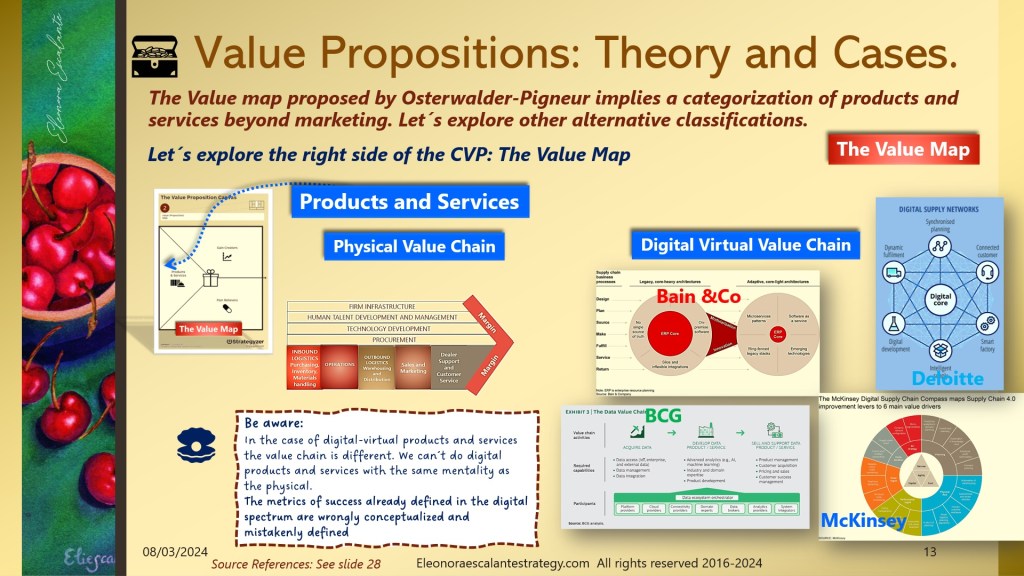
Additionally, don´t get me wrong: the Osterwalder-Pigneur CVP framework is not the only one. Each top consulting house on earth (such as McKinsey, Bain & Co, Boston Consulting Group, Deloitte, PWC, and others) has its own methods to establish customer value propositions for its clients. The Osterwalder model is the easiest to comprehend for everyone, and it could be modified, enhanced, and improved, particularly for the Micro, Small, and Medium enterprises (MSMEs) that cannot pay for a consulting advisor. According to the United Nations, “MSMEs account for 90% of global businesses, 60 to 70% of employment and 50% of GDP worldwide. The MSMEs are the backbone of societies everywhere. The MSMEs contribute to local and national economies and sustain livelihoods, in particular among the working poor, women, youth, and groups in vulnerable situations”. The question is how can we help the MSMEs with decision-making in the context of the NAIQI disruptive technologies? The impact of the MSMEs is enormous in society, and we shall help them with knowledge and good theoretical frameworks too. We must help the MSMEs to think “well” before they decide to embrace the NAIQI hype in their present and future business modeling that will modify their own products and services.
The NAIQI products/services were sold to us without carrying out trial testing before hitting the marketplace. Insanely since 20 years ago, no testing was done on the NAIQI products before releasing them in our marketplaces. Regardless of what consulting house has been analyzing the topic of the new wave of disruptive technologies agglutinated under the NAIQI acronym (Nanotechnology, Artificial Intelligence -Includes automation and robotics-, Quantum supremacy, and the Internet); the NAIQI products went directly from the oven of manufacturing plants to consumers. The NAIQI products/services are simply still in the testing stage, but frankly, and irresponsibly, we all citizens of the world have been using them without knowing that our generation was the real-fast track testing exam. We began to use them since the advent of the iPhone in 2007. Without any type of regulation, and without learning before that there is a philosophy and a theoretical framework behind it. A philosophy of creating wealth through “games of thrones” that comes from the times of Gutenberg (before the Enlightenment). We all live immersed in an imperial warfare that has been there for several centuries. We must be aware of all that is driving our businesses, and how or why the NAIQI technologies are leading us to a time of “je ne sais quoi” Feudalism, in which if we accept it, we all are paving the road for our kids to become digital beggars without comprehending it. Anyway, I already explained to you about this last year.
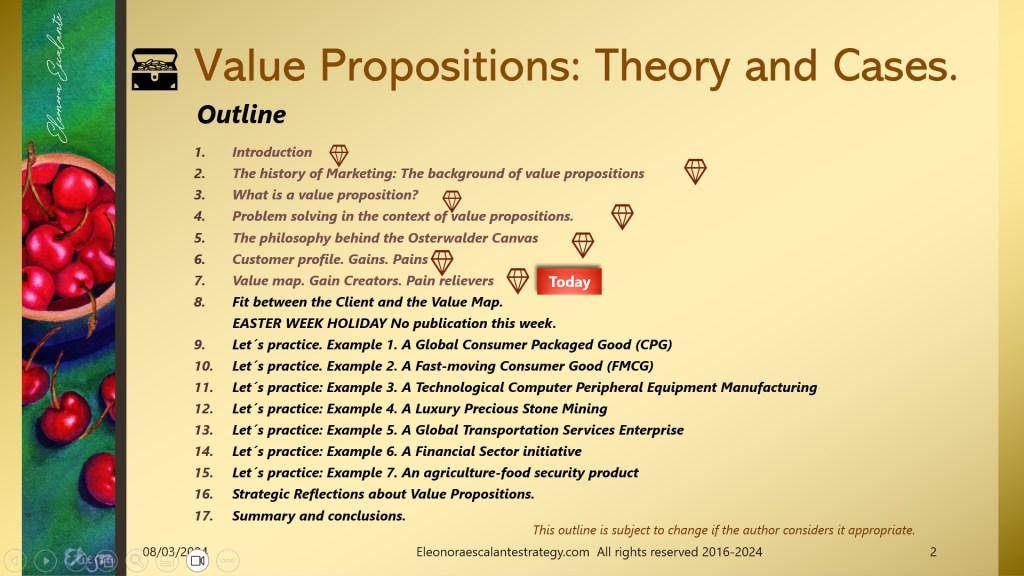
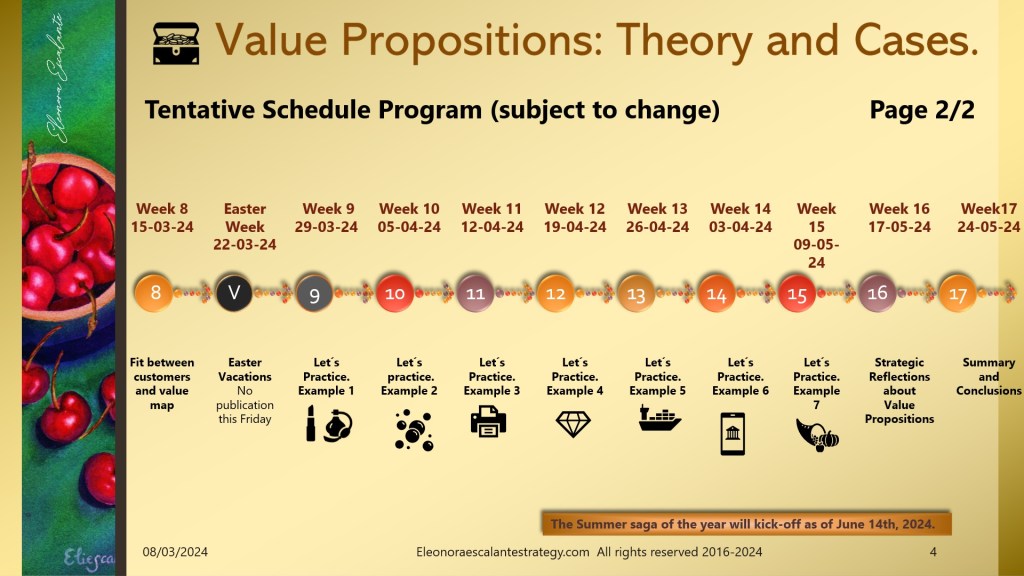
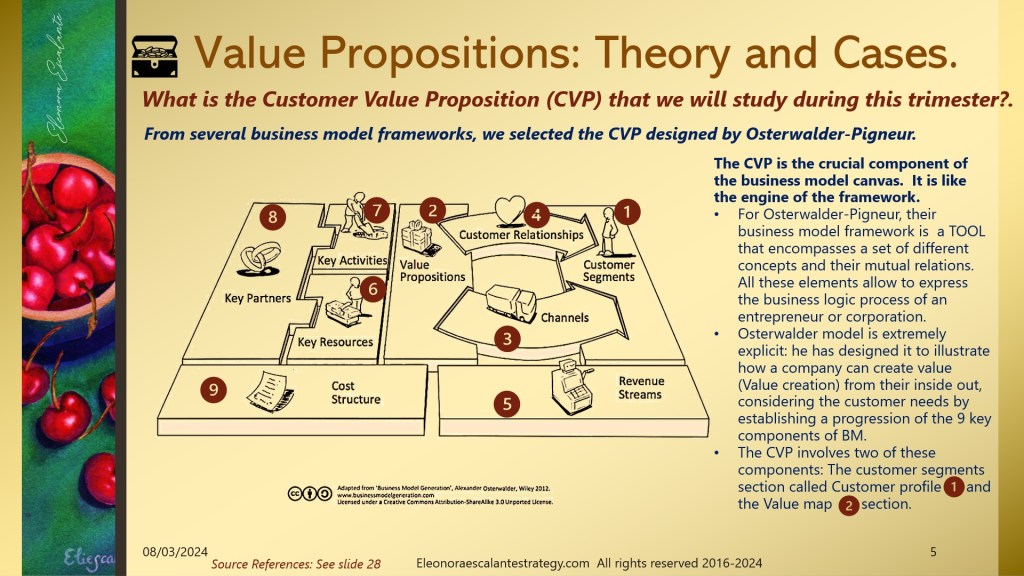
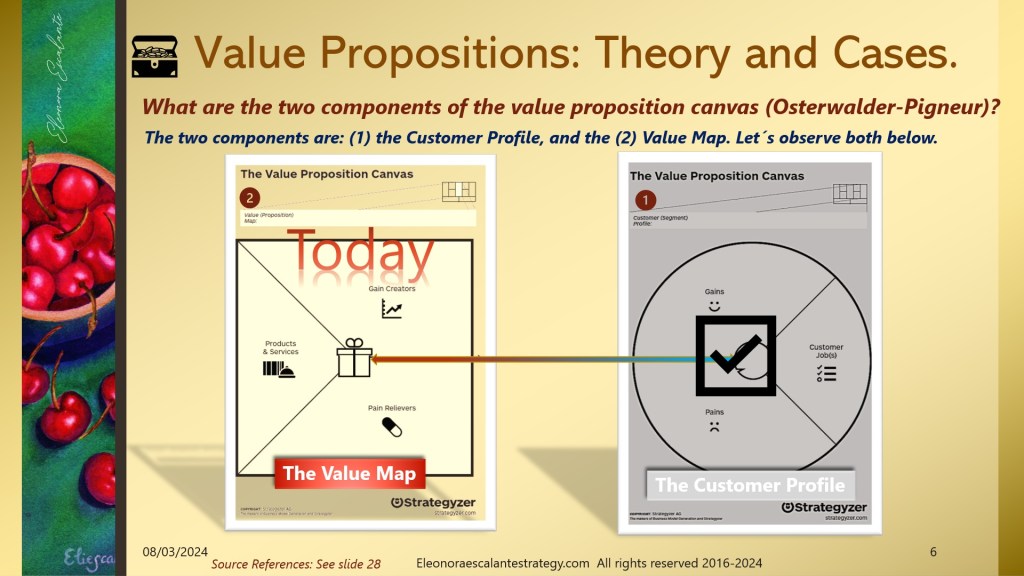
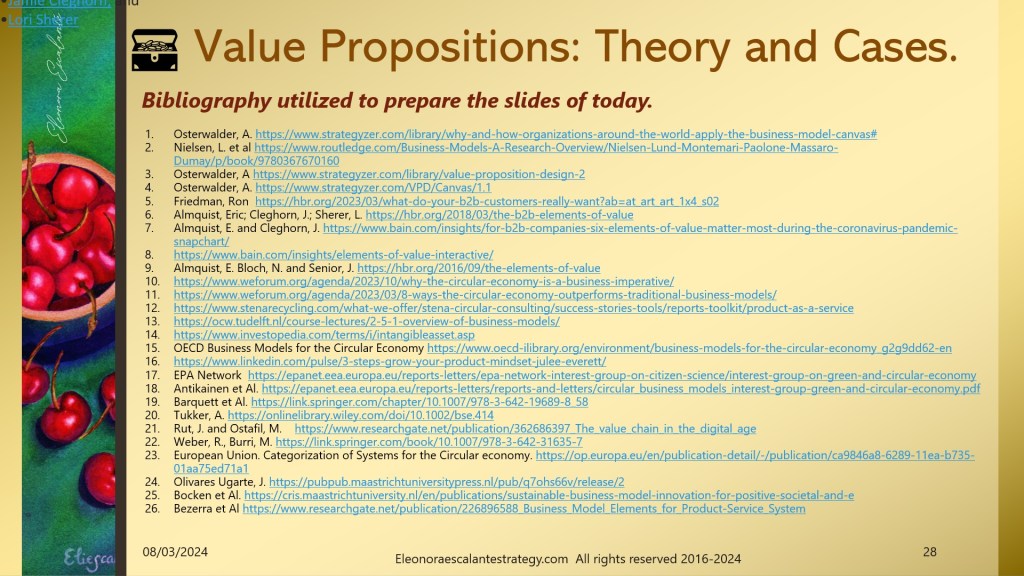
Before gaining a moment in this publication, let´s review the material that we have prepared for you during the week. Feel free to share it, download it, print it, and discuss it with your friends, or with your colleagues. Do not hesitate to ask yourself questions. Any slide that I include here, will make you wonder, and I reassure you that is what we wish. We truly desire you to think beyond the apparent, and we truly adore that you can go to our bibliography (slide 28), and get acquainted with more information for your delight.
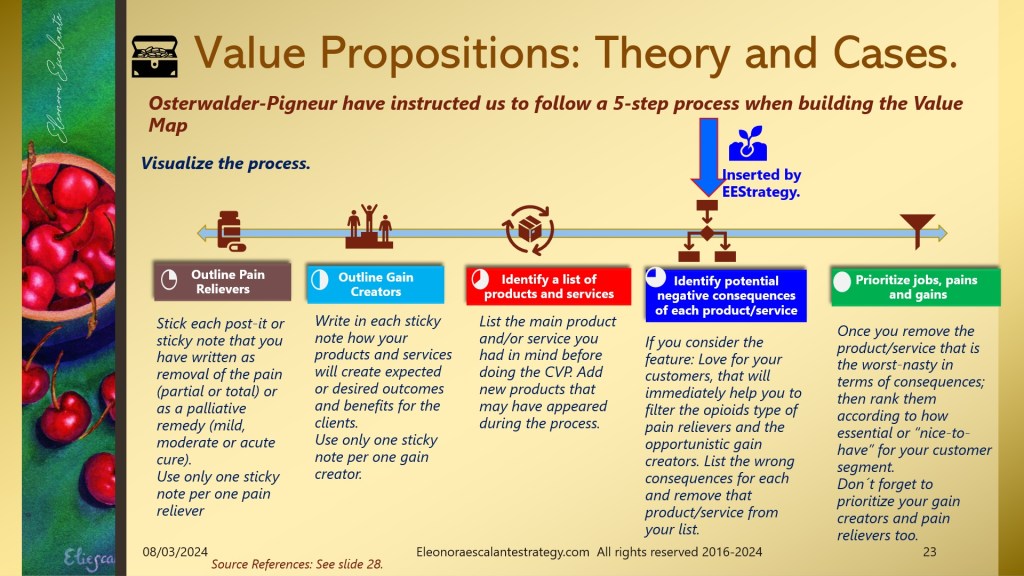
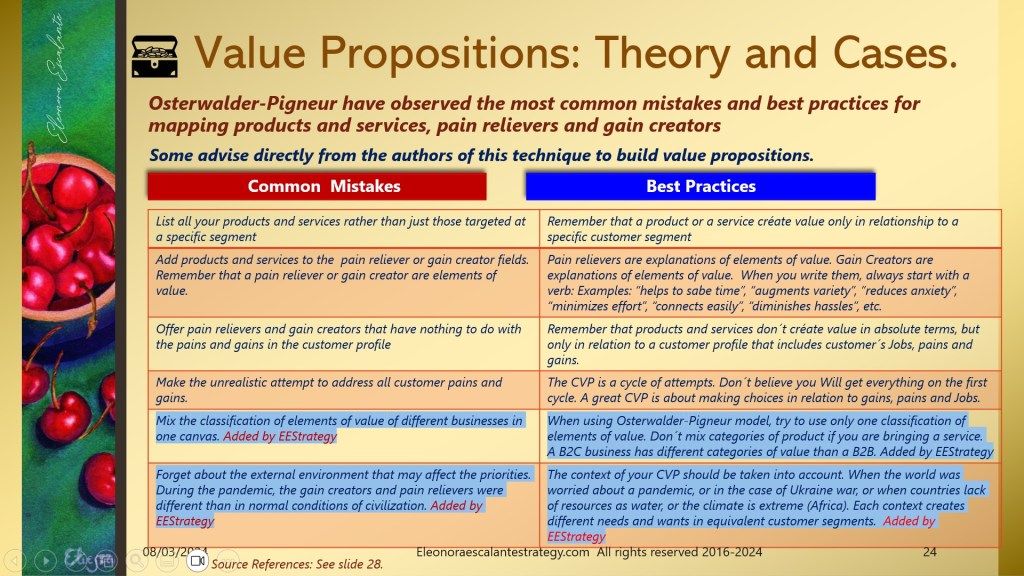
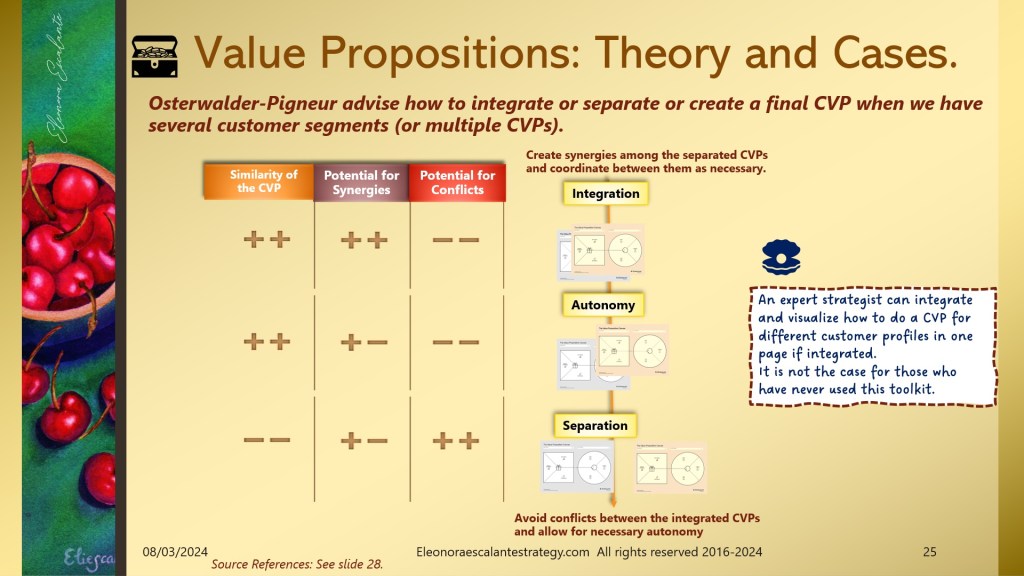
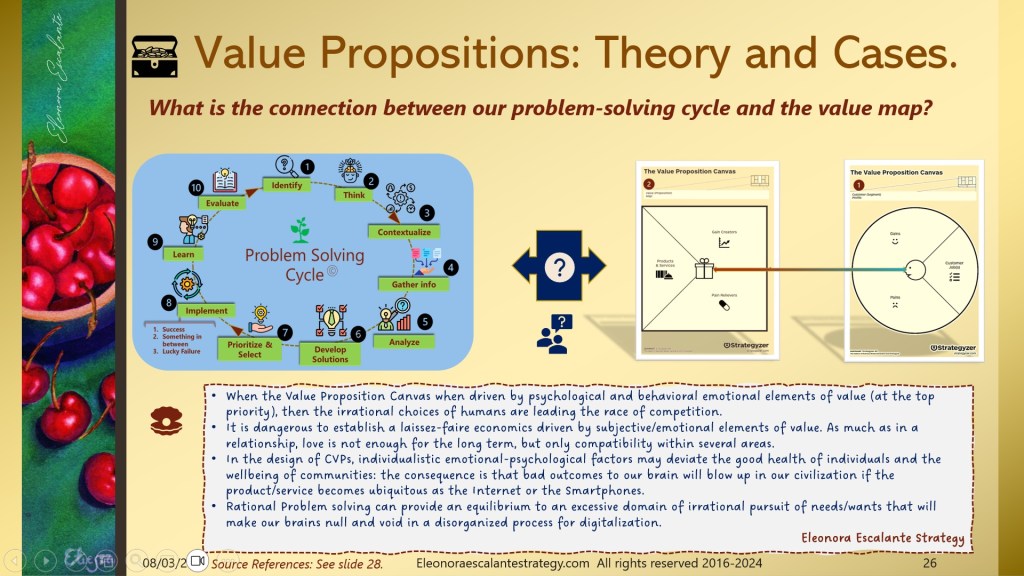
Strategic reflections.
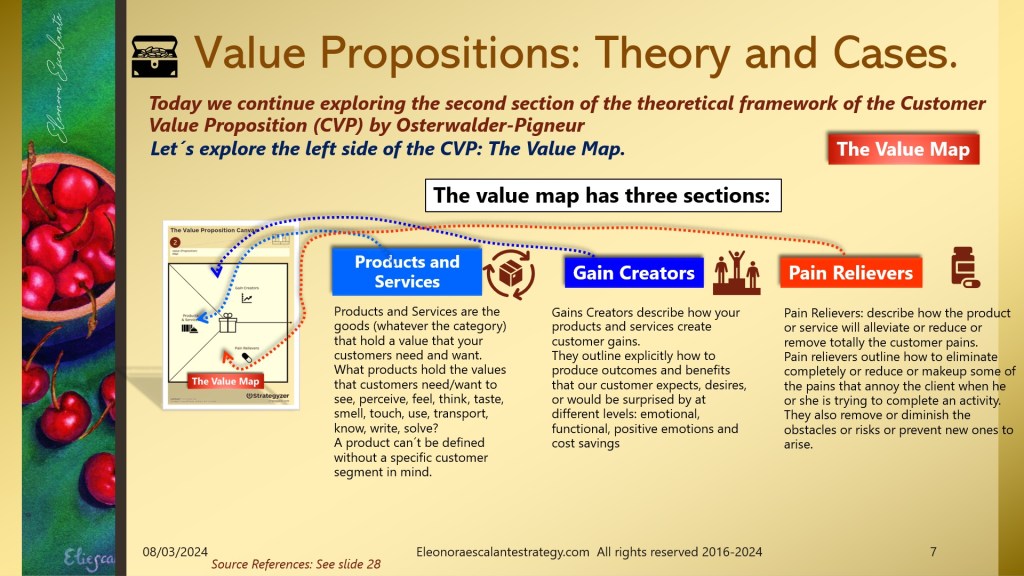
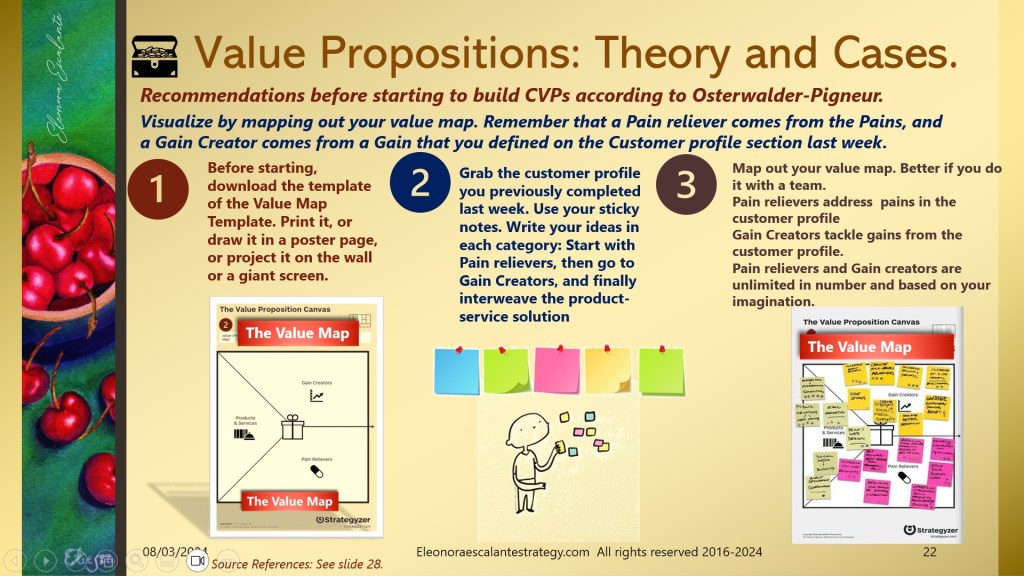
The Value Map describes the elements of value of our products and services.
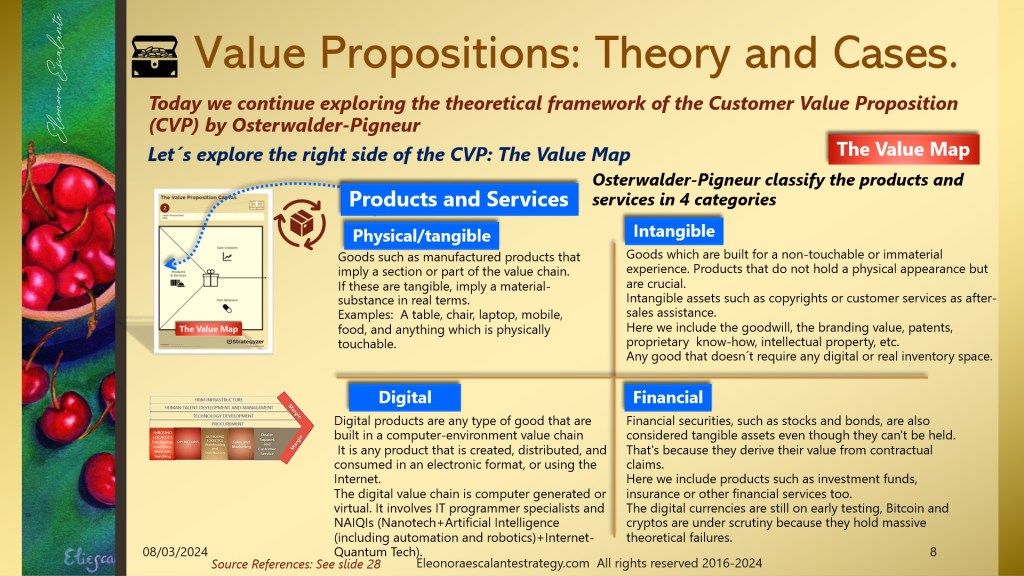
Let´s begin with our strategic reflections on the second section of the Value Proposition: The Value Map. Don´t forget that we are now exploring the basics, the theoretical rationale behind the process designed by Osterwalder-Pigneur. Designing CVPs (Customer Value Propositions) is an art, and it takes a while to master the process. Many specialists in marketing do not hold that expertise, because it takes several years of experience and a lot of contact with several segments of clients to realize what defines them. The more data-analytical the marketing new professionals, the harder it is for them to get it right.
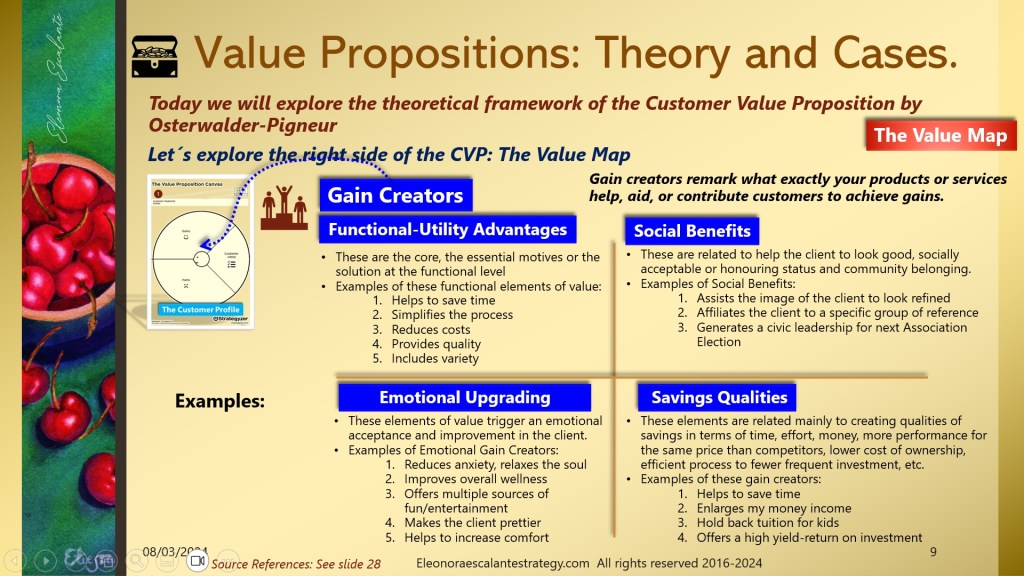
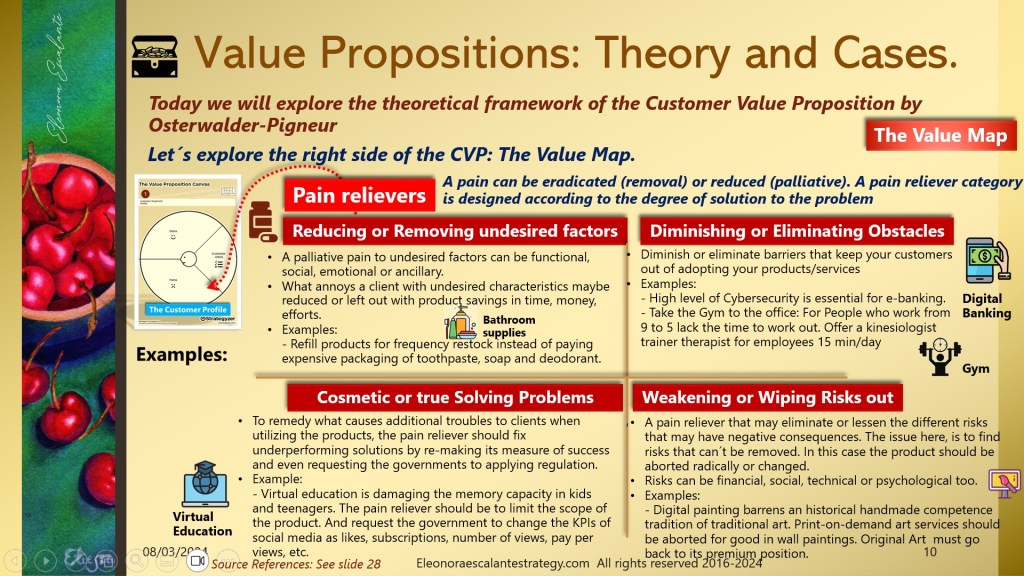
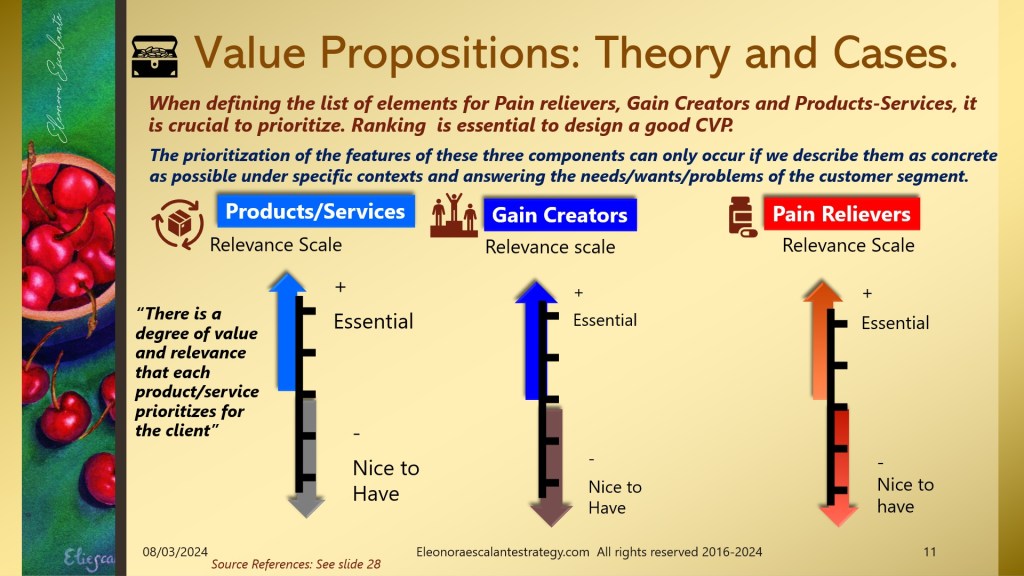
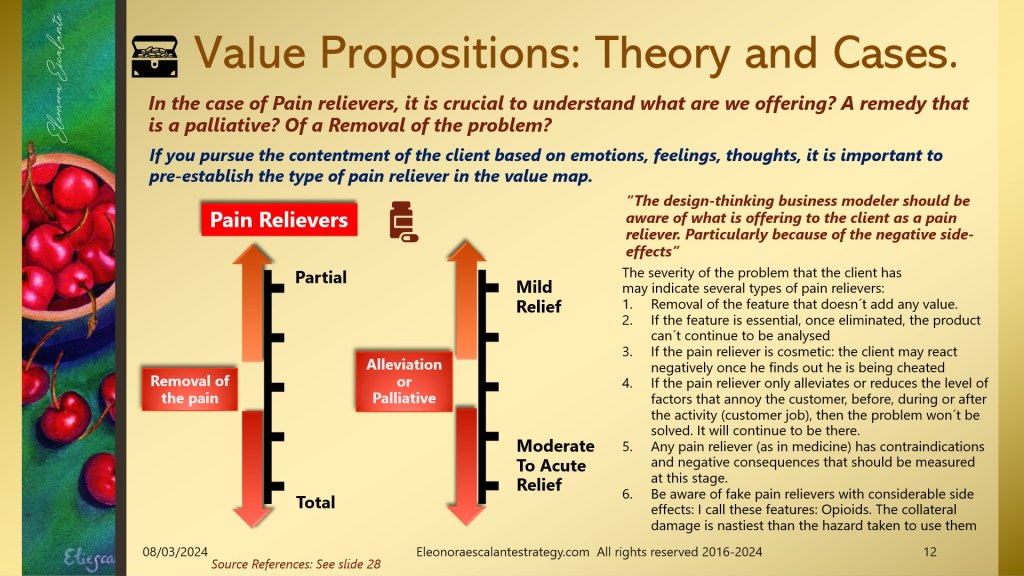
The package of slides includes the theoretical explanation of the terms used by Osterwalder-Pigneur. Slides 5 to 12 are self-explanatory. The first thing to reflect here is the definition of a product, a service, or a hybrid mix of product/service, which must hold the “values that customers need or want or aspire or the solution of value to the customer”. Each client has elements of value that are different from other clients. That is why we must understand the customer first. Do we wish to target the segment of people who value the quality of time spent? Or are we considering the segment of the population that value more the money to pay? The elements of “value” for each client segment will be of a certain category. And so the gain creators and the pain relievers that will be embedded in the product/service will differ.
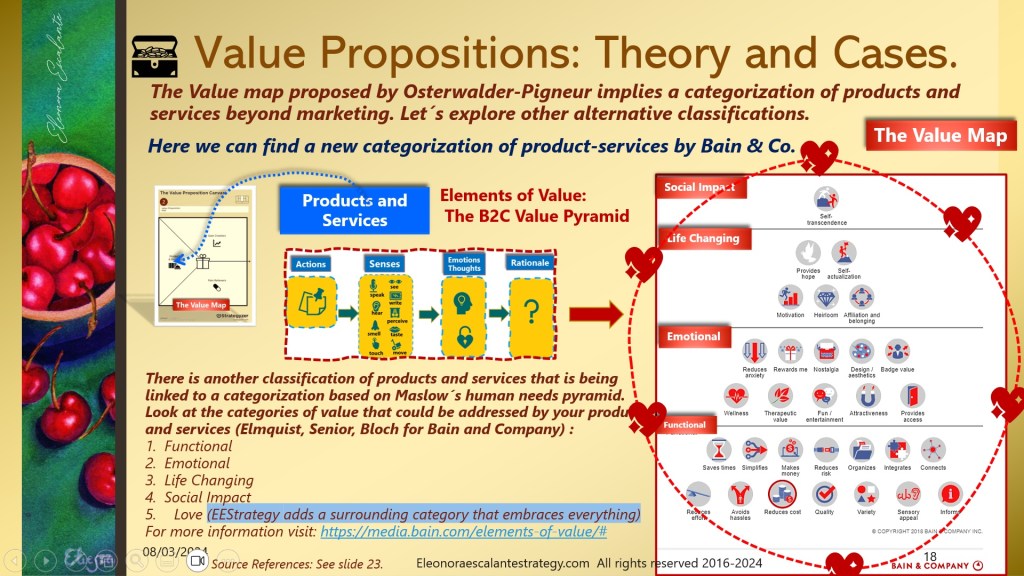
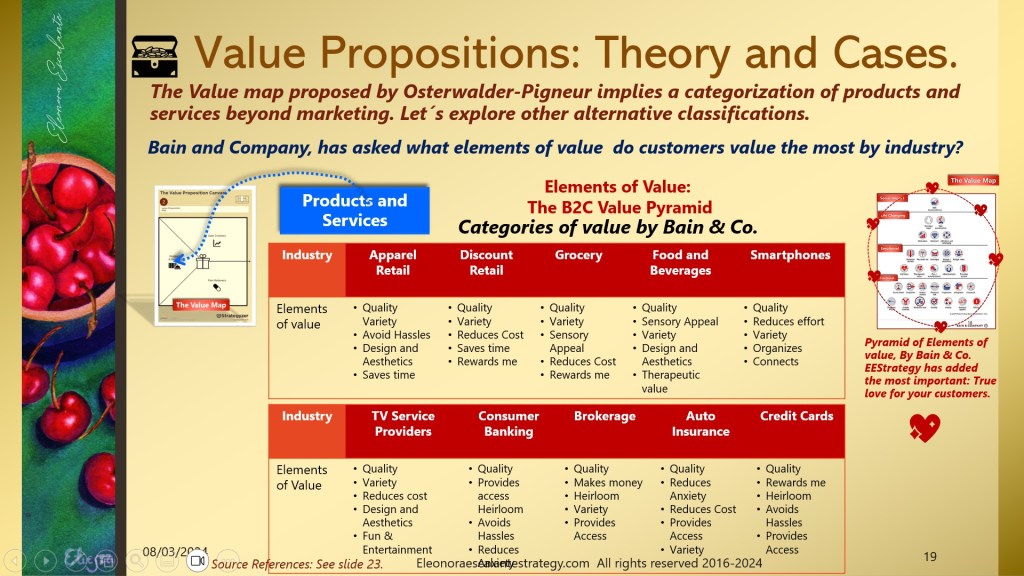
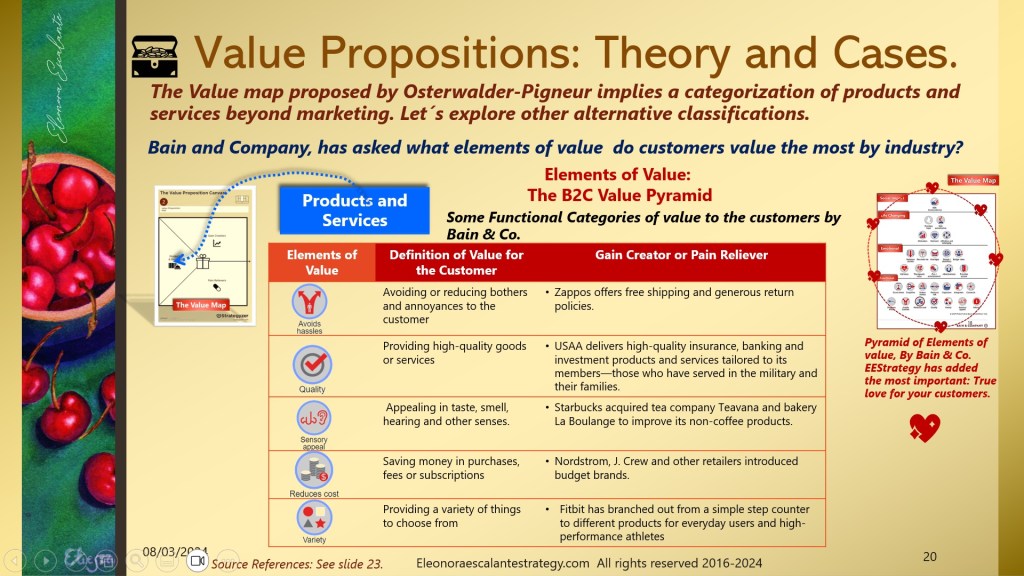
Bain and Company, a prestigious consulting house located in Boston, has categorized 30 elements of value in a general manner for businesses to consumers. These elements of value are fundamental attributes in their most essential and discrete forms. If you visit slide 18, let´s look at the 4 basic categories:
- Functional
- Emotional
- Life Changing
- Social Impact
We have added a fifth one called Love which is transformational and inspirational for our clients. Love that embraces the 4 categories mentioned above.
It is important that you can see the parallel between Maslow´s hierarchy of needs (published in 1943) and the Bain & Co. pyramid of elements of value. Let´s refresh Maslow´s hierarchy and the progressive economic path of value (by Pine II and Gilmore):
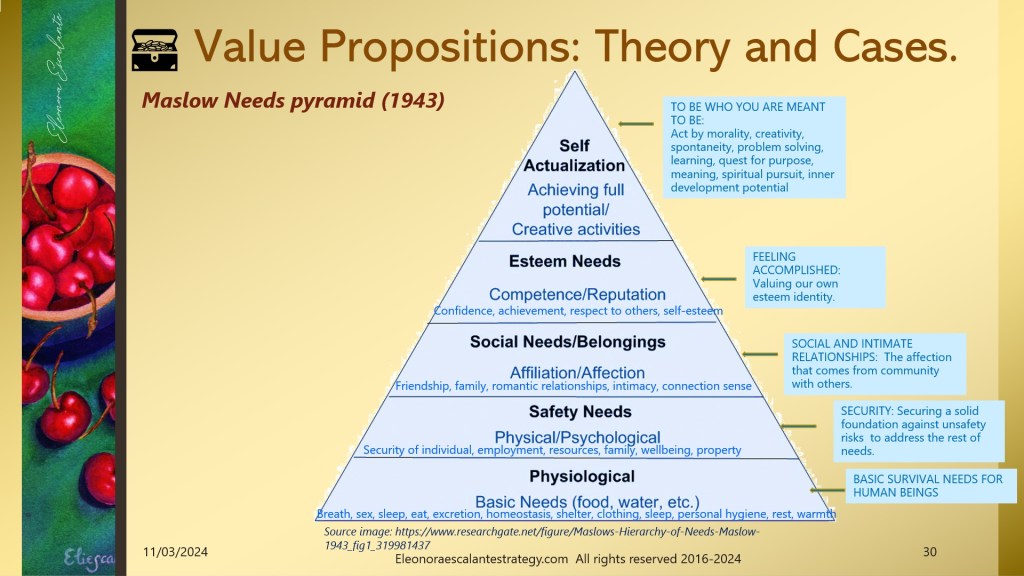
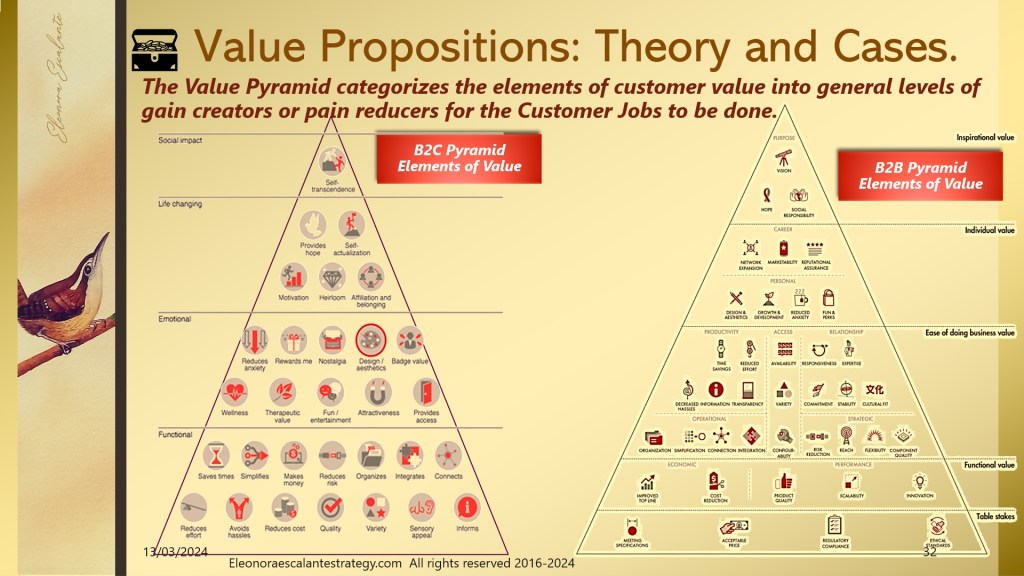
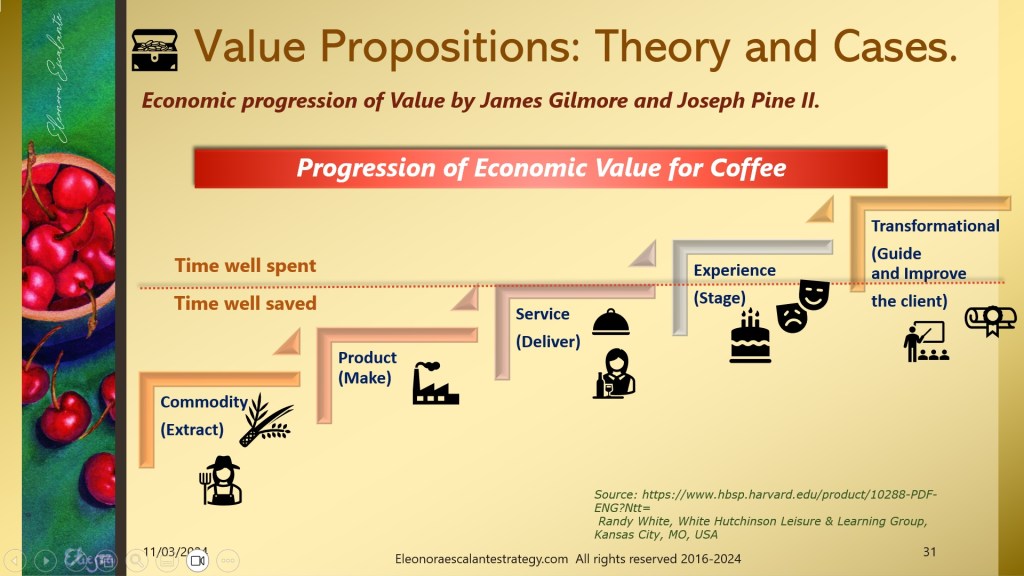
Can you observe the parallel between the Bain & Co pyramid of categorization of elements of value and the Maslow Needs hierarchy? What can we learn from this? See slides 18 to 21 and 30 (Maslow´s hierarchy).
- Elements of value are categories of benefits or advantages that a customer can gain, or reductants of pain that he/she holds when doing a task.
- Each element of value is grouped under a general classification, but that doesn´t mean that clients only fulfill elements of value of one level. Customers are driven by multiple elements of value which are located in different levels and are independent of each other. For example: let´s explore a task of a specific niche of clients: mountain climbers who hike every weekend (this is the customer’s job). Our product is hiking shoes. One pain experienced by the customer is the lack of good hiking shoes that can adapt to warmth or colder weather. Another pain is to find excellent tracking soles made with a material that is not heavy weight. A gain could be the soft aerodynamic comfort. Another gain is the perfect traction of the sole. The elements of value are self-transcendence located at the top of the pyramid (a unique outdoor experience of fulfillment for the client), and at the same time Reduces Risk (located at the functional bottom), and wellness (located at the middle Emotional section). Look how a pair of walking shoes is related to two elements of value of gain creators (Self-transcendence and Wellness), and to one element of value related to a pain reducer (reduces risk). The three elements of value are at different levels of the pyramid. Here we have a pattern that disrupts the idea that people cannot attain the needs at the top until they meet the bottom ones.
- The 30 elements of value help us to look for pre-established categories that can help us to be more efficient when understanding the level of needs/wants of our clients. This is the case for the B2C pyramid of value.
- The psychology of happiness: According to several books about happiness, “money helps people to reduce their anxiety. It helps people to relax and enjoy themselves without the preoccupation of what´s next if there aren´t basic needs covered. But money doesn´t always contribute to the moments in life that bring happiness”. It is not in accumulating material products/services that human beings feel completed and fulfilled, but through social interactions with others and by finding the call or purpose in life that could fill their main activities beyond work.
- Each product and service that we design can be seen as our contribution to build elements of value that help our customers in their quest to find contentment, and or happiness. The emotional elements of value play a key role but are not the only ones to study. For example, the experiential elements of value may offer not just emotional gratification, but the possibility to share in person with family and friends. The entertainment and leisure industries may benefit from a specific customer segment that values time spent with others more than money spent with others and offers not just quality as an element of value, but other elements that are located at the emotional level, and at the self-transcendence top level too.
- Our brains are simply looking for comfort. The reason why the digital experiences of products/services inside our Smartphones have captured the juvenile segment is so straightforward: the screens offer a refuge of safety/security in comparison to the real life of kids and teens. When parents are not available, or there exists domestic violence at home, or the child/teen has no control or parental monitoring over the Smartphone´s schedule; the little ones’ brains will look for an escape. It is like oxytocin for the brain. The mobile offers them not just the emotional elements of value, but also at the life-changing level: Provides Hope, Affiliation and belonging, Motivation and Self-actualization. When mom and Dad talk to their kids at the level of the functional-basic needs (do cleaning, do chores, do homework), children’s brains feel compelled to work, in comparison to rest or have fun through the Netflix series which is attainable 24/7. The youngster feels more attracted to a gain creator that “falsely” makes them feel loved: social media rewards them with emotional happiness that has nothing of truth but appeals as if it is true. The addiction to social media is the outcome of a constant quest for happiness that doesn´t exist in real terms, but only in virtual terms.
- Certain elements of value are common to all products/services within a specific industry. Slides 19 and 20 show us the elements of value for ten industries: Apparel Retail, Discount Retail, Grocery, Food and Beverages, Smartphones, TV Service providers, Consumer Banking, Brokerage, Auto Insurance, and Credit Cards. If you see slide 19 with careful attention, the element of value “Quality” is by far what clients are looking for, and immediately you can write it on a sticky note as a gain creator. This means that providing high-quality goods or services will always be better than low-cost mediocrity.
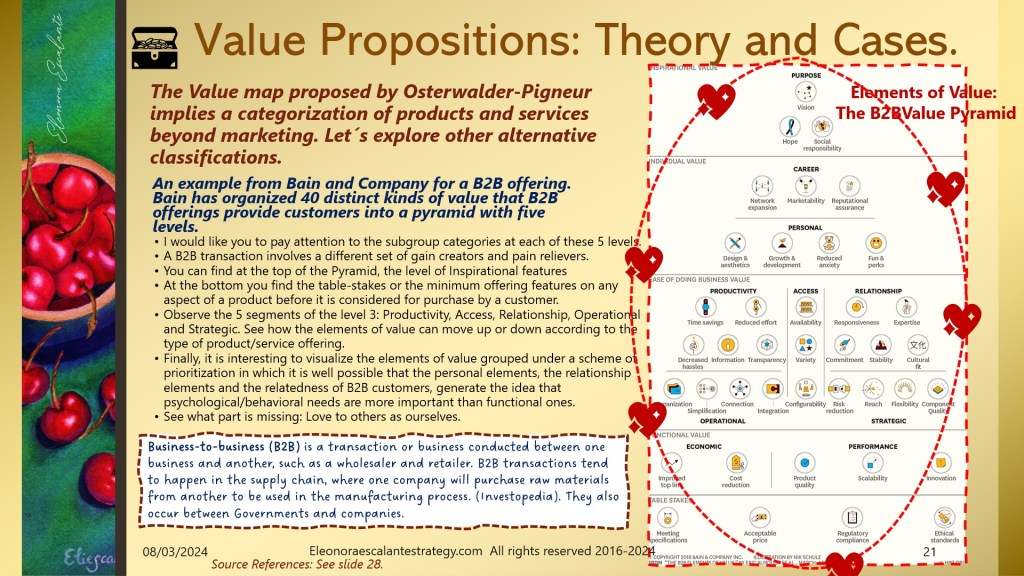
- The elements of value for the B2B pyramid (physical offer or digital or any type of hybrid PSS scale), are grouped distinctively by the Bain Consultants. Search Slide 21. Why do we have two pyramids, one for the ultimate consumer (B2C) and one designed for the B2B sectors? It is obvious: that business-to-business transactions are co-entangled or intertwined: these occur in the supply value chain. A seller of raw materials for a manufacturing plant is one example. Another example: Microsoft has won a $10 billion US Government contract to provide the military with cloud services via its Azure platform. A third example is a medicines contract for the State hospital network.
- The B2B elements of value privilege the level of “Ease of doing business”, and here we can find 5 segments of elements of value: Productivity, access, relationship, operations, and strategy. In the case of a state administration, any government services require not just time savings, but transparency. The strategic institutional elements of value such as Reducing risks, Reach, flexibility, and Quality must characterize any government product/service, beyond the functional or table-stakes level elements of value. If cybersecurity, electricity-Internet provision, and sovereign ownership of technology are not a priority for a government that is digitizing its bureaucratic red tape procedures, then the product/service is condemned to fail by hackers, natural disasters, apocalyptical religious preoccupations, and any external crisis that may jeopardize the government digital services to corporations. For example, a government may design PSS technological software, considering the ease of doing business elements of value, forgetting about an element of personal value called “reduced anxiety”. If this last pain reliever is not included in the product, and it is a priority for the customers, the clients won´t utilize the government platform, because the product is not well designed for the top priority of the citizens. The element of value “reduce anxiety” plays a strong role in the citizens’ scheme of priorities.
- According to J. Cleghorn from Bain and Co. “As B2B offerings become more commoditized (or ubiquitous), then the subjective, personal concerns of the business customer become increasingly important… Considerations such as whether a product can enhance the buyer´s reputation or reduce anxiety play a larger role. Businesses that ignore this are going to lose out”. The B2B elements of the value pyramid help the Value Proposition designer to consider different levels of needs and wants and address preoccupations (pains), or wishes (gains) that the ultimate consumer values more than the functional values of the product.
- Another example is the educational sector. The Education sector should address the top inspirational elements of value, which do not only mean improving the student´s vision of the future, and the self-transcendence of learners but also target the differentiating talent of its professors. Professors must feel that they provide hope when learning better to teach the best. Professors must serve as an inspiration to enhance the educational institutional reputation too. The educational businesses (schools, universities, language centers, etc.) are now under more pressure to improve the quality of their professors. To invest in technological tools for the classrooms doesn´t make any sense if the professors are not enhanced in quality content, pedagogic tools, and a variety of teaching resources that can compete against the YouTube video of another professor on the other side of the world. The core of a university is not the students but the professors. By investing in the emotional, life-changing, and self-actualization levels of the professors, the university attains more than the functional level of the technological tools.
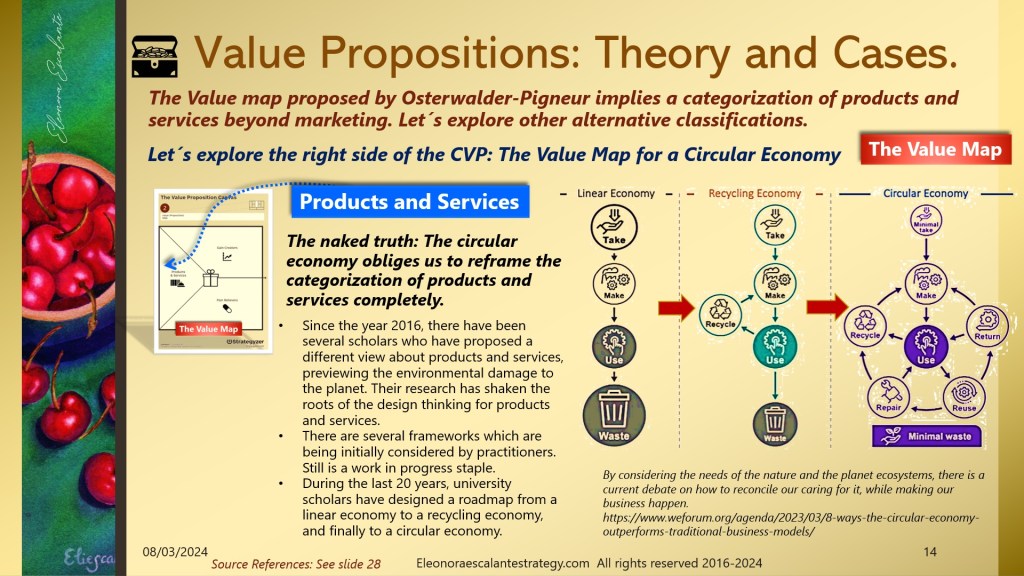
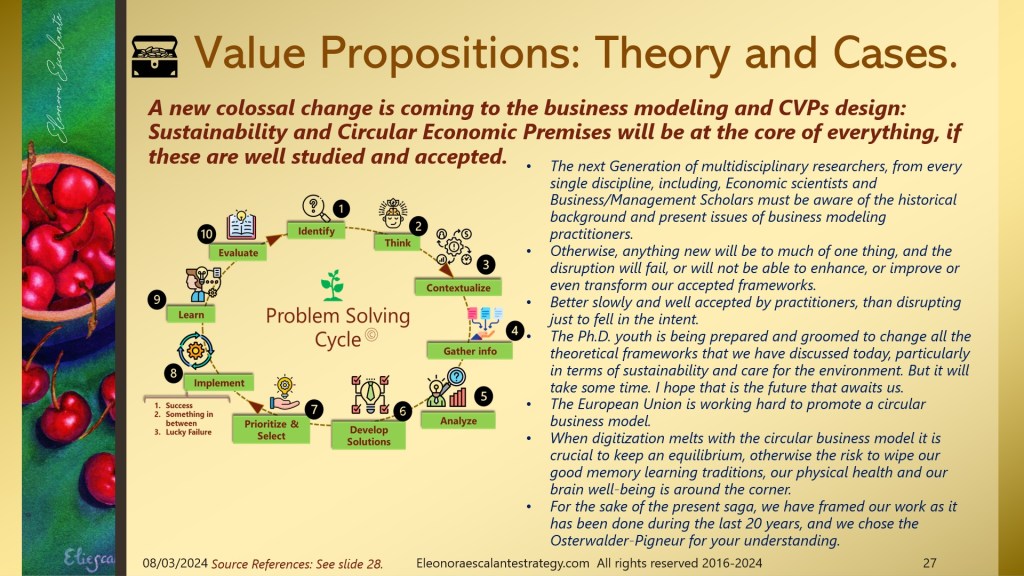
- The elements of value that help us to define gain creators and pain relievers easily are already in these two systems: the B2C and the B2B pyramids of elements of value (by Bain and Co). Be aware that these tools were prepared for linear economy business models. It is so important to be ready for the challenges that will come once we stop using a linear value chain of production, and evolve to a circular economy. Read slide 27.
Sustainability-Circular economy value propositions.
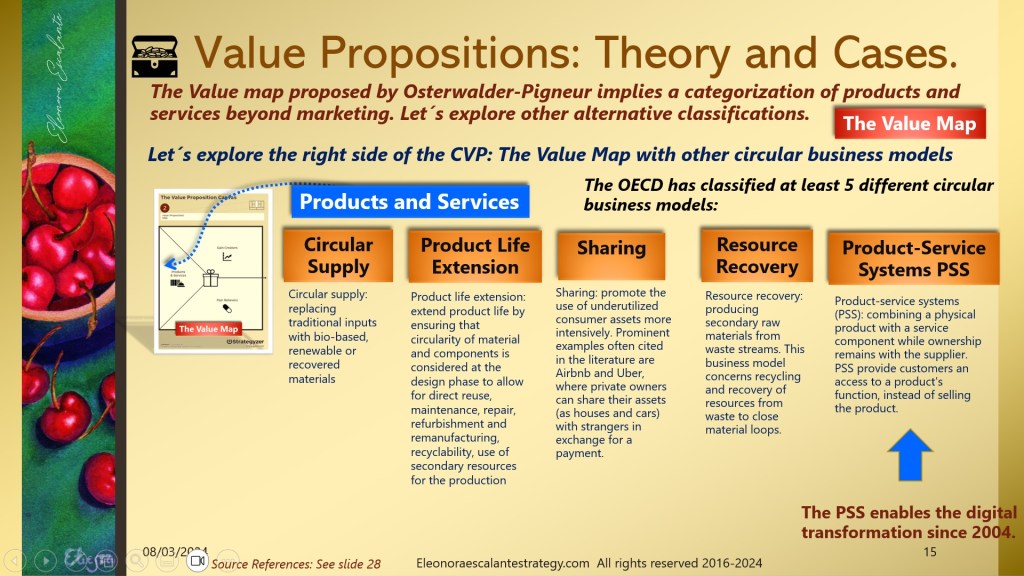
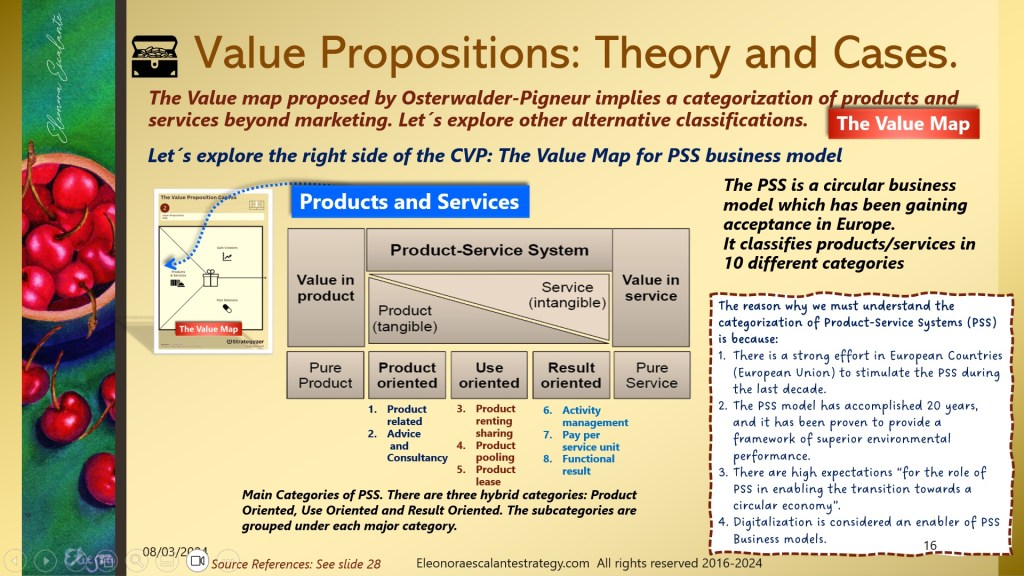
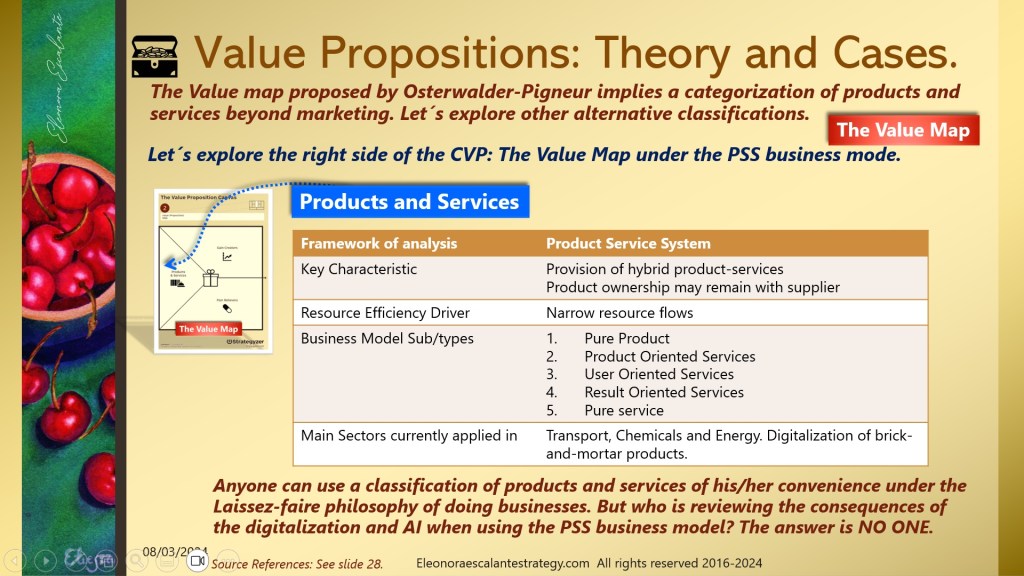
Until here we have discussed the elements of value to produce good Customer value propositions. However, the Osterwalder-Pigneur addresses the linear economy model. What happens with the circular economy models? Slides 13 to 17 hold some highlights to us about the Value Map for a Circular Economy. Once you consider a circular supply and resource recoveries beyond recycling, a new paradigm must be considered.
A mistake that has been rolled out in our CVPs design is to erroneously think that by going digital, we are saving the planet. It is not true. It is a fallacy. To stop using paper in education is causing damage to our brains. What are we going to do 30 years from now, when the next generation will be unable to think because the memory capacity has been gone? Going digital without considering the consequences in our brains, is worse than using paper. Additionally, no one is reviewing the outcomes of digitalization in education or the utilization of AI in our employment rates either. The PSS circular business model still requires a deep revision by multidisciplinary scholars and specialists. The solution to the utilization of paper is to use a circular economy business model, in which resource recovery is the crucial factor. By enabling a substitute for paper (digital devices) in education, we are hurting our brains for the long term, and that will never be recovered easily. My petition is to respect paper in education and reading books. At least in the economic sector of education (the elements of value here are self-actualization and inspirational), writing and reading are knitted together, and the use of paper means a lot to our brains. Artificial Intelligence should be out of our Education too. Our brains can recover from everything, but not automatically from unconsciousness and inexperience. It takes several generations to fix ignorance.
Love in our products and services:
As Eleonora Escalante Strategy we are convinced that the more we love what we do, and how we offer it with “pure love” to our clients, it will pay back for society and the next generations ahead will reap that love abundantly too. Love in business as we define it, is a deep tender feeling of affection toward people, in terms of offering just the best we can, in terms of providing “several elements of value” that cherish our clients, and expecting the best for them with our products and services (if there is love, a business will never offer a product or service with a wrong consequence that may alter their well-being).
A call for balance and equilibrium.
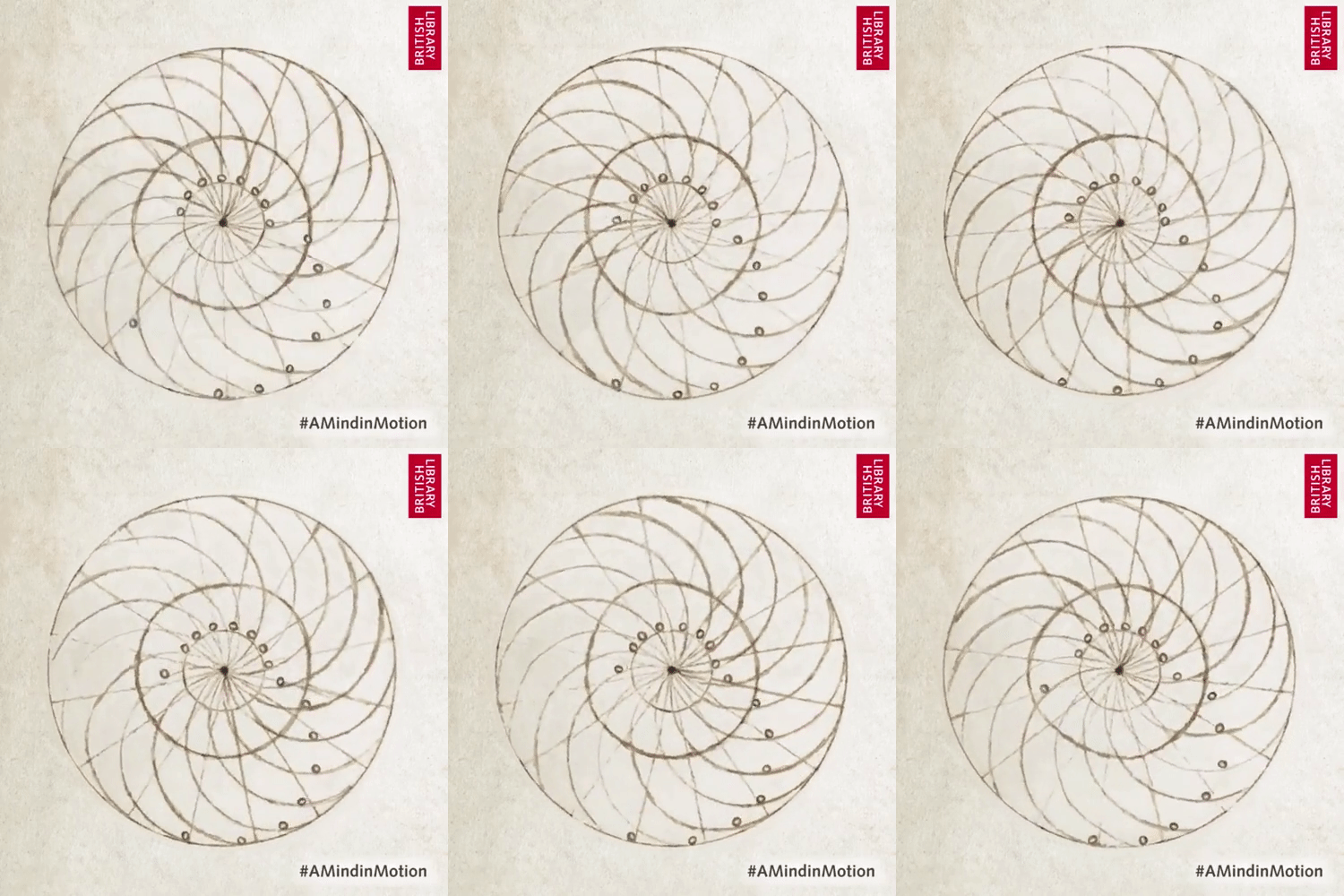
Any methodology to design Customer value propositions can´t be focused only on emotional behavioristical terms. It must address an ample range of elements of value that help us to describe the pain relievers and gain creators of our products and services. If we only focus on the functional aspects of our needs and wants, we may lose the rest of the levels of elements of value. If we only focus on the emotional or transcendence values at the top, we may lose sight of the bottom functional values. If we don´t learn from our mistakes and correct our solutions (Services) to problems, we will end up in a mess like the one you see in Figure A (to your left). But if we begin to consider a circular business model paradigm, the equilibrium is perfect: See Figure B (at your right below). The pendulum will never reach a balance unless we define and design it differently.

Announcement.
This spring saga has been extended a couple of weeks more. It will last until the 24th of May. Please remember that we publish only on Fridays, and we upload our strategic reflections on Mondays. Occasionally, if required we will add more additional episodes on Tuesdays. We always publish at the latest before 11:59 pm (CST). Our next episode will be about the Fit that must occur between the customer profile and the Value Map
Musical Section.
This saga is about improvement, amelioration, upgrading, and the advancement required in the theory and practice of value propositions. Value propositions are the first step in our business modeling frameworks. If the value proposition is improper, then our business model is mistaken. Therefore, we will also share the music of classical progress that marked a before and after in the history of music. The instrument of today is the harp. “Harps were widely used in the ancient Mediterranean and Middle East, although rare in Greece and Rome; depictions survive from Egypt and Mesopotamia from about 3000 BCE”. During the Baroque era, the harp had its own place, and every time it was included as the main protagonist, the musical piece meant sweet relaxing, and romantic appeal.
Our chosen collection of harp concerts is delightfully awesome. Brilliant Classics has compiled several concertos for harp, from Handel and Mozart, Boieldieu, Wagenseil, Dittersdorf, and Albrechtsberger. The harpists are Charlotte Balzereit, Giselle Herbert, Jutta Zoff, Jana Bouskova. The orchestras playing are the Staatskapelle Dresden, Les Violins du Roy, the Stuttgart Chamber Orchestra, and the Südwestdeutsches Kammerorchester Pforzheim.
Thank you for reading http://www.eleonoraescalantestrategy.com. Blessings see you on our next episode.

Sources of reference and Bibliography utilized today. All are written in slide 28.
Disclaimer: Eleonora Escalante paints Illustrations in Watercolor. Other types of illustrations or videos (which are not mine) are used for educational purposes ONLY. All are used as Illustrative and non-commercial images. Utilized only informatively for the public good. Nevertheless, most of this blog’s pictures, images, or videos are not mine. I do not own any of the lovely photos or images unless otherwise stated.
 Eleonora Escalante Strategy - Strategic Reflections Think Tank