
Value Propositions: Theory and cases. Episode 9. Let´s practice. Example 1. A CPG Beauty Aspiration
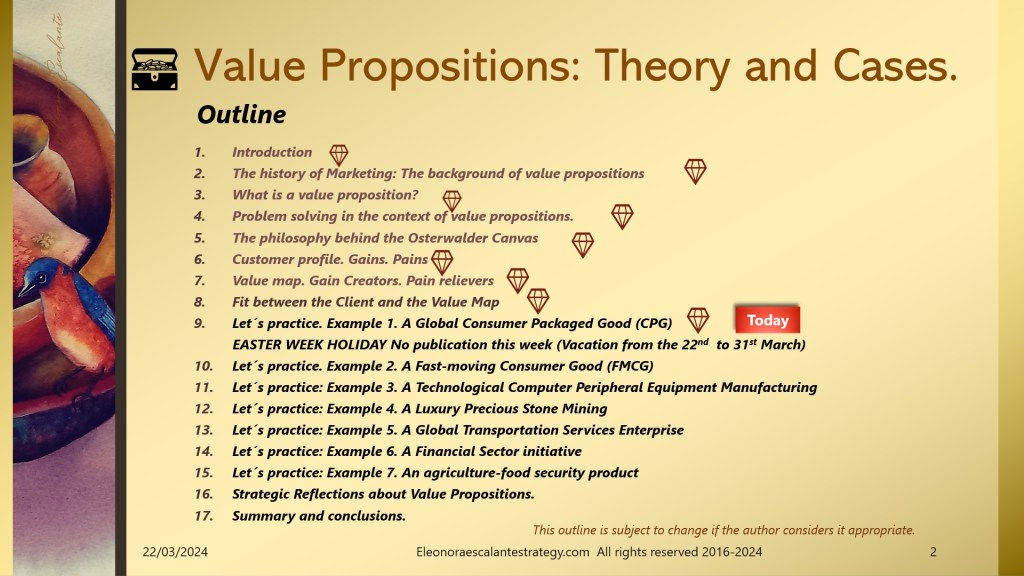
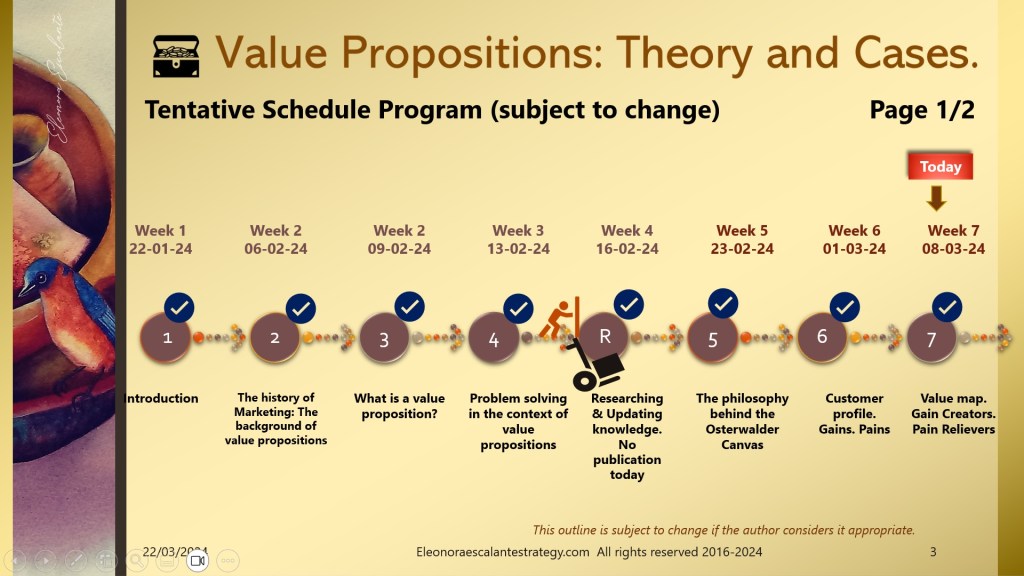
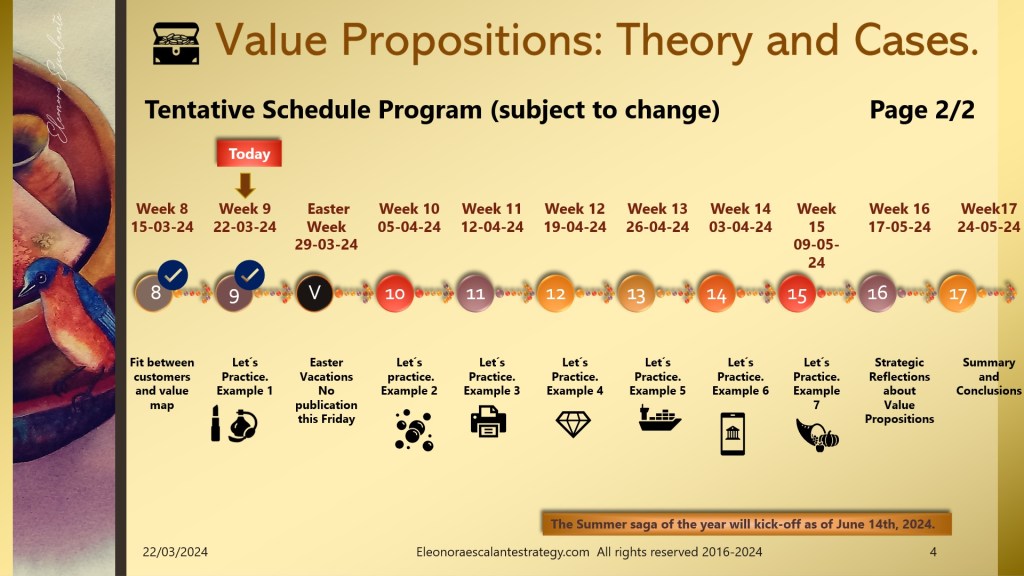
Today is the beginning of Easter Vacations in town for the public and academic sector. We will return back with a new production on Friday 5th of April. Until then, you will have enough material to study during Easter recess time.
As of today, we will practice, practice, and practice all the theoretical work we have been working on since January. We kick off with an example that belongs to the Consumer Packaged Good industry, specifically, we are landing in the global cosmetics market, and particularly in the ecological organic green or eco facial skin care products. The majesty diva ingredient of today´s example is the Rose Damascene or Damask Rose planted in the Valley of Roses of Bulgaria. We will study the case of one entrepreneur who wishes to sell a unique product he has patented under the name: Elixir Bio Damascene Formula. The entrepreneur has been doing Research and Development Innovation by creating this formula for over 10 years. He is ready to explore the best alternative option for his business model. Currently, the main focus of attention is the customer value proposition in its version 1.0.
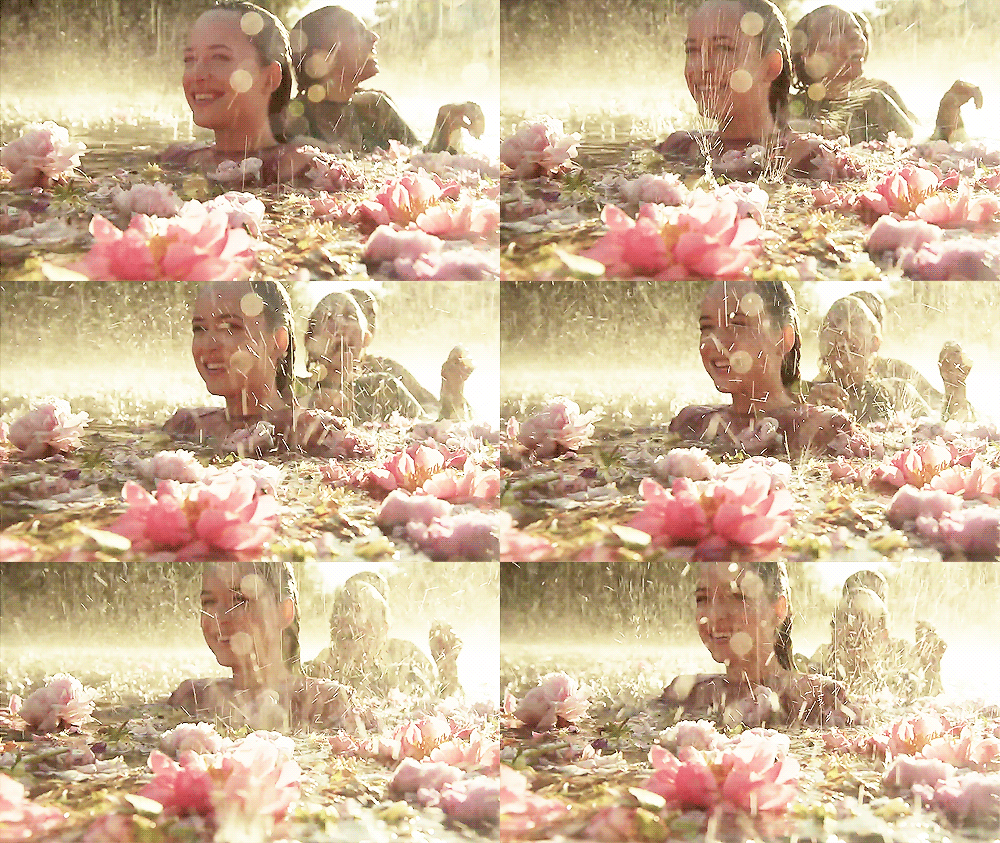
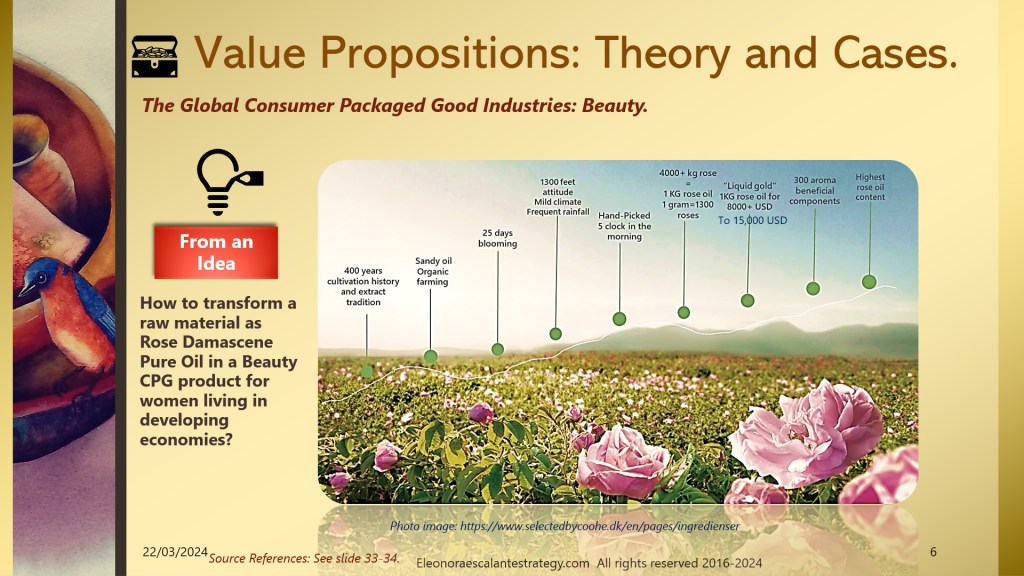
The Rose Damascene Miller, also called the damask rose, is the most valuable rose from Central Asia. Particularly the most important producers are located in Bulgaria and Turkey. According to the experts, the oldest ancient damask rose has 3 parental origins: The Rose Moschata, the Rose Gallica, and, the Rose Fedschenkoana. The rose flower petals from Central Asia are mainly used for perfumery. The Rose Damascene Oil is golden not just for its high price, which can reach between USD 10,000 to USD 15,000 per kilogram; but also because of its delicate and hard-work-intensive collection process and the quality control of its extraction.
Let´s read our 35 slides prepared for your delightful study over the weekend. The objective is to leave you with the homework to read our material. Read it please, only then you will be able to learn. We procure our Monday strategic reflections then because only then, you will be able to comprehend our content. We want you to read and ask yourself questions. The only way to become a thoughtful philosopher in corporate and business strategy is by exercising our brainiac capabilities. Feel free to download our slides, share them with your friends or colleagues, print them, and write notes with your pencils or pens over them. Visit our bibliography for supplementary information.





Our strategic reflections are coming.
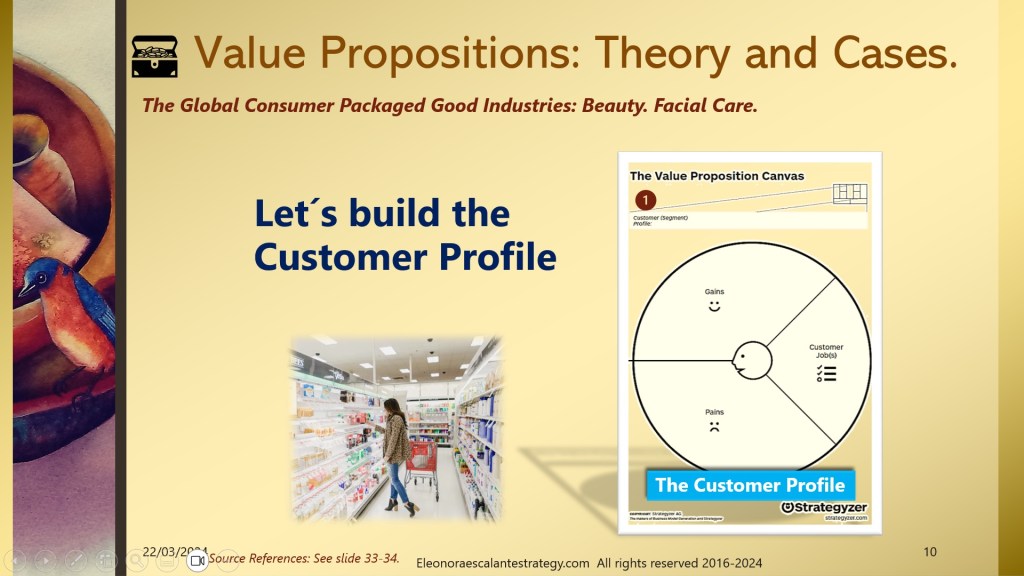
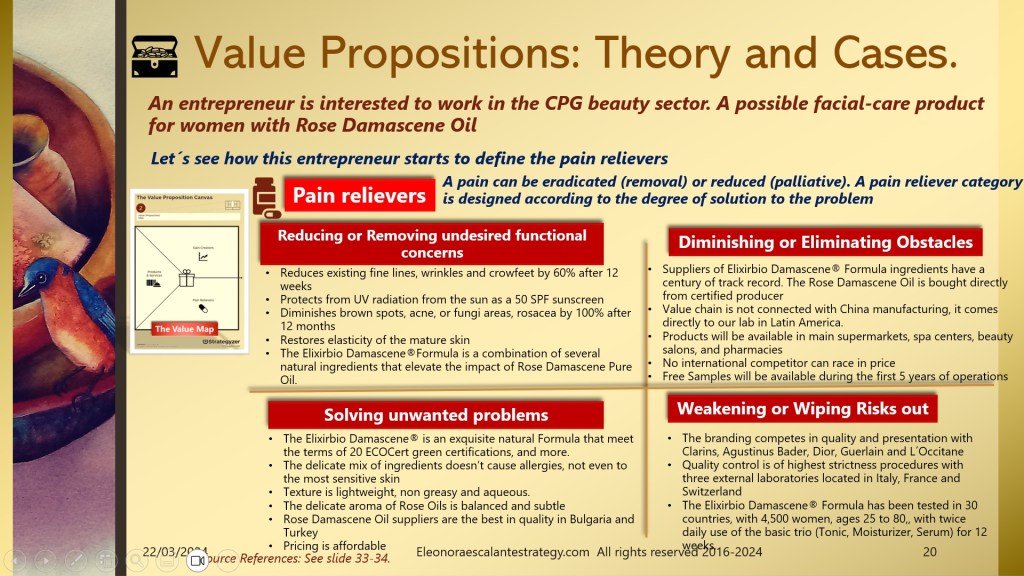
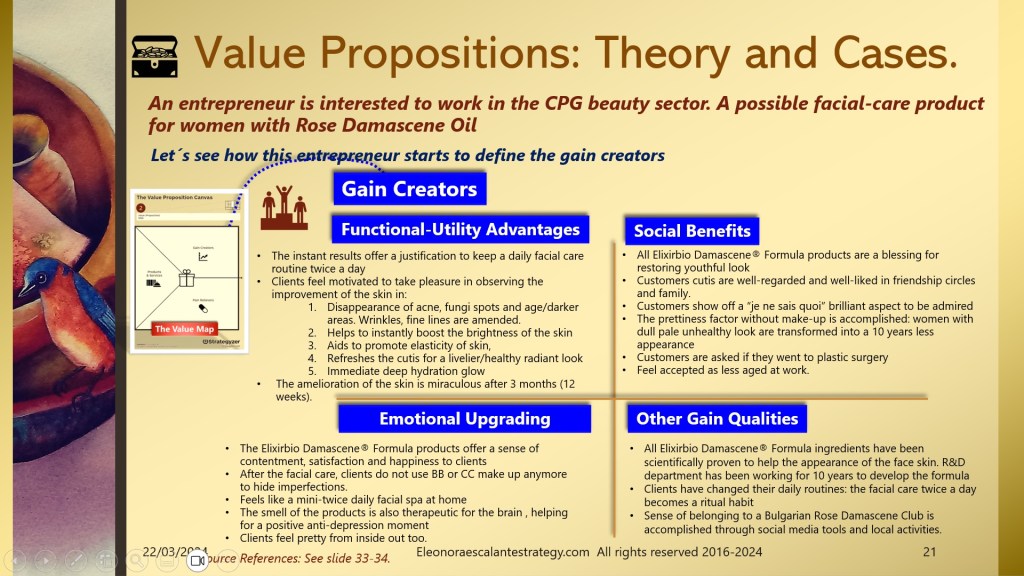
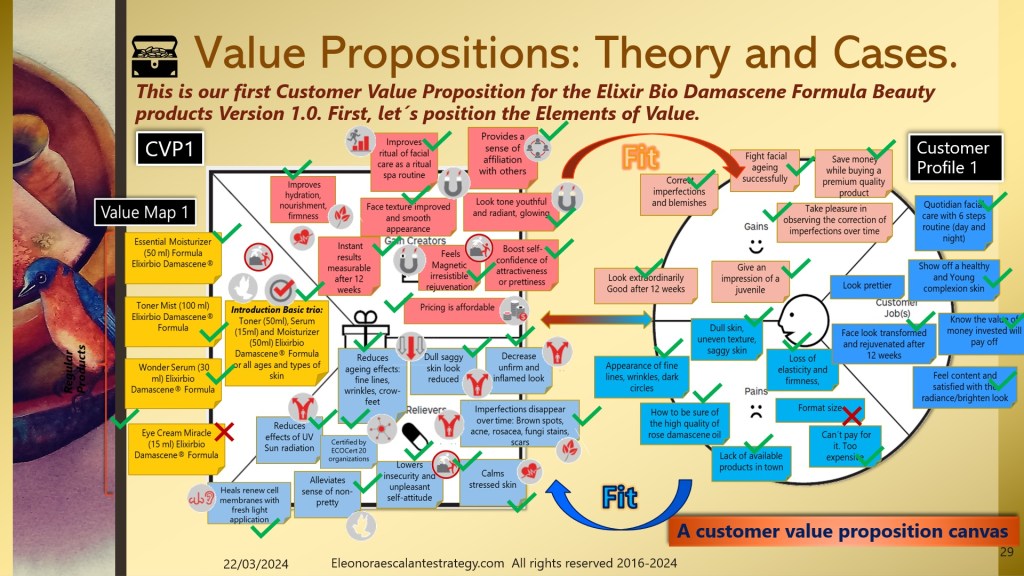
We advise you to go slide by slide trying to understand each of the components of the customer profile and value map. Particularly, center your attention on the way we get pain relievers from the pains, and how can we build gain creators from the functional, desired, or expected gains of the customers. We also wish you to take your time over the next week to explore the meaning of love in our products and services through this example.
What is the industry of CPG?
The CPG is the acronym for Consumer-Packaged Goods. CPGs are nothing else than any product that is used regularly by consumers at their homes or habitual practices or routines, and in consequence, these are bought constantly (and frequently). Usually, the nature of these products is a need. However, it may be an indulgent want. By convention, the CPGs, once bought, are immediately put into usage or are manipulated to restock the many shelves of households, offices, or institutions. These places are frequently visited, like closets, fridges, pantries, perishable or unperishable food racks, vanity/bathroom shelves, washing area racks, garage storage, etc. Once we comprehend the philosophical nature of the CPGs, it is discernible that these products range from food, beverage, over-the-counter drugs/medicines, cleaning, cosmetics, etc.
Categories of CPGs:
Several researchers have appreciated different segment categories:
- Food and beverages: This is the largest of the CPGs. It includes food perishable and non-perishable products. Here, we include snacks, breakfast cereals, canned goods, frozen groceries, dairy products, soft drinks, and alcoholic beverages.
- Beauty and Wellness: Cosmetics, hair, and skincare, fragrances, supplements, vitamins, etc.
- Household products: In this group, we include (1) home care products, which consist of cleaning products such as laundry detergents, kitchen soaps, toilet paper, and any item related to keeping and maintaining the house tidy. The rest of the products are for (2) personal care, used for cleansing individuals properly, personal hygiene, and grooming such as daily use soap, shampoo, deodorant, toothpaste, razors, feminine hygienic products, etc.
- Over-the-counter medical products: In this last product scheme, we include anything available in supermarkets or pharmacies that doesn´t require a doctor’s or physician’s prescription.
- Apparel Quotidian: Finally, some consulting companies also include here the daily wearing clothing and garments, such as socks, underwear, t-shirts, sneakers, and sporty apparel that is used regularly.
For today´s publication, we land on the second group: The Beauty and Wellness products. Particularly in the organic, fair supply chain, sustainable, and good for the environment production. The beauty product of our pursuits comes from the entrepreneur involved in the research and development of a lovely flushed rose cultivated in the Valley of Roses from Bulgaria.
Strategic reflections about this example.
- This case is very illustrative for those entrepreneurs who might find a natural holy grail ingredient in their community ecosystems, for those who wish to give quality through the most affordable terms, and for those who wish to improve the value chains of farmers and keep traditional manufacturing processes. During the current context of insane technology abuse, it is refreshing to find a new product or service whose backbone does not originate from the NAIQIs. Several countries in developing economies are blessed with a tropical climate (all year long), in Latin America, Asia, the Middle East, and even Africa. By choosing to discover precious ingredients that have subsisted for centuries, we can disrupt the market by curing, healing, and offering solutions that are well-knitted to other new adjacencies that promote integral well-being from the farm to your home.
- Any product planted on soil requires water and a self-regenerating ecosystem which must be respected. Even if a NAIQI high tech is applied to a specific portion in the production of these cultivated areas, (for example to monitor the temperature or for quality control), certain traditional processes can´t be lost, because these processes help to honor the high quality. If we lose these methods we may modify the essence of the farm’s raw materials. For example, an organic production of flowers, collected by hand, and manufactured under “non-modern” terms is the crucial component that keeps the value of the oil.
- Given our most recent millennia of slavery records, agricultural farms have been considered locations of high exposure to exploitation, with an embedded structure for cheap labor. It can´t be this way anymore. European countries have been trying to raise the standards of occupational safety and health (OSH), but still, the self-employed family farm owners (which is the case of Bulgaria Valley of Roses) face agricultural injuries and illness risks. Any business owner in developing economies, that requires massive amounts of human force (for collection of the agricultural raw-material supply) is entitled to change the lives of those employees or self-employed workers, not just by providing the right OSH fulfillment, but also by raising their salaries, to improve the quality of life of those populations.
- The Valley of Roses of Bulgaria represents more than 400 years of cultivation history. Slide 6 shows you a brush of what it means to cultivate and extract oil and rose water from the rose fields there. The Oil of Rose Damascene is one of the most expensive that you can find on earth. I did skim pricing research, and it starts at around USD 6,000 per kilo of organic non-certified pure oil (1). Anything below that price has been diluted in other carrier oils. The premium organic-certified oil of Roses from that region can reach a price above USD 10,000 (2).
- About the extraction process of Organic Certified Pure Rose Damascene Oil: Slides 6 and 7 provide a snapshot of the approach.
- The benefits of this fantastic oil are shown in slide number 8. Academic scientific evidence is provided in our bibliography.
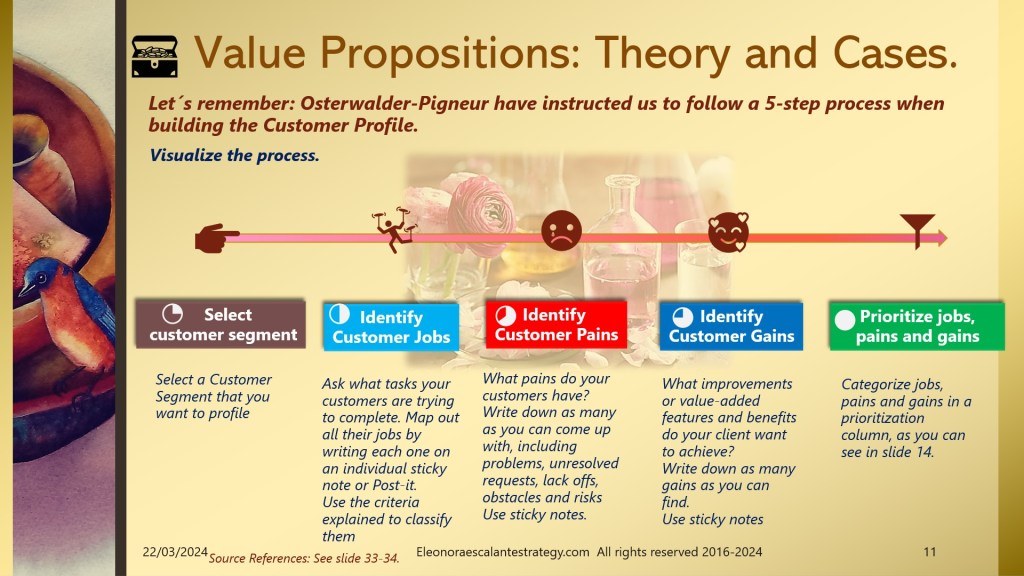
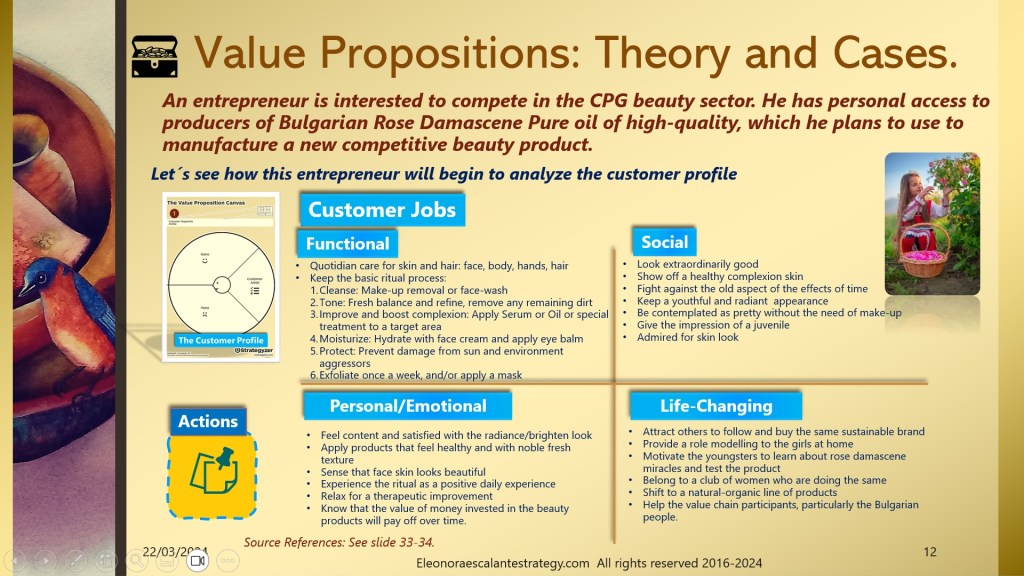
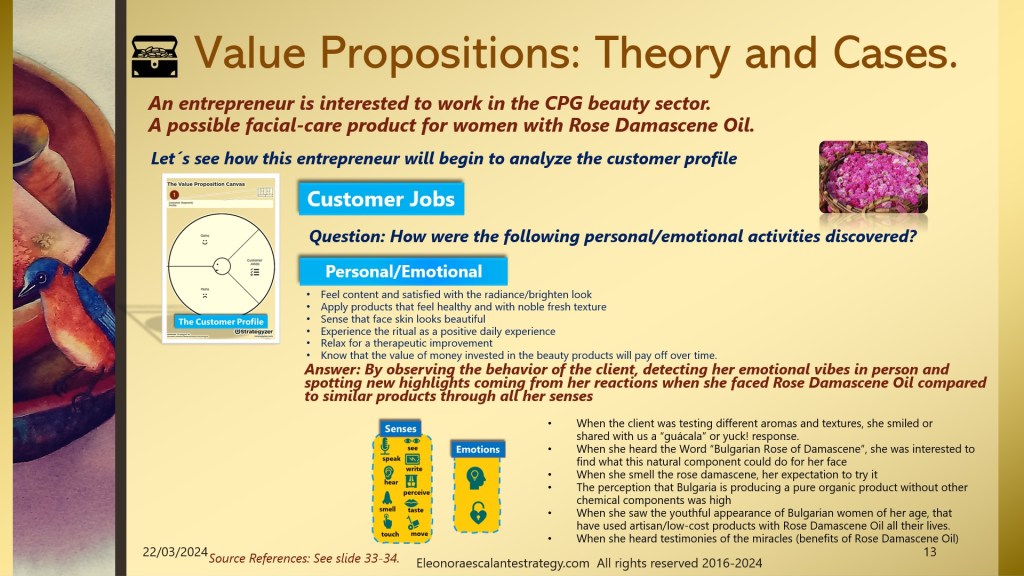
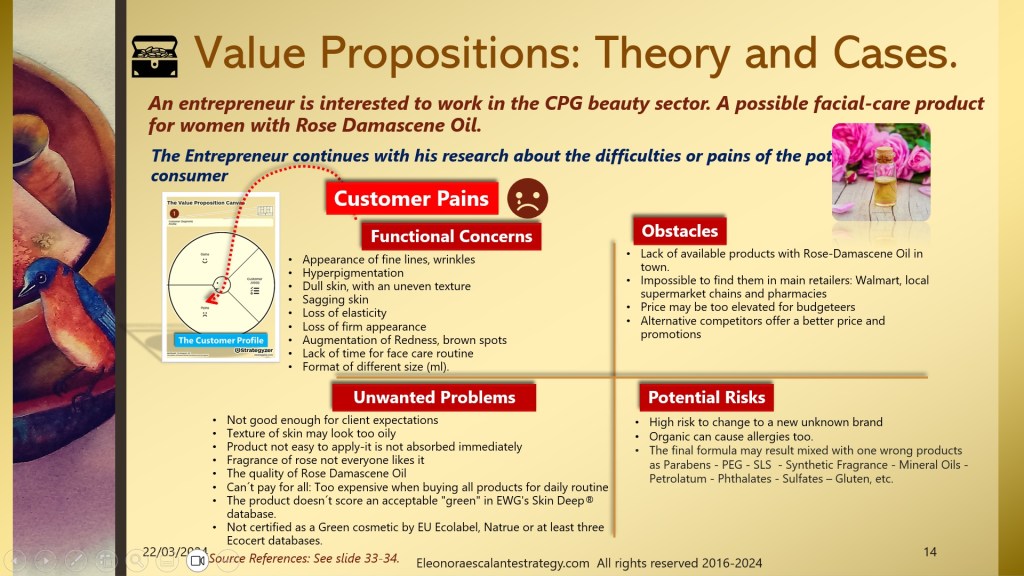
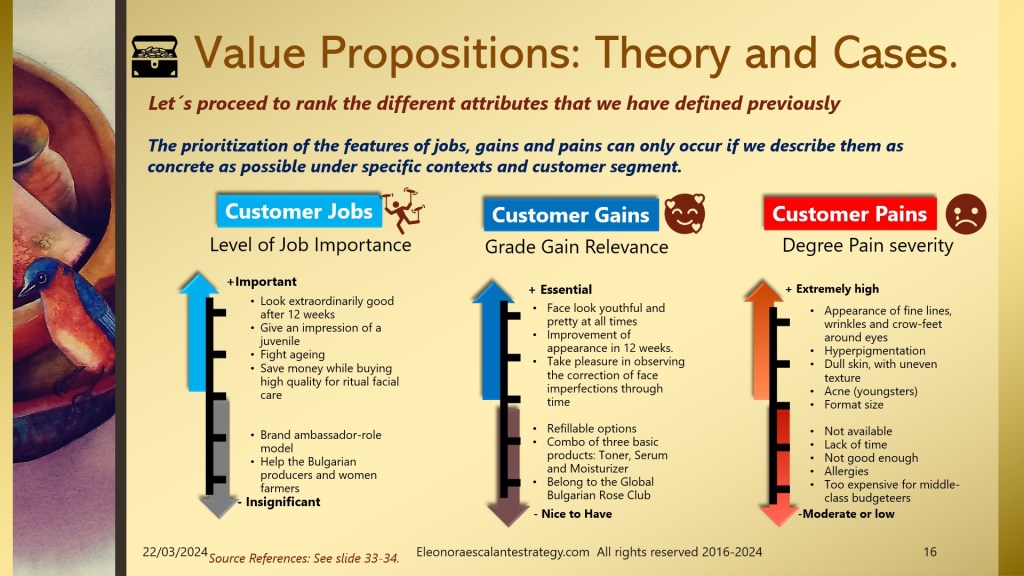
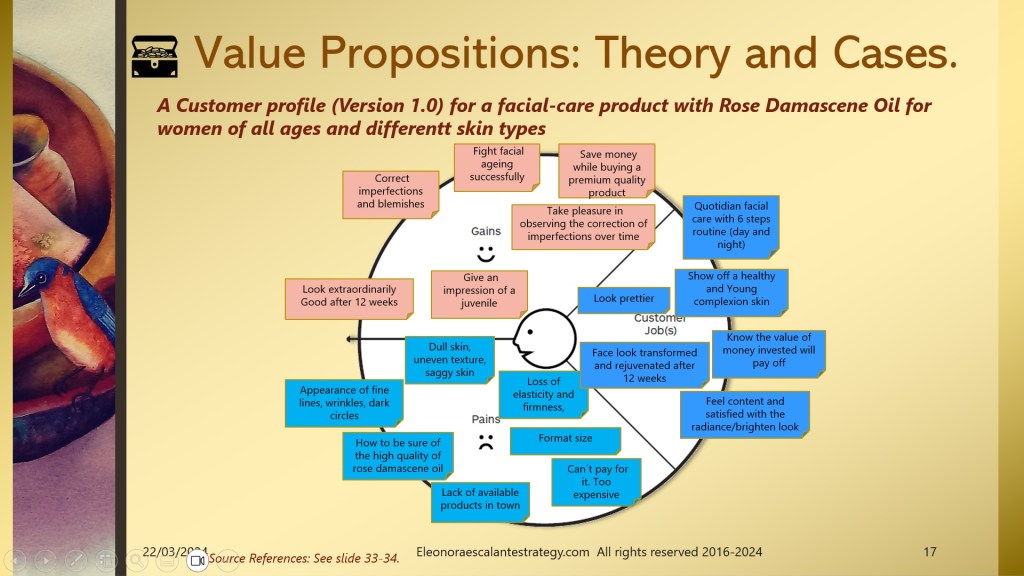
- Building the first version of the Customer Profile: From slides 10 to 17. We prepared a journey of what could be our first intent in drafting a customer profile. When segmenting a population that could be interested in buying a beauty product in which the Bulgarian Rose might be the superstar and remedy for all facial skin care troubles, can´t be conceived on the first intent. This is just the basic first approximation. Don´t forget that a value proposition belongs to a business model framework that will affect the whole exercise too.
- When building our customer profile, we must be ready to make mistakes. No one can get it right instinctively. The entrepreneur of our analysis is considering a trio of beauty products made with his patented Elixir Bio Damascene ® Formula: The Tonic Mist, the Essence Moisturizer, and the Serum. This is his pre-devised product before starting the customer profile, but be sure that at the end of the slides, we have discovered at least other 3 formats of products that will require a new value proposition and different customer profiles. We believe slides 10 to 17 are self-explanatory, and we have included all our thoughts and discoveries there.
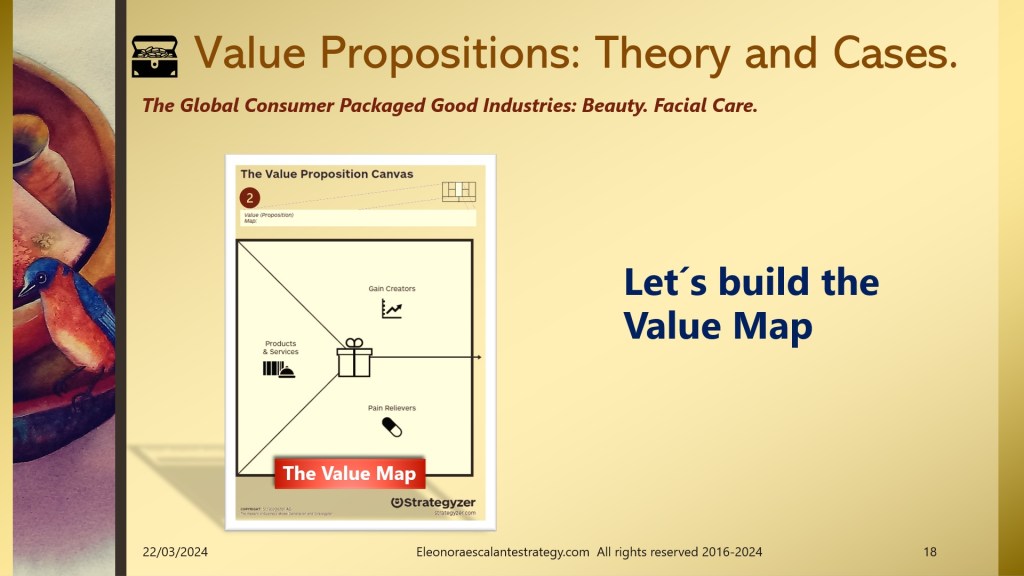
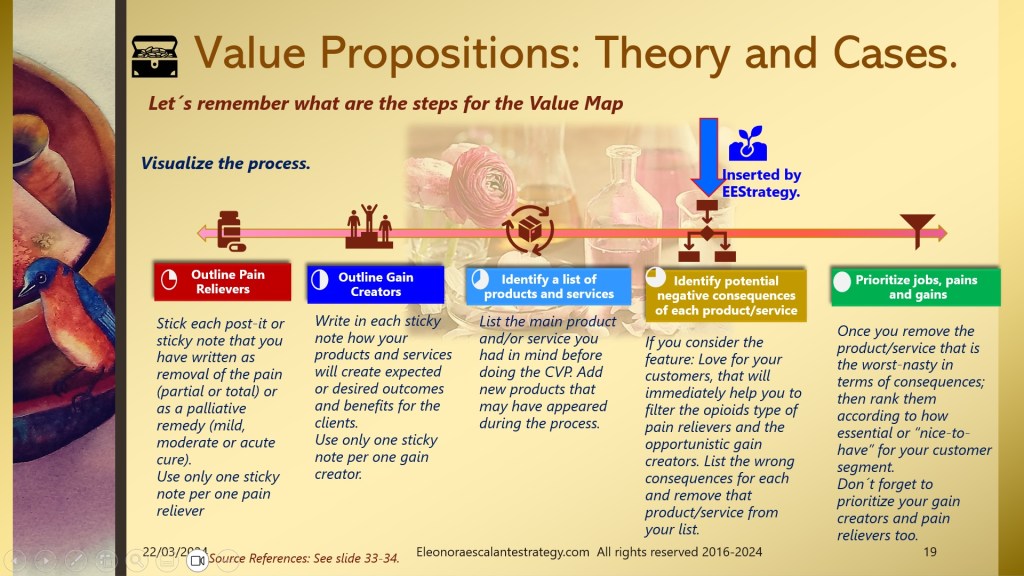
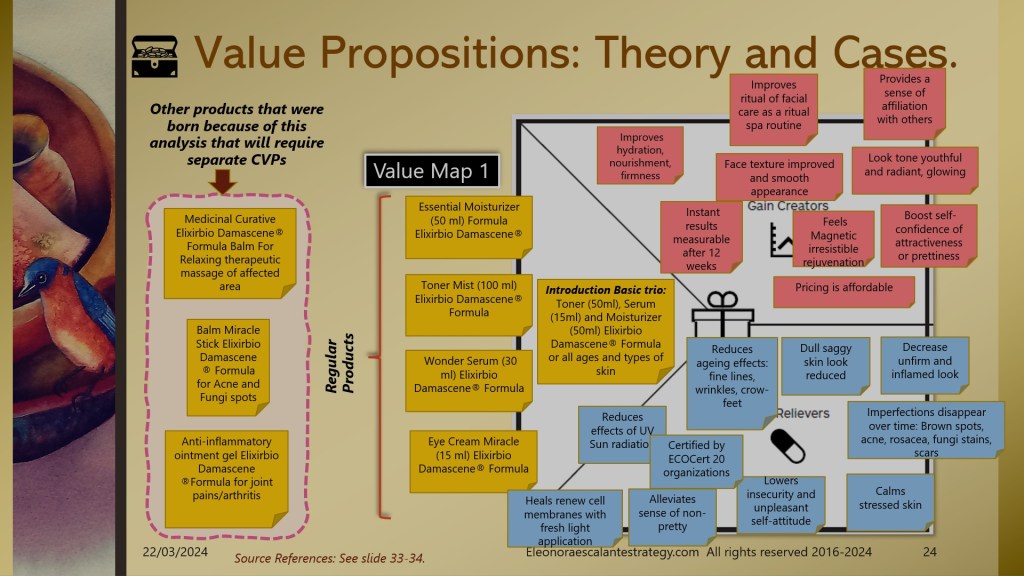
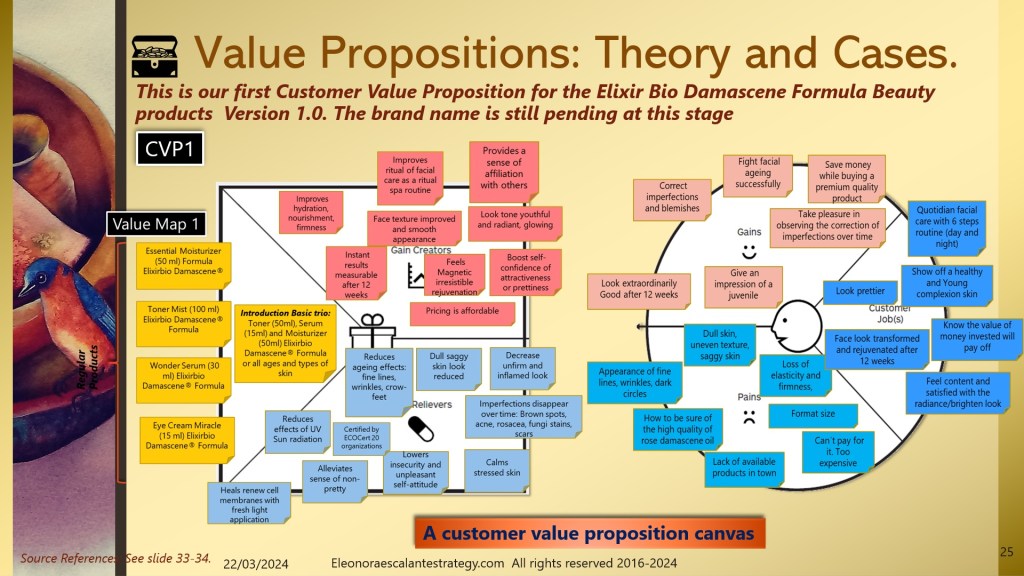
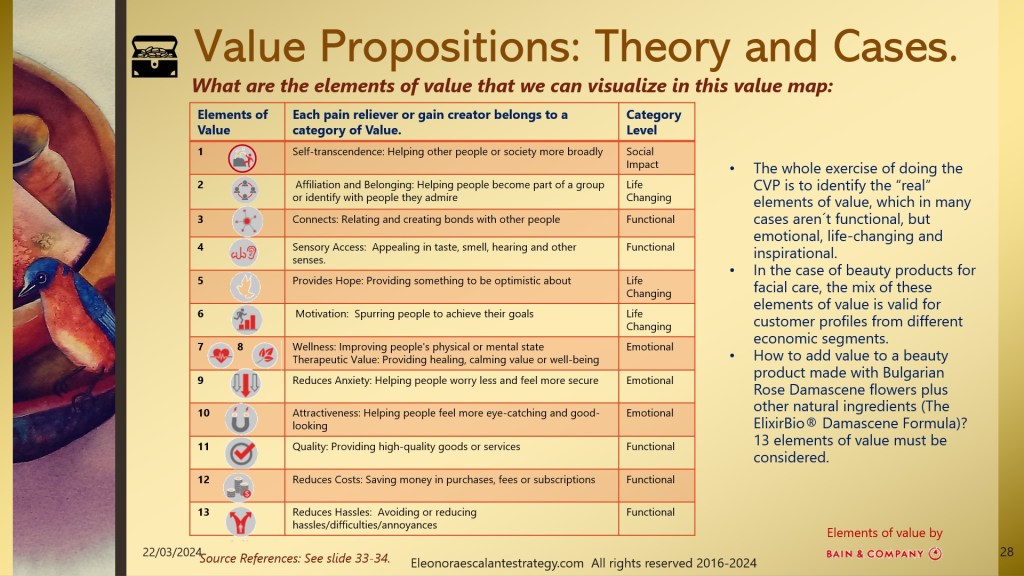
- About the value map, see slides 18 to 25. The slides can show you how the pain relievers address each of the pains. In addition, the gain creators, are linked to each of the gains mentioned by our potential customers. For example, our customers are worried about the appearance of fine lines and wrinkles. This is a pain that is written on a cyan sticky note on the customer profile. When defining the pain reliever, the question to ask ourselves is: What attribute or characteristic of our product can remove or diminish this specific client concern? The answer is written on the sticky note of blue-sky color as a pain reliever: “Reduces aging effects: fine lines, wrinkles, crow-feet”. Then we ask ourselves, what is the element of value that corresponds to this attribute? According to the Bain&Co pyramid we have identified the value of “Reduces anxiety”.
- Let´s see a gain that has been defined for our clients: They wish to see themselves as younger, giving an impression of the juvenile aspect. This is a gain that is written on a salmon color sticky note on the customer profile. To define the gain creator, we ask ourselves: what expected attribute can offer an answer to this gain? The answer is pretty straightforward: The tone of the skin looks youthful, radiant, and glowing. This pink sticky note can be found in the section of gain creators of the value map.
- The entrepreneur has been testing his Elixir Bio Damascene® Formula for 10 years, he is already sure and has evidence of the miraculous product in the format of the basic trio or combo of three: Toner, Moisturizer, and Serum. But we also found other needs beyond facial skin care beauty, needs that came up as pains. In consequence, we also found that other products could be designed (under a different value proposition canvas). These are listed on slide 24 as a Medicinal Balm for therapeutic massages, a Stick balm for Acne and fungi spots, and an anti-inflammatory ointment gel that works wonders for joint pains, arthritis, and sprains. Can you see the multiplying effect of using a value proposition canvas to design our product and service?
- The result of the first loop is on slide 25. At this stage, we don’t have a brand yet. We identify the product under the Elixir Bio Damascene® Formula. Don´t despair, the branding comes afterward when the business model is finalized.
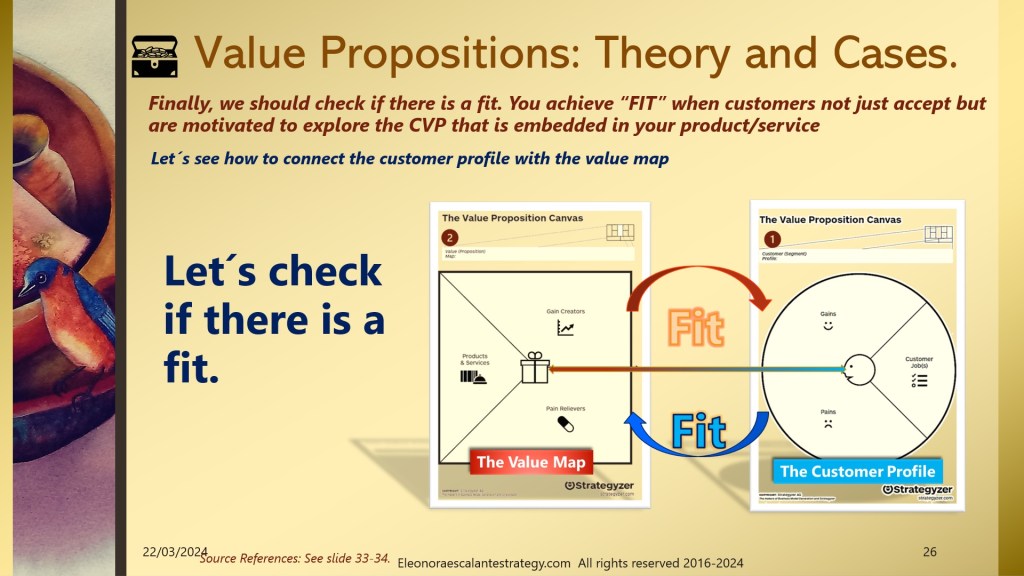
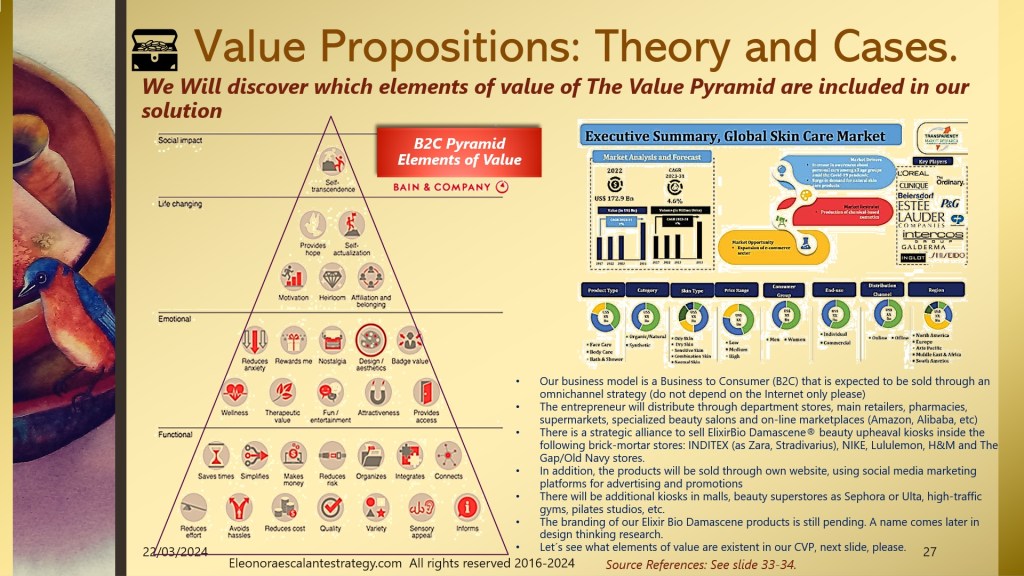
- Let´s see the fit between both sections: The customer profile and the value map. This section is assembled using the elements of value of Bain&Co. This is something personal from our boutique consulting house, that will help us later when comparing business models, and appropriate decision-making. The elements of value allow us to apply the NPS (Net Promoter Score), a metric indicator that is used for customer loyalty and advocacy(3). The NPS is utilized as a technique for understanding clients, and it can be used for testing our value proposition and business models too. It is used in several levels of decision-making, before, during, and after launching a product. Additionally, for identifying the values of revenue growth. In one phrase, the elements of value help us with our Design-Based Research approach and marketing deconstruction efforts.
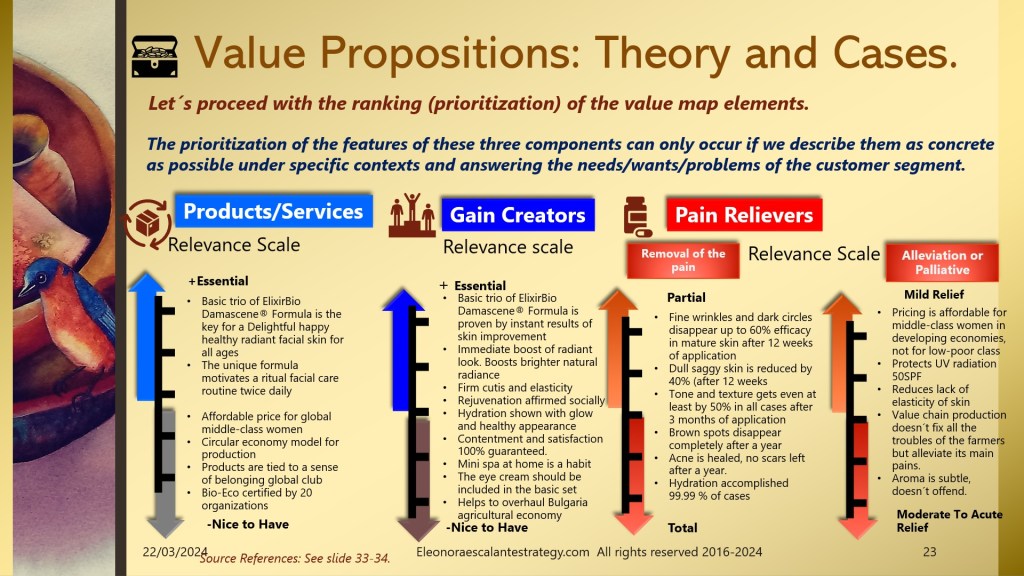
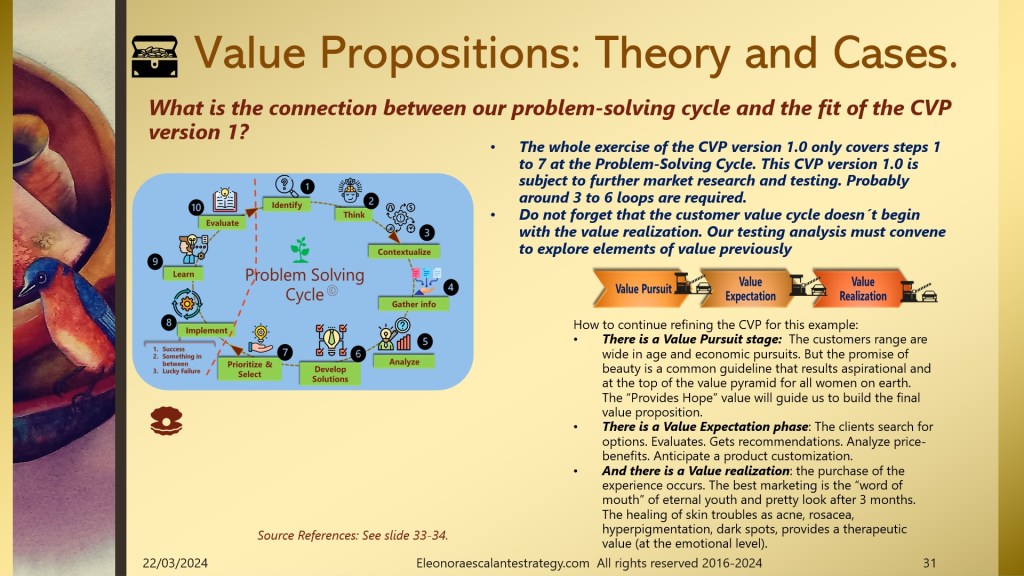
- Slides 26 to 32 are self-explanatory. We have covered all the details of elements of value that might be involved in our exercise. Thirteen of them are listed on slide 28. The fit is achieved, but it won´t be ratified or totally endorsed until we test this CVP version 1.0. Testing is the only way to take our most risky assumptions into reality. The phase of testing is not part of our saga, we are interested in igniting your innovative efforts with version 1.0 only. Teasing out the CVP version 1.0 will unfold the next CVP version 2.0, and the sequence will continue.
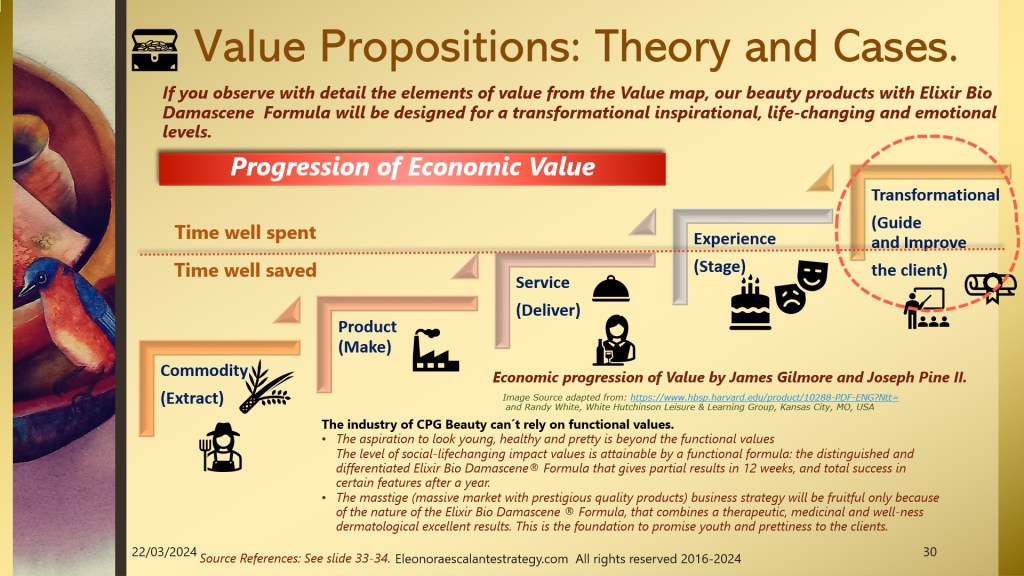
- The progression of economic value shown on slide 30, is helping our entrepreneur to don´t focus only on the commodity and product manufacturing stages. By addressing the product under the functional values we can miss the mark. Regardless of the nationality, age, or origin of women, the wrinkles, lack of skin firmness, or dark circles, can´t be cured only with an external epidermic solution. Happiness comes from the inside out, and many times it is an emotional positive attitude that helps women transform, guide, and improve their looks. By raising above the functional values of the Elixir Bio Damascene® power with the inspirational transformation (social impact changing) values, our marketing efforts will elevate our value proposition to a new level that is only well played by luxurious products sold by the most expensive beauty houses in the planet, led by Bernard Arnault, Charles Rosier, Christian and Oliver Courtin, Phillip d´Ornano and others. The business owners of sumptuous costly beauty products are experts in offering exquisite prettiness under aspirational terms. The question that attains us: Can we sell a formula that traditionally has been seen as lavish and magnificently expensive to a massive group of women from the middle class? How to transform our value proposition for a “masstige” customer segment (massive market demanding prestigious quality) without falling into the dupes?
Announcement.
The Easter or Paques week starts today in town. El Salvador academic world will go on vacation from now until the 31st of March, but I will upload the strategic reflections over Easter week. Please remember that we publish our frame-of-reference slides only on Fridays, and we upload our strategic reflections later. Occasionally, if required we will add more additional episodes on Tuesdays. We always publish at the latest before 11:59 pm (CST). The 10th episode is about a Fast Moving Consumer Good (FMCG).
Musical Section.
This saga is about improvement, amelioration, upgrading, and the advancement required in the theory and practice of value propositions. Value propositions are the first step in our business modeling frameworks. If the value proposition is improper, then our business model is mistaken. Therefore, we will also share the music of classical progress that marked a before and after in the history of music. The waltz was the first acceptable not-immoral genre of music for dancing. Regardless of its origin in the Renaissance humble folk music, it wasn´t until the Enlightenment, particularly with Composer Strauss, that the Waltz remade the interaction between women and men, enabling the transformation of the traditional culture by admitting Ballroom dancing through Vienna, Austria, and Germany, spreading later to all Europe. Around the mid-19th century, the United States also was dancing waltzes.
Today´s video is a compilation of the best waltzes that have ever been composed on our planet. This collection of Strauss Waltzes has been grouped by the Halidon Music YouTube Channel.
Thank you for reading http://www.eleonoraescalantestrategy.com. Blessings see you on our next episode.

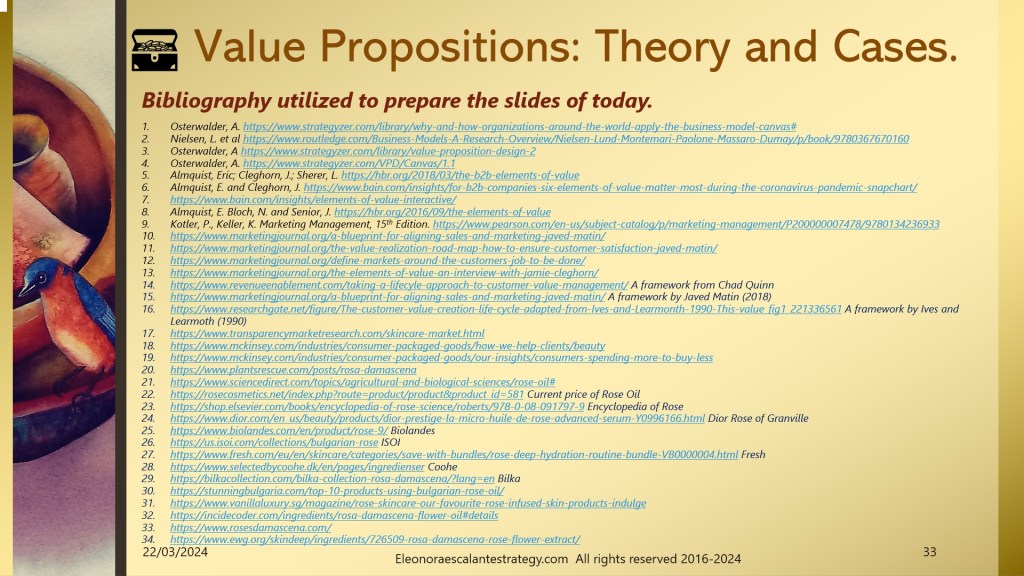
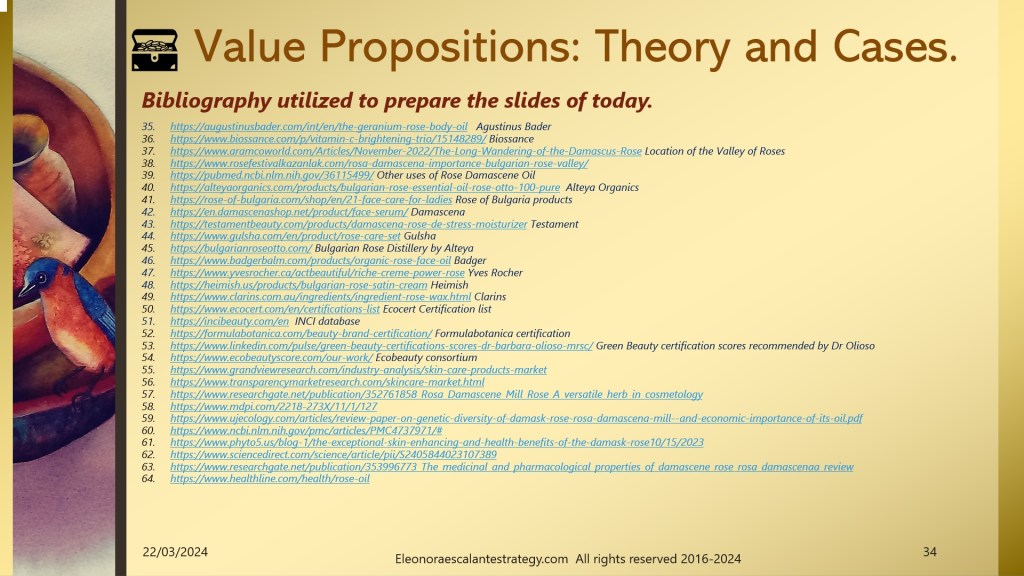
Sources of reference and Bibliography utilized today. All are written in slide 33-34.
- https://m.indiamart.com/proddetail/rose-damask-absolute-oil-16824407897.html
- https://www.nhrorganicoils.com/products.php?id=14149
- https://www.netpromotersystem.com/about/measuring-your-net-promoter-score/
Disclaimer: Eleonora Escalante paints Illustrations in Watercolor. Other types of illustrations or videos (which are not mine) are used for educational purposes ONLY. All are used as Illustrative and non-commercial images. Utilized only informatively for the public good. Nevertheless, most of this blog’s pictures, images, or videos are not mine. I do not own any of the lovely photos or images unless otherwise stated.
 Eleonora Escalante Strategy - Strategic Reflections Think Tank