

Central America: A quest for the progression of economic value. Episode 5. Charles V: An Overlooked Identity.
Today we will cover the life of Charles V of Ghent. From his birth in the year 1500 to the moment when his grandfather Emperor Maximilian I passed away in 1519. The relevance of this chapter is far beyond the historiography of our textbooks. By understanding Charles V’s birth context and initial steps in his life: his family, childhood, and education in the Burgundian Netherlands, we will be able to analyze and discern why we (in Central America) were also born with a twisted allure that wasn´t Castillian or Aragonese by heart, but a mélange of court strategy affairs that came drafted and defined by Maximilian I of Austria, and never by the Spanish Kingdom crowns.
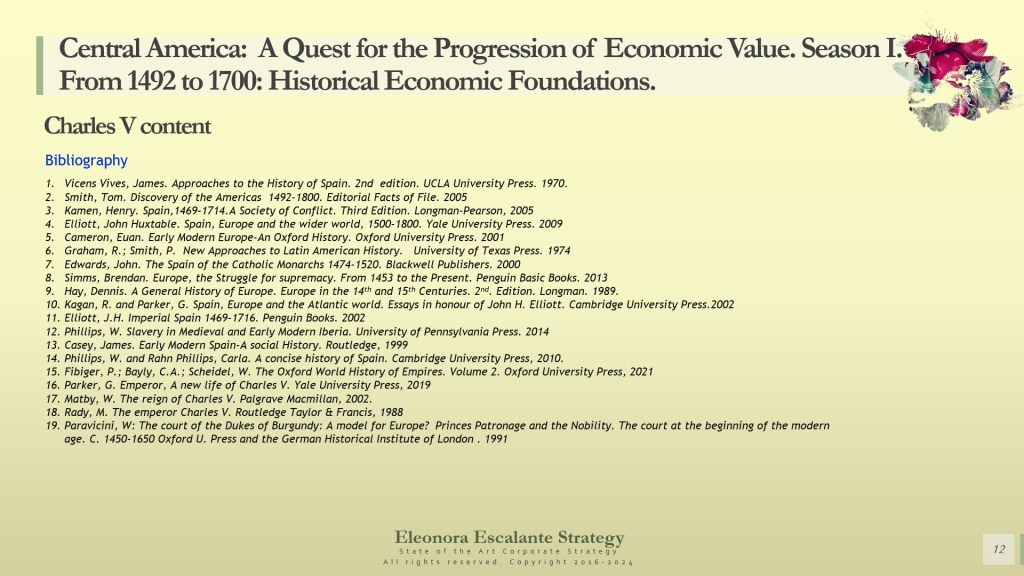
Find our reference support material below. Feel free to download this document in PDF and share it with your friends, classmates, or colleagues.


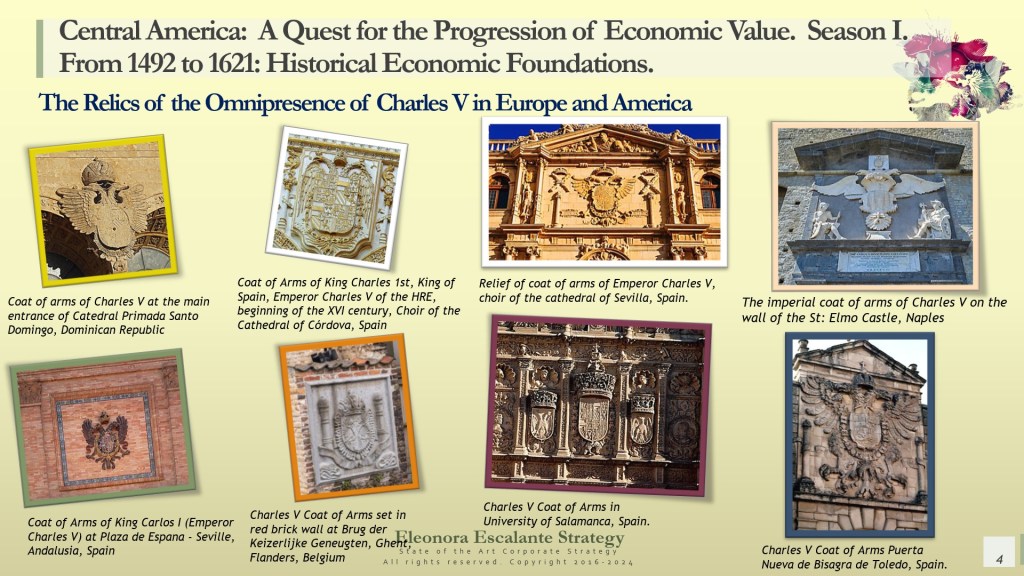

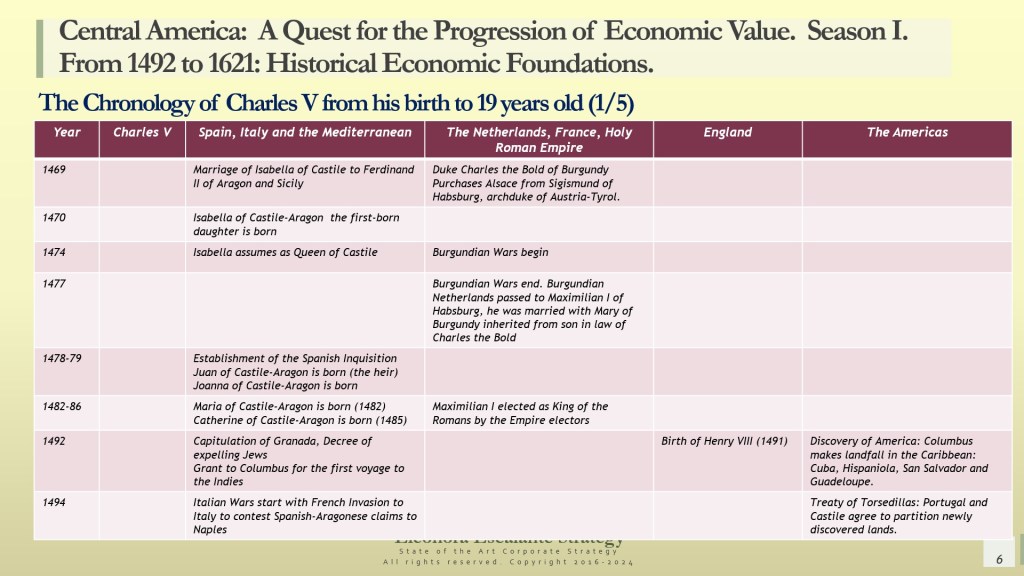
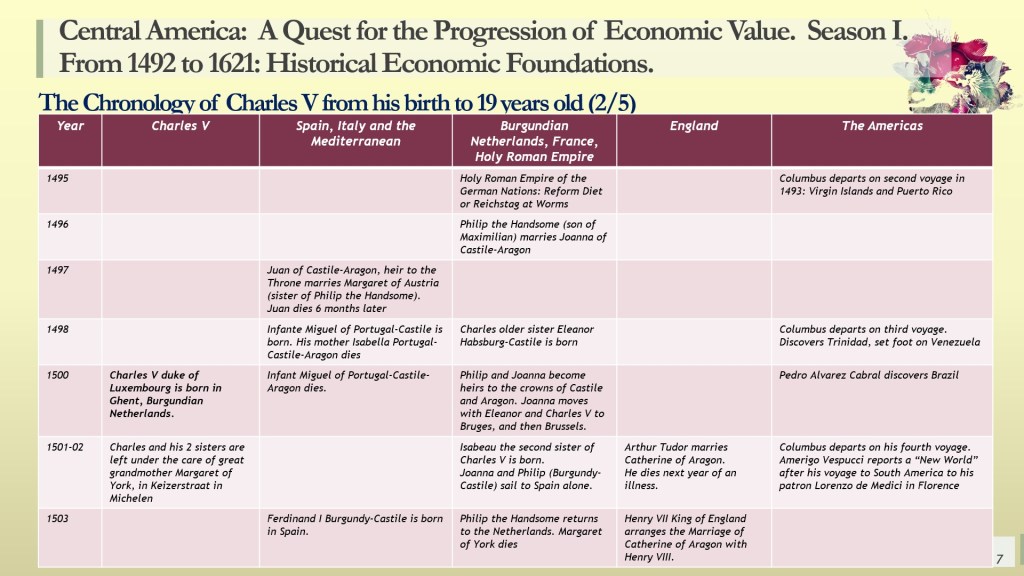

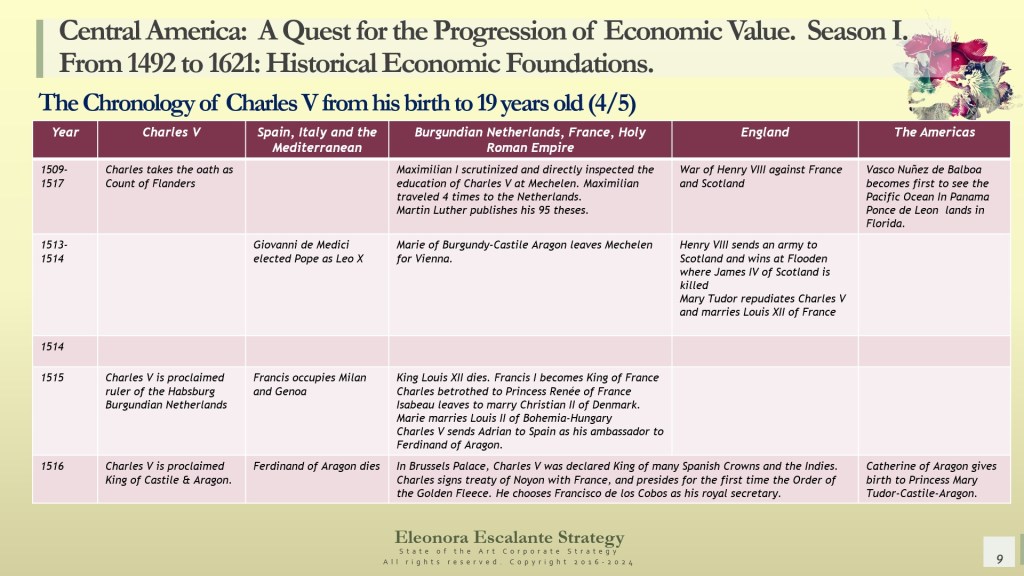



The life of Charles V (1500-1558) influenced the birth roots of the history of America.
It is impossible to teach America’s economic development without visiting the history of the Holy Roman Empire and the main players of the hereditary heights of Emperor Charles V. In him, we find one of the most anticipated magnifiers of the meaning of dynastic matrimonial crocheting in Europe. Probably only to be surpassed by the dynastic weaving of the children of Queen Victoria of Britain (1819-1901). The life of Charles V is essential for anyone interested in business, economics, strategy, globalization, Latin America development, and political economy studies. Why is it so crucial? The philosophy of commerce, strategic policies, and axis of economic development of what happened in America after 1492 has been the framework of our business endeavors. The China model can only be understood by traveling in time to the life of Charles V, his parents, his grandparents, and great-grandparents (4 generations of royals). The current digital global economy of technological feudalism is also governed by what was installed after Charles V’s life. To write this episode, we had to travel to the Carolingian dynasty of Charlemagne in our quest to understand Charles V. History helps a lot if it is the truth. Despite the imperfection of the historians’ work, we responsibly assume a bottom line of an error margin. That is why we all need Medieval historiography researchers to continue investigating the past because every generation of historians brings a new validation or contribution in our quest to find meaning in our endeavors of the present.
Charles V’s ruling mental framework was affected by his predecessors.
The decision-making mentality of Charles V didn´t start when he was learning to crawl in the halls of Prinsenhof Palace in Ghent. It didn´t begin when he became skilled at dancing with his sisters Eleanor, Marie, and Isabeau at his aunt Margareth’s palace, the Hof van Savoye court household in Mechelen. Furthermore, it didn´t commence when his parents moved to Coudenberg Palace located in Brussels. Charles V, as a child, never met his Iberian grandmother Isabella of Castile; a sure sign that he was uprooted from Spain. Nevertheless, Ferdinand II of Aragon’s actions concurrently with the moves of Maximilian I of Austria shaped Charles V during his lifetime. And it also transformed the strategy of conquest and colonization of America.
At the time of Charles V’s birth, the Burgundian Netherlands territories were mainly the Duchy of Brabant, Duchy of Luxembourg, Franche Comte, County of Holland, County of Zeeland, County of Flanders and Artois. Seven years before, Maximilian I, his grandfather, added Tyrol to his Austrian dominions: the Archduchy of Austria, the Duchy of Styria, and the Duchy of Carinthia and Carniola (see map below). At that time, we can also consider the Venetian Republic an undercovered Habsburg territory. In consequence, the world of Charles V when Queen Isabella of Castile died, jumped into a new metier, that no one ever experienced. The discovery of America evolved from voyage to voyage between 1500 to 1519. Suddenly, the word of Columbus wanted to be ratified by others, such as Amerigo Vespucci. The construction of the map of the new continent was coming in pieces of a puzzle that extended the Caribbean to Yucatán, Florida, the South American coast, Panamá, the Pacific Ocean, Mississippi, Brazil, etc. New private sponsors of the voyages joined the Castile-Aragon endeavors: the Medicis, the crown of Portugal, and the Venetians wanted the piece of the cake that the Papacy had restricted its access in Tordesillas. In short, the West Indies weren´t only the Caribbean. There was a huge mainland awaiting Emperor Charles V and his family.

The Castile-Aragon-Avis New World discovery was too much to hide.
Not even the Treaty of Tordesillas could counteract the novelty of the discovery phenomenon of America in Europe. For Charles V, things were not going to be easy. He was supposed to shield and defend a new land that wasn´t under his domains on the other side of the Atlantic Ocean. He was obliged to safeguard America from his hereditable European adversaries. Charles V had to fight for America in Europe. Whom was Charles V fighting for? For whom was he being groomed? For his Spanish Castile-Aragon family interests? For his Austrian-Burgundy domains? For both? For the Holy Roman Empire of the German Nations? Or was he simply caring for his mother Juana of Castile-Aragon and himself? A new vast continent (with promised riches) was impossible to conceal from the rest of European maritime connections.
Charles V’s organic network of hereditary rights positioned him, far beyond his Iberian-Habsburg-Austrian-Burgundian interests. Charles V was galloping in the middle of a spiderweb of Kingdoms, Duchies, and Counties that his grandfather Emperor Maximilian I tried to keep under his control. How could he defend America when Castile & Aragon were so politically/economically weak? How could Charles V prepare himself out of debt? How could an orphan prince (with poor health conditions) be ready for the battles of his century? We try to put ourselves in the shoes of the Emperor. In this context, we can comprehend the stressful sense of worries that Emperor Maximilian I had before his death. We are convinced that Emperor Maximilian knew that his title of HRE wasn´t enough to shield Charles V. But Oh my God, Maximilian truly tried.
Charles V, an Orphan Prince.
While I was reading the biographies of Charles V (we encourage you to read the books about his life, listed in the bibliography), we strongly believe that matrimonial dynastic arrangements (with inbreeding risks) were the only solution they had. Castile & Aragon didn´t have the army, the resources, or the capital to afford a robust defensive strategy for the new continent. The Austrian-Burgundian kingdom wasn´t ready either. But out of nothing, Charles V had to conceive and master a plan. The marriage arrangements of the Habsburgs were the strategy devised to protect America, while it was being discovered. Charles V lived his childhood and teenage years as an orphan, under his procurator Margaret Habsburg-Savoy, but with the strict supervision of Emperor Maximilian I. When Charles V of Ghent was proclaimed King of Castile and Aragon in 1516, he had no idea of how to speak Spanish. His education was Burgundian and Austrian, and his model of the court was not the same as the one he was going to encounter in Spain. Charles V was an orphan not because his father Philip perished when he was 6 years old, but because he was received as an alien orphan in the kingdoms of Spain 10 years later. His eyes were watching the trophy of the New World, while the lands of his maternal lineage were used to achieve it.
The role of the Habsburg Princesses was to protect Charles V’s mission.
Each of the sisters of Charles V of Ghent married royals who could threaten or become future enemies of Charles V’s new domains. Eleanor married Manuel I of Portugal and later Francis I of France. Isabeau married Christian II of Denmark. Marie married Louis II of Hungary. Catalina was given to John III of Portugal. Charles’ auntie, Austrian Margareth also wedded twice. Three of his Castile aunts: Catherine married two Tudors, while Manuel I of Portugal married Isabella and María of Castile-Aragon. Can you read it again: King Manuel I of Portugal was the husband of three Castile-Aragon princesses: Isabella, Maria, and later Eleanor (Charles V’s sister). What a mess! Are you able to perceive how hard they tried to keep Portugal as a friendly associated nation during the conquest and colonization of America?

Another version of history for Charles V.
The 16th century was the Habsburg-Burgundian-Castile-Aragon period in Europe and America. We searched for the existing imperial coats of arms of Charles V (slides 4 and 5) that could be dangling from cathedrals, government palaces, offices, and/or convents in Latin America. Still, we found many of them hanging in Spain. But sadly we didn´t uncover Charles V’s coat of arms in his American domain viceroyalties, except for the one of Santo Domingo, and the Tlexcalan in México. There could be a few more hidden around. Much of the Austrian heraldry was removed during or after the Independence movement of the 19th century. Indeed, we bet that Charles V’s strategy was to “repartir” the land, the native Indigenous, and different personalized coats of arms to the conquistadors as they deserved an “award” for conquering New Spain, Central America, and the northern part of South America. Despite the posterior destruction of Charles V´s heraldry, we have observed certain symbols of Charles V’s heraldry in the coat of arms of the conquistadors. We also believe that Charles V and his dynastic family (at least his parent’s Castile-Burgundian part of it) had planned a strategy on how to remove those conquistadors from the game. Historians remark that no Habsburg or Castile-Aragon royal journeyed to America during the 16th century. We are not so sure of that. If the Habsburgs of Castile-Aragon triggered marriages to defend the New World; they easily could have traveled to America after the conquest was over and/or the colonization began. An interesting fact is that Hernan Cortés didn´t penetrate México, until 1519, the year in which Charles V received the baton as Holy Roman Emperor of the German Nations.
In addition, we truly believe that the death of so many royals of the Houses of Burgundy, Trastámara, Barcelona, Castile, and Avis, wasn´t an accident. It would be interesting to initiate a crime investigation with a mandate to discover the truth about the different fatalities occurring around the life of Charles V. It is never too late to rewrite history as it truly was.
To be continued…
Announcement.
Next Friday 8th of November, we will continue with Episode 6 “Charles V: Surfing the Waves of his foes”. Our next chapter will be about the life of Charles V between 1519 to his death in 1558.
Musical Section.
Our melodious selection of music during this saga will be served with songs and concerts that could have been listed on the most important Billboard during the century of our themes. Today, we have chosen the following one: From the Imperial Court: Music for the House of Habsburg. Ensemble: Stile Antico. From the Youtube channel Vingul.
Thank you for reading http://www.eleonoraescalantestrategy.com. It is a privilege to learn. Blessings.

Sources of reference and Bibliography utilized today. Shown in the set of slides.
Disclaimer: Eleonora Escalante paints Illustrations in Watercolor. Other types of illustrations or videos (which are not mine) are used for educational purposes ONLY. All are used as Illustrative and non-commercial images. Utilized only informatively for the public good. Nevertheless, most of this blog’s pictures, images, or videos are not mine. I do not own any of the lovely photos or images unless otherwise stated.
 Eleonora Escalante Strategy - Strategic Reflections Think Tank