

Central America: A quest for the progression of economic value. Episode 6. Amid Maximilian I Strategic Plans.
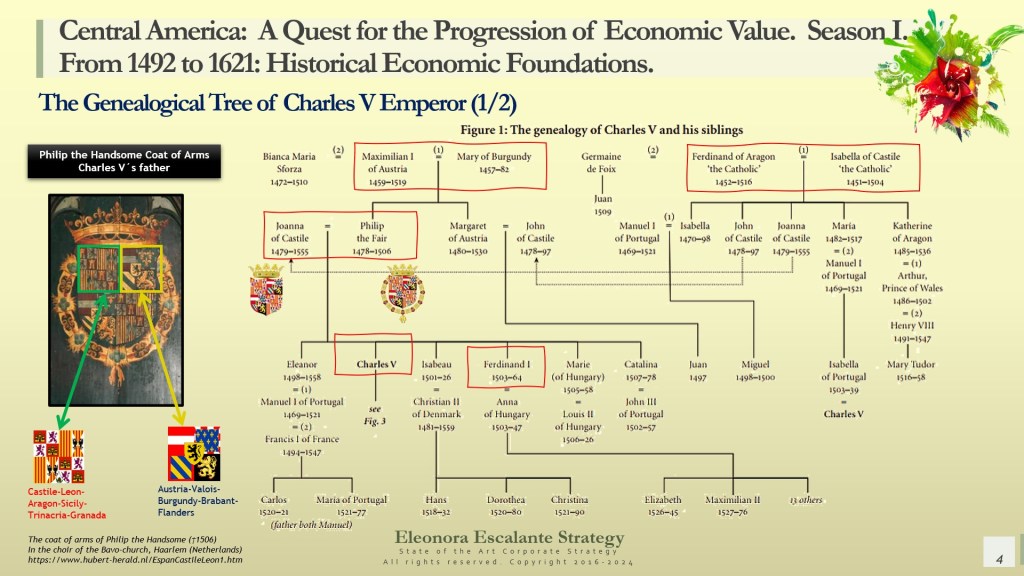
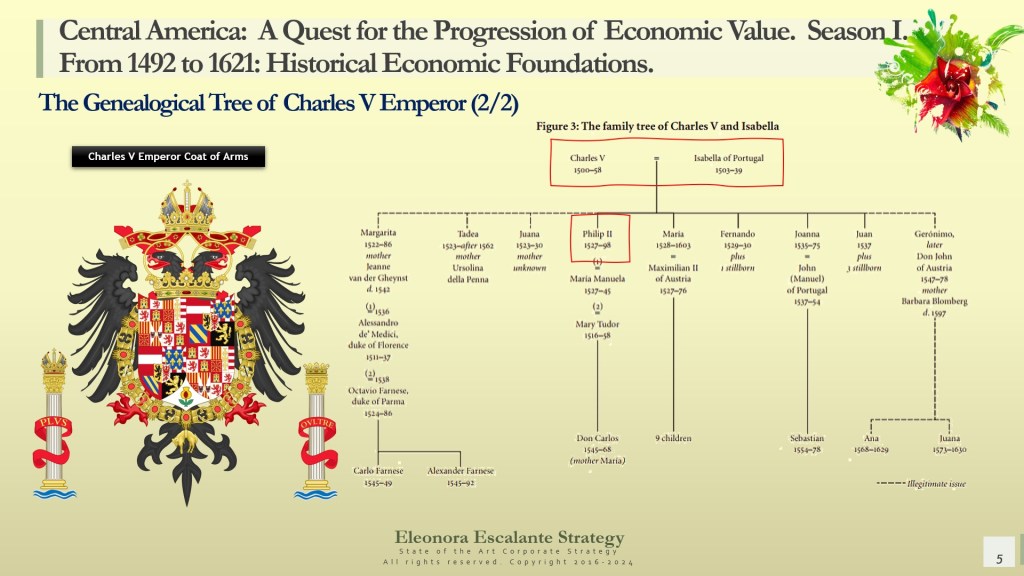
Today we will cover the life of Emperor Maximilian I, one of the most relevant figures in the history of Europe in the 15th century. Not studying him is like not knowing anything about Spanish America. Consequently, we decided to insert this episode to analyze Maximilian´s endeavors and his strategic plans for his descendants. His decision to betroth his Habsburg-Burgundian son, Philip the Handsome with Joanna of Castile-Aragón, was the beginning of everything we have lived in Latin America. It is of tremendous importance for all the descendants of the Indigenous populations of the Americas to understand Emperor Maximilian I because only then we will be able to comprehend the thinking context and the philosophy of the conquest and colonization of this region. By analyzing how Maximilian I was able to design and implement his corporate strategy in Europe, only then will we become conscious of the rationale that was behind the divergent phases and respective actions taken by the Conquistadors. Furthermore, by figuring out the Maximilian I A.E.I.O.U corporate strategy, we will also grasp why and what Charles V Emperor permitted (or didn´t allow) as the commander in chief or the ultimate top leader of the Conquista. Maximilian was the one who defined the fate of his grandchildren. Each of them was born and chosen with a specific goal. It was Maximilian who entrusted Charles V, with the operational (warfare) management of the conquest of America, in the hands of the Conquistadors.
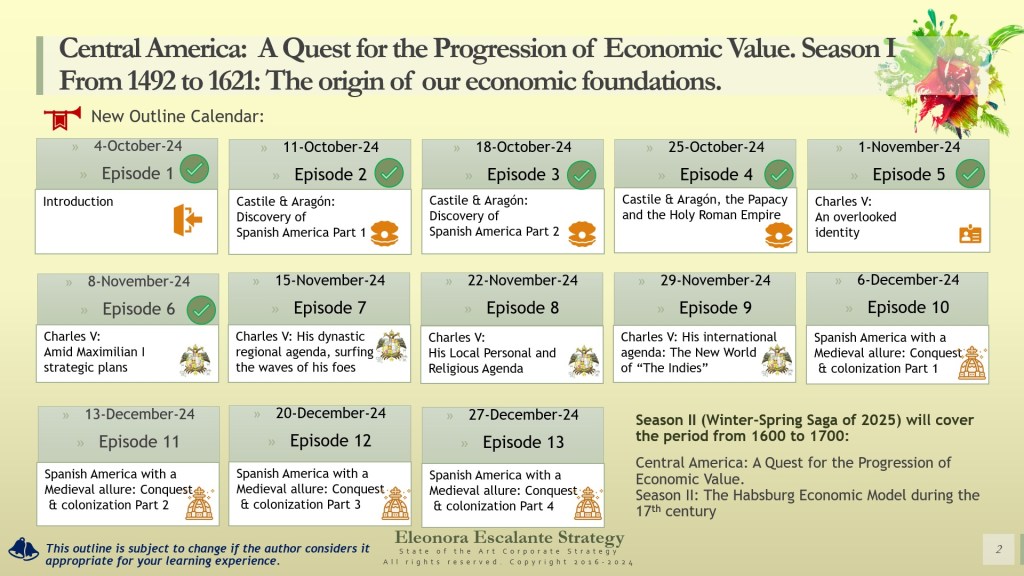
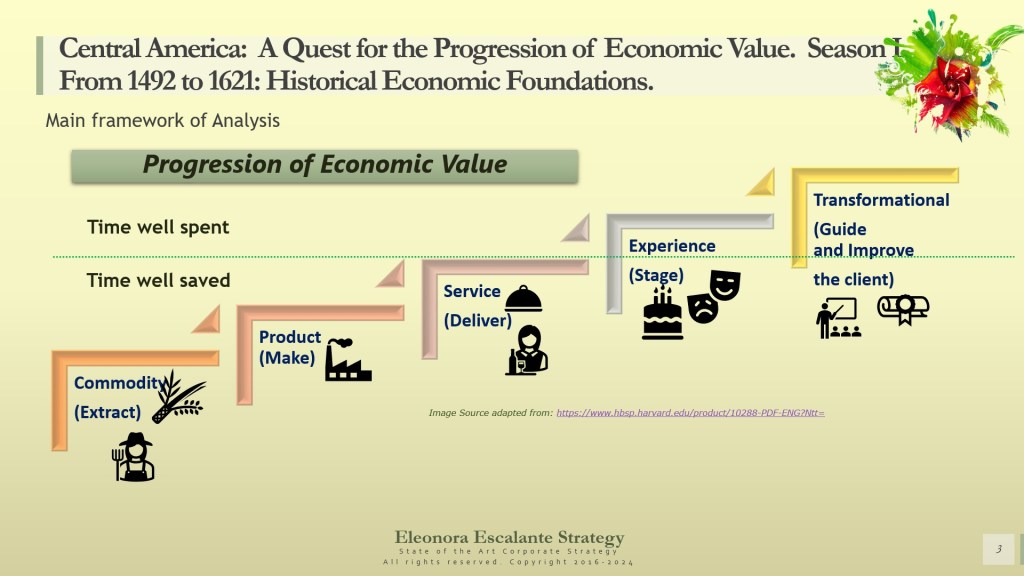
Our slides of reference for this publication are shown below. We expect that you can download them, print them, and read them thoroughly. This is crucial for the analysis of today. Feel free to share them with your colleagues and friends. We always encourage you download the PDF presentation, because it is clear and you can print it on paper, which truly helps better for your learning.
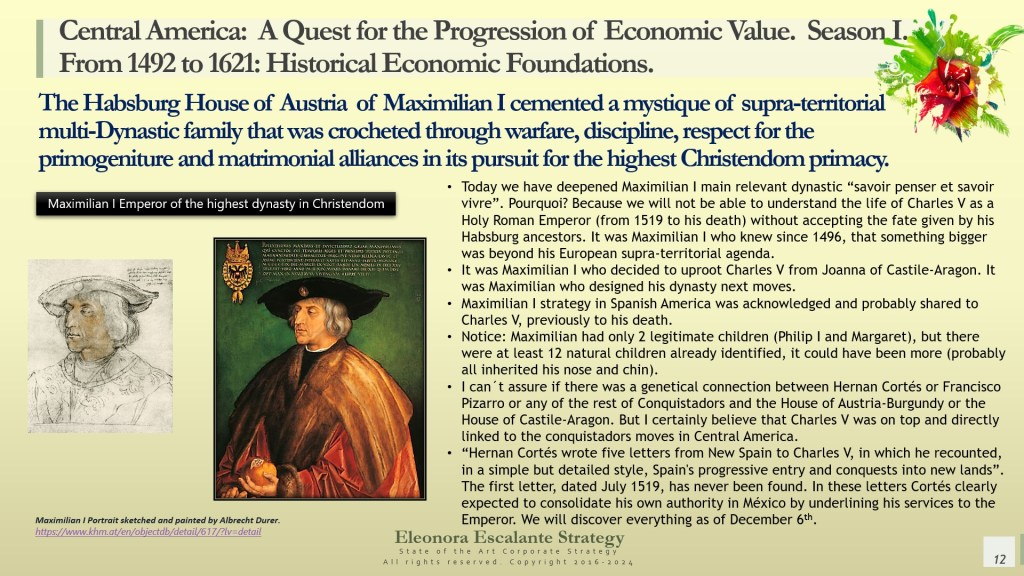
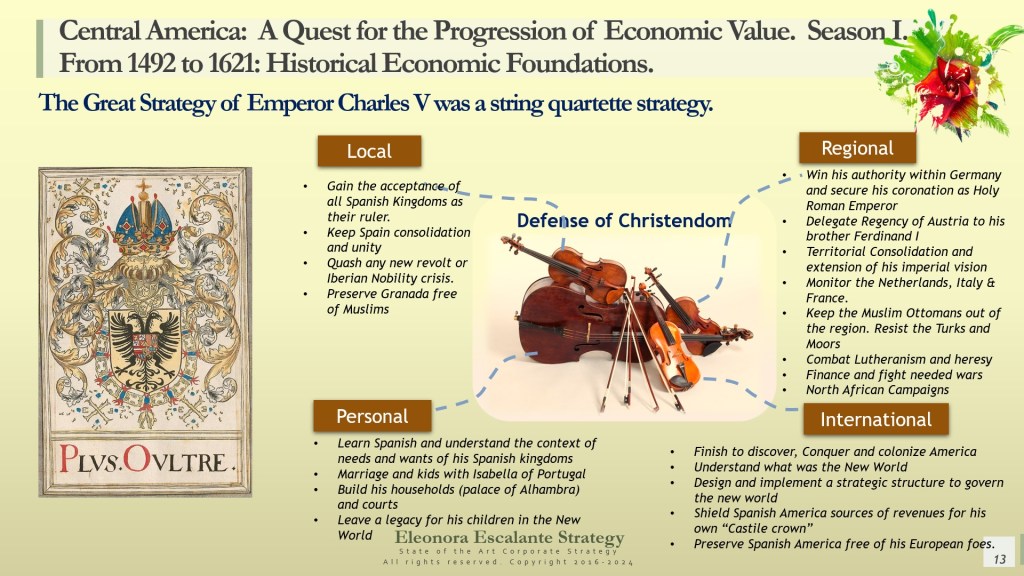
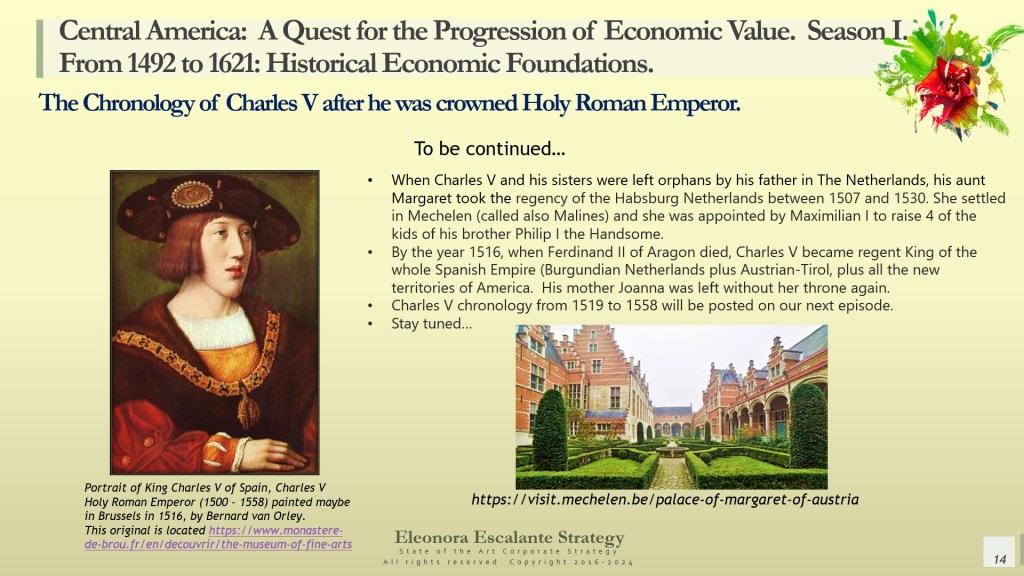


The world of Emperor Maximilian I.
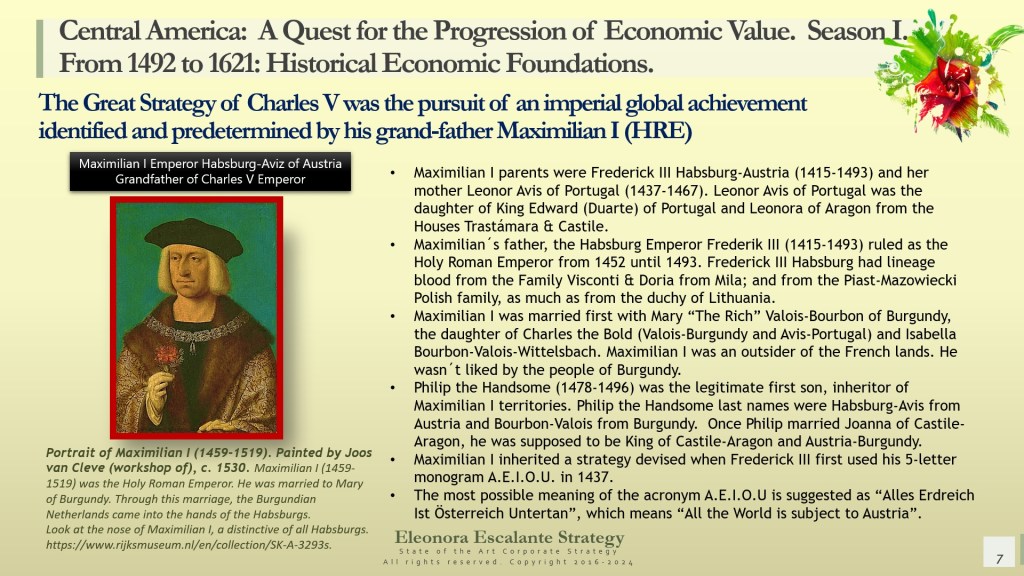
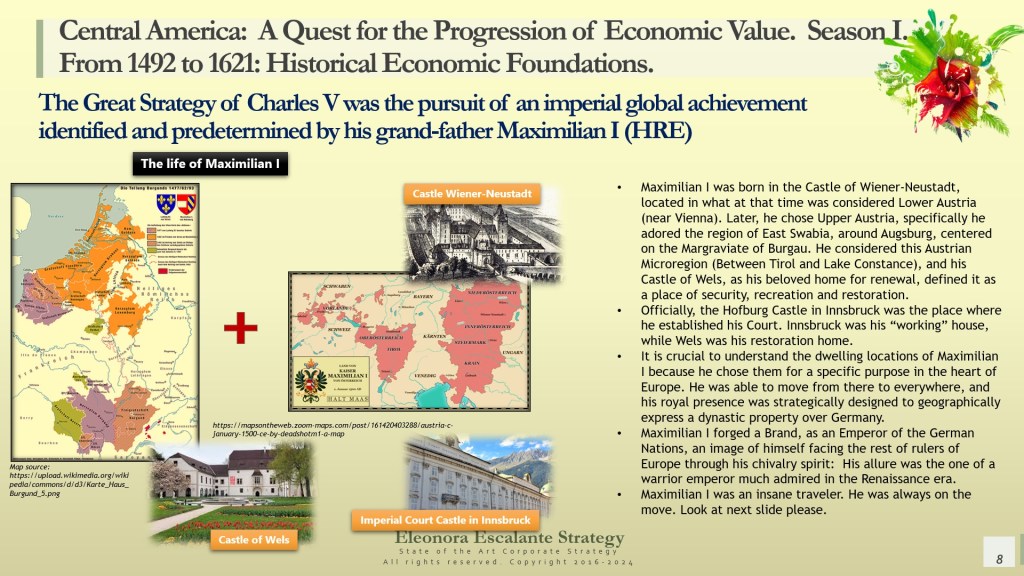
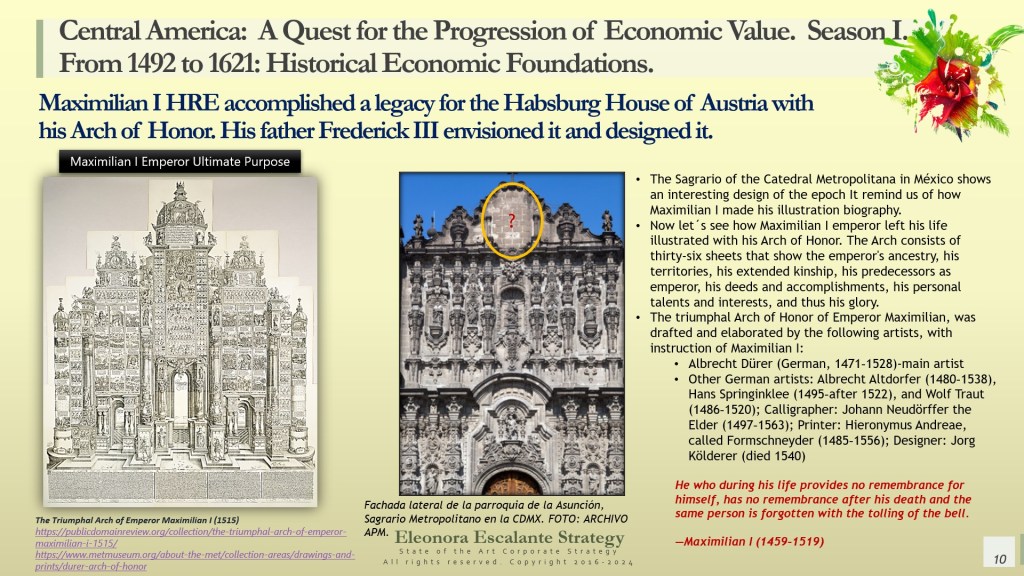
Maximilian was born in the Palace of Wiener-Neustadt in 1459, Austria. He was the son of the Holy Roman Emperor Frederick III (1415-1493) and Leonor Avis (1437-1467), the daughter of King Edward of Portugal. Maximilian was spoiled by his Portuguese mother, who left him an orphan at the age of eight. Maximilian life summary was perfectly captured by a team of the best illustrators of his time, excellent German painters who drew in a triumphal honor arch. Around 36 plates describe his genealogical chronicle, his wars, his heraldry, his armory, his children’s betrothals, and his devotions for hunting, falconry, fishing, building his palaces, his morality behavior, his pacts, etc. Look at slide number 10 please.
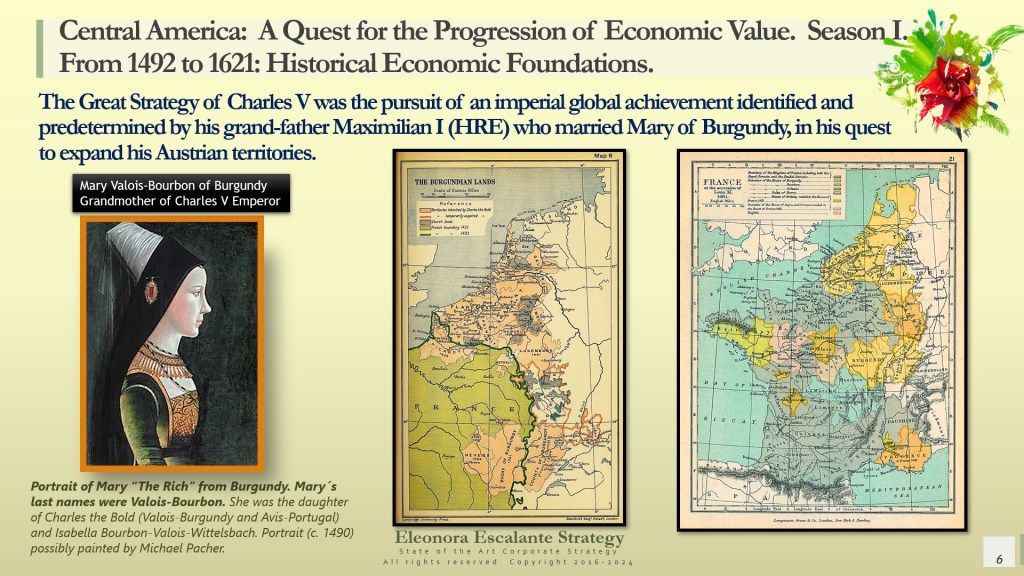
The Habsburgs´ good luck began with a matrimonial alliance between Maximilian I and Mary “The Rich” Valois-Bourbon of Burgundy that allowed the Habsburgs to grow in assets, territories, and economic benefits. Mary was the heir, the daughter of Charles the Bold (a descendant from the houses of Valois-Burgundy and Avis-Portugal) and Isabella Bourbon-Valois-Wittelsbach. Nevertheless, Maximilian I was an outsider of the French-Netherlands lands. He wasn´t liked by the people of Burgundy, but he defended it as if it was a Habsburg territory. Maximilian fought back against Louis XI of France’s attacks, defeating him at the Battle of Guinegate in 1479. When Mary died in 1482, Maximilian was forced to act simply as a regent for his son Philip the Handsome. Philip, by inheritance, became then the Archduke of Austria, Duke and Count of Burgundy, Lorraine, Brabant, Limburg, Luxembourg, Gelderland, and Milan. Count of Habsburg, Flanders, Artois, Palatine of Tyrol, Count Palatine of Hainault, of Holland, Zeeland, Namur and Zutphen. Prince of Zwave, Marquess of the Holy Roman Empire, Lord of Friesland, of Salijnes, of Mechelen, and the cities and countries of Utrecht, Overijssel, and Groningen (1).
How to conquer a New World without money?.
It is remarkably interesting to perceive how the different rulers of Germany before Frederick III, tiled a particular route for the Austrian Habsburgs to the Americas. Frederick III died the same year that Columbus first traveled to America. In addition, the royal house of Castile-Aragon was emerging from seven hundred years of conflicts with the Muslims, and it wasn´t possible for them (alone) to finance the discovery of a New World. The Habsburgs were also in financial troubles. Philip the Handsome matrimonial alliance with Joanna of Castile-Aragon was the beginning of a “golden fate” in which new riches were expected to arrive. It was a “you discover and buy now, I will pay later” strategy. Look at the following plate that describes the Betrothal of Phillip with Joanna, found in the art commissioned by Maximilian I to Albrecht Durer:
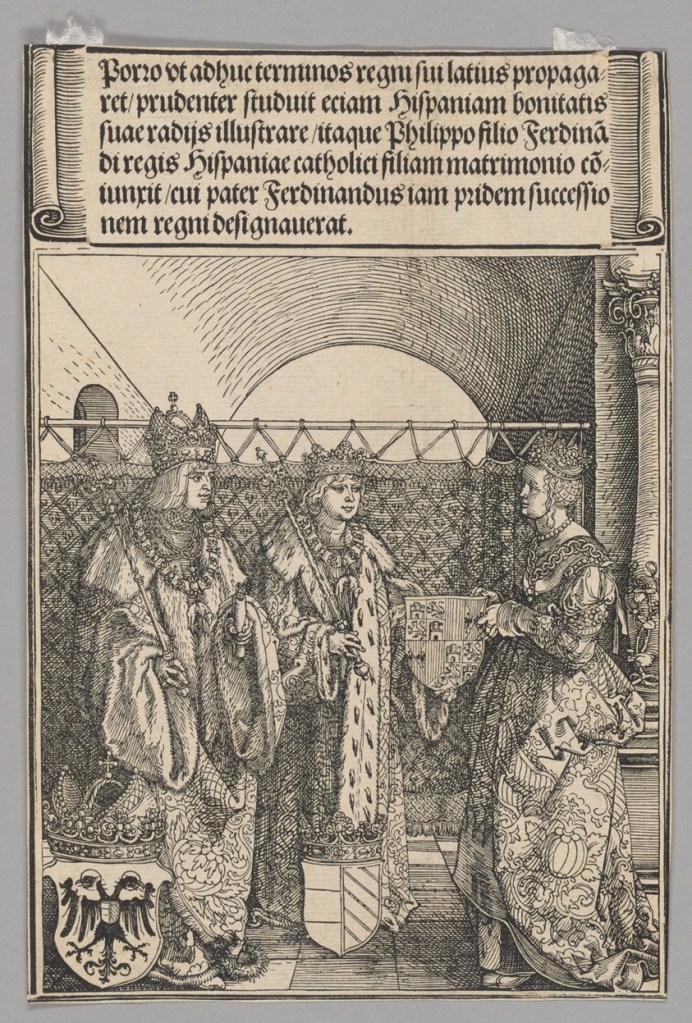
Once Queen Isabella passed away in 1504, Philip the Handsome knew that he was going to add the rest of the Spanish titles: King of Castile, Leon, Aragon, Portugal, Navarre, both the Sicilies, of Jerusalem, Granada, Toledo, Valencia, Galicia, of Mallorca, of Seville, of Sardinia, of Cordoba, of Corfijcke, of Murcia, Jaen, Al Gharbia, of Algefiere, of Gibraltar, and “the islands and the countries of the ocean”. When Philip died he was still unaware of the size of America. The German cartographer Martin Waldseemüller, originally published the first map in April 1507. But Waldseemüller was clearly linked to Maximilian.
The economic warfare and religious strategy of Maximilian I.
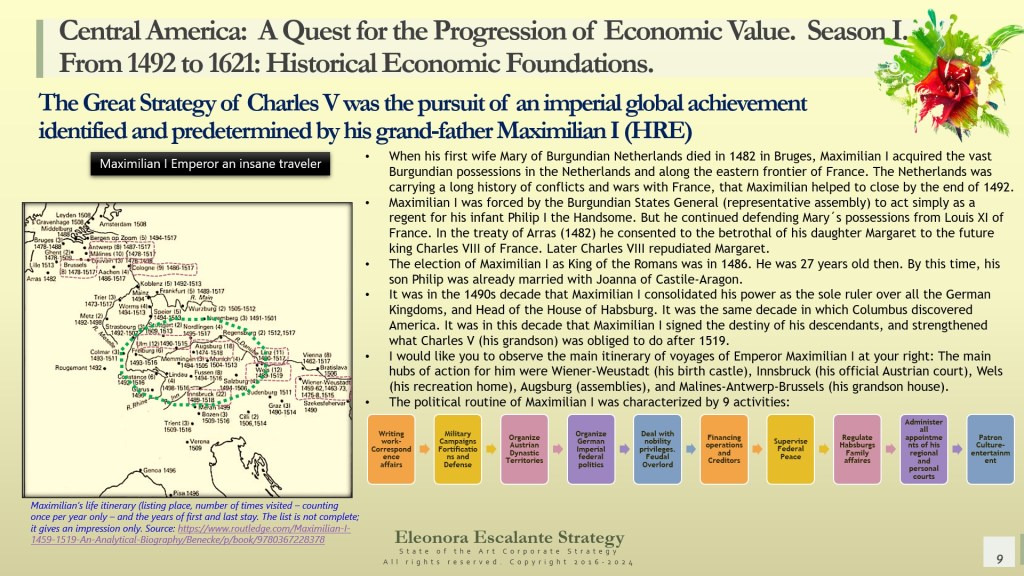
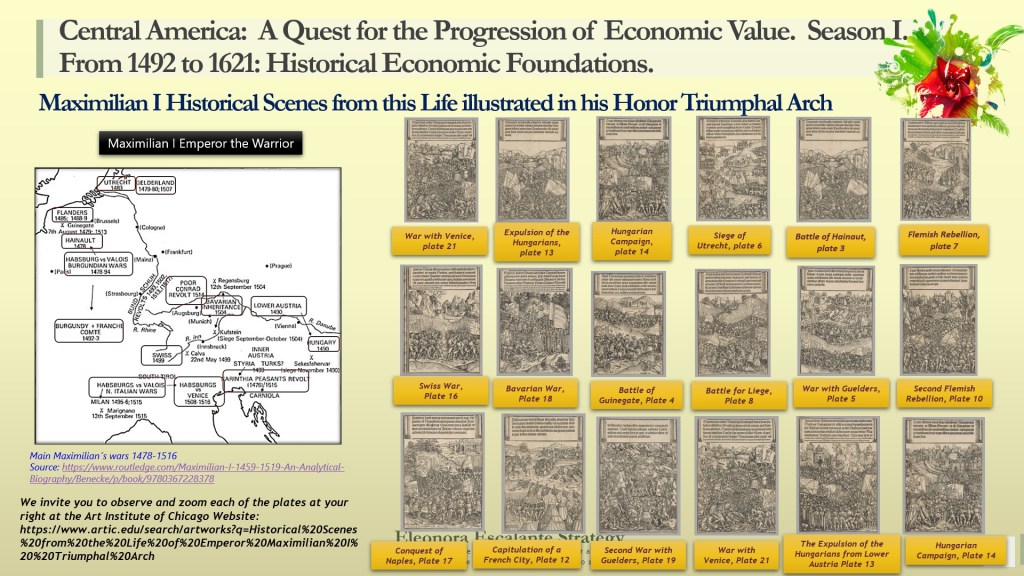
As a king of Germany Holy Roman Emperor, Maximilian never fully delegated matters of his responsibilities. He traveled all his life, and we have proof of evidence of his voyages as the core of his leadership style. He wished to lead directly, and he took unswerving/constant accountability of his administration all over his lands. As an Emperor, he held over twenty “full-scale Reichstags” or Imperial Assemblies with different territorial rulers, to discuss diverse problems of the Empire. And he never gave up on warfare. Warfare was the problem-solving toolkit for all the leaders of his epoch. Warfare was normal, it was the way to win and establish dominance either alone or in coalition with other strategic partners. Maximilian was always assessing and gathering more resources (money, combat equipment, soldiers for the army, the silver mines of Innsbruck, etc.), and he used innovative warfare tactics to keep his foes out of his territories (the Hungarians or the French for example). His expansion and consolidation of power were influenced by the flourishing culture of the Burgundian Netherlands, much interested in literature, art, music, new government policies, and new state-of-the-art military inventions. His political agenda and conflict problem-solving (look at slide 11) only demonstrated how hard he was undertaking his role to unify all his territories for his descendants. Using discipline, fighting (as it was the modus operandi of medieval chivalry), and procuring matrimonial alliances for his children and grandchildren. His new lands required his successors’ presence, and he worked hard to educate them to accomplish arranged nuptials with his highest adversaries or with his convenient friends in the Iberian territories, Vienna, Prague, Lisbon, and Brussels. His financing debt with the Venetian Fuggers only indicated a sign: how much he was holding to endure his opposition to the Ottoman Turks (and the Muslims established previously in Granada and the North of Africa). He proclaimed himself the Lord of all Europe, except for France and some areas of Northern Germany. Maximilian planned a smart sequence of actions and maneuvers to keep Ferdinand II of Aragon and his daughter aside, while Charles V was trained with his daughter Margaret in Mechelen. Once Maximilian secured Spanish control, his next steps were to create different coalitions with the Pope and the rest of his allies, including England. Between 1506 to 1519, Maximilian was extremely straightforward: as an HRE, he was conducting the corporate strategy of Europe in favor of what Charles V and his siblings were “required to do”. I am convinced that Maximilian marriage with Bianca Maria Sforza (his second wife), was part of a strategy to keep Milan and Venice on his vessel, not just to defend what Columbus discovered, but to comprehend the size of the breakthrough in America. Were the two grandfathers of Charles V working together? Was Maximilian I and Ferdinand II of Aragon playing the same defensive strategy of America together? What do you think?
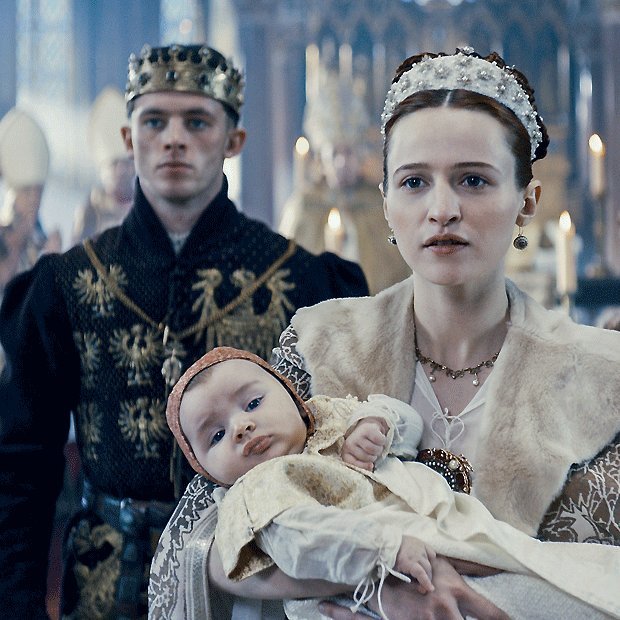
Maximilian I attempted to keep the Empire under the Habsburg control before passing it to Charles V. Maximilian I took steps to control the German Rulers and kept them under strict monitoring, to make it easier for Charles V. We are convinced that Maximilian I knew much better than anyone in Europe, who was who inside the German, Burgundian, Hungarian and French lands. He learned how to counteract or even weaken all the European opponents who later could be interested in obtaining a piece of the Spanish American pie. From the point of view of a corporate strategist, we can affirm that Maximilian was the planner of America´s defensive strategy against any European ruler who could steal the trophy of America from his grandchildren. Ferdinand II of Aragon also did it after Philip his son-in-law died. The reason why we need to re-write the history of the discovery, conquest, and colonization of America is so simple: it was a custom for all the kings and emperors of that time to utilize misleading messages of what was occurring, in their quest to gain relative advantages or get information about the next movement of their enemies over time. Any intent of entering the lands of America was contained by the Spaniards, Burgundians, and Habsburgs for several decades using confusing tales or blurring news of propaganda navigating from America to Europe. For Maximilian I, his worst enemies were those outsiders around his Habsburg territories (Hungarians, Turks, Swiss, French, and others), the rebels of the newly acquired lands (the Muslims of Granada, the mutineers of Burgundy, the Italians who weren´t obeying him, the heretics against the Pope, etc.), and those who may swipe the new America´s territories of his descendants. It is important to notice that the regions of Germany which weren´t under explicit control of Maximilian I, were the same ones which began the Lutheranism contagion in Europe.
Maximilian I also acknowledged that his itinerary oversight wasn´t enough.
He had to build a household in every strategic place of importance after every land acquisition through war, to show that he was staying and that he was serious about remaining around regardless of his voyages. Nevertheless, he never stopped traveling, even with his coffin during the last years of his life. His voyages made him the top creator of strategic alliances between Central Europe and the Iberian Peninsula, and he was a Master on European affairs horizontal growth. What Maximilian lacked was the primitive capitalist system that could help him to eradicate his debts. Given the feudalist omnipresence of the epoch, his legacy to Charles V couldn´t help him overcome the burden of raising taxes, requesting special tributes and resources to boost all the money required for warfare. Maximilian was aware of the Lutheran Reform around the corner, and we perceive that he could envisage the superiority of the clashes coming from Germany against Charles V: The Knights Revolt (1522-3), the German Peasants War (1524-6), the sack to Rome after Pope Clement VII sided with France, etc. But Maximilian wasn´t knowledgeable enough of the schism degree of the Swiss Dutch German Protestantism, nor about the emergence of Lutheranism as a permanent alternative to Catholicism after the Schmalkaldic League in 1531. The first-born grandson Charles V’s corporate strategy decision-making was supposed to serve Spanish America, while Ferdinand I was supposed to protect the Habsburgs from the Hungarians and expand Austrian territories to Croatia, Bohemia, Moravia and Hungary. The European conflicts of Charles V delayed the A.E.I.O.U plans that Frederick III and Maximilian I carefully tried to weave. We wonder what happened with Charles V and his strategic route map with America´s conquistadors. How did he organize the conquest as of 1519? Was this his job as soon as his grandfather died? Or were their grandfathers Ferdinand of Aragon or Maximilian, the ones who organized how to command what happened later in Spanish America?
In our next episode: we will analyze how Charles V resolved the latter issues after he was elected Holy Roman Emperor in 1519.
To be continued…
Announcement.
We have inserted today´s episode in our quest to provide the background of the decision-making of Charles V emperor. Without understanding the life of his grandfather Maximilian I, it will be impossible for all of us to comprehend Charles V. Visit the outline calendar that has been modified accordingly. Next Friday 15th of November, we will continue with Episode 7 “Charles V: His Dynastic Regional Agenda, Surfing the Waves of his foes”. Our next chapter will be about the life of Charles V between 1519 to his death in 1558.
Musical Section.
Our melodious selection of music during this saga will be served with songs and concerts that could have been listed on the most important Billboard during the century of our themes. Today, we have chosen the following one: We found this old treasure titled: Musica Reservata from the Court of Burgundy (Full 1969 Album), from the YouTube channel Hollowchatter.
Thank you for reading http://www.eleonoraescalantestrategy.com. It is a privilege to learn. Blessings.

Sources of reference and Bibliography utilized today. Shown in the set of slides.
(1) https://hemmahoshilde.wordpress.com/2016/09/20/philip-the-handsome-ruler-of-pretty-much-everything/
(1isclaimer: Eleonora Escalante paints Illustrations in Watercolor. Other types of illustrations or videos (which are not mine) are used for educational purposes ONLY. All are used as Illustrative and non-commercial images. Utilized only informatively for the public good. Nevertheless, most of this blog’s pictures, images, or videos are not mine. I do not own any of the lovely photos or images unless otherwise stated.
 Eleonora Escalante Strategy - Strategic Reflections Think Tank