

Central America: A Quest for the Progression of Economic Value Season I. Episode 7. Charles V: His dynastic regional agenda & surfing the waves of his foes.
Dear fantastic readers:
Wishing you a beautiful and relaxed weekend. Today is the turn to continue skinning the box of surprises of the Habsburg-Castile-Aragon family. We have been analyzing all the possible links or networks of people around Emperor Charles V to understand who his foes, friends, and/or both were. We are also weaving the underlying truth of his motives behind the discovery and colonization of Spanish America. Charles V’s corporate strategy in America was not pursued to prolong the quixotic allure of his Burgundian roots of Mechelen. Charles V was living his imperial problem-solving ideal with his exquisite style in Europe. We are convinced that Charles V multiplied himself using different masks or identities that helped him to stay in two places simultaneously: This is called identity theft nowadays. And we will study and analyze how he did it during season I of this saga.
As soon as his grandfather died, the young Charles V who was proclaimed King of Romans, was probably not just a curious teenager who wanted to play to war in Europe only. Before Maximilian I passed away, Charles V was clear enough that the new lands of Spanish America were waiting for him, and his family. In this case, his family is defined as Castile-Aragon-Habsburg of the Low Countries. Since 1519, Charles V already knew his fate wasn´t in Europe. He didn´t lose time moving his brother Ferdinand to Austria, where his grandfather Maximilian wanted him. Charles V perceived that his destiny wasn´t designed to make the waves in Europe, even though “official history” insists on showing him as Europe’s most engaged and dynamic Emperor, who never ceased to protect his German Nations from France and the Turks.

We have prepared a set of 20 slides for you today. This material of reference will help us understand the Habsburgs’ dynastic regional agenda, regardless of whether Charles V conducted it in person or not. Can one person be in two places at the same time? In reality, the answer is no. But using an identity theft strategy, it is possible if you find someone who looks at least 90% similar to you. Was Charles V able to escape Maximilian’s destiny? Was Charles V able to save himself from the serendipity of warfare that awaited him after his grandfather died? Could Charles V use a doppelganger for his European warfare, while he was in Spanish America? Under what identity?. Is this scenario a possible one?
We also have reflected on the possibility of dynastic marriages with the Ottoman Empire. We might be completely wrong, but there exists the chance that one Habsburg princess could have taken the risk to do it. As a double hypothesis for this episode, you are welcome to explore the following material. Feel free to download it, share it, and discuss it with your friends and colleagues. Please print the PDF document, it is better for your learning experience because you can write your notes and thoughts on paper while reading it.
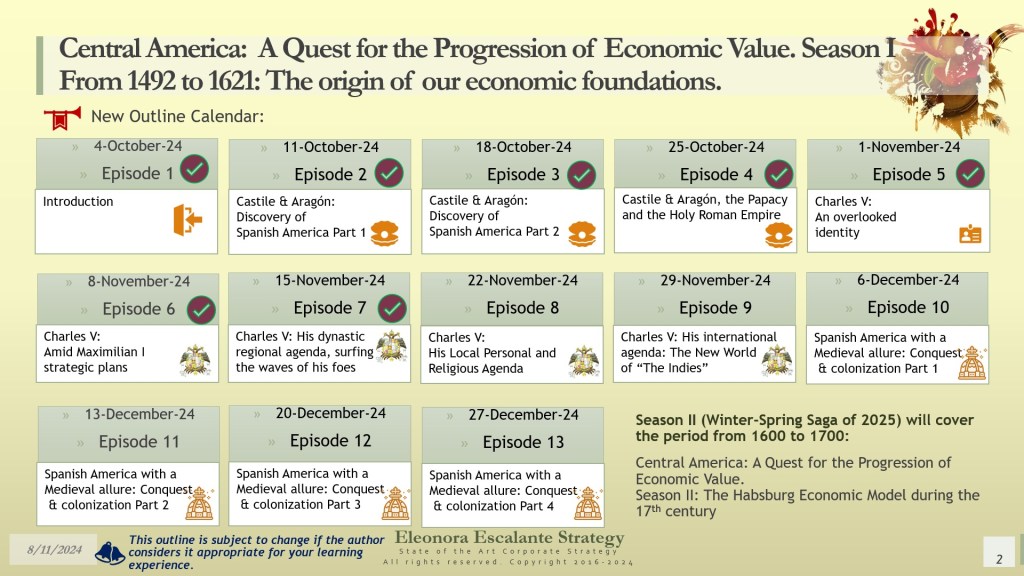

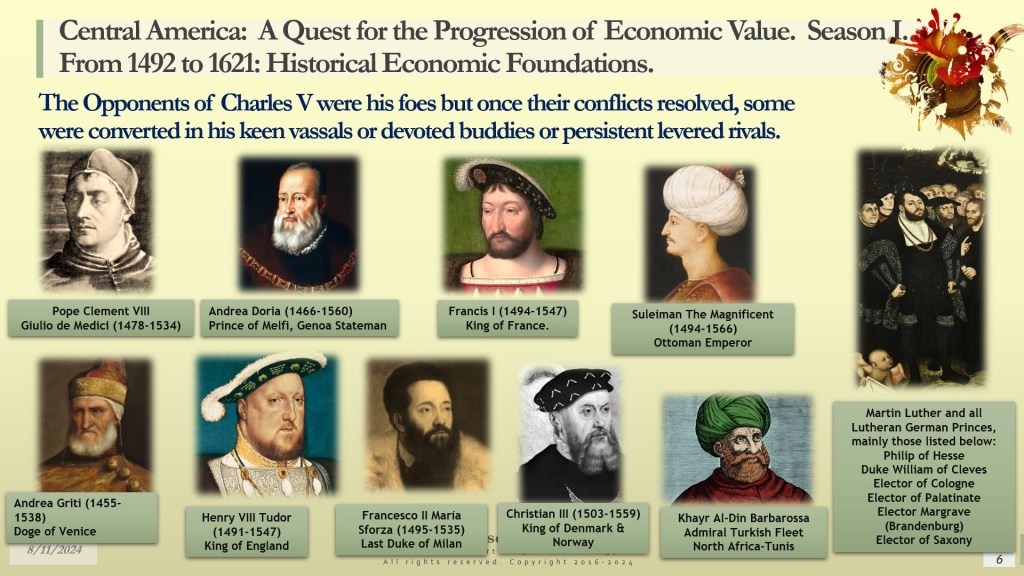
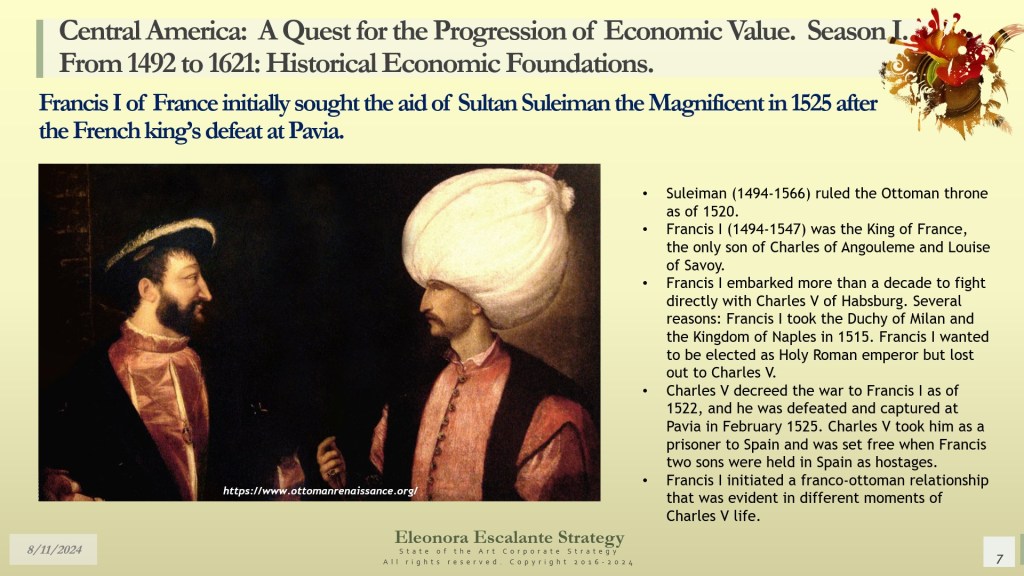

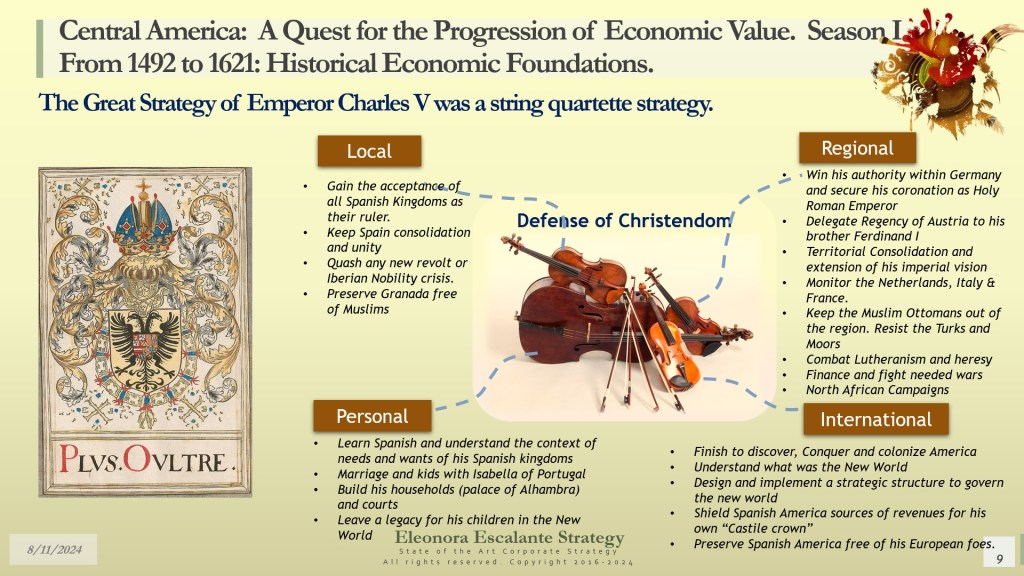


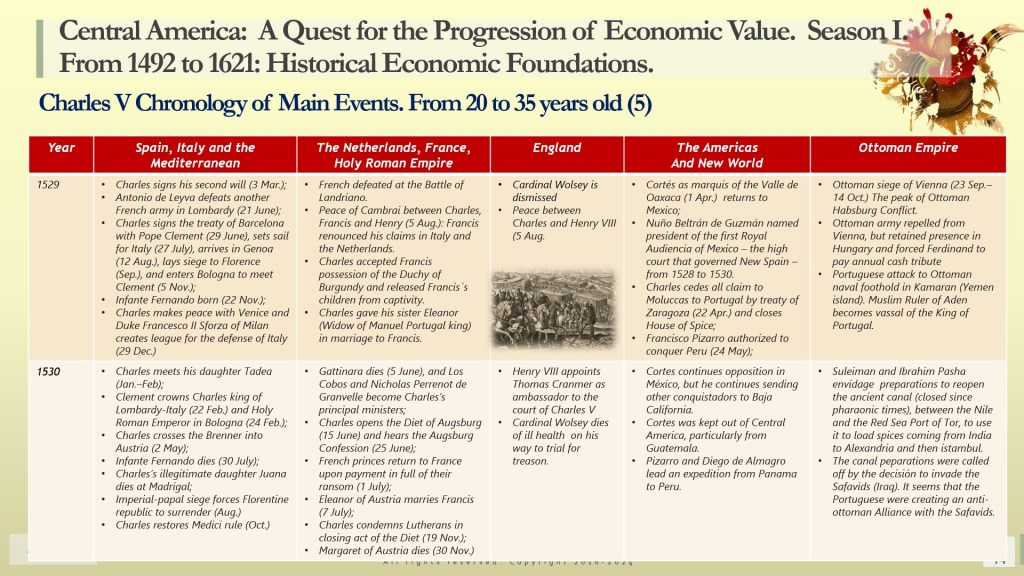
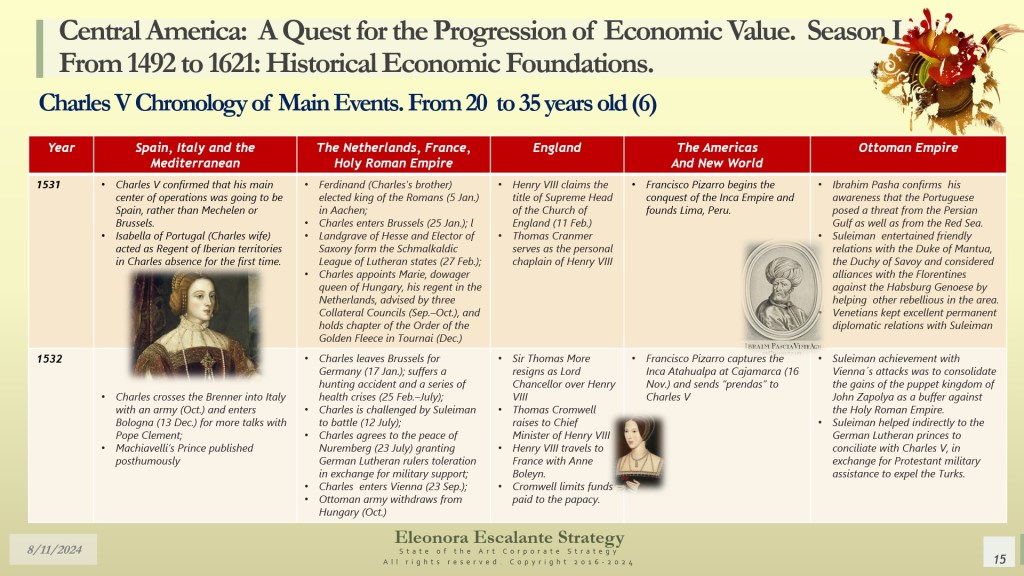

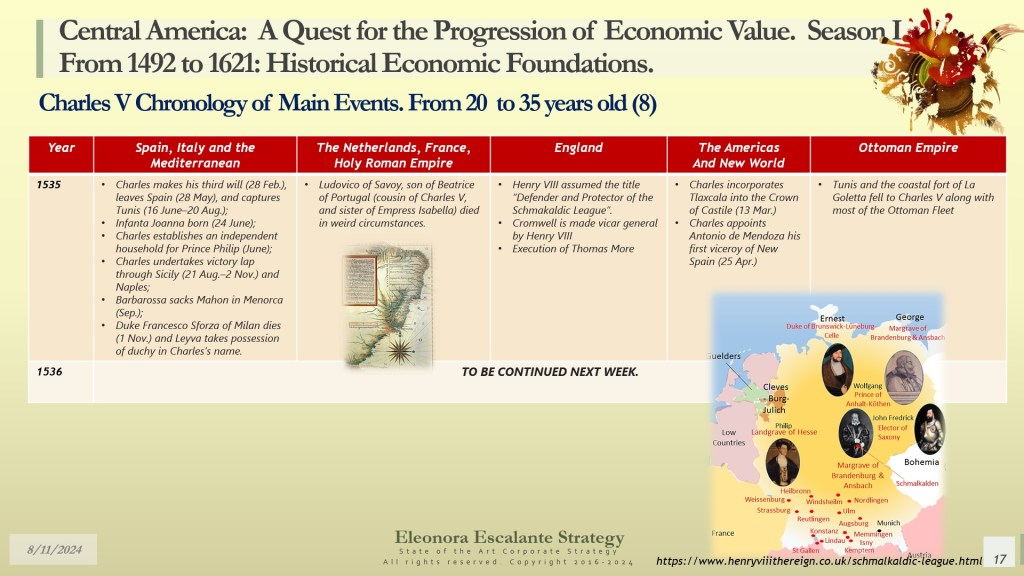


Chronology of main events of Charles V Emperor from 20 to 35 years old.
The document of today includes a comparative timeline of the main events lived by Charles V, since he was crowned Holy Roman Emperor to the moment in time in which we have perceived that he lost interest to
continue fighting for the Empire (see slides 10 to 17). We have included the Ottoman Empire chronology of events under Suleiman because we noticed an instant that could have altered the life of the Habsburgs forever: could it be possible that one Habsburg princess may have married Suleiman? See slide 8. We cannot confirm it, despite that we have done our research. Nevertheless, it is remarkable to observe the motives and the coincidence, given the context of what Charles V was facing. Before proceeding further, we encourage you to download the PDF document, print it, and read it from start to finish.
Charles V was doomed to become an Emperor in 1506. Charles V’s beginnings were turbulent.
When Philip the Handsome, husband of Joanna of Castile-Aragon passed away, it was her right to become the Queen of Castile-Aragon. Charles V’s grandfather, Ferdinand I of Aragon took Joanna responsibility, while she was sent to Tordesillas. Between 1506 and 1516, Emperor Maximilian I was watching from not so far away, what type of kingdom was awaiting Charles V. Maximilian I had already someone in mind who could help Charles in Castile, Mercurino Gattinara who was president of the Council of the Netherlands. So we can observe a grandfather Maximilian who was preparing the future chief advisor for Charles V. Maximilian I was also on top of Charles’s education before he acceded to the throne of Spain (1516). When Charles organized his court to travel to Castile-Aragon, the orphan teenager, raised under Margaret of Austria’s values and education was simply too young to understand that Mechelen (Duchy of Brabant) was not even a bit like the palace of Pimentel, in Valladolid. Moreover, Charles V was almost so sick on his arrival to Spain, that he had to stop for a few weeks to recover his health before his first meeting with his mother, and his siblings Ferdinand, and Catalina. Therefore, Charles V didn´t have a unique royal household prepared in advance for him. His Aragones grandfather simply closed the remains of the household of Queen Isabella of Castile (d. 1504), shut away his daughter Joanna to Tordesillas Convent (with last daughter Catalina), and moved all his belongings back to Zaragoza, Aragon. It was from the Cortes of Zaragoza that Ferdinand II was managing his government. The royal households of Queen Isabella were basically on hold without a royal ruler, only under the regency of Cardinal Cisneros. Charles found a vacant palace in Madrigal de las Altas Torres in Avila; and an abandoned Alcázar of Segovia, where his grandmother Isabella´s court operated from Castile and León. Let´s remember that the Catholic grandparents of Charles V were always on the move, and so their residence houses depended on the location of the different courts they visited. In addition, when his wife died, King Ferdinand II, moved definitely to Zaragoza, to his main Palace of Aljafería.
In consequence, the situation of the Spanish Monarchy between 1506 and 1516 was of immense uncertainty. Despite that Charles´s Burgundian Fleming Advisors were already living in Castile before he arrived in 1517, and they anticipated the difficulties that Charles V was going to encounter; we have understood that Charles V was clear of the situation: (1) a government of Castile ruled by its authoritarian Catholic regent Cardinal Cisneros; (2) a government of Aragon in the hands of Alonso de Aragon, the bastard son of King Ferdinand II; (3) a fraction of the nobles who wished to proclaim his brother Ferdinand as the new king; (4) an entourage of Burgundian Flemings who were considered by the locals as rapacious and advantage takers of its new positions; (5) a grandfather Maximilian I who was monitoring everything in advance, but who also faded away a couple of years later.
When Maximilian I died, Charles V was trying to resolve the latter elements of uncertainty. Charles V was introduced to the different Courts of Iberia, each of them with plenty of difficulties and requests. For Charles V, it was a challenge to request money for his new administration. Charles V faced the troubles of any “new kid of the block”. On top, he was obliged to exercise the role of his grandfathers: From new king of Castile and León, King of Aragon and Count of Barcelona and Duke-Count of the Low-Countries Burgundian territories; he was levied in 1519 with the title of SCCR Magestad: Sacra-Cesárea-Católica-Real Magestad, in short, the future Emperor of the Holy Roman Empire. When Charles V was called to leave Castile for Germany, the Iberian Cortes (Courts) were already disappointed and angry because Charles left them with the idea that Spain must pay for his interests abroad. The Comuneros revolt and the Germanias rising in Valencia are the symptoms of the Iberian courts resentment against Charles V.
As we mentioned previously, Charles V’s new Chancellor, Mercurino Gattinara was already the man chosen by Maximilian to help Charles in his transition from king to Emperor. When Charles V was living in Mechelen with his aunt Margaret, Gattinara was the chief advisor of Margaret. When Charles moved to Spain, he was accompanied by Guillaume de Croy (Lord of Chievres), Adrian of Utrecht, and Gattinara. Gattinara played a crucial role in the philosophy of conducting the Empire over Charles V’s actions. In Gattinara´s words to his master “God has by His grace elevated you above all other Christian kings and princes making you the greatest Emperor since Charlemagne and putting you on the path to world monarchy”. This phrase links us to his dynastic regional agenda, an agenda that was preconceived and planned by his grandfather Maximilian I.
Charles V’s regional dynastic agenda.
There was already an AEIOU Austrian plan designed and implemented through Maximilian I. The AEIOU acronym “Alles Erdreich Ist Österreich Untertan”, which means “All the World is subject to Austria” was omnipresent in Gattinara´s words. The motto AEIOU was in every single advisor, court member, and/or closest ally of Maximilian I. We suspect that Maximilian was completely aware of the strengths and weaknesses of his grandson. He knew that Charles was “the key” to his dynastic future with Castile-Aragon crowns and the new world. Maximilian I prepared a royal household for Charles V, but not in Spain. Maximilian I wanted a royal household for them in New Spain. By the time Maximilian I died, he already knew that America was worthy and bigger than the Caribbean, as much as Ferdinand II of Aragon too. Maximilian also knew that Charles was not going to be the conqueror needed to subjugate the Native American populations of America. Maximilian I and Charles´s tutors recognized the learning difficulties that Charles asserted during childhood. On top, Charles V was raised without the affectionate love of his mom and dad, regardless of his aunt’s protective environment. The concept of the Austrian dynasty was so new, and it was established over painful detachment motives: Joanna was secluded and anointed as crazy, four of her children remained with the Habsburgs in Mechelen, Duchy of Brabant, while Ferdinand and Catalina stayed in Iberia. Was Mechelen the right emotional equation for Charles V’s development? A child separated from his mother is raised without the solid reassurance of his personality, develops a “reaction” spirit instead of a “proactive action”, and loses the 6th instinct of intuition, converting him into a sufferer target of others´ plans, abuses, and betrayals.
Charles V regional agenda:
His dynastic regional motto of AEIOU is reminisced in the following elements:
- Consolidation of his authority as a Holy Roman Emperor, a position that was already secured with Maximilian I. Charles V only had to gain Germany for the Habsburgs and secure his coronation as Holy Roman Emperor
- Delegation of the Regency of Austria to his brother Ferdinand I
- Territorial Consolidation and extension of his imperial vision
- Monitoring and control the Netherlands, Italy & France.
- Maintaining the Muslim Ottomans out of his domains. Resist the Turks’ advances in the Mediterranean and North Africa.
- Combat Lutheranism and heresy in Germany.
- Finding sources of finance to fight the wars.
All these elements were attainable if the historians of Charles V could have discovered that Charles V was working under identity theft simultaneously in America. Or was another member of the Royal Habsburg-Castile-Aragon family involved? Maximilian´s advisors (inherited by Charles V) were watching outside of Spain too. Between 1519 to 1535, Charles V’s rituals were described to us by historians as an Emperor who was focused only on Europe. Coincidentally, this is the precise time that Hernan Cortés was conquering México and discovering Central America. And here we go: our hypothesis of Charles V’s / conquistador’s identity theft could explain many things. Charles V knew the New World was the goal, but his everyday movements carried him to act in Europe. How could Charles V (or someone of higher royal rank) be positioned in the New World conquering, and at the same time in Europe defending his territories? We are convinced that a Royal Habsburg led the conquest in America, while history describes Charles V as too busy in Europe. Or is it the other way around? Can you imagine Charles V directly conquering America in two phases, first in México and later in Perú? Or did another senior member of the Castile-Aragon-Habsburg come to monitor or lead the conquistadors? Did this personage mainly supervise or use Hernan Cortés identity in México?.
Why do we ask this? We have perceived that Hernan Cortés’ true identity wasn´t his. We have identified three possible royals or high nobility princes (close to the Aragonese royal family, and close to the Austrian Habsburgs) that could have stolen Cortés’ identity. The strategy utilized to conquer México wasn´t associated with the profile of the real Hernan Cortés, but with someone who owned golden and robust carat years of experience in special operations warfare. This person came accompanied by a royal order of knights to conquer Tenochtitlan. Please remember that each king of that time was the Great Master of his respective knight orders. Concerning the possibility that royal members of the Castile-Aragon-Habsburg network were directly positioned in America, leading its conquest and colonization, we will discuss this topic in detail as of December 6th.
An European Princess kidnapped for the Ottoman Empire?. We are convinced that something extraordinarily wrong happened in Charles V’s life after the siege of Vienna (1529). This event changed Charles V’s actions significantly. The siege was led by the “infidel non-Christian” Ottoman Emperor Suleiman. The fact that Vienna was almost lost in Suleiman’s hands, while Hungary had completely vanished in the hands of the Muslims, only shows us that the conditions of the Muslims to restrain from taking Austria must have been beyond our imagination. Giving up to a Habsburg Princess was the price to be paid to retain Austrian lands under Charles V’s control. Mary was the little sister of Charles V, and to lose her as a slave who later arrived at the Court of Suleiman could have traumatized the Habsburg Family beyond all means. Suddenly, a widowed Habsburg queen was no longer in the House of Austria, a house of royals who pioneered the defense of Christendom. If this occurred, and we have a solid hypothesis to be verified with DNA tests, Roxelana Hurrem Sultan (aka Mary Habsburg-Castile-Aragon) was the redeemer of Austria, not Charles V. And Roxelana could have converted herself in the espionage spine column of Austria. This Plus Ultra strategic shield protected Austrian AEIOU against the grand global Muslim expansionist strategy of her time.
The sources of funds for Charles V´s dynastic regional agenda.
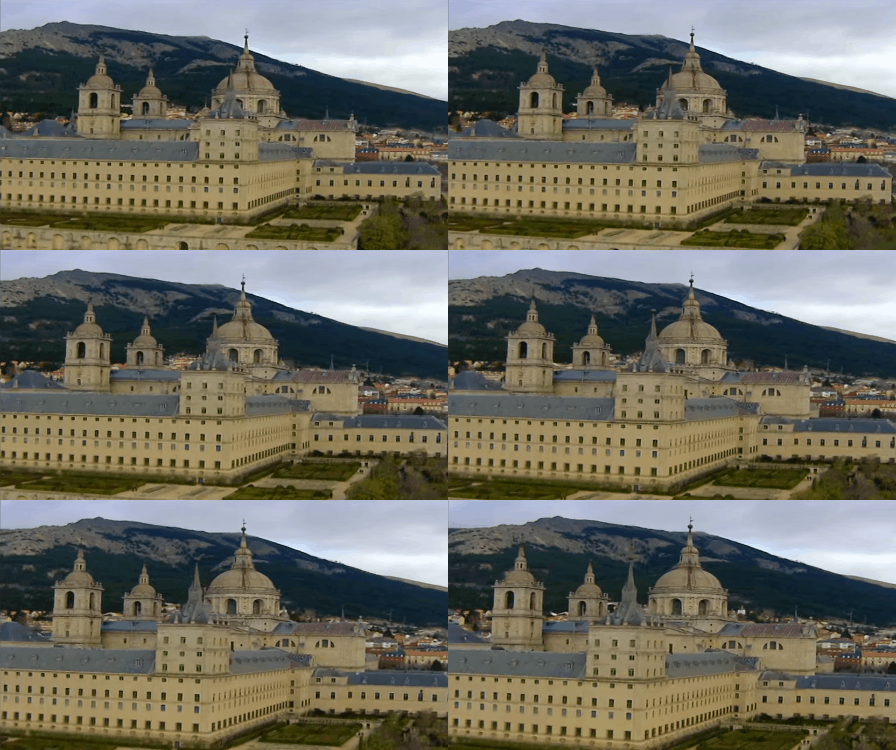
Maximilian created a strong link of business with the Fugger family from Augsburg. It was the money of the Fugger bankers that moved all the warfare of Maximilian I. But what about Charles V? During Charles V’s period, from the start the ritual of requesting loans to the Fuggers continued. The Burgundian Habsburg thought that Castile-Aragon crowns were swimming in gold bullion coming from America. It wasn´t until the mandate of Philip II (the son of Charles V) that we could see consistent accumulated wealth coming from America´s silver extraction. This is the money that helped the Spanish Habsburgs not only to construct The Escorial (built between 1563 and 1584) but to make the monumental palaces and government institutions in the Viceroyalties of New Spain, Peru, and the rest of Audiencias of the New World.
To be continued…
Announcement.
Next Friday 22nd of November, we will continue with Episode 8 “Charles V: His Local, Personal and Religious Agenda”. Our next chapter will include the rest of the chronology about the life of Charles V between 1535 to his death in 1558, but we will discuss how the Emperor performed for the benefit of his most beloved successors. In the meantime, we hope that you can think about our observations written today, ask yourself questions, and be confident that history sometimes is not what is “officially written”.
Musical Section.
Our selection of music during this saga will be fitted with songs and concerts that could have been listed on the most important Billboard during the 16th century. Today, we have chosen a collection of 21 pieces directed by Jordi Savall, from the CD “Carlos V. Mille Regretz: La Cancion Del Emperador”. The album was recorded at the Colegiata del Castillo de Cardona, Catalonia.
Thank you for reading http://www.eleonoraescalantestrategy.com. It is a privilege to learn. Blessings.

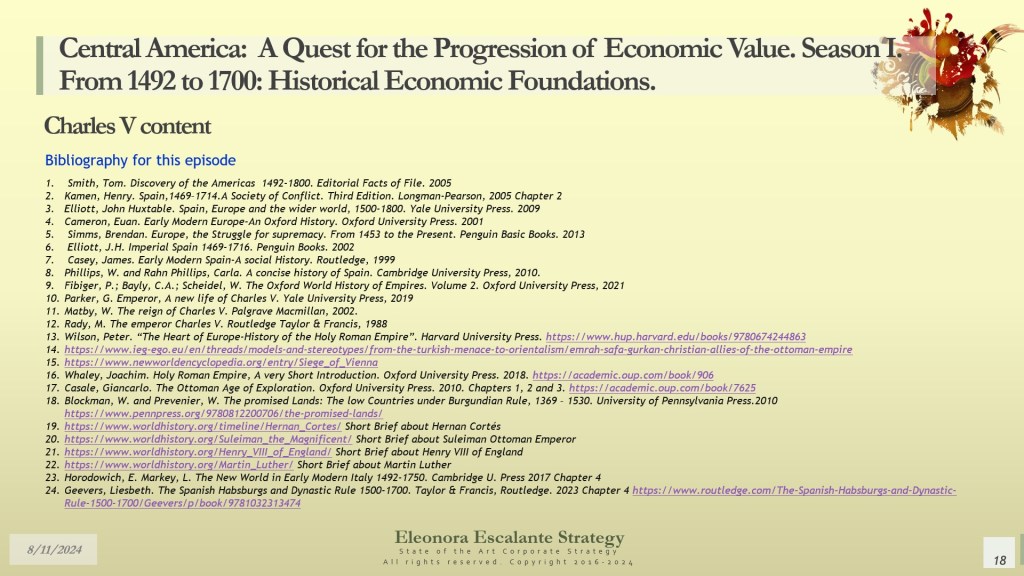
Sources of reference and Bibliography utilized today. Shown in the set of slides.
Disclaimer: Eleonora Escalante paints Illustrations in Watercolor. Other types of illustrations or videos (which are not mine) are used for educational purposes ONLY. All are used as Illustrative and non-commercial images. Utilized only informatively for the public good. Nevertheless, most of this blog’s pictures, images, or videos are not mine. I do not own any of the lovely photos or images unless otherwise stated.
 Eleonora Escalante Strategy - Strategic Reflections Think Tank