
Central America: A quest for the progression of economic value. Episode 11. Charles V: His Religious Agenda.
What can I write about Charles V Emperor in terms of his religious agenda, after everything has been unfolded in front of your eyes?
After our last two episodes of the Spanish Inquisition, we expect that all our readers and students have understood the tough religious context in which Charles V emperor was forced to complete the corporate strategy of his mandate. In medieval times, with Christian rulers, nothing was accomplished without the defense of Christendom and the expansion of Catholicism. It is not possible to study the historical context of the Middle Ages in its transition to Early Modern times; without considering the significance of the Papacy and religious authority, feudalism, the Holy Roman Empire, and the different inquisitions that were designed to align populations and rulers in one single religion (Catholicism), the backbone of the societies cultures, values and traditions.
Illustrative and non-commercial GIF image. Used for educational purposes. It’s been used only informatively for the public good. Source: Public Domain
Just put yourself in the shoes of Charles V Emperor (in Germany), identified as Charles I (in Iberian Kingdoms). This man was born to be considered the Messiah, the Plus Ultra, and the highest defender of Christendom on earth. His court was designed to fulfill the mandate of his grandfather Maximilian. This is not only a weight of colossal proportions for any child, but in the case of Charles, if we trust that he was an orphan, it meant a different whole story. Even if his aunt Margaret Habsburg did all she could to offer all the required Burgundian religious traditions and cultural ordinances, all the essential education for a future emperor (which indeed she did); it is hard to know at that moment in time, how difficult was for Charles to develop his personality, his religious allure, without the guidance of his mother Joanna and the direction of his Burgundian father, Philip the Handsome. The only family masculine role model that our Emperor Charles V had was the one represented by his grandfather Maximilian I. His other grandfather (Ferdinand II) is not named in Charles’s formative years.
As usual, we are sharing our framework of reference in the following slides. Feel free to download, and share them with your friends, colleagues, or classmates. We always encourage you to print the material, read it consciously, and write notes or questions. Please print this material, and build a file with all our slides. You don´t know when you will need them. Visit our bibliography listed on the last slides on the Internet.


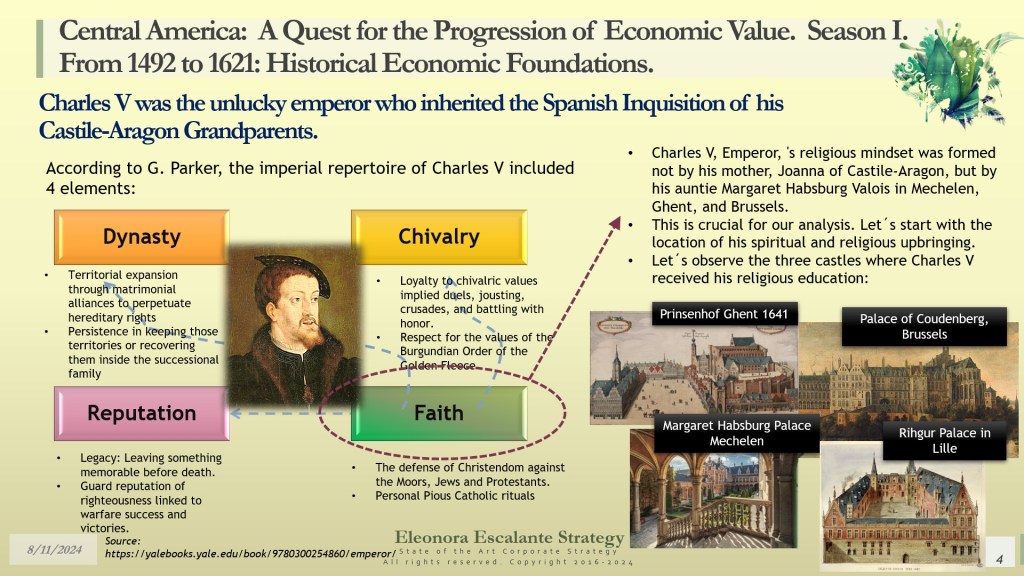

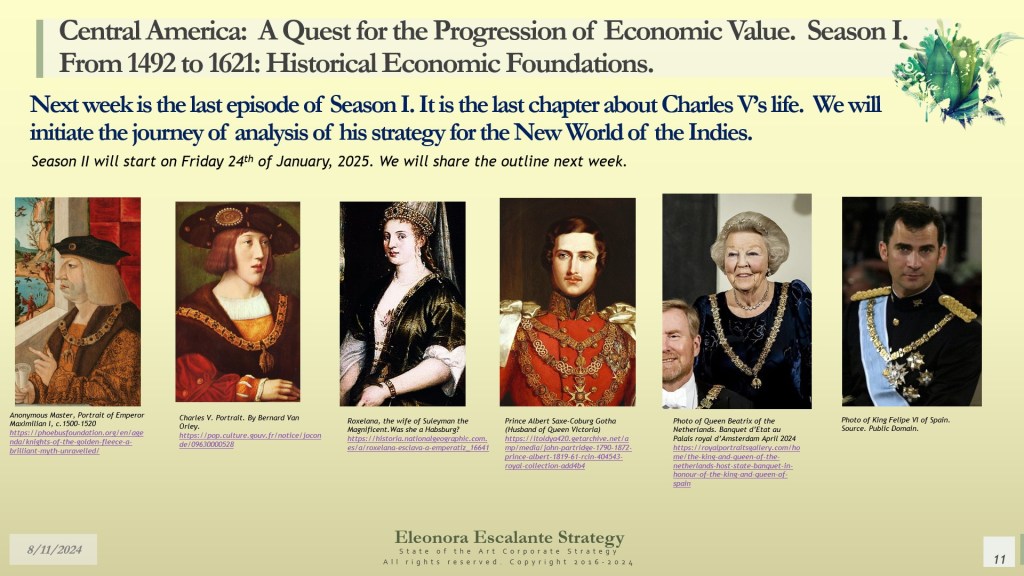

In consequence, it was foolish to be raised as a Burgundian Habsburg, without the crucial connections to Castile and Aragon. Maximilian I´s religious mindset plus the traditions of Margaret Habsburg (a two-time widow, first from John of Castile-Aragon and later from Philibert of Savoy), were deeply ingrained in Charles V’s mentality and comprehension of the world. His childhood and youth were spent in between the Castles of the Burgundian Valois: Prinsenhof, Coudenberg, Rihour-Lille, and the Hof van Savoye Castle at Mechelen, the court of Margaret, his aunt. These were the places where he received education from Spanish and Dutch tutors. He was the head of the knight elite order of the Golden Fleece, and his life as a Burgundian had nothing in common with what was expected of him in Spain.
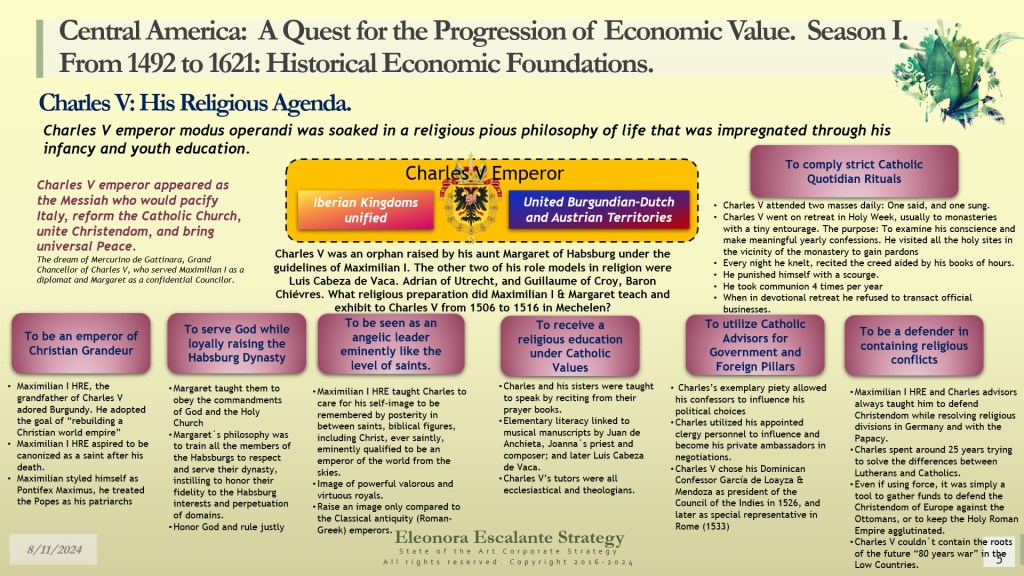
Charles’s religious education was transmitted from his aunt Margaret of Habsburg and his tutors as role models. He was taught not just to comply with the daily rituals of prayers and mass attendance, but he also saw and interacted in a Court institution that was designed and prepared by Maximilian I for his cognitive and cultural development. We have prepared slide number 5, which summarizes the 7 elements of Charles V’s religious upbringing under Burgundian and Habsburg terms:
- To be an emperor of Christian grandeur
- To serve God while loyally raising the Habsburg Dynasty
- To be seen as an angelic leader eminently like the level of saints
- To receive a religious education under Catholic values
- To utilize Catholic advisors for Government and as his Foreign Diplomatic Pillars
- To be a defender in religious conflicts
- To comply with strict Catholic Quotidian Rituals.
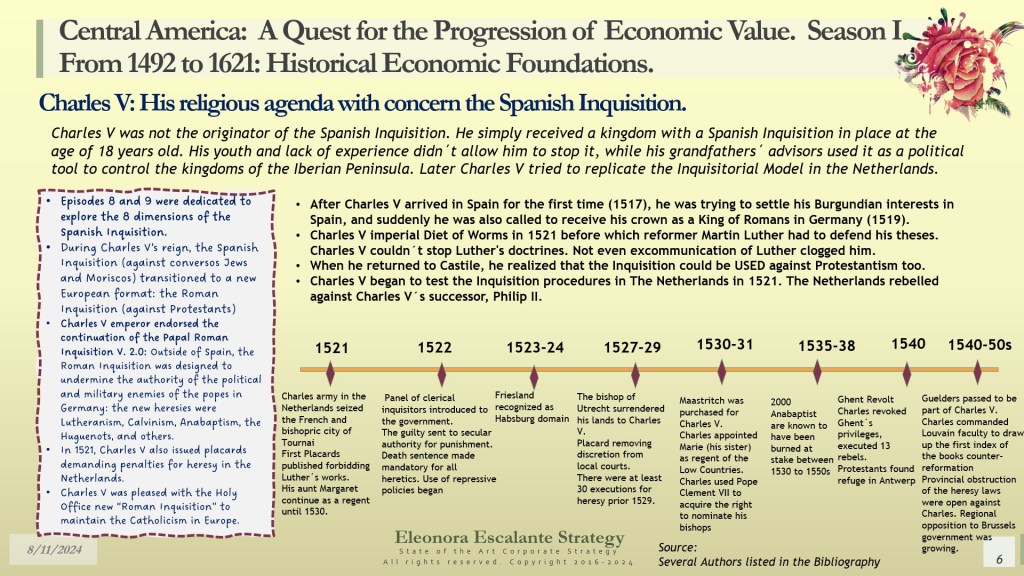
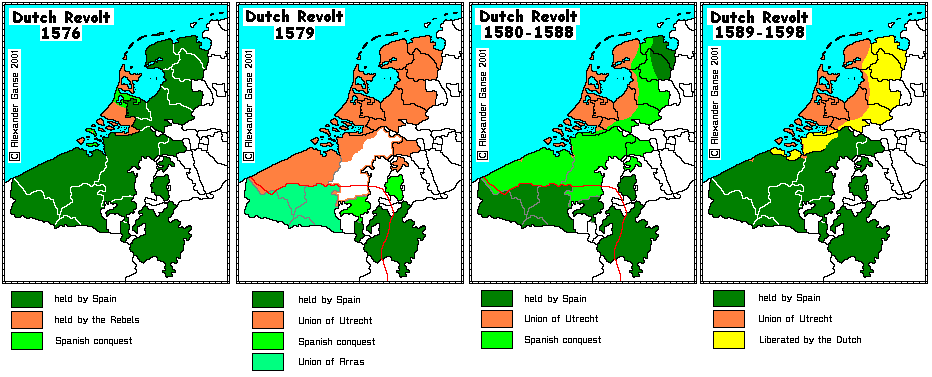
How do you not disseminate the wrong policies to other countries? Then in slide 6, we recap how Charles V (with the help of his advisors) transferred the model of the Spanish Inquisition (created with a crusading spirit) to fight Protestantism in the rest of Europe, particularly when he assessed it in the Burgundian Netherlands. This was a mistake of appalling consequences that affected the rest of the successors of Charles V (Philips II, III, and IV) during their future mandates. The Eighty Years’ War was the result of the religious, economic, and fiscal wrong measures ordered by Spain against the Low-Countries. The United Provinces fought between 1568 to 1648 to gain its independence from Spain. Despite that, this conflict arose during the ruling period of King Philip II (1527-1598); the foundations of the war began with the discontent created by Charles V when he ordered to increase the inquisitorial methods against protestant heresy in the Netherlands as of 1550: more burnings, men were beheaded, women drowned and the unrepentant or relapsed were burned at stake. This inquisitorial transference of Spanish crusading policies against the Protestants in the United Provinces provoked a deep opposition to the Habsburgs. Most of the noble and intellectual elite switched to Calvinism at that time. The most relevant nobility and aristocratic knights from the Burgundian territories decided to move forward with the “Netherlands Revolt”. Later, it converted into a confessional war that divided the Netherlands into two sections: the Catholic Union of Arras in the South (as of 1579), called later Spanish Netherlands; and the Protestant United Provinces of Utrecht in the north. The seven united Provinces of Utrecht became the refuge to all the European intellectually persecuted inhabitants and the sanctuary for the victimized merchants.
Charles V was a failure when overseeing Protestantism in the Holy Roman Empire.
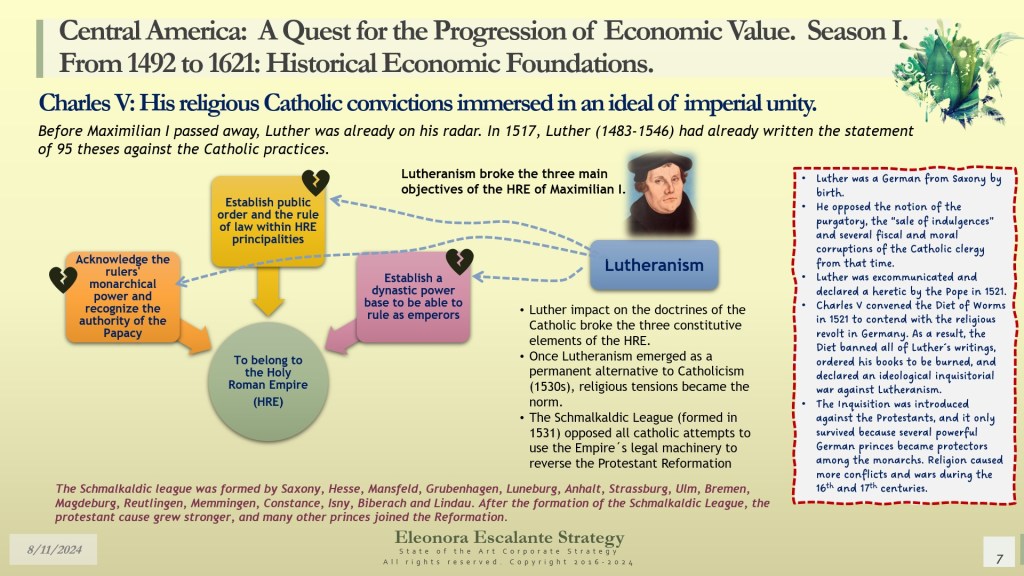
According to official historians, Luther’s convictions were nothing inappropriate. He wrote his 95 theses as a Catholic Priest who observed the excesses and corrupted vices of the Catholic Church. But the world of Charles V was extremely intolerant although even Charles V wanted a reform of the Catholic Church before then. Charles failed to ignore his inner voice of creating and pushing for the Holy Roman Empire reform and the reformation of the Catholic Church from the inside out. Instead, Charles took the Spanish Inquisition and transplanted it to persecute protestants in other regions of Europe, and he used it against the Burgundian Dutch too, part of his genetic blood roots were from there. It was offensive! I can´t believe that an Emperor who was raised as a Burgundian-Dutch decided to use torture and terror to tame his birthland. And that was the worst mistake of his life. Slide number 7 shows how Luther crushed the three main objectives of Maximilian I Holy Roman Empire. Frederick III the Wise, protected Luther, not just as an elector of Saxony who worked for constitutional reform of the Holy Roman Empire; but as an indirect helper to contain the religious crisis that Charles V was facing. (See slide 8).
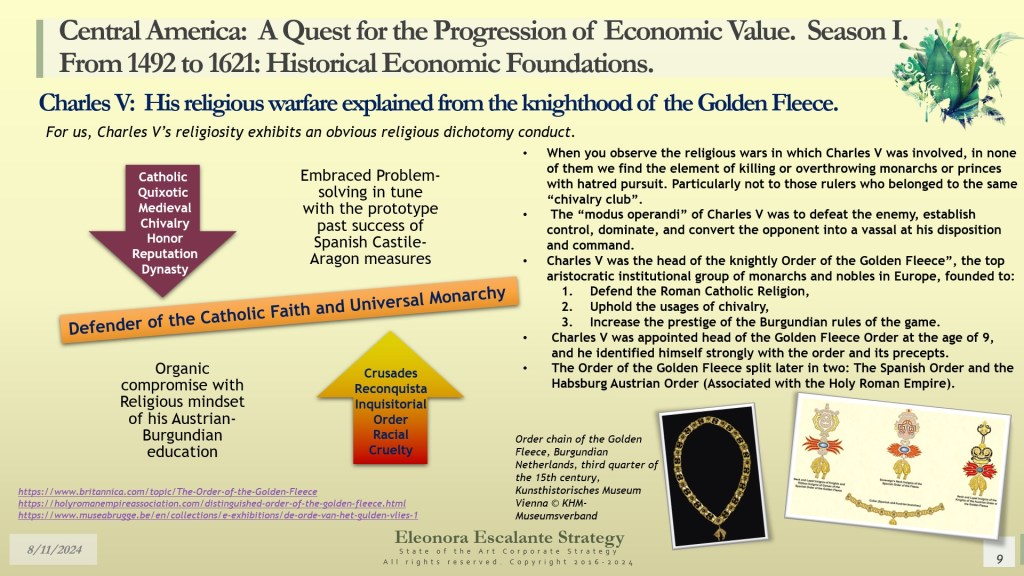
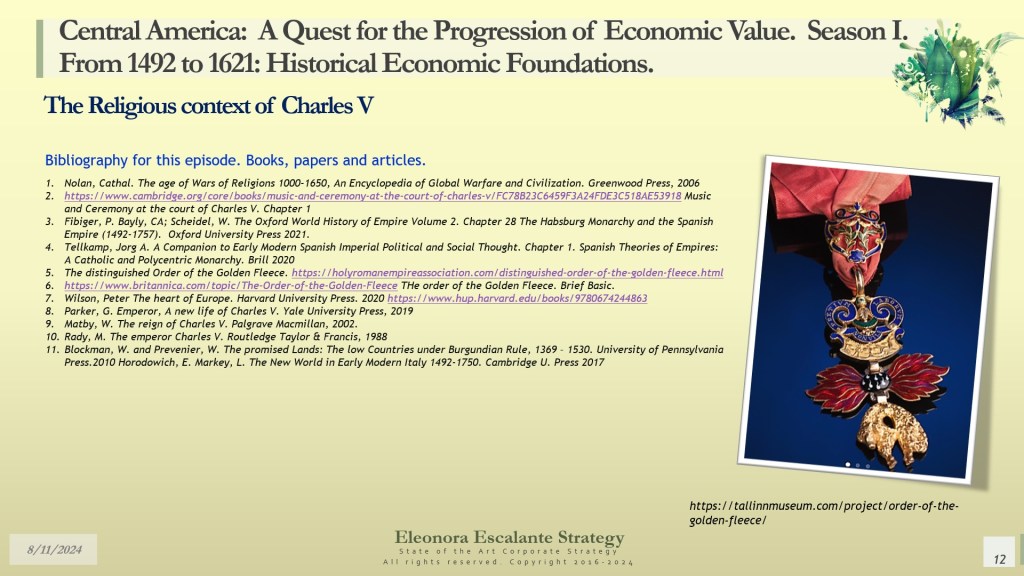
Charles V’s religious decision-making is explained by the knighthood of the Golden Fleece.
See slide 9.
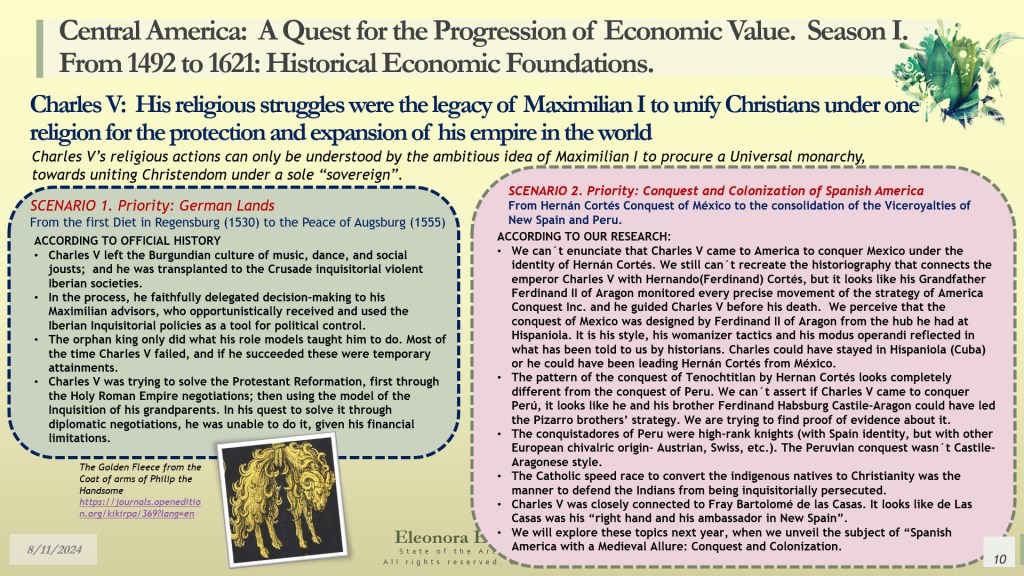
Additionally, we have prepared a strategic analysis of the Charles V religious dichotomy conduct. It can only be understood if we see the divergent frameworks of problem-solving and their remarkable shocking implications in Charles V´s decision-making. Our emperor was raised in a Catholic quixotic medieval chivalry environment, where honor, reputation, faith, and dynastic matrimonial arrangements were crucial and the priority to comply with the values of the knightly order of the Golden Fleece. This was his Burgundian organic compromise with God. On the other extreme, Charles V was forced to go to work in Castile and Aragon, a region of more than 700 years of conflicts and violence, where the spirit of Reconquista, and cruel inquisitorial procedures were utilized to provoke terror in the populations to install order and racial “cleansing” of the blood from its contamination with Jews and Muslims. On top, the Dutch Advisors that Maximilian I attached to Charles V were not the right match to help the Emperor in their quest to keep all the troubles of Europe and the New World.
Alternatively, we suggest a new historical scenario for the life of Charles V. See slide 10.
Increasingly we are studying and researching a new scenario for the life of Charles V. We comprehend that historians have framed us according to what they have gathered as official documents. But there are a lot of missing connections in the Emperor’s life. We can´t see him staying in Europe, while Spanish America was conquered by an elite of knights who were doing cruel things written by Bartolomé de las Casas. We genuinely believe that De las Casas was the “right hand” of emperor Charles V in America. We encourage you to read our detailed probable scenario on slide 10 for your consideration.
To be continued…
Announcement.
Next Friday 27th of December is our last episode of Season I. We truly wish you a fantastic Christmas time and delicious celebrations with your loved ones. Next year, during January, we will take three weeks of vacation for our strategic mindset maintenance. Season II of the saga “Central America: A Quest for the Progression of Economic Value” will begin as of Friday 24th of January, 2025. Season II will be shaped first with 4 weeks about the topic “Spanish America with a Medieval Allure: Conquest and Colonization”. I will share the new updated outline of Saga II before the end of this year. Do not lose sight, please! There is a lot of learning coming for all of us next year. Stay tuned.
Musical Section.
Our selection of music during this saga will be fitted with songs and concerts that could have been listed on the most important Billboard during the 16th century. Today, we have selected the collection of songs from the 16th-century masters of the Spanish vihuela, interpreted in the 21st century through the modern guitar of Giuseppe Chiaramonte. Composer: Luys Milán & Luys de Narváez Artists: Giuseppe Chiaramonte (guitar). Music from Brilliant Classics YouTube channel. Beautiful melodic and harmonic compositions!
Thank you for reading http://www.eleonoraescalantestrategy.com. It is a privilege to learn. Blessings.

Sources of reference and Bibliography utilized today. From this text are below. The rest are shown in the set of slides.
Disclaimer: Eleonora Escalante paints Illustrations in Watercolor. Other types of illustrations or videos (which are not mine) are used for educational purposes ONLY. All are used as Illustrative and non-commercial images. Utilized only informatively for the public good. Nevertheless, most of this blog’s pictures, images, or videos are not mine. I do not own any of the lovely photos or images unless otherwise stated.
 Eleonora Escalante Strategy - Strategic Reflections Think Tank