
Central America: A quest for the progression of economic value. Season II. Episode 1. Ouverture
The year 2025 embraced us with courage and hope.
Happy new year for all of you. Today, we are overjoyed to begin our first saga of the year. Season II of “Central America: A Quest for the Progression of Economic Value” is the essence of our annual labor since October last year. We are digging tunnels and connecting knowledge to understand the truth about the foundations of Spanish America’s economic development. If you are a new reader to http://www.eleonoraescalantestrategy.com, we recommend you to read the season I of this saga, otherwise it will be hard for you to get the appropriate vinculation of our research.
During the 16th century, the rulers of the nascent “plus ultra” Spanish Empire cursed but at the same time consecrated the Catholic financial and economic foundation, settlement, and occupation of the new territories under Iberian domains. This process was undoubtedly followed by each of the successors of Habsburgs´ (and later Bourbon) administrations. It was a Catholic Social and Economic Order organically designed and transplanted to the new discovered lands from Iberia & Holy Roman Empire domains in European territories. The Iberian lands held innumerable corporate strategic issues because the Peninsula wasn´t a congruent state but a recently weak glued alliance between the Aragon, Castile, Portugal, the Papal States, and its extensions all over Europe and Asia. The Holy Roman Catholic Church was the ideological-cultural pillar of the colonization of Spanish America, while the military knights or mercenaries from the orders of Calatrava, Alcantara, Santiago, and Montesa under direct submission to the Ruler of Spain, were the unequivocal perpetrators of the conquest. These specialized conquistador knights may have been related genetically to the monarchs or not. Now that you have read the last paragraph and compare it with a typical historian chronicle or book from our sources of reference, are you starting to cognize the abysmal contrast between the “official history” and our inferences, don´t you agree?

The beauty of a detailed comparative review of “official history” is that we bump into a series of blurred or inconsistent data (information) from various authors. Sometimes I believe these mishaps or holes were left on purpose by the scholars, so any of the next generation round of researchers could solve the puzzle written in encrypted language, with all the hints or clues included. Why did historians conceal the truth for 500 years? The answer is clear: they were at risk of perishing with the cultural inquisitorial terror practices imposed by the madness of the rulers of each of their life spans. We come from inquisitorial horrendous dreadful practices, transferred from Hispania to all over the Habsburg-Castile-Aragon world for centuries. These practices were the norm of “savoir vivre” and have been around to this day. Moreover, it looks like those Spaniards who witnessed the reality were experts in covering certain facts that were veiled and buried on purpose. First, for the sake of keeping the Empire’s real strategy away from their organic foes; and second to protect their lives. Additionally, it is amusing for us to discover that most of the historians with excellent intellectual production were not of Spanish origin, but British, Dutch, or from the Middle East, most of them with a background of studies in the United Kingdom. For us, it looks like reality is quite straightforward, and we have tried to follow the shadowy symbols left by those historians who have tried to tell us the truth in a concealed non-explicit way. Eleonora Escalante Strategy is committed to providing some new hints of truth about it. I do not promise to find the whole truth, but at least provide a few guidelines for new research agendas that can be followed by the new historians of the 21st century. “For there is nothing hidden that will not be disclosed and nothing secret that will not be known and come out into the open”. Luke 8:17.
In our quest to find the truth, we have already identified multiple patchy and/or irreconcilable texts, just by studying the life of Charles V, the initial decades in which the Conquest and first rounds of Colonization took place. Nevertheless, what occurred after Charles V died, was not his fault either. And at the end of this saga, you will understand why.
Spanish America triggered the state formation of Spain under the Habsburgs from 1516 to 1700.
The rationale of the state formation of Spain wasn´t led by the spirit of setting the peninsula territories and then leading a huge continent outside of it. It was the discovery of America that triggered the enormous desire to give birth to Spain (with Spanish-American lands included as the starting point). Hispania took shape because the New World pushed for it. It was Spanish America’s existence that forced the state formation of Spain (Only geographically separated by the immense Atlantic Ocean).
I will reiterate this because the notion of the last paragraph is the core message of this introduction: We need to reframe our minds to read Season II of this saga. We can´t see Spanish America as a fragmented group of nations as it is currently geographically segmented. For the time being forget that the whole region below had independence movements. Simply see the region as a united land, please.
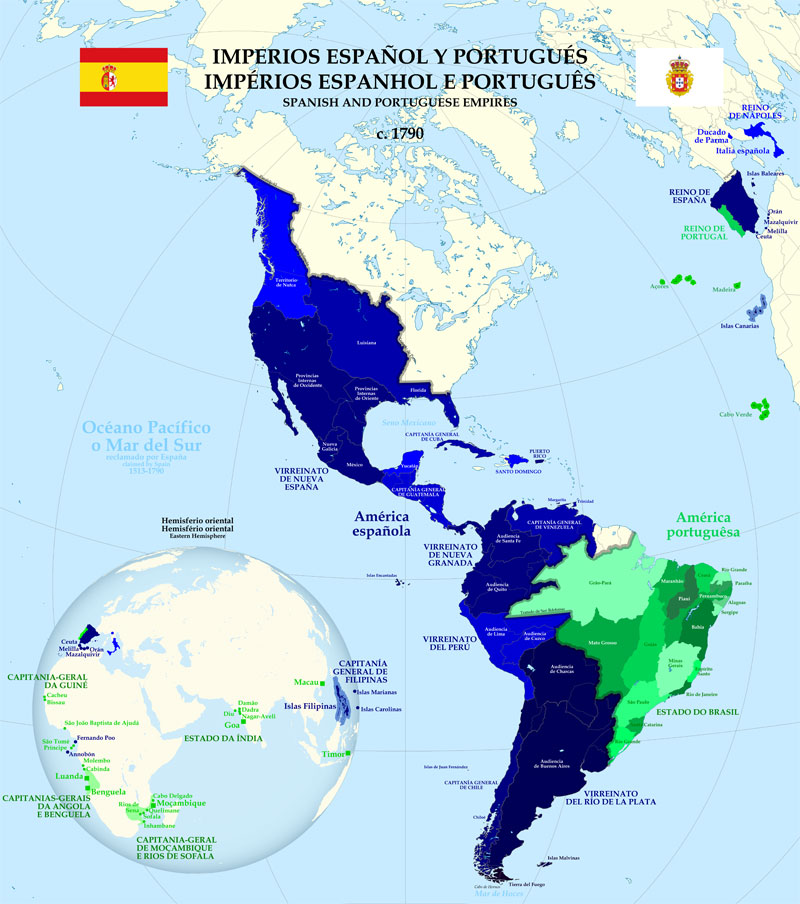
Who were the ultimate responsible leaders of the conquest and colonization of Spanish America?
Do you think it was Charles V representing the Burgundian Austrians and the Dutch?. Or can you consider the Italian Pope and his allies? Were the Aragonese knights from the Military Orders of King Ferdinand II who were residing in Hispaniola? Or what about Maximilian I who managed to organize all the court who belonged to his son Philip I? What about the Avis dynasty from Portugal? Each of these parties was busy in Asia (dealing with the East Indies), keeping the Protestant German Kingdoms out of sight, maintaining the Ottomans engaged with conflicts in the Balkan Territories, or building imperial marriages that could provide a competitive advantage in the future. Additionally, it was during the 16th century that most of the naval warfare began, and here we can mention the Anglo-Dutch wars between 1625 to 1784. The British were preparing to take North America by storm, while the French were doing the same in what today is Canada. Three additional religious wars demonstrate this hypothesis: The Thirteen Years War (1593-1606), the Thirty Years War (1618-1648), and the Eighty Years War (1568-1648). For some periods, it looks like the Castile-Aragonese wanted to push the Dutch aside, but they were already tied to Britain by royal alliances. We also need to add innumerable conflicts between Catholic and Protestant kingdoms. Would you mind thinking that it could be possible that so many wars were crucially invented as a defensive strategy to keep the rest of the Empires away from the Spanish new paradise lands in America?
As a corporate strategist, we are taking the risk of sharing possible scenarios about the conquest and colonization of America that might change the understanding of our region. The new lands of America were the core endeavor project designed for HRE Charles V by King Ferdinand II of Aragon in juxtaposition to the global expansion plan of Emperor Maximilian I of Austria. Charles V (the orphan king) obeyed initially what was taught to him as AEIOU. He had no choice, it was his inherited job. He had to perform the plan of Maximilian I, carried by the advisors of his father King Philip I (the husband of Joanna the Mad). But something happened to him in the decade of 1520s, that coincided when he married Isabella Avis of Portugal. We perceive that Charles V reacted against Maximilian original plans, and he changed this strategy little by little. We believe that Charles V realized that Castile-Aragon America was by far more important than his original mandate with the Burgundian-Austrian program. Charles V was doing a job for his family in America, not in Europe. He married Isabella Avis of Portugal because his priority was America, not Jerusalem, not Asia, not the German Nations, not the Dutch Burgundians of his childhood Golden Fleece. But at the same time we also have found that Charles V fractured the European Medieval system. Why?
Was Conquest America Inc. the cause for breaking the Medieval world? The emergence of the “ Real and Supremo Consejo de Indias” or Council of The Indies may validate this. Charles V established this Council because it was his priority to govern it. Charles V left this project and established it as of the highest significance for further administrations. This project wasn´t fortuity, and it wasn´t a casual move. And even if we confirm as true that Columbus discovered Hispaniola and the Atlantic Coast of Central America by mistake, we have already commented that between 1492 to 1516 (the year of Ferdinand II of Aragon’s death), there were enough years to find out that the new continent of America was vast and greater than the Caribbean Islands. The New World was called the “West Indies,” because the word “Indies” was the existing mental cognition framework of expansion to the East, and it was the buzzword transferred to baptize America.
Conquest America Inc. seems like the current MNCs (Multinational Corporations). But originally it wasn´t designed as such. For our mindset of today, it is logical to think like that. But the reality is that the theory of “raw-materials extraction” wasn´t even conceived as such in the times of Charles V. It wasn´t seen as that in the 16th and 17th centuries. Moreover, anyone who investigates and writes about the period of “Conquest America Inc.” is driven by its place of birth, and this bias has to be removed. It is not the same to see Spanish America from the point of view of a Latin American citizen, with a post-independence mentality; as to perceive it as a Spanish citizen located on the Peninsula; or to study it from the point of view of the British historians or the Dutch or the Genoese/Venetians. Moreover, it is also not the same if you watch it from the vision of the German or Austrian studious historian philosophers either. We have tried to put ourselves in the shoes of the Spanish Habsburgs: Spain was the newcomer nation (Portugal+Castile+Aragon+Spanish America) under a compact nascent strategic alliance with the Austrian Dutch Habsburgs. This strategic alliance was envisaged and decided by Maximilian I during the 15th century. With it, the fate of Spanish America was also decided.
At the geopolitical sociological level, despite the Independence movements during the Bourbon era, Spanish American culture remained as part of “La Madre Patria”. Moreover, the French Revolution (against a Bourbon-Habsburg king) is not separated from the Independence Take Over of America. We suggest that the ideological responsible for the French Revolution were those who led the Independence movements of the 1820s in the new land of Spain located in the Atlantic. We will discover who were they during Season III.
Purpose, Philosophy, Rationale, and Objectives of Season II.
We have prepared the next document that explains in detail the purpose, the content of each episode per day of publication, the philosophy, the rationale, and the specific objectives of Season II. We truly expect to keep our schedule this time. Season I was an exception (as you already know, I was dealing with my broken foot recovery process). We encourage you to print the attached slides and read each section of our material thoroughly. Feel free to pass them on, share them, and discuss them with your colleagues, peers, or friends.
The importance of printing each of our Master Class documents only reflects our love for your brain empowerment. Paper matters when it comes to learning, regardless of your age or expertise when reading. We wish to contribute to your cognitive improvement by recommending printing the slides below. Keep them in a file for your future reference.

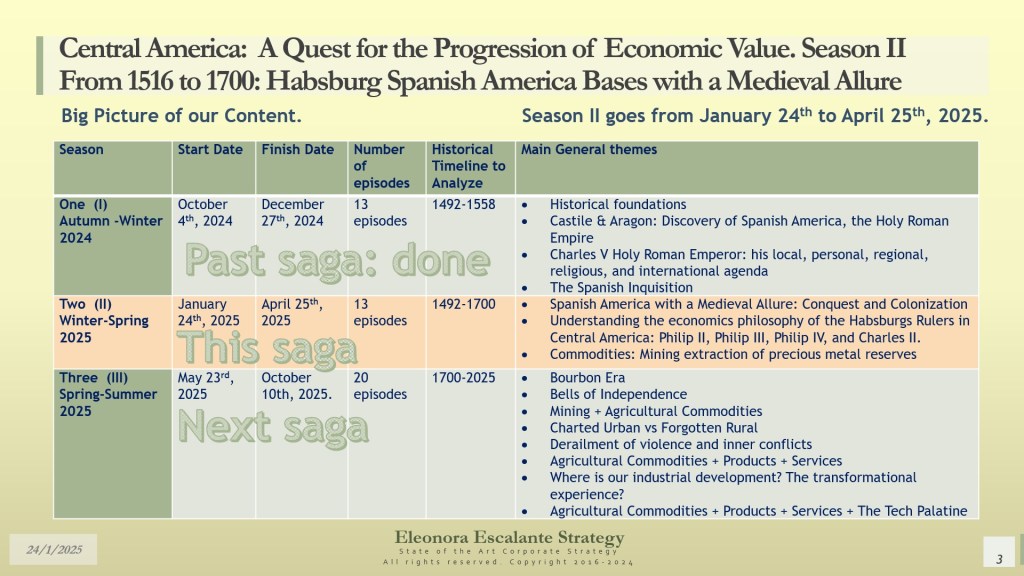
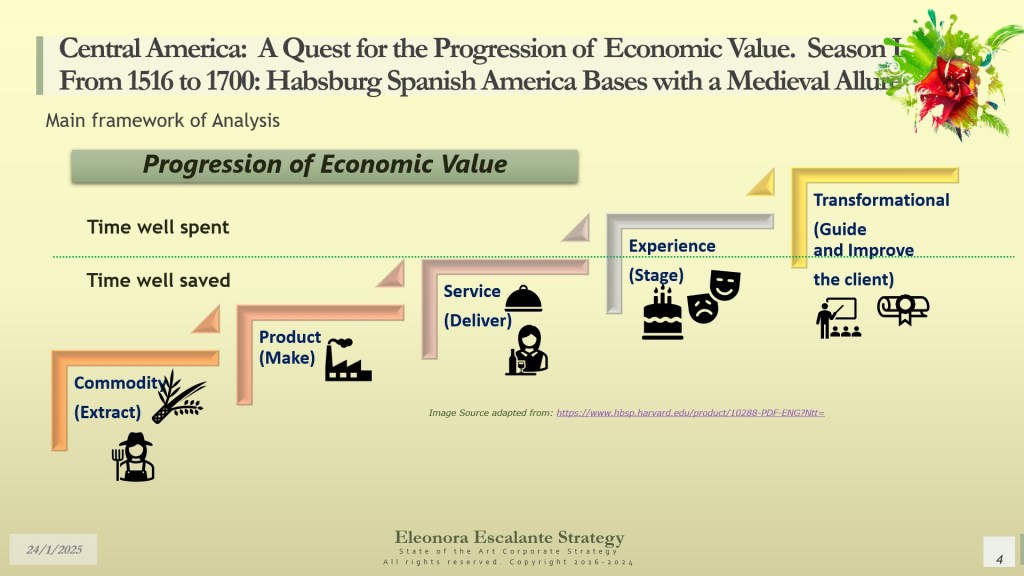
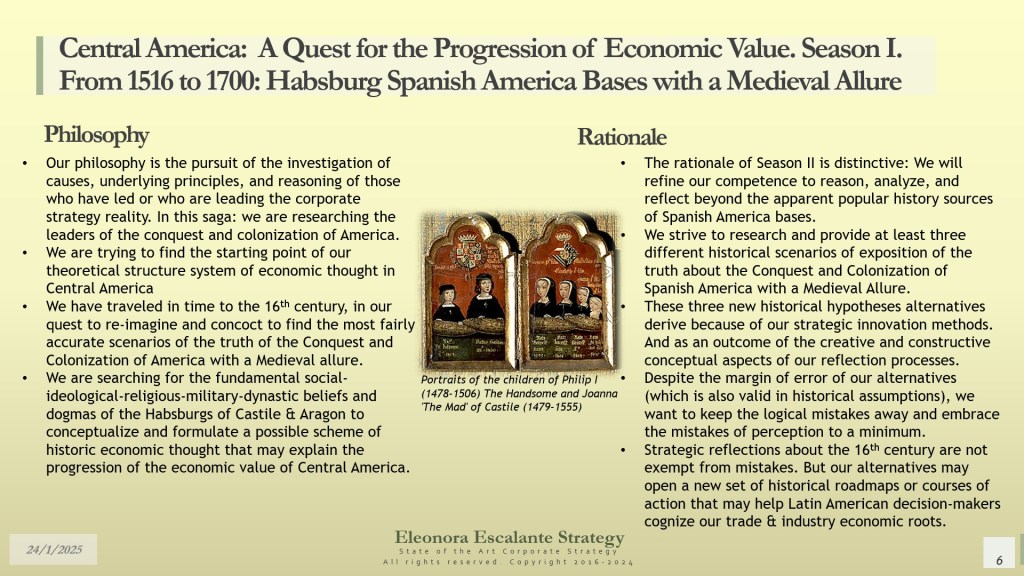
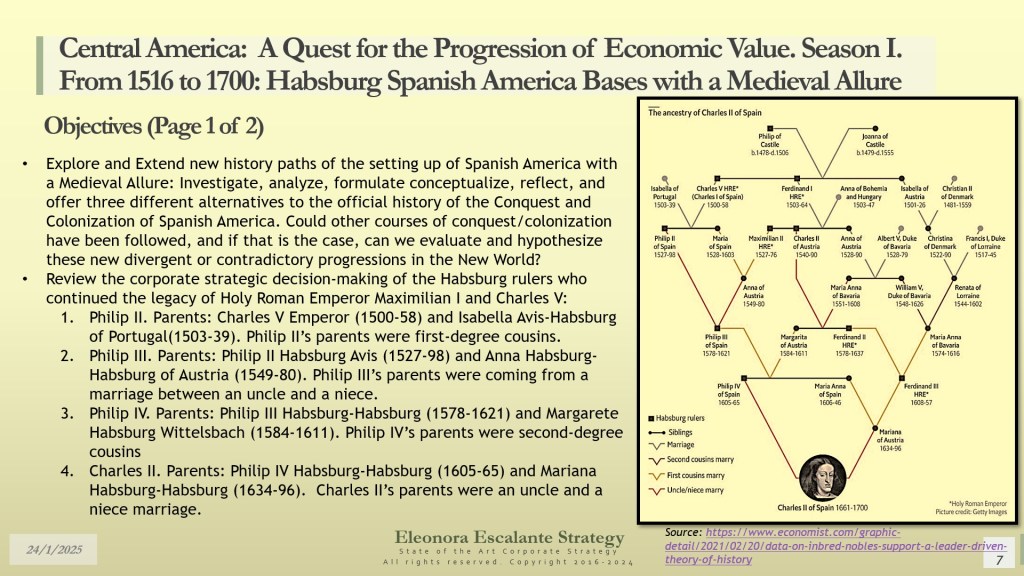
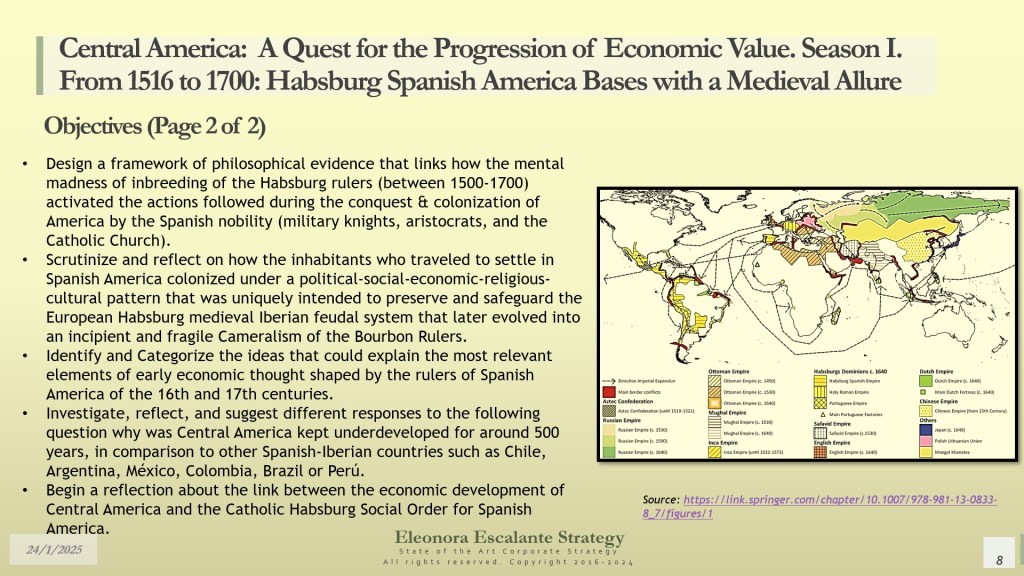
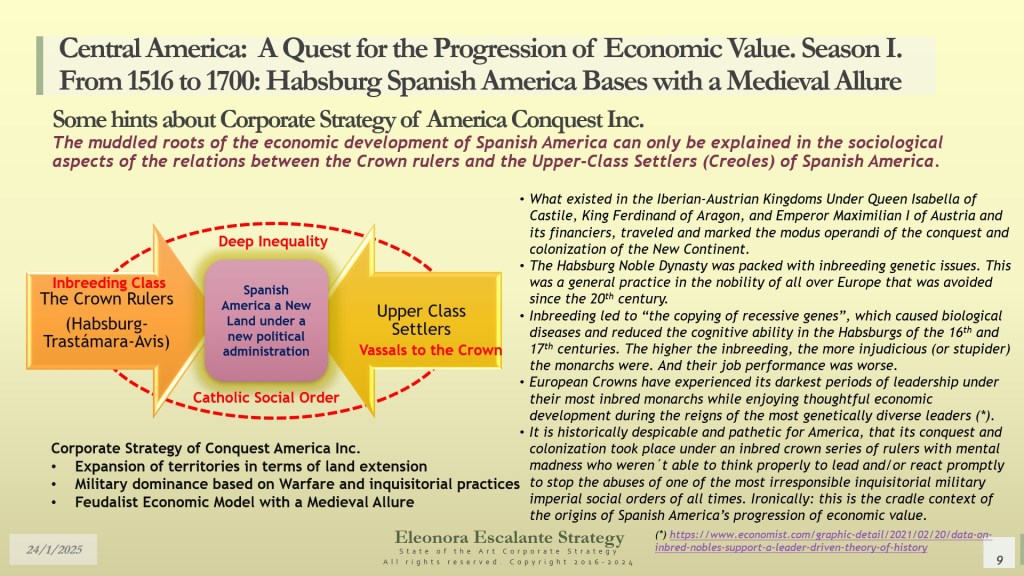
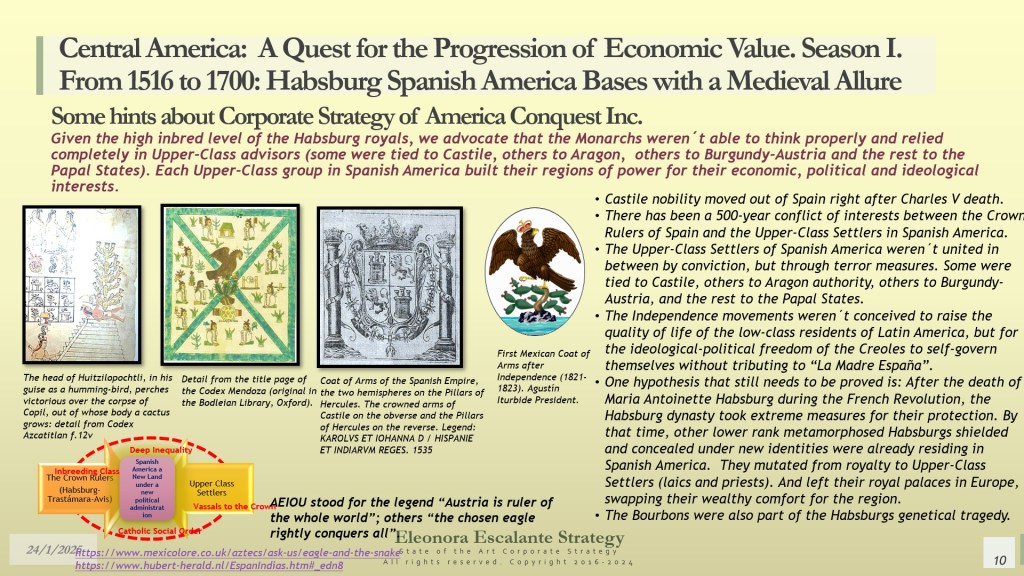


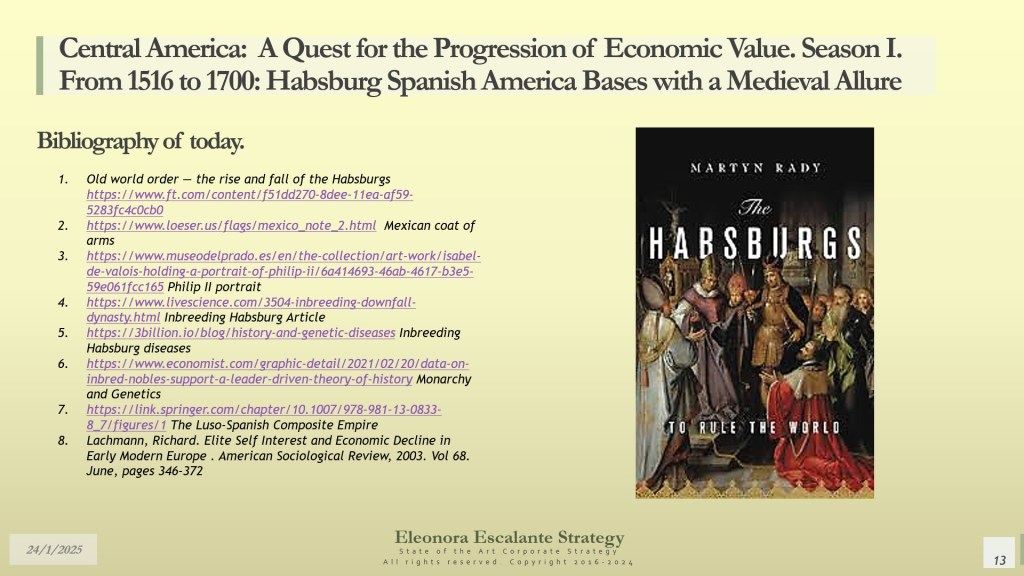

The next four episodes will be fully dedicated to exploring and extending three historic alternative paths of what happened during the conquest and colonization of America. We have envisioned three different scenarios, developing a comparative overview of official history versus each of the three hypotheses of what may have occurred under the mandate of Charles V Holy Roman Emperor with Conquest America Inc. We will show you three hypotheses about how the superstructure of decision makers of the Habsburg-Trastámara (Castile-Aragon) dynasty came to conquer and colonize America, and how these dynastic groups fought in between and at the same time kept themselves tied and united by genetical reasons over all these years.
The worth of finding the truth about Spanish-American roots doesn´t denote a sensational drama chattering. Its relevance concerns us because if reality has been hidden, that means something truly dreadful and upsetting (such as the Holocaust of Jews during WWII) struck or at least it was beneficial to keep it in secret. The Spaniards are experts in hiding things given the strategic terror of their inquisitorial culture. In the aftermath of the conquest, certain political moves have a substantial responsibility magnitude to our days. The economic decisions of the past have messed up the world, and we are entitled to correct it. If we don´t do it, the next high-tech work dynamics in the future will continue replicating the AEIOU imperialism and the expansionist replications of the powers not involved in the block of those who discovered and conquered America.
A framework of the conquest and colonization of Spanish America.
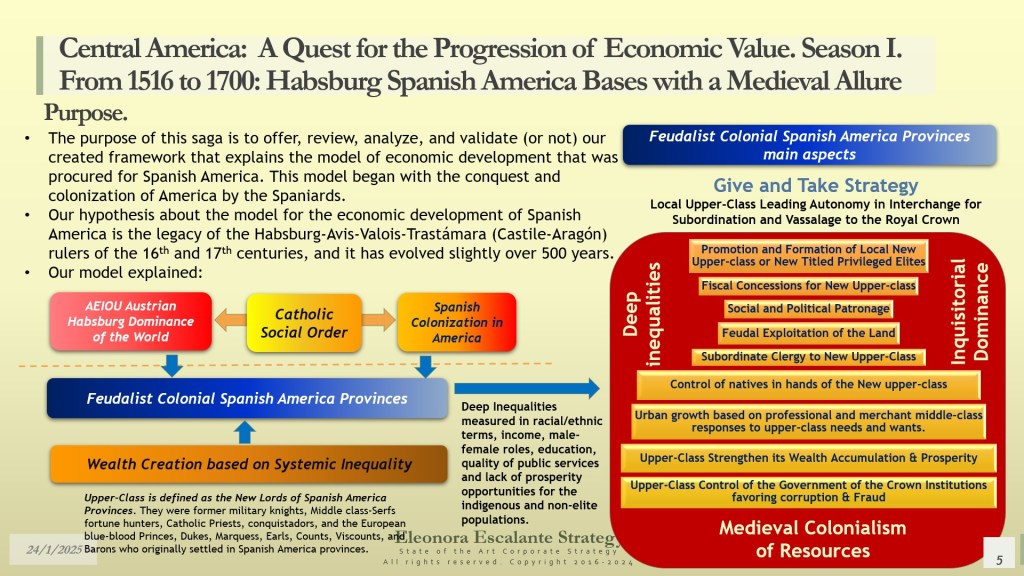
Our framework for understanding the conquest and colonization of the new lands in America is built from a philosophical-sociological and political control point of view. You can find it in slide 5. The economic foundations for wealth and prosperity of the 16th century were measured in terms of territorial land extension through warfare and agricultural and mining production for minting or for paying war armies. Most of the rulers of Medieval European polities or kingdoms understood that land and having enough people for war were the two key variables for development. Spanish America was the newly founded land, which required to be in control of Spain Monarchs, under a Catholic Social Order that kept the Crown Rulers and the Upper Class Settlers in the new world in a dynamic equilibrium. The Upper-Class Settlers are defined as Elites by several scholars. We have defined the Upper-Class settlers as the New Lords of Spanish America Provinces. They were former military knights, Iberian vassals fortune hunters, Catholic Priests, Conquistadors, and the European blue-blood Princes, Dukes, Marquess, Earls, Counts, Viscounts, and Barons who originally settled in Spanish American provinces. Regardless if the nobility coming to America were Nobles of the sword-(knights, mercenaries, or military order members) or were nobles of the robe (government officers) and/or blue-blood aristocrats linked to the royals, the colonization and further economic development of Spanish America can only be understood within the sociological aspects of the former relations between the Crown Rulers (and its respective advisors) and the Upper-Class Settlers in the new territories.
Where do we leave the pre-Hispanic people?
The prehispanic populations, or Indigenous (native, ethnical original populations of America) were most of the time ignored. Some of the Upper-Class Settlers coming to America did not considered them as humans or at the same level of human development as Europeans. This racial idea plus the inquisitorial methods against “non-Catholics” explain the “modus operandi” of the Conquest. In consequence, when the conquest occurred, the Spaniards acted accordingly. It doesn´t matter if the strategy utilized by the Spanish Conquistadors was inquisitorial or not, the objective was to take over the land, no matter who was living there, what the natives were doing or how were they functioning. The disappearance of the natives (using criminal methods or plagues) didn´t carry weight of importance for all the rulers of Europe. On the other hand, other Upper-Class Settlers linked to the Catholic Church in South America, considered the Indigenous as worthy and capable of shining high as much as any European if they had the opportunities and good quality of education.. If the native populations were not considered on the table, there is proof of evidence of it. Legally most of the pre-Hispanic inhabitants were not even citizens until after the French Revolution, most of them were seen as a source of labor, without any constitutional right. It was up to each of the Upper-Class Settlers to decide how to ignore or procure the well-being of the Indigenous at their service. Urban dwellers were mostly Creoles or anywhere in between the pure Spanish of the Peninsula and their mixtures. While the Rural tenants were workers to the Upper-Class settlers without registered property land.
If you study slide 5, you will be able to perceive that there are three emblematic powers at the top:
- The Austrian AEIOU Philosophical elite located in the epicenter of Religious conflicts in the heart of the German Nations, who had their imperial views on how to dominate the world,
- The Roman Catholic Church at the service of the Holy Roman Empire led by Austrian rulers and the Spanish crown, and
- The Spanish Castile-Aragon Perpetrators of the Conquest-Colonization of America.
The Catholic Social Order was part and serving the composite monarchies involved in the Spanish Empire, and a Feudalist Colonial Spanish-American system was the result of this tri-partite strategic alliance at the top. At the right of slide 5, you can glimpse what were the 9 most relevant aspects of the Feudalist Colonial Spanish America model. It was no dissimilar from what was happening in the Spanish Peninsula. What was streaming in Spain, traveled to America as a pandemic, and continued in the New Lands with one subtle main difference: In the new Spanish Provinces of America there weren´t protestants, there was an absolute Catholic Social Order, and there was enough land for repartimientos and encomiendas for any Spaniard who wanted to adventure himself/herself under submission to the Spanish or Portuguese Crowns. The nine aspects listed under the “Give and Take Strategy” between the Spanish Crown and the new Settlers of America have existed to this century, in almost an intact manner. The land of Spanish America was so green, beautiful, captivating, vast, and grandiose, that even if the realms were not producers of Gold and Silver, there was enough land for everyone, not just for the traditional upper class of Iberia.
From the point of view of corporate strategy, the project Conquest America Inc. had a detailed goal setting: to exercise power and control of the new territories, keep them under the Spanish domain, and defend all the Spanish domains shown in the titles inherited by Philip II (the son of Charles V Emperor). See slide 11, please. At least that is what the official history narrative has been taught to all of us. During this saga we will explore and analyze our model shown in Slide 5, and the relationships between the Spanish Crown and the Upper-Class Settlers in each of the Habsburg ruling periods of Philip II, Philip III, Philip IV, and finally Charles II. Once we finish the analysis of the different periods of the Habsburgs´ kings from Spain, we expect to close this saga with 4 weeks dedicated to Central America’s hidden colonization strategy. See slide number 2.
We are cheering our spirit to open and inaugurate our work of the year. Thank you and blessings for reading to eleonoraescalantestrategy.com
Announcement.
Next week we will kick off with the first chapter of the Conquest and Colonization analysis of Spanish America with a Medieval Allure. Episode two is coming. Stay tuned.
Musical Section.
Our selection of music during this saga will continue to explore adorable music produced between the 16th and 17th centuries. Season II will be dedicated only to one instrument in extinction for most of the young audiences: The lute. Our selection for today´s episode is from the YouTube channel Brilliant Classics. Five hours of Italian Lute compositions from the Renaissance and Baroque eras, performed by talented artists like Domenico Cerasani, Elliot Simpson, Ugo Nastrucci, and Sandro Volta.
Thank you for reading http://www.eleonoraescalantestrategy.com. It is a privilege to learn. Blessings.

Sources of reference and Bibliography utilized today. All are listed inside the slides document.
Disclaimer: Eleonora Escalante paints Illustrations in Watercolor. Other types of illustrations or videos (which are not mine) are used for educational purposes ONLY. All are used as Illustrative and non-commercial images. Utilized only informatively for the public good. Nevertheless, most of this blog’s pictures, images, or videos are not mine. I do not own any of the lovely photos or images unless otherwise stated.
 Eleonora Escalante Strategy - Strategic Reflections Think Tank