

Central America: A quest for the progression of economic value. Season II. Episode 3. Spanish America with a Medieval Allure: Conquest and Colonization Part 2.
Day D has arrived:
Today is the day we begin to release three alternative history scenarios about the conquest and colonization of Spanish America, focusing on New Spain and Central America. Our episode unfolds the Alternative History Scenario 1.
Alternative History Scenario 1.
We have decided to believe in the variable of time. To build scenario 1, we have respected with devotion that historians have recorded timekeeping accurately. We esteem the variable of days, months, and years conjugated in dates of history´s records as true. However, we decided to pursue the question: What if this relevant character or that royal did not pass away? We have tried to substitute some identities of the people involved under the Monarchies of Castile-Aragon-Habsburg, in our pursuit to create a new storyline that could make substantial sense in the context of the conquest and colonization of Spanish America. Even if you consider it as “out of mind”, we have decided not to consider certain aspects of the “official history” royal identities. We have envisaged putting our shoes on the main individuals who gave birth to those who out-survived them after the discovery of the New World. We have tried to “feel” the burden of Isabella of Castile and Ferdinand II of Aragon. And we have traveled in time to the epoch in which the Catholic Rulers of Spain lost Prince Juan of Asturias (1478-1497). “Official history” tells us that the death of Juan de Asturias, the heir of the Castile-Aragon monarchy occurred right after his marriage with Margaret Habsburg, the daughter of Maximilian I HRE. But what if Prince Juan did not die? Or what if Prince Juan had a doppelganger(*) or someone who replaced him facing his wedding to Margaret? What could have happened then?
(*) Doppelganger means an apparition or double of a living person.

The first alternative history scenario incorporates the following assumptions:
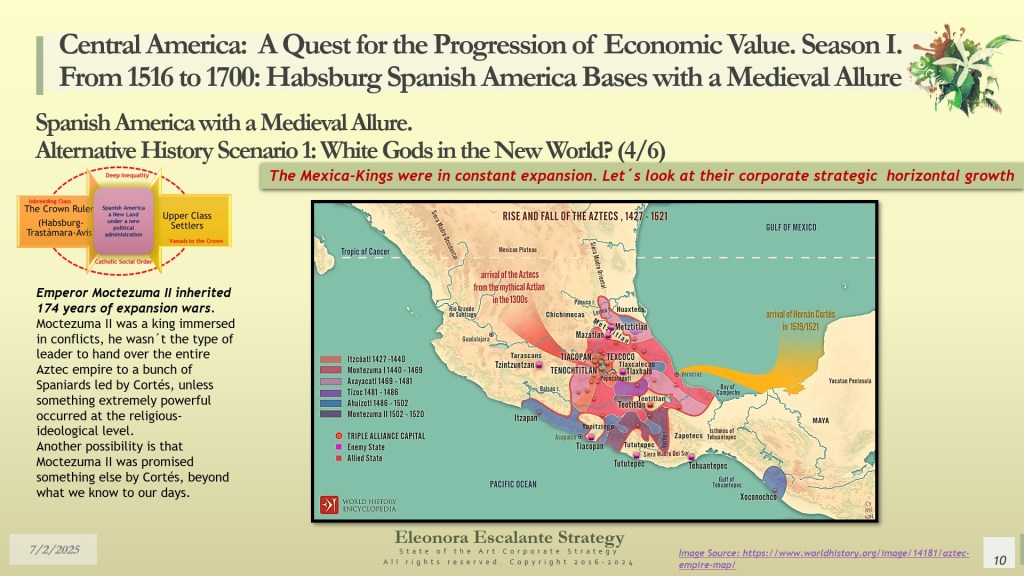
1. It is possible that Europeans visited the Aztecs before the arrival of the Spaniards’ missions from Cuba to México and Guatemala. We conceive the possibility of Europeans visiting the Aztec territory between 1375 to 1519. This European visit to the Aztecs was conceived and melted with the Quetzalcoatl identity, a deity equivalent to the God of white skin, and blond hair who came from the East.
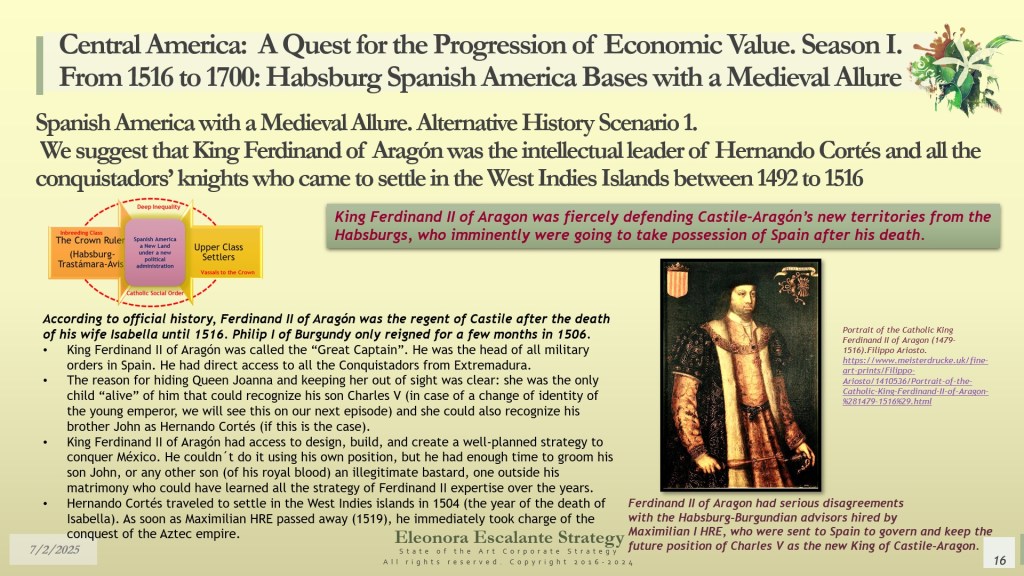
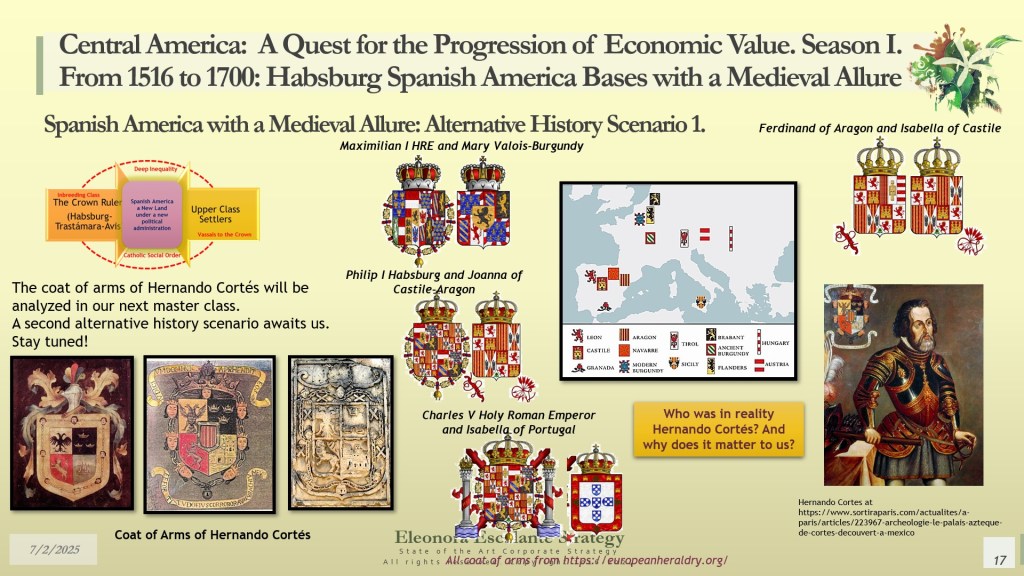
2. Hernando Cortés (1485-1547) is the son of King Ferdinand II of Aragon. It could be possible, that Hernando Cortés is an illegitimate son of him or a closest royal relative of King Ferdinand II of Aragón. But it could be possible that he is Prince Juan of Asturias (if he did not die in 1497). The identity of this son will be discussed in our slides. For this scenario, we suggest that Prince Juan of Asturias did not perish, but his real royal identity was covered under the one of Hernando Cortés.
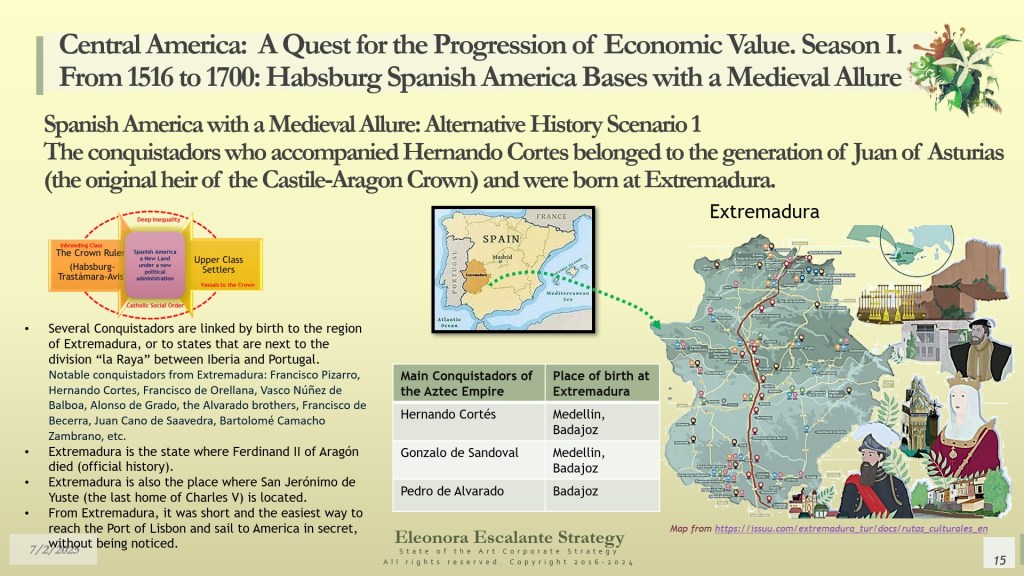
3. The Conquistadors who accompanied Hernando Cortés belong to the generation of Juan of Asturias (the original heir of the Castile-Aragon Crown). As a coincidence, the year of birth of Prince Juan is the same one of Philip I Habsburg-Burgundy.
4. King Ferdinand II of Aragón was the intellectual leader of the strategy pursued by Hernando Cortés to defeat the Aztec Empire. Ferdinand of Aragón was also the head of all the knights (who belonged to the military orders of Santiago, Calatrava, Montesa, and Alcántara). If King Ferdinand passed away in the year 1516, he left a specifically designed strategic plan in the hands of Hernando Cortés, conceived for implementation immediately after the death of Maximilian I, at the moment in which Charles V, in Europe, was busy traveling from Spain to Germany.
Let´s proceed to read all our strategic analyses described in our slides. As always, we recommend you print the material, take notes on it, ask yourself questions, and follow to read the additional bibliography. Feel free to share our material with your friends, colleagues, and classmates.





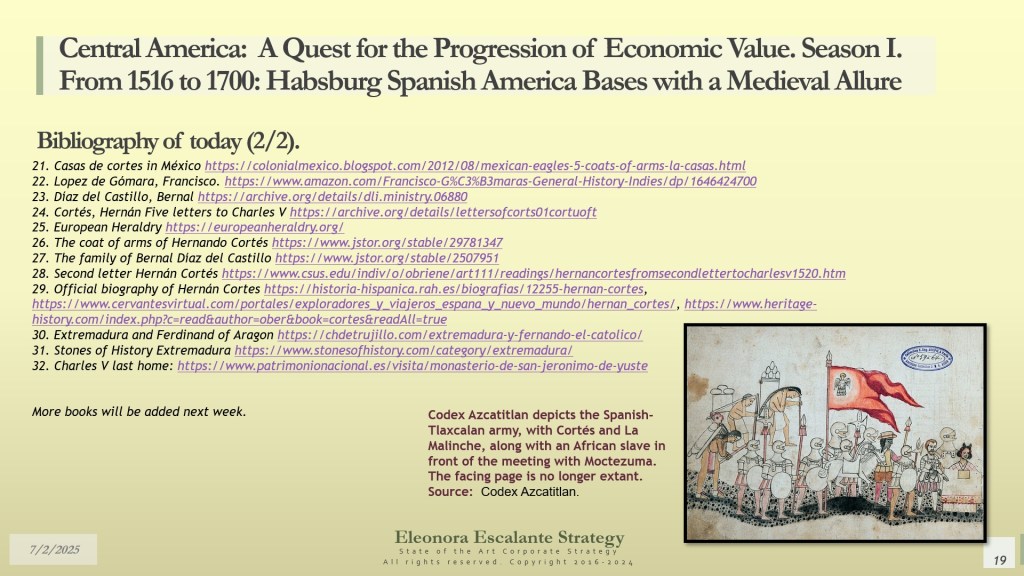


We will add a few additional strategic reflections before Monday 10th of February. Look at the paragraph below.
We aim to trigger in you the desire to reflect on our material before we post our final findings. It is only then that you will be able to compare your thoughts. Our authentic desire is to shake the roots of the 16th century because nothing seems to be as it is officially accepted.
The conquest and colonization of Spanish America was the most intriguing priority not just for Spain, but for all the friends and rivals of Charles V. Colonizing a New continent wasn´t a common phenomenon. It was “the happening”, the most relevant experience of the 16th and 17th centuries. It is not the same to be conquered by a bunch of adventurers who were out of control of the commands of the Spanish rulers as to be colonized by members of the royal dynasties. There is a new sense of responsibility, a new sense of commitment, and a burden to be fixed, that requires immediate attention. It doesn’t matter if 525 years have passed. But how are the economists of today going to fix the poverty of Latin America? Particularly if we don’t know the truth. The vrai verité needs to be revealed into the light. Otherwise, what happens is that Central America is only changing from the hands of the Medieval past to a new digital begging technological system (that functions under the same medieval premises), in which the traditional handmade stuff gets virtual, but the roots of our problems remain untouched, as it was in the 16th century. Central America’s present “lack” of equitable economic development comes from the radical and brutal roots of inquisitorial conquest and the specific encomienda style of colonialism over the prehispanic populations. It was the medieval “modus operandi” of the Spanish kingdom of Castile and Aragón in Spanish America. The Catholic colonization (in many cases to protect the life of the survivors of Mesoamerican Indians) was performed in Spanish America. The Protestant Dutch, German, and British styles of colonization went to North America later. We will discover and discuss much more about these topics over the next episodes of Season 2.
Additional Strategic thoughts after the weekend (Added to the original writing on Monday 10th February):
- The rationale of our alternative history scenarios is a meaningful response to a lack of consistency (or coherence) that we have found after reading 10 books about the life of Charles V, Holy Roman Emperor. We have already read and covered the books of Geoffrey Parker, William Maltby, Martyn Rady, J. H. Elliott, Harry Kamen, Francisco López de Gómara, Wim Blockmans, J.D. Tracy, Edward Amstrong, and William Robertson. Irrespective that all these authors have the same storyline, and most of his books have been written on different dates, there are significant discrepancies. Sometimes I feel as if I am reading a collection of patchwork chapters, or a kludge of information dispatches (“kluge,” means “something ill-glued that shouldn’t work together but it does”), a series of information stuck in between without a smooth roadmap, a product of filling holes with facts of an incessant voyageur that was deeply transformed in the decade of the 1520s. We also have discerned that the teenager Charles V before the death of Maximilian I (1519), was a different man than the adult Charles V who married Isabella of Portugal in 1526. At the time of his reign, an emperor like Charles V, grew up thinking that honor, dynastic marriage, warfare, chivalry, and Flemish music were pivotal factors for his experience of a lifetime. Charles V emerged after his wedding as a warfare elite boss of the most specialized European knights who couldn´t win most of his conflicts in Europe. How could it be, that it was under his mandate that he subjugated more than 200,000 Aztecs under his realms on the other side of the Atlantic Ocean? How could it be? Charles V wasn´t someone who could leave the conquest and colonization of America in the hands of some explorers of Extremadura who were looking for gold, fame, and fortune in the New World. That is not acceptable, considering the mentality of the Iberian-Burgundian-Habsburg leaders who were prepared by Maximilian I as an entourage for his grandson Charles V Emperor. In consequence, our first strategic reflection comes from the perspective of questioning ourselves on the official storyline of 10 books about the emperor.
- While learning about the conquest and colonization of the Mexica Aztecs from the oldest official sources of reference: Bernal Díaz del Castillo, Francisco Gómez de Gómara, and the letters that Hernán Cortés wrote to Charles V Emperor, we also don´t acknowledge 100% in the logic of these collusive conceptions. These three documents come from authors who were linked directly to Hernán Cortés life. Hernando Cortés was the boss of Díaz del Castillo and Gómez de Gómara. It was the time of the Inquisition, the reign of terror, and no one working for the conquistador of the Emperor could say something different than their direct chief commander. On the contrary, if we want to cross-check with other biographies of Charles V or similar chronicles from the 16th or 17th centuries, little is said in the life stories of Charles V about Spanish America. We just find no more than one discreet chapter written about the conquest in most of these books. As a result, our second strategic reflection is aligned with the first one: there is something hidden that Iberian historians didn´t want us to know. Why? What did the Spaniard conquistadors perform in México and the Caribbean that they had hidden for more than 500 years? What happened in reality in Tenochtitlan? And why Moctezuma II was doomed to fail before the start of the conquest?
- The figure of Hernando Cortés is not just crucial, but critical in finding the answer to our last questions. Hernando Cortés couldn´t have disobeyed the orders of the representative leader of the Emperor in Cuba in the way he did. Official history frames him as acting in contradiction of Diego Velásquez de Cuellar (1465-1524) in Cuba. Velásquez de Cuellar was an adelantado, the first governor of Cuba, who as of 1511 was responsible for sending missions of exploration from Cuba to Yucatán and the coast of of the Bay of Campeche. In 1519, Cortés sailed to México with around 500 people, without permission from Velásquez, and this action could only be possible because Cortés was not reporting to Velásquez but to the king of Spain directly. Charles V was a newcomer leader in Spain at that time. His grandfather Ferdinand was already deceased. A young emperor like Charles V had a direct line of communication with Cortés. Why? What is the meaning of those letters? Nonetheless, if you read these letters in Spanish or English, the situation of Cortés (as described in official history) wasn´t an expedition, it shows as if he was acting with an order from a king, directly instructed to conquer a new land. In exchange, Cortés future earnings, as accustomed in Medieval Iberia: to acquire wealth, personal recognition, and land gains. In the case of winning the land of the Aztecs, Cortés wanted his new property as a colony under his possessions and authority.
- Therefore, who is Hernando Cortés in reality? Was he a knight of the order of Santiago, a mercenary specialized and groomed by the Iberian king before Charles V? If this is the case, then Ferdinand II of Aragón was involved directly in the organization and planning of the Conquest America Inc. project. But it looks unbearable to leave such an operation in the hands of mercenaries or any X knight hired in Extremadura. This is why, for us, Hernando Cortés was truly a member of the royal family of Castile-Aragón reporting to the German-Burgundian Emperor Charles V through his five letters of relations. His identity can´t be too far from the circle of closeness of King Ferdinand de Aragón: our best bet is his son Prince Juan, the heir to the throne. However, Prince Juan died in 1497, after his wedding to Margaret of Habsburg. What if he was alive?
- Hernándo Cortés construction of his real royal identity is not easy. Working from El Salvador, we are trying to reconstruct his life, without access to authentic data about him, other accurate documents about his strategy, hidden pictograms about Moctezuma II, or other testimonials that could be safeguarded at archives located in Sevilla, Salamanca, the Vatican, or with the Aztec communities, or private collector hands. We are trying the best we can to provide new hints about this case. There is a piece of this puzzle that we are trying to yield, despite the limitations of our current research.
- Most of our strategic reflections are written on our slides. We invite you to read them, to continue exploring our material, please. Our faithful research is for you. We have dedicated the previous months to setting you up in the context of the conquest and colonization of Spanish America, with a focus on Central America. We aim to find the truth or at least, the closest trustful possible scenarios that could help the next generation of historians to find it. So they can re-write history as it was.
- There is a pending historical debt with Latin America, and there are specific European empires who are obliged to help us to develop our economic development without enslaving us with the encomienda style of the past, as their ancestors did. The new digital technological economy won´t fix the issues that started with the encomiendas in the 16th century. There is a shift in mentality required from developed European Empires to Latin America, but this will only happen if the truth comes to light. Otherwise, the same medieval values existing in Europe will continue giving birth to inequality projects in which Latin Americans will never rise to the same level of “superior” skills as Europeans, and we will end up as digital beggars, without land or prosperity, enslaved by the Internet platforms, unable to produce our flourishing potential in any type of industry or academic extent available.
Announcement.
Next week we will release the second Alternative History Scenario of the Conquest and Colonization of Spanish America with a Medieval Allure. We are convinced that the real history of the conquest and colonization of the West Indies deserves the correct explanation. In addition, it is fair and authentic to do it very far away, and out of the “political pro-left movements who have manipulated the cause of the prehispanic populations during the 20th century”. Eleonora Escalante Strategy is not tied to any of both sides of the political wings, and this is the key factor of our differentiation as strategists. There is a reality of the 16th century beyond the politics of today, that requires a serious and professional investigation, and these are pending matters in history. Expect a new surprise for next week!
Musical Section.
Our selection of music during this saga will continue to explore adorable music produced between the 16th and 17th centuries. Season II is dedicated to the lute. Our choice for today´s episode is from the YouTube channel Brilliant Classics. Various Composers accompany us. The artists are all playing at the Quartetto di Liuti da Milano, with Bernhard Hofstötter as the virtuoso of the relaxing lute.
Thank you for reading http://www.eleonoraescalantestrategy.com. It is a privilege to learn. Blessings.

Sources of reference and Bibliography utilized today. All are listed inside the slides document.
Disclaimer: Eleonora Escalante paints Illustrations in Watercolor. Other types of illustrations or videos (which are not mine) are used for educational purposes ONLY. All are used as Illustrative and non-commercial images. Utilized only informatively for the public good. Nevertheless, most of this blog’s pictures, images, or videos are not mine. I do not own any of the lovely photos or images unless otherwise stated.
 Eleonora Escalante Strategy - Strategic Reflections Think Tank