

Central America: A quest for the progression of economic value. Season II. Episode 4. Spanish America with a Medieval Allure: Conquest and Colonization Part 3.
Dear adorable audience:
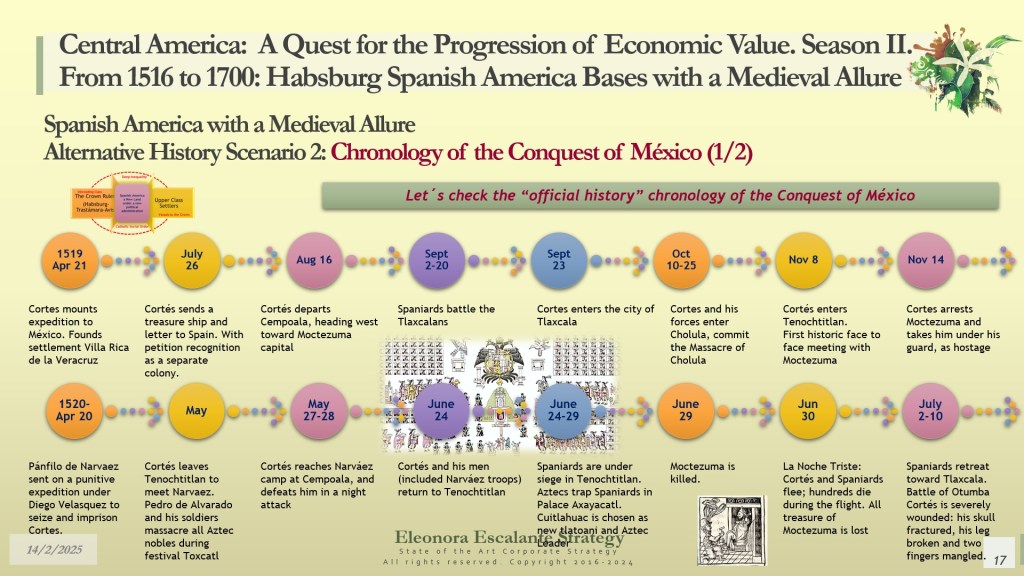
Today is the release of our second alternative scenario about the Conquest and Colonization of Spanish America. We intend to find different hypotheses that might explain certain discrepancies concerning the series of events that occurred in two years in the lands of México (between April 1519 to August 1521).
The Second Alternative History scenario incorporates the following assumptions:
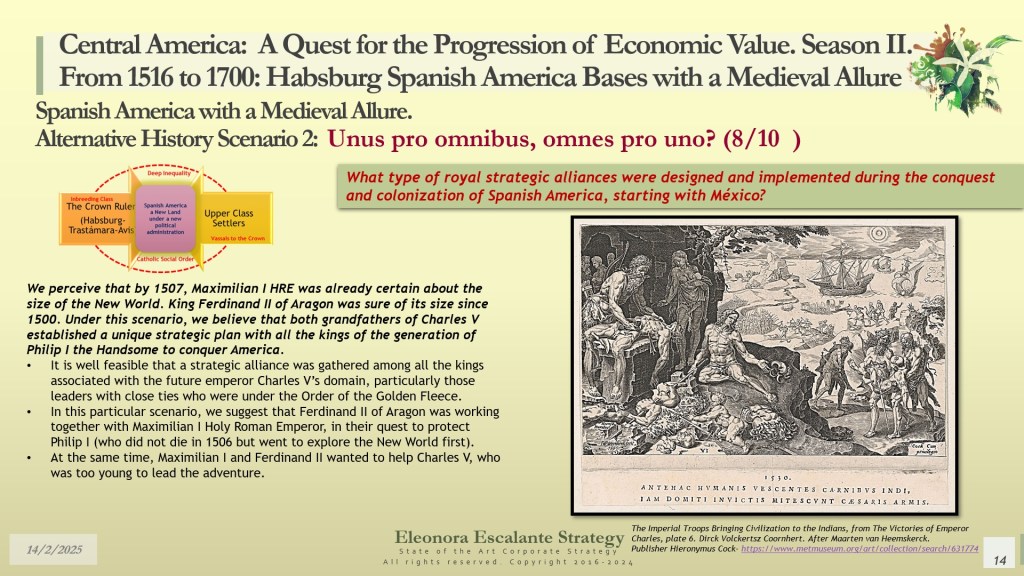
- Unus pro omnibus, omnes pro uno: Once the different kingdoms associated with Charles V and his family were sure of the dimension of America, they decided to make a strong strategic alliance for the conquest of Spanish America. Here we understand the association of the kingdoms of the dynastic marriages: the Iberian Kingdoms, Portugal, France, England, Holy Roman Empire of the German Nations, Austria, The Low Countries, Italy states under Castile-Aragon Domains, the Papal States, Denmark, etc.)
- Hernando Cortés might be the real emperor Charles V, while a double (doppelganger) of the emperor performed his activities in Europe between 1519 and 1521.
- Philip I the Handsome didn´t die in 1506? He traveled to America and stayed in Cuba and from there he explored Tenochtitlan a few years before 1519. He was proclaimed a White God by the Aztecs. Philip I died during or after the conquest of Tenochtitlan (before his burial in 1525).
- The nature of Conquistadors: The conquistadors from Castile who accompanied Cortes were all mercenary knights hired specifically for the conquest of the Aztecs. It is also possible that Pánfilo Narvaez may have taken some members of the European Golden Fleece League to help Cortés.
Let´s go to read the essence of our strategic analyses in the following set of 28 slides. As always, we recommend you download the PDF document, print the material, take notes on it, ask yourself questions, follow the bibliography that we share at the end of the document, and search for academic additional sources of books. Feel free to share our material with your friends, colleagues, and family members. This is a beautiful opportunity for all of you to make strategic reflections about a topic that is so important for everyone in the world.








We invite you to return next Monday 17th of February to read our additional strategic reflections. During the weekend, please prepare a list of your original thoughts, and write them on paper, whatever idea that you might have envisaged while reading our document. Only then you will be able to compare your reflections with ours. When the reflections will be ready, these will appear in the paragraph below.
Additional strategic reflections: (added on Monday 17th of February).
- The context of the conquest and colonization of America in the hands of the Iberian kingdoms was mud-covered and opaque. The Iberian Peninsula was just starting to build itself after the distribution of lands to the military orders, after the expulsion of Jews, and after forced conversions. After the Granada fall, with an installed inquisition, the Spain rulers were dealing with the organization of the resettlements and the grouping of the villages and towns under the jurisdiction of the new cities chosen by the Catholic Kings administration. Spain was under a restructuring of fief communities, new districts that were growing differently than before the Reconquest. The process of feudalization of Iberia was taking place at the same time as the discovery and conquest of America. For example, let´s see the case of the townland of Benamejí: after the threat of border raids from the Moors of Granada ceased in 1492, the region attracted settlers to reside and stay. By 1529, around 19 families were tiling the soil and living in the shadow of the fortress which belonged to the Military Order of Santiago. King Charles V decided, as Master of the Order, to sell the jurisdiction to a private individual, Diego de Bernuy (Bermúdez), a wealthy alderman of Burgos (1). Charles V got the papal permission to separate the area´s land from the Military Order of Santiago, and it was sold to Burnuy in 1548. In exchange, the new Feudal lord de Bernuy offered to build a flour mill, an oil press, and provide enough tiles to each family to roof their house and the village church. Additionally, the new feudal lord offered to build a bridge to improve access to and from the town. Later the Lord of Bernuy obtained the title of Marquis of Benamejí. This example demonstrates the context of what was occurring in Spain when the conquest and colonization took place. It is obvious that Charles V’s administration was installing the feudalism model, so large numbers of villages were separated from the old jurisdiction of their former district capitals and sold off to private individuals.
- What was happening in Spain at the moment of the conquest of México? At the precise moment of the conquest of the Aztecs, the Comuneros revolt was taking place in Spain. Official history describes Charles V as traveling out of Iberia, “apparently” to prevail in his quest for the Holy Roman Emperor title in the German Nations. To construct Alternative Scenario 2, we asked ourselves, what if the years 1519 to 1521 were lived differently by the Emperor? What if Charles V decided to take charge directly of the Conquest of New Spain, a role that had been waiting for him since the year 1500? What if the Mexican Conquest was nothing else than the preparation to expand out of Europe, using the same tactics explained above with the Conquistadors? During the 2 years of the conquest of México, Emperor Charles V wasn´t in Spain. Did he travel as a head of the conquistadors? For the conquistadors, there was no conquest without immediate settlement. The Iberian conquistadors were trained as such during the reconquest of the Peninsula. In consequence, their strategy to conquer the land of the Aztecs was going to be repeated accordingly, with the improvisation required at the moment of warfare against the Aztec communities.
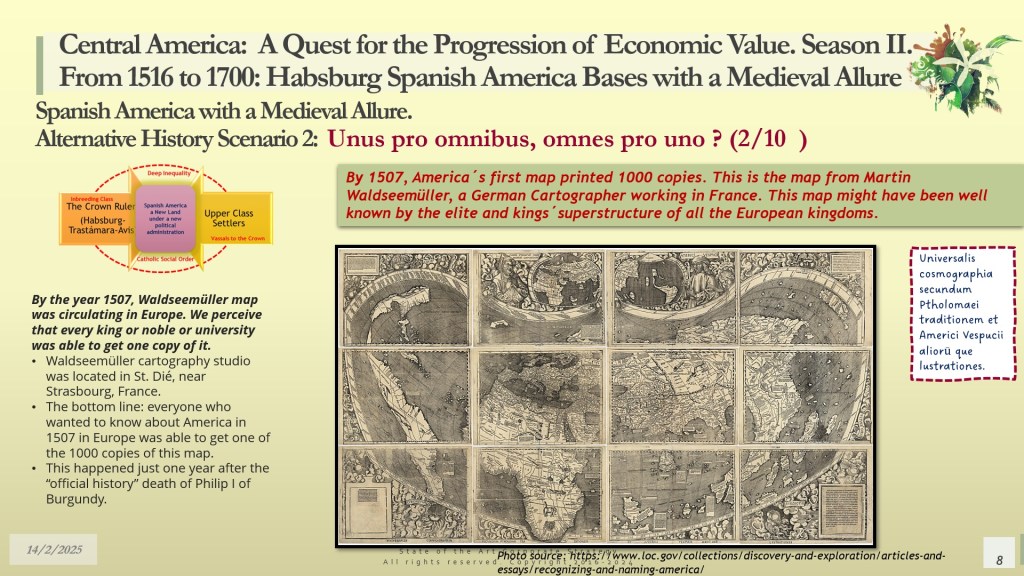
- Maps of America, the trend of the moment. From slides number 7 to 16, we took the time to show you the importance of maps. Without any desire to teach you geographic economics, we compiled the different maps about America that were coming fresh from the oven, maps available out of reports, letters, travelogues, and diplomatic information coming out of Iberia towards continental Europe and beyond. The Explorers of Castile-Aragon were “supposedly” responsible for providing cartographic intelligence to the Spanish and Portuguese crowns, but at the same time these explorers were bribed at the best alternative offer, and many of these reports ended in Venice, Paris, Nuremberg, Antwerp, Augsburg, Basel and beyond. Amerigo Vespucci was initially hired by Lorenzo de Medici and ended up making 4 voyages for the Spanish and Portuguese rulers. The information coming out of the explorers spread quickly. By 1507, one thousand copies of the map of Waldseemüller were printed on the first edition with the sponsorship of the Duke of Lorraine. The most interesting aspect of the process of elaboration of these maps is that the mapmakers were so clever to go back in time to the 2nd century CE, to check the works of Ptolemy, and they agglutinated all the additional works as of Columbus’s first voyage. In less than 14 years, the map of Waldseemüller was in the hands of most of the kings, decision-makers, universities, and intellectual scholars. Our reflection implies that everyone who wanted to know what was happening on the other side of the Atlantic was able to get it. This was only possible because the flow of information was rapid, and it went directly to the ones who could afford it. The link from explorers to map-makers was expeditious. The map-making process was coherent, accumulative, and disseminated continuously. Year after year, other maps were released. According to Fernandez-Armesto (2), more than 15 world maps were drawn, and some were printed for specific beneficiaries between 1500 to 1526. So, it was lucrative to be part of the value chain map-making industry. On the other hand, the Spanish crown also built their own data center of intelligence. An interesting fact, Peter Martyr d´Anghiera (chaplain to the Catholic kings and member of the Council of Indies of Charles V), wrote a book “De orbe novo decades” and by 1504, he illustrated perfectly all the coast of México, Florida, and Central América. Finally, in 1529, a copy of the Padron Real was gifted to the Pope by emperor Charles V. This copy is equivalent to the map created by Juan Vespucci in 1526.
- Unus pro omnibus, omnes pro uno. Despite that official history has been specifically earnest to explain the conquest of Spanish America in the hands of a bunch of adventurers who were coming in waves of bandit bands to join the Americas’ new lands; we have already demonstrated to you that all these conquistadors were part of pre-established military orders that reported directly to the ruler of Iberia. Even if there were conquistadors who organized themselves as entrepreneurs’ caudillos who recruited their family members voluntarily to explore the new continent; there were other conquistadores, such as Hernando Cortés, who weren´t “adelantados”. The term Adelantado refers to those adventurers who financed their trips and were appointed by the Spanish crown, in return for a percentage of the profits (3). Then, we asked ourselves, how could it be that Hernando Cortés, simply decided to disobey his boss in Cuba, and took 600 men to come to conquest México, out of nowhere, and without money? It doesn´t make any sense. Not even emperor Charles V could do that without asking for funding at the different kingdoms´ cortes. From this rationale, we can´t explain the behavior of the conquistador Hernando Cortés, unless he was part of a bigger plan, directly related to a Habsburg-Castile-Aragón partnership. This is clear as soon as we confirm that he was a leading director knight of a military order, and probably he was prepared in advance as a SWAT commander to do it. Hernando Cortés was not a citizen without warfare experience. For us, he was equipped for years to play the role that he performed after the death of Maximilian I, and he was able to do it, only when his grandfather passed away. If Charles V, an Emperor of such high standards was going to enter México, he couldn´t come alone. He had to carry the best-prepared army that he could gather in Iberia, and these knights must have been taken from the military orders at the service of the crown. Additionally, if an emperor was going to travel for 2 years to conquer a new land, he couldn´t do it without the best strategists of warfare available that his other grandfather Ferdinand II used for the reconquest of Granada. As a top secret of the Spanish state, the accompaniment was also complementary at the utmost canopy of his Golden Fleece friends. We can´t envisage if some of them came with him, but at least they covered him in Europe.
- Philip I, the husband of Queen Joanna didn´t die in 1506. This fact is almost impossible to believe. It has been taught to us in such a way that Joanna looks like the mad crazy royal of the picture, keeping his husband’s coffin next to her for 19 years until his burial in Granada. But we wonder if there is a remote chance that King Philip could have moved to America to prepare the conquest route for his son Charles V. Wouldn´t he? If Philip I had access to the lovely maps being produced all over Europe, he knew that time was running against them. The first-come-first-serve rule of the game is applied when winning new lands. He was the husband of a jealous woman who loved him endlessly to undertake 6 pregnancies. He was the king of the nascent Spain. He was ultimately responsible for the expansion of his kingdom in the new world. It was an urgent matter for him to explore, find, conquer, and colonize the new gigantic continent. If he left for America through Lisbon, then the Portugal kingdom was potentially an ally, or he had to do it using a new identity. If Philip I was able to arrive and live with the Aztecs between 1506 to 1519, then the situation of the conquest of the Aztecs in less than two years is explained fully. If Philip I was one of the white Gods, with Quetzalcoatlish allure, the God that is mentioned repeatedly in several Aztec CODEX, then it is also possible that he was the one who helped the Aztecs to develop the adorable Tenochtitlan, sacked and fired by Hernando Cortés (alias Charles V). It is also possible that Maximilian I knew of the whereabouts of his only son, and that is why the conquest was delayed until after his death.
- Why would an Emperor leave Europe to conquer America? Given the circumstances of the context of the epoch, then no one was safest in Europe in comparison to the New World. We are speaking about an emperor raised to become a conqueror, not a ruler behind a desk. So, in his chivalry context, exploring and winning new lands was a matter of top honor and recognition. As early as reaching the sky of God, the mindset of Charles V wasn´t built to remain in Spain, but to conquer America for Spain, and it might be possible that he used Hernando Cortés identity for a few years.
Why does it matter? If you see the big picture: The reign of Charles V was a disaster in Europe. He failed in each and all the aspirations that his grandfather Maximilian I HRE left to him as a mandate list in Europe. He failed to agglutinate the imperial German nations under one religion. He failed to contain the Muslims out of Hungary when the siege of Vienna to the Turks was almost imminent, it was a miracle that he could push them out. He sacked Rome, and he lost almost all his battles. It looks like he wasn´t leading anything right in Europe. On the other hand, it was outside, it was in Spanish America where extraordinary achievements were happening. His expansion overseas can´t be explained unless it was led by the same Emperor. How could it be that? “While the crack imperial armies of the Habsburgs, counting in the tens of thousands, remained stuck in their tracks in the Old World”, just two gangster conquerors, “Cortés and Pizarro could capture the Aztec and the Inca empires with a few hundred European soldiers”(4)… Can you start to comprehend why are we dedicating our time to try to discover the truth?
Announcement.
Happy Valentine´s Day! Next week we will release the third and last Alternative History Scenario of the Conquest and Colonization of Spanish America with a Medieval Allure. We are convinced that the real history of the conquest and colonization of the West Indies deserves the correct explanation. We are opening three new lines of research that might help future scholars find insights into their investigation expectations about the 16th century. Without the past truth, we won´t be able to understand our current endeavors. Expect a new surprise for next week!
Musical Section.
Our selection of music during this saga will continue to explore adorable music produced between the 16th and 17th centuries. Season II is dedicated to the lute. Our choice for today´s episode is from the YouTube channel Brilliant Classics. The album is named: Peaceful Lute Music Vol.1. With the artists: Oleg Timofeyev, Quartetto di Liuti da Milano, and Bernhard Hofstötter. It is an album full of lute!
Thank you for reading http://www.eleonoraescalantestrategy.com. It is a privilege to learn. Blessings.

Sources of reference and Bibliography utilized today. All are listed inside the slides document.
References of this text:
(1) Casey, James.”Early Modern Spain-A social history”. Routledge, 1999. Chapter 5. Feudal Lords and Village Potentates.
(2) Fernández-Armesto, F. “History of Cartography-Cartography in the European Renaissance”. Edited by David Woodward. Book 3, Part 1. Chapter 30. The University of Chicago Press, 2007
(3) Fibiger, Bayly, Scheidel. “The Oxford World History of Empire”. Volume 2. Oxford University Press. 2021. Part VI. Page 724.
(4) Hennessy, Alistair. “The Nature of the Conquest and the Conquistadors”. Proceedings of the British Academy, 1993. Volume 81.
Disclaimer: Eleonora Escalante paints Illustrations in Watercolor. Other types of illustrations or videos (which are not mine) are used for educational purposes ONLY. All are used as Illustrative and non-commercial images. Utilized only informatively for the public good. Nevertheless, most of this blog’s pictures, images, or videos are not mine. I do not own any of the lovely photos or images unless otherwise stated.
 Eleonora Escalante Strategy - Strategic Reflections Think Tank