

Central America:A Quest for the Progression of Economic Value. Season II. Episode 5. Spanish America with a Medieval Allure. Conquest and Colonization Part 4.
Dear amazing readers:
Today we will be brief. Our aim is to share all of our week’s research results. We will continue with the third scenario in our next episode. The nature of this alternative history is complex in its essence because we have tried to explore the meaning of all the heraldic symbols of the coat of arms of Hernando Cortés, and from there infer all the unrestricted possibilities, despite the version of “official history”. We are not experts in medieval heraldry, which has taken a toll on us, but we are putting all our efforts into it. This is our chance to provide the most approximate versions of what Charles V meant when he granted the Coat of Arms of Ferdinando Cortes (to himself or to another member of his integrated family).
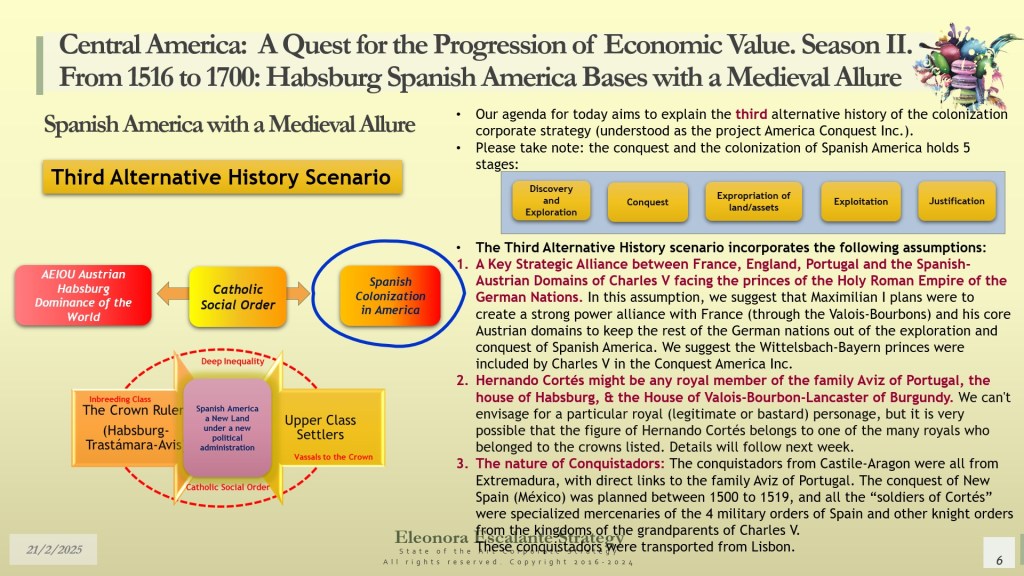
The Third Alternative History scenario incorporates the following assumptions:
- A Key Strategic Alliance between France, England, Portugal, and the Spanish-Austrian Domains of Charles V facing the princes of the Holy Roman Empire of the German Nations. In this assumption, we suggest that Maximilian I plans were to create a strong power alliance with France (through the Valois-Bourbons) and his core Austrian domains to keep the rest of the German nations out of the exploration and conquest of Spanish America. We suggest the Wittelsbach-Bayern princes were included by Charles V in the Conquest America Inc.
- Hernando Cortés might be any royal member of the family Aviz of Portugal, the house of Habsburg, & the House of Valois-Bourbon-Lancaster of Burgundy. We can’t envisage a particular royal (legitimate or bastard) personage, but the figure of Hernando Cortés may belong to one of the many royals who belonged to the crowns listed above. Details will follow next week.
- The nature of Conquistadors. The conquistadors from Castile-Aragon were all from Extremadura, with direct links to the family Aviz of Portugal. The conquest of New Spain (México) was planned between 1500 to 1519, and all the “soldiers of Cortés” were specialized mercenaries of the 4 military orders of Spain and other knight orders from the kingdoms of the grandparents of Charles V. These conquistadors were transported from Lisbon to America, and no one else noticed, because they left from and through Extremadura, the most arid, controlled and non-populated region of the country during the 16th century. Anyone can walk from Badajoz, Extremadura to Lisbon Port (by foot) in just 48 hours (2 days without stopping, or 3 days if staying overnight in any of the villages).

Find our framework of reference below. Feel free to download, print, and keep it for your records. No one of us knows how long we will have the Internet. We have forgotten that around 30 years ago, the Internet wasn´t ubiquitous. Currently, we have ignored that the Internet is truthful “a not required luxury”. As a civilization we have lost the perception that the Internet is not indispensable for our life (humans never needed it before the 1990s decade), and that makes us so vulnerable. So, please, it is better to keep this material on paper for your reading experiences.




We invite you to return next Monday 24th of February to read our additional strategic reflections about this work-in-progress chapter. During the weekend, please prepare a list of your original thoughts, and write them on paper, whatever idea that you might have envisaged while reading our document. Only then you will be able to compare your reflections with ours. When the reflections will be ready, these will appear in the paragraph below.
Additional strategic reflections: (added on Monday 24th of February).
- What about the Portuguese Empire?
Most of the books about the conquest and colonization of America are focused on the role of the Spanish Empire, Charles V Holy Roman Emperor, and “the official history documents” written by the religious personalities who accompanied the conquistadors to America. But what about the empire of Portugal? Mistakenly we have commonly accepted that Portugal was simply focusing its navigation conquests on Brazil and its colonies in Africa and Asia. This is a wrong statement. Our strategic argument is that Portugal was indirectly leading the conquest of America, and probably they were the most interested in pushing the new Spanish Catholic monarchy to conquer it with them. Despite that there was a recent war between Portugal and Spain (1475-79), the treaty of Alcacovas was signed and ratified in 1480. This treaty contemplated future dynastic matrimonial affairs between the two nations´ royal families, and certain regulations in terms of navigation of territories, an effort that ended in the Treaty of Tordesillas in 1494.
When Columbus discovered America, some scholars believe that Columbus made a “successful Portuguese voyage to the west,”(1) using the Castile-Aragon resources. King Joao II of Portugal (1432-1495) and his son King Manuel I (1489-1525) were the main protagonists of the Portugal Empire before and during the conquest of New Spain. We can certainly assess that after the treaty of Alcacovas, the kingdom of Portugal flew into a strategic alliance with the kingdoms of Castile-Aragón, and it is demonstrated not only in the three Castile-Aragon brides that King Manuel I accumulated during his life, but also in the marriage between Charles V HRE and Isabella of Portugal. - Portugal-Castile-Aragon was a strong dynastic union before 1492. Furthermore, Portugal-Austria/Burgundy consumed another strategic alliance with the birth of Maximilian I.
Maximilian I (the grandfather of Charles V HRE) was the son of the HRE Frederic III Habsburg-Piast Mazowiecki (1415-1493). HRE Frederick III married Eleanor Aviz-Aragon of Portugal (1434-1467), and she was a direct descendant of John of Gaunt (from the Plantagenet English royal rule). This fact positions two lines of connection which are usually overlooked. Once you link Maximilian I HRE with the kingdoms of Portugal and Plantagenet-England, then you are ready to understand that the conquest and colonization of America was an orchestrated teamwork between Portugal and the Spanish kingdoms. Catherine of Aragon (1485-1536), sister of Joanna the Mad, was the connection to the Tudor Dynasty. Later, in 1526, Charles V didn´t married by luck with Isabella of Portugal, it was already predetermined and entangled a long time before, right after the Alcacovas treaty. - The connection of the Spanish Habsburgs was also well-heeled with the Valois-Wittelsbach of Hainaut-Aviz-Bourbon families.
Mary of Burgundy (1457-1482), the wife of Maximilian I Habsburg-Aviz was also a descendent of the family Valois, the Aviz-Gaunt branch, the Bourbons, and the Wittelsbach of the County of Hainaut family from Germany. Moreover, Mary of Burgundy was linked to the mother of French King Francis I Valois-Angouleme. King Francis I was the son of Louise Savoie-Bourbon, a first-degree cousin of Mary of Burgundy, the wife of Maximilian I. In short, the dynastic matrimonial arrangements of all the grandparents of Charles V Holy Roman Emperor positioned him as the hereditary individual that agglutinated three strong imperial crowns (not mentioned in his “official” titles): Portugal, France, and England. - As a result of the genealogical analysis of the ancestors of Charles V HRE, we dared to incorporate our third alternative history scenario.
At least during the lifetime of Charles V Emperor (first half of the 16th century), there existed a hereditary legacy of the crowns of France, England, Portugal, and the Spanish Austrian domains of Charles V. Despite that Burgundy was part of the Low Countries, the Valois-Bourbons were more French than Burgundian. The domains of the family Wittelsbach from the Duchy of Bayern, called Bavaria were related to the County of Hainaut (Located in the Low Countries) through Margarita Wittelsbach of Hainaut (1363-1424), one great-grandmother of Mary of Burgundy, the wife of Maximilian I Habsburg HRE. - Now that we have explained our third alternative scenario, we must find out who Hernando Cortés was, and heraldry is helping us. Our bet for today (given the considerations that we have developed from slides 7 to 15) relies upon heraldry. Every single symbol, distribution of the field (shield), texture, color, position, and format of a coat of arms of the medieval nobility and royals has a meaning. Heraldry was one of the most solemn and thoughtful endeavors during Medieval and Early Modern times. It was so significant because the essence of the families and their association with wealth and prosperity was defined by it. In consequence, every royal crown and order of military knights all over Europe dedicated personnel and effective communication to define all the characteristics of the shields and coat of arms. The verb “blazon” means to describe in words a given coat of arms, and the noun “blazon” refers to that description. The “Blazoning” system of nobility was more than the description of the armory ID of the nobility, it was the core constitution of the European societies. We have been exploring and dedicating all our last week to comprehend the rules of blazoning, in our quest to diagnose what is the real meaning of the Coat of Arms of Hernando Cortés. Official History describes the Coat of Arms of Cortés under a simple historical account. We disagree with accepting it as a genuine face value. Furthermore, we will have a new meaning of Hernando Cortés core identification as of next week. For the time being, we appeal to your conscience that we are exhibiting all the heraldic possibilities. In our next episode, we will provide our definitive resolution. So please try to read as much as you can about medieval heraldry. We have shared the most outstanding bibliography about it on slide 16.
This week we will continue analyzing and deducing about the coat of Arms of Hernando Cortés. From the point of view of the corporate strategy of the medieval leaders, it is imperative to understand who was who during the “America Conquest Inc.” project. Without an inquisitive heraldry approach, it is unviable to land into the truth.
To be continued on Episode 6…

Announcement.
We have changed our outline. Next week we will continue with the third and last Alternative History Scenario of the Conquest and Colonization of Spanish America with a Medieval Allure. We have envisaged that the real history of the conquest and colonization of America is not as it has been taught to all of us. The inquisitorial fear of persecution to Spanish Historians was so enormous, that they never told us the truth, but only what the monarchical authorities wanted us to acknowledge. We are opening three new lines of research that might help future scholars find insights into their investigation expectations about the 16th century. It is our aim to explore all the alternatives that might help us to understand why Spanish America began as it was.
Musical Section.
Our selection of music during this saga will continue to explore adorable music produced between the 16th and 17th centuries. Season II is dedicated to the lute. Our choice for today´s episode is from the YouTube channel Classical Tunes. It is a collection of Lute artworks from John Dowland, interpreted by Massimo Lonardi. John Dowland (1562-1626) was a virtuoso lutenist, English composer, and one of the most famous lute erudites of his time.
Thank you for reading http://www.eleonoraescalantestrategy.com. It is a privilege to learn. Blessings.

Sources of reference and Bibliography utilized today. All are listed inside the slides document.
Related to this text:
(1) Diffie, B and Winnus, G. Foundations of the Portuguese Empire, 1415-1580. Volume 1. University of Minesotta Press, 1977. Chapters 9 and 11
Disclaimer: Eleonora Escalante paints Illustrations in Watercolor. Other types of illustrations or videos (which are not mine) are used for educational purposes ONLY. All are used as Illustrative and non-commercial images. Utilized only informatively for the public good. Nevertheless, most of this blog’s pictures, images, or videos are not mine. I do not own any of the lovely photos or images unless otherwise stated.
 Eleonora Escalante Strategy - Strategic Reflections Think Tank