

Central America:A Quest for the Progression of Economic Value Season II. Episode 6. Spanish America with a Medieval Allure. Conquest and Colonization Part 5.
Happy weekend to all our magnificent readers. Today, we will finalize our strategic analysis and deconstruction of the meaning of the coat of Arms of Hernando Cortés. From the point of view of the corporate strategy of the medieval leaders, it has been imperative to understand the nature of the “America Conquest Inc” project. We have dedicated 5 episodes to it because it matters more than you imagine. Last week, we scanned the importance of an inquisitive heraldry approach. We expect that you may have all the elements to make a sound judgement too.
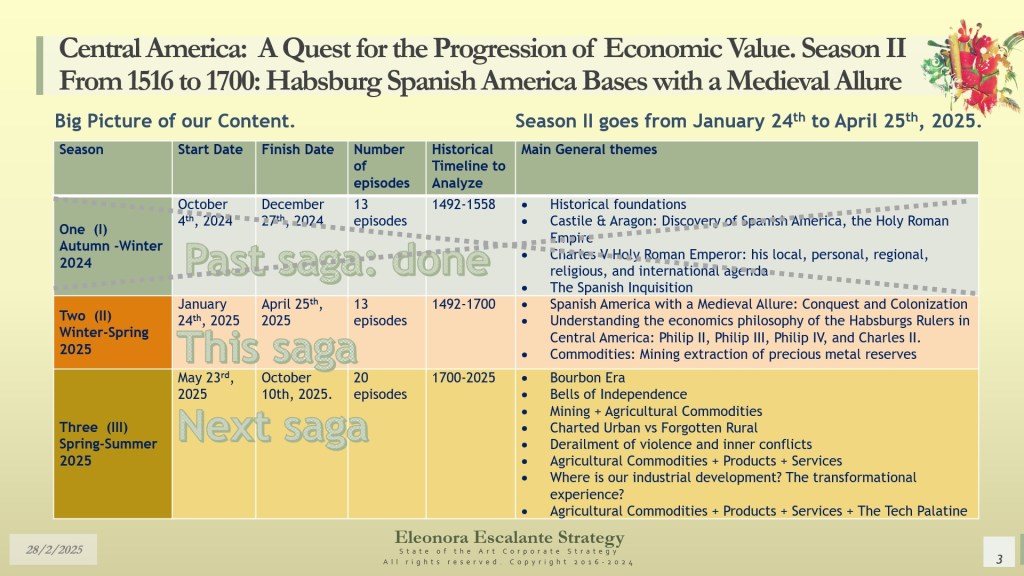
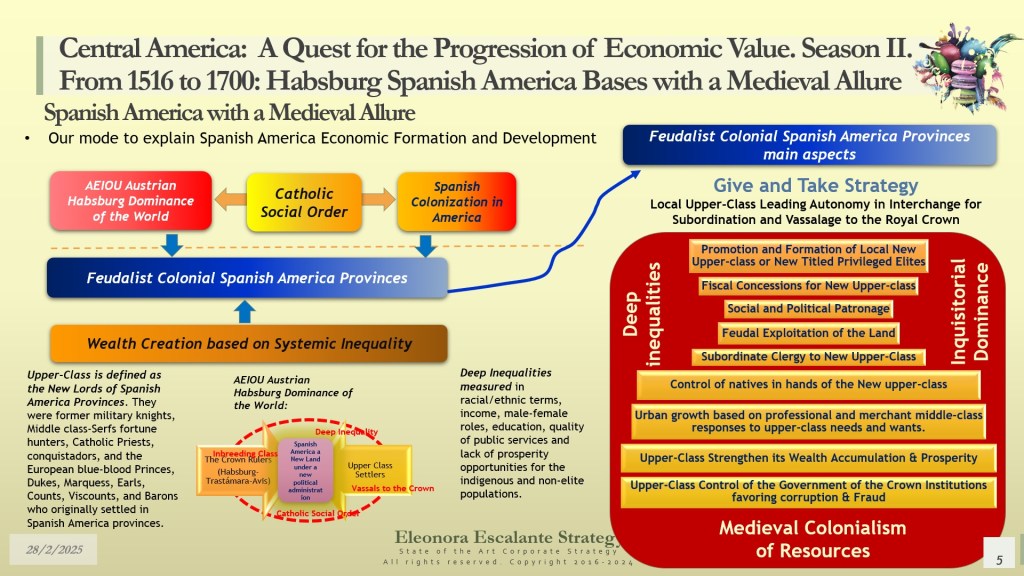
Let´s proceed to read and study our framework of reference material. Feel free to download, print, and share this package of slides with your friends and colleagues. It is loaded with interesting assumptions that we expect can open doors for future lines of research.

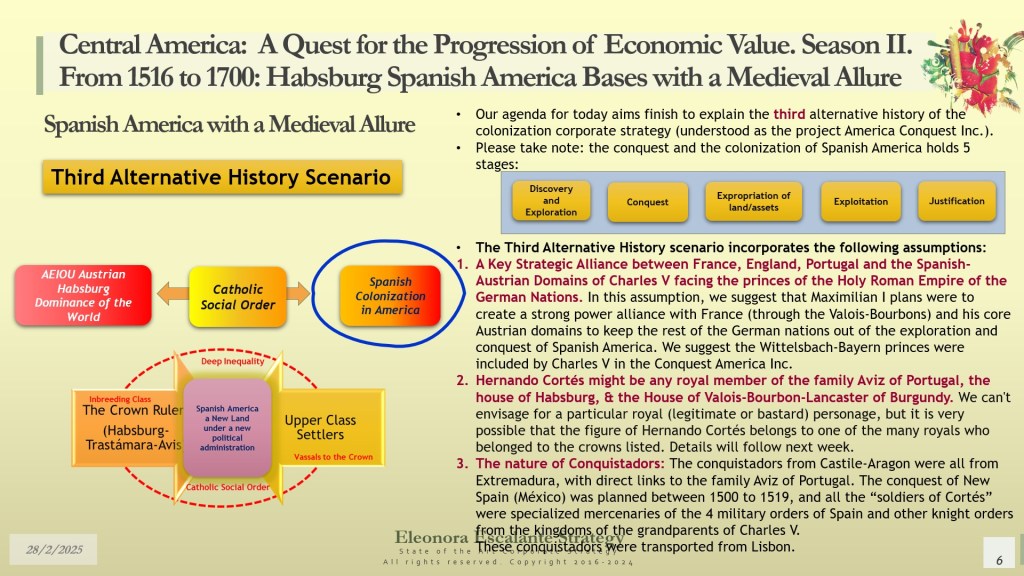





We invite you to return next Monday, the 3rd of March, to read our additional strategic reflections about this work-in-progress chapter. During the weekend, please prepare a list of your scrutiny training containing all your original thoughts. Write down whatever idea you might have envisaged while reading our document. Only then will you be able to compare your reflections with ours. When our reflections are ready, they will appear in the paragraph below.
Additional strategic reflections (added on Monday, 3rd of March).

México.
https://www.medellinhistoria.com/medellin/08%20PERALES%20P.%20VISION%20ESTETICA%20DE%20LA%20FIGURA%20DE%20CORTES.pdf
- The coat of Arms of Hernando Cortés:
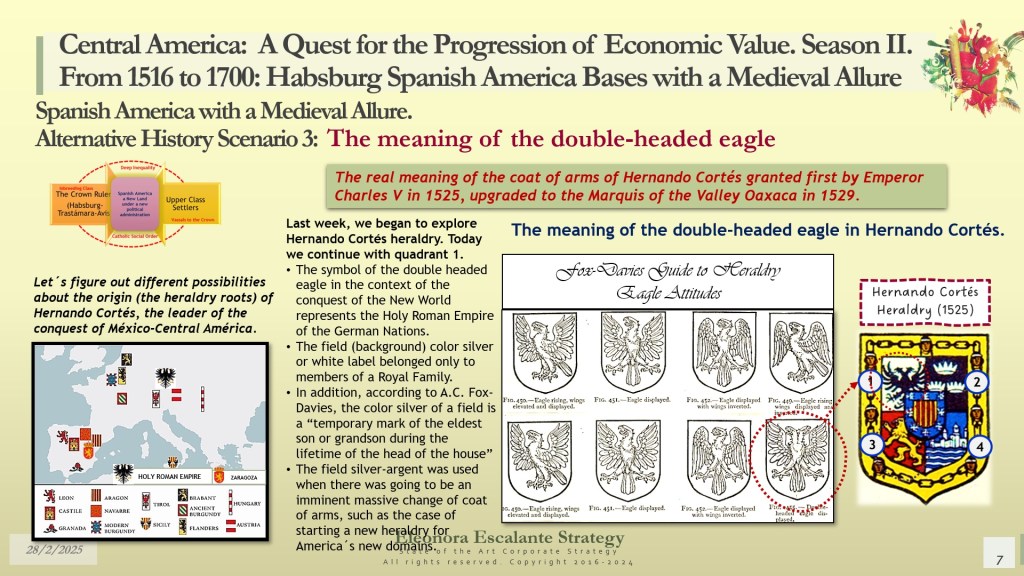
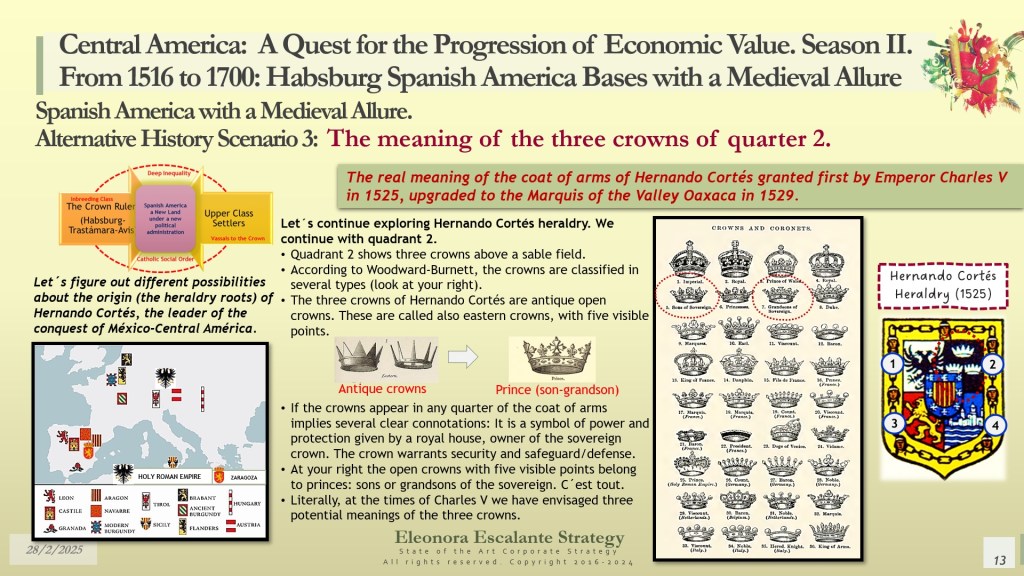
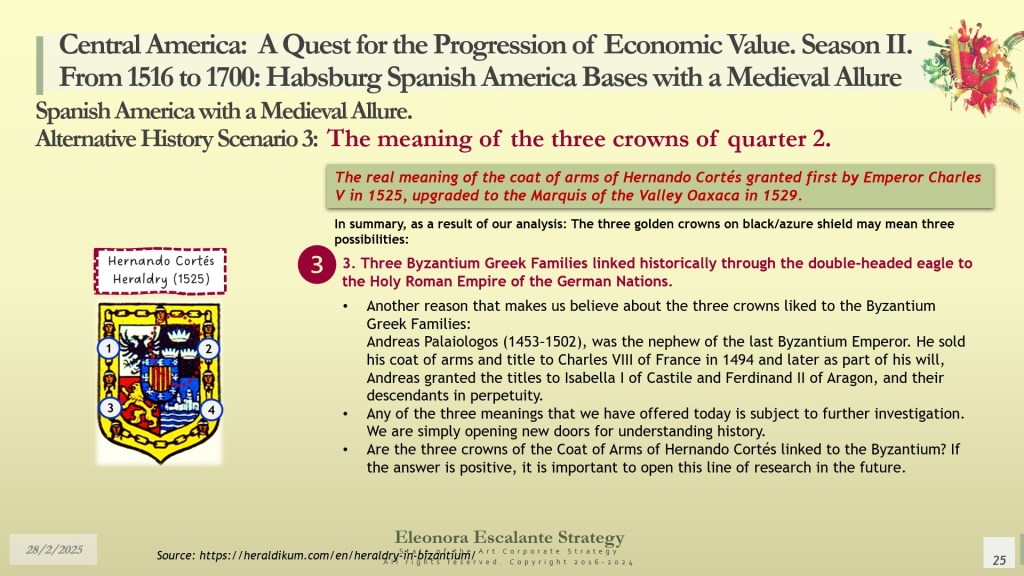
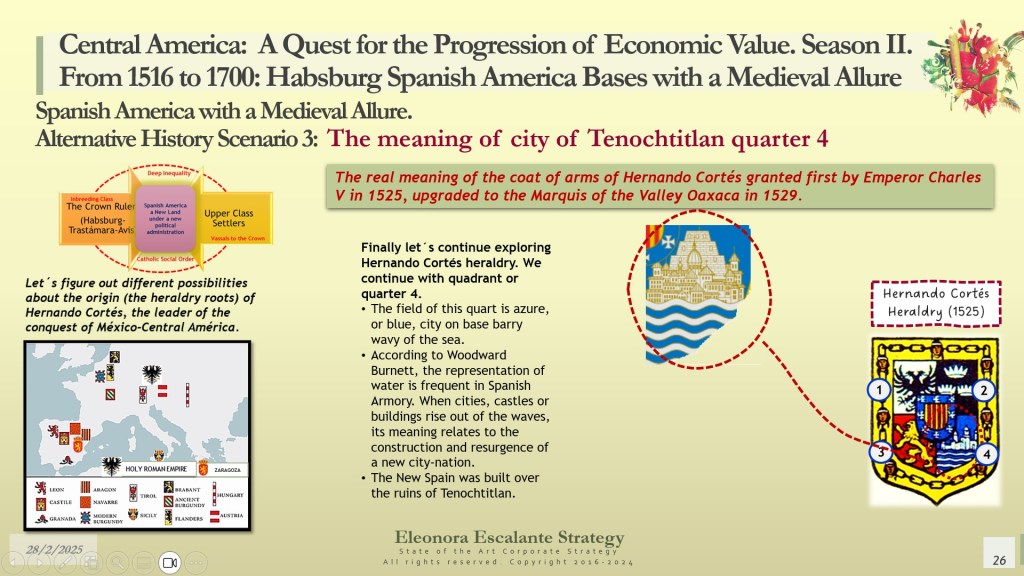
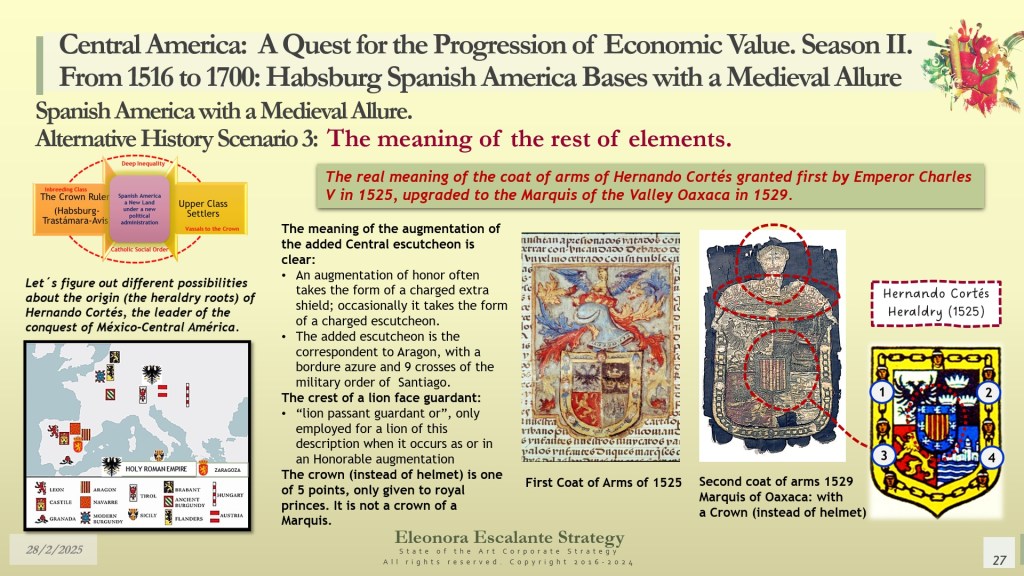
How can we describe the coat of arms of Hernando Cortés? Let´s read the image above of 1529: A bordure or, charged with a chain sable and 7 Indian’s heads proper, within this quarterly: 1st quarter, field argent, a double eagle sable; 2nd quarter, sable, three (eastern?) crowns argent; 3rd quarter, gules, a lion rampant or; 4th quarter: azure, a city argent above waves azure and argent. In the center of all this, a smaller inescutcheon: within a bordure azure charged with crosses argent; or, four pallets gules.
About the crown located above the Coat of arms: The open crown of Hernando Cortés belongs to a royal one of 8 points; from these, only 5 are visible points or peaks. On top of the prince crown of Hernando Cortés, there is a rampant lion at the crest position. This type of crown was generally situated over the coat of arms of the sons or grandsons of sovereigns. The difference between the coronet of a marquess and the crown of a prince is that the marquess coronet has 3 visible points and 2 intermediate shorter alternate points ending in pearls (these are called cusping supporting a pearl or smaller foliation). Most of the royal open crowns of the 16th century generally had 8 points, of which 5 are visible peaks or points ornamented with strawberry leaves or fleurs-de-lis. Depending on the dynasty, the design of the peaks for princes (or princesses) was slightly different in the details, but all the 8 points were of the same height (only 5 visible), using conventional strawberry leaves (feuilles de ache), alternated or not with crosses-patée, or fleurs-de-lis.
The face of the guardant lion at the crest position above the crown is only reserved for those who had a royal lineage and who demonstrated merits and accomplishments only reserved for those of honor position according to the monarch who granted the heraldic achievement. - This episode incorporates a deep analysis of several “hidden” contextual meanings of the coat of arms of Hernando Cortés.
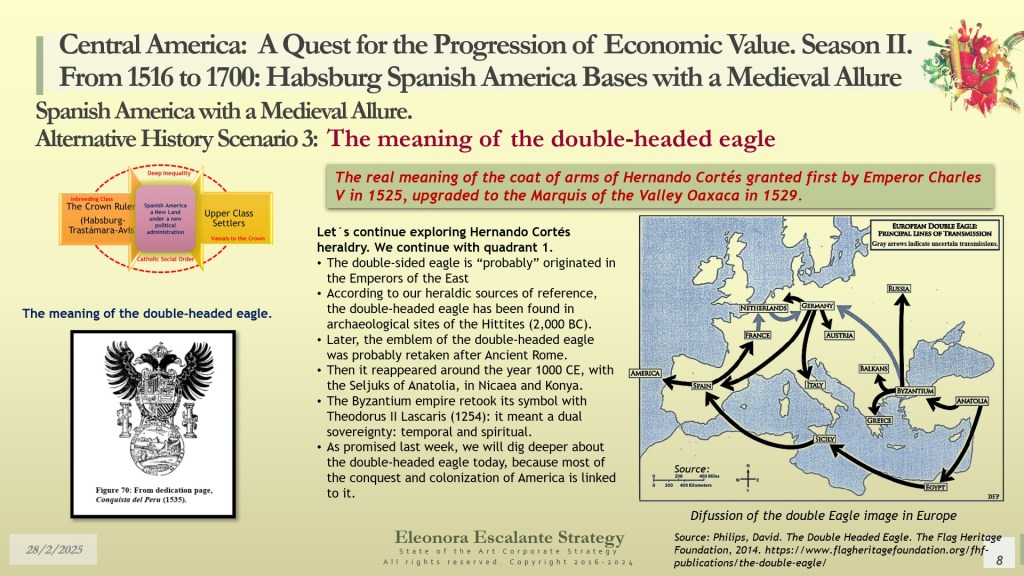
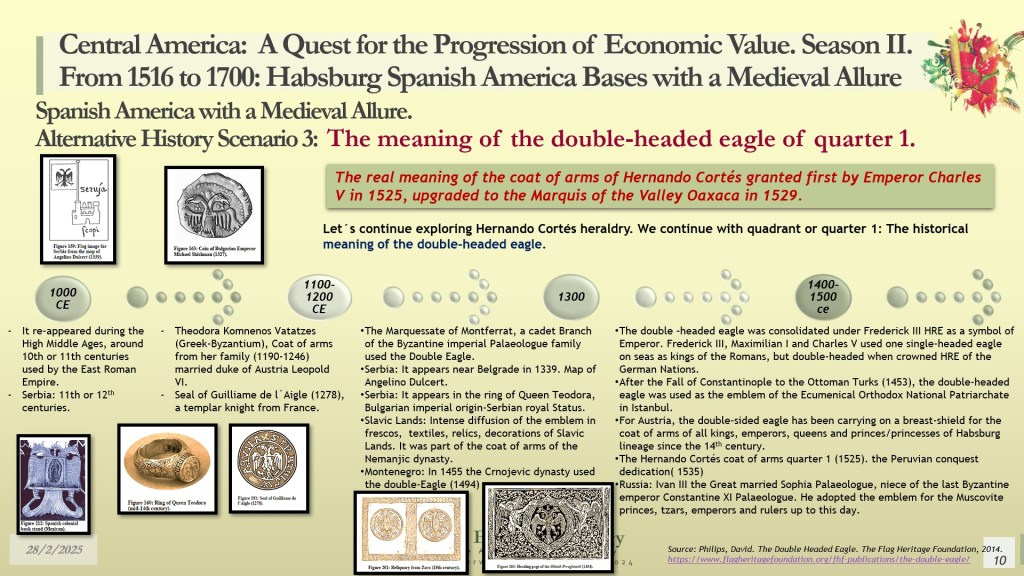
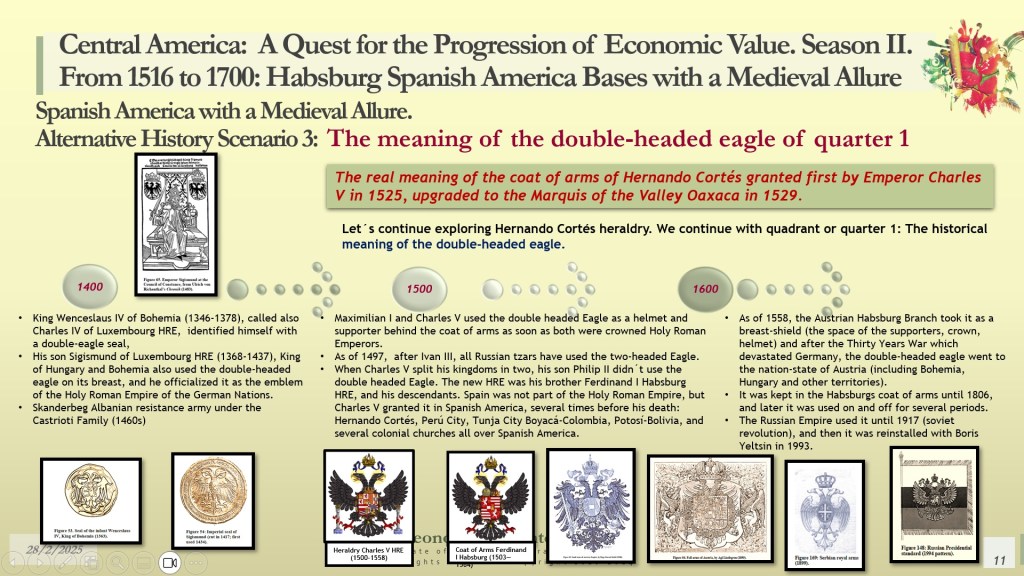
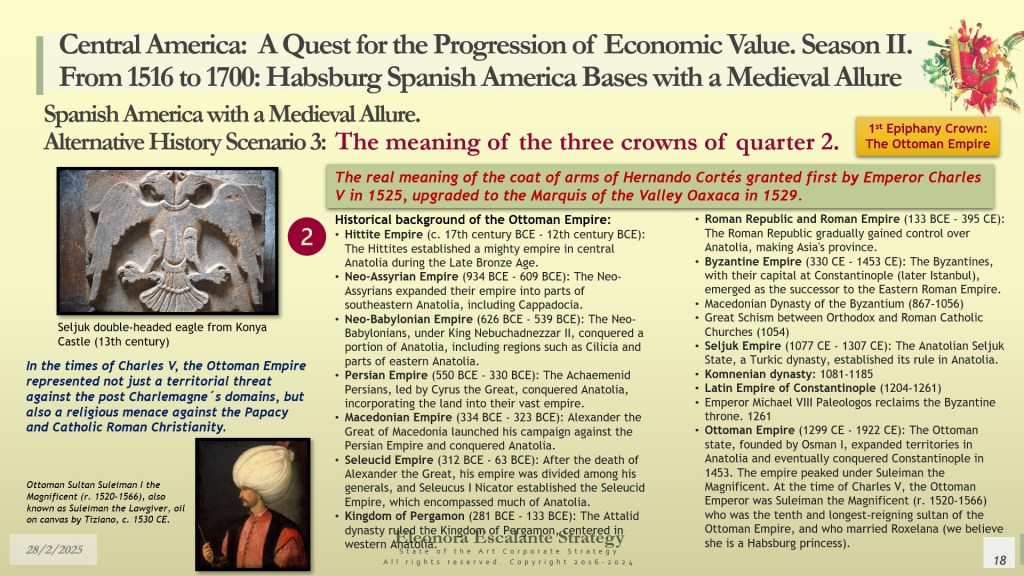
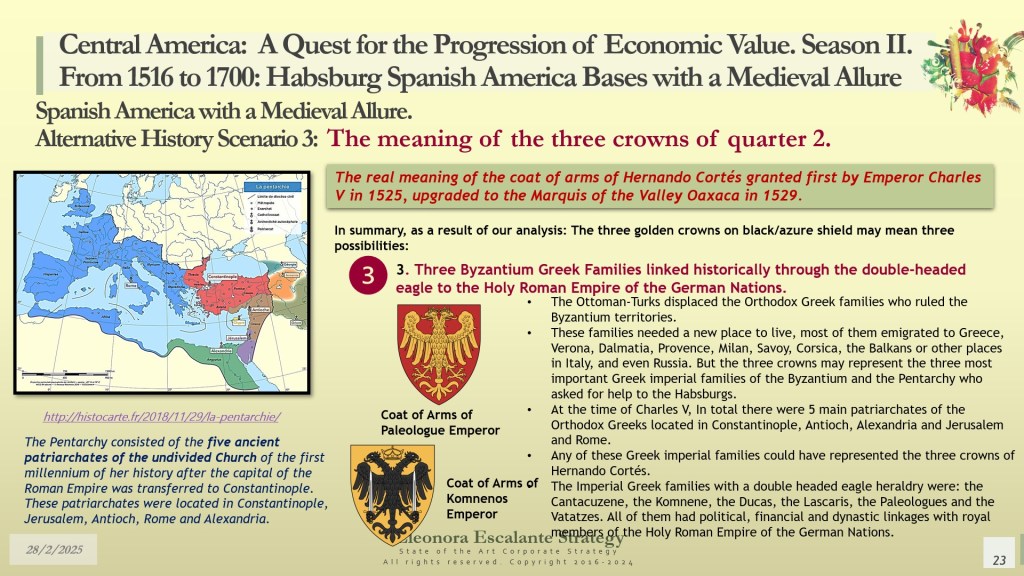
Our hypothesis is that Hernando Cortés wasn´t an adventurer soldier of Extremadura. He was the result of a swap identity strategy, in which this name was used by a member of a royal house with credentials to lead the conquest of México between 1519 and 1521. At the same time, the Spanish rulers were threatened by the expansion of the Muslim Infidels in Europe. When the Ottoman Empire conquered Constantinople in 1453, their growth continued to the East and the West. The Byzantium emperors and respective families were linked to the Holy Roman Empire of the German Nations, not just by dynastic marriages but also through the patriarchates of the Byzantine Orthodox church. The Pentarchy consisted of the union of 5 ancient patriarchates of the undivided Church of the first millennium after the capital of the Roman empire was transferred to Constantinople. These 5 powerful patriarchates were located in Constantinople, Jerusalem, Antioch, Rome, and Alexandria. The Crusades were a response to the needs and wants of the Patriarchates. In consequence, when the Ottoman Empire took the Byzantium territories, any order from the Pentarchy was a priority for the Holy Roman Empire of the German Nations. It is likely and viable that the Greek Imperial families of the Byzantium moved into Germany when the Habsburgs adopted the double-headed eagle as their main heraldic identifier. - The meaning of the double-headed eagle in quarter 1.
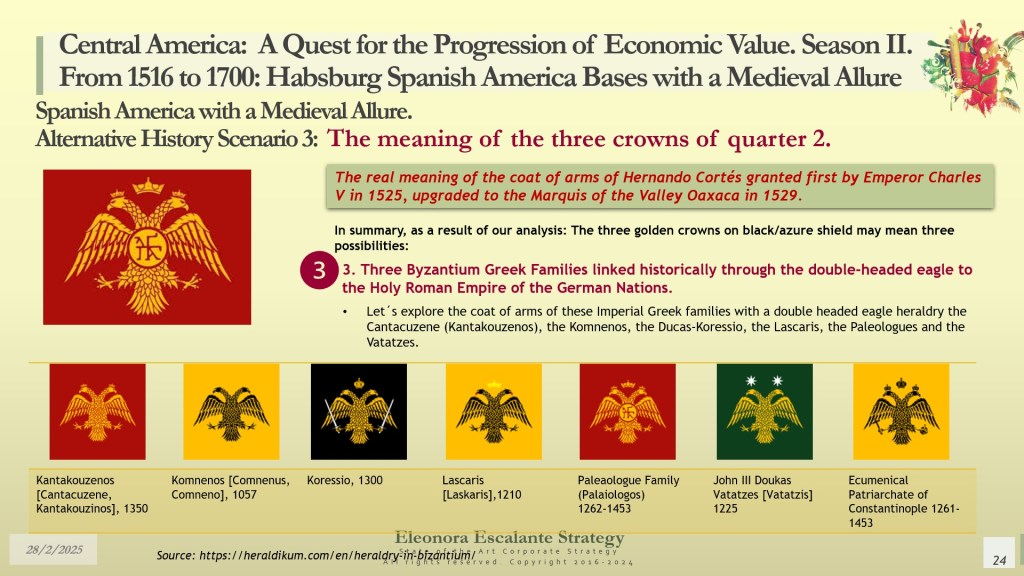
Slides 7 to 12 are dedicated completely to the symbol of the double-headed eagle. We explain with full details the origin of it (Hittites), how this was adopted by the different kingdoms of the region of Anatolia, Nicaea, Konya, and later by the Greek Imperial families of the Byzantium. We have shown you the distinct heraldic representations from 2500 BC to 1500 CE. In summary, this symbol was used by the different kingdoms associated with the region of what is now Turkey, Syria, Iran, Northern India, and the Levant. Then, it was wind down to Imperial Habsburgs and Russia through the Greek Paleologue, Komnene, and Vatatzes family. How did Hernando Cortés get in quarter 1 of his coat of arms, a double headed eagle too? Why on a silver field? This wasn´t a symbol of nobility; it was an Imperial heraldic achievement granted by Charles V Holy Roman Emperor, not as propaganda, but as an essential recognition of his own royal identity. Slide 12 shows our statement regarding quarter 1. - The mean of the three crowns of quarter 2.
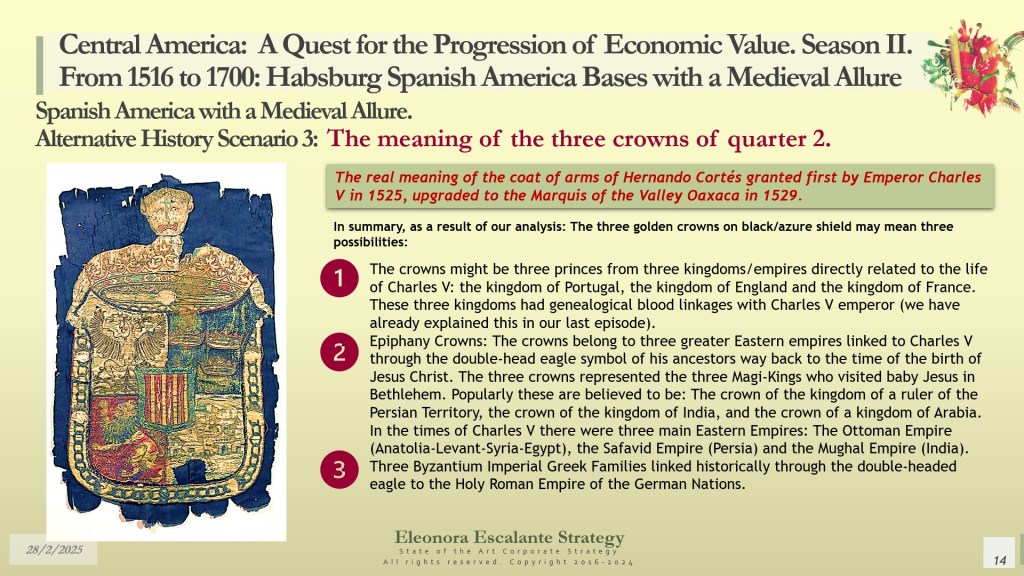
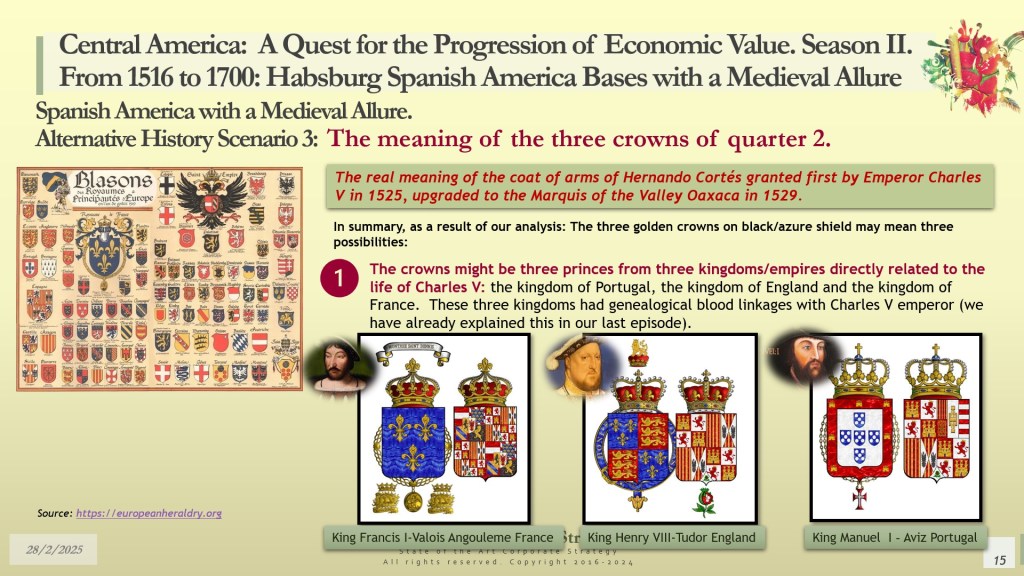
Slides 13 to 26 are extremely significant for us. We have added three additional possibilities to the meaning of the “three golden crowns on sable field”. The color of quarter 2 is sable (black) according to the official description of it. The knight-princes with an armour noir were coming from Germany (they were called Black Riders or Schwatzeriters). The same Charles V used a black armour with bordures in gold, in several of the Titian paintings. Concerning the meaning of the three crowns, we already discussed the possibility of the Kalmar Union (Sweden, Norway, and Denmark) in our last episode. However, today, we have added three extra alternatives:
- The three crowns represent the Kingdom of Portugal, the Kingdom of England, and the Kingdom of France. This scenario was discussed last week, given the genealogical analysis of the family of Charles V HRE. See slide 15 for further reference.
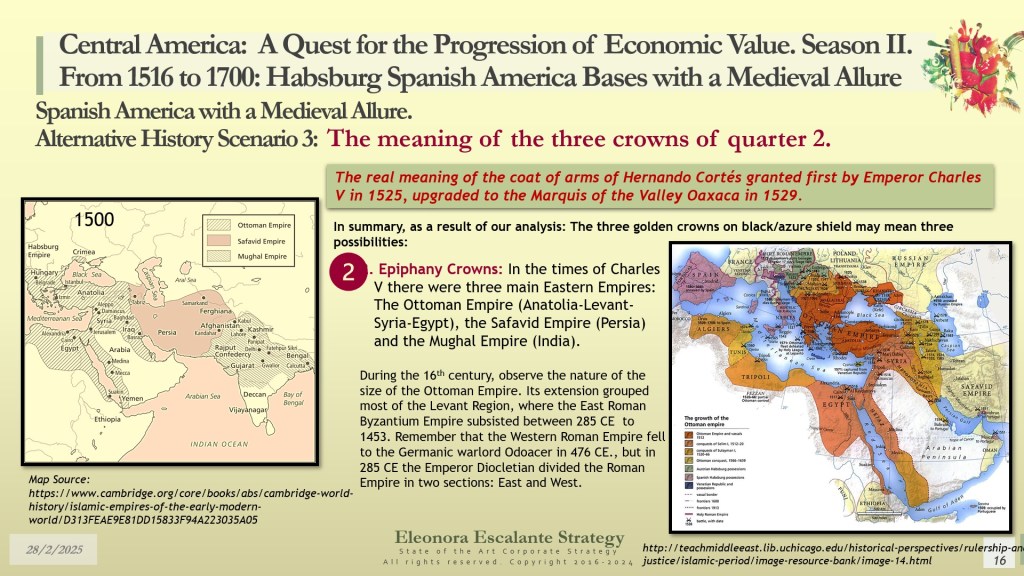
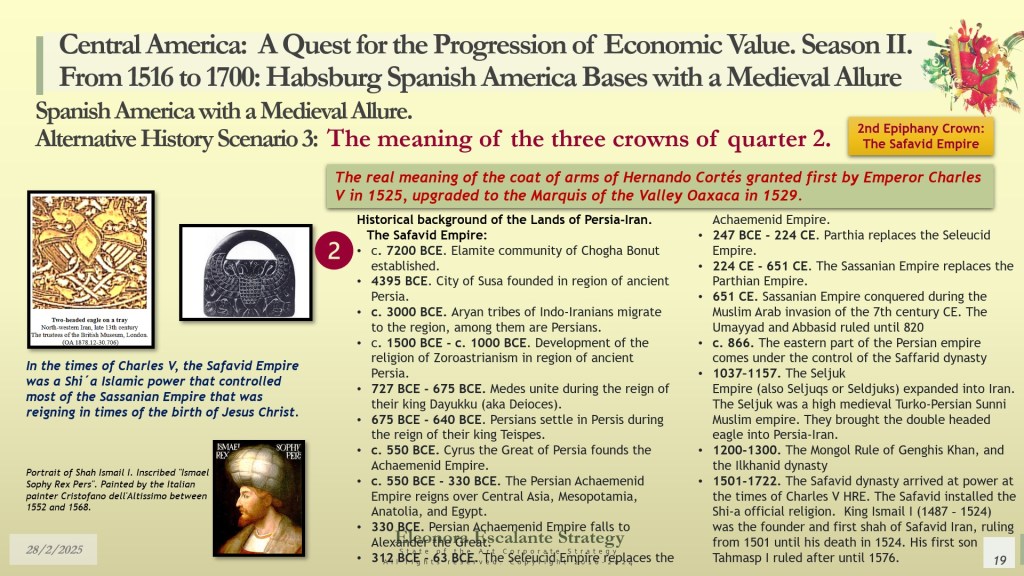
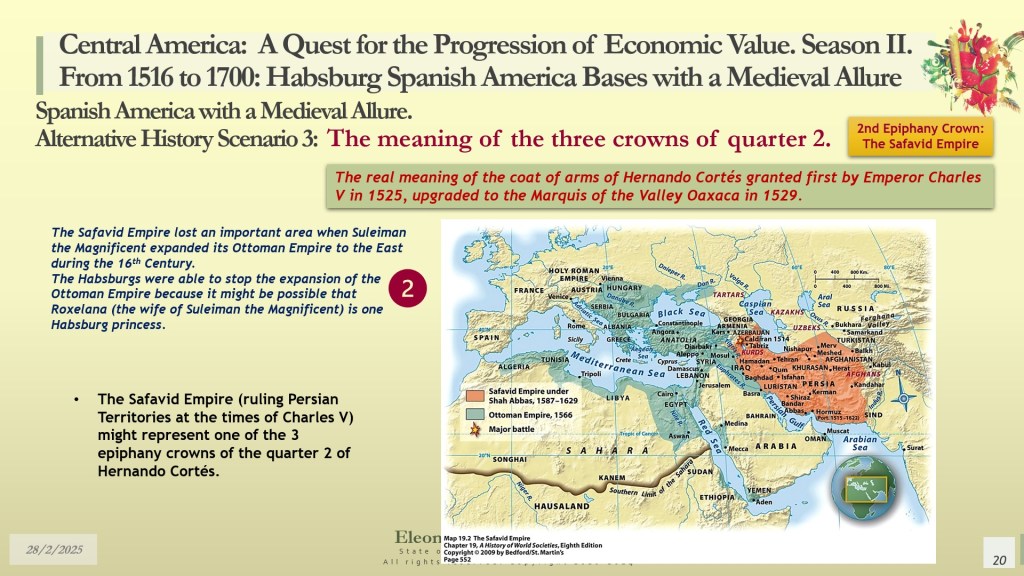
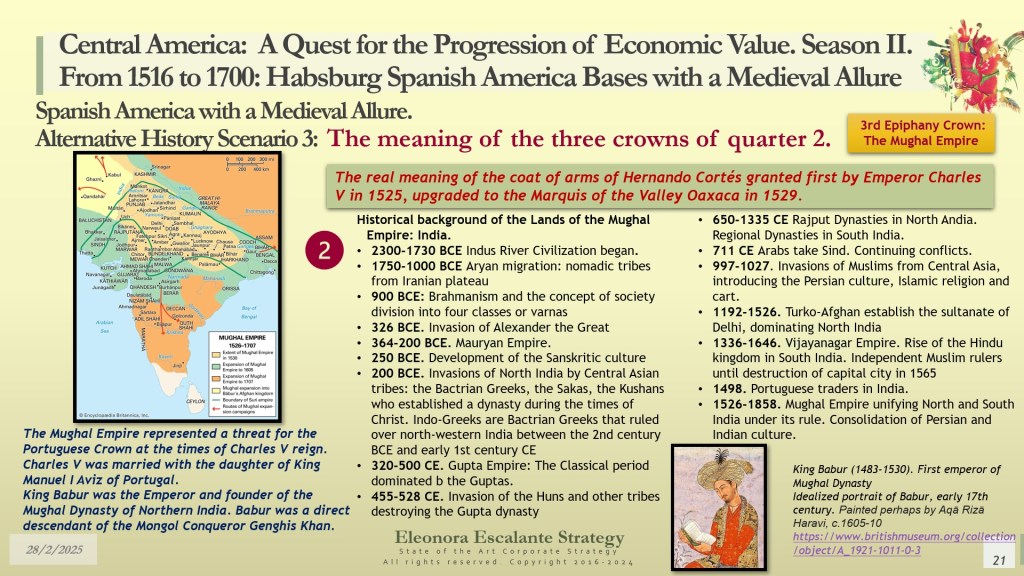
- Epiphany Crowns: We have pursued the historic representation of the visit of the three magi-kings to baby Jesus in Bethlehem. This is the official meaning of the coat of Arms of Lima, too. We offer a long explanation of how the three main Eastern Empires at the time of Charles V may be entangled with the fate of New Spain and Perú. See slides 16 to 22.
- Three Byzantium Greek families´ Crowns: This alternative came because of our interpretation of the Pentarchy and its linkage to Rome. During the first millennium after Christ, the East Roman Empire was Catholic, not Orthodox. The Great Schism that divided the East from the West occurred in 1054 CE. “The Eastern theology had its roots in Greek philosophy, whereas a great deal of Western theology was based on Roman law”(1), but the Ecumenical Patriarchate of Constantinople was still powerful after the Latin Empire of Constantinople fell in 1261. There is a connection between the Greek Imperial Families and the Habsburgs (genealogically explained), but at the same time, it is very possible that Charles V could have taken them into account. See slides 23 to 25, please.
Our verdict is an approximation to the truth.
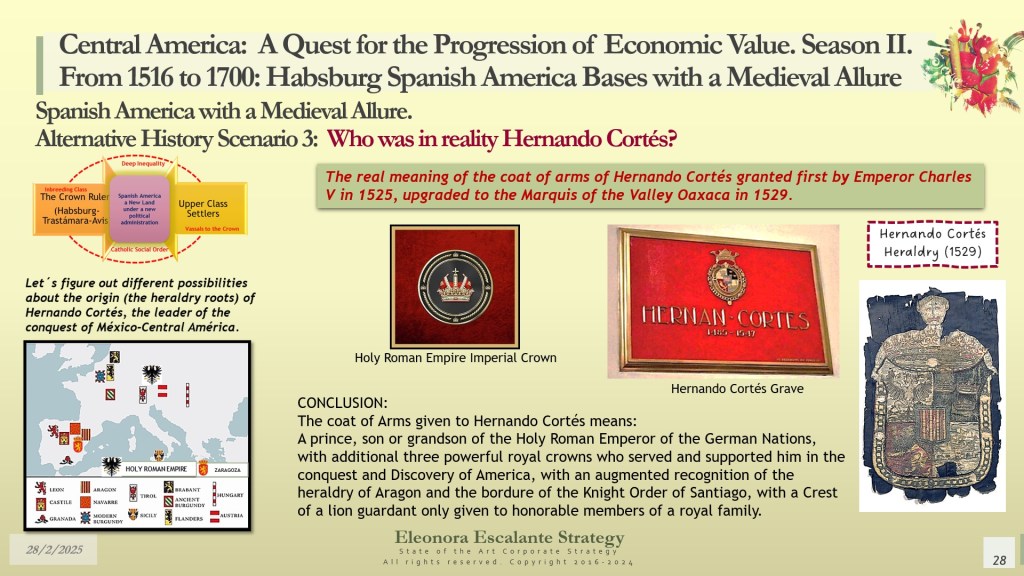
Slide 28 represents the approximated conclusion to all our last weeks´ work. The coat of Arms given to Hernando Cortés means:
A prince, son or grandson of the Holy Roman Emperor of the German Nations, with additional three powerful royal crowns who served and sustained him in the conquest and Discovery of America, with an augmentation inescutcheon support and recognition of the kingdom of Aragon as part of this latter domains. The azure bordure with 8 crosses of the best knights from all military Orders who fought to expel the Moors from Iberia (former Templar knights) also reaffirms that the conquistadores coming with the imperial prince who took the identity of Hernando Cortés were highly specialized and trained for it. All the military knight orders were reporting directly to King Ferdinand II of Aragon and later to his grandson Charles V. The lion guardant’s crest was only given to honorable royal family members. Can you guess who Hernando Cortés was? The answer is on your plate. Bon Appetit.
Announcement.
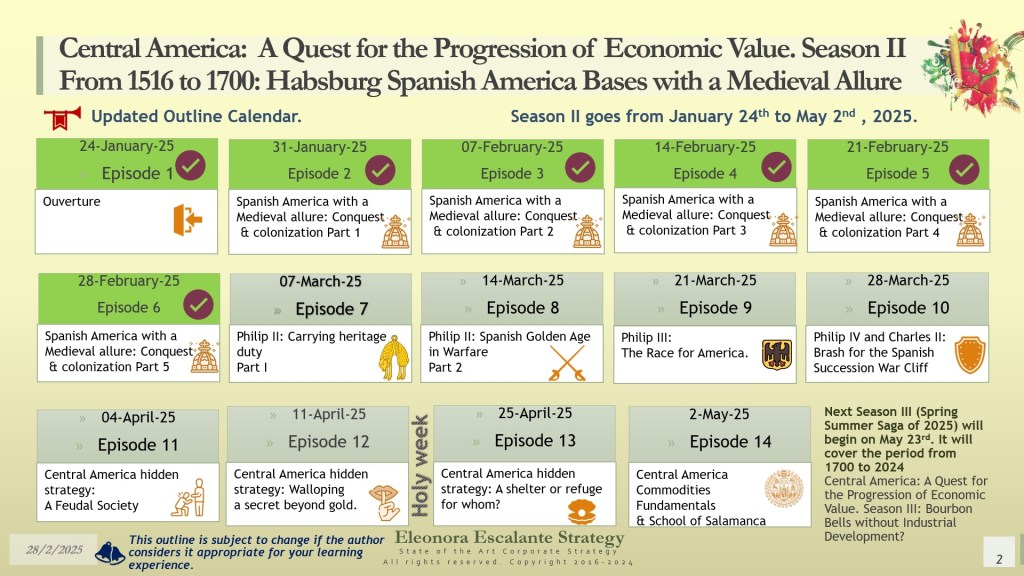
Next week, we will continue exploring the role of Philip II, king of Spain. Understanding Charles V’s legacy over his son, Philip II, is fascinating. We will dedicate two episodes to his corporate strategy with America. Our aim is to explore all the alternatives that might help us understand why Spanish America began as it did.
Musical Section.
Our selection of music during this saga will continue to explore adorable music produced between the 16th and 17th centuries. Season II is dedicated to the lute. Our choice for today´s episode is from the YouTube of the Chamber Music Detroit-Camera Music. This is a concert of Paul O’Dette, the “dean” of American lutenists. Enjoy it.
Thank you for reading http://www.eleonoraescalantestrategy.com. It is a privilege to learn. Blessings.

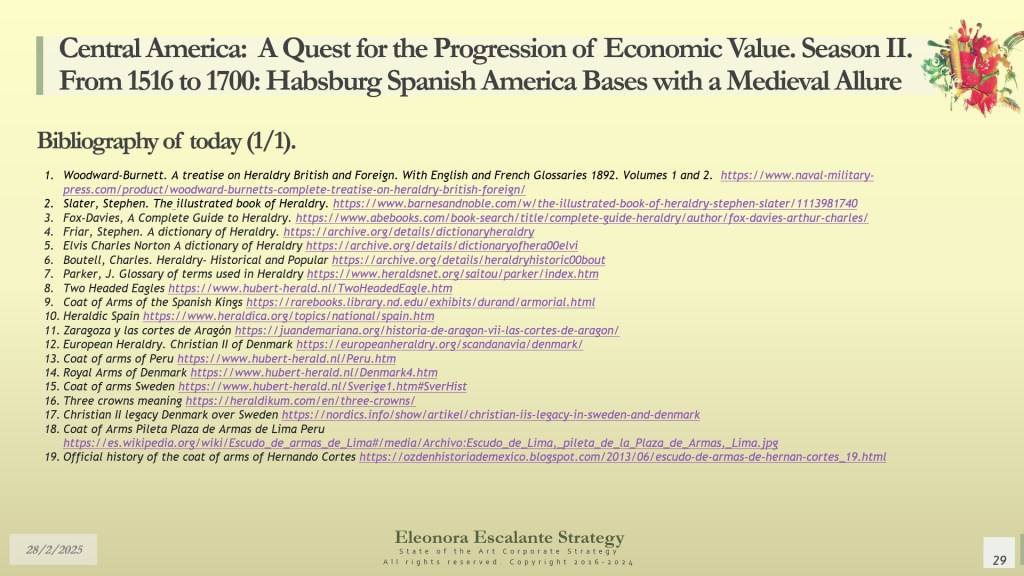
Sources of reference and Bibliography utilized today. All are listed in the document. We will add more over the weekend.
(1) https://www.britannica.com/event/East-West-Schism-1054
Disclaimer: Eleonora Escalante paints Illustrations in Watercolor. Other types of illustrations or videos (which are not mine) are used for educational purposes ONLY. All are used as Illustrative and non-commercial images. Utilized only informatively for the public good. Nevertheless, most of this blog’s pictures, images, and videos are not mine. I do not own any of the lovely photos or images unless otherwise stated.
 Eleonora Escalante Strategy - Strategic Reflections Think Tank