
Central America:A Quest for the Progression of Economic Value Season II. Episode 7. Philip II: Carrying heritage duty
Dear magnificent readers:
We have decided to defer episode 7 until next week and merge it with the next episode 8. The reason: I am reading several books about the life of Philip II (1527-1598), and there are huge dissimilarities when comparing information. For the sake of the integrity of our analysis, we have convened to adjust the gears of our journey. King Philip II Habsburg-Aviz has been analyzed using several waves of radiographic assumptions. Historians can´t be so eclectic without a purpose. For us, it seems as if Philip II lived the life of the first architect of a new nation in the Iberian Peninsula, but we are elucidating the limits of his mental madness of governance suspicion, sometimes with an attribution of criminal, and his prudent cautiousness. There is a blurry line between the two arguments. Additionally, since Philip II was the result of an inbreeding marriage between Charles V Holy Roman Emperor and Isabella Aviz of Portugal, we can envisage some degree of natural apprehension intrinsically unfolded by the experts of this king’s endeavors. Philip II has been identified as a king of inquisitorial terror against the Netherlands and against English Protestants (while he was married to Mary Tudor-Aragon). It was under his mandate that the Catholic Counter-Reformation occurred. The implications of his decisions marked a distinctive style in the birth of Central America. We are busy filtering and gathering the right links to the truth. Since Hernando Cortés wasn´t the conquistador adventurer of “official history”, we are entitled to procure a proper reality for Charles V’s son, Philip II, at the moment. Just grant us some more days to land on our correct strategic hypotheses for Philip II. Thank you.
Please remember that the term Corporate Strategy in the context of the Conquest and Colonization of America is equivalent to military-warfare strategy to gain competitive advantage under the terms of Early Modern Europe in the 16th to 18th centuries (previous to the French Revolution).
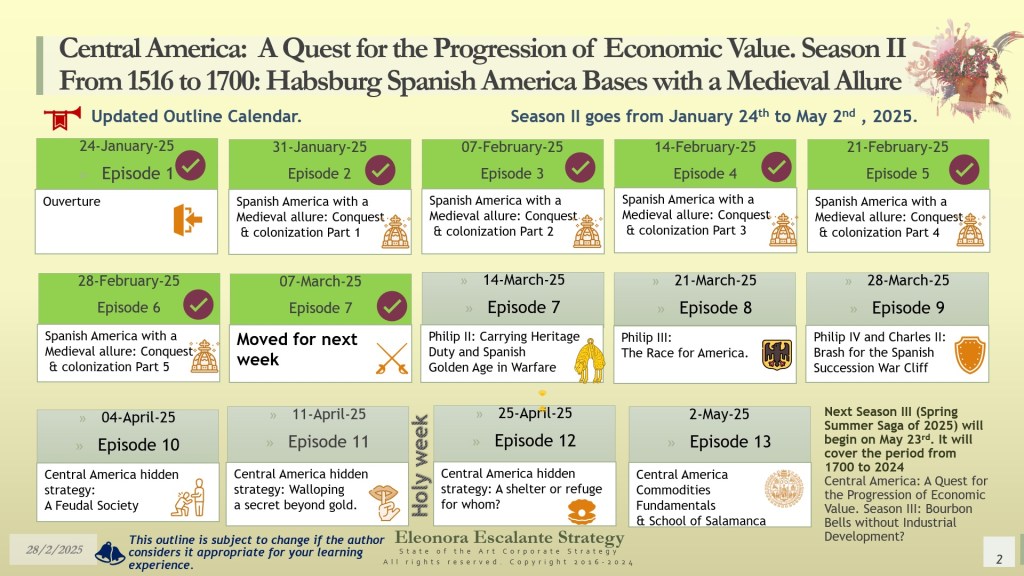
See you next week with a long episode, full of strategic reflections tailor-made for you. A bientot. Until next Friday, you are free to relax.
Blessings.
 Eleonora Escalante Strategy - Strategic Reflections Think Tank