
Central America:A Quest for the Progression of Economic Value Season II. Episode 8. Philip II: Spanish Golden Age in Warfare.
Dear adorable readers:
It is my pleasure to introduce the framework of reference for our episode today. We think we have covered all the relevant affairs of the life of Philip II (according to official history). No one knows, if the son of Charles V, continued with the approach to travel to Spanish America after his father’s death. Our strategy house believes that he might have been in America too. But let´s believe that Philip II was really the personage of our historians for the time being.
As usual, we encourage you to read our material during the weekend. Try to read the content of the books and papers in our bibliography. Feel free to pass this document on to your friends, colleagues, superiors, or students. Print it and write your ideas too.
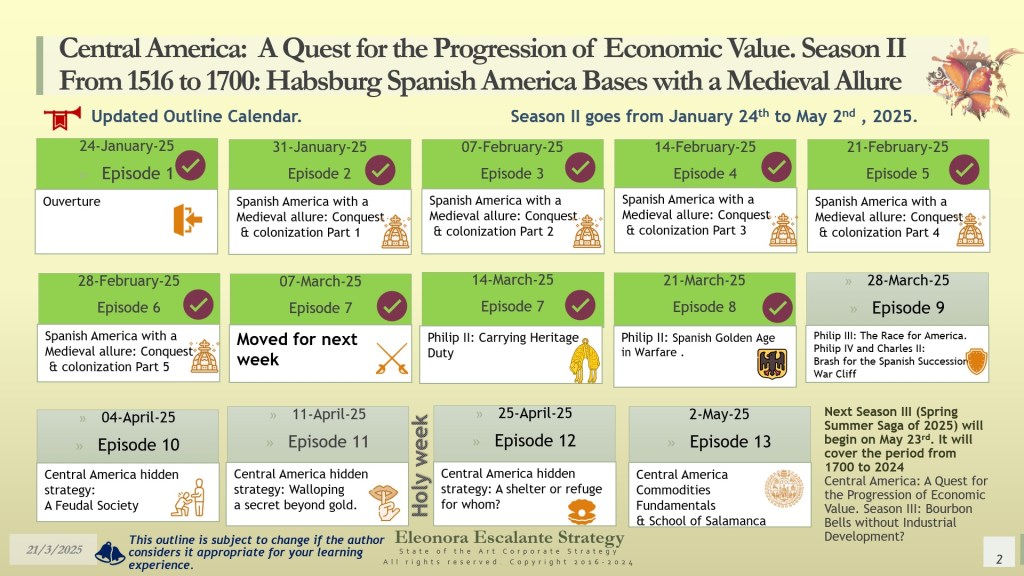








We invite you to return next Monday, the 24th of March, to read our additional strategic reflections about this chapter.
We encourage our readers to get acquainted with our Friday master class by reading the document of the slides over the weekend. We expect you to create your own ideas that might be strategic reflections. Every Monday, we upload our strategic inferences. These appear in the paragraph below. Only then will you be able to compare your own reflections with ours.
Additional strategic reflections (added below on Monday, 24th of March).
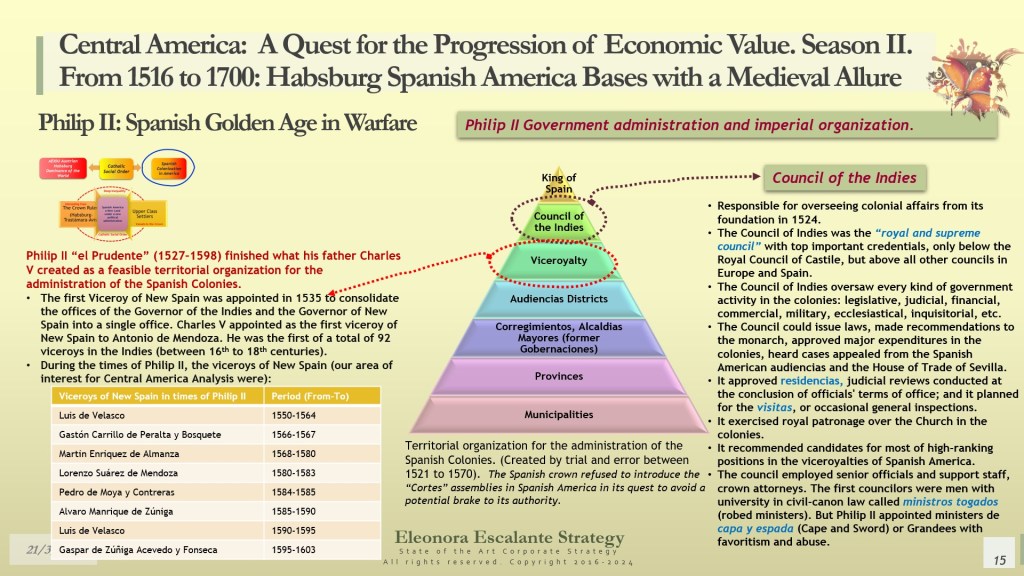
- The life of Philip II of Spain had a precise and unique impact on the economic development of Central America. His father, Charles V’s main achievement was the conquest of Spanish America under Austrian terms. At the same time, Philip II honed his achievements with the stamp of approval of the colonization of the American lands under the Viceroyalty of New Spain (including the Kingdom of Guatemala, the whole Central American region without Panamá), and the Viceroyalty of Perú. Please be aware that the colonization of Spanish America was made through the installment of “obispados” or bishoprics, and the Catholic Church played a pivotal role in the process. Most of the initial territorial divisions were performed by the bishopric’s limits of the missionaries, who were the real conquerors of the Indians.
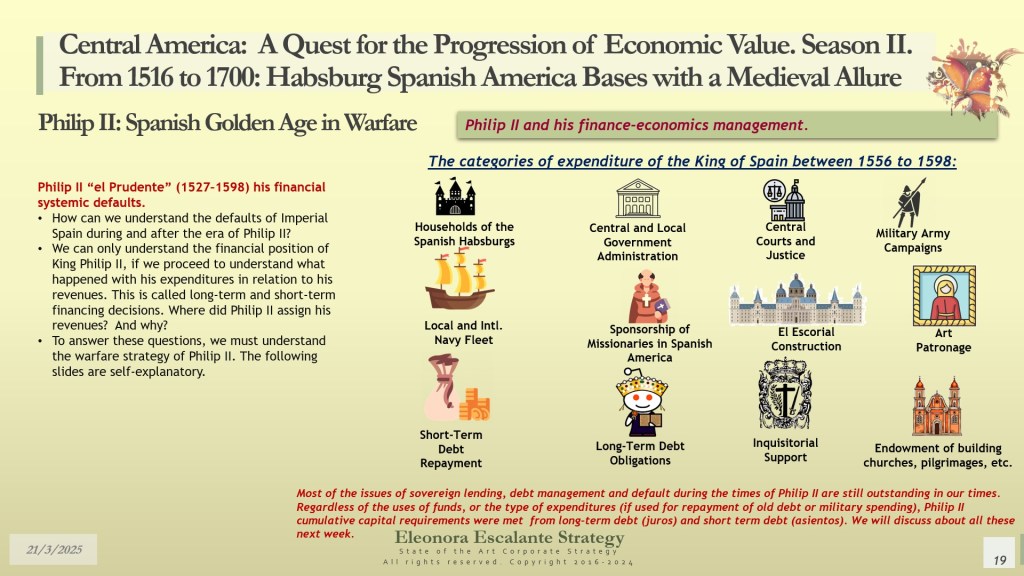
- Colonial Christendom: An important expenditure in the administration of Philip II was the sponsorship of the friars and missionaries who had not stopped coming since 1521. The Indians of our region were converted to Catholicism because the friars and catholic priests installed monasteries and built churches as evidence of their presence. Yet, it was through education that they touched on the most. Still, their passion for converting pagan souls was exceptionally talented, and their mission to educate the Indians about Christianity created the first global solution for translation and communication from the Castilian language to the multiple native languages they were encountering. The 16th century represented the first cultivation of the native civilization in the Americas by the form of Christianity. This occurred initially between the catholic missionaries and the autochthonous noble Indians. With time, the Catechism permeated all levels of the native population. The model of appeasement of Bartolomé de las Casas was so successful that even if Philip II´s colonists tried to modify it with his inquisitorial measures, the Las Casas pacification process was so ingrained in the priests doing evangelization in Central American, that most of the Mayan Nobility not only learned how to read and write in Spanish, but they indirectly protected their religious tutors (missionaries) too. The natives translated their sacred books into Spanish (sometimes in Latin) and carefully hid them from the Colonialist Spaniards. The Natives understood that if they wanted to survive, they had to play the rules of the game of the Spaniards. And if they wanted to preserve their history from the flames of being burned (1), they had to hide it. One of the disadvantages of the colonization of the Catholic friars was the Inquisition, and depending on the bishop’s turn, this was never exercised fully, or sometimes a bit more or less, during the period of King Philip II.
- Communication for religious conversion. The friar’s religious conversion was done in the original Mexican Nahuatl, the Zapotec, and the Mayan languages, etc. It was of deep interest to the friars, who learned the Indian languages as soon as they settled, to spread Spanish and keep the missionary zeal for colonial Christendom in every Indian village. The Catholic Church representatives were trained to perceive any reversion to the old Indian practices, and they were ready to stop any type of Indian sorcery practice through inquisitorial methods or terror measures. One of the most notorious inquisition events of native Mayans was led by the bishop of Yucatán, Fray Diego de Landa, in the 1560s (2). During the period of Las Casas in Chiapas, the bishops had intense conflicts with each of the main cities’ governors.
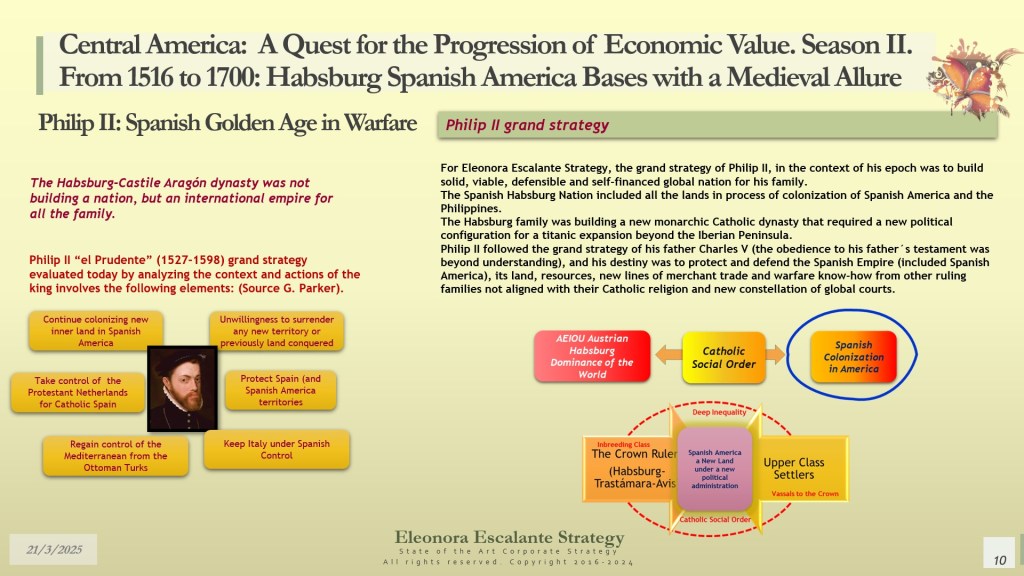
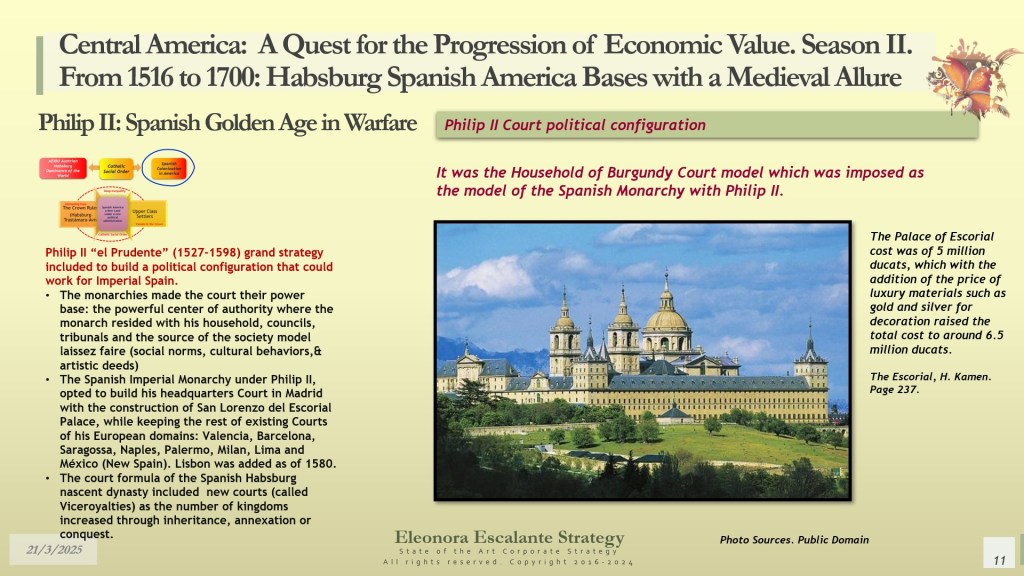
- The Grand Strategy of Philip II: Without the colonial Christendom mission of the Catholic Church, the Spanish Monarchy couldn´t have fulfilled the grand strategy of Philip II in the New World. See slide number 10. Philip II´s operation in Spanish America wasn´t only to colonize for the mere fact of adding land and extracting precious metals. His governance in the New World was a fate written by his father, Charles V, and he was obliged to ensure the evangelization of the Indians as an “essential” part of the colonization process, because Philip II was preparing the land for his Habsburg successors. God´s glory was seen “in terms of number of conversions”(3). The importance of any new Spanish Settlement stemmed from the expansion of itinerant missionaries to outreach to Indian territories. Let´s see one example in Guatemala: Once the Indians were acknowledged as human beings who should not be treated as slaves (Pope Paul II issued a papal bull in 1537 affirming the rationality of the Indians), Fray Bartolomé de las Casas started to work as a missionary in Northern Guatemala. He was named bishop of Chiapas in 1543, and he kept going back to Spain to debate with theologians from Salamanca, to demonstrate to Charles V´s team that Indians had souls, and deserved to be treated with respect. The impact of Las Casas continued to press for changes to Philip II. But Charles V foresaw these problems before his death, and he was wise enough to back up the church mission in Spanish America with the Pope. When Pope Paul III issued the bull “Sublimis Deus” in 1537, which condemned the enslavement of Indigenous peoples and affirmed their rights, he allowed not only the possibility to keep the legacy of Bartolomé de Las Casas in Chiapas and the Kingdom of Guatemala. Las Casas was able to create a league of cooperation with the rest of the bishops on behalf of the Indians, which included Cristóbal de Pedraza-Bishop of Honduras 1545-1583; Pablo de Torres-Bishop of Panamá 1547-54; Juan del Valle, Bishop of Popayán, New Granada 1548-1560; and Agustin de Coruña, his successor. On the other side of South America, the Jesuit missionaries arrived in 1549 to establish a new colony at São Paulo in 1554. The work of the Jesuits began also in Mexico and Paraguay, at the same time as in Brazil. The strategy of the Jesuits to facilitate the evangelization of the native guaranis was the reducción, a closed settlement that protected the Indians from Iberian, mostly Portuguese raiders who were in search of slaves. Not all the Catholic missions were fighting for the human rights of the pre-Hispanic populations. Except for some Dominicans and Jesuits, most of the catholic monastic orders were serving the colonial Imperial power and backed up the exploitative practices.
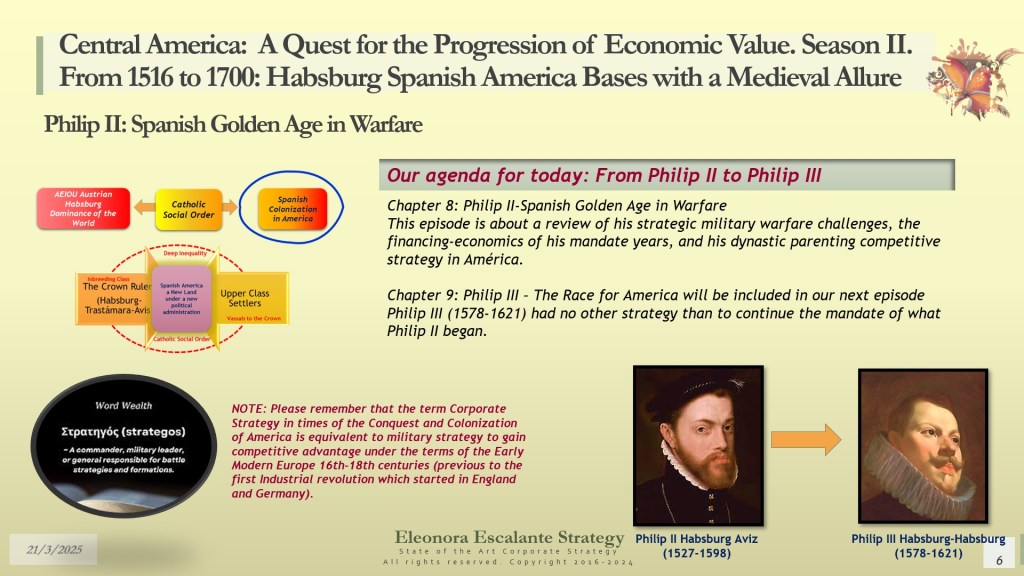
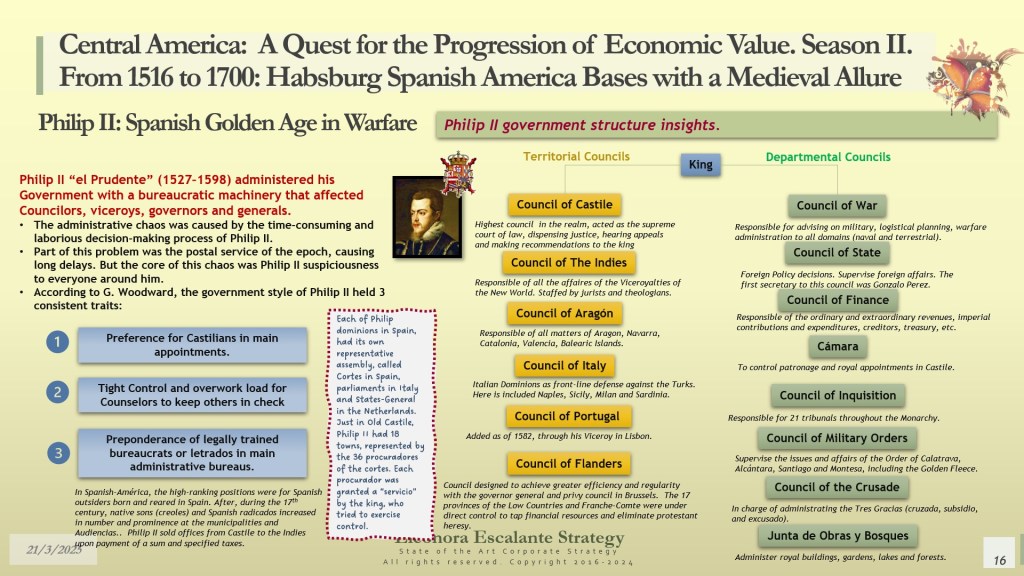
- Philip II’s life of warfare was a virtual extension of his father Charles V. Philip II was forced into warfare without his real attendance. He was reluctant to leave Spain after 1559. So, he managed his conflicts under remote control. Between 1543 to 1598, he inherited disharmonies as a heritage from his father, and he created new constant disagreements with the Low Countries. However, Philip II did not directly participate in them. Philip II delegated his presence in war to others. He broke the rule of the medieval chivalric warrior king and swapped it for the architect king of his domestic bureau. Philip II was a king of written letters and paper. The improvements to the International Castile Post office were made by him because he wasn´t the type of king who wanted to leave Iberia. When Philip II succeeded Charles V, his last direct participation in warfare was to put an end to the Valois-Habsburg battles that started with Maximilian I over the Italian territories. As a result, a marriage arose as a pact of peace between both families. Philip II married his third wife, Elizabeth Valois-Medici, in June of 1559. Slide 7 shows us the importance of the two daughters of Elizabeth Valois-Medici in the life of the king: Isabel Clara Eugenia married Albert VII of Austria, and Catalina Micaela married Carlo Emanuel I, Duke of Savoy. These dynastic marriages were the solution of Philip II, first to contain the conflict in the Spanish Netherlands, and second to stop new conflicts in the Savoy-Italian territories. Both daughters played a political role during the 16th century, beyond the role of mothers and princesses.
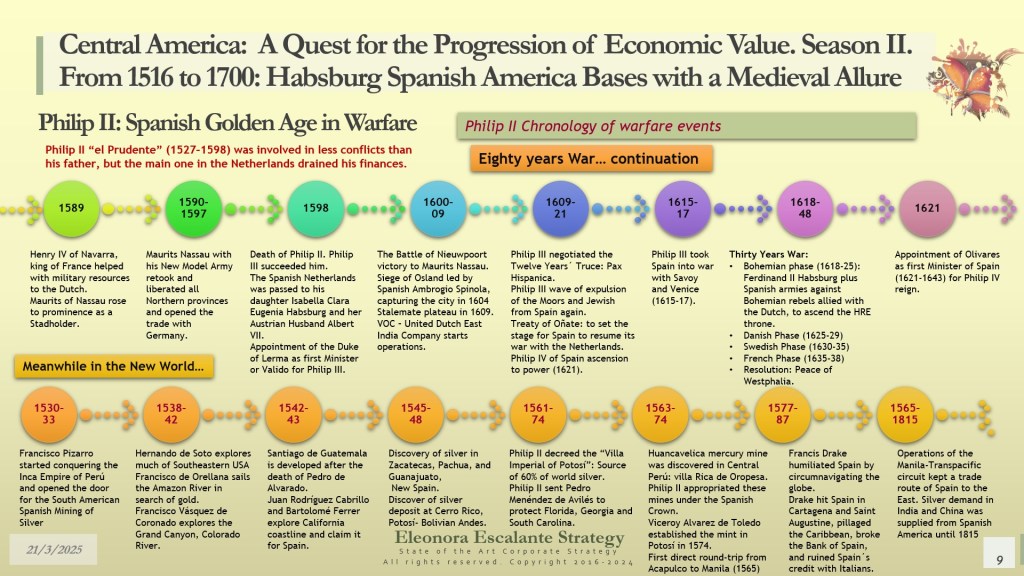
- The Eighty Years War (1566-1648). Slides 8 and 9 describe a chronology of warfare events for Philip II. Of all the clashes surrounding the life of the king, the most important for Philip II was the war of independence of the United Provinces of the Netherlands from Spain (4). It began with the “Revolt of the Low Countries” in 1566, in the same decade that the process of amalgamation of silver with mercury was introduced in the mines of México and Perú. In addition, the Jesuits entered Brazil to procure the “reduccion” settlements with the natives. It was during this decade that Philip II sold most of the municipal offices in Iberia to the Indies in his efforts to keep the municipalities from being collateral for his bankers. The relevance of the 1560s was the discovery of the Philippines as a point of trade with Asia: it was during this decade that Philip II designed and established the foundations of the future regular trade between Perú, México, Manila, and Spain. On top, the Kingdom of Guatemala was raising the bar in terms of religious infrastructure supported directly by Philip II. The details of the conflict between Spain and the Netherlands are described chronologically, and there is a link to the Thirty Years War with Philip III (his son).
- First primogeniture was crushed. Don Carlos (1545-68), was the first son of Philip II and María Manuela Aviz Habsburg. He died in mysterious circumstances after being blamed for treachery and mental instability. Historically, there is a debate about the motives of Don Carlos’s death: from starvation to poisoning (5).
- Elizabeth I of England. Elizabeth I of England ascended to the Throne the same year that Philip II married Elizabeth of Valois-Medici. In an unexpected turn, Elizabeth I allied with the Sea Beggars of the Low Countries, and she began to support the Dutch against Spain. As a response, Philip II annexed Portugal and its colonies to his domains. During the 1580s, Elizabeth I sponsored Sir Francis Drake, who captured galleons and treasure ships off its main ports in the Caribbean: Drake attacked Vigo, Santo Domingo, St. Augustine-Florida, Cadiz, Lisbon, and several Spanish Armada warehouses. In 1588, the Spanish Invincible Armada against England was defeated in the English Channel. The conflicts in the Atlantic by sea were a norm provoked out of England after Philip II’s trade routes. It was during this period (1580-1603) that the Dutch invested heavily in the development of their Asian trade navy. The East India Company from England sent its first expedition to Sumatra in 1601; while the Low Countries VOC ( Vereenigde Oostindische Compagnie or United East India Company) began its tea trade with China in 1609.
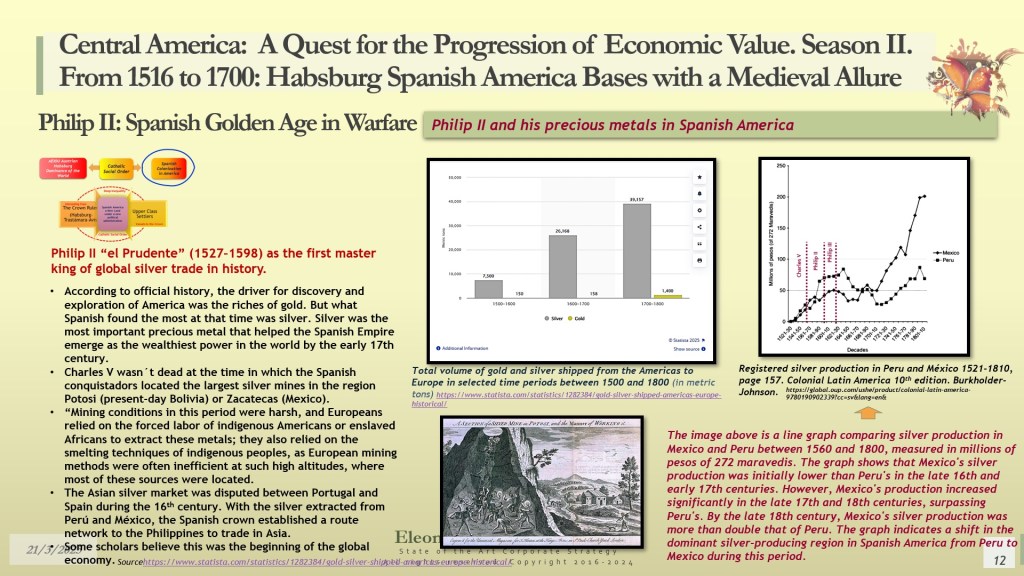
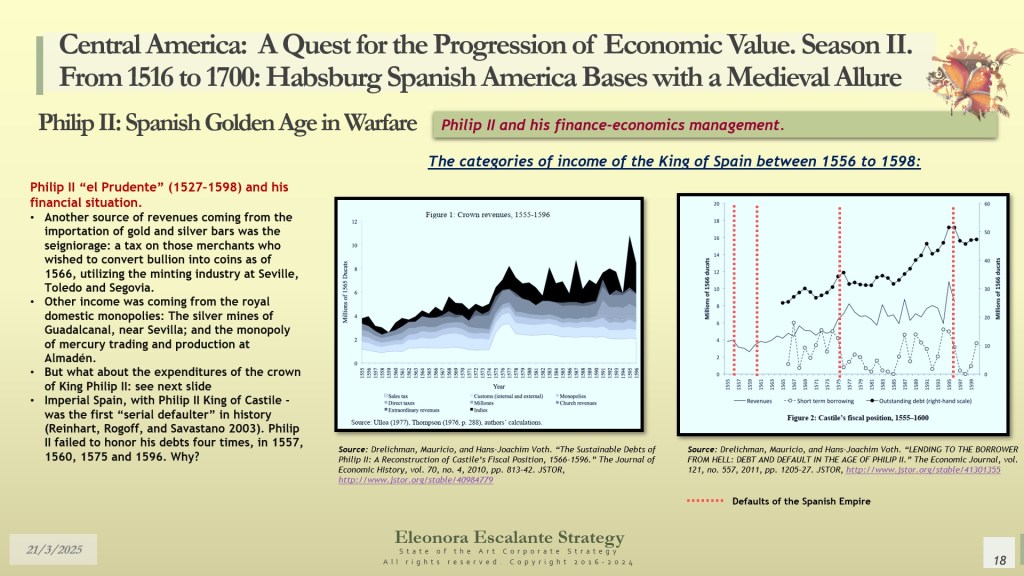
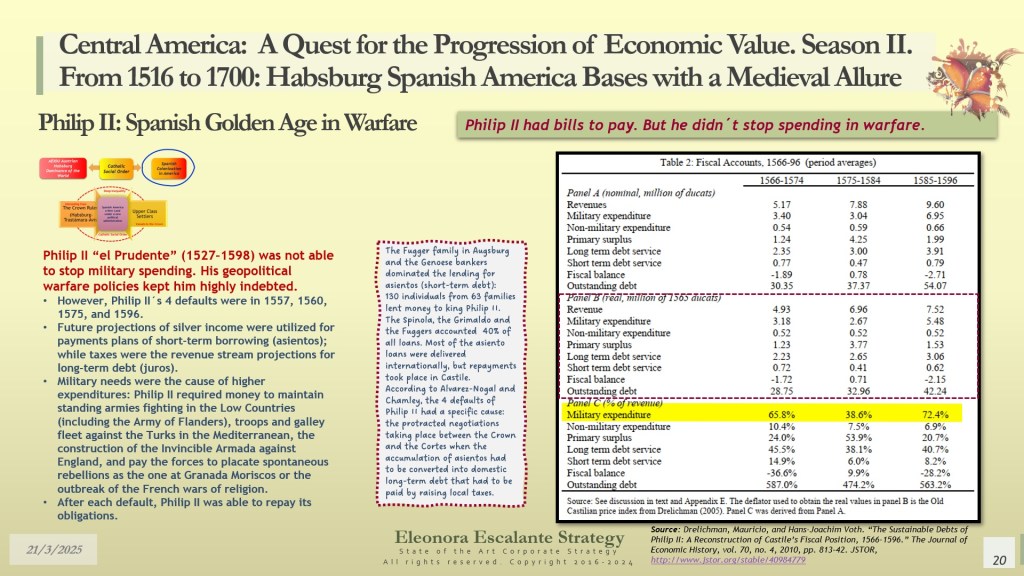
- We have noticed an interesting pattern in the finances of Philip II. First, when it comes to short-term debt management, the Spanish crown made every effort to earn direct revenues without going to the Cortes. They tried to solve their lack of immediate cash, making decisions within the bureaus of the King. The extreme was that Philip II sold municipalities in his quest to increase the cashflows, but not the provinces of the mines of silver in México and Perú-Bolivia. We suggest that all the revenues of the registered silver production in Perú and México were going directly to the Spanish Crown, with a minimum amount held in private hands. In consequence, the kingdom of Spain had enough money to pay all the bills to their bankers of Augsburg and Genoa. Money wasn´t supposed to be an issue. According to the scholars that we have cited, the problems of default were simply matters of short-term debt management. Philip II’s accumulation of profits coming from precious metals was more than enough to pay all his bills, including the capital expenditures required to expand the industry of Spanish America Silver Mining, the architectural infrastructure of Philip II’s palaces in Iberia, etc. We suggest that Philip II was mobilizing and investing in the network of Habsburg relatives in Europe, and in the new future court households of the Habsburgs in Spanish America. It seems to us that every major default was linked to an event of warfare taking place in Europe, but not to industrial operations in the New World (1557, 1560, 1575, 1596). Warfare was the smog curtain used by Philip II as a need to default to provide a propaganda message to the rest of the European kingdoms served by his same bankers. Additionally, long-term debt was perfectly secured from taxes. See slides 18 to 20. The Spanish crown did a suspension of payment for short-term debt, for further consolidation and refinancing under long-term debt schemes within the same group of bankers, bankers who also served and knew the rest of the kings, queens, and royal households in Europe. Double check please: One-third (1/3) of the silver production went to Asia through Manila, Philippines.
- What happened with the revenue streams of the silver mines in direct control of the Spanish Crown? What was the Habsburg family doing? How did they share their income with the rest of the Habsburgs in Austria? We have not found the revenue streams of the silver that went directly to the Spanish Crown, but only the revenues representing taxes coming out of the 1/5 (20%) of the imports coming into Spain. Without that information, we can´t argue or strategize the financial position of the Spanish Habsburgs concerning warfare or military spending. It is also important to redefine short-term debt suspension of payments in comparison to long-term bankruptcy for Philip II.
- To summarize. In summary, during the period of Philip II, the Spanish crown was one of the richest in Europe. Philip II was able to build a future network of new lands of future households for his relatives in New Spain and Perú, and in his Iberian Peninsula beyond the Palace San Lorenzo of Escorial. He concentrated his efforts on creating a solid nation in Spain, and from there, he was preparing the new land in Spanish America, diverting resources through the Church, keeping the flow of metals from Spanish Iberia as a secure source of income, saving for the future of his family in the New World. The financial ratios of the Kingdom of Spain (including America) can´t be analyzed unless we can uncover which percentage of the silver production from New Spain and Perú was going directly to Philip II. Current investigations examine Spain’s revenue streams without certainty. How could it be? No sovereign investor like Philip II might have procured a greenfield miner’s business for others, without taking out something else than 20% custom taxes in return. And it is a big question mark for us. According to researcher Moreno Alvarez: “Large-scale silver mining in Mexico and Perú began in the mid-16th century. To sustain trade and bullion transportation across the Atlantic, the Castilian Crown developed a convoy system known as the Carrera de Indias. This system of armed fleets that sailed between authorized ports regularly began in the 1560s and peaked between 1580 and 1620. During this period, Spanish silver peso coins of eight reales were the “de facto international monetary standard” because of their high proportion of high-purity metal. Silver circulated in the American colonies before departing for Spain, whether through trade or inter-colonial transfers. Bullion and coins also moved through channels beyond the Castilian monarchy’s control, most notably through unregistered remittances and unauthorized trade with other European interlopers” (6). If the global world of trade depended on Spanish silver coming from New Spain and Perú, what occurred to those sources of funds in reality, and how was this income shared or distributed between all the court households of the Habsburgs in Europe (including the Austrian branch)? We believe that the Habsburg imperial family (Austrian and Spanish) had at its disposal the so-called ‘family support fund’ (Familienversorgungsfonds) (7) since the times of Maximilian I, and this could be a reason why we are not able to understand how the revenues from Silver coming from Spanish America were distributed within the family.
Announcement.
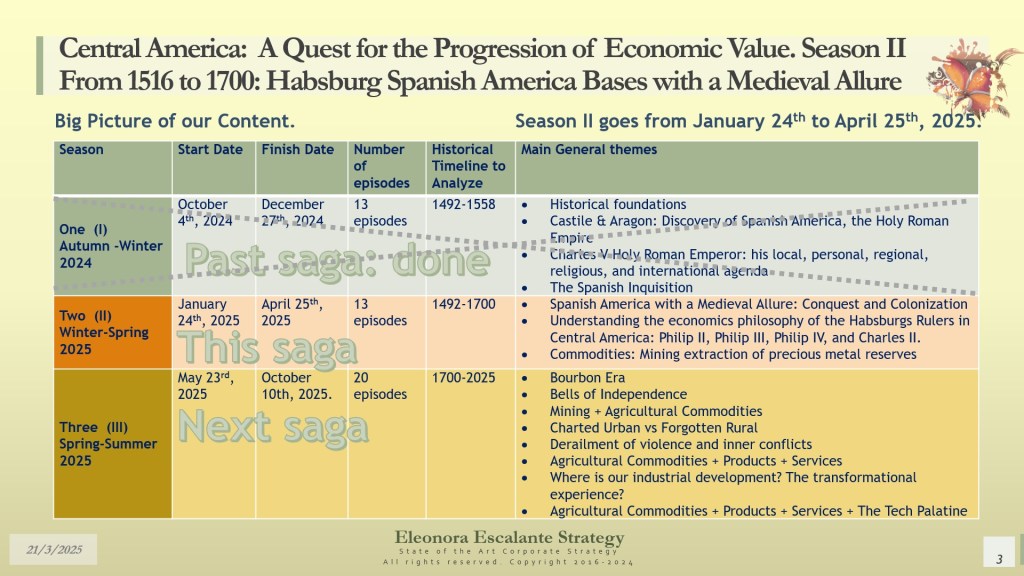
Our episode of today was fully dedicated to Philip II. Next week, we will cover three kings: The reigns of Philip III, Philip IV, and Charles II. Please do not lose sight of the fact that we are comprehending the corporate strategy of the Spanish Habsburgs from 1519 to 1700 in our quest to understand the economic foundations of the Kingdom of Guatemala, the lands that later were called the United Provinces of Central America.
Musical Section.
Our selection of music during this saga will continue to explore adorable music produced between the 16th and 17th centuries. Season II is dedicated to the lute. Our choice for today´s episode is from the Argentinian Lutenist Evangelina Mascardi, who interprets Johann Sebastian Bach’s Suite in G minor, BWV 995.
Thank you for reading http://www.eleonoraescalantestrategy.com. It is a privilege to learn. Blessings.

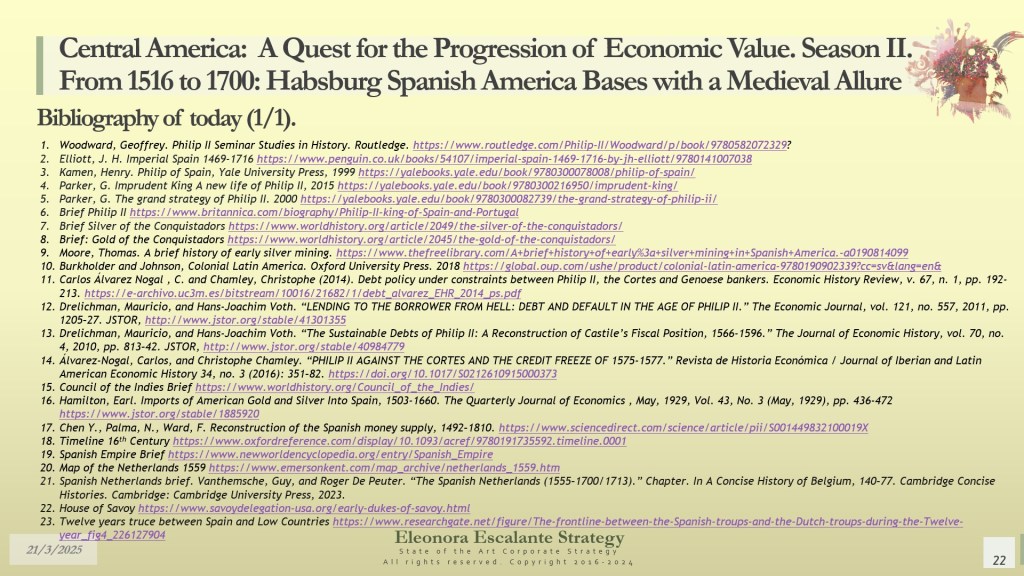
Sources of reference and Bibliography utilized today. All are listed in the document. If needed, we will add more over the weekend. Sources of this document post:
- Foster, Lynda “ A brief history of Central America” https://www.historyisaweapon.com/defcon7/Lynn%20V.%20Foster-Brief%20History%20of%20Central%20America-Facts%20on%20File%20(2007).pdf page 82
- Lopes Don, Patricia. Franciscans, Indian Sorcerers, and the Inquisition in New Spain, 1536-1543. Journal of World History, Vol. 17. No. 1.
- Tombs, David. Conquest & Colonialism, 1492-1800. Brill, 2002. Chapter 1. https://brill.com/display/book/9789004496460/B9789004496460_s005.xml?language=en
- https://www.abebooks.com/9780313330452/Age-Wars-Religion-1000-1650-volumes-031333045X/plp page 243
- https://www.habsburger.net/en/chapter/don-carlos-tragedy-kings-son
- https://www.academia.edu/105429295/Silver_Trade_and_Transportation_in_the_Spanish_Atlantic
- https://www.habsburger.net/en/chapter/money-new-world-sources-money-and-taxation-under-habsburgs
Disclaimer: Eleonora Escalante paints Illustrations in Watercolor. Other types of illustrations or videos (which are not mine) are used for educational purposes ONLY. All are used as Illustrative and non-commercial images. Utilized only informatively for the public good. Nevertheless, most of this blog’s pictures, images, and videos are not mine. I do not own any of the lovely photos or images unless otherwise stated.
 Eleonora Escalante Strategy - Strategic Reflections Think Tank