
Central America: A Quest for the Progression of Economic Value. Season II. Episode 12. Central American Hidden strategy: A Feudal Society
Dear fantastic readers:
We wish you a pleasant and joyful weekend ahead, with a pause for strategic reflections, of course. Today, we are delighted to dispatch our framework of reference for the master class about the feudal society that the Habsburg-Valois/Castile-Aragón dynasty was building in Central America.
The Kingdom of Guatemala, which was later transitioned to the Captaincy General of Guatemala in 1609, encompassed an integrated region from Chiapas to Costa Rica. It was the most overlooked region by the Spaniards who migrated from the Peninsula to Spanish America. This region wasn´t recognized as a source of precious metals, and it wasn´t designed as a center for manufacturing or production of premium agricultural commodities like the Brazilian or Caribbean plantations. From the start, the Spanish crown kept the region as a shelter or a refuge for dwelling in harmony and peace, far but so far away from the religious and political struggles of Europe.
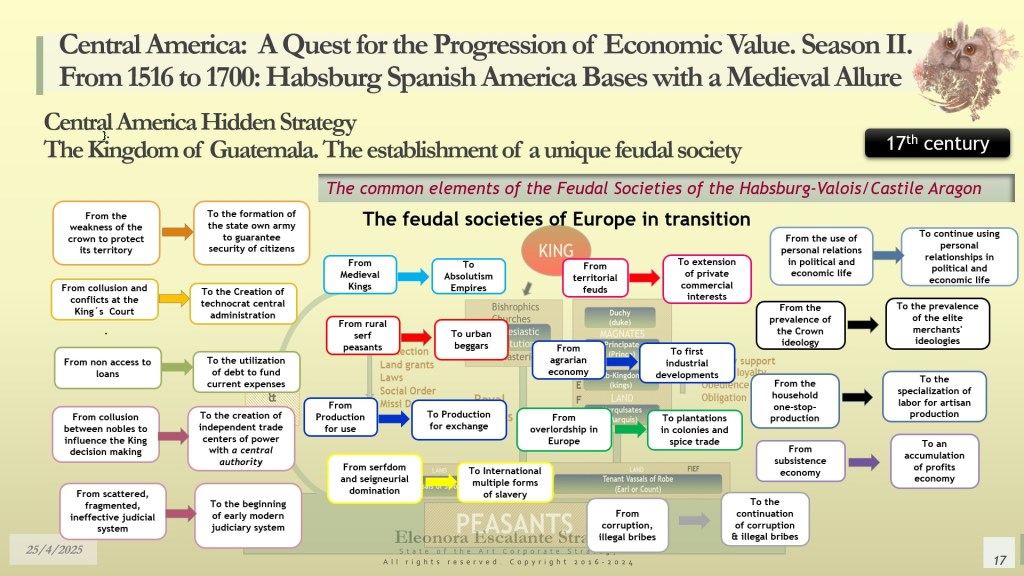
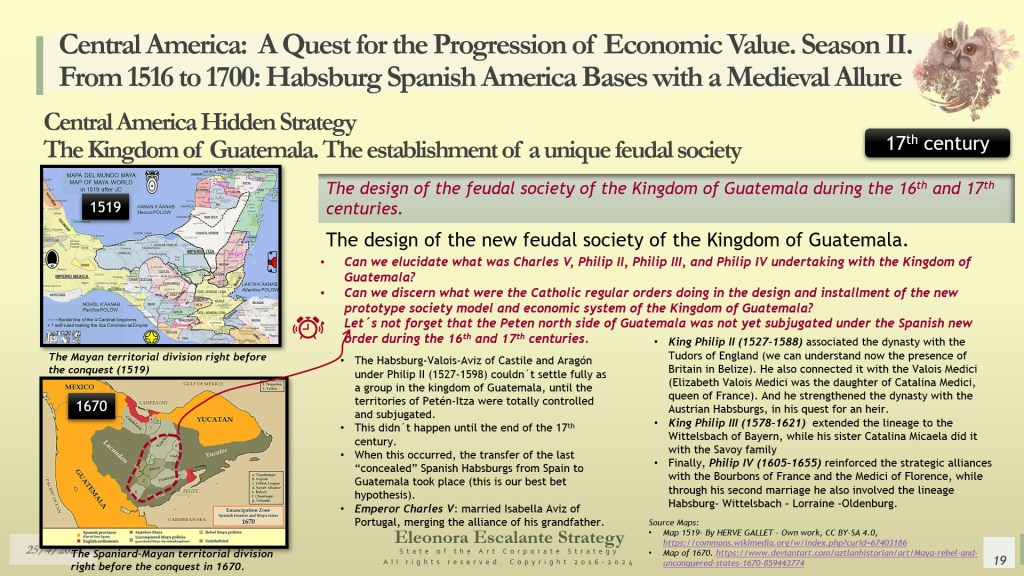
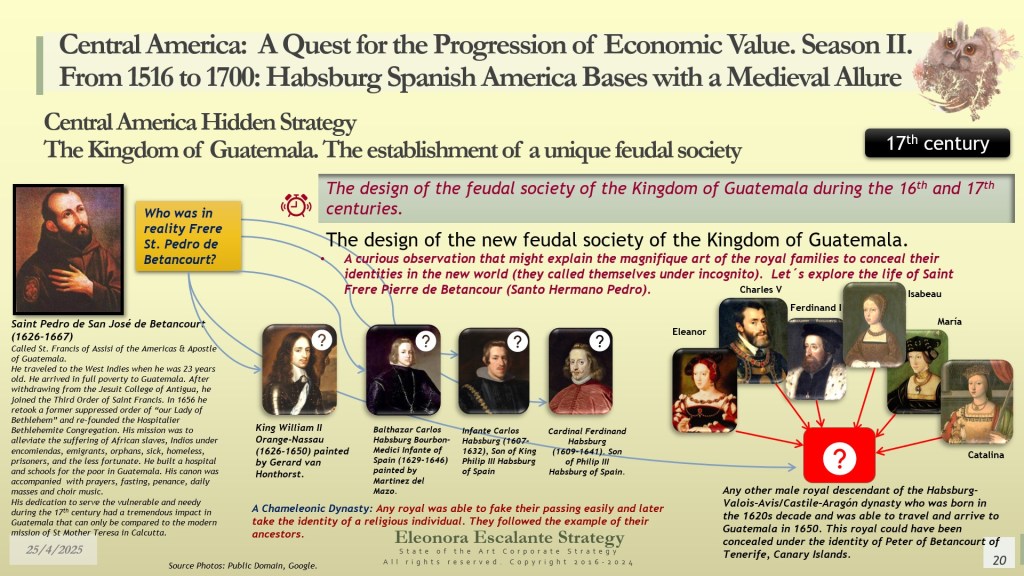
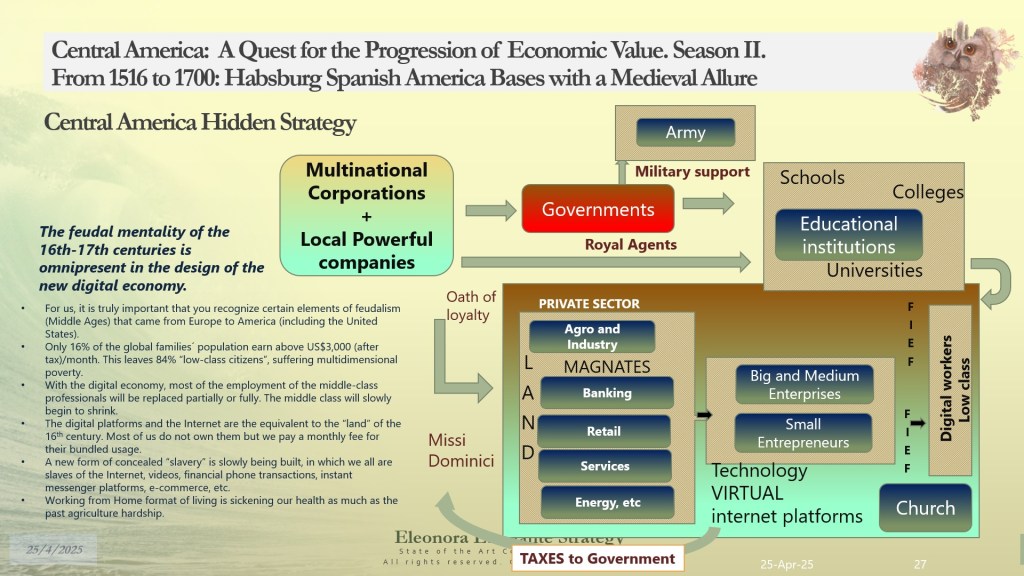
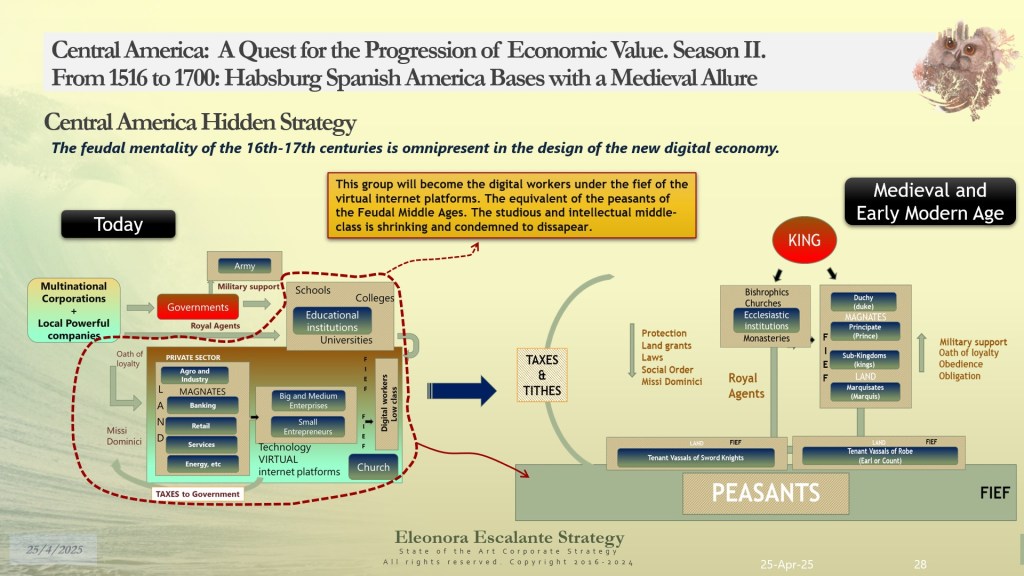
The Feudal society that was designed and established in the Kingdom of Guatemala was a mix of different elements of the composite monarchy. What existed in Europe traveled to be inserted into the New World. But the directive for Central America was different, dissimilar to what materialized in México or South América. Why was that difference? In our quest to find the answer, first, we have investigated the main elements of the society framework of the Habsburg-Valois/Castile-Aragon in the Peninsula: Land Property, Vassalage system, Dynastic Exercise of Power, and Access to Trading Routes. Further, we have researched the main circumstances of the majority of the population in the feudalist Spanish Iberian kingdoms: the peasants. Our intention is that you can perceive all the details of a feudal society that was initiating its transition through mercantilism from the riches of America. Slides 6 to 16 directly illustrate this situation. From slide 17 to slide 28, we have tried to elucidate what was the specific design of the society that the Kingdom of Guatemala was maturing. We also devise, as a hypothesis, that there was a direct presence of the Habsburgs in Central America. In reality, if they arrived in Guatemala, they weren´t recreating their influential majesty roles, but they did it under “concealed incognito identities,” and their new presence was tied to the Catholic Church or tied to the appointments of the new government institutions in the audiencias, corregimientos, governorships, or intendancies. Please remember, all our current strategic analysis is still a “hypothesis” and requires additional examination.
We invite you to download and print the document below. Feel free to pass it on to your friends, family, colleagues, and students. You must read this material before I introduce you to our strategic reflections. Otherwise, you will be completely misplaced. Thank you.












We request that you return next Monday, April 28th, to read our additional strategic reflections on this chapter.
We encourage our readers to get acquainted with our Friday master class by reading the slides over the weekend. We expect you to create ideas that might be strategic reflections or not. Every Monday, we upload our strategic inferences below. These will appear in the next paragraph. Only then will you be able to compare your own reflections with ours.
Additional strategic reflections after the weekend. Posted on Monday, April 28th, 2025.

- Common Elements of the European Feudal Societies of the Habsburg-Valois/Castile Aragón domains (16th-17th centuries).
The feudal societies of Early Modern Europe were not “only” shaped by the chivalric legacy of their medieval times. These societies were slowly evolving from the original Carolingian characteristics, adding elements of innovation at every level, because their gifted citizens began to expand their knowledge through the different universities emerging in Europe. The university education began to shape the way to do things in all the contexts and levels of the various societies under the domain of the Habsburg-Valois/Castile-Aragón territories. By the time of Charles V’s ascendance to power, the Iberian Peninsula and England comprised at least a dozen good universities, and the Holy Roman Empire (including the Low Countries) held around 7 excellent universities. While most of the top universities were in the Italian territories, France was not left behind either, with two dozen of them. The role of the Medieval Universities began to shape the mentality of the people working around the monarchs, influencing the approach towards the crusading military spirit, the urban development, the scientific mindset, and the relationship of power established between the landholders and those who did not have a property, but survived under slavery through it. The impact of education expanded the curiosity beyond the existing trading routes of the Old World, which were distinctly held in the hands of the Mediterranean bankers and commerce intermediaries: the Genoese and the Venetians. By 1500, the possibility of ships crossing the Atlantic was the consequence of the education of a new class of naval engineers of the epoch. Universities have always been the intellectual, scientific, and philosophical development engine of the nations. Even in the context of medieval feudalism. - The discovery of new trading routes to and from Asia and America was the key disruption of feudal societies at the time.
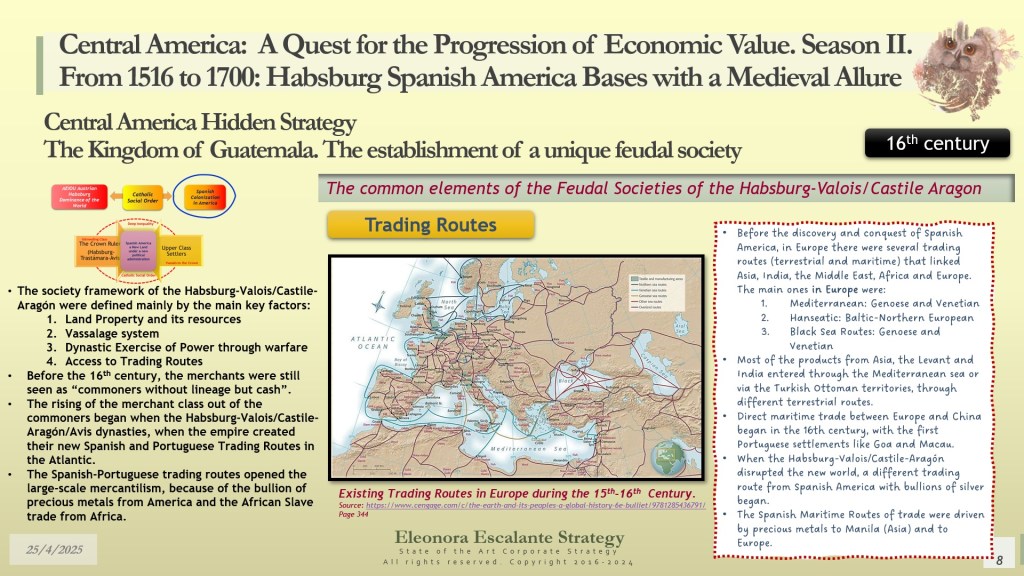
The existing terrestrial and maritime routes between Western Europe and the Middle East, India, and Asia were impacted by the discovery of new alternative routes of trade by new players (the dynasty of the Habsburg-Valois-Aviz/Castile-Aragón). The existing unabridged “modus operandi” of trading was disordered. Discovering a different way of living under other human cultures and traditions impacted each and all of those who were conducting investigation and research at the existing universities in Europe. See slide 8, please. It affected not only the rulers of Western Europe but everyone else around the diverse value chains of the existing trading routes. The existing value chains of commerce in Western Europe changed because other logistics requirements, raw materials, and operations were involved. The money supply shifted. The supply and demand of products and services were organically altered. New mechanisms of control and regulation were necessitated, and on top of all that, the competitive environment wasn´t ready to do reasonable decision making. Suddenly, the competitive advantage of the Spanish Composite Habsburg monarchy was subject to observation, bigotry, and greed. If warfare was used to conquer the populations and their resources, the violence of expropriation and inequality was the standard. In one phrase: the discovery and conquest of America forced the conquerors to act as they did, shattering the status quo of the defeated. Spanish America wasn´t a side-dish colony; it was the core business of all the kingdoms associated with the conquest of Spanish America. The Native-Prehispanic philosophy of land and property was never going to be understood by the type of Spaniards who arrived first in America. When humans do not understand, they tend to disregard or destroy, or dismiss, or punish what they don´t oversee. And the Spaniards banned the Aztec-Mayan philosophy of life. The sociological aspects of the conquest and colonization of these two Indigenous groups were nullified at their roots by the new social catholic order. - What existed in the Habsburg-Valois-Aviz/Castile-Aragón domains in Europe traveled to Spanish America. Observe slides 22-25. The social composition of the feudal societies in Europe traveled all the way to Spanish America, with additional features. Some improved, and some destroyed all traces of the defeated natives. The utilization of Africans and Native Pre-Hispanic as workforce slaves wasn´t a fortuitous mistake. Standard discrimination was used after warfare since ancient times; the winners enslaved the losers. And this was normal. The American scandal of the 16th century was based on the Black-Legend of King Philip II of Spain. The Native-American losers weren´t considered reputable or worthy humans, but worse than animals. The caste system of Castile–Aragón in the Iberian Peninsula wasn´t pyramidal; it was like a ship cargo with two masts (see slide 10). That same social composition was installed in America. The Flanders-Brabant societies were rich and flourishing because of the Hanseatic trade route and banking activities. The Aragonese society was the closest one to the Italian Renaissance, with pivotal access to Venetians and Genoese. The Portuguese role model of international African slavery was the pioneer of all the mess thereafter in the Atlantic trade. In consequence, those who were leading the design of the new society of the Kingdom of Guatemala were the medieval Catholic protagonists with the first Castilians (and Spaniards from Andalucia) who settled in the region. For these first immigrants, there was no need to develop a commercial maritime infrastructure. Their mandate wasn´t to create a society for profit. It had no significance for them to establish a corridor of commerce in the region either. Whatever we can find about the archaeological remains of Flanders and Brabant in Guatemala was merely an aspirational replication of the cultural wealth and religious traditions that traveled with the friars, monks, and missionaries. Did the dynasty of the Habsburg-Valois-Aviz/Castile-Aragon voyage under incognito? It could be possible… However, official history offers a different political brush: it was the Castilian feudal society the one that triumphed in this region. Even if there were “incognito” members of the Habsburgs dwelling in the Kingdom of Guatemala (see slide 20), these did not come with a Crown position, but used the identities of other people: religious leaders, government officers, or new Spaniard nobles in the new kingdom towns. The Habsburgs from Spain left their crowns and traveled as urban planners, architects, municipal officials, gobernador-managers, policymakers, and religious authorities. Slides 20 to 25 explain it in detail. We have chosen the case of Saint Pedro de San José de Betancourt (1626-1667) or Santo Hermano Pedro, as an example of the illustration of how a royal member of the Habsburgs might have changed his or her identity and traveled incognito to the Kingdom of Guatemala. Look at this significant point: if a royal member of Europe came to America, under the monk habits of Santo Hermano Pedro, that situation can´t be dismissed by historians. The true meaning of his presence is beyond extending a helping hand to the needy.
- The vassalage system in Europe was transferred under a new “state of the art” concept.
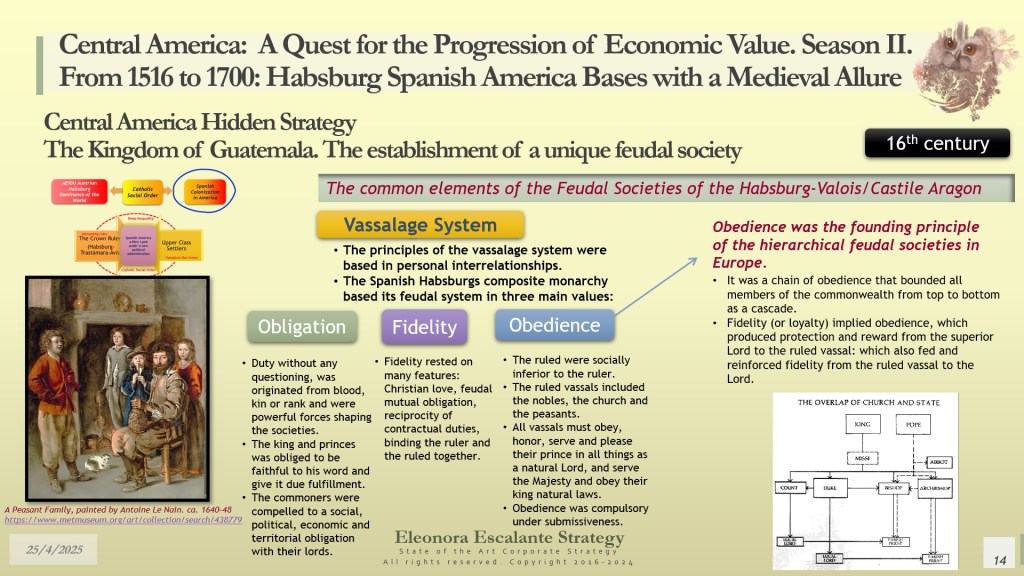
A vassal is a subordinate person who holds land in custody from a feudal lord (the feudal lord could be the king, a duke, a baron, a prince, a marquess, a count, a wealthy military knight, etc.), and receives protection in return for homage and allegiance. A Vassalage is the condition of being a vassal. The vassalage system was the underlying truth of feudalism in Europe. Feudalism in Europe only functioned because there was a personal relationship between the feudal lord and the vassal, and this relationship was vertical: the position of the vassal was one of subjection, subordination, servitude, and slavery. However, the position of the Feudal Lord could be of subjection to a greater Superior Noble (as the king), and at the same time, he ruled over the lowest subjects or lower rank vassals. Three main values were required for a vassalage system to exist: obedience, fidelity, and obligation.
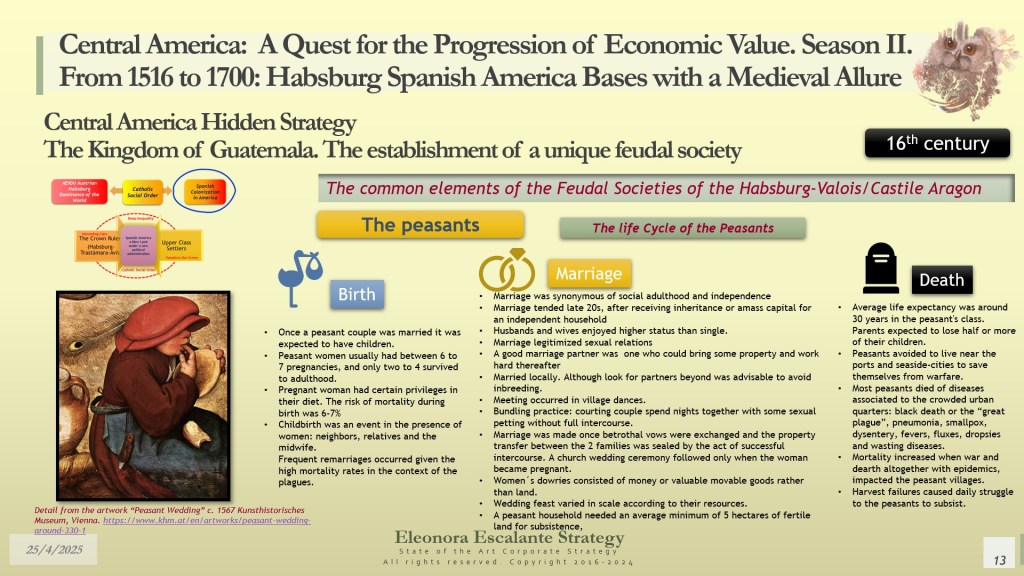
The system worked in Europe because there was an abundance of military conflicts and warfare, and the members of the fief necessitated defense and security services from the Feudal Lord, who fought the battles to protect them from external danger. Slides 14 and 15 explain the foundations of the Vassalage system. What happened in Spanish America? Can we perceive what type of vassalage relationships occurred? The vassals were the Native populations under the encomienda system. - The Peasants. Slides 11-13. When you read these slides, European peasants lived in precarious conditions, very similar to the situation of the small farmers or agricultural workers in Spanish America. However, the life of the peasants in Europe was of a wealthier status in comparison to the peasants of Central America, who never had a legal document of property of the land, until a few decades ago. However, the activities of the peasants of Europe five hundred years ago are similar to the peasants in Central America. Certain aspects of the life cycle are distinct, but it is remarkable to observe that the peasants living in Central America did not improve their conditions of life for five hundred years since the arrival of Hernán Cortés and Pedro de Alvarado. A few decades ago, after the end of the civil wars of the Nations of Central America, their situation began to improve. At least, little by little.
- What was happening in the kingdom of Guatemala?
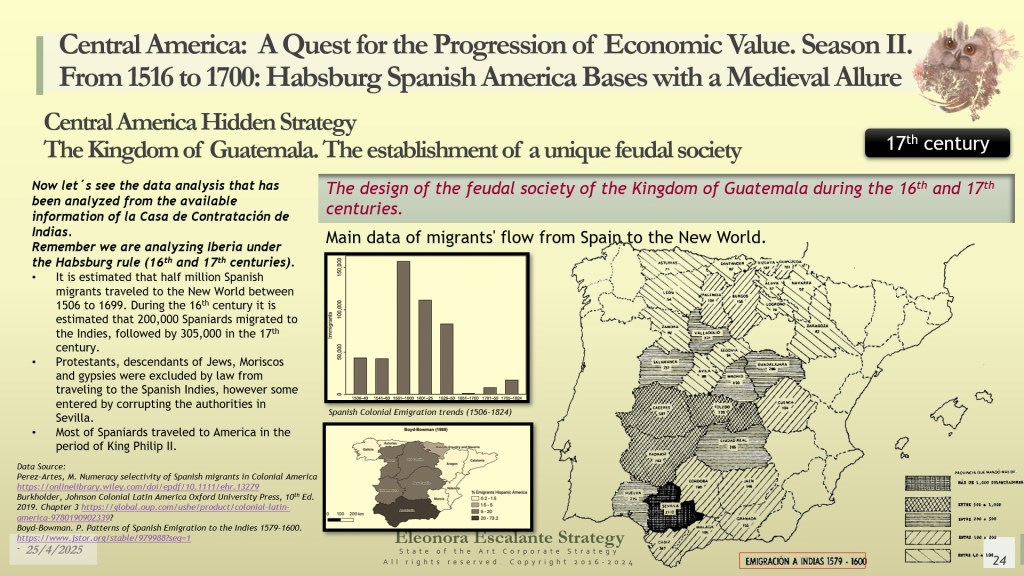
The kingdom of Guatemala was part of New Spain. This remote “Tierra de los Confines” was chosen because it was located in the middle of the two silver-producing regions, far away from the market bustling ports or trading cities. It was the land with a smaller percentage of migrants coming from Seville. During the time of King Philip II, only 2.7% of Spaniards arrived in the Kingdom of Guatemala. If the Spanish Habsburgs wanted to live incognito, they were obliged to choose the most remote and hidden land of all Spanish America. When the Spanish catholic traditions melted with the culture of the Pre-Hispanic populations, a new Catholicism activated a formula that was inherent to the society of a feudal dwelling place (not a port, not a mine production location, not a financial bourse, not a plantation either). The Catholic friars’ mandate was to pacify the region, while a selective group of Spaniards began slowly to migrate from Europe to the refuge of a monarchy that had no intention of staying in Spain. This strategy is well explained by slides 16 to 28. After the earthquake of 1773, the Habsburg-Valois-Aviz/Castile-Aragon segment of the dynasty might have been forced to rethink its territorial settlement strategy. We perceive that some of them may have moved to Costa Rica, “The Castile of Gold”. By the time of the arrival of the Bourbon Habsburgs to the Spanish throne, the dynasty was huge all over Europe. Both branches grew in size and resources. One thing is sure: there were members of the dynasty dwelling in this region, organizing a unique agrarian medieval feudal society under the concept of an “agrarian commodities export system” that was trying to choose what was good from Europe and the USA.
Announcement.
After Holy Week´s vacation, we are rejoiced to inform you that this is the penultimate episode of season II. The importance of Central America’s Hidden Strategy during the 16th and 17th centuries has offered us innumerable discoveries. If the Kingdom of Guatemala was conceived, planned, and built as a refuge, a hidden shelter, and a paradise for a royal family that wanted to escape from the disaster of their entangled conflicts with the rest of the European monarchies; then economists need to discern about the original use of the land and re-imagine the terms of development of each region in the world. Believe it or not, there are aspects of Central American culture, mentality, and rural settings that are still hanging on the Habsburg-Valois/Castile-Aragon feudal frameworks, and we can´t jump into a digital economy with those cognitive aspects, because we will persist with a feudalist model under new technological defaults. To force us to do it will break and harm us in the process. Please, this also applies to the Artificial Intelligence new products and services in other developed societies that were established in North America during the 17th century. Today, we have illustrated the main relevant aspects of the feudal society that was installed in Central America, and things weren´t that different in Canada or the USA either then. Let´s see us again on May 2nd, with the last episode of season II: “Central America Hidden Strategy: Commodities Fundamentals and the School of Salamanca”. Season III of this saga is coming!
Musical Section.
Our selection of music during this saga will continue to explore adorable music produced between the 16th and 17th centuries. Season II is dedicated to the lute. Our choice for today´s episode is a Japanese Lutenist. His name is Naochika Sogabe. He has studied historical music and music ethnology in Cologne/Germany, and The Hague/Netherlands.
Thank you for reading http://www.eleonoraescalantestrategy.com. It is a privilege to learn. Blessings.

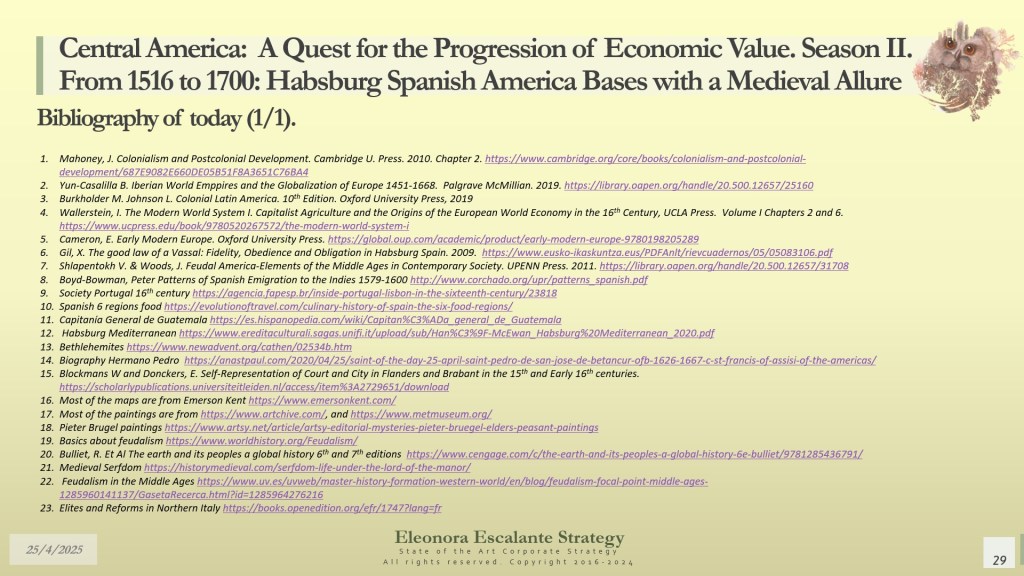
Sources of reference and Bibliography utilized today. All are listed in the document. Additional material will be added when we upload the strategic reflections.
Disclaimer: Eleonora Escalante paints Illustrations in Watercolor. Other types of illustrations or videos (which are not mine) are used for educational purposes ONLY. All are used as Illustrative and non-commercial images. Utilized only informatively for the public good. Nevertheless, most of this blog’s pictures, images, and videos are not mine. Unless otherwise stated, I do not own any lovely photos or images.
 Eleonora Escalante Strategy - Strategic Reflections Think Tank