
Central America: A Quest for the Progression of Economic Value. Season III. Episode 1. Introduction.
Dear adorable readers:
We are honored to begin the last season of the saga “Central America: A Quest for the Progression of Economic Value.” Our intellectual stamina is ready for it. We welcome Season III with a heartwarming, cheerful outlook, and we expect that you can enjoy your masterclass sessions as much as we are delighted to prepare them for your strategic reflections’ improvement.
This first opening episode is about the introduction of our publications´ strategic planning. We have envisaged a research agenda segmented into 29 episodes. As usual, we dispatch our framework of reference every Friday before midnight, and we return on Monday to offer our additional strategic reflections. Every weekend, the core material of the class is on your table, and we assume that you have read all our slides carefully. We also require that you try to reflect on the material. You are required to print and write your own production of notes, ideas, and try to stretch your mind to generate your personal strategic reflections. Afterwards, you will be able to compare yours with ours, and by matching them or not, you will be able to evaluate the quality of your own thinking and analytical capabilities.
Every saga is the summary of an elective course at the level of a master’s degree at a good, respected university, and if you perform the effort to read our bibliographical references, we are convinced to the marrow of our bones that you will develop your critical thinking and your philosophical allure. If you don´t grind enough your brain, you will not be able to develop your insights, losing a blessed opportunity to work out your brainiac intuitive mindset, either.
Despite that, this saga is focusing on Central America, it attains all the conquered territories of the Iberian Peninsula, France, the United Kingdom, the Low-Countries, and the rest of the territories of the subsequent heirs of the Habsburg-Valois/Castile-Aragon dynasties. This last sprint of publications is about the Spanish Bourbon empire, and we will discover its link with the Bourbons of France, and how both branches shaped the fate of America, all together with England and Portugal.
Our introductory agenda for the rest of the year.
Find below our awaited introductory slides material. It is protected with exclusive rights, and it has been reviewed by many peer doctors of various recognized universities all over the continents for a few years. Most of the PhD authors that we cite, know about this project, and I am thankful to all of them for helping me to attain their thoughtful work that is always listed in our bibliography. With a humble approach, we are trying to do the best we can from the best we can find on the planet. We practice reading to them following the secrets of their prose. Trust me, they have left hints of the truth, but it is our job to collect all the puzzle pieces to make sense of it. Therefore, feel secure that we are trying to find the truth. Even if we make slips because we don´t have all the elements of the real history (which have been well-hidden by historians), those mishaps are part of this journey, and we are committed to overcoming them in every way we can. Feel free to share these slides with your friends, your colleagues, your supervisors, your managers, and your family. Every publication is a blessing for your intellectual growth because our perspective is always established at the corporate strategy level. We don´t participate in any political activity, we do not charge one single cent of economic profit for these publications, and we are consistently committed to our continuous search for academic excellence. Our goal is to be appointed as a lecturer and senior researcher by a faculty of history-business-economics of a prestigious university, an institution that will adore having our innovative transformational mindset on board.





Outline. Central America: A Quest for the Progression of Economic Value. Season III.
We kindly request that you go to pages 3 and 4. We have separated the outline into two big sections. Section 1 is dedicated to understanding the corporate strategy leaders of Imperial Spain from the death of King Charles II Habsburg in the year 1700 up to the mandate of King Alphonso XIII (1886-1941). Given that the Bourbon Habsburg Dynasty took Spain territorial domains after the War of Spanish Succession (1700-1714), we will explore each of the main periods of leadership under different kings, the French Revolution impact in Spanish America, the Napoleonic invasion, the restoration of the Bourbons into power and the First Republic. We will try to focus on economic issues, trade, and Foreign policy of Imperial Spain under each of the kings of the Iberian Peninsula listed in the outline. Section 1 will have a duration of 14 weeks. From today to August 22nd. The exploration of these Iberian leaders is a prerequisite to comprehending Section 2. Regardless that our hypothesis of last season has suggested that the Habsburg dynasty moved (hidden under other identities) to Spanish America, we need to review the achievements, contributions, and mistakes of each of the Spanish Bourbon Kings throughout this period.
Section 2 of the outline calendar is shown on page 4. This section is exclusively focused on Central America. It is purely designed to explore the main economic sectors and agricultural industries´ origins and/or first steps in development in this region. We will explore why the agricultural commodities were designed as this region’s core business and how the hacienda economic model was enacted and supported in New Spain. We will also study in detail the cradle of the following agro-industries: cacao, indigo, coffee, sugar, livestock, tobacco, and other subsistence harvests like corn and beans. Additionally, we will cover the period of the Independence movements, the short phase of the Federal United Provinces of Central America, and the further atomization of separate republics. Finally, we will review the Panama Canal’s strategic purpose and the banana plantations during the 19th century. The content of slide 4 will be produced from the 5th of September to the 5th of December 2025. In case we need to add a last chapter, we are leaving the option open for Friday, December 12th.
In summary, Season III will last 29 episodes, from May to December. This will be one of the longest historical sagas that we have dared to research and write. Hence, we will be busy, and we will learn innumerable lessons under the money-making history of the Kingdom of Guatemala, the theoretical economics utilized during this period, and the role of the merchant feudalism imposed by the Bourbons in the region.
The Industry Production Map of Central America during the 17th-18th Centuries.
Now let´s visit slide 5. This is the map of the agricultural production commodities of New Spain (including Central America). It is from the year 1925. Our main objective during season III is to cognize how we arrived at this distribution of agricultural commodities and comprehend how Central America never joined the Industrialization of manufactures that took place in England, Germany, and other European kingdoms. We will evaluate who, why, when, and how the corporate leaders of the time decided our economic destiny. Because Imperial Spain was led by monarchs who exploited the “owners” of the private merchant enterprises at their discretion, it is hard to conceive any economic decision-making without studying the Bourbon kings.
The Kingdom of Guatemala’s Feudalism was unique.
During the last two seasons, we proposed a Central America Framework of Development. It was our model to explain the origins of the Spanish American Economic Design and Formation. For Season III, we have updated it, and we have reviewed it. Our hypothesis model remains almost the same with some peculiar essential changes (visit slides 6 and 7). We have changed the “give and take strategy” between the Royals and the Spanish-American Vassals, and we switched the context of the feudalist colonial model of Spanish America. The absolutism model of the Bourbons was dissimilar to the Habsburgs. We want to reassure that it was a mix of the same philosophical medieval model, but the Bourbons were following their French nature, and the Bourbons were not aligned with the policies of the Habsburgs. This new Bourbon administration wished to perpetuate the absolute domination of Spanish American Vassals residing in the viceroyalties of New Spain and Perú. It was during this time that 2 new viceroyalties were added: the viceroyalty of New Granada and the viceroyalty of Río de la Plata. The inquisitorial repressive dominance continued through the already installed military orders that were grouped under General Captaincies, and the deep economic inequalities were based on social, ethnic, and racial differences. See slide 7 to observe our updated ideas.
Rationale of why we are stopping this saga in the year 1900.
Slide 8 explains in detail why we decided not to proceed with the 20th century. There are colossal-weighted reasons for that. We cannot advance to explain Central America’s economic decision-making in the context of the impact of World Wars I and II in the region. For most of us the Nazis horrors are not linked with the legacy of Imperial Spain in Latin America, but that is not correct. In consequence, we need to wait for historians of today who could release the truth about the authentic causes of the European World Wars, which arose when the Holy Roman Empire of the German Nations declined in 1812.
Updating our framework of Spanish America Economic Formation.
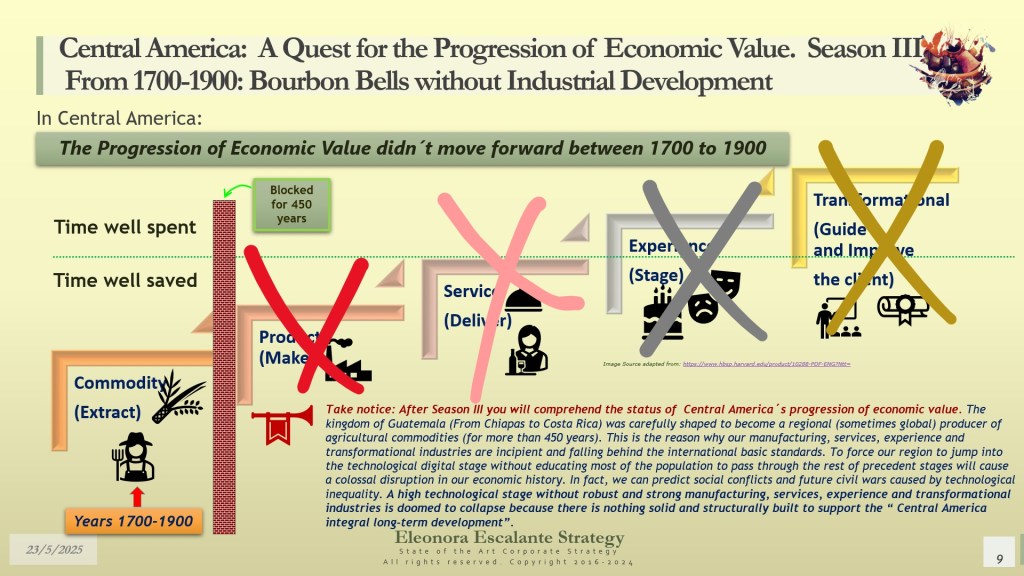
Our analysis can be read from slides 9 to 15. Most of our critical thinking observations are self-explanatory. Please print these slides, read them carefully, and try to grasp every detail. These slides explain our purpose, philosophy, objectives, and rationale for Season III. We request that you return next Monday, May 26th, to read our additional strategic reflections on this last section. As we have explained above, we encourage our readers to get acquainted with our Friday master class by reading the slides over the weekend. We expect you to create ideas that might be strategic reflections or not. Every Monday, we upload our strategic inferences below. These will appear in the next paragraph for your individual comparison and self-checking progress.

Additional strategic reflections added on Monday, May 26th, 2025.
After a careful review of Slides 9 to 15, we post our strategic reflections here. Do you remember that we were publishing about value propositions a year ago? We taught you how to utilize the pyramid of value that is utilized by one of the most recognized consulting companies, Bain & Co. We also showed you how to categorize the elements of value when using the Strategyzer (Osterwalder-Pigneur) tool for building value propositions. We dedicated a lot of months to showing you how to build value propositions in different industries and countries. From the point of view of marketing, building good value propositions is complex; it can´t be done without good judgment, and it can´t be dismissed if we are product designers. Joe Pine II and James Gilmore, authors of the book “Experience Economy”, provided the basic scheme of the framework that Eleonora Escalante Strategy modified to add the last level, the Transformational. We customized it in that way for the saga “Value Proposition: Theory and Cases”, because we craved to update and align the Pine-Gilmore framework with the Bain & Co. pyramid of value. Moreover, we also reframed it because we were on duty to tie the knot between the Maslow Pyramid human needs and wants, with the philosophical root of product design according to the elements of value. Look at the slide below.

The framework of Pine-Gilmore, called the progression of economic value, and modified by Eleonora Escalante’s Strategy (framework 4 of the latter slide), relates offering differentiation relevant to customer needs to customer value and pricing. The rationale behind this frame of reference is easy: the more an offering is tailored, or customized, to meet the specific needs of a customer, the higher the value, thus the higher the premium that can be charged for that offering. And this is genuinely applied to every single economic sector and industry around. Let me explain it in one tiny quotidian example from the real estate sector. Some architectural design firms in the world dedicate their innovative knowledge to redesigning old homes, and they sell them for triple or more of what they invested in them. The extraordinary philosophy of these firms has been their unique differentiation: to buy old properties with homes that hold a historically forgotten antiquity. They keep the old structure, renovate it, and expand with new areas that are modern and light. The result is a mix of both: past and present, with a new transformational allure that raises the value of the property. At the end, the property is sold with excellent premiums (high profit margins), because the house is so delicately well restored with the exquisiteness of its “unique past history”, a daintiness refined value of differentiation that can´t be replicated easily: its final value is greater than any new construction around. Another example is coffee. It is not the same to sell quintales of coffee in raw grain from El Salvador to Switzerland, in comparison to transforming it into the final luxurious velvet bag of one kilo each, filled with toasted ground coffee that is exported to Europe. Next example: it is not the same to sell the stone of diamond without cutting and polishing, than retailing the complete jewel ring with a delicate, polished diamond to the new bride-to-be. There are thousands of examples that we can perceive in our quotidian life about the progression of economic value, and this framework is as relevant and outstanding today as it was in 1999.
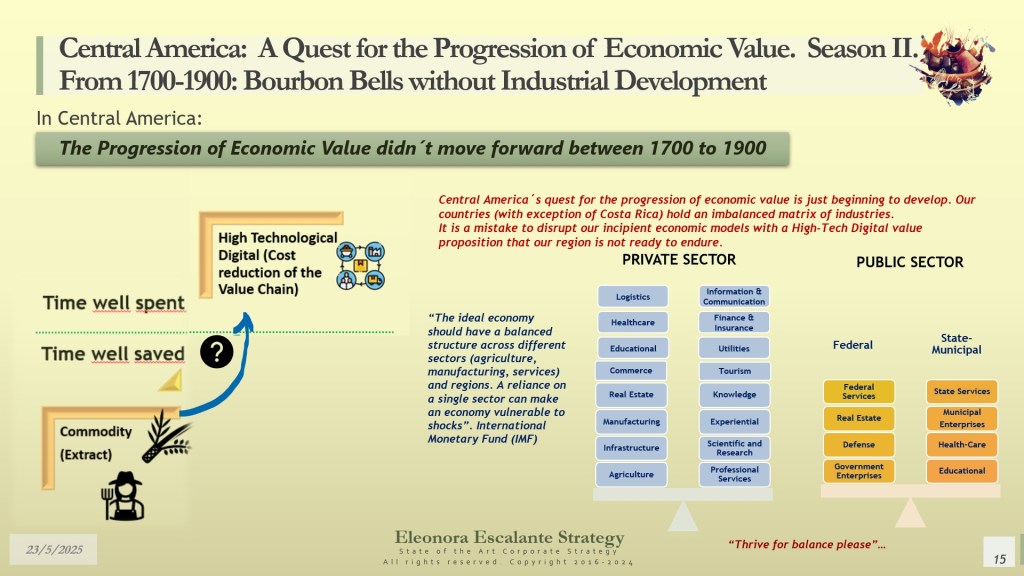
We modified the original Pine-Gillmore scheme to include the categories of value of Bain & Co., and we have added today a new last level, the digital-high-tech one. We have plotted this framework as it is mistakenly applied in the world. See slide 10. This framework has a theoretical mistake: the high-tech digital products are philosophically created to reduce costs, in consequence it is wrongly positioned at the high level of the progression of economic value, but that is how people perceive it, and that is why the majority of the population “unconsciously” view it. We have adapted the framework so you can see where the mistake is. It is a theoretical error that is dragging our economies into a low-cost cannibalization of digitally made products and services. This is why the knowledge-transformational economy is begging for donations over the internet. The framework is not working because the High-Tech digital economy was not structurally designed to be at the highest progression of economic value. But it has been positioned “philosophically” at the top level (as we have drafted it from slides 10 to 15).

The popular belief of the youngsters’ phrases towards the old generations: “You are out of date”, “the society has changed”, “our high-tech products represent the new generation”, etc. All those dogmatic phrases have been coined to cut the new with the old. These “value propositions” are bombarding the population everywhere, making us believe that the high-tech-digital products are the top of the top of differentiation; when in reality, these products are ubiquitous, are products designed to “belittle the costs, to cheapenize” everything.
Can you see this is not an invented drama? The high-tech digital economy has been wrongly designed, because by pursuing the low-cost strategy, it has been adopted by all economic sectors and industries, creating a barbaric slaughtering of the artisan-handmade economy, including the brainiac knowledge transformational one. We have explained everything in detail from slides 10 to 15. The problem with the high-tech digital economy is its poor design and its philosophical premises. It is theoretically destroying the generic strategy of differentiation, and it is extinguishing the premium for uniqueness as a source of competitive advantage. In short, with the high-tech digital economy, the generic model of competitive advantage will be reduced to two quadrants: Cost focus and Cost leadership. See slide 14, please. For example, let´s look at the educational experience. If you have kids in need of mathematical extracurricular tutorship in high school, you will stop paying for a real math professor, and will opt to pay nothing by pushing your kid to use an X math algorithm powered by Artificial Intelligence that explains math to your kids with Chat GPT. Moreover, the decision is taken by the student, not by the parents, as it is currently happening. That decision shows how the high-tech digital economy works at the moment: if you consider to leave out the math professor as part of the experience and educational transformational levels, and you allow your kid to choose Chat GPT, you are not adding value to your kids´ math training, you are deciding, by considering functional elements of value of the pyramid of value of Bain as “saving time”, “simplifies”, “reduces cost”, “avoid hassles” or “reduces effort”. Additionally, you are disregarding the life-changing and transformational aspects of tutorship from a well-trained expert. And you are not considering the elements of value of the top of the Bain pyramid: “self-actualization”, “producing security of knowledge”, “motivation”, etc. Educational products were never designed with low-functional levels of value, but by their nature, the transformational, life-changing, and inspirational levels were cherished by respecting the instructors. What is happening? There is a dichotomy: The high-tech digital economy is being marketed as the top-level frontier of the progression of economic value, but it responds to the basic elements of functional value at the low level. Can you see the mistake in the design of the high-tech digital economy? The mistake is theoretical and philosophical. The expert is dismissed, and his product is downloaded to a functional level, and he has no other choice but to perform digital begging for donations in the digital internet model. Horror of reality! The most prepared intellectual and prodigious individuals (virtuosos of the art, excellent educators, and scientific researchers) should be paid at the top of the high-skilled wages on earth, and this is not happening now. The highest-paid individuals are in Silicon valley, but they are being paid to make theoretical and philosophical mistakes with their products and services to the world!
Finally, an economy that has not built a solid and vigorous base of different economic sectors is extremely vulnerable to fluctuations and shocks of different natures. The International Monetary Fund states it, “The ideal economy should have a balanced structure across different sectors (agriculture, manufacturing, services, etc.) and regions. A reliance on a single sector can make an economy vulnerable to shocks.”Slide 15 explains it. Central America was not developed as a manufacturing nation. Regardless of the motives, Central American nations are obliged to be self-sustainable with the basics: food, shelter, health, education, transportation, public infrastructure, utilities, scientific and research, professional services, etc. Our region can´t rely on cheap imports from other nations to establish a retailing commerce pillar that will be fractured by another pandemic or a global war that affects the international shipping and logistics sectors.
The lack of a sound and robust manufacturing sector in Central America is not only obvious, but it is what it is. The development of the services sector began in the 1990s in this region of the world, but there are still several micro-regions of tourism here, where you can´t find decent lodges. The Airbnb value proposition filled those spots, but it has stopped the development of hoteliers. Concerning the experience level, Central America began to assemble it in the 2000s, slowly but steadily, and it was paying off until the COVID-19 pandemic. Gradually, bit by bit, some innovative entrepreneurs are trying to build their businesses at this level, but it is hard to compete when there is no middle class that can afford those lavish prospects.
We invite you to discover how we ended up in this stage of theoretical mistakes reflected in our frameworks of analysis. Stay with us for the next 7 months. You will be delighted to come to an awareness of how our historical development has not created critical thinkers who could have stopped these mishaps a long time ago.
Announcements.
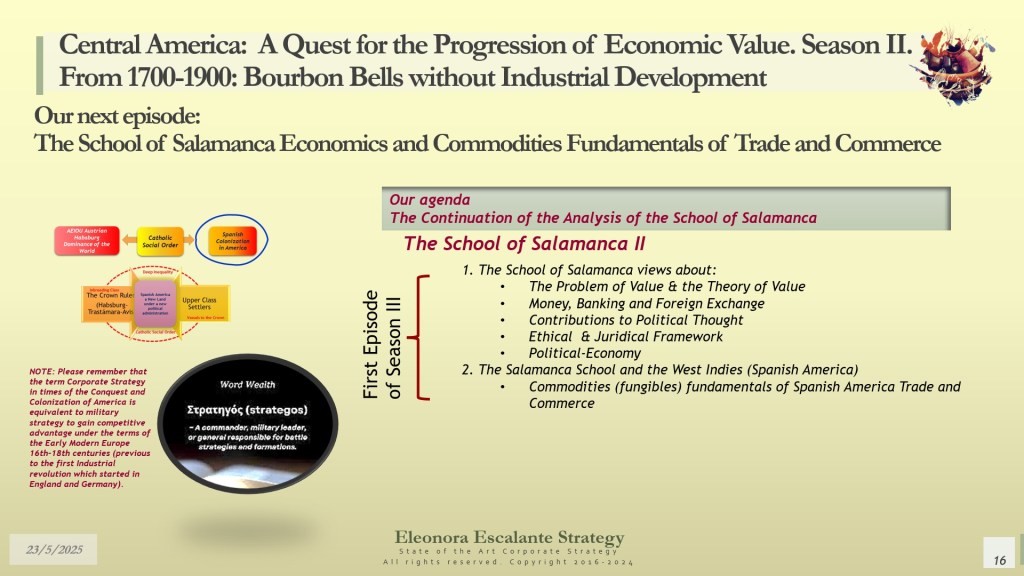
The progression of economic value of the nations of the former kingdom of Guatemala was designed since its conception without the industrialization aspects of other regions. It was defined as a region of agricultural sourcing of commodities. Any effort of industrialization was limited to certain sectors (as sugar, for example), and in general, for more than 450 years, Central America was not producing anything within the industrial standards of the United States or Europe. As of next week, we will begin our journey to identify how this happened and why. Our subsequent chapter will be about the School of Salamanca’s views on economics, and we will explore the origins of the commodities fundamentals of Spanish America Trade and Commerce.
Musical Section.
Season III of “Central America: A Quest for the Progression of Economic Value” has assigned a new instrument for every episode. It is the guitar!. Our selection of music during Season III will continue to explore adorable music produced between the 17th and 19th centuries with interpretations of virtuoso guitarists. We will embark on the selection of the top 29 loveliest guitarists from the last 5 generations, playing music composed during the time of this saga. Our choice for today´s episode is “Recuerdos de la Alhambra,” in the hands of the Virtuoso Goran Krivokapić. This artwork’s tender feelings make everyone virtually travel to the beautiful palace of Al-hambra. I encourage you to visit Goran´s biography to learn about his journey of devotion and quality https://goran-krivokapic.com/biography/. With this amazing interpretation, we welcome Season III by remembering the Spanish Maestro Francisco Tárrega (1852-1909), who originally composed it. Enjoy!
Thank you for reading http://www.eleonoraescalantestrategy.com. It is a privilege to learn. Blessings.

Sources of reference and Bibliography utilized today. All are listed in the slide document. Additional material will be added when we upload the strategic reflections.
Disclaimer: Eleonora Escalante paints Illustrations in Watercolor. Other types of illustrations or videos (which are not mine) are used for educational purposes ONLY. All are used as Illustrative and non-commercial images. Utilized only informatively for the public good. Nevertheless, most of this blog’s pictures, images, and videos are not mine. Unless otherwise stated, I do not own any lovely photos or images.
 Eleonora Escalante Strategy - Strategic Reflections Think Tank