
Central America:A Quest for the Progression of Economic Value.Season III. Episode 3. The Bourbon Era begins.
Dear adorable and fantastic readers:
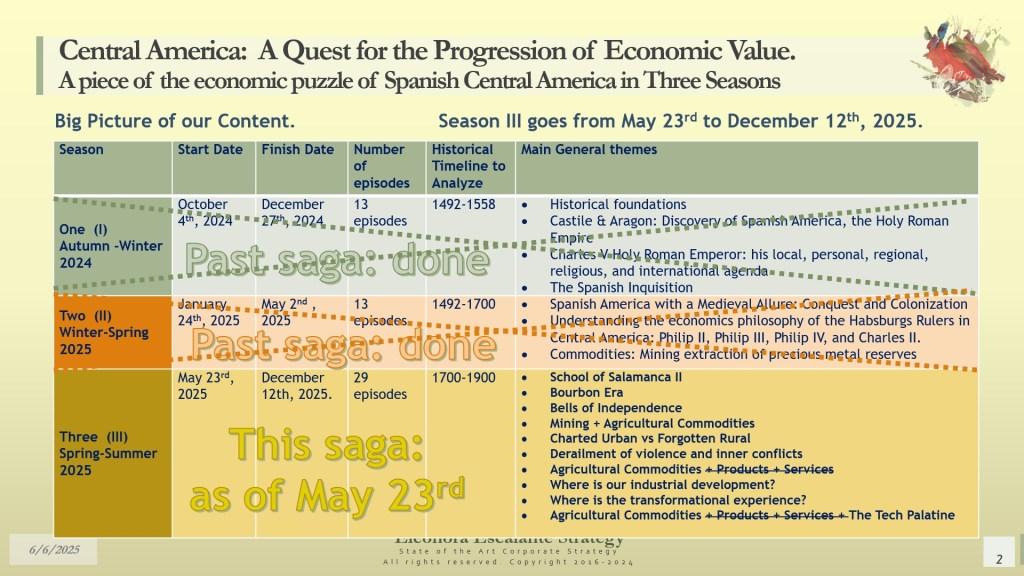
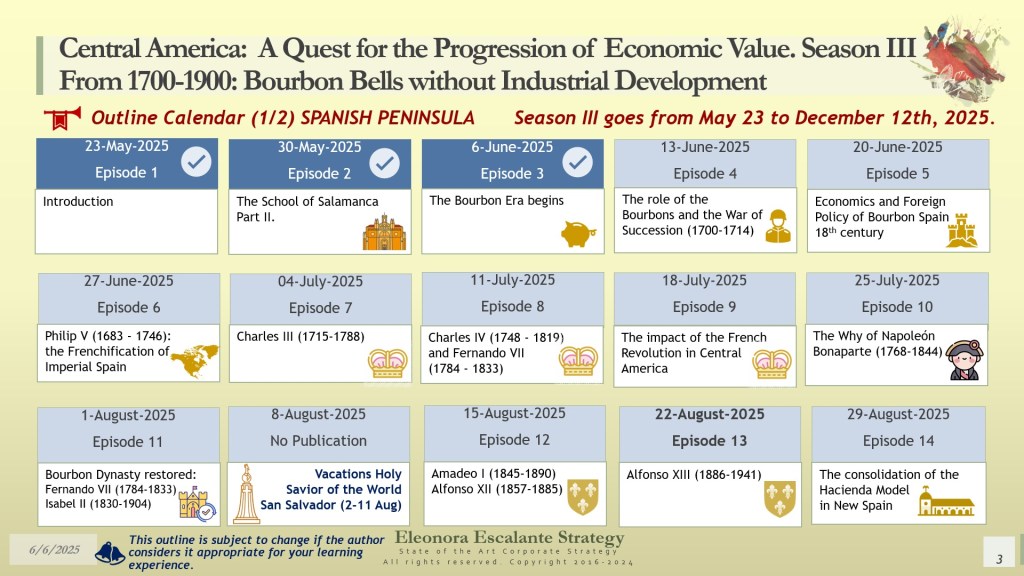
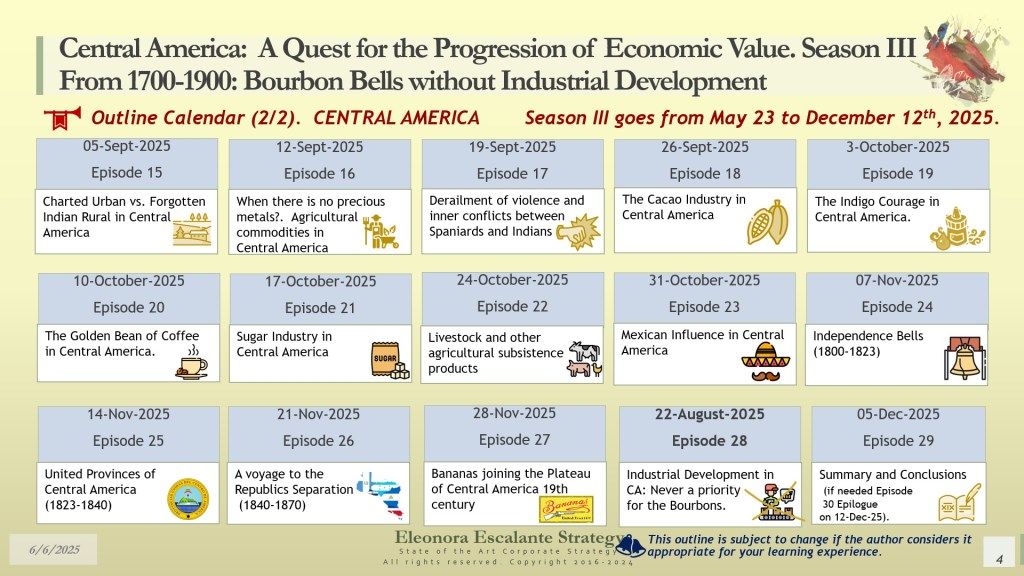
Today, with this episode, we begin a long trajectory to understand the economic premises and corporate strategy of the Bourbon-Habsburg period of Spain (1700-1900). As you can see in slide 3, the first 14 episodes of Season 3 (around 3 months) are totally dedicated to comprehending the impact of the economic decisions of the Bourbon Rulers in Spanish America. Consequently, we will have enough time to offer you a solid and well-grounded academic analysis. Take notice that we are screening and purifying information from our academic peers and historical authors in such a way that we can suggest to you the closest scenario to the truth. It is our intention to reveal the real truth of the actions of the Bourbon rulers, their rationale, and the impact of their economic-financial advisors on trade in the New World. We are not offering a class on history about this period; we are starting with history to deliver to you a corporate strategic analysis of the frameworks of economic development utilized by Imperial Spain during the French-Spanish period of the Bourbons. That is the key to our writings.
To explore the Economic and foreign policy of the Spanish Empire under a new administration (the branch of
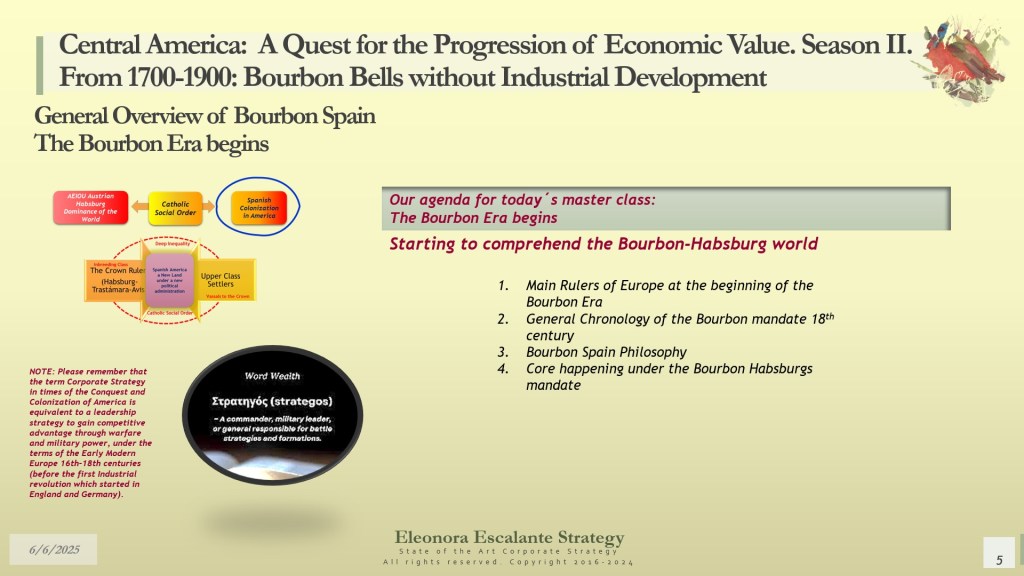
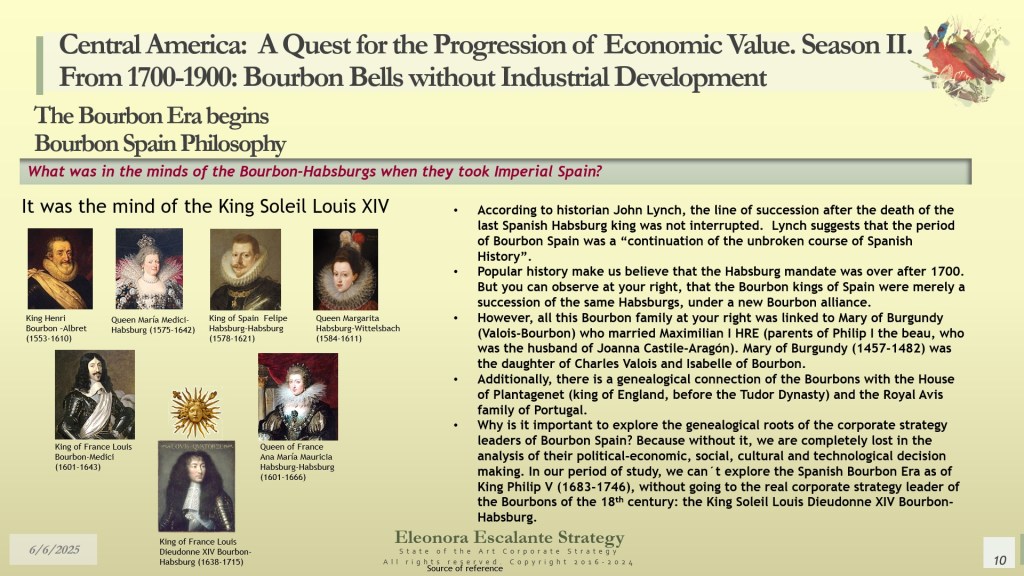
the French Bourbon Habsburgs) requires us to provide a brief introduction about the main factors that drove the Bourbon Era. And instead of starting over with Philip V (the grandson of the Sun King of France, Louis XIV), we were compelled to begin with his grandfather, Le grand Roi Louis Dieudonne Bourbon Habsburg (1638-1715). It was Louis XIV who arranged the succession after Charles II.
Find below our framework of reference for today. We encourage you to download and print the slide material. Keep it for your records. You never know when the Internet will fail, and at least you will have your files on your computer or in printed format. While reading, use your pen and pencil and take notes. Write your doubts, your eureka ideas, and your questions. Feel free to visit our bibliography links offered in the document. Additionally, share this master class with your friends, colleagues, supervisors, or employees. You will have a couple of days over the weekend to practice the art of producing your own strategic reflections.
We request that you return next Monday, June 9th, to read our additional strategic reflections on this chapter.
We encourage our readers to get acquainted with our Friday master class by reading the slides over the weekend. We expect you to create ideas that might be strategic reflections or not. Every Monday, we upload our strategic inferences below. These will appear in the next paragraph. Only then will you be able to compare your own reflections with ours.
Additional strategic reflections after the weekend. These will be posted on Monday, 9th of June, 2025.
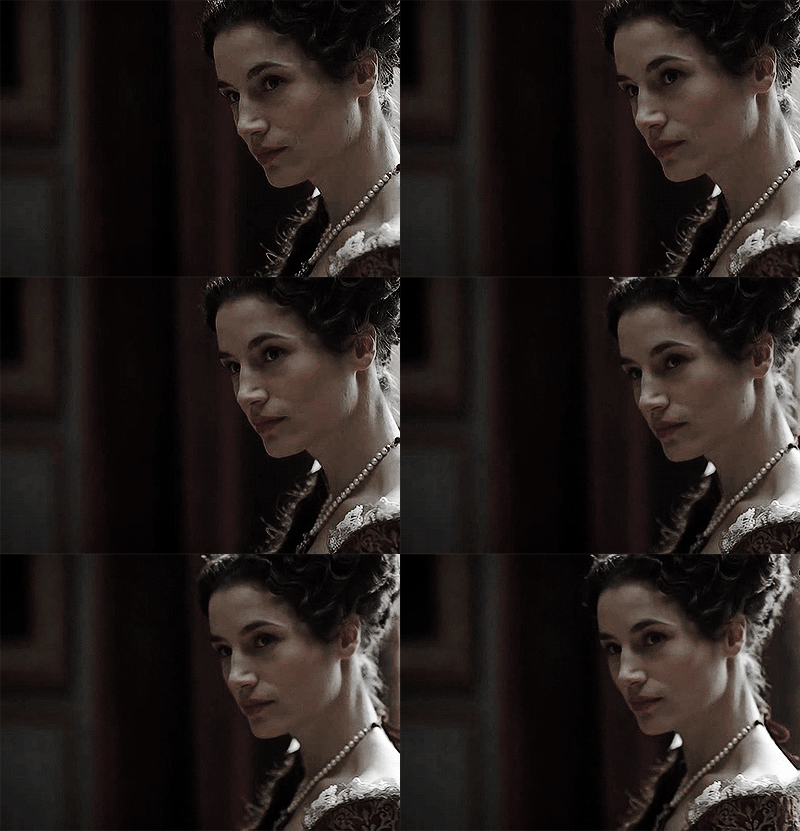
Welcome to the grind on the occasion of the Bourbon Habsburg governance of Spanish America.
Historiographers and historians categorize Bourbon Spain as the period from 1700 to 1808. In our saga, we have extended it to 1900 because the Bourbons in Spain continued ruling the country despite the Napoleonic invasion of Joseph Bonaparte. The Bourbon dynasty in the Iberian Peninsula was restored twice during the 19th century until the reign of Alfonso XIII, who was also a Bourbon-Habsburg.
We will spend several weeks digging into the real dimension of the origins of this dynastic branch group, as much as we have already covered the origins of the Habsburgs-Castile/Aragon royal house. Our mission is to comprehend what type of corporate strategy was employed by the new Bourbon Administration. Don´t forget that the Habsburgs ruled Austria until World War I (1918), and family connections of power existed between the Habsburg Austrians and the French-Spanish male Bourbons, who were mostly associated with the females of the Austrian Habsburg branch through arranged marriages. Also, it was during the 18th-19th centuries that we can observe how the Austrian Habsburg branch intermingled with different families of the Holy Roman German principalities or duchies, with the Prussian Hohenzollerns, with the Nassau of the Low countries, and with the Saxon-Coburg British line. Coincidentally or not, Alfonso XIII (1886-1941) will be our last analyzed king of this saga, and he was the son of an Austrian German Habsburg, too.
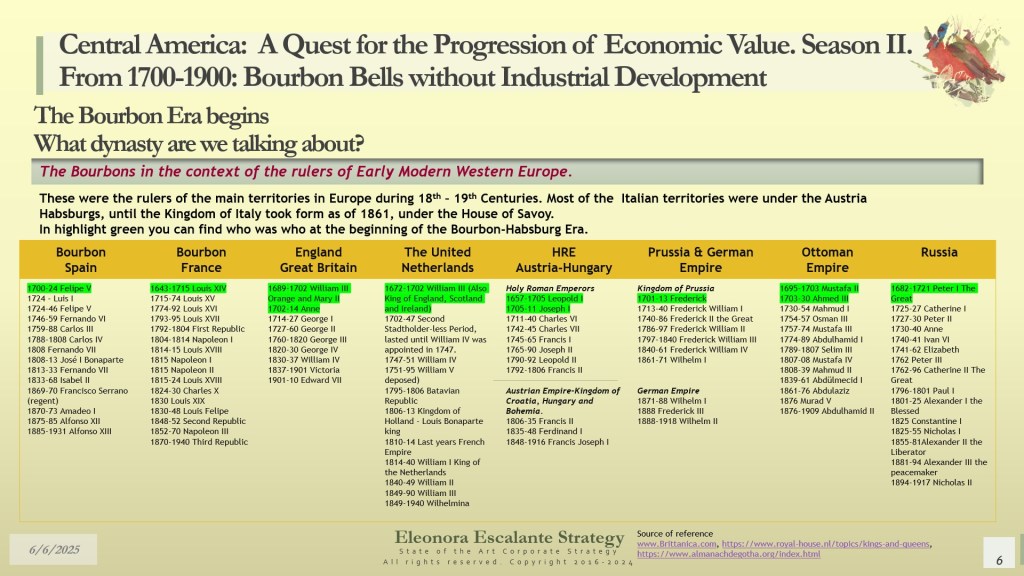
The Bourbon era begins. Let´s visit slide 6. We have shown you who was ruling what in this slide. We have included Russia, the German lands (which later became the Prussian German Empire), and the Ottoman Empire. Felipe V was inevitably the first registered Bourbon-Habsburg king of Spain, but he was appointed exactly at the time when King Louis XIV was alive. We advocate that it was Louis XIV who clinched him there, despite the War of Spanish Succession. We will analyze this war in detail in episode 4. Additionally, the 18th century did not have Marxism on the horizon; communism didn´t exist at that time. In consequence, the philosophical ideology of our investigation does not contemplate any political struggle from the point of view of right-left, because it wasn´t present then, at least between 1700 to 1848. Take notice: Karl Marx political theories were published by the mid-nineteenth century.
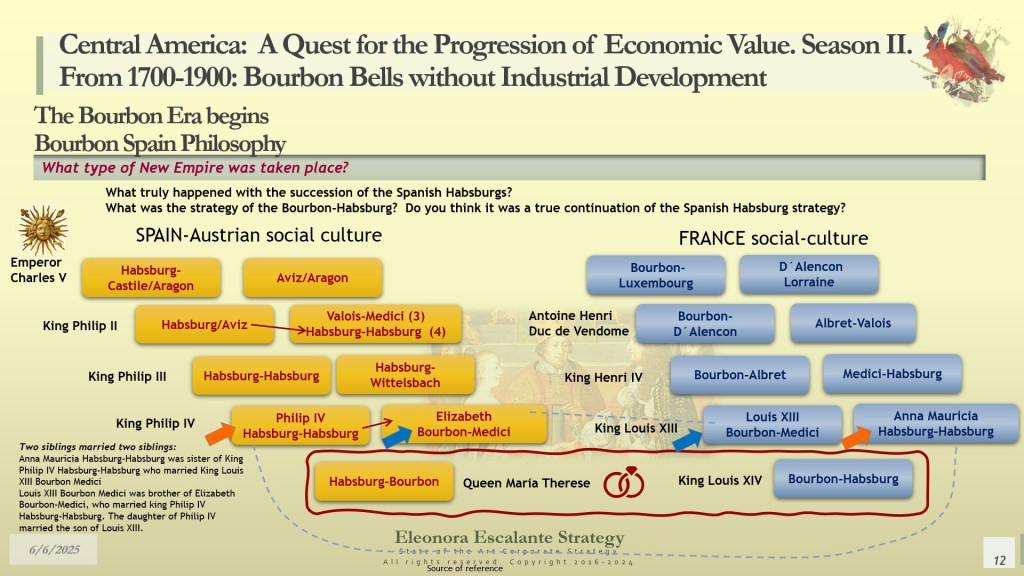
With the latter principle in mind, we must display the precedence historical linkage of the Bourbons and the Habsburgs. The Bourbon family was present in the life of the Habsburgs since the marriage of Mary the Rich (who was Bourbon-Valois) and Maximilian I. Charles V´s emperor, Maximilian I’s grandson, invalidated the desire of his sister Eleanor to marry Charles III, duke of Bourbon. In July 1523, Eleanor was engaged to Charles III, Duke of Bourbon, but the marriage never took place. According to official history, instead, Eleanor Habsburg was forced to marry King Manuel Aviz of Portugal first. Later, she had to marry King Francis Valois of France. Sadly, Charles III, Duke of Bourbon, was appointed as the military commander-in-chief of Charles V’s imperial troops for the Sack of Rome in 1527, where he was killed. In consequence, the history of the Bourbons was never far away from the Habsburg monarchy. King Henry IV (1553-1610) was the first Bourbon who ruled France and Navarre. By the 1700s, the Bourbons had already been sitting on the French throne for more than a century.
General Chronology of main events during the Bourbon-Habsburg Tenure.
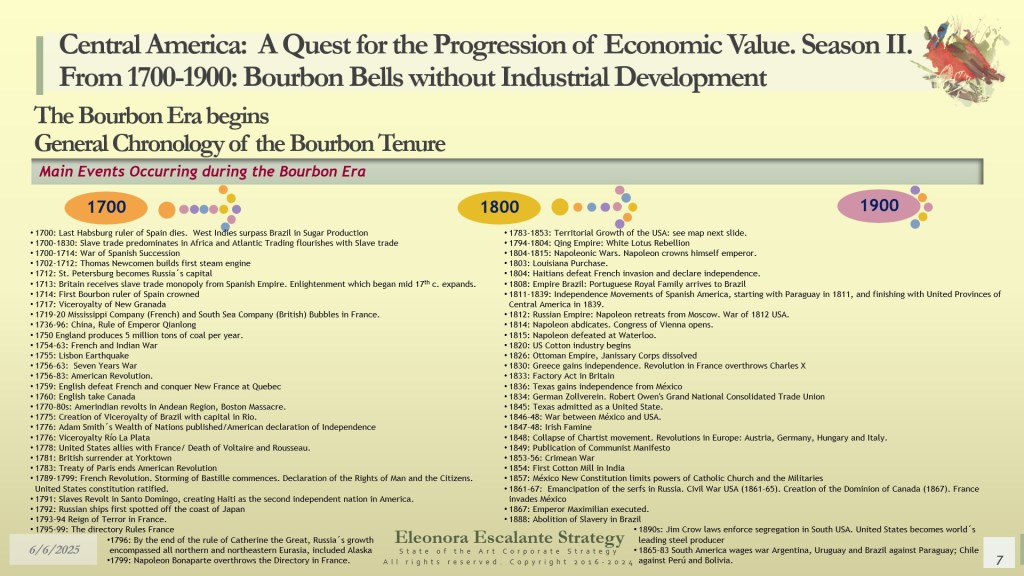
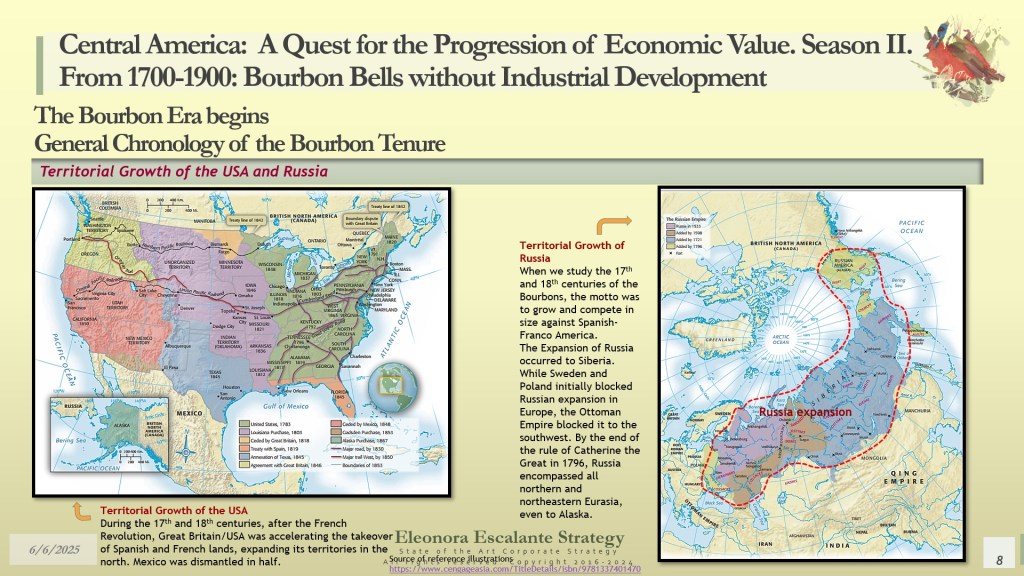
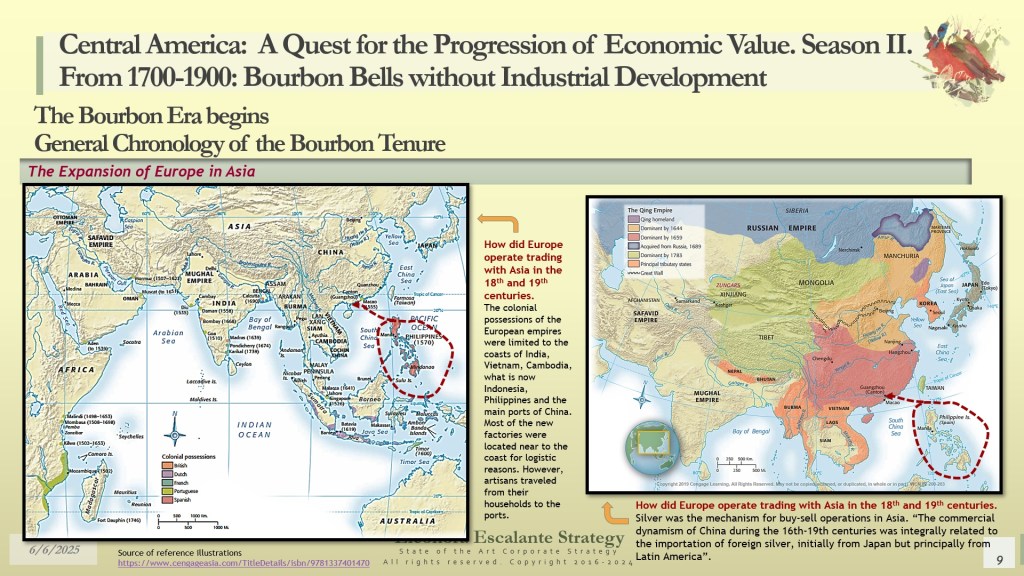
Slide 7 is our effort to show you what was occurring during these two centuries. However, from the point of view of economics, the 18th century was the century of true commercial competition for the Spanish Empire. It is a century in which mercantilism reached a maximum expression, with trade not only in Europe, but also with Asia (China), and the rest of the nations around the Indian Ocean, Africa, etc. This is the period of expansion of the Russian Empire (see slide 8), and this is the same period in which the 13 British colonies of North America led the American Revolution between 1775-1800 (slide 8). Organically and steadily, the first industrial revolution took place, not just in Britain or Germany, but it also expanded to the colonies in the New World. Furthermore, look at how globalized the economy of this century was: all the European Powers were attracted to trade with Asia. Look at slide 9. Their interest in Oriental products was so significant. Beyond Persian and Turkish carpets or ceramics from China, the Europeans, as the Dutch, began to established the first factories or centers of production in Batavia (Indonesia).
Spain and Silver.
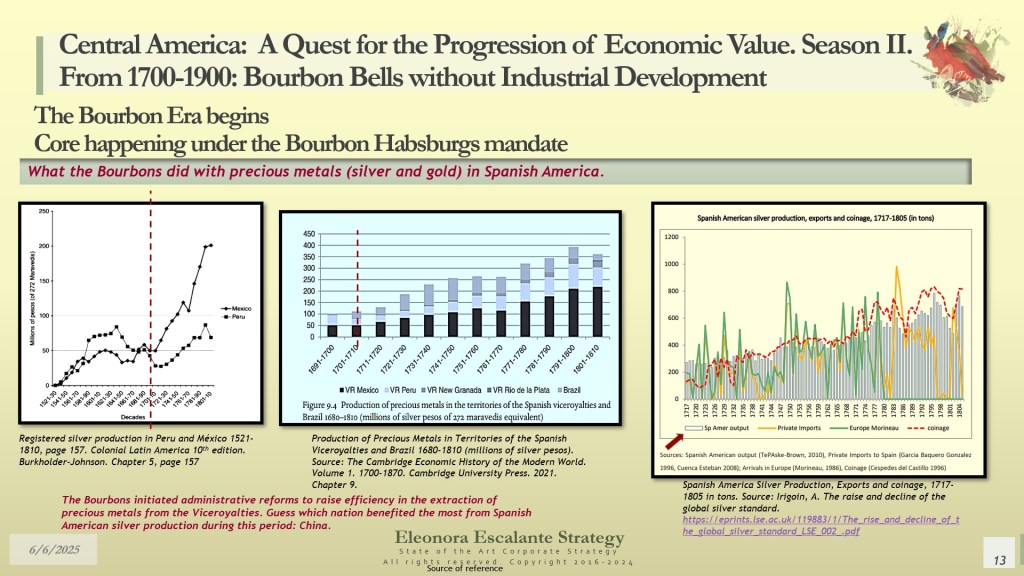
This brings us to the medullary commercial role of Imperial Spain during the 18th century: Spain was the main supplier of silver to the mercantilist model of trade and commerce. Spain became “the” supplier of silver from Spanish America to Europe. How? “Through Spanish licensed merchants and northern European interlopers, then it continued on to China through the organized trade of European chartered companies, primarily the English (EIC) and the Dutch East India Companies (VOC).” (1). We have already shown you that Spanish American silver was transferred from Perú and México to Manila in the Philippines. It was during the 18th century of the Bourbon administration that silver reached its highest peak ever. See slide 13.
Bourbon Spain shift.
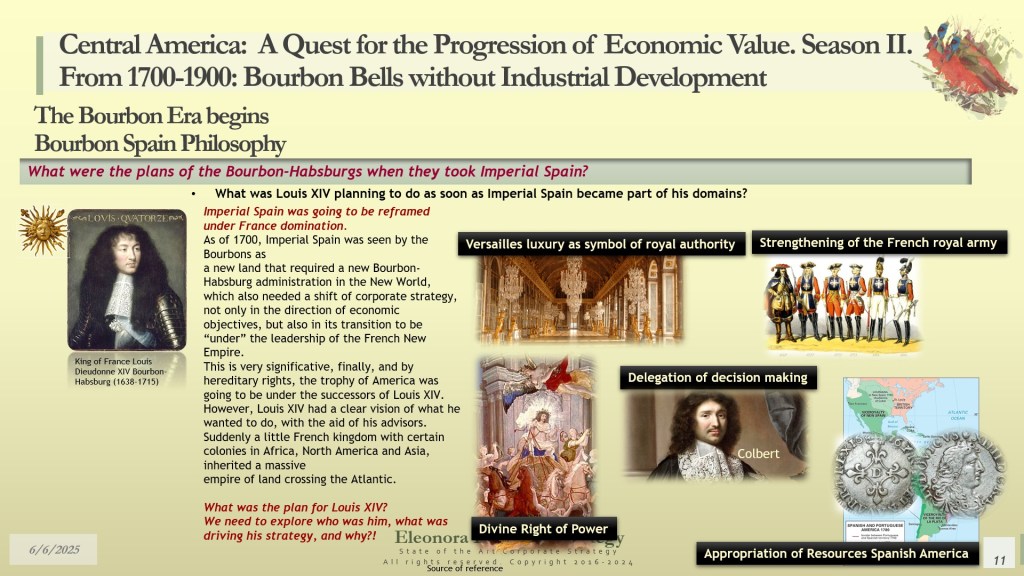
The Bourbon Habsburgs under King Louis XIV took the spotlight of the world. Suddenly, the French priorities at the top corporate strategy level were more crucial than ever. It was the mindset of the king soleil, Louis XIV, who predominated universally. And the imbalance of power was even more out of all proportion than before. It is for this reason that we can´t analyze the Bourbon period of Spain without considering what was happening in France. Most of the actions of the French and Spanish Bourbon kings were answers to the moves of the rest of the existing empires in America and Asia. See slides 10 to 12, please.
What was Louis XIV planning to do as soon as imperial Spain became part of his domains?
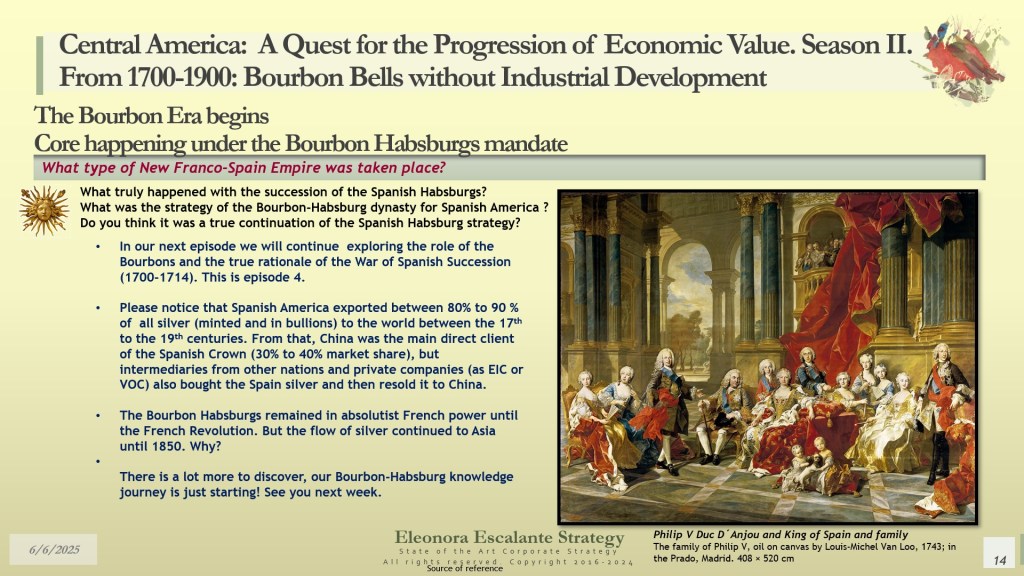
I would like you to reflect on the most important message of this episode: Imperial Spain ended its weak leadership with the death of Charles II in 1700. But the Habsburg AEIOU strategy continued. The “Alles Erdreich ist Österreich Untertan” (The whole world is subject to Austria) under the King Soleil was consolidated and expanded. After his death, the decisions were not taken from Spain anymore. We have inferred that it was a tacit subordination from Spain to France as of King Philip V (1683-1746). What was the degree of subservience of Spain to the French Kings? The Bourbons from France were certainly not going to allow the Spanish to lead the course of the silver trade. That is the main message for today.
To be continued…
Announcement:
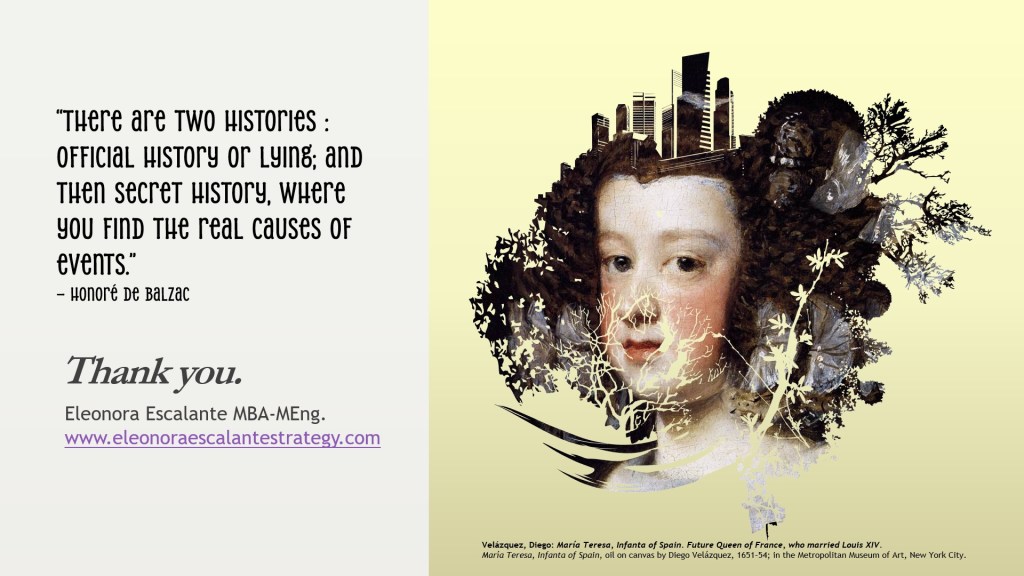
With this episode, we are paving the foundations of this saga. Today, we have shown you the context of who was who when the Bourbon Era began. We also have exhibited what was happening in Asia, Russia, Europe, and Spanish America, when the grandfather of Philip V, King Louis XIV, took the baton of ruling Imperial Spain. We have done a journey to the genealogical roots of the Bourbons, and how they thoughtfully planned the marriage of Louis XIV Bourbon-Habsburg and María Theresa Habsburg-Bourbon. This royal marriage was the result of their parents: two siblings ended up tying the knot with two siblings, and the result was a “heritage” of double impact. This was planned in advance by their respective royal grandparents; it wasn´t a coincidence at all. We will explain it all in our next episode. We have started to guide you in what was driving the Economics and Foreign Policy of the Spanish Empire during the 18th century, but there is still a long voyage to comprehend. Our next chapter will be about exploring the role of the Bourbons and understanding the War of Succession (1700-1714).
Musical Section.
Season III of “Central America: A Quest for the Progression of Economic Value” has assigned a new instrument for the rest of the year. It is the guitar!. Our selection of music during Season III will continue to explore adorable music produced between the 17th and 19th centuries with interpretations of virtuoso guitarists. We will embark on the selection of the top 29 loveliest guitarists from the last 5 generations, playing music composed during the time of this saga. Our choice for today is Maestro Andres Segovia. 1st Marquis of Salobreña (1893 -1987).
Thank you for reading http://www.eleonoraescalantestrategy.com. It is a privilege to learn. Blessings.

Sources of reference and Bibliography utilized today. All are listed in the slide document. Additional material will be added when we upload the strategic reflections.
Disclaimer: Eleonora Escalante paints Illustrations in Watercolor. Other types of illustrations or videos (which are not mine) are used for educational purposes ONLY. All are used as Illustrative and non-commercial images. Utilized only informatively for the public good. Nevertheless, most of this blog’s pictures, images, and videos are not mine. Unless otherwise stated, I do not own any lovely photos or images.

 Eleonora Escalante Strategy Strategic Reflections Think Tank