
Central America: A Quest for the Progression of Economic Value. Season III. Episode 5. Economics and Foreign Policy of the Spanish Empire Early 18th century.
Welcome to our Master class about Economics and Foreign Policy of the Spanish Empire in the Early 18th Century. Firstly, we would like to thank you for your patience while waiting for this episode. I was indeed sick. But I have healed with lots of medicines, and I am feeling well at the moment.
Our aim for today is to introduce our readers to the frame of reference of this chapter. We start by showing you the main elements of the Peace of Westphalia, signed in 1648. This is essential for understanding that the context of the Bourbon ascension to power in France goes beyond the treaty itself. According to Farr (1), before the Peace of Westphalia, “most polities in Europe were ruled by one emperor, a prince or a king, a leading clergyman or cardinal, or a feudal lord. After Westphalia, the Holy Roman Empire’s ability to enforce its ecclesiastical and political hegemony was virtually destroyed.” The recognition that expansion to new territories was linked to the wealth or prosperity of the nations caused all the kingdoms of Europe to desire to increase their growth beyond their continental borders and acquire as many resources as possible. The sentiment of “globalization of trade” was ingrained in the minds of the rulers of the 17th century, in such a way that a new emerging economic system was being developed by the intellectual class in each of the main powers: The Dutch, the French, the English (later Britain), and our Imperial Spain. The rulers of these nations were preoccupied with finding an academic framework that could help them to solve their economic issues within the context of the incipient industrialization, production of agricultural inputs, warfare, slavery, and trade. Second, we continue exploring King Louis XIV’s Foreign Policy concerning the Westphalian legacy. Third, we have conceived the War of the Spanish Succession as a symptom of Louis XIV’s economic-foreign policy. As a fourth point of our agenda, we will discuss how the French Crown secured economic and political dominance over Spain and Spanish America territories, in addition to the French territories of North America. Finally, we will close our session with Colbertism: what did the Colberts accomplish for the French-Spanish Bourbons?
We encourage our readers to immerse themselves in the following presentation slides. Feel free to download it, print it, and explore all our content. Visit our suggested bibliographies. Do not hesitate to share our slides with your professors, family, friends, colleagues, or supervisors. We aim to be a subject of discussion over the weekend. We can´t wait to see you talking about these topics during your gatherings, particularly if you are coming from any of the maritime powers of Europe or the Spanish American countries conquered. This is a corporate strategy class that doesn´t want to be a history course. We are elevating our research to understand how the “commerce owners” of the 18th century were making decisions of “growth”, given the circumstances of that century. Even if official history has not been released with the real motives of the actions of the dynastic rulers, there is plenty of room to arrive at the truth by following the hidden signs that historians have left us in their original books. That is why we all need to dedicate hours to reading their manuscripts. Only by reading, we all will share the true past, for lighting our present, and not continue making inappropriate corporate strategies for the future. Particularly in the context of the new ubiquitous technological developments.











We request that you return next Monday, June 30th, to read our additional strategic reflections on this chapter.
We encourage our readers to get acquainted with our Friday master class by reading the slides over the weekend. We expect you to create ideas that might be strategic reflections or not. Every Monday, we upload our strategic inferences below. These will appear in the next paragraph. Only then will you be able to compare your own reflections with ours.
Additional strategic reflections after the weekend. These have been posted on Monday, the 30th of June, 2025.
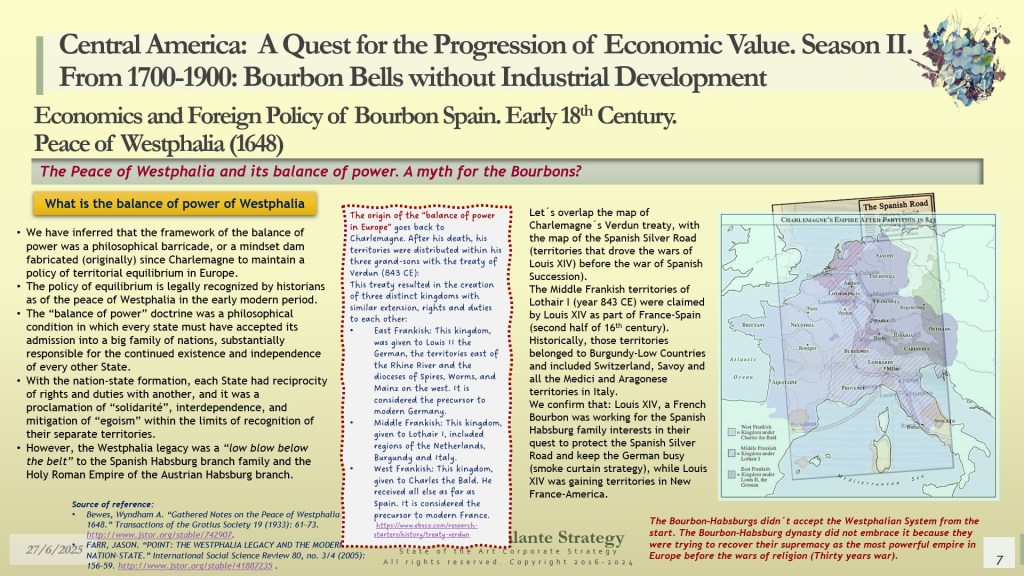
Let´s begin to analyze our slides. We kick off our strategic reflections with the Peace of Westphalia. According to official European historians of money matters, the Peace of Westphalia is one of the most remarkable events of Early Modern Economics. Superficially, anyone can be jumbled with its shallow definition as the resolution through a political diplomatic settlement of two devastating wars: The Eighty Years’ War between Spain and the Netherlands, and the Thirty Years´ War (a conflict of Catholic against Protestant in which all the nations of Europe were entangled). However, there is always a reason beyond the “official reason” in everything we find.

The Treaty of Verdun, of 843 CE, marked a significant turning point in early European history by partitioning the Carolingian Empire among the three grandsons of Charlemagne: Lothair, Louis the German, and Charles the Bald. Source: https://www.edmaps.com/html/charlemagne_empire_verdun_843.html 
A map illustrating the situation in Europe after the Peace of Westphalia was signed in Osnabrück and Münster between May and October 1648. The two treaties ended the Thirty Years’ War, and the Eighty years war too. https://www.edmaps.com/html/europe_1648.html
- Peace of Westphalia 101. The Peace of Westphalia was not the origin of the “balance of power” concept in Europe. Slides 6 and 7 were brought to show you that the Peace of Westphalia revolves around three philosophical aspects that we dare to remark on here. The initial prototype of keeping an equilibrium between the dynastic families ruling Europe began before the discovery of America. The balance of power idea began with the grandsons of Charlemagne. See slide 7. It started with the Treaty of Verdun (843 CE), when Europe was divided into three regions: East Frankish, Middle Frankish, and West Frankish. If you overlap the Spanish Road in which Louis XIV was fighting all his wars, that region was exactly the Middle Frankish area of King Lothair I (it included the Netherlands, all the Burgundian lands, almost all Switzerland, and Italy). This is exactly the region that the French King Louis XIV was extremely eager to bring back to the French Valois-Bourbons. See the map above, please.
Charlemagne´s court was located in Aachen (Aix-la-Chapelle in French). Charlemagne set the example of ruling with the support of the Frankish and Lombard Feudal Lords and the Medieval Catholic Church Pope, who was in the Italian Peninsula. Charlemagne was crowned as Holy Roman Emperor by Pope Leo III in December 800 CE. His Carolingian Empire stretched from Navarre and Barcelona all the way to Hungary. And this big land was then partitioned between his grandsons. It is remarkable to see that the Middle Frankish kingdom (the Lothair region) kept the leadership of the development of Europe up to the times of Louis XIV in social, legal, cultural, linguistic, artistic, religious, economic, and academic affairs. Coincidentally, it was also the terrestrial path of the Venice-Italian Merchants during their golden age of taking goods and products from Asia to Northern Europe, and it was the Silver Spanish Road to the Netherlands. Additionally, Aachen was the place for the coronations of the German “Roman Kings” for more than 600 years after Charlemagne. From 936 to 1531, the original Aachen Palatine Chapel saw the coronation of thirty-one German kings and twelve queens. Why is this important? Because the Middle-Frankish region was the intellectual cradle of Europe. It was the most prolific and rich region of the Treaty of Verdun, and it was consolidated for the primogeniture of the Carolingians. The Dutch-Burgundians were located there, a region that was taken by Maximilian I Habsburg-Aviz when he married Mary of Burgundy, the grandmother of Charles V, Holy Roman Emperor. - The Peace of Westphalia as a solution to a specific problem: For the first time in history, the powerful dynastic families of Europe were able to resolve an “ideological-religious” series of conflicts by using supra-national diplomatic skills on a huge scale. Since the Cuneiform system of writing of the Sumerians of Mesopotamia (c. 3500 BCE), it took more than 4,800 years to shape and assemble the human competences of peace resolution using international common diplomatic standards ingrained in the European rulers’ mindset evolution. Whatever the reason (mercantilism reasons to stop the war, or the balance of power, or the utilization of diplomatic premises of the Enlightenment, or a tactic to replenish resources and continue with posteriori conflicts); the Peace of Westphalia established a centralized system with “a new non-religious character” that broke the sacred intervention of the Holy Roman Empire of the Pope. This is why the Peace of Westphalia has been considered the foundation of modern international relations. Nowadays, the philosophy of the Westphalian system can still be observed in all the United Nations System, in the European Union System, and even in organizations of supranational military alliance as the NATO, or the North Atlantic Treaty Organization; or organizations for the security of trade and commerce such as the OPEC ( Organization of the Petroleum Exporting Countries) or ASEAN (The Association of Southeast Asian Nations).
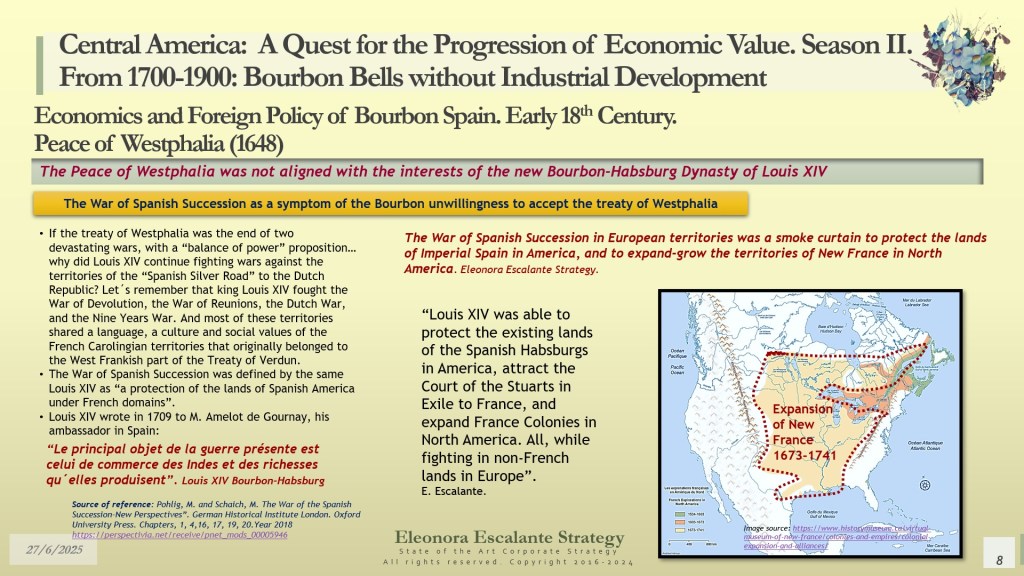
- The Peace of Westphalia was a cause of more problems. In the context of Louis XIV, the Peace of Westphalia meant nothing for him. Louis XIV was born in 1643, a year after the death of Cardinal Richelieu, the man who transformed the wars of religion into a political struggle, rather than a purely religious conflict for France. At age four (1648), Louis XIV succeeded his father to the throne, under the regency of his mother, Anne of Austria. However, it was the spirit of Richelieu who continued with Cardinal Mazarin’s policies in terms of foreign affairs against the Habsburgs. According to official history, there was a natural antipathy of the French Bourbons against the German or Spanish Habsburgs, but we don´t trust that rationale, given the arranged marriages between different relatives of the Habsburgs and Bourbons. Both families engineered Louis XIV to defend Spanish America in times of a chaotic lack of succession for Imperial Spain. It was a Habsburg land across the Atlantic that necessitated the French king as a supporter and protector to continue ahead, keeping the Spain domains in America. It was the same Frankish Carolingian vertebral column that started with Charlemagne.
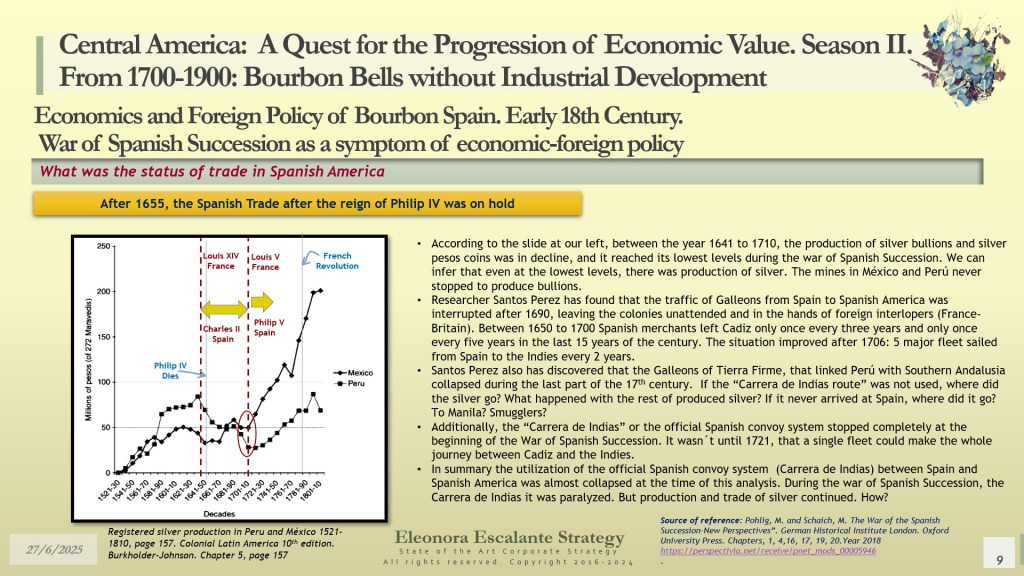
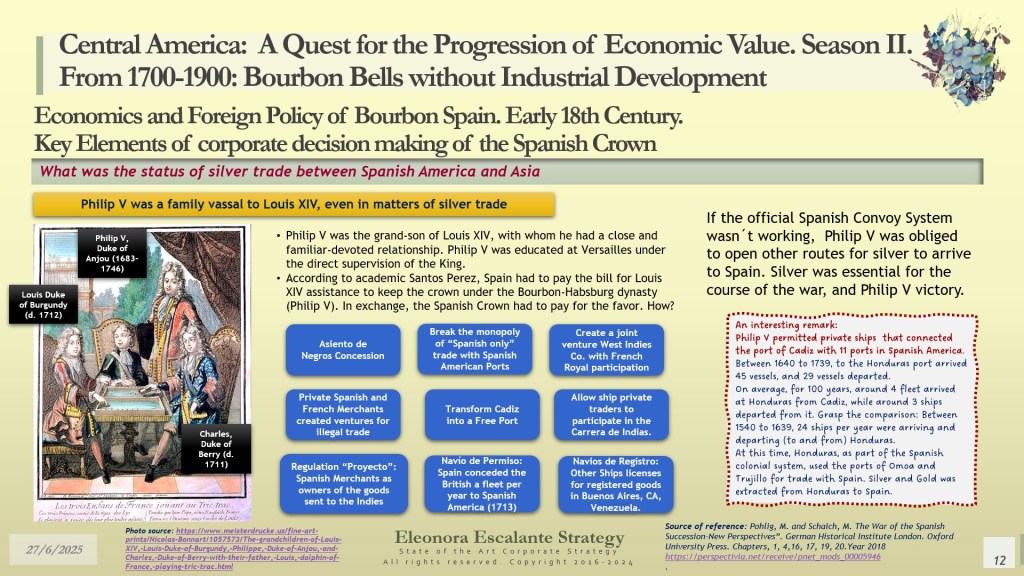
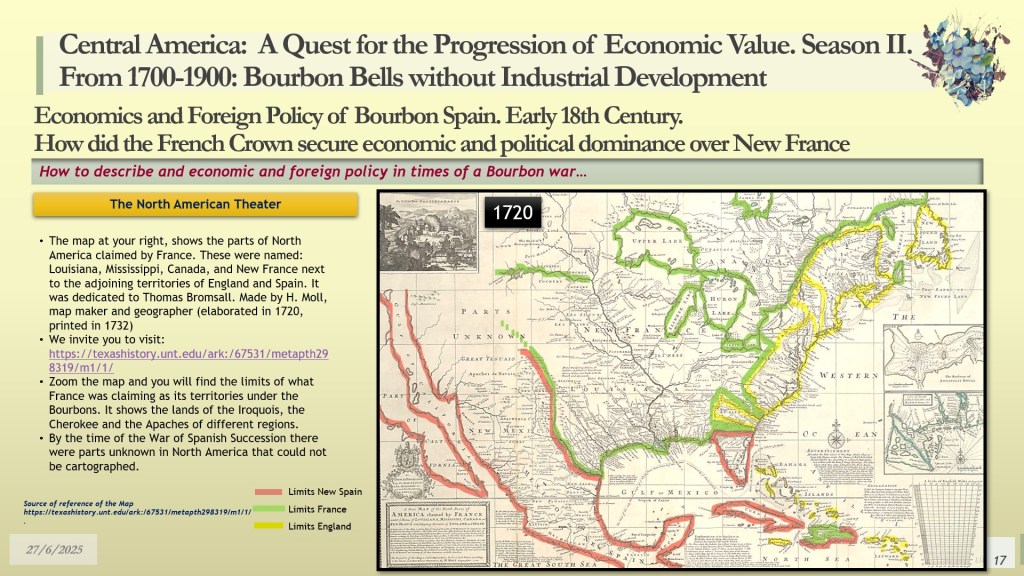
The cause of new problems of the Peace of Westphalia for Imperial Spain was originated in its medullar intention: The national sovereignty of each territorial dynasty in Europe (and its territories in America), characterized by independent authority with its own domestic decision making, autonomy of foreign affairs and trade, and interstate competition for resources became the primary governing system of Europe, exhausting the Holy Roman Empire that was built under the Habsburg rule. A new Westphalian system depleted the Holy Roman Empire and its Catholic Religion. This motive caused Imperial Spain to run to protect its lands in America, which were born under the Catholic power. Native American populations were conquered through the evangelization of the Catholic priests. Yet, trade and commerce with Spanish America were catapulted, protected, and kept under Spanish-American Feudal Lords that hanged around the Catholic authority in such a way that their loyalty was glued by values that were not going to continue outstanding in Europe. In consequence, America was not only being exploited under the Catholic feudal vassal model, but it was also producing goods, merchandise, and exports with slavery. The ideological Westphalian system, if enacted in America, was going to create a mess of gigantic proportions for Imperial Spain. This is why Spain (and France as its protector ally) did not embrace the Westphalian System that shaped European diplomacy from Early Modern Europe up to this day. By refusing the Westphalian spirit, the French and Spanish Kingdoms displayed Louis XIV with a belligerent series of conflicts in Europe, while their agents were trying to protect their American domains using all types of tools, including corruption, fraud, sales of public offices, and immorality of contraband. See slide 8, please. - War of the Spanish Succession as a Symptom of Economic Foreign Policy. Slides 9 to 11. Slides 16 and 17. Wars don´t happen by fortuitous accidents. The Spanish trade of silver from the Americas to Europe or Asia was crucial for the emerging world trade system. The trade of silver continued, despite all the wars of Louis XIV. Even if the silver trade was reduced to a minimum (slide 9), the new route of Río de la Plata was used by French and British merchants for smuggling silver from Potosi, and as a new route for smuggling slaves to Brazil and Perú (slide 10). While the Carrera de Indias (Official Spanish Convoy System) was interrupted, gold, silver, and precious metals continued to leave the coasts of America under new foreign interlopers. From slide 10, we can clearly cognize that Imperial Spanish trade (under their exclusivity arranged by the Papacy with Tordesillas in 1494) was being demolished in pieces, because the same Peace of Westphalia treaty encouraged it. After Westphalia, the Papacy leadership and the obedience to it from England or the Netherlands were totally nullified. The German protestant states, gaining their autonomy, were not under any restriction of the Roman Catholic Church. Not under spiritual vassalage to the Papacy, and not under trade serfdom either. After Westphalia, there was no religious law that could stop the rest of the Maritime Powers from entering the Spanish American trade, either by force or by any other type of coercion. The War of the Spanish Succession concealed other wars for conquering and expanding North American territories, because the Spanish had to pay tribute to France for Louis XIV’s work. The Spaniards opened the door of Louisiana to the French (slides 16 and 17).
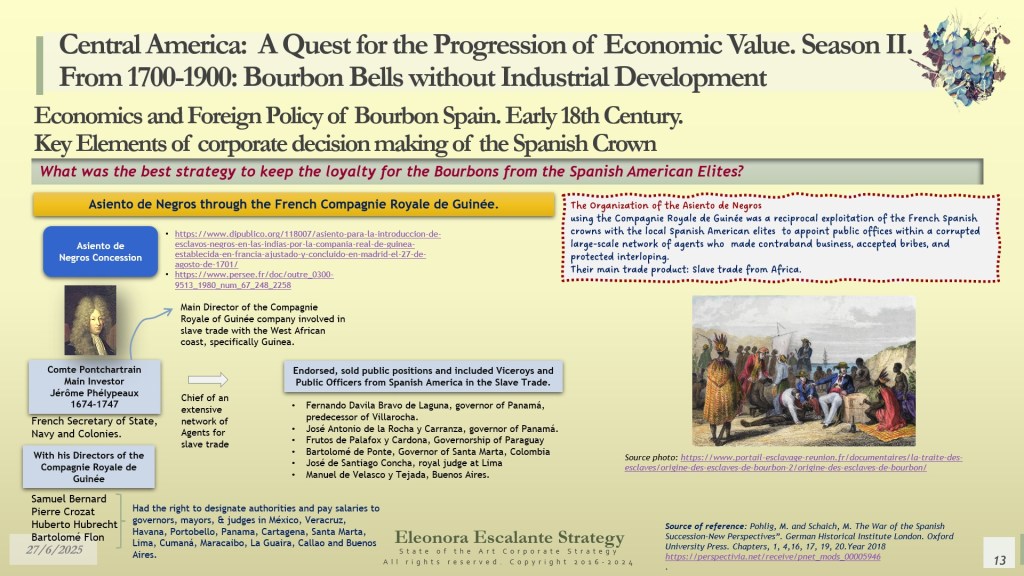
- Key elements of corporate decision making of the new Franco-Spanish Crown: Slides 12 to 15. These slides are self-explanatory. We have tried to gather different facts that academic scholars have researched about the status of silver trade between Spanish America and Asia, how the Bourbon-Habsburg agents (under Louis XIV court Ministers and superintendents) gained or rather bought the loyalty and will of most of the governors, mayors, judges and custom duties representatives of Spanish America, and how the sale of Spanish America Public Offices continued at the highest rate in the whole history of Imperial Spain. If you are a keen observer, the conduct of public officers in Latin America of the last century to this day is the consequence of the encouragement of the sale of public offices under the Habsburgs and the Bourbons. The institutional corruption was inserted by the Spanish Crown agents, decade over decade, with the highest apex under the French Spanish duo of Louis XIV Bourbon-Habsburg and Philip V Bourbon-Wittelsbach. The colonial elites of the early 18th century got used to corruption when arriving at public power positions, and this drama has continued despite the odds of the Independence movements of the 19th century. Slide 15 is particularly noteworthy because we are not permitted to believe 100% in the official motives of the foreign affairs struggles between the Dutch, English, German Roman Empire against France and Spain. Why? All the rulers of the early 18th century were a family. All of them were linked genealogically in between. If all were relatives at first or second level of consanguinity, what were the grounds of this show? By far, the answer is not in Europe, but in America. If true, it was an insane game of thrones, in which the territories of America caused the Enlightenment, prompted the conflicts of territorial occupations in North America, and triggered future alliances that we will discover over the next month. We can dare to affirm that even the French Revolution against French King Louis XVI and the Bonaparte phenomenon, at the end of the 18th century, were also triggered by the expansion and growth of American domains of all European nations.
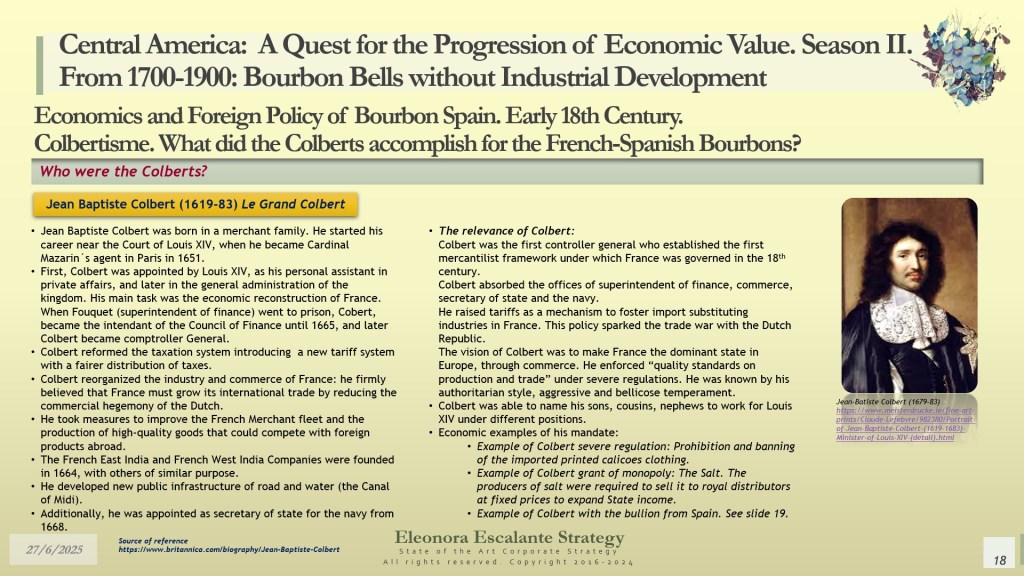
- Colbertisme. What did the Colberts accomplish for the French and Spanish Bourbons? Slides 18 to 20. The Colberts were appointed by King Louis XIV to solve problems of the French economy. The “Grand Colbert,” Jean Baptiste Colbert (1619-83), was the first controller general, who established the first mercantilist framework that promised to help France become prosperous and wealthy. It didn´t happen for the majority of the population, but it gave fortune to the Bourbon-Habsburg family. Although Colbert´s economic thoughts were merely intuitive to create more chaos than benefits (given his lack of formal university education), Colbert´s initial measures were designed to create a robust industrial development in France. However, the extreme regulations and his sick tariff management system (see slide 20) only attracted the black market and smuggling, two of the most pestilent and harmful consequences of wrongly designed regulatory controls. Therefore, “the existence of black markets and smuggling can be viewed as unintended consequences of regulations and tariffs, as they provide avenues for individuals and groups to circumvent legal restrictions and benefit from illicit activities” (2). Look at slide 20 again, please: You can see the 6 main elements of Colbertisme that arose simultaneously during the century after Richelieu passed away. These 6 elements, all of them working together, created an exponential destructive impact on the French Economy. It was as if all the negative factors were created and bundled on purpose to defeat the French for ruining Imperial Spain. Be aware that we firmly believe that Colbertisme is not a synonym of patriotism or nationalism, despite that scholars have branded it in that way. There are prosperous countries with certain mild elements of Colbert that have reached prosperity during the 20th century, but these countries, as Norway or the United Arab Emirates, hold a treasure below their feet: oil and gas, and they are directly administering it with a certain degree of operational excellence. In the case of Imperial Spain and its Bourbon French ally, the silver extraction was not exactly in their hands, but in the hands of the smugglers and corrupted agents. One thing is true: history has proven that every nation founded on corruption, bribery, smuggling, and/or black markets is condemned to succumb (3).
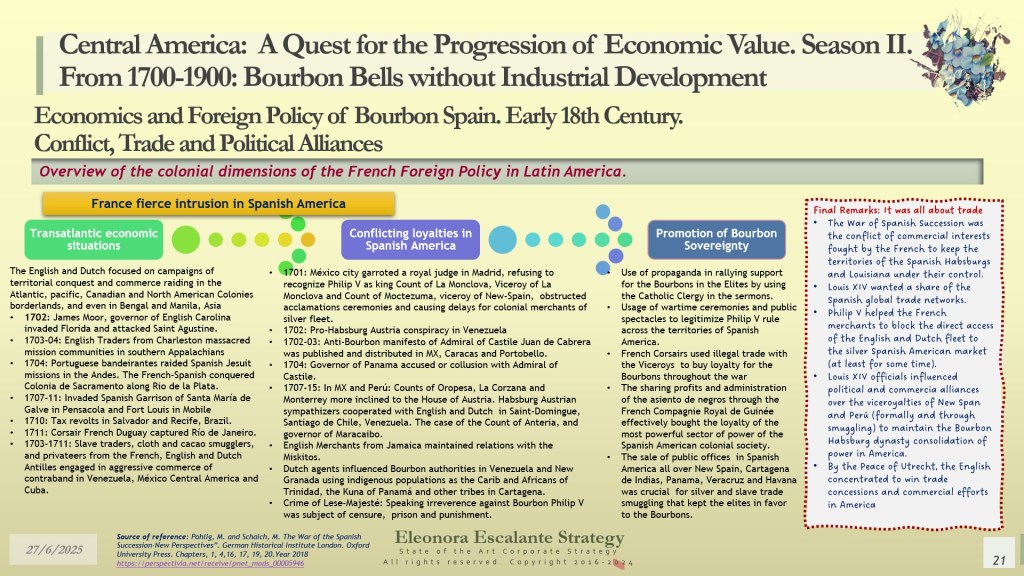
- Overview of the colonial dimensions of the French Foreign Policy in Spanish America (early 18th century). Slide 21. Please read this slide to chronologically learn how the Franco-Spanish mercantilism was the expression of corrupted transatlantic economic situations, plus a manipulation and buyout of loyalty to the Crown, plus the promotion of Bourbon sovereignty in Spanish America.
The French Bourbon new regime in Spanish America was a profit-driven delinquency system that started so badly, but so critically ill, given its lack of ethical values, immorality and corruption design, that even now, 325 years after the death of king Charles II Habsburg in 1700, most of Latin American countries still suffer of an institutional widespread corrupted philosophy, deeply rooted at the political super-structure of political parties leaders. The new young leaders of today are getting ahead with a new technological AI system founded on the same paradigm. Nothing good will come out of it, if the corruption and digital begging of the slaves of the Internet is so alike the asiento de negros and smuggling of silver under Louis XIV. Same old song, under different technological circumstances. Same old song.
To be continued…
Announcement:
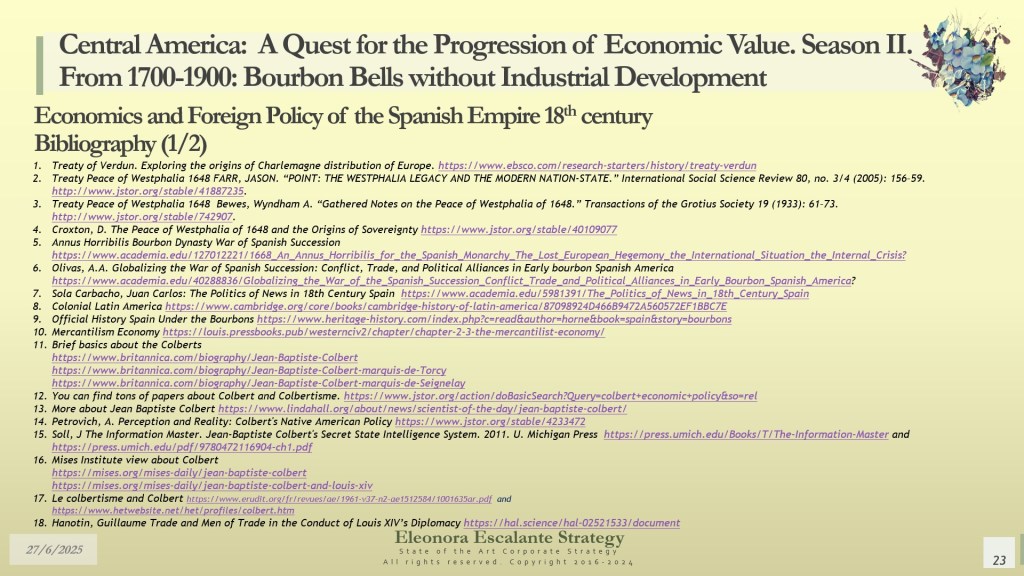
With this episode, we hope that we have set you on the same page. We think that we have covered the most important details of what occurred before the arrival of Philip V Bourbon-Wittelsbach to Imperial Spain. We have also provided the main elements of what King Louis XIV did during his reign and why. The study of Jean Baptiste Colbert (1619-1683) and his nephew was imperative because the ” economics-foreign policy monarchical decision-making design of France” was in the hands of the Colberts. We aspire to understand how a constellation of families (Bourbon-Habsburg-Medici-Wittelsbach-Stuart-Oldenburg-Nassau-Savoy) was preparing the way to remove the Castile-Aragon interests in Spanish America, and take North America from the Appalachians and Native tribes like a storm. There is a lot to learn during the following weeks. See you then.
Musical Section.
Season III of “Central America: A Quest for the Progression of Economic Value” has assigned a new instrument for the rest of the year. It is the guitar!. Our selection of music during Season III will continue to explore adorable music produced between the 17th and 19th centuries with interpretations of virtuoso guitarists. We will embark on the selection of the top 29 loveliest guitarists from the last 5 generations, playing music composed during the time of this saga. Our choice for today is John Williams. Williams plays as a soloist guitar under the direction of Conductor Daniel Barenboim. Concert: A Latin American Night – Berliner Philharmoniker, 1998. Visit the website of Williams to learn more about his wonderful life dedicated to playing the guitar. https://www.johnwilliamsguitarnotes.com/. Enjoy
Thank you for reading http://www.eleonoraescalantestrategy.com. It is a privilege to learn. Blessings.

Sources of reference and Bibliography utilized today. All are listed in the slide document. Additional material will be added when we upload the strategic reflections.
1.FARR, JASON. “POINT: THE WESTPHALIA LEGACY AND THE MODERN NATION-STATE.” International Social Science Review 80, no. 3/4 (2005): 156–59. http://www.jstor.org/stable/41887235.
(2) https://www.justice.gc.ca/eng/rp-pr/csj-sjc/jsp-sjp/rp02_12-dr02_12/p3.html#foot8
(3) https://www.ebsco.com/research-starters/law/smuggling
Disclaimer: Eleonora Escalante paints Illustrations in Watercolor. Other types of illustrations or videos (which are not mine) are used for educational purposes ONLY. All are used as Illustrative and non-commercial images. Utilized only informatively for the public good. Nevertheless, most of this blog’s pictures, images, and videos are not mine. Unless otherwise stated, I do not own any lovely photos or images

 Eleonora Escalante Strategy - Strategic Reflections Think Tank