
Central America: A Quest for the Progression of Economic Value. Season III. Episode 6. Philip V (1683-1746). The Frenchification of Imperial Spain.
Dear fantastic readers:
Welcome to the 6th masterclass about our strategic analysis of the rulers of Imperial Spain in the 18th century. We are pleased to begin with King Philip V Bourbon-Wittelsbach Von Bayern (1683-1746). Regardless that we have already given you certain elements of his ruling value proposition, we are commanded to offer you the foundations of the Bourbon New administration of Spain, Spanish America, and the North-American Conquest under the Bourbons of France.
Our framework of study for today has been prepared. We begin with exploring the “official” history genealogical connections of Philip V lineage. His ancestors, and particularly the influence of his grandfather King Louis XIV, were primarily conceived by the Bourbons and the Habsburgs, as the solution for a Franco-Spanish new Empire that could convert this new dynasty into a global force, beyond the AEIOU Austrian motto. Philip V´s two marriages allowed him to recover his lost domains of Italy before he passed away. His marriage to Elisabetta (Isabel) Farnese of Parma was a clever move for him. Apart from offering you his general biographic details, we then explore the main events of his two ruling periods. As a third point of the agenda, we continue with a summary of his Secretaries of State, under his new government structure. The new Bourbon administration pretended to nullify the Council of Castile, and the influence of the elites or grandees’ families of Castile. Additionally, the autonomy of the kingdoms of the Crown of Aragon and Valencia was abolished. We demonstrate that historians have captured the Bourbon solid family strategic alliance between Spain and France under three family compacts, and how Philip V changed the old Habsburg traditional system of Councils into a New Commercial centralized absolute monarchy. Finally, we have focused on explaining the 7 priorities of Philip V’s foreign affairs, one by one, for your clarification and comprehension.
As usual, find the document of slides below. Please, we encourage its detailed reading by visiting the bibliography. Feel free to share it with your friends, professors, colleagues, and family members. Download the document. Print it. Write your ideas and question notes using a pen or a pencil. Beyond a history reminder, we wish you to observe the details. Most of the modern history of Spanish America (in particular Central America) is tied to the decision-making of the Bourbon dynasty.








We request that you return next Monday, July 7th, to read our additional strategic reflections on this chapter.
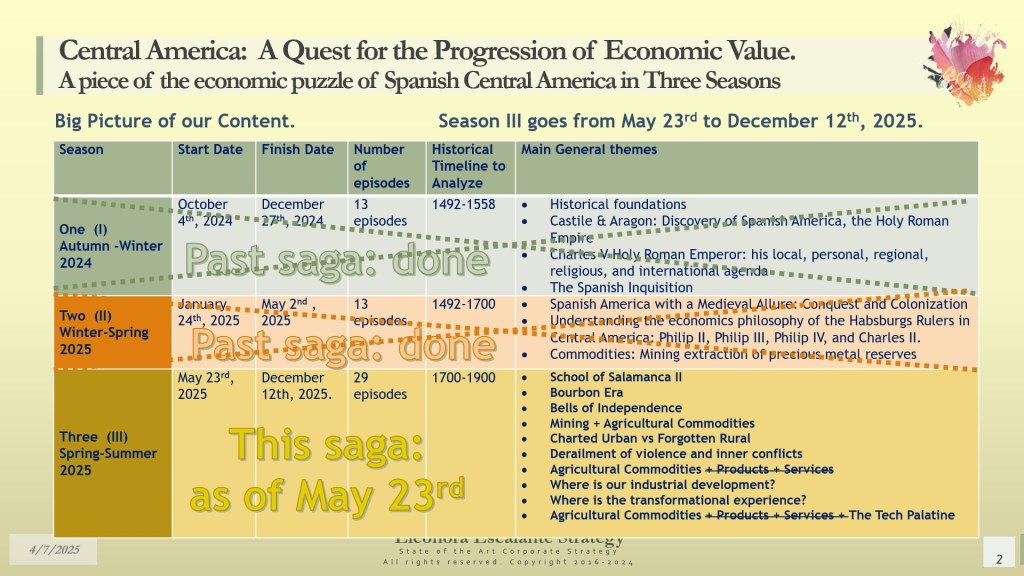
We encourage our readers to familiarize themselves with our Friday master class by reviewing the slides over the weekend. We expect you to create ideas that might be strategic reflections or not. Every Monday, we upload our strategic inferences below. These will appear in the next paragraph. Only then will you be able to compare your own reflections with ours.
Additional strategic reflections after the weekend. These have been posted today, Monday, July 7, 2025.
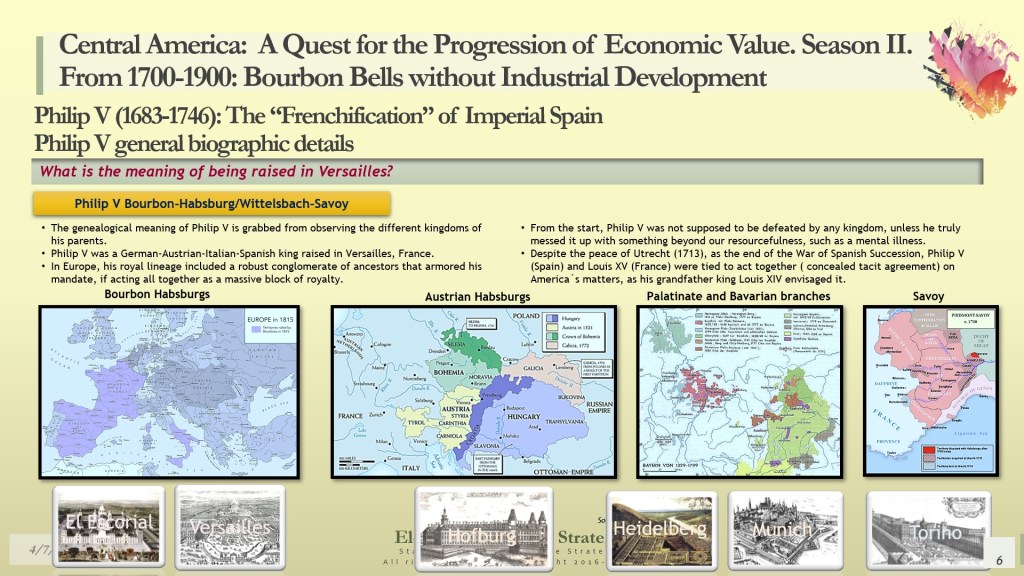
Philip Bourbon-Habsburg/Wittelsbach-Savoy. Slide number 6 situates us in the geographic background of Philip V. The importance of this shot lies beyond the genetic royal blood of the character. First, let´s look at the combo of his 4 last names, does it look like a Spanish personage? Not even the first name was Castilian. He was named Philippe (A french version of Felipe). And it seems to us, he never learned Spanish properly. About his last names: ancient royal members and their emblematic coat of arms traditionally represented the territory. The potency of a “last name” in Medieval and Early Modern times was not as we use it today. Nowadays, the last name of any “very important person” is like a commodity that can be bought or sold for pennies. Before the time of Philippe V, the last names of kings and queens were not necessary. The monarchs were identified by their territories. However, with the Bourbons, this “last name” took a new distinctness. The royal last name not only represented a domain, an area or region that was translated into the ownership of lands that were conquered by wars and battles. Philippe V Bourbon, the last name of this king, introduced us to a new family. Philosophically, there was a shift from land to family. It was the name of a family that embodied a constellation of members who all together symbolized authority and control of States and populations. With the Bourbons in France and Spain, the kings of Western Europe finally adopted the family surname tradition of the Eastern Byzantine kings and emperors; in consequence, by the time of Philippe V Bourbon, his 4 last names were not a “flipbook page to pass”. The new Bourbon Dynasty arriving at the Spanish domains of the old and new world was coming to destitute the Castilian legacy of the Trastámara domestic interpretation of Spain since King Ferdinand II of Aragon and Queen Isabella of Castile. Philippe V was the opportunity to wind down the Spanish leadership superstructure from Castile, and install a Versailles French + Hofburg Spanish-Austrian + Heidelberg/Munich Palatinate-Bavarian + Torino Savoyard culture. The Castilian Spain was in danger. Not Habsburg Spain. It was the Castilian Spain. Can you observe how far Philippe V was to be accepted as the ruler of Castilian Spain in 1700? This duke of Anjou, grandson of the French king Louis XIV, had no cultural delicacy clues about what was essential for the “Castilian-ly” power traditions of the elites of Spain and Spanish America.
After the War of the Spanish Succession, the people of the Spanish Peninsula had no choice but to accept such discomfiture. It was a mess during and after the war. But there was no other choice. A war fought in Spain’s territories was a chaotic terror contextual situation in which Philippe V was obligatory, and the elites of Spain, deprived of their merchant silver interests in the New World, had no other choice but to accept the changes that the new king was going to implement. Please remember that the Carrera de Indias stopped for several years before the arrival of King Philippe V. However, all the high-elite nobility of the Castile and Aragon kingdoms knew in advance that their fate wasn´t flattering enough. For many of them, it was unacceptable to remain in Spain. That is why many of the nobles of Spain decided to move to Spanish America, by buying government positions, meanwhile, their implicit prosperity could afford and offer the same lifestyle that they had left in the Peninsula. Philippe V was not a Spanish King; he was a Versailles French vassal to the French crown, and he knew that his allure barely arrived at a “Viceroy” in the eyes of Louis XIV. Not even the death of Louis XIV (2015) made him free from his French auspices. The value chain of silver from Río de la Plata was already in the hands of the French royal smugglers, and he and his ministers didn’t have the power to stop it. The disintegration of Imperial Spain for the Spaniards of Castilian origin began with the death of King Felipe IV (in 1665). But with the French Philippe V, the disintegration of Castile was absolutely undeniable. We have already observed how King Louis XIV disrupted and weakened the silver value chain from Spanish America to Europe, through all the conflicts that we have listed in Episode 4. Let´s continue with slides 7 and 8, please.

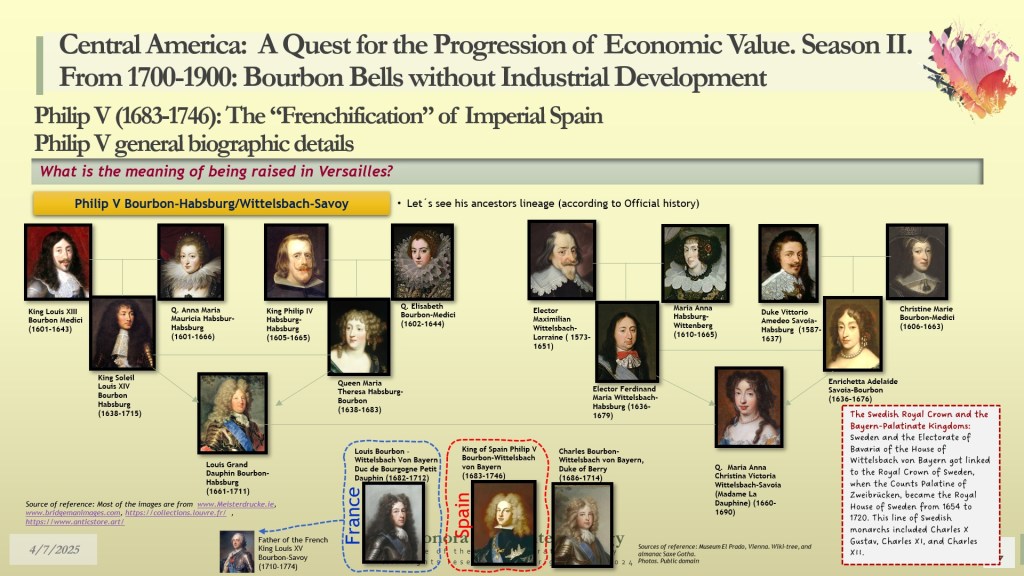
Philip V General Biographic details. Slides 7-8. We have spent a good portion of last week verifying and confirming the genealogical tree of King Philip V of Spain. We think we are at least on the same page with historians on that. I would like you to see slide 7, please. Originally, if you check the maternal and paternal lines of Philippe V of Anjou, the Habsburgs’ omnipresence is still portrayed. The Habsburgs weren´t removed from the identity of Philippe V. Their culture and traditions were present in each of the 3 precursor generations. The Habsburgs were not deleted from the decision-making of the Bourbons. On the contrary, they were ingrained in them. As embedded or more than in Austria. We dare to assert that the Habsburg dynasty used the Bourbon house to clean their blood from the sicknesses of their inbreeding, and they allowed the Wittelsbach and the Savoy families to join their Golden Fleece elite age. There must have been something in the mindsets of these two new latter families that the Habsburgs perceived as qualitatively noteworthy. The Habsburg families (both branches) of the 18th century had no problem with territorial expansion. Their main corporate monarchy trouble was the mentality of their kings. And they wanted to solve it. However, cleaning their genetic mess required several decades, and they instigated a series of test-and-error cycles in each of their old and new genetic branches. Even if the kings or queens were not aware of the problem, their advisors knew it. By far, the advisors of Philippe V were aware of the importance of choosing the correct successor, because these counselors were navigating without a smart captain. And that was the main misfortune of the Habsburgs. They had it all (territorial domains, wealth, castles, luxurious lifestyles), but they were in a deep, disgusting hole of mental insanity that required a lengthy process of cleansing. How? By choosing the genealogical far-away future partners that would not compromise their upcoming “mental” competencies. Philippe V didn´t want to reign in Spain. He abdicated as soon as his first son was able to rule. Whatever the reason, Philip V knew he was not the “right” person for Spain, and he tried to retreat. However, he ended up reigning following the indications of France. Versailles planned all his initial reforms, and France was establishing its colonies in North America. There was no point of return. Over time, France planned to implement a new government organization structure, and its foreign policies were not against Spain-Habsburg, but against Castile.
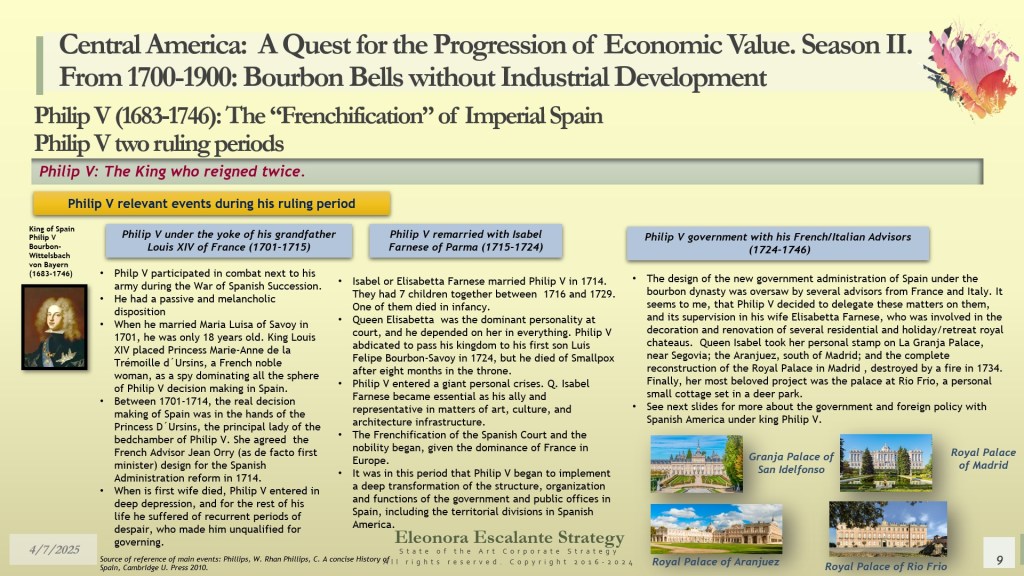
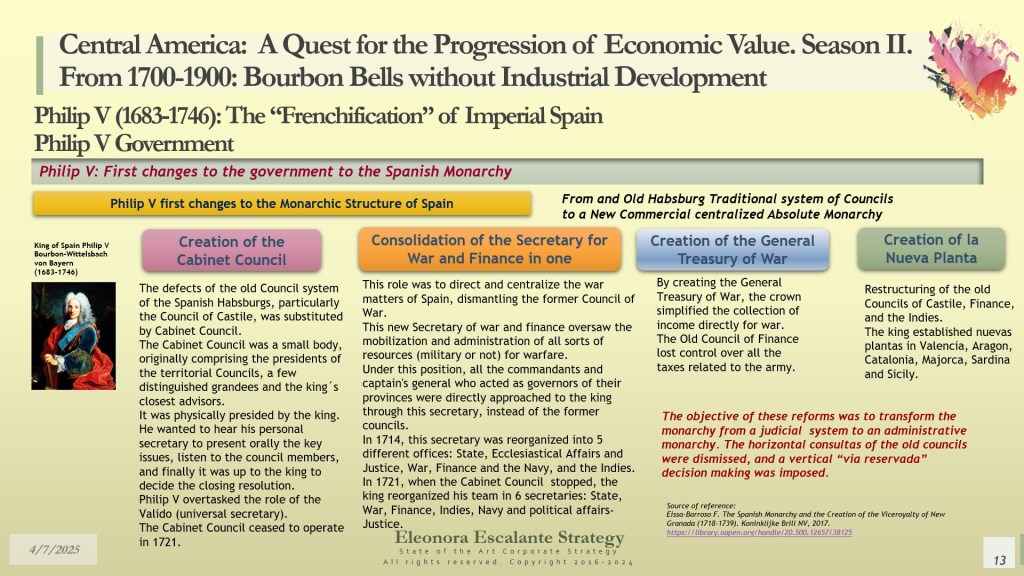
When a dynasty’s head can´t think well. The situation of the first Bourbon in Spain is summarized in the next phrase: he delegated his obligations to his advisors. See slide 9. Why did a king of such a powerful pedigree have trouble leading Spain? We took the time to read several chapters of the 2 main biographies about this king – one by Alfred Braudillart (1), and a recent one by Henry Kamen (2). According to Kamen, Philippe V suffered from frequent periods of what at that time was defined as “mental illness or recurrent periods of depression.” His court and government staff described him as lazy, inept, and a puppet dominated by his queens. However, Kamen asserts that Philip V had a physical disability: he suffered from bipolar disorder (which explains the episodes of his life of manic depression). Additionally, Kamen suggests that Philippe V’s behavior got worse from his mid-thirties up to his death: he adopted a schedule that reversed day and night. His “night owl” insomnia was intense, but there you have a king who worked at night, probably because in that way he felt protected in the middle of the Spanish foreign world. For extended periods, he was bedridden and mute, or else he was an incarnation of piteous howling (3). He also wasn´t a tidy king: he appeared filthy and messy, with long hair and untrimmed nails. Though, the king was not foolish, because his madness did not damage his clarity of thought, he “used” his dementia, toward refusing to lead Spain by himself, delegating his decision-making in his advisors and secretaries of State, Political Affairs, War, Finance, the Indies, the General Treasury of war, Justice and the Navy. Philippe V organized his government structure through the “vía reservada” as a means to cover up his troubled mind, leaving the government in the hands of his advisors. See slide 13.
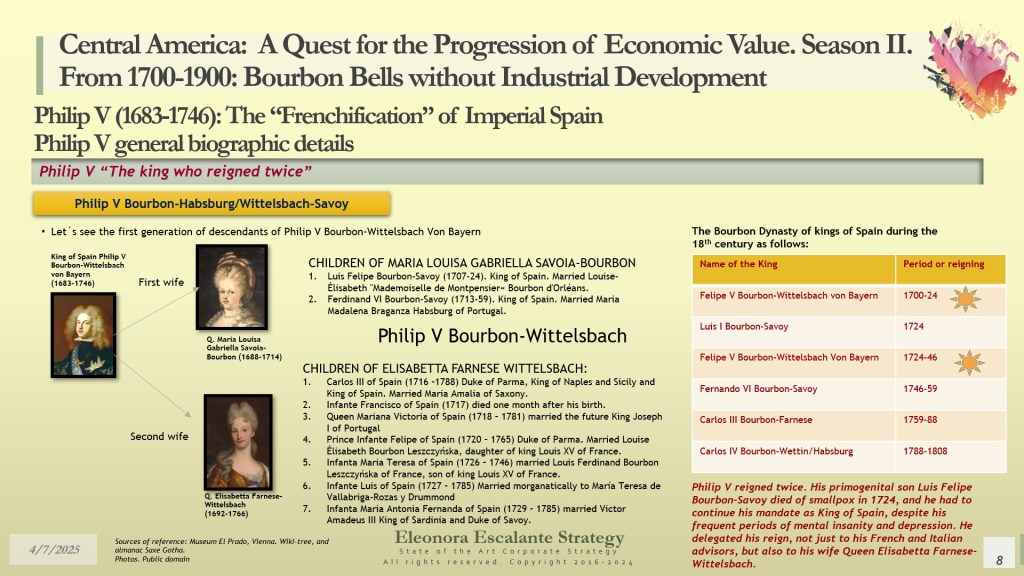
Philippe V’s government. Slides 10 to 12. Reading the names of the secretaries of state doesn´t give us a clue about what Philip V did, but it gives us hints of how he reorganized his administration. Hugely different from what the Council of Castile was before. The objective of Philippe V was to nullify the Council of Castile, with the sole purpose of undermining the Castilian Nobility, the elite class that could stop him in his plans. Still, please look at the first 16 years of his reign: his advisors were French. And we dare to suggest that Philip V would have remained in that same direction until his death. But something happened. An Italian Advisor, Giulio Alberoni, was the one who took Isabel (Elisabetta) Farnese to marry the King, and the story of the government of Spain changed. Through Queen Isabel Farnese, she was compelled to look for help, and she opened the door to the Italian advisors of the Enlightenment, a diplomatic team of high caliber that was accepted by the side of the Aragon-Catalunya-Valencia regions. Little by little, the Spanish empire moved “theoretically from the French” to an “Italian foreign policy” that unlocked the Spain of Farnese to his primogeniture Charles III Bourbon-Farnese. Charles III was the Spanish king who focused his foreign policy on the takeover of the bottom of South America. We suggest that Philippe V marked the transition from Louis XIV’s French power plans to the Italian insurgent plans of gaining a foothold in the Americas. Philippe V’s femmes were not as fatales as we might think. The Savoy and the Farnese queens had their own agendas for their children, and they were able to see Philippe V’s struggles, who only achieved what his dynastic legacy expected from him: the weakening of an empire that had richness beyond Europe. An empire that was navigating a feeble automatic pilot since its historical conception as of 1492, led by advisors and counselors who only cared for their own egoistic plans. Many of them had personal motivations that were the cause of corruption operations, bought by other dynastic complex interests who wished their own prosperity in America (From Canada to Patagonia). However, the royal advisors and validos were not totally responsible for the lack of leadership of the insane Spanish kings. The counsellors played a role that each king allowed (or had no choice but to allow). Each king was responsible for his own actions. With folly, mental madness, or not. It is no coincidence that most of the advisors ended in tragedy after their mandate was over. Even in the case of Charles II Habsburg, the regent and the grandees of Spain involved in the Council of Castile were somehow legitimizing the king’s advisors’ “monarchical strategy”. When hiring advisors, this has not changed to our day. For example, at the moment, most of the top consulting advisors of the high VIP economic groups in the world have opted to support the Artificial Intelligence path. Our corporate strategy house is against that roadmap as it has been designed. Even if we demonstrate that we are correct, the last word is in the hands of the “current grandees of the world”. They have been fooled by the immediate “cost-cutting weaponry, quickness, and efficiency” of the AI. As independent advisors, all we can do is to continue with our philosophical analysis and wait until the same top consulting houses reach our conclusions.
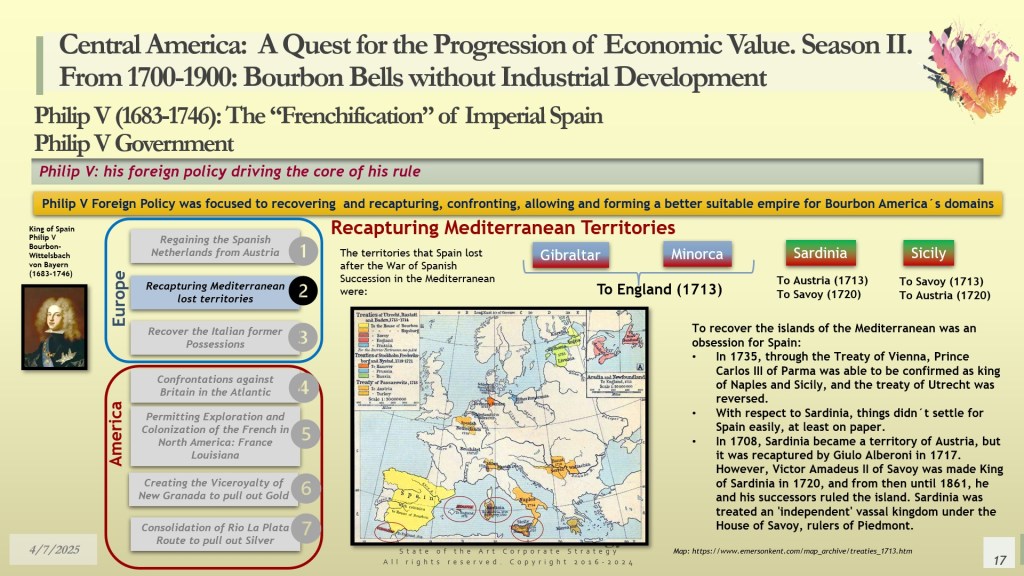
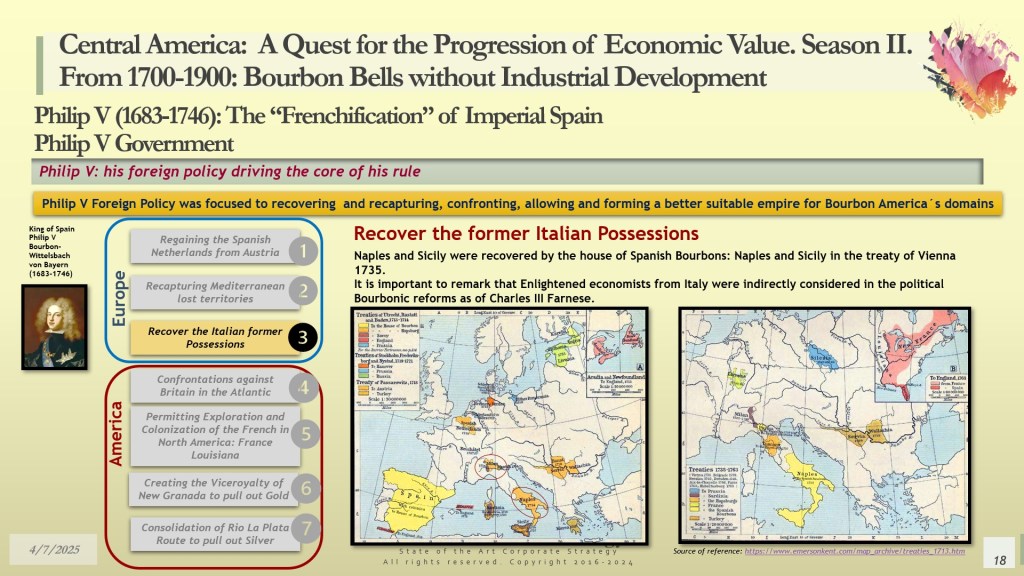
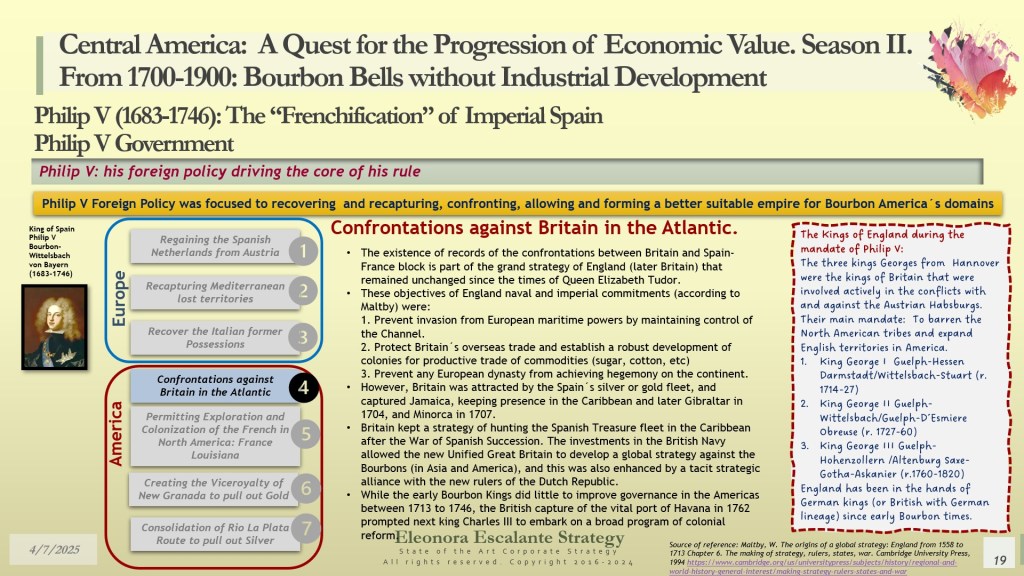
Philippe V’s Foreign Policy. Slides 15-21. These slides are self-explanatory. I wouldn´t strategize more than what we have already delivered last Friday. There are only three ideas that I would like you to read again, please:
- The confrontations against the Dutch/British in the Americas (slide 19)
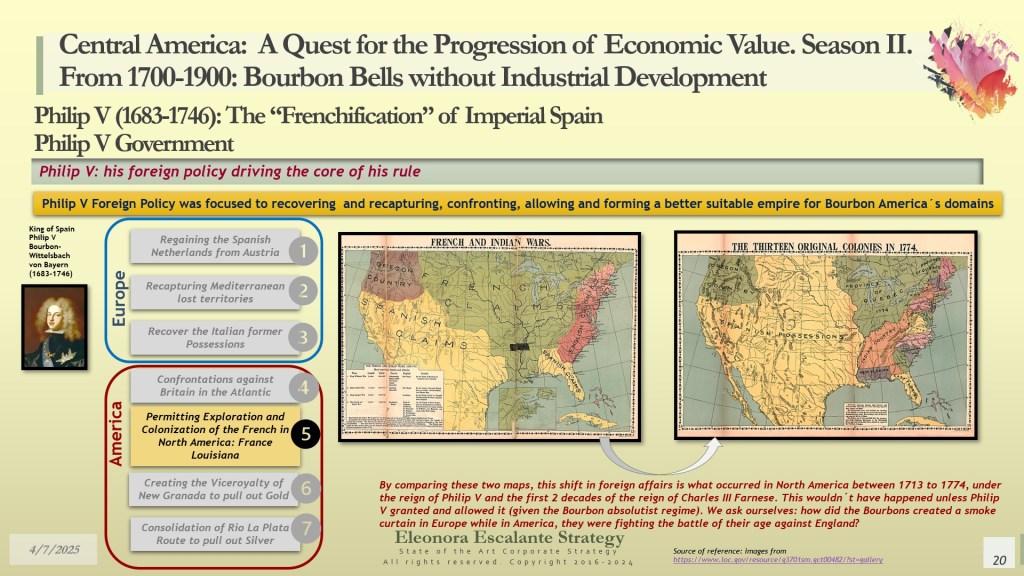
- North America changes (slide 20), and re-read all the slides of episode 5.
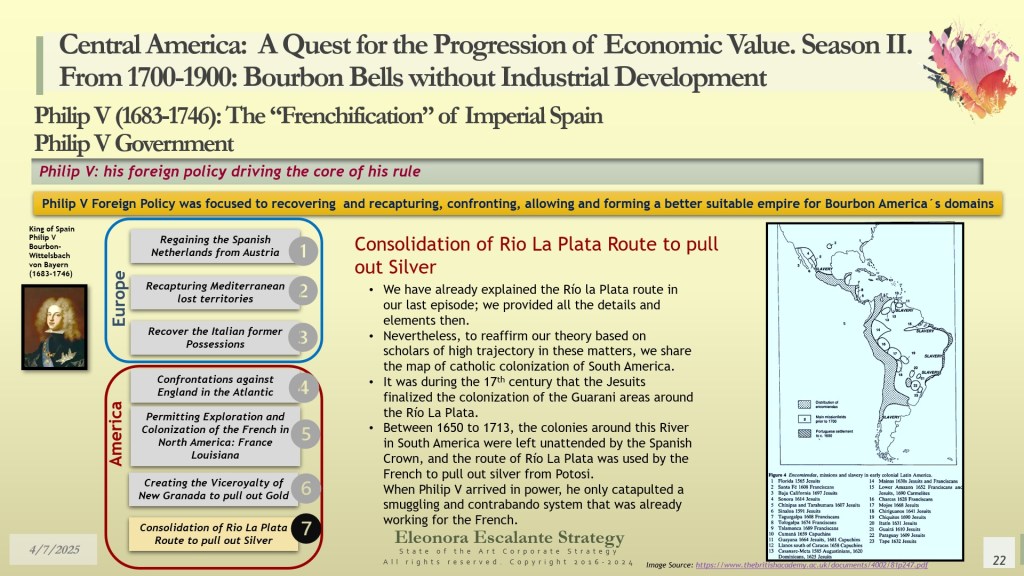
- The creation of additional viceroyalties in South America: New Granada and Río de la Plata (slides 21 and 22).
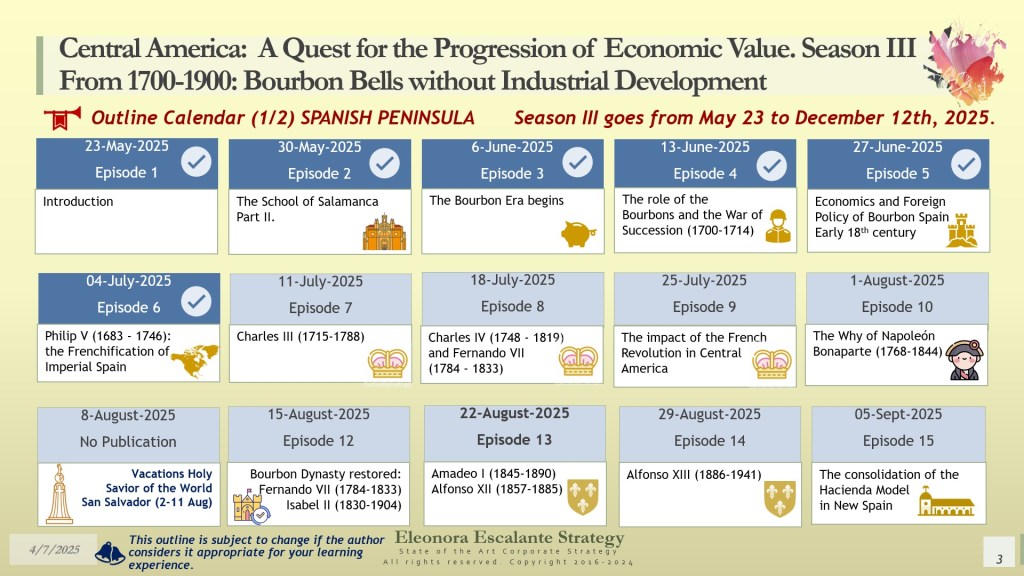
The last three points were crucial for the Bourbons of Imperial Spain in Spanish America. It was during the time of Philippe V that Guatemala received special attention. According to our analysis, Guatemala was the Habsburg refuge horizon since Charles V. During the reign of Philippe V, Guatemala continued to be considered with financing to attain its splendor. A magnificent new direction that can´t be taken for granted. A route that was obstructed by an Earthquake in 1773. We will analyze this situation as of September 5th. Once we finish describing the Bourbon mandates in Europe.
Finally, with the introduction of the French-Bourbon administration, it is clear to us that Spain was not alone anymore. The entrance of competitors wasn´t a coincidence. The two main maritime powers, the British entangled with the Germans and the Dutch, were not going to stop until they could settle against the French and Spanish forts in North America. No matter what the French and Spanish dynasty of the Bourbons could do, the British (particularly) had a clear horizon to hijack and take control. The entrance of the Prussians was also relevant, while the big brothers of Austria were also observing from not that far away… The omnipresence of the Habsburgs remained, under a new edited branding, “the Bourbons”…
To be continued…
Announcement:
This episode is the beginning of knowing who was who in the Spanish Bourbon Dynasty. Philip V Bourbon-Wittelsbach was the king of Spain who dismantled the CASTILIAN Spanish Council system. He took every single column of the Castile former administration and destroyed it. His game was to conceal the French expansion of Bourbon America. The Wittelsbach kept their German intervention in Castile, and little by little, Spain was guided into the Britain-German plans. There is a lot to learn during the following weeks. See you then.
Musical Section.
Season III of “Central America: A Quest for the Progression of Economic Value” has assigned a new instrument for the rest of the year. It is the guitar!. Our selection of music during Season III will continue to explore adorable music produced between the 17th and 19th centuries with interpretations of virtuoso guitarists. We will embark on the selection of the top 29 loveliest guitarists from the last 5 generations, playing music composed during the time of this saga. Our choice for today is Sharon Isbin, a virtuoso guitarist who has achieved multiple recognitions. https://www.sharonisbin.com/biography.html. For the occasion, we have chosen her performance of Vivaldi’s Guitar Concerto in D Major RV93 with the Salomé Chamber Orchestra, at the Metropolitan Museum of Art Grace Rainey Rogers Auditorium, New York City, in 2011. We invite you to search for the two additional sections of the concert (Adagio and Allegro) on the YouTube channel @salomechamber. Enjoy!
Thank you for reading http://www.eleonoraescalantestrategy.com. It is a privilege to learn. Blessings.

Sources of reference and Bibliography utilized today. All are listed in the slide document. Additional material will be added when we upload the strategic reflections.
(1) Braudillart, Alfred https://www.amazon.com/Philippe-France-1700-1715-Classic-Reprint/dp/1334985006 and https://archive.org/details/philippevetlacou00baud
(2) Kamen, H. Philip V of Spain. Yale University Press. https://archive.org/details/philipvofspainki00kame/page/n5/mode/2up
(3) Boyden, J. Reviewed work Philip V of Spain: The King who reigned Twice by Henry Kamen. https://www.jstor.org/stable/1261876
Disclaimer: Eleonora Escalante paints Illustrations in Watercolor. Other types of illustrations or videos (which are not mine) are used for educational purposes ONLY. All are used as Illustrative and non-commercial images. Utilized only informatively for the public good. Nevertheless, most of this blog’s pictures, images, and videos are not mine. Unless otherwise stated, I do not own any lovely photos or images
 Eleonora Escalante Strategy - Strategic Reflections Think Tank