
Central America: A Quest for the Progression of Economic Value.Season III. Episode 7. King Charles III (1715-1788) Bourbon-Farnese.
Dear lovely readers:
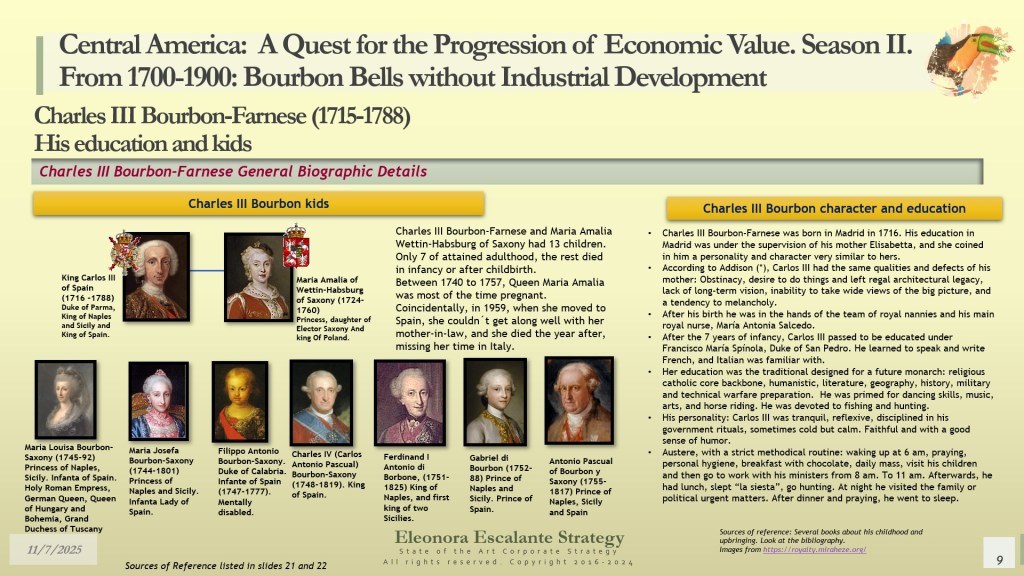
Wishing you a delightful and relaxed weekend. Today, our masterclass is about an overview of the life of Carlos III Bourbon Farnese, King of Spain, who reigned between 1759 and 1788. Carlos III is a personage all over Spanish America. However, in Spanish America, the name Carlos III of Spain has always been tied to Education. There are several academic entities, exchange programs, and doctorates in agreement with the Universidad Carlos III de Madrid (UC3M) of Spain. Many smart Latin American students with economic difficulties have been able to succeed through the Universidad Carlos III of Madrid scholarships. We are thankful for that.
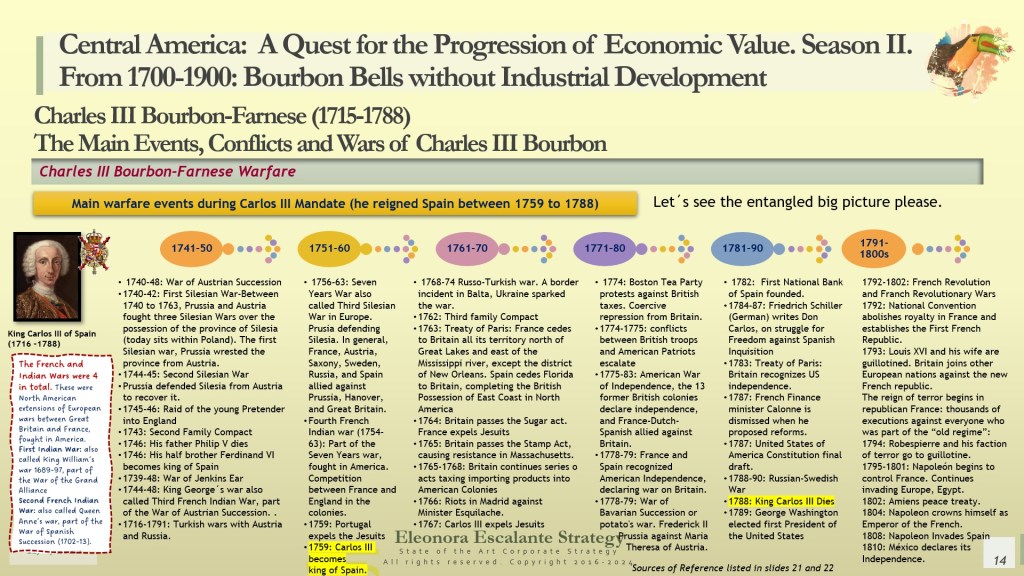
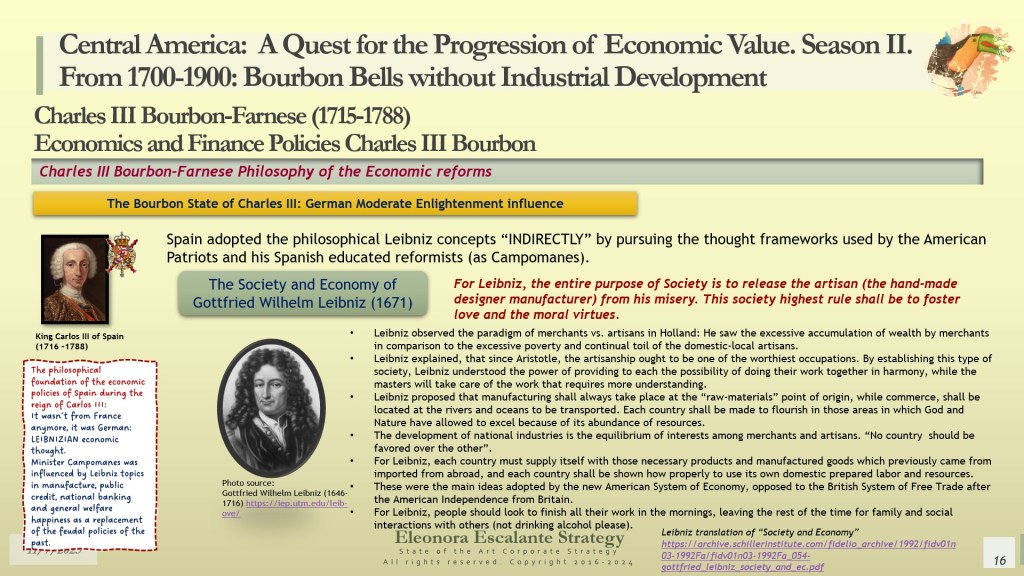
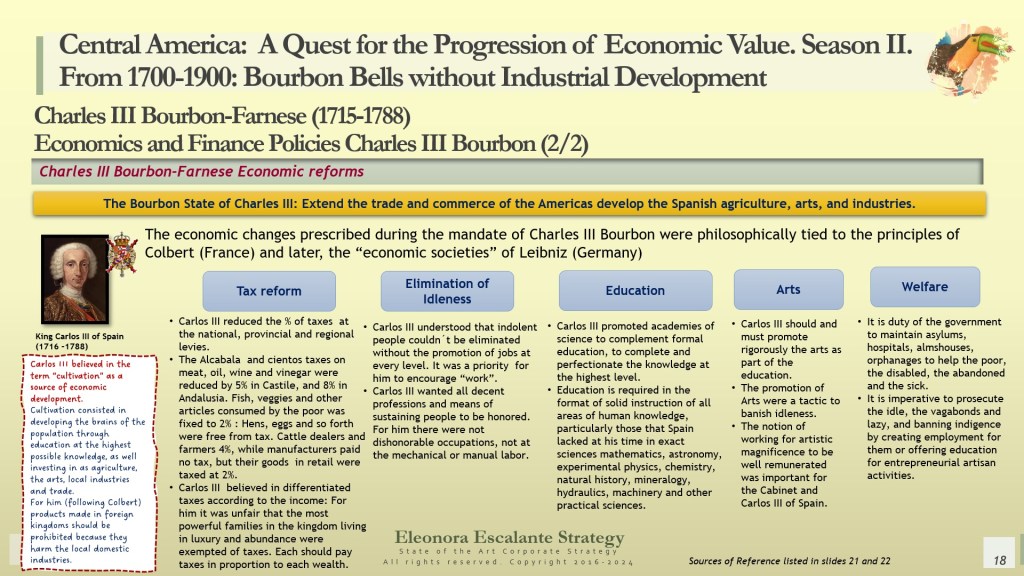
Our agenda for today is straightforward. We have tried to remark the most important features of King Carlos III Bourbon Farnese (1716-88). We begin our content of today with a general biography, exploring his ancestors’ lineage with the Germans of the Holy Roman Empire. Observing his genealogical tree, you are truly not sure if he in reality is from Spain. At least 70% of his maternal and paternal pedigree is filled with German/Austrian origins, coming mainly from the Wittelsbach, Hessen-Darmstadt, Hohenzollern, and Habsburgs. The rest is distributed between the Bourbons and the Farnese. This is an interesting fact to take into consideration. Second, we continue explaining the Bourbonic reforms’ purpose and why these reforms were amplified and took place during the time of Carlos III. Then we proceed to explain the rationale of the New Intendancies System. As a fourth point of our class, we proceed to show you in one shot, the main events, conflicts, and wars of Carlos III. His foreign affairs are described here too. As a fifth topic, we describe the three main elements of his Military Strategy. Finally, we discuss the philosophical Leibnizian transformation of his economics and finance policies. Look at the importance of Spanish America for the Bourbon dynasty, a new model of territorial organization was being rolled out. His plans were completely different than the Habsburg administration.
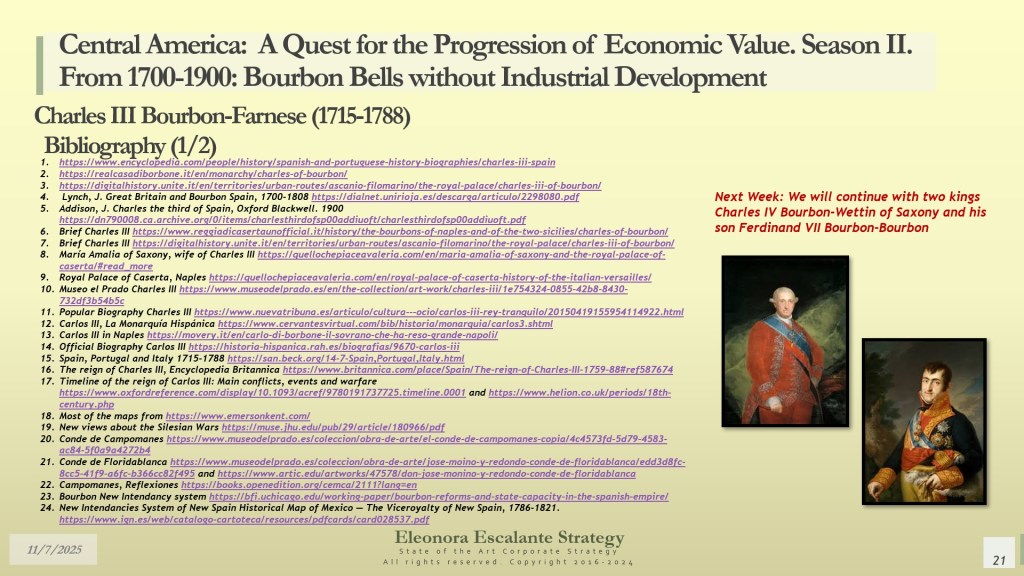
We invite you to download and read the slides document below. Take your time to print it, write notes, ideas, and questions with a pen or a pencil. Do not forget to visit our bibliography for additional information, and feel free to share this content with your loved ones.

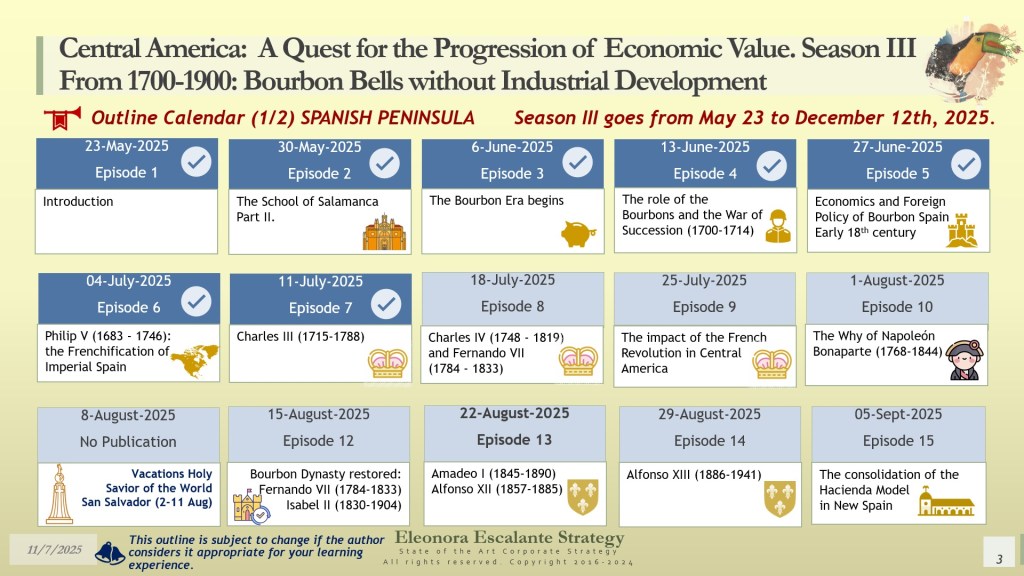
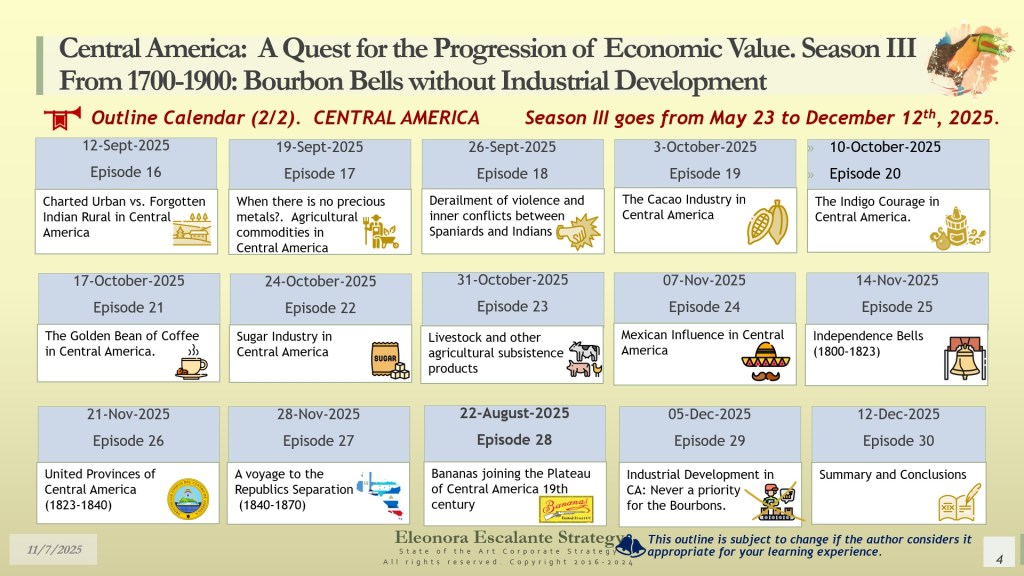










We request that you return next Monday, July 14th, to read our additional strategic reflections on this chapter.
We encourage our readers to familiarize themselves with our Friday master class by reviewing the slides over the weekend. We expect you to create ideas that might be strategic reflections or not. Every Monday, we upload our strategic inferences below. These will appear in the next paragraph. Only then will you be able to compare your own reflections with ours.
Additional strategic reflections after the weekend. These have been posted today, July 14th, 2025.

Our strategic reflections about King Carlos III Bourbon-Farnese.
Spain without Spanish leaders.
Official history has taught that the Spanish King Carlos III was the pioneer of economic change for Imperial Spain. What a fallacy of intent. Not too bad, eh! My adorable readers, I am entitled to write that Carlos III was not from Spain, not even one cent, even if he was born in the Royal Palace of Madrid. If the new leader of Imperial Spain wasn´t from Spain, then with him, it was crystal clear as the water, that in the headquarters office of Spain, a big shift was happening beyond the nationality of the new leader. Most historians have observed that the life of Carlos III was shaped by Queen Elisabetta Farnese’s European interests. This is why we tend to see Carlos III’s formation as a king in Naples (the land of King Ferdinand II, husband of Isabella of Castile) as the objective of Queen Elisabetta for him. But sadly, that was not the truth behind the proposed truth. Beating the odds, we decided to search for other historical sources of reference, other forgotten books that could give us hidden hints in between lines, and we found different memoirs of Carlos III, according to the eyes of other non-Spanish beholders who kept records of him beyond the Iberian frontiers. Our slides have tried to give you a general brush based on those “independent” biographical details.
If his hereditary lineage is true, and assuming that the solid evidence of his maternal and paternal ancestors is also true, then we can also affirm that Carlos III was not culturally of Spanish origin, despite that his first years were in the hands of the Madrid Court. King Philip V was considered French and a vassal of the French King Louis XIV. But there was something different with Carlos III when he returned to Spain in 1759: he had a Naples experience that made him of perfect acceptance to the grandees of Aragon, Valencia, and Catalunya; something that his father didn´t have as a cultural backbone for the Iberian Grandees. That was critical. When Carlos III returned to Spain, he wasn´t seen as a French-German, but as coming from the Italian territories of Spain, and the shift was immense. Despite that, Elisabetta wasn´t Spanish; she brought an umbrella from Parma, Piacenza, and Modena to the kingdom of Spain with his son. Look at slide 7, please. But the reality is that Elisabetta Farnese was a clear assemblage of German families who were the domain owners of more than half of the Holy Roman Empire. See slide 8, please. The areas of territorial influence of the ancestors of Elisabetta were most of the regions where the Habsburgs of Austria did not have direct territorial influence (see map below, please):
- House of Hohenzollern: Electorate of Brandenburg, a domain that was growing quickly and expanding, winning Silesia, Magdeburg, the bishopric of Munster, Pomerania, and Friesland.
- House of Wittelsbach: Both the Bavarian (Von Bayern) region and the Upper Palatinate, with the area of the Rhine Palatinate next to the Duchy of Lorraine.
- House of Hesse-Darmstadt: This dynasty included the region of the landgraviate of the Electorate of Hesse-Darmstadt.
- House of Wettin: The Ernestine line of the Electorate of Saxony and the Albertine line of the Duchy of Holstein and territories around the Duchy of Brunswick. This family was brought to the Bourbons with the marriage of Carlos III to María Amalia of Wettin-Saxony. Please remember that Maria Amalia´s father was the King of Poland, a kingdom that was cut into pieces between Russia, Prussia, and Austria (between 1772 to 1795).
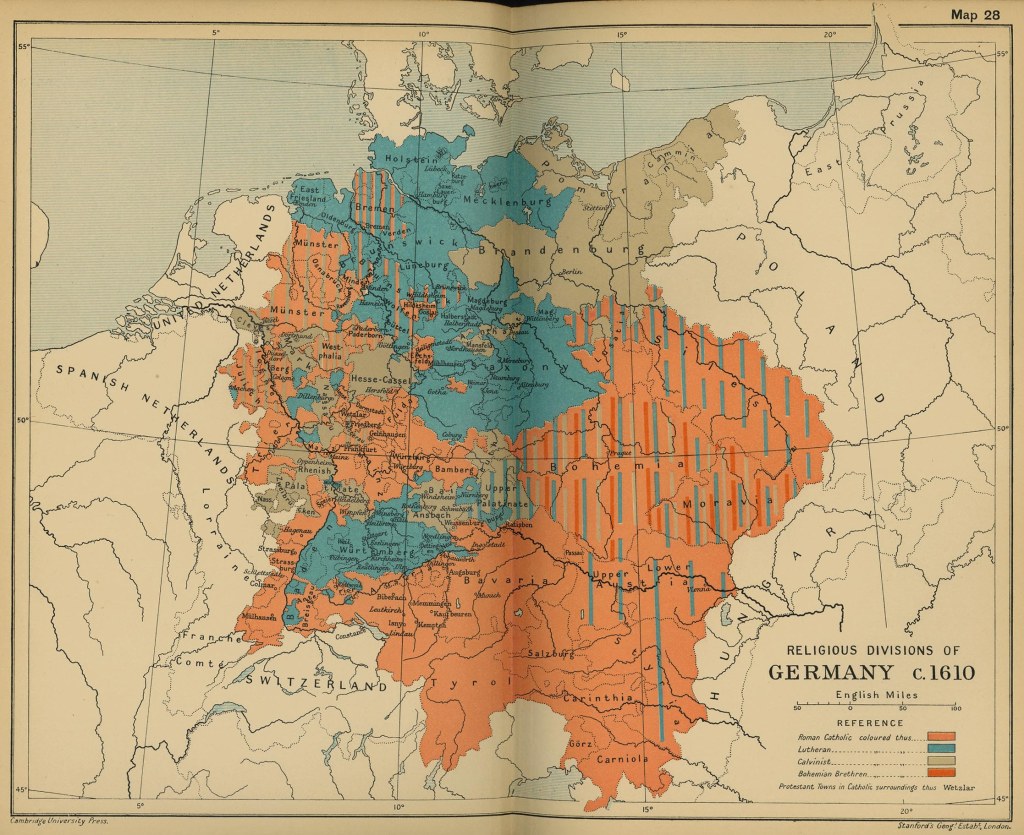
The rest of the Holy Roman Empire not listed under the last 4 houses described above, were imperial free cities or were part of the Habsburgs, or part of the area of Hanover, Duchy of Brunswick-Luneburg, the new dynasty of the Georges of Great Britain as of the death of Queen Anne Stuart-Bourbon in 1714. However, the Hanover dynasty (the Guelphs) was historically linked to the Bavarian Wittelsbach and the D´Este of Italy. Through the house of Wettin, the Bourbon-Farnese family of Carlos III arrived indirectly with the same family of the Saxons of Great Britain.
A sordid takeover of the kingdom of Spain. With the last explanation, I am very sorry to hurt the feelings of the Spaniards of Castile and Aragon, but with the arrival of Carlos III Bourbon into power, what occurred was a vile takeover of the kingdom of Spain. This new Bourbon dynasty in Spain had nothing in common with the Iberian Peninsula. Nothing means nothing. And the strategy to be accepted by the grandees of Castile and Aragon was the “quest for economic development”. A new formula of prosperity was needed after the “War of Spanish Succession”. Philippe V tried but was not successful, because he was seen as the king who would put Spain below France. Carlos III branded his image as the “Naples king” who was arriving with Bourbonic reforms in 1759. And that shifted the game. His most promising foes (Aragon, Catalunya, and Valencia) were neutralized because he was coming from the same territory as Ferdinand II, the Aragonese king who expelled the Muslims from his territories 300 years before. The only way that Carlos III could gain the confidence of the grandees from Spain was by showing them a “new” way for wealth creation, with a “new” value proposition. However, the big mistake of the new Bourbons was to ignore that there were concealed Habsburgs living in Spanish America. These traveled to the New World before the year 1700, and were already living under new last names, as any other Creole from New Spain or Perú. The Río de la Plata was being evangelized by the Jesuits, and the new Bourbon was trying to enter this region with the mandate to rescind anyone who could put in jeopardy the supply of silver to the Bourbons. While the Habsburgs were already living in America, they were going to defend their territories with cape and sword. These Habsburgs of Castile and Aragon were going to defend their territories against the Bourbons. No matter what. Particularly after the expulsion of the Jesuits in 1773. We firmly believe that there is a connection between safeguarding Spanish America from the Bourbon plans and the French Revolution that occurred in 1789. This ensued just a year after Carlos III Bourbon passed away.
Anglo-Spanish relations.
Carlos III Bourbon Farnese associated himself with Great Britain as of 1783 onwards (the Treaty of Paris recognized American Independence then). We suggest that there was a plan about how the French-Spanish Bourbons were going to handle those territories. We perceive that Carlos III Bourbon had already understood that it was not going to be possible to keep Louisiana under the French Bourbon family compact domains. Simply, it was not going to happen. His navy and the French one were exhausted and weren´t ready to fight for their domains in North America. In consequence, his priority shifted. When he lost Cuba to Britain, he knew that the fate of leaving North America was already written. He swapped Florida to recover Cuba later. Afterwards, he truly began to focus on implanting the French territorial organization in Spanish America’s domains. After 1782, he implemented the new intendant system, a model that was different from what the Jesuits thought. This is the reason why the Jesuits were expelled before. The work of the Jesuits was mainly focused on the territorial organization of the Native Indian populations.
Carlos III, as an Enlightened despot, couldn´t allow others to take control of his new dynastic territories, those that his father had left in the hands of smugglers. In our next episode, we will explain the suppression of the Jesuits by order of Pope Clement XIV from all possible angles, beyond the “official history” explanation.
The last item we wish to analyze is the influence of the German Moderate Enlightenment on the Spanish Inquisitorial Royal Crown. The only way we uncovered that a Bourbon king of Spain could accept the philosophical new ideas of the Enlightenment was because of the hereditary linkages with certain parts of Germany and Italy. The Italians and the Germans of his mother’s and father’s ancestors allowed this Bourbon king to accept possibilities for change. This is why French-Spain, Italy, Austria, and some regions of Germany have acted as a coalition under the same dynastic economic interests. The rest of the slides shared are self-explanatory.
Announcement:
This episode is all about the life of Charles III Bourbon-Farnese. We would like you to observe how the Spanish Monarchy was leaving its Trastamara Castile-Aragón heritage. In less than a century, the Germans were imposing and taking over the philosophical rationale of the economics, finance, military, and foreign affairs of Spain. Do not lose sight, please. We are explaining first the situation of the rulers of Spain during the 18th and 19th centuries. In a few weeks from now, we will study the economic impact of the kings of Spain on the progression of the economic value of Central America. Our strategic reflections are prepared for a master’s degree or Ph.D. level. Even if a reader has learned about these events in high school or has studied them for the AP exams, our approach is not to teach you history as it has been taught. We are investigating the causes of the economic development of Central America in the real history that no one taught you. There is a lot to learn during the following weeks. See you then.
Musical Section.
Season III of “Central America: A Quest for the Progression of Economic Value” has assigned a new instrument for the rest of the year. It is the guitar!. Our selection of music during Season III will continue to explore adorable music produced between the 17th and 19th centuries with interpretations of virtuoso guitarists. We will embark on the selection of the top 29 loveliest guitarists from the last 5 generations, playing music composed during the time of this saga. Our choice for today is David Russell, from Glasgow, Scotland, with a concert in several churches in Spain. Mr. Russell’s biography and achievements with his beloved guitar can be found at https://www.davidrussellguitar.com/ . Enjoy!.
Thank you for reading http://www.eleonoraescalantestrategy.com. It is a privilege to learn. Blessings.

Sources of reference and Bibliography utilized today. All are listed in the slide document. Additional material will be added when we upload the strategic reflections.
Disclaimer: Eleonora Escalante paints Illustrations in Watercolor. Other types of illustrations or videos (which are not mine) are used for educational purposes ONLY. All are used as Illustrative and non-commercial images. Utilized only informatively for the public good. Nevertheless, most of this blog’s pictures, images, and videos are not mine. Unless otherwise stated, I do not own any lovely photos or images
 Eleonora Escalante Strategy - Strategic Reflections Think Tank