
Central America: A Quest for the Progression of Economic Value. Season III. Episode 8. Carlos IV (1748-1819) and Fernando VII (1784-1833). PART 1
Dear precious readers of my soul:
Wishing you a beautiful weekend. Today, we begin a new phase in our route to comprehend the historical foundations of Spanish America. It is an honor for us to have reached the pinnacle of the 18th century. With the king Carlos IV Bourbon-Wettin of Saxony, and his son Fernando VII Bourbon, we are reaching the stage of what historians have defined as the decline or the dissolution of the Spanish Monarchy.
This period, between 1763 to 1808, is enormously relevant because of three convergent conditions:
1. The Spanish Bourbon monarchy was trying to find a different roadmap to what was the “status quo” of the old Spanish Habsburg rule.
2. The Bourbonic Reforms initiated by King Carlos II Bourbon-Farnese were designed and implemented by his team of “enlightened” proyectistas in all the domains of Spanish America, including the parts that later passed to become the United States of America.
3. The 18th century shows a dynamic back and forth of strategic alliances between France, Spain, and Britain. The royal families of these nations used dynastic marriages to invite other European families to join their club. By the time of Carlos IV, most of the main protestant principalities and duchies of the Holy Roman Empire were already tied to Britain or the Low Countries, or the Baltic zone. The rest of the catholic German states were tied to Spain and/or France, Parma, Milan, Venice, or other relevant Catholic Italian duchies. Even members of the royal houses of Poland, Prussia, and Muscovy appear in matrimonial coalitions with the Austrian Habsburgs and the Bourbon families.
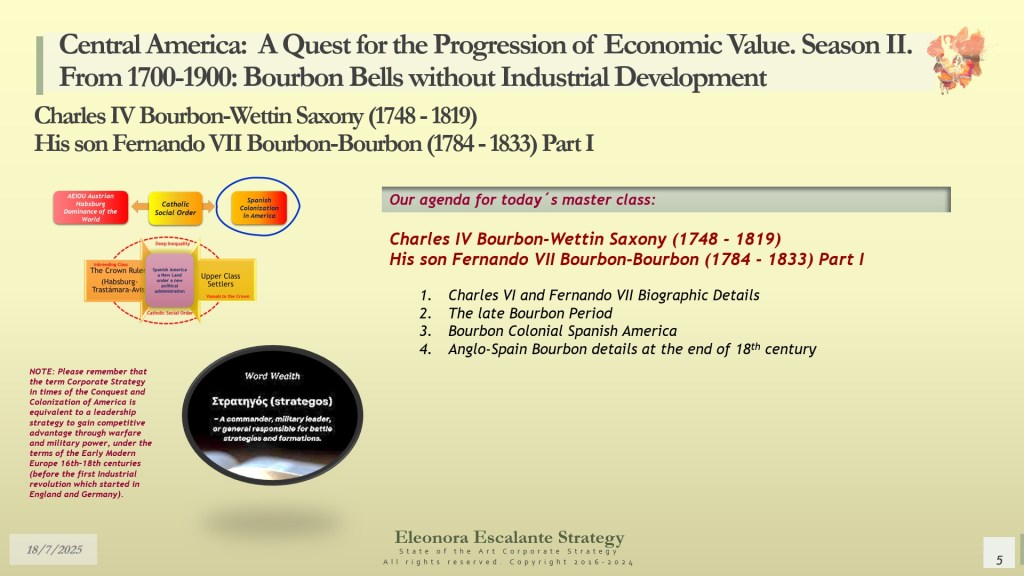
Our agenda for today is concentrated and short. Firstly, we will explore the genealogical and biographic details of these two kings. Second, we will begin to define the late bourbon period (1763-1808). Third, we will show you the different interpretations of Bourbon Colonial Spanish America, based on the historians´ expertise. And finally, we will introduce the theme of the Anglo-Spanish relations at the end of the 18th century. We encourage you to download the following package of slides, print it, read it, take notes, and ask yourself questions. Look for more information in our listed bibliography. Share it with your friends and everyone who is interested to learn to practice how to create strategic reflections.


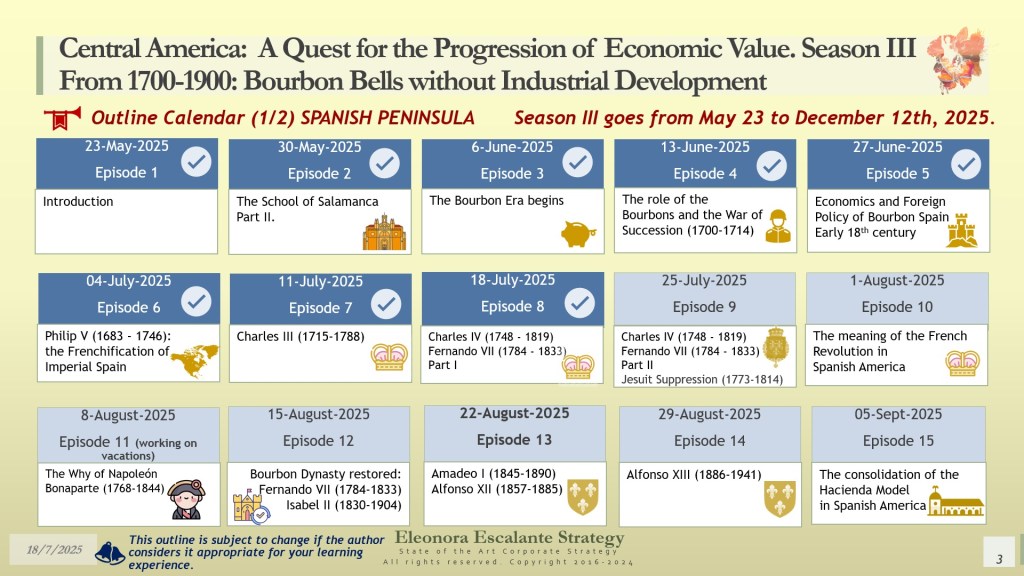
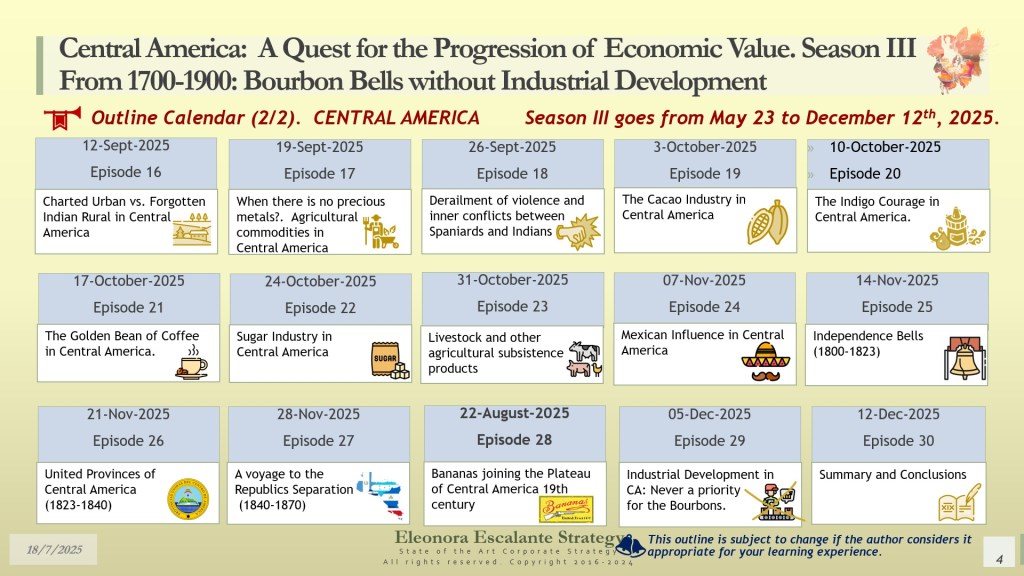




We request that you return next Monday, July 21st, to read our additional strategic reflections on this chapter.
We encourage our readers to familiarize themselves with our Friday master class by reviewing the slides over the weekend. We expect you to create ideas that might be strategic reflections or not. Every Monday, we upload our strategic inferences below. These will appear in the next paragraph. Only then will you be able to compare your own reflections with ours.
Additional strategic reflections on this episode. These have been posted on Monday, July 21st, 2025.

Our strategic reflections about the kingship period of Charles IV, Bourbon-Wettin of Saxony.The genealogical connections of Charles VI and his son Ferdinand VII.
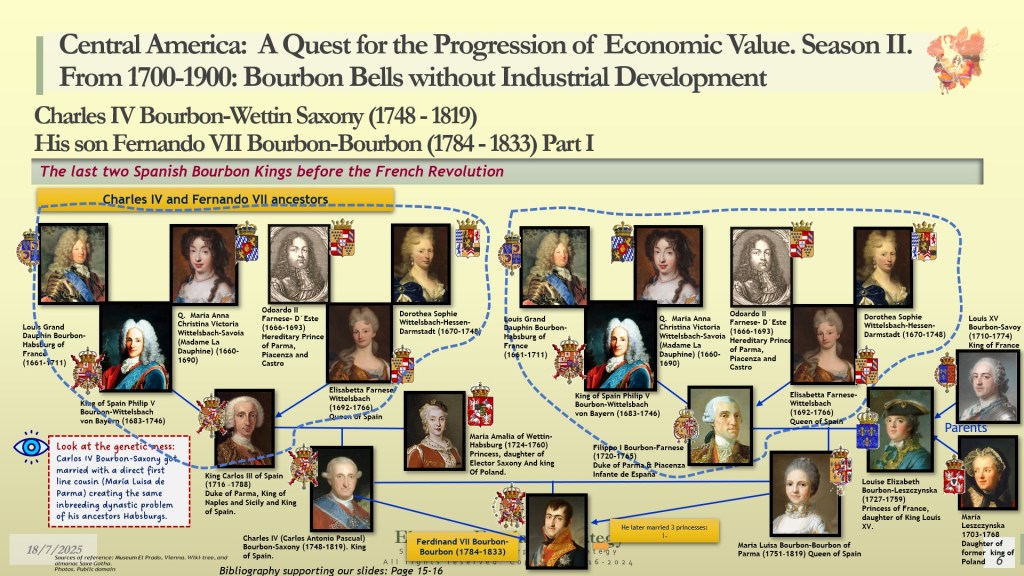
Our first grand theme of the day is to understand the genealogical ancestors of these two kings and the context of their reigns. Today is the turn of Carlos IV. Next Friday, we will continue with Ferdinand VII and the sad episode of the suppression of the Jesuit Catholic Order in Spanish America between 1773 and 1814. Firstly, let´s see Carlos VI and Ferdinand VII genealogical tree on slide 6. We spent more than 2 days thinking and understanding their pedigree in the context of what the previous Bourbon king Charles III left as a legacy to his successors. It took me a lot of discernment to review why the Bourbon-Habsburg family of Louis XIV and his grandson in Spain, Philip V, could be against their own Habsburg ancestors. It doesn´t make any sense to me. The AEIOU plan of HRE Maximilian I Habsburg-Aviz (the patriarch of the Spanish Habsburgs) was not to separate his empire, but to expand it all over the world. Every action of his successors was aligned with Maximilian I Habsburg’s Grand Strategy. Each king did it, regardless of its limitations or inbreeding troubles. We have observed it repeatedly since Charles V Emperor, over and over again. The AEIOU Habsburg motto was also in the minds of each king’s “valido” advisor.
The three family compacts between the Bourbons of France-Imperial Spain were part of the same family strategy. These kings were Bourbons, but they were also Habsburgs. There was Habsburg blood flowing in the Bourbons of France. But then something changed. Something happened that cut the cord of the Habsburgs’ plans in Spanish America. This change started with the Farnese. When the Bourbons decided to invite the Farnese family of Italy (Parma, Mantua, Modena, Piacenza, and Castro) to their ruling party in Spain. You might conceive that the Italian influence of Elisabetta Farnese (Queen of Spain) caused the shift. But it wasn´t to blame Italy. It was to accuse the Wittelsbach of Bavaria (Bayern). Historically, the Wittelsbachs of Bavaria were in constant conflict against the Habsburgs’ expansionism, despite their intermarriages. Queen Elisabetta Farnese knew about it, and she was prompted to marry his primogenital son to the daughter of the kingdom of Poland, María Amalia Wettin-Habsburg of Saxony. The Saxony queen was a Princess of Poland, with Habsburg blood too. A generation later, the Bourbons, instead of expanding outside France, Charles VI intermingled with a first-in-line direct cousin that was linked to the same Bourbon-Wittelsbach family of the royals of France? For us, it is not just weird, but totally inappropriate for the emerging dynasty. It makes sense to us to expand a royal family that suffered from inbreeding idiots in the past, out of France and Spain. It makes more sense to establish a foothold in Parma-Sicily and Naples through Charles III, because these were lost territories that were recovered in favor of Spain after the War of Spanish Succession; but with Charles IV, why return to his cousin Maria Luisa Bourbon of Parma using the inbreeding strategy that destroyed the Habsburgs? It looks like a dynastic suicide. Why did the nascent Bourbons of Spain make that mistake? What do you think?
Who was Charles IV Bourbon-Wettin of Saxony? Historians tell us that Charles IV was not a clever king, but a man of weak character, without any academic background, immature, without good judgment to lead his prime ministers, and deprived of critical thinking to appraise good decision-making. His father, Charles III, should have known before his death that the Bourbonic monarchy of Spain was going nowhere. According to Lynch (1), Charles IV destituted two prime ministers of good mental competences (Count of FloridaBlanca and Count of Aranda) and he selected a “puppet who was the lover of the queen”, the prime minister Manuel de Godoy in 1793, exactly during the time that his cousin King Louis Bourbon XVI was guillotined in Paris.
Why on earth, King Charles IV, who needed a top smart man as a Prime Minister, chose a mediocre Godoy, in the context of the French Revolution that ended the Franco-Spanish alliance? After the execution of the French Bourbon monarchs in January 1793, Godoy allied with Great Britain, a nation with which they had core doubts. Mainly, the grandees and the Cabinet of the Spanish king suspected that Britain wanted to provoke the elimination of the Spanish Navy. The Spanish army was already weakened and wasn´t ready for any war as of 1793, but Revolutionary France opened the war against Spain. Godoy relinquished his alliance with Britain after Spain signed the Peace of Basel Treaty with France in 1795, confirming an offensive and defensive war against Great Britain.
What occurred then? Spain had a war against Great Britain, while Spain´s maritime power was reduced to nothing. What the Castilian grandees of Spain premonitioned, ocurred in fact three years later. After 1796, Spain’s foreign affairs were aligned with the interests of the French Directory and later with Emperor Napoleon. Economically, between 1793 to 1808, Spain’s commercial plans and its transatlantic system totally collapsed.
Then we ask ourselves? How could it be that Charles IV Bourbon-Wettin of Saxony allowed an alliance with the Directory of France (the same country that assassinated members of his own family)? Why did they decide to go on everything that debilitated Imperial Spain? Is it out of any logical order? Everything that we learn about Charles IV was against the interests of Imperial Spain, at the service of the interests of Imperial France, or Great Britain. Most of the narrative of Charles IV looks as if he were a vassal to Great Britain, too. Why? And later, why did they pursue a strategic alliance with Napoleon? Why? This can only be explained if Napoleon was also a concealed Bourbon, and Napoleon was working for the political interests of Great Britain.
The rebellions in Spanish America.
During the late Bourbon period, defined by us as from 1763 to 1808, Carlos IV had to bear so many upheavals or mutinies of different degrees of magnitude in Spanish America. The two main ones during his mandate as king ocurred in South America. The Comunero uprising in New Granada (1781), and three uprising concurrent events in Peru and Upper Peru (1780-82): One led by Tupac Amaru in Cuzco, the second one led by Tomas Katari and his brothers in Chayanta Region (today modern Bolivia), and the last one by Tupac Katari in La Paz region (2). However, a growing number of Andean Indian community revolts and protests happened simultaneously to the main ones as a reaction of some Creoles allied with the Native Indian nobility and their peasants against the new dynastic Bourbonic reforms. The Tupac Amaru at Cuzco indigenous groups aimed to return to the old order of things before the arrival of the Spaniards; but the rebellions of the Kataris were different, they wanted to be included to be citizens of a fully Spanish reformed Society and not separated as second-class (almost slave) members of their communities.

The role of Great Britain in the late Bourbon Period.
We have identified that Saxony was historically a greater region than what we find in common maps of Germany. This is the reason why we chose the Historical Map of the Religious Divisions of Germany, c. 1610. See slide 7, please. This map shows the red regions as Roman Catholic, the blue ones as Lutheran-Protestant, and the beige ones as Calvinist-Protestant. Saxony was a whole region starting from its south borderland with the Wittelsbach Bavarian Catholic region up to the north borderland with Holstein-Mecklenburg. Saxony was never part of the Habsburg domains. Saxony-Hanover included the duchy of Brunswick (Braunschweig-Luneburg in German), Wolfenbüttel up to East-Friesland; and Saxony Wettin included several areas spread all over central Germany in 1750. From the Wettin dynasty, the Ernestine branch held several duchies around Thuringia. These included Saxe-Weimar, Saxe-Gotha, Saxe-Eisenach, Saxe-Altenburg, and Saxe-Coburg. The Albertine branch held the Electorate of Saxony, which included the Duchy of Saxony centered at Wittenberg. In summary, Upper Saxony was the Wettin lands. And Lower Saxony was from the Guelph (Brunswick-Lüneburg), later called the Hanover lands.
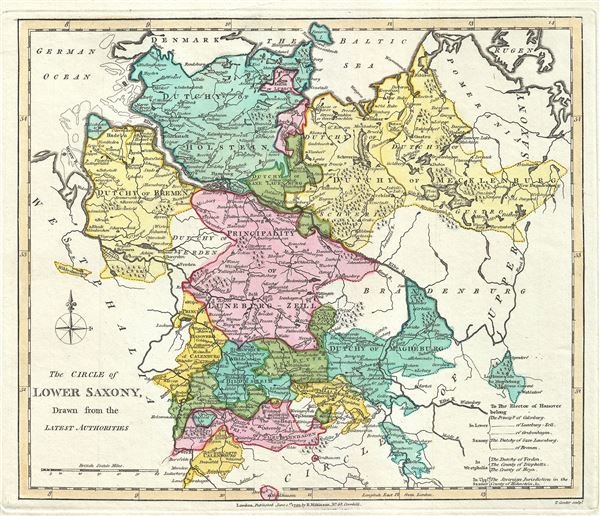

King George I of England and Saxony: The bottom line: Great Britain King George I Guelph-Hessen Darmstadt/Wittelsbach-Stuart of England, the successor of Queen Anne Stuart-Bourbon (1665-1714) was from Brunswick-Lüneburg, part of Saxony Hanover. The rest of his successors, George August II, Frederick Ludwig, George William Frederick III, and Georg August IV of Hanover, evolved from electors of Brunswick-Luneburg, marrying German princesses of Saxony, to reign from Windsor Castle, Windsor, Berkshire, England. In one century, the new royal dynasty of England replaced its past, formally taking the format of the German Hanover of Saxony identification (they were from the duchy of Brunswick-Lüneburg). It was a totally protestant zone from Saxony, Germany, tied and with connections to the Nassau, the Mecklenburg, and the Prussian Hohenzollern domains.
The relation between Bourbon Spain and the British Royal Family that wasn´t British.
The fact that Great Britain (United Kingdom of England, Scotland, and Wales) was under the leadership of 4 consecutive kings from the duchy of Brunswick-Luneburg of Northern Germany offers us a different panorama to the current analysis. The crown of the Bourbons from Spain got linked to the Wittelsbach of Germany, and later to the daughter of the king of Poland (A Wettin-Saxony royal member) who died as soon as she arrived in Madrid in 1767. Bourbon Carlos IV’s role was genetically constructed to keep a friendly bond with the Saxony royal members of England on good terms, not at war. From the start, Carlos IV was unable to use his hereditary links to stop Britain’s constant conflicts in the Atlantic. His minister of State, Godoy, followed the French even during the French Revolutionary conflicts. The rebellions of Spanish America were also a strong blockage to the Bourbonic Reforms started by his father, and finally, the whole Catholic Habsburg mission was broken by the philosophical new trends of the Enlightenment. We wonder, where did the Wettin-Saxony aid appear?
Apparently, Carlos IV did everything wrong by using Godoy to offer Louisiana to Napoleon in 1800, who then sold it to Great Britain in 1803.
The reign of Carlos IV (1788-1808) was designed to be a mess. Everywhere.
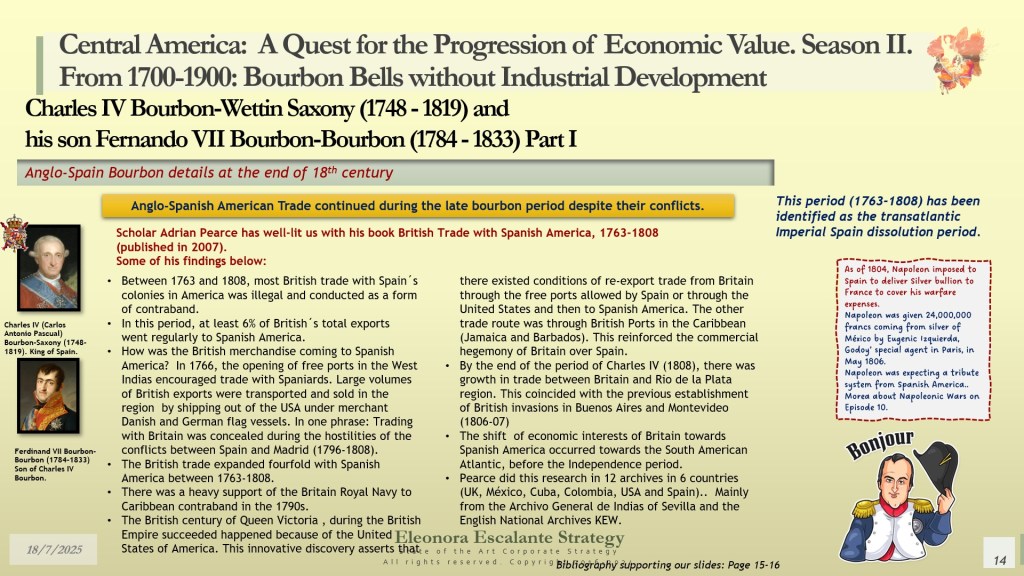
In the middle of all this mess of conflicts between 1788 to 1808, the Anglo-Spanish American trade continued. The American Independence Wars started in 1765 and concluded with the signing of the Treaty of Paris in 1783, where Great Britain officially recognized the independence of the United States. Was this “independence” a tacit prearrangement to weaken the France-Spain compact strategy? Poland was partitioned between 1772 to 1795 between Austria, Russia, and Prussia. A new British Protestant dynasty tied to the Hanover domains in German Saxony began to populate North America, regardless of its independence. Another new Spanish Catholic dynasty, tied to the Wittelsbach Bavarian and Italian Catholic States, began to populate Spanish America. Before the independence movements, the transatlantic modus operandi system was altered, but continued (see slide 14). So, we ask ourselves what the real purpose of Napoleon was?. What was the impact of the French Revolution and Napoleon Bonaparte on Spanish America? Why did the Bourbons subordinate to Napoleon so easily? And finally, how did Great Britain nullify the Napoleonic phenomena after getting Louisiana for the USA? If the United States of America were not Great Britain, then… Indeed, what about a Dutch tacit deal with Great Britain to manage their territories in the USA in their name, as if the Dutch were a concealed part of the new USA residents? Read the last 2 sentences again.
To be continued…

Announcement:
This episode is one of two chapters about the decline of Imperial Spain. We have made a couple of changes to our outline calendar. Historians have named the late Spanish Bourbon period as the dissolution of the Spanish Monarchy. We have a different thesis. We believe that most of the troubles of Imperial Spain during the 18th century were a transition from the precious metals mercantilism “savoir faire” to the “industrialist” capitalist system that was starting to be rolled out in Germany and Britain. The Spanish Monarchy was never dissolved. It was transformed to “concealed terms” before Charles II Habsburg passed away. It came to Spanish America way before the Bourbons’ administrators in Europe. The more evidence that we look for, the more we can affirm our ideas. The French Revolution is also linked to Spanish America. Believe it or not, you will discover why on Episode 10. There is a lot to learn during the following weeks. See you then.
Musical Section.
Season III of “Central America: A Quest for the Progression of Economic Value” has assigned a new instrument for the rest of the year. It is the guitar!. Our selection of music during Season III will continue to explore adorable music produced between the 17th and 19th centuries with interpretations of virtuoso guitarists. We will embark on the selection of the top 29 loveliest guitarists from the last 5 generations, playing music composed during the time of this saga. Our choice for today is the virtuoso guitarist Berta Rojas from Paraguay. We invite you to visit her website to learn about her trajectory. https://www.bertarojas.com/en/ We have selected a concert that she offered in the year 2011, in San José Costa Rica.
Thank you for reading http://www.eleonoraescalantestrategy.com. It is a privilege to learn. Blessings.

Sources of reference and Bibliography utilized today. All are listed in the slide document. Additional material will be added when we upload the strategic reflections.
(1) Lynch, J. Bourbon Spain, 1700-1808. Blackwell Publishers, 1994. In Spanish: “La españa del siglo XVIII”, Critica Barcelona Editoriales. 1999.
(2) Chiovelli, Fergusson, Martinez, Torres, Valencia Caicedo. Bourbon Reforms, State Capacity, and Revolution in the Spanish Empire. University of Chicago, Becker Friedman Institute for Economics Working Paper No. 2024-36. June 2025. https://bfi.uchicago.edu/working-paper/bourbon-reforms-and-state-capacity-in-the-spanish-empire/
Disclaimer: Eleonora Escalante paints Illustrations in Watercolor. Other types of illustrations or videos (which are not mine) are used for educational purposes ONLY. All are used as Illustrative and non-commercial images. Utilized only informatively for the public good. Nevertheless, most of this blog’s pictures, images, and videos are not mine. Unless otherwise stated, I do not own any lovely photos or images
 Eleonora Escalante Strategy - Strategic Reflections Think Tank