
Central America: A Quest for the Progression of Economic Value. Season III. Episode 12. Bourbon Dynasty Restored: Ferdinand VII and Isabella II.
Dear magnificent readers:
Today, we will continue our exploration journey of what occurred after the Napoleonic Invasion of Spain during the 19th century. The essence of Napoleon Bonaparte and his family was so disruptive not in the Napoleonic Wars, but in the mission to reject the Enlightenment Republican project that was being pursued all over Europe. We have already investigated what the real truth was behind the scenes of Napoleon’s moves and warfare. With the Congress of Vienna, a new political change process was arriving at all the dynasties of Europe. Imperial Spain and Portugal´s strategic priorities were to save their lands in Spanish America. And the concealed Habsburgs residing in America did so indirectly through their Independence Movements. Yet, in the eyes of the rest of European beholders, their empire was being demolished. We need to be cautious by not trusting what we see on the superficial level. There is always a truth behind the apparent. However, there was an undisputed new nascent empire, Great Britain, that already had a deal with the Bourbons after the cession of the lands of North America. Additionally, there was a newborn figurative Napoleonic transcendence that was standing universally as a “justicier supervisor of all the kingdoms” in concealed terms.
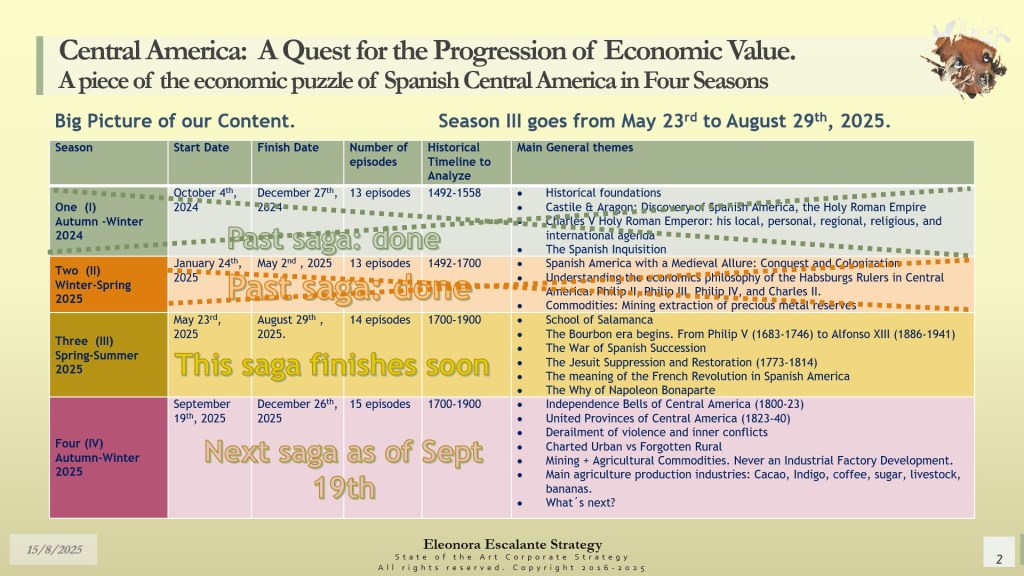
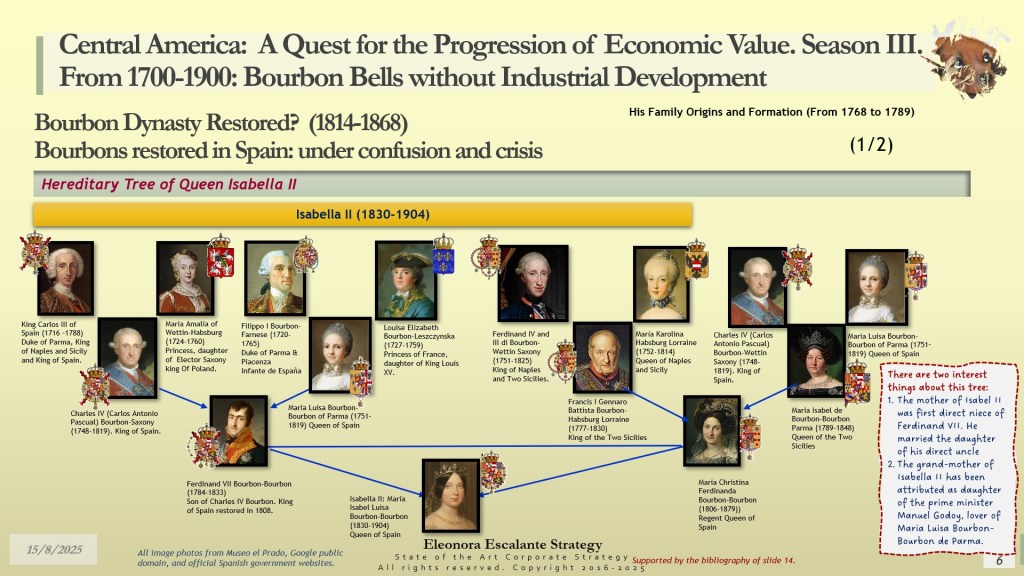
Our content today is about the Spanish Bourbons between 1814 to 1868, only in the Iberian Peninsula. The rest of the content about the Nineteenth century of Spanish America will be transmitted as of September 19th, 2025. So, let´s proceed: Two Bourbon royals took the spotlight during this period: King Ferdinand VII Bourbon-Bourbon and his daughter Queen Isabella II Bourbon-Bourbon. We begin with a review of the family tree of Isabella II and her progeny. Then we continue with a descriptive and political analysis in three phases:
1. From 1814 to 1833: The eclipse of King Ferdinand VII
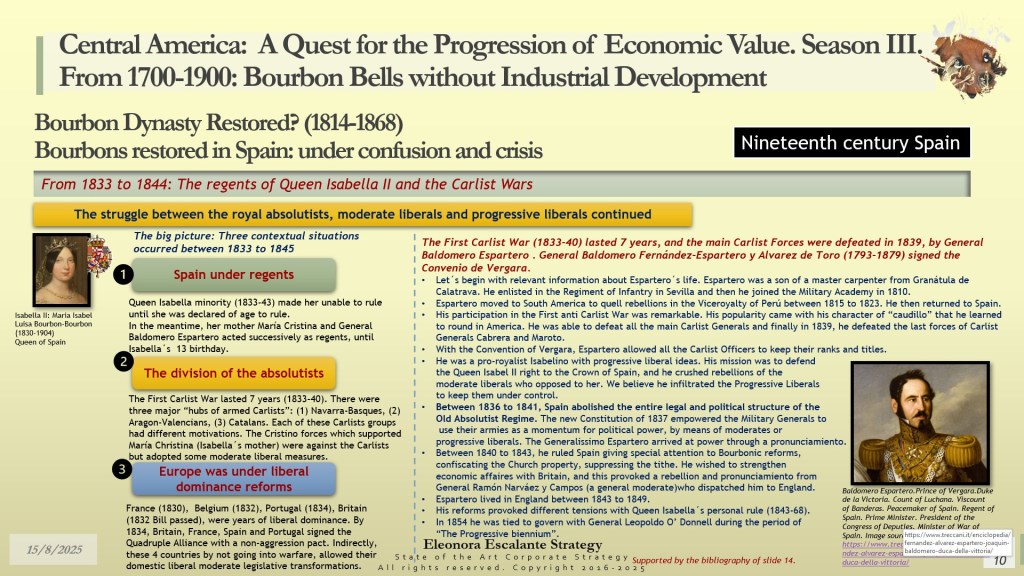
2. From 1833 to 1844: The regents of Queen Isabella II and the First Carlist Wars
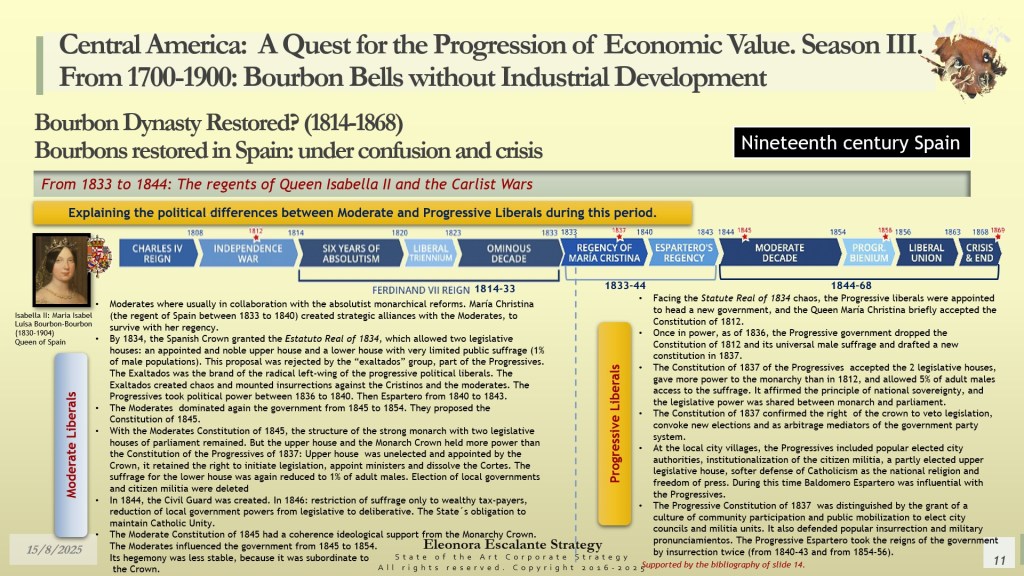
3. From 1844 to 1868: The Marinating of a Liberal Constitutional Monarchy.
We encourage our readers to download and print the frame of reference of our strategic reflections below. It is relevant to read on paper pages. We recommend that you write your ideas and questions spontaneously on every page. Later, you can proceed to add more understanding by reading our bibliography on slide 14. Feel free to share this material with your professors, bosses, friends, and family. Enjoy.




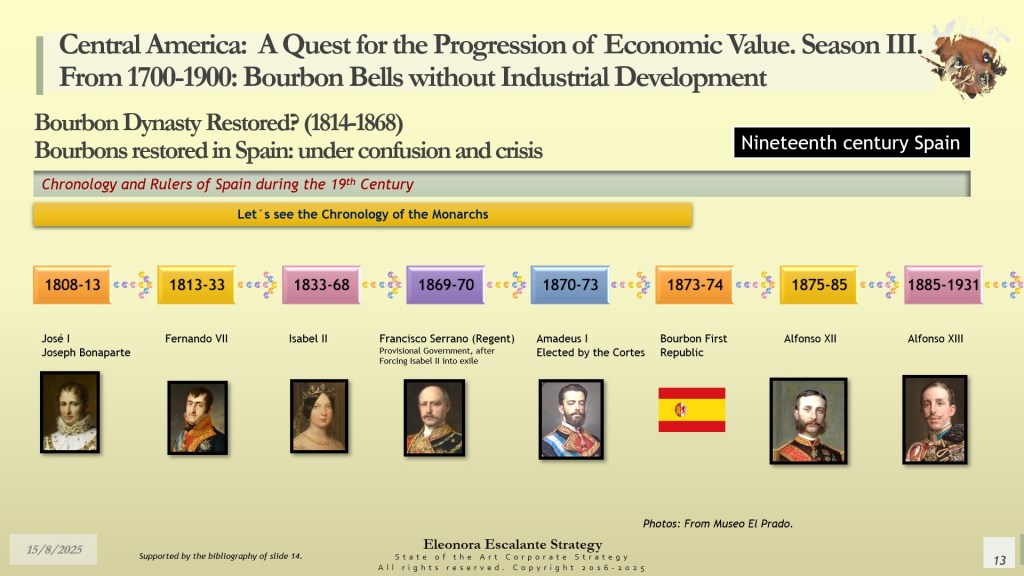
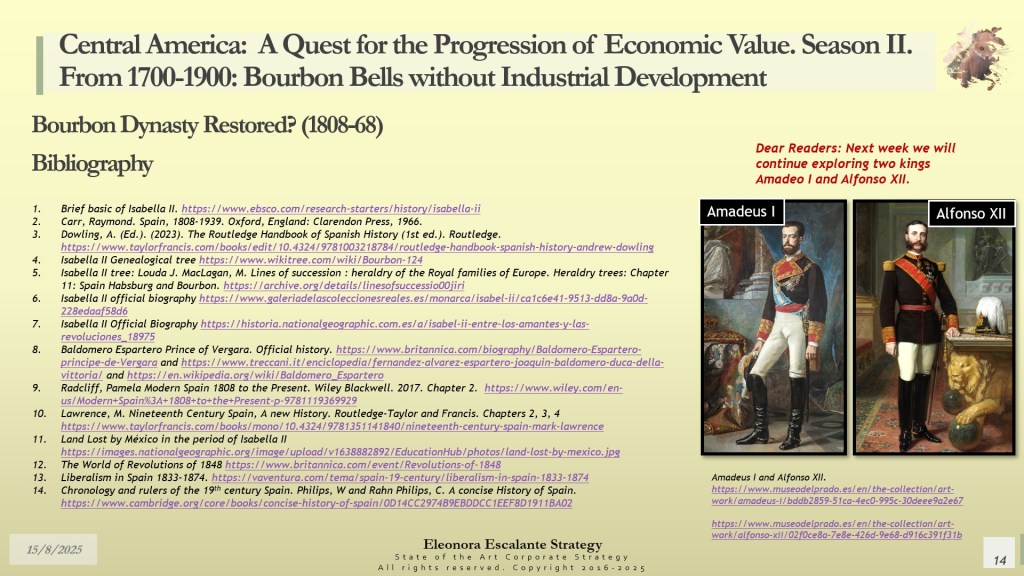
We request that you return next Monday, August 18th, to read our additional strategic reflections on this chapter.
We encourage our readers to familiarize themselves with our Friday master class by reviewing the slides over the weekend. We expect you to create ideas that might be strategic reflections or not. Every Monday, we upload our strategic inferences below. These will appear in the next paragraph. Only then will you be able to compare your own reflections with our introspections.
Additional strategic reflections on this episode. These will appear below on Monday, August 18th, 2025.

Isabella II Bourbon-Bourbon (1830-1904). Same inbreeding old song. (Slides 6 to 9)
We kick off our analysis by screening the hereditary family tree of Queen Isabella II. We are sure that you can perceive the same old trouble of the Habsburgs: inbreeding. The Bourbons followed the same recipe of genetic mental disintegration with their nascent Spanish house. If they did it, it was because they thought they were protecting their royal lineage. Look at slide 6. According to researchers Sebastian Ottinger and Nico Voigtländer (1), the brain competencies and ruler’s ability were affected by the degree of inbreeding, and this clearly impacted his or her state’s performance if he or she were an absolutist royal making decisions without supervision and control of the legislative echelons. The inbreeding level of Queen Isabella II and her husband, Francisco de Asis de Bourbon, was that of double first cousins. Only five of her 12 children were able to reach adulthood.
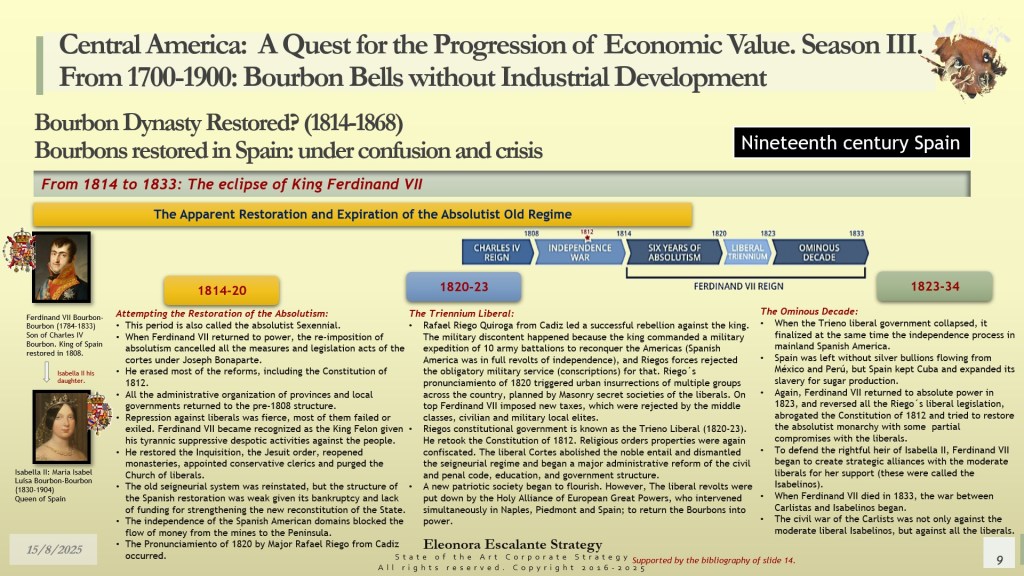
Second, after his restoration to the Spanish Throne, the reigning period of the father of Isabella II, King Ferdinand VII, was characterized by his successive attempts to return the kingdom of Spain to what it was before the French Revolution. He tried, but he failed. He was so busy attempting to re-install the old structure of the kingdom of Spain that he missed the mark about the Independence movements of his domains in the New World. This is what official history has taught us. However, our strategic acumen has observed two interesting factors (we will offer a major analysis of these two factors in a few weeks. For the time being, we are simply analyzing Spain in the context of the European political muddle after Napoleon). These two aspects are:
- Ferdinand VII’s second term (from 1814 to 1834) was crucial for the Habsburg mission. He was “kept busy” on purpose; meanwhile, Spanish America deliberately was set off far away from the Bourbons´ plans and reforms. This is important to understand, because the Bourbons and the Habsburgs, despite their dynastic marriages, were not a happy family with a soft path of “honest adoration”. Before Archduke HRE Maximilian I Habsburg Aviz, the patriarch of the AEIOU Austrian motto (Austria Est Imperare Orbi Universo), there were certain complex political hate-love, antipathy-goodwill support relations between both families. These relationships date back to the Middle Ages, when French pilgrims crossed the Austrian lands in their quest to arrive in Jerusalem. However, the first marriage between the Habsburgs and the Burgundian Valois occurred not with Maximilian I, but with Rudolf of Habsburg to Isabella of Burgundy in 1284 (2). Over time, the Valois mutated to become the Bourbons with King Henry IV, the rulers of France; but the Bourbons never crossed the line of Spain, until the French Philip V, Duc d´Anjou, joined the Iberian throne after the War of Spanish Succession. None of the Habsburgs (branch Austria or the concealed branch Spain residing in America) was prepared for the Bourbons’ quick ascension to power via the Wittelsbach and the Farnese. The concealed Habsburgs of America kept them busy for around a century. But Charles III Bourbon-Farnese exasperated them with the Bourbon Reforms. And that marked the beginning of the Bourbons’ own suffering. If the 18th century was a disaster for the Bourbons of Spain and France, the 19th century was not going to better either. The Bourbons were not going to be free to take Spanish America. We are keen to suggest assertively that if the Bourbons would have never dared to touch Spain’s realms through King Philip V, probably the French Revolution would have never occurred. In consequence, it doesn´t matter which Bourbon could be ruling Spain, his or her ruling initiatives were condemned to fail because they were not welcomed in that AEIOU program, and they were not part of the original strategy that was developed by the constellation of dynasties after Maximilian I Habsburg-Aviz.
- The second factor that we have envisaged about the ruling period of Ferdinand VII (between 1814 to 1834), see slide 9 please, is that he was technically restored to his throne with the unique purpose to show him a lesson: the strings of the flow of bullion of silver from Spanish America to Europe were going to be removed. The concealed Habsburgs living in Spanish America were determined to stop the Bourbons’ appropriation of the silver commercial endeavor. The concealed Habsburgs did it using the Independence strategy of the nations in their beloved lands, crossing the Atlantic.
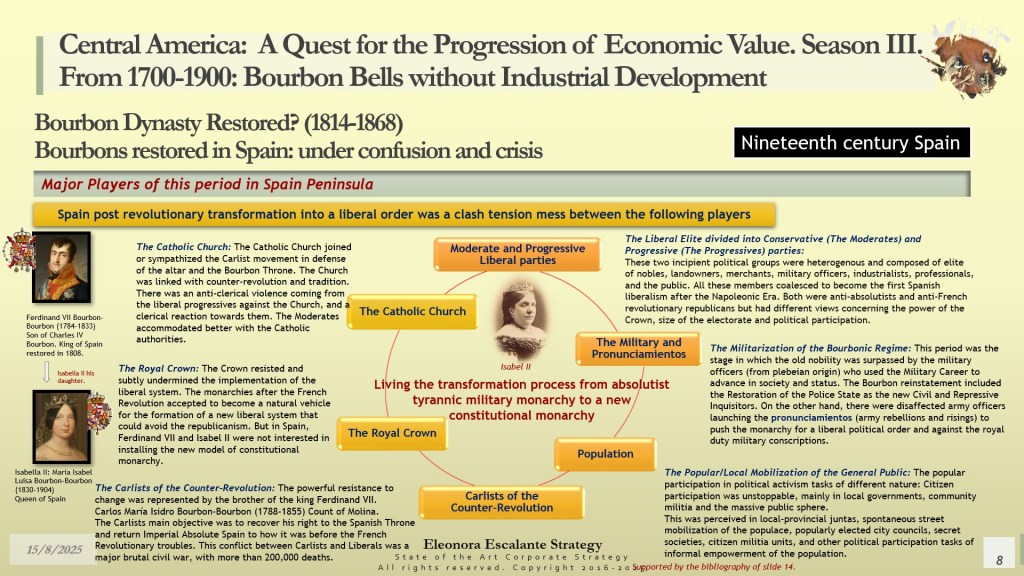
Major Players of the Spanish Bourbon Chaotic 19th century (Slide 8)
We have described the main protagonists of this century based on the analysis of Pamela Radcliff (3). Slide 8 is self-explanatory.
The Bourbon Spain 19th century explored in three stages (slides 9 to 12):
These slides are our dedicated effort to summarize what occurred in Spain between 1814 to 1868. We believe all the slides have the general elements required for the understanding of the chaos that the Spanish Bourbons were living. However, this chaos was not only happening domestically in Spain, but it was also occurring all over Europe. Let´s proceed to comprehend the revolutions of 1848-49.
The revolutions of 1848-49 in Europe. Bonus Material Below.
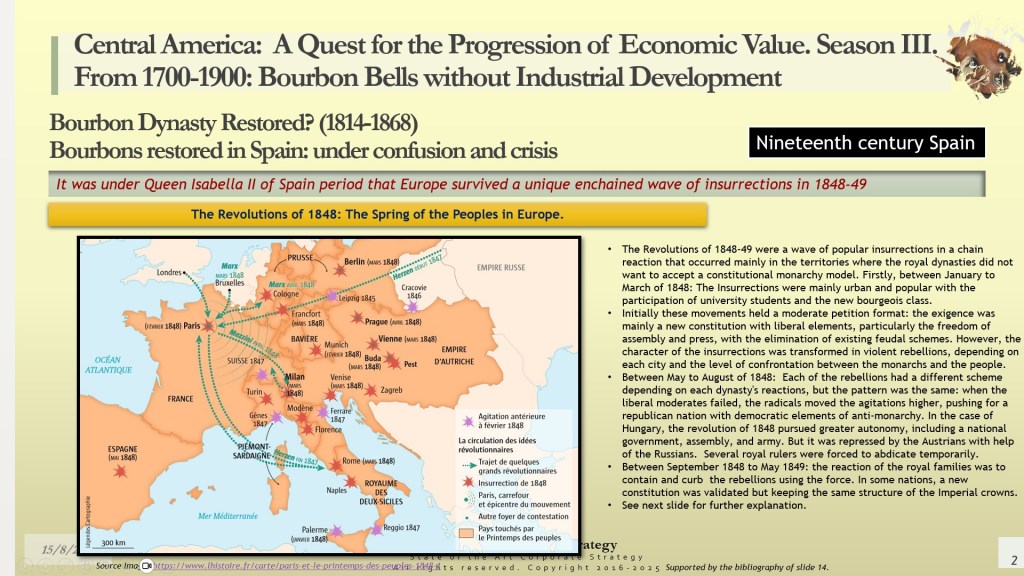
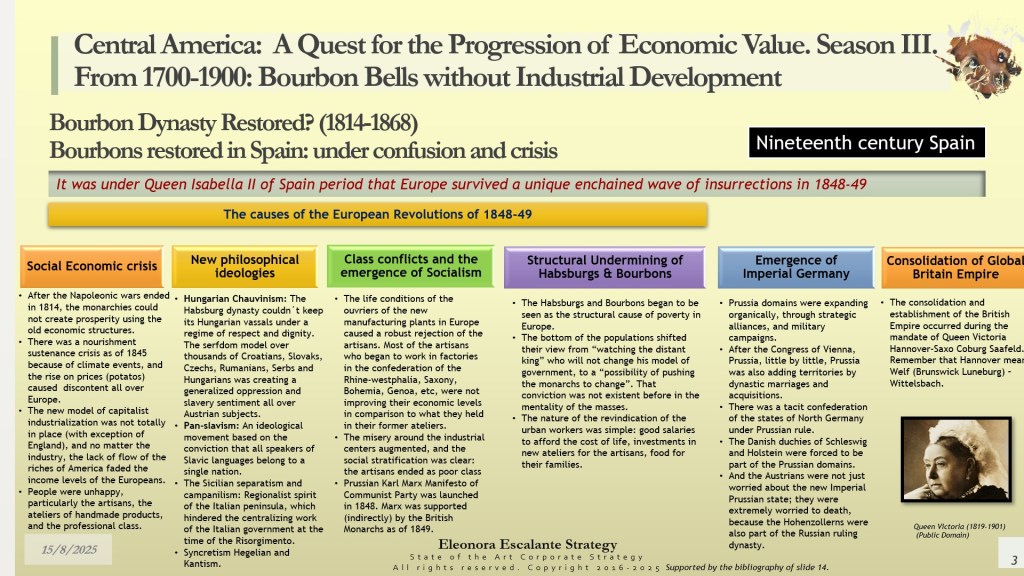

From our bonus material, we are committed to questioning: why did the insurrections against the Bourbons not happen in Russia, Sweden, or England? What do you think? Who was behind the revolutions of 1848-49? Which kingdoms could benefit from the instability of Europe? I will answer with the following information. If official history is not wrong, during the 19th century, the Russian monarchy was in the hands of the Tsars Romanov; however, their true last names were purely of German, Prussian, and Swedish origin. The last Romanovs on the throne of Russia were Elizabeth and her sister Anna Petrovna Romanov (both daughters of Peter I). Anna Petrovna married a member of the Holstein Gottorp dynasty, and she had a son, Peter III. The Romanovs of the male line died out in 1762, but the name Romanov was conserved by the branch of the house of Holstein-Gottorp that then mounted it over Peter III´s descendants. Let´s explore the true last names of the Romanov tsars during the 19th century.
1. Alexander I Holstein Gottorp-Anhalt Zerbst/Württemberg -Hohenzollern (1777-1825)
2. Nicholas I Holstein Gottorp-Anhalt Zerbst/Württemberg Hohenzollern (1796-1855)
3. Alexander II Holstein Gottorp-Württemberg/Hohenzollern-Mecklenburg Strelitz (1818-1881)
4. Alexander III Holstein Gottorp-Hohenzollern/Zahringen-Hessen Darmstadt (1845-1894).
Additionally, Queen Victoria I of Britain was a member of the House of Hannover-Mecklenburg Strelitz/Saxe Coburg-Saxe Saalfeld-Reuss. Queen Victoria’s last names were derived from Germany, specifically from the Wittelsbach and Saxon regions. Please remember that Hannover means in reality Guelph-Wittelsbach. There is a direct family link between Queen Victoria I and the Holstein-Gottorp of Alexander II through the Mecklenburg Strelitz.
Why does it matter? It matters because we must comprehend that every single warfare has a rationale, a “why” behind “official history”. And, just as the French Revolution and the Napoleonic phenomenon were designed to put Europe in order, the Revolutions of 1848-49 were guided by the same group of intellectuals who moved behind the scenes, supported by some of the royals. This is the century of Frederick Engels and Karl Marx, and both were stirring things up with their ideas. The notion of how to design a state and its prosperity was in the game: an absolutist monarchical regime? a constitutional monarchy? a democratic nation? a republic? A moderated socialist system? An industrialized factory model versus the entrepreneurial artisan atelier? Every dynasty was trying to find a pathway to move ahead, and it was a trial-and-error process in which the only clear idea was to accumulate land and resources; meanwhile, the new political economists couldn’t agree on which way to go with the main royals who sponsored them. Russia and England were part of that game, and we can´t ignore them when studying the 19th century of Bourbon Spain. Read the following phrase, please: Karl Marx, a Prussian, was also sponsored by a royal dynasty. He was not a product of an independent enlightenment strategy. He was chosen to provide an explanation of the French Revolution. But his analyses were manipulated to block the dynastic interests of the new emerging empires, using the discontent of the masses in the context of Europe at the end of the 19th century. Those who still believe that Marx was not subsidized by a royal family are truly mistaken.
Finally, take notice of all this information about the Tsar dynasty of the 19th century. The revolutionary changes of the European monarchies were not isolated from what was occurring in Spain or in America. Additionally, the royal dynasties of the Baltics, Brits, the Russians, and the Ottomans were not that far from what was occurring to the disgraced Bourbons.
To be continued…
Final Statement and Announcements:
This episode is about the contextual and political situation of the monarchical strategy of Spain during the 19th century. A period characterized by a pendulum of multidimensional oscillations between the absolutist reinstatement of the Bourbons and the Liberal moves to change the government into a democratic or, later, a republican State. We can perceive the roadmap of the Bourbons’ struggles while trying to keep Spain afloat in the middle of “a process to develop a constitutional monarchy against their will”. The tensions between all the players were many times antagonistic, opposed radically to each other, and the ascension of a disgruntled new military class not only complicated the resolutions to the problems, but aggravated additional troubles. The ruling period of Ferdinand VII and Isabella II, after Napoleon, was established on muddy sand waters. The Spanish Bourbons were not really restored during this century of analysis. Isabella II abdicated and moved to France in 1868, leaving a provisional government that was subsequently established as the First Bourbon Republic. Coincidentally, it was during this period that Imperial Spain lost all the territories in America. The former Viceroyalty of New Spain (now México) also renounced the rest of the Spanish North American domains. There is a lot to learn during the following weeks. See you in our next episode. Thank you.
Musical Section.
Season III of “Central America: A Quest for the Progression of Economic Value” has assigned a new instrument for the rest of the year. It is the guitar!. Our selection of music during Season III will continue to explore the delightful music produced between the 17th and 19th centuries, featuring interpretations by virtuoso guitarists. We will embark on selecting the top 29 loveliest guitarists from the last five generations, who played music composed during the time of this saga. Our choice for today is Irina Kulikova from Russia. Her biography is here https://irinakulikova.com/biography/. At the age of 19, she broke her arm and was unable to practice for more than a year. However, her determination to return to the classical guitar was so decisive that she has continued delighting us with her pleasant music. This compilation of classical guitar is exquisite. Enjoy!
Thank you for reading http://www.eleonoraescalantestrategy.com. It is a privilege to learn. Blessings.

Sources of reference and Bibliography utilized today. All are listed in the slide document. Additional material will be added when we upload the strategic reflections.
(1) Sebastian Ottinger and Nico Voigtländer. History’s Masters: The Effect of European Monarchs on State Performance. NBER Working Paper No. 28297. December 2020, Revised May 2022. https://www.nber.org/system/files/working_papers/w28297/w28297.pdf
(2) VILAIN, ROBERT. “Austria and France: Introduction.” Austrian Studies 13 (2005): 1–18. http://www.jstor.org/stable/27944757
(3) Radcliff, Pamela. Modern Spain 1808 to the Present. Wiley Blackwell. 2017. Chapter 2. https://www.wiley.com/en-us/Modern+Spain%3A+1808+to+the+Present-p-9781119369929
Disclaimer: Eleonora Escalante paints Illustrations in Watercolor. Other types of illustrations or videos (which are not mine) are used for educational purposes ONLY. All are used as Illustrative and non-commercial images. Utilized only informatively for the public good. Nevertheless, most of this blog’s pictures, images, and videos are not mine. Unless otherwise stated, I do not own any lovely photos or images
 Eleonora Escalante Strategy - Strategic Reflections Think Tank