
Central America: A Quest for the Progression of Economic Value. Season III. Bourbon Dynasty restored. Amadeo I and Alfonso XII
Good night, beloved readers.
It is an achievement to be here with you today. We have prepared a master class with all the elements of historical strategy required to understand what was happening in Europe, while the Bourbons were in the process of transition from an absolutist monarchy to a constitutional conservative one.
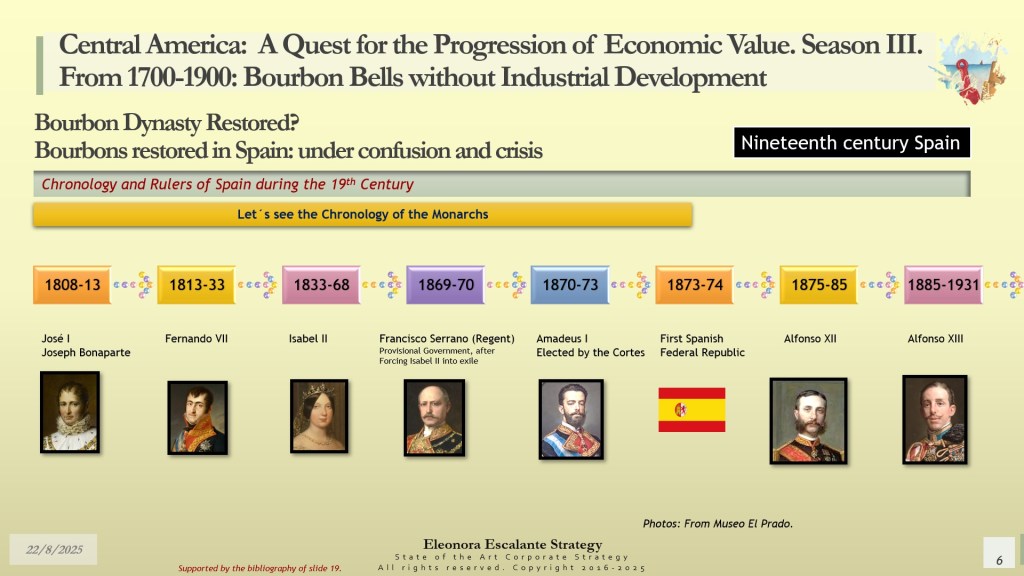
Our triumph is to deliver a complete episode that will change all your misconceptions about Spain in the geopolitical context of the second half of the 19th century. You will be able to elucidate what was going on then. Our material starts with the family trees of the kings of Spain during this period: King Amadeo Ferdinando Savoia-Habsburg Lorraine Bourbon (1845-1890), who only reigned between 1870 to 1873; and the period of the First Spanish Republic, which lasted only two years. And then, finally, the son of Isabella II, King Alfonso XII (1857-85) was able to rule.
Find our frame of reference below. Feel free to share it with your friends, professors, acquaintances, and colleagues. Print the slides, and read them carefully. Look for further information beyond our bibliography. Write your questions and notes on paper. This is a crucial episode because most of what Spain is reaping today is linked to the decision-making of this century. We have attempted to disentangle the political buzzword from the complex political conflicts, inviting you to view this period as the consolidation of what the militaries, then, replicated in Latin America during the 20th century. You will understand why today. From an economic perspective, we also wish to highlight who supported which incipient economic model and how Spain lost its unique business development pioneering spirit by following the rest of the European Great Powers (mainly Britain and France) in matters of monarchical decision-making. The 19th century represents a span of 100 years lost for Spain. In the 19th century, Spain was trying to reconfigure its own political model, soothing revolts, igniting chaos, defusing the entrance of the socialists-anarchists, appeasing the elites, controlling the Carlistas and Alfonsistas Bourbons in the Peninsula, lulling the Cuban-Separatists, while relying on a repressive militarism. In a domino effect, Latin America was also left behind, not only because our rulers were unable to find an economic model (there wasn´t one specifically created or designed for Latin America, but only an incipient one for Britain-Germany, and another one for the migrants living in America), but because our darling continent was being protected from the political mess of Europe. Our hypothesis about several waves of relevant members of the Dynasty Habsburg-Castile-Aragon-Valois coming to America, before the rise of the Bourbons in Europe, is not unreasonable or illogical. You will find out why we are closer to confirming it.









We request that you return next Monday, August 25th, to read our additional strategic reflections on this chapter.
We encourage our readers to familiarize themselves with our Friday master class by reviewing the slides over the weekend. We expect you to create ideas that might be strategic reflections or not. Every Monday, we upload our strategic inferences below. These will appear in the next paragraph. Only then will you be able to compare your own reflections with our introspections.
Additional strategic reflections on this episode. These will appear below on Monday, August 25th, 2025.

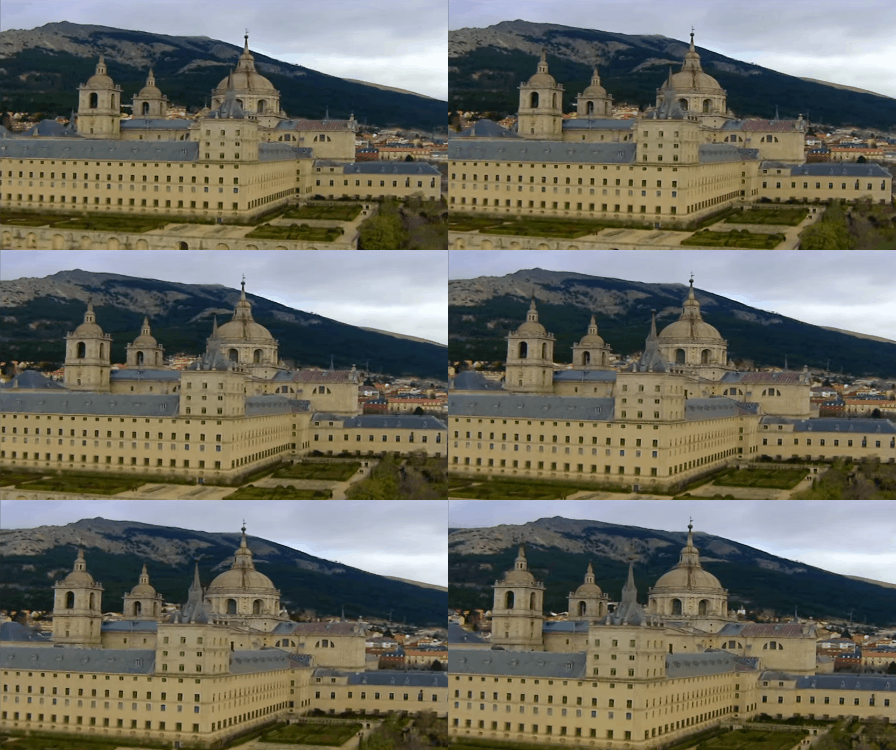
The Escorial Palace was the symbol of the Habsburg family’s protection prayers.
Spain´s 19th century might be patented or tagged with a trademark: it is “the” conflictive century, a kind of eruption of an announced political volcano. It was an eruption of more than 400 years of a latent conflict between the Habsburgs of Austria and Germany (including Spain) and the rest of the dynastic families who wanted the trophy of America. The French Bourbons were the recipients of the hereditary Valois French dynasty, and by coincidence, were the first dynasty in Europe to claim to erase the Habsburg motto “Austriae est imperare orbi universo”. This 19th-century outbreak was not an isolated or sudden situation that began with the French Revolution or the suppression of the Jesuits. It was a plan that was conceived to undermine the AEIOU Habsburg program. This plan was linked directly to the Protestant nations of the Holy Roman Empire of the German Nations. Those who still think that the French Bourbons Valois were a temporary dynastic oversight of Spain are completely mistaken. The Bourbons were tied to Britain through the German territories of the Wittelsbach and Brunswick-Lüneburg, the Wettin, the Saxonies, etc. We have explained it before. The 19th century in Spain was the century of dissolution and debauchery that was premonished to Charles V HRE when he was alive. The Emperor from Ghent was reproached for this coming decadence, as a chronicle epitomized by Bernal Díaz del Castillo. The 19th century was a foretold explosion that began to be exposed by the Salamanca´s religious and academic authorities during the 16th century. Fundamentally, the 19th century of Spain was the consequence of 400 years of an organic mistake that was warned by the authentic loving martyr missionaries who personally got acquainted with the Native Populations of America, those who alphabetized and taught the Indigenous to believe in Christ, to write, read, create things, sing and play music instruments at the same European valuable and treasured level. Charles V HRE was so convinced of this coming disaster for their family that he entrusted his son Philip II Habsburg Aviz to build El Escorial. All under the supervision of a specific group of Catholic priests (the Hieronymite order) who accompanied the emperor in his last days at San Jerónimo del Yuste. If someone knew about the real life of Charles V HRE, those were the Hieronymites. The Escorial Palace was not built as a residence of the Habsburg family. It was built as a royal family pantheon and monastery for those who prayed for the protection of the Habsburg family. The Hieronymite order was installed in that monastery castle by the end of the 16th century. They were champions of almsgiving, but were expelled from El Escorial Palace in a clear betrayal of the inheritance will instructions commanded by Charles V. “Coincidentally”, this expulsion occurred during the chaotic Spanish 19th century. Take notice: the Order was ejected by the Bourbons, during the reign of Isabella II, three times: in 1808, 1837, and 1854. King Alfonso XII finally struck them out and replaced them with the Augustinians in 1885. The case of the Hieronymite Order expulsion from the Escorial is an example of how far and distant the Bourbons were from the original Habsburgs in their “monarchical decision-making”.
Family trees of Amadeo I and Alfonso XII. Slides 7 and 8.
Amadeo Ferdinando Savoia-Habsburg Lorraine (1845-90) was not a mundane prince coming from the Italian lands. He was the son of the new king of unified Italy. Moreover, he held a strong Habsburg “blood” warranty, in comparison to Isabella II or her infant son Alfonso XII Bourbon-Bourbon. During those years, the heritage pedigree was more important than the “competences or capabilities” of the rulers. They were selected by order of arrival, not by brainiac abilities, an extraordinary education, or experience. The inbreeding of the Bourbons caused a disaster in the brain condition of Isabella II. No historian talks about her mental state properly, but we don´t need to dig too far to realize it (Ferdinand VII and Isabella II’s different biographies show the madness of their decision-making). The progressive and moderate militaries who maintained the Crown knew about it perfectly. And they aspired to have capable rulers who could lead in such a muddy 19th century. The Military Bourbonic Generals replaced the King or Queen in their “monarchical strategic leadership,” and this is the context of how Amadeo I arrived at Madrid. Though Amadeo I was a Habsburg-Lorraine. He wasn´t a Bourbon, and he was defeated from the start in a land that wasn´t his. With Amadeo I, the Habsburgs were trying to return to their beloved kingdom. Remember that the Spanish Peninsula, since Philip V Bourbon-Wittelsbach was not a Habsburg territory anymore, and the Bourbons (with all their ingrained leaders) were not going to allow any Habsburg to dwell in Madrid.
Alfonso XII Bourbon-Bourbon (1857-85) was the son of two first double cousins.
Official history has researched his family tree (slide 8). Again, here we can observe the incredible level of inbreeding of this character. However, if Alfonso XII was able to make decisions by himself, which might have happened, it is because his heritage tree is not true, or the condition of devious sexual orientation of Francisco de Asis of Bourbon (his father) was real, and this kid wasn´t from him. But we can´t assert their personal image. Nevertheless, with that level of “inbreeding,” we are facing the same situation as with Carlos II Habsburg-Habsburg, the Bewitched, who caused the War of Spanish Succession. Why does this matter to us? It is relevant because when Spain was facing an incompetent or inept king, then the decision makers of the political-warfare-economy were not the Kings (or queens) but the advisors, or in this century, the military. A society in such a condition of social-political-economic burst was placed in the hands of the generals, or military caudillos, who were taught to think and behave under a pretorian rule.
Spain under a pretorian dictatorship of the military.
The term pretorian has its origin in the Roman pretorians, the elite unit of SWAT bodyguards of the Roman emperors who were experienced and influential enough to protect, appoint, and even eliminate them. Spain’s survival during the 19th century was clinging to the pretorian militaries as Baldomero Espartero, Leopoldo O´Donnell, Francisco Serrano y Dominguez, and Juan Prim y Prats, among others. The military strengthening of Spain was the decisive foundation of the Crown. The Bourbonic Militaries were military dictators. They weren´t built at the level of Napoleon Bonaparte, but they aspired to be as such. Their obedience to the Monarchs converted them not into Emperors but into commanders-in-chief dictators, prearranged by the kings (or their closest non-mentally ill family members). Any dictator, in the context of Bourbon Spain of the 19th century, had no independent institution that could limit their power, nor the Cortes, nor the press, nor the Catholic Church, nor academia. There was no civil authority that could counterweight the military order of Spain. In consequence, their regime foundations were unlimited in the words “repression” and “persecution” against anyone who was or looked like, or seemed revolutionary. The term “revolutionary” was ample: it applied to the political activists, and it applied to the intellectuals. Thousands of Spaniards also traveled to settle in Latin America, escaping from those levels of cruelty and terror. What occurred in Spain during the 19th century is the original model of what was replicated later in Spanish America during the 20th century. All the features of Latin American dictatorships of the 20th century were implemented first by the military Generals who were following the example of the Spanish pro-bourbons in their own lands. In the case of Spain, the uniqueness regards the military dictators as playing the role of “plenipotentiary regents” between 1834 to 1931. There were some subtle differences between all these generals, but the Bourbonic militaries were characterized by their “brutal” authoritarianism and inquisitorial tyrannical measures. With rulers as such, maintained and reinforced by the Bourbon family, there was no possibility of creating or designing any economic model for prosperity during this century.
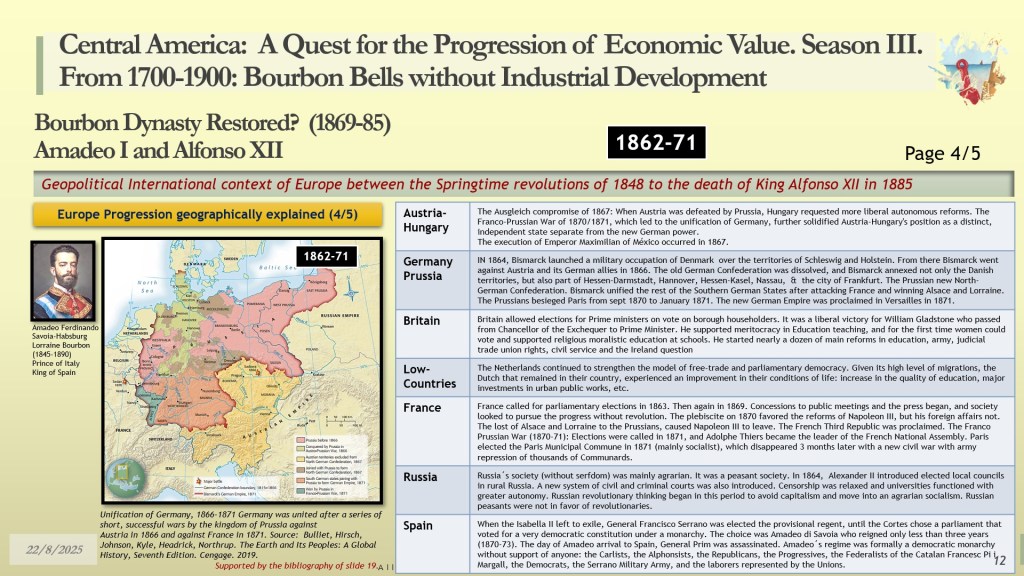
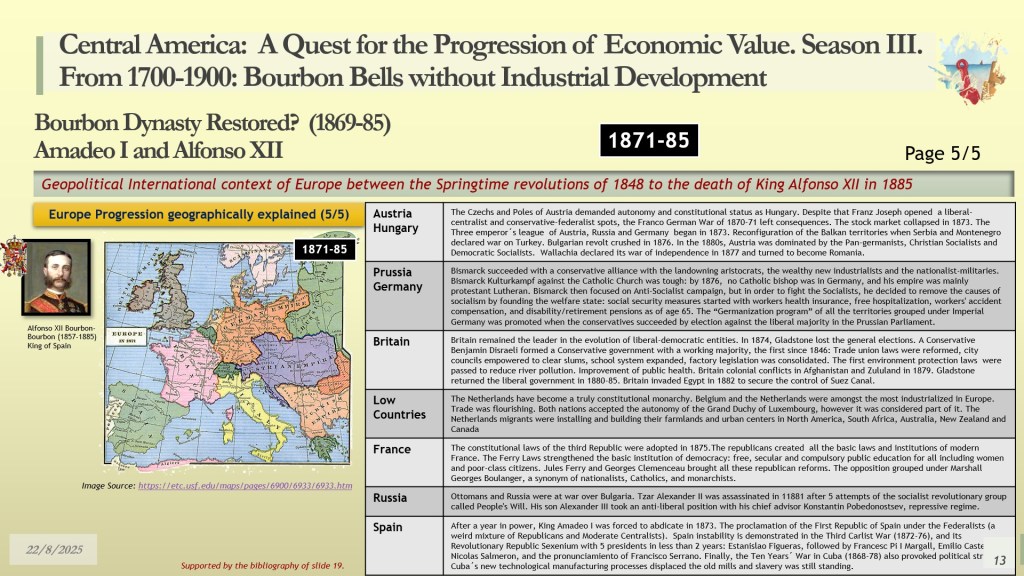
Geopolitical European International Context between the Springtime Revolts of 1848 to the death of King Alfonso XII in 1885. Slides 9 to 14.
We have divided our comparison analysis between 1848 to 1885 into five sub-periods:
1. 1848-50: Slide 9
2. 1850-57: Slide 10
3. 1857-62: Slide 11
4. 1862-71: Slide 12
5. 1871-85: Slide 13
We have compared what was occurring simultaneously in 7 dynastic territories that were transitioning from monarchical absolutism to become constitutional monarchy nations: Austria-Hungary, Prussia-Germany, Britain, the Low Countries, France, Russia, and Spain. All the slides are self-explanatory. We invite you to read them thoroughly. Each of these slides is a summary of days of our strategic reading; we truly request you to read each of them slowly and pay attention to the details.
The big picture of this period of analysis is on slide 14. This slide agglutinates the summary of the main wars in which all the Great Powers were involved, and the factors and/or issues that were shared or common among all these nations. We have identified 5 leading wars in Europe: (1) The Revolutions of 1848; (2) The Crimean War (1853-56); (3) The Wars previous to the proclamation of the Kingdom of Italy (1859-61); (4) the Schleswig-Holstein Wars (1848-51, 1864); (5) the Austria-Prussian War (1866); and (6) the Franco Prussian War (1870-71). The last three conflicts are all tangled in one main event of the century: The Unification of Germany under Prussian Leadership. The phenomenon of Otto Von Bismarck is so relevant in our Latin American days that we can´t take it lightly. I will return to explain the impact of this personage in one of our episodes of the next saga.
The 11 key factors that our strategy house has identified in European lands during the second half of the 19th century are:
- Ideological political internal conflicts between liberal-republican-democrats-revolutionaries and the monarchists-conservatives. In several nations, these conflicts were higher because of the mobilization of socialists, Marxists, and anarchists.
- Numerous internal violent revolts (involved repression and brutal degrees of punishment).
- New Technological Advancements in the transportation system sector (railroads, steamships), communications (telegraph cables and photo-camera), steel and chemical industries, environmental first pollution crisis in urban industrialized centers, energy (electricity), and the expansion of trade and finance to the middle class.
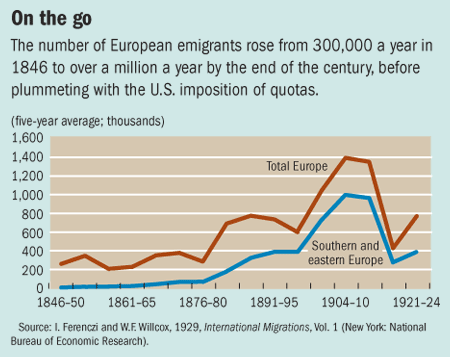
- Massive Migrations from Europe to America: Nine out of 10 Germans (including Prussia) migrated to the USA. Additionally, a similar number of emigrants from Ireland, the Netherlands, and Spain went to the Americas, mostly to South America, and in general to Argentina and Brazil.
- The Socialist-Marxism ideology was expanding all over European nations.
- Nationalism: Each of the Great Powers was building its own ideocracy and grouping territories based on its cultural identity, language, and territorial historical configurations
- The emergence of the concept of social security welfare for the needy, the poor, the peasants, the orphans, the widows, and the factory workers.
- The Jews emancipation
- The Strengthening of education at all levels, from primary to university levels.
- Industrialization and the mechanization of the factories. This was the period of the disappearance of the traditional artisan ateliers.
- The Crises of the Balkan Nations began.
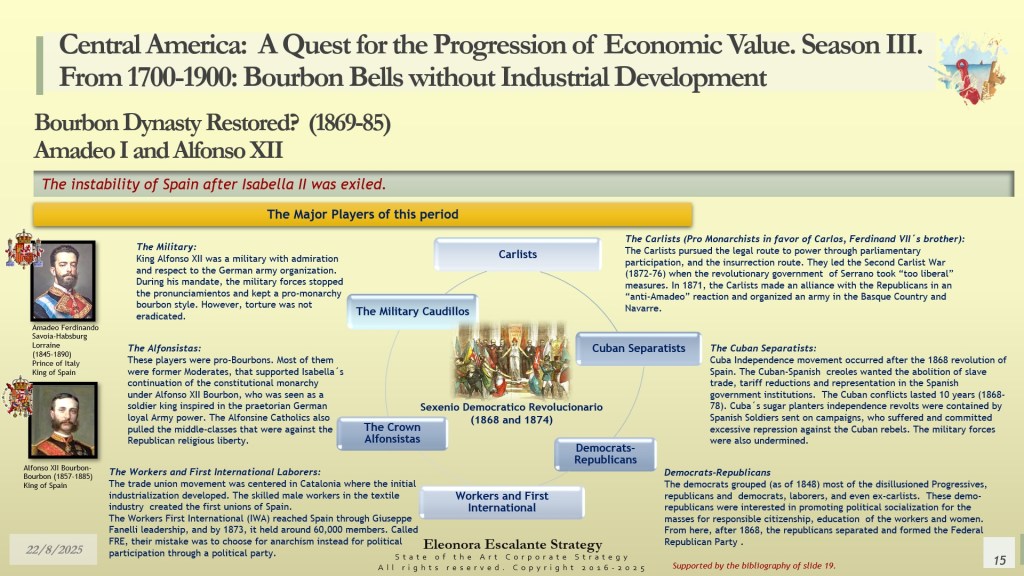
Amadeo I, the first Spanish Republic, and Alfonso XII. Slides 15-18.
We start by defining who is who during this period. In historical strategic analysis, we always commence by asking who the main players were. For this specific case, we have identified 6 main protagonists (with the help of historians Pamela Beth Radcliff and Mark Lawrence):
- The Carlists (pro-monarchists in favor of Carlos María Isidro Bourbon-Bourbon (1788-1855), and his descendants who continued fighting for the right of the Spanish throne – Carlos Luis Bourbon y Braganza, Juan Carlos María Bourbon y Braganza, and Carlos de Bourbon-Austria Este).
- The Cuban Separatists. The Cuban independence movement occurred as of 1868.
- Democrats-Republicans: This group gathered the Progressives, the republicans, democrats, laborers, and even ex-Carlists.
- Workers and the First International Working Men: The Spanish Regional Federation of the International Workingmen’s Association (FRE-AIT in Spanish)
- The Alfonsistas (those who supported Alfonso XII, following the pro-monarchist line of Isabella II).
- The Military, represented by the pretorian Generals who backed up the Bourbons as their regents.
After every player has been identified, we proceed to understand the phases of the period. We have identified 4 phases after the coup d´état of Isabella II in 1868. The first one is called Provisional Government (1868); the second one, is the period of Amadeo I as an elected democratic monarch (1869-73); then what is called the First Federal Republic (1873-74); and finally, the return of Alfonso XII under a conservative monarchy (his ruling mandate lasted 10 years, from 1875 to 1885). The Sexennial Democratic-Revolutionary Period groups the first three phases (from 1868 to 1874), and it is explained in slides 16 and 17. We have provided a summary of each with the main order of events and their explanations.
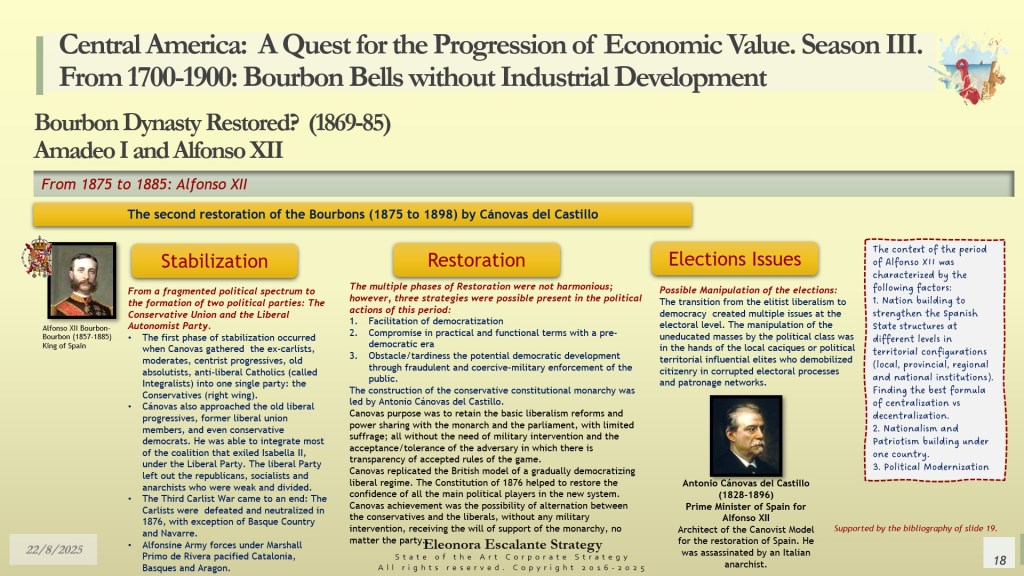
Finally, our last slide 18 is about the Alfonso XII period. His authority as a king in power was the second restoration of the Bourbons in Spain after the Joseph Bonaparte years. Alfonso XII delegated his decision-making to his prime minister, Antonio Cánovas del Castillo. The rebuilding of the constitutional monarchy was a process of three steps: Stabilization of all the main social and political forces in the territory, the Restoration per se, and finally the election process (which had multiple issues). Our analysis about this period is clear: no economic prosperity can rise if there is no peace and a major degree of tolerance, respect, and confidence between the leaders, institutions, and a righteous system of justice for all levels of society. And Spain was still far, but far from attaining these key performance indicators in its quest to define the “modus operandi” of their own society. Slide 18 is self-explanatory.
You might be tempted to suppose that with Alfonso XII, Spain was decisively arriving at a certain type of steadying calm. But no. Dear readers, what happened to Spain in the 20th century was unimaginably worse.
To be continued…
Final Statement and Announcements:
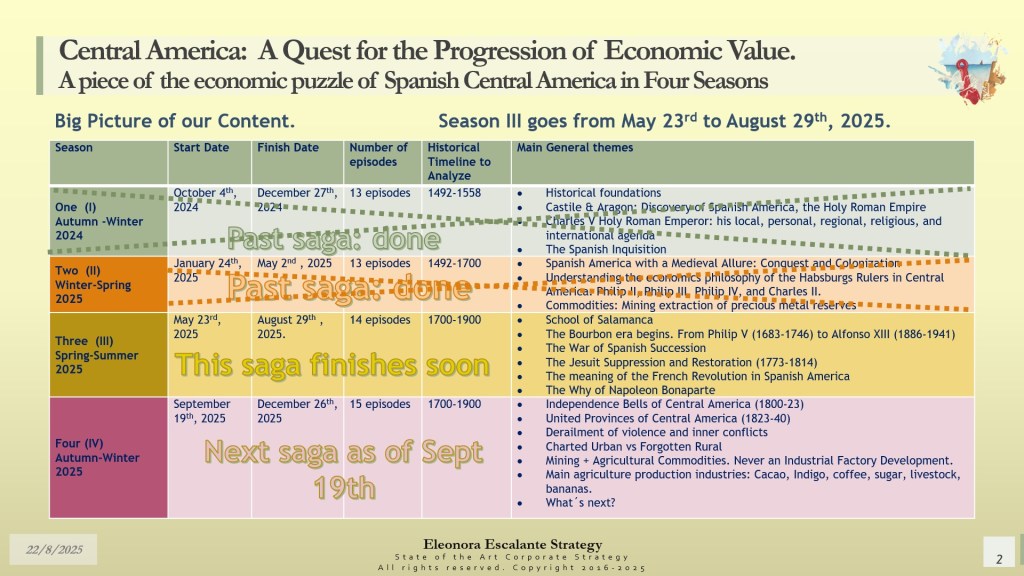
This master class is the avant-dernier episode of season III. We are close to finishing the analysis of the Iberian Peninsula geopolitical situation between 1700 to 1900. After our next episode, we will take two weeks of recess. Our next season IV, which starts next Sept 19th, will be about the political economy situation in Central America, and we will cover all the main economic sectors (incipient agro-export industries). There is a lot to learn during the following weeks. See you in our next episode. Thank you.
Musical Section.
Season III of “Central America: A Quest for the Progression of Economic Value” has assigned a new instrument for the rest of the year. It is the guitar!. Our selection of music during Season III will continue to explore the delightful music produced between the 17th and 19th centuries, featuring interpretations by virtuoso guitarists. We will embark on selecting the top 29 loveliest guitarists from the last five generations, who played music composed during the time of this saga. Our choice for today is an exception to our rule of classical guitar performers. Our three guitarists are interpreting a flamenco piece with a jazz allure. The three virtuosos are Al Di Meola, Paco de Lucía, and John McLaughlin. The occasion: They were invited to a Pavarotti and Friends concert in Modena, Italy, in 1980. I can´t leave them out of our guitar journey. Thanks to La Cave Studios YouTube Channel for sharing it.
For more information about the artists, click below:
Paco de Lucía Biography: https://www.guitarsalon.com/blog/recording-artist-paco-de-lucia?
Al Di Meola Biography: https://www.aldimeola.com/bio
John McLaughlin: https://www.muzines.co.uk/articles/john-mclaughlin/3946
Thank you for reading http://www.eleonoraescalantestrategy.com. It is a privilege to learn. Blessings.

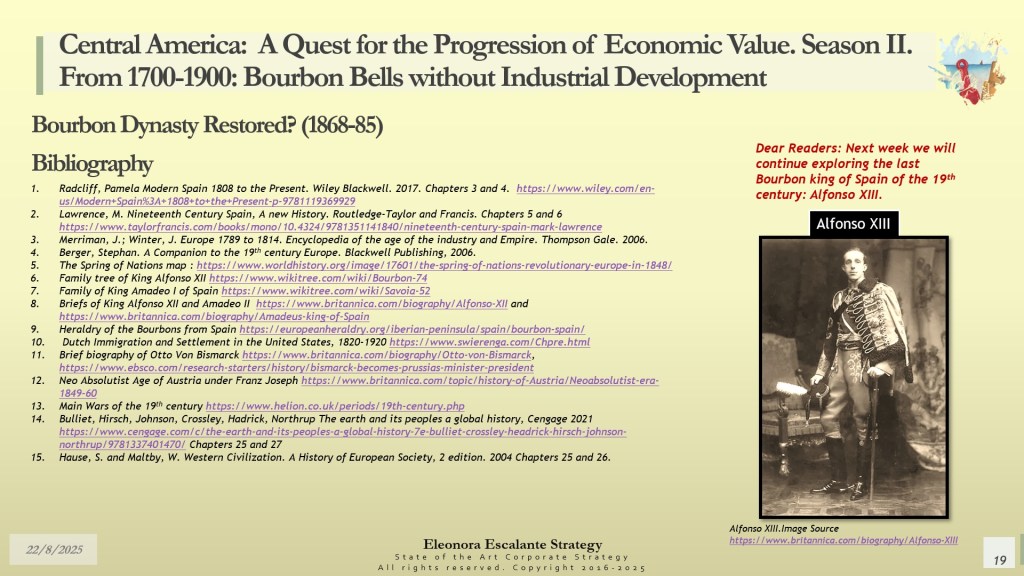
Sources of reference and Bibliography utilized today. All are listed in the slide document. Additional material will be added when we upload the strategic reflections.
Disclaimer: Eleonora Escalante paints Illustrations in Watercolor. Other types of illustrations or videos (which are not mine) are used for educational purposes ONLY. All are used as Illustrative and non-commercial images. Utilized only informatively for the public good. Nevertheless, most of this blog’s pictures, images, and videos are not mine. Unless otherwise stated, I do not own any lovely photos or images
 Eleonora Escalante Strategy - Strategic Reflections Think Tank
