
Central America: A Quest for the Progression of Economic Value. Season IV. Episode 4. Independence Bells (1800-23) Part 2.
Dear incredible readers:
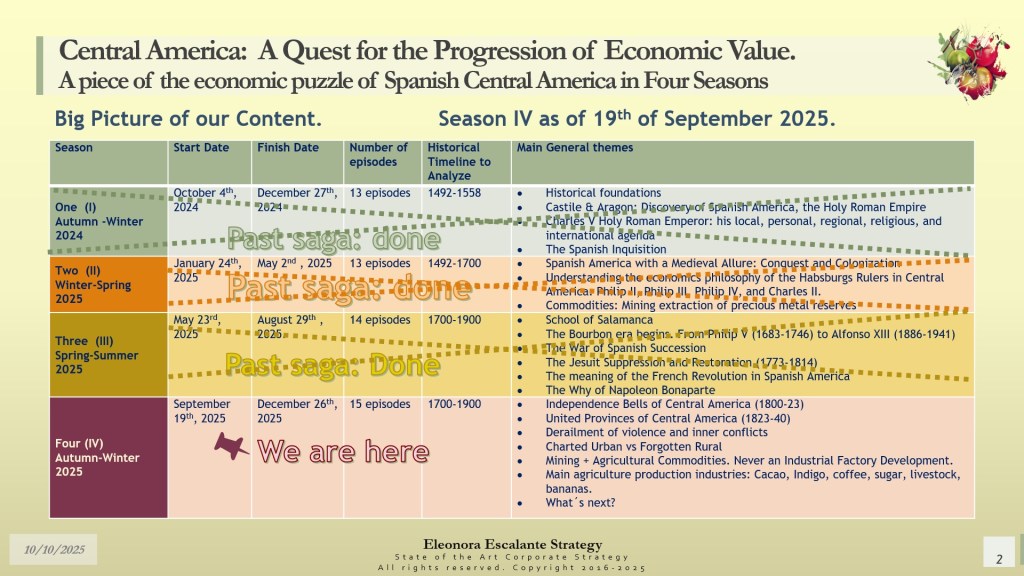
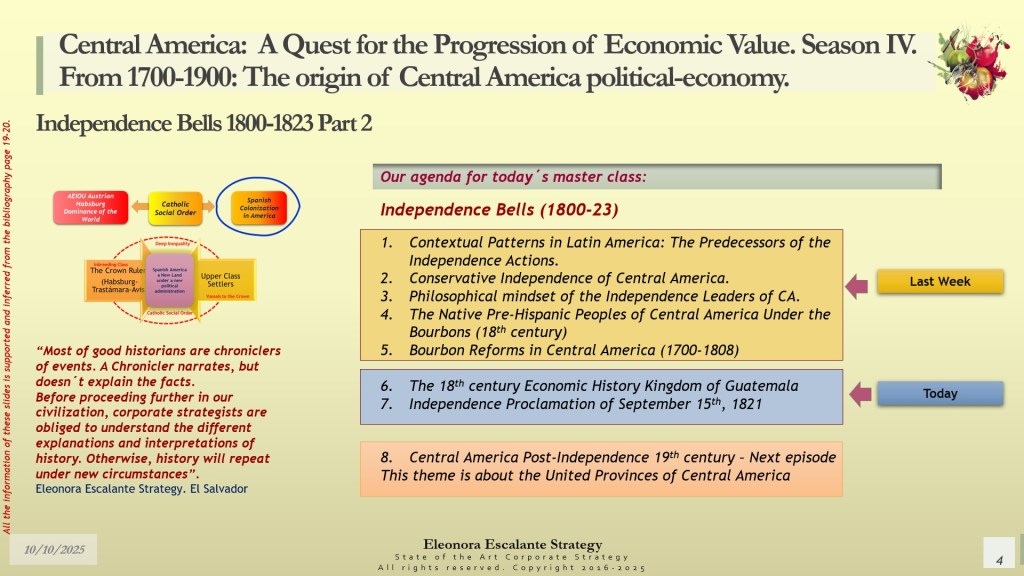
This masterclass is the second part of the theme “Independence Bells (1800-23)” of Central America. Last week, we introduced the general context of the antecedents and precursors of it. Today, we are going to develop the rest.
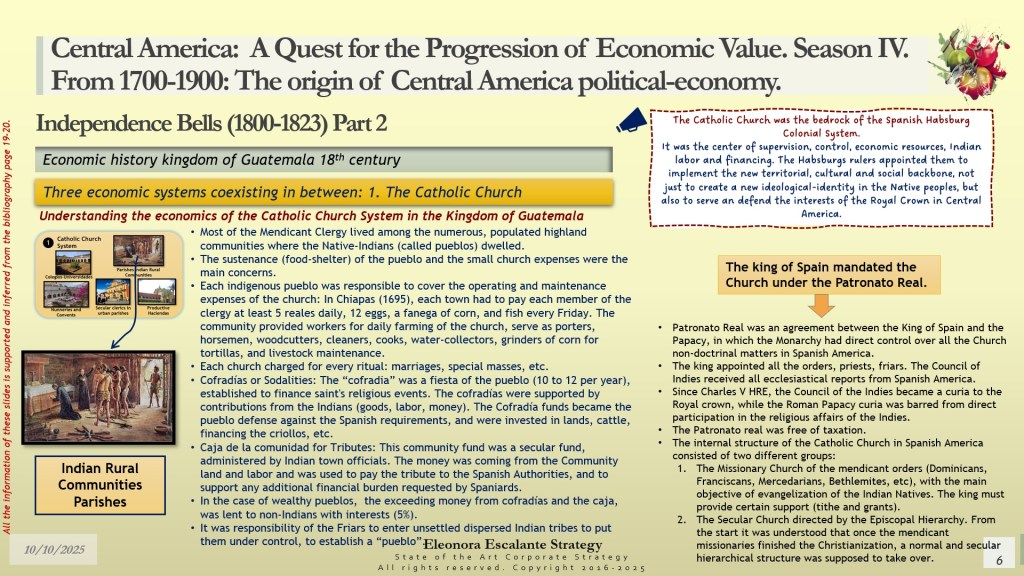
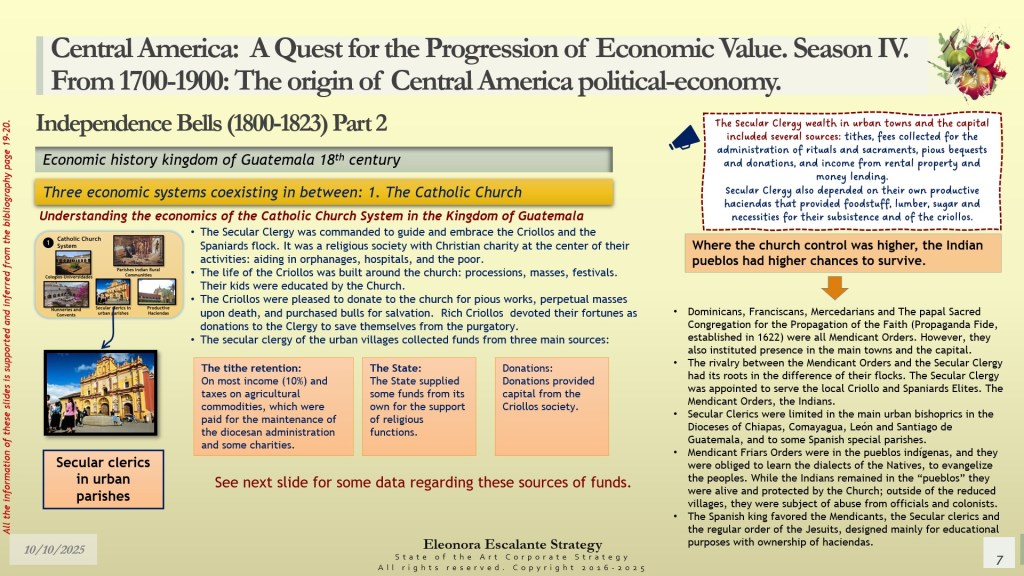
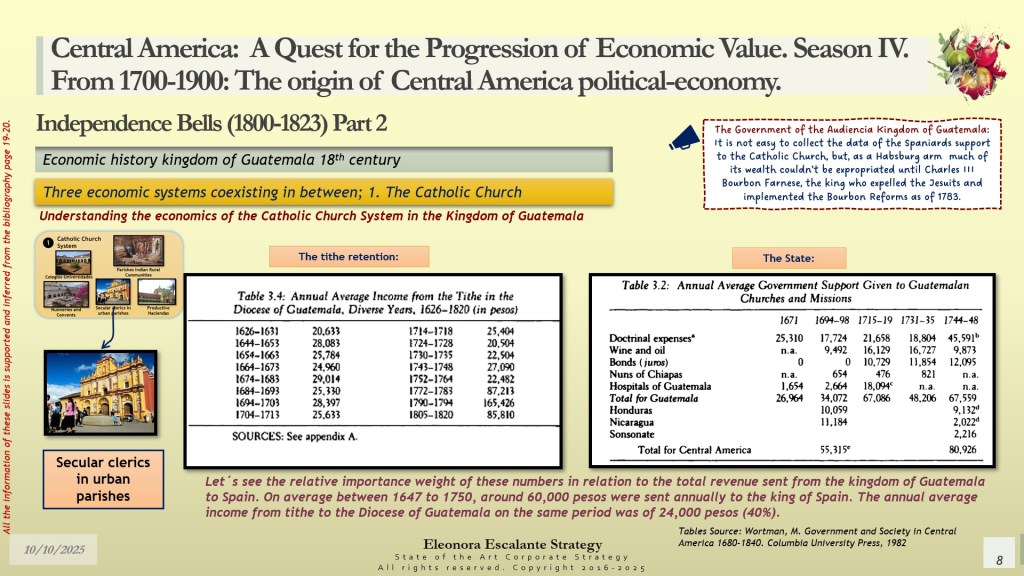
We have dedicated most of our time to understanding the economic situation of the Kingdom de Guatemala during the 18th century. We have identified three different economic models integrated and correlated in between by the Catholic Church, the most powerful institution of Colonial Central America. These economic models were:
- The Catholic Church’s economic system,
- The Native-Indian Subsistence-Tribute system, and
- The Colonial Criollos-Spaniard Provincial Trade and Commerce system.
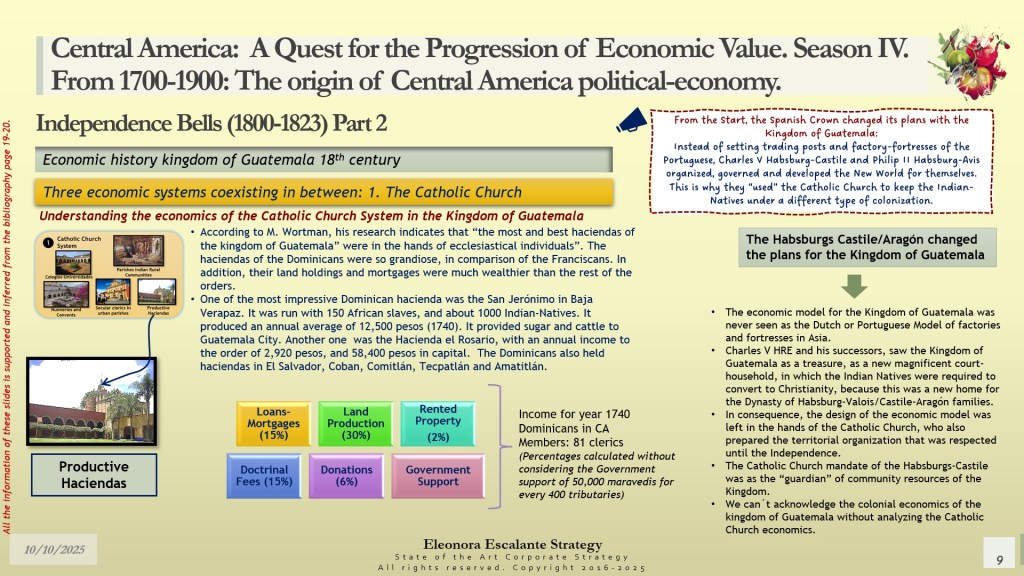
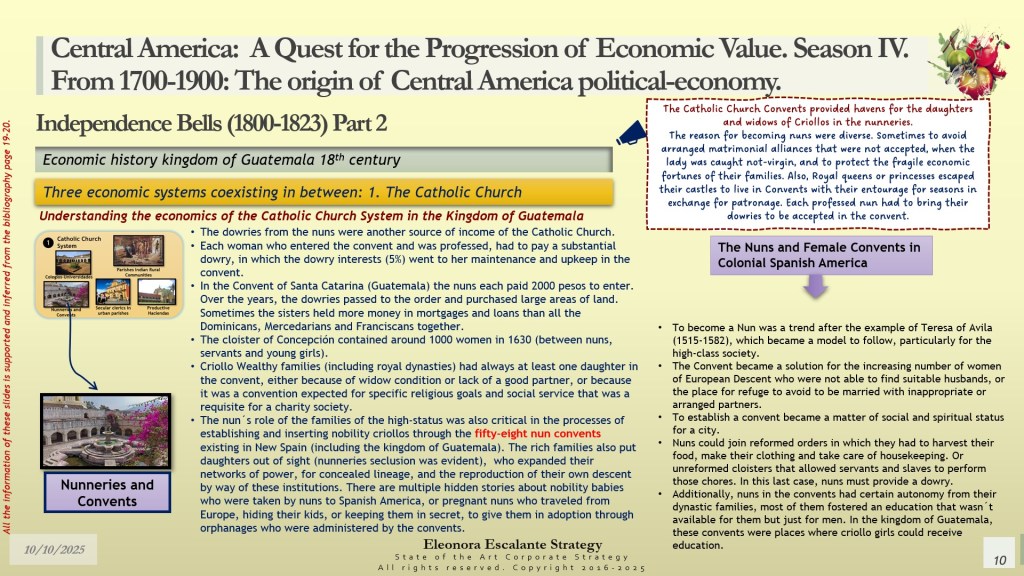
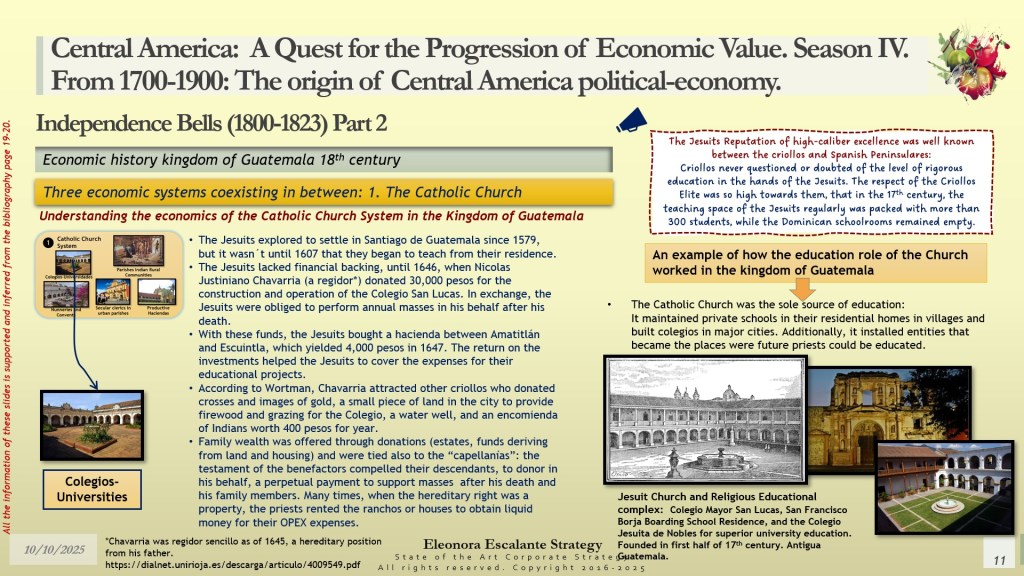
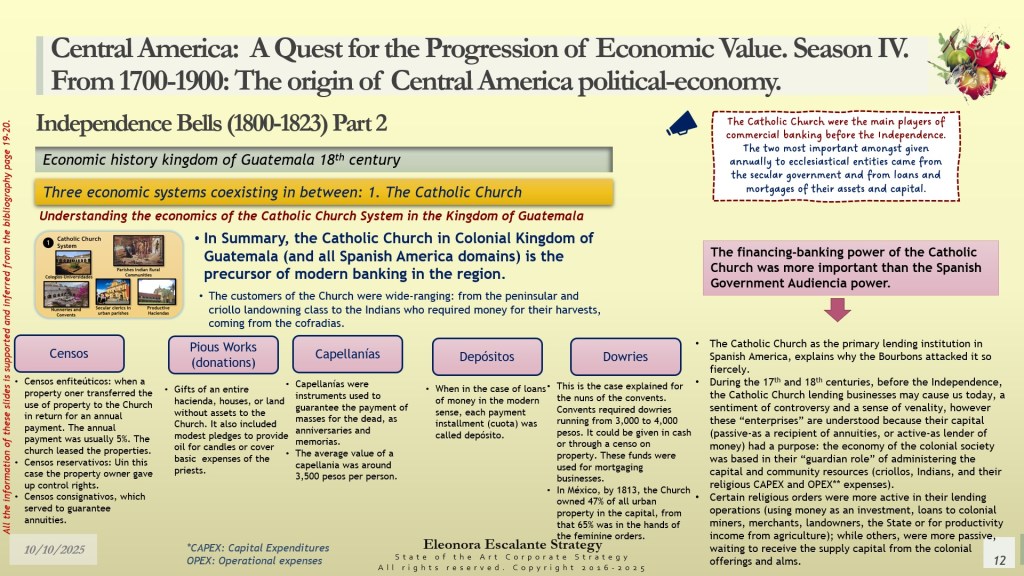
From slides 5 to 14, we have completed the main aspects of each of the three; however, we will continue developing more details about the Native-Indian economy and the Criollos-Spaniard economic interests over the rest of the saga. This is just the beginning.
We invite you to read our frame of reference below. Feel free to share it with your people. We also encourage printing it, writing notes, and finding additional information that is related to our bibliography. Our slides are the core reading material that will help you write your strategic inferences about this topic.
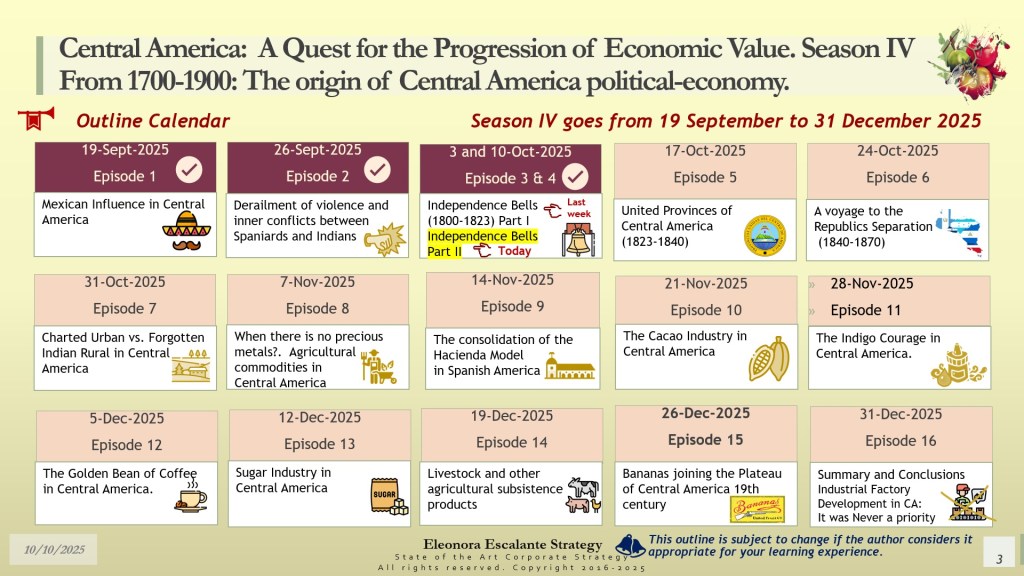

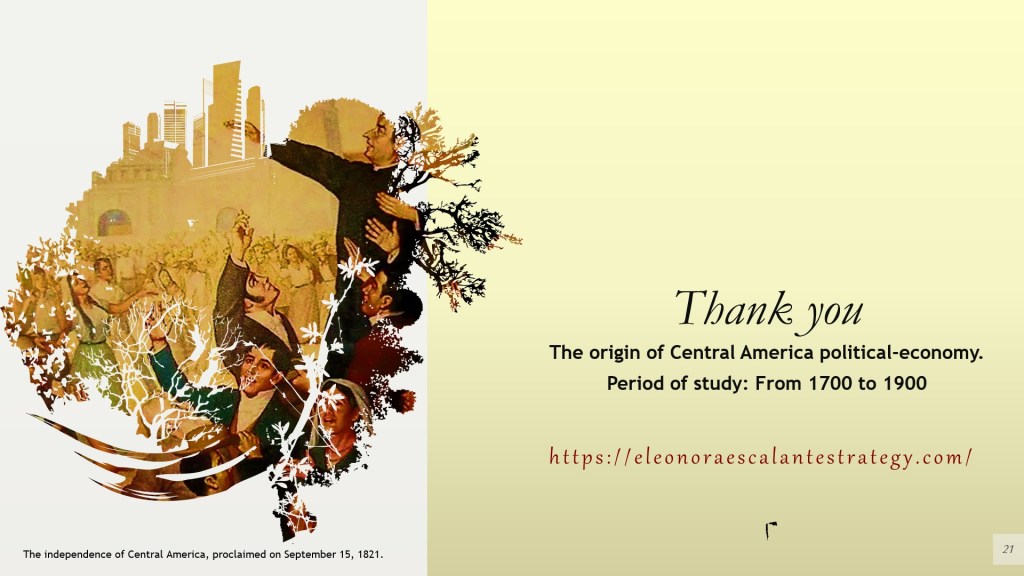
We request that you return next Monday, October 13th, to read our additional strategic reflections on this chapter.
We encourage our readers to familiarize themselves with our Friday master class by reviewing the slides over the weekend. We expect you to create ideas that might be strategic reflections or not. Every Monday, we upload our strategic inferences below. These will appear in the next paragraph. Only then will you be able to compare your own reflections with our introspection. Moreover, our strategic reflections on this topic will be aggregated (episodes 3 and 4).
Additional strategic reflections on this episode. These will appear below on Monday, October 13th, 2025.
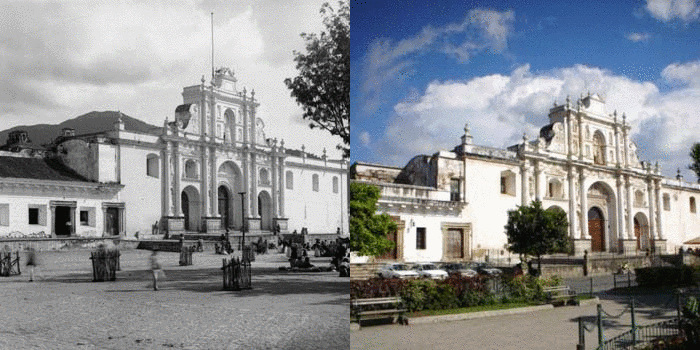
Comparing before and today. Source. Public Domain. Illustrative and non-commercial GIF image. Used for educational purposes. Utilized only informatively for the public good.
Once upon a time…
Once upon a time, a group of royal families from Western Europe got together to play as discoverers of the New World. These regal dynasties, at the time of Christopher Columbus´s endeavor, were identified mainly as the Habsburgs from Austria, Aviz from Portugal, Valois from a conglomerate of Northern French/Dutch Burgundian lands, and the Trastámara lineage from Aragón and Castile. These realms were assembled despite their complex, conflictual ties, and all together came to conquer a vast, rich continent called America. The families´ consortium, with the help of the Venetian Patriarchs of Genoa, and the bemused indirect supervision of the Tudors from England, in conjunction with the observation of the Baltic kingdoms of Northern Europe under the Kalmar Union of Norway, Sweden, and Denmark, started to expand their territories in the New World. France, a Valois nation, was supposed to be embraced in the process from the start, but it was excluded, it was left behind, as much as the Germans Wittelsbach, the Hohenzollern, and the Wettin-Saxony. Other former Roman dynasties who were apparently ignored, as the Medici and their extended allies (Gonzaga, Farnese, Savoy), were finely honed to captivate the matrimonial Habsburg slots without success to decisively get a foot in America. The victory of the bling-bling treasures of this wild tropical continent was fiercely protected by the Spaniards of Castile-Aragon. And it was also shielded by the Hungarian Royal Habsburgs, who kept the other realms tied up through the Holy Roman Empire. Everyone wanted a new piece of the American cake. But the primacy of the Spaniards was already in place. And since then, the warfare in Europe was embarked in constant waves of conflicts, ranging from superficial matrimonial quarrels, religious confrontations, up to world wars occurring during the 20th century.
Spanish America was planted with the Inquisitorial crusade spirit of the royal SWAT military orders, who accomplished the violent conquest with their superior weaponry, while taking advantage of the different ideological cosmovision of the native pre-Hispanic populations. The Catholic Church was the head of the territorial organization of the new continent, as they were appointed by Charles V HRE to evangelize and build the social culture of his recently acquired pristine household. However, the outstanding clash between the Bourbon-Valois and the Habsburg-Castile/Aragón remained. The Bourbons tried for several rounds to arrive at the cusp of decision-making, in their quest to obtain the riches of the New World, an endeavor that started with the King of Navarra, Henry of Bourbon, who arrived in France accompanied by a Medici. However, the hard road to America was inaccessible. It was left under the armor of the Catholic Church. It wasn´t until the 18th century that a Bourbon Wittelsbach (Philip V) was able to sit on the throne of real power of the global Spanish domains.
Little did the Bourbons grasp that Spanish America was so well tamed by the Habsburgs’ network of Criollos and their earlier allies that the Reforms of Charles III Bourbon-Farnese only triggered the desperation and the need for separation from Spain. The French Revolution beheaded the Bourbon plans, and Napoleón Bonaparte, with his family, was set as the solution of the royal dynasties to stop the Enlightenment ideas, which were blamed in the first place, as the cause of the crisis. This is not true. The liberté-fraternité-égalité flag simply created the philosophical ecosystem to manipulate the incipient middle-intellectual class, while the bottom of the populations in Europe and America continued under a difficult political-economic system that was far from improvement and prosperity. It is in this contextual background that we initiate our strategic inferences of the Independence process of Central America between 1800 to 1823.
Before proceeding further, we encourage our students to print both presentation slides (Episode 3 and Episode 4) and keep them next to you, while reading subsequently.
The predecessors of the Independence of the Kingdom of Guatemala.
Slides 5-6 Episode 3. The process of independence movements from Bourbon Spain did not start in New Spain. It began first in South America. The leaders were all White-Criollos, most of them from the privileged families who held extensive haciendas or were engaged in the value chain of trading. Simón Bolívar, Antonio Nariño, Manuel Belgrano, and Mariano Moreno were all born after the expulsion of the Jesuits from Spanish América (after 1767). If you compare their profiles (see slide 5-Ep. 3), all of them were produced or built under the same pattern of knowledge and conceptual vision of life. Slide 6-Ep.3 describes 8 characteristics of them:
- Belonging to the criollos-white caste, the second or third generation of wealthy peninsulares.
- Catholic: Educated under the Catholic tradition.
- Grounded in the 18th-century Enlightenment acknowledgment.
- Favored Rousseau’s philosophical allure over the rest.
- Supporters of paternalistic governance
- Encouraged independence as a Separation from the Bourbon Spain (during the period of Joseph Bonaparte)
- Esteemed the Royalist Medieval/Spanish American Political thought.
- Held a colossal fear of anarchy if nothing was done.
In México, Father Hidalgo and Morelos’ pre-independence rebellions were of a different latitude. The priests were coming from a religious order, and they organized the natives to fight, and both (one after the other) were brutally repressed.
So, when the motivation for Independence of the Kingdom of Guatemala occurred in 1821, in the South and in the North of Spanish America, the main poles of silver production development, the quest for freedom from Bourbon Spain had already started at least 10 years earlier.
The concept of Independence of Spanish America from Bourbon-Spain. Slide 7 to 9. Episode 3.
This concept is well explained in slide 7-Ep.3. By asking ourselves a few strategic questions, about who the próceres were, what their intentions were, why they thought the way they thought, and what their rationale was behind their actions, we have come to the essential notion that guided the independence leaders all over the continent. What type of independence were they talking about? And it is clear to us that there were multiple sections of Spanish America doing the same, in parallel, for different targets, kind of unrelated experiments for the superficial observer. However, it was part of a big plan. We suggest that the big plan of Spanish Habsburg America was to stop the implementation of the Bourbons´ new strategy. Depending on the criollo families that installed themselves in the region, the nature of the Independence movements had its own particularities.
“After a hundred years, the kings are peasants. “After two hundred years, the peasants are kings. ” Old Spanish proverb. Professor Murdo McLeod opens his book about Spanish America with the last proverb (1). And now we can deeply relate to it.
Wallerstein identified the core of the Spanish Kingdom in the Iberian Peninsula. The peripheral areas were then positioned in the new continent with México and Perú, and the semi-peripheries were in rural settings; this last classification is the case of the Kingdom of Guatemala. However, as of the 18th century, the weak Bourbon-Wittelsbach-Farnese pre-capitalist Kingdom of Guatemala turned to become the core of the Habsburg dynasty. What was previously classified as a semi-phery was transformed into the core of decision-making. Unexpectedly, what was considered the rubbish of the Latin American hemisphere strategically became the Habsburg core. In the meantime, the Spanish Peninsula, from Bonaparte to our days, turned out to be the farthest semi-periphery. Look at this notion with careful attention: By the time of the expulsion of the Jesuits (1767), Spanish America held the core of decision-making, and the Kingdom of Guatemala was the capital of a grand empire. This region was above the vice-royalties. This is our hypothesis that we have been studying since August last year. The Kingdom of Guatemala was a dwelling place, not a production factory region of silver like México or Perú-Potosí. This was the place where a special class of Criollos or mestizos (Habsburgs concealed under new last names) established their new household. In consequence, whatever was happening to the Bourbons situated in the Iberian Peninsula was less than relevant. The Bonaparte phenomenon was the solution of the royal consortium to kick out the disorder of Europe; while in Spanish America, the goal was to maneuver and avoid any future chaos, through the Independence movements, triggered by the same royals who were not using crowns or living in castles, but hiding under haciendas or behind the doors of a monastery.
We have described again what was occurring in Spain between 1808 to 1821 in slide 8-Ep.3. The Independence movement in Central America was merely a conservative transfer of power rather than a liberal or enlightened revolution. With Independence, the Criollos retained all the colonial past features of Spain before the Bourbons: hierarchy, authoritarianism, elitism, patriarchy, Catholicism, incipient mercantilism, and the land of the Indigenous populations. Yet, the new Criollos´ owners were not aware of what could it be the price of asking for help from the Bonapartes, and if they could retain their old organization, under their new sovereignty. See slide 11-Ep.3.
Central America Proceres mindset. Slide 9-Episode 3.
Independence from Bourbon Spain was driven by the mentality of those who led it. The philosophical allure of the Independence leaders and the próceres of the Kingdom of Guatemala was founded on 7 pillars:
- Criollo Aristocracy: all of them were part of a big lineage melted and concealed inside the catholic church organization, or with a high commercial-social pedigree as the Aycinena from Guatemala.
- Not pursuing a democratic government: The proceres and the caudillos of the Kingdom of Guatemala were not interested in creating a republic with democratic values.
- Unity: The elites of Central America were acting as a block, despite their differences; they learned over the decades to rely on each other, they shared labor and resources, and that didn´t change over the period of the independence process
- Needing a strong centralized executive authority. This was the heritage of the viceroyalty-intendencies system. Moreover, the reason Guatemala joined the Mexican Empire of Iturbide is the mirror of what the most powerful criollo society was looking for.
- The evident weakness of the rest of the ruling powers. If the executive were powerful, then the legislative and the judicial powers had to be diminished to a minimum. In this formula, what we are discovering is the same structure of centralization of power of a king and his court.
- Ample power to the President in case of emergency: The same authority monarchical functionality of a king.
- Tacit Agreement between the military, the church, and the criollo elite. This was true in the case of the Spanish Habsburg period, but it was broken with the Bourbon reforms that are clearly explained in slide 12-Ep.3.
The Bourbons disrupted the sovereignty of the Pueblos Indígenas of the Kingdom of Guatemala. Slides 10 to 12, Episode 3.
They touched the territorial, commercial, financial, and social organization of the main House of the Habsburgs in Spanish America, and that was the worst unpardonable crime. The Pueblos Mayas under the Mendicant religious orders (even as tributing subjects) were living in separation from the criollos. They held their lands for their necessities and agricultural endeavors of subsistence; they were able to maintain parishes and cover all the operational and capital expenditures of their communities. Nonetheless, with the Bourbon Reforms under King Charles III, the Habsburg-Catholic organization was broken into pieces. The centralization of power of the Bourbons (for economic, commercial, fiscal, administrative, and military purposes), and the modification of the principles of colonial society in relation to land ownership, impacted the Native-Prehispanic peoples at their essence. The Indians of the Kingdom of Guatemala were “nothing” facing the Spanish law; their lack of citizenship made them illegal, without any type of juridical protection for their lands. When the mendicant priests were substituted by the secular ones, the Indians were left without a moral safeguard and without an economic umbrella. They became direct objects of persecution by the new Bourbon protagonists, who were trying to change everything underneath the state order of things. How were the Bourbons playing their cards with the British Germans of Saxon origin in the context of the 18th century? We are not sure yet, but our strategic intuition has started to articulate certain benchmarks that we will disclose soon. At this point in time, we can only affirm that the British German Hanoverian dynasty of the Guelph von Braunschweig-Lüneburg was defending the position of Central America and the Caribbean as the big brothers of the Spanish Habsburgs, descendants of Charles V HRE. The Bourbons were a different Capetian family in the new constellation of broods, trying to get a piece of the cake of Latin America. What was the role of Britain when the rest of the German families were preparing the way to remove the Castile-Aragon interests in Spanish America? Can you sense it?.
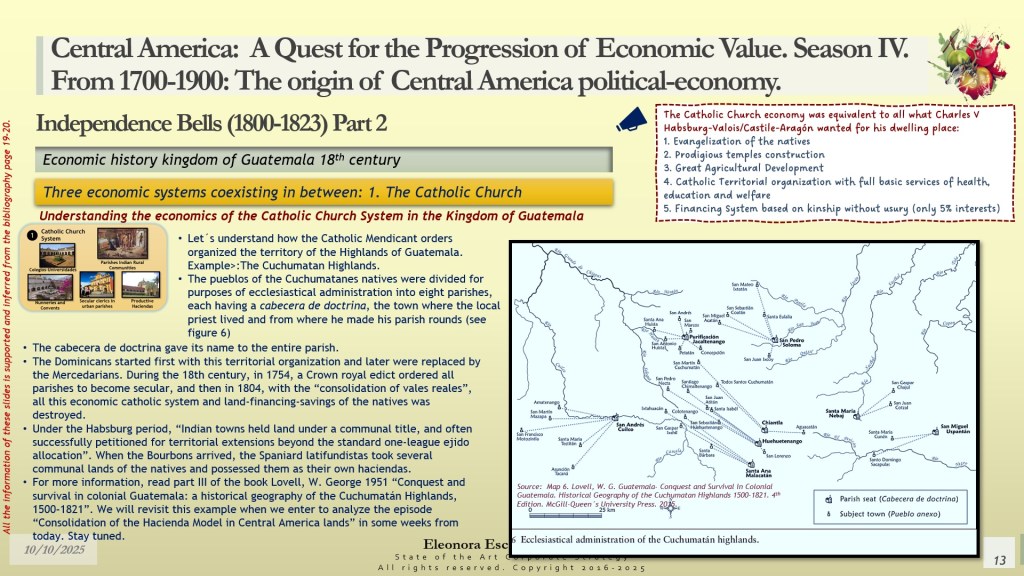
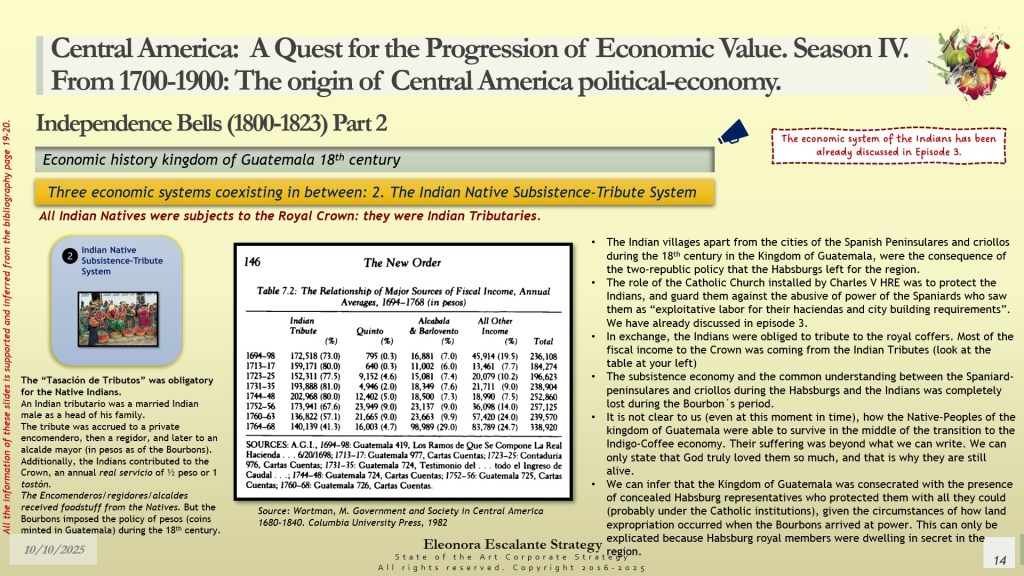
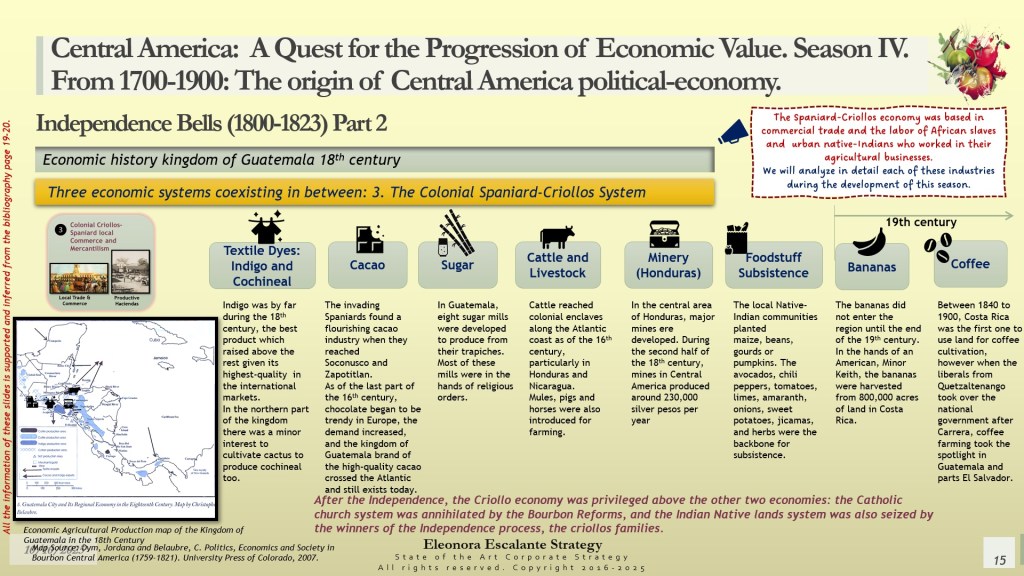
The Economic History of the Kingdom of Guatemala during the 18th Century. Slides 5 to 15. Episode 4. Our strategy house has identified three economic systems in the Kingdom of Guatemala. They were separate in between (even physically), only integrated through limited lines of commercial interests and rituals through the Catholic Church. The main economic system was the Catholic Church organization, the second one was the Indian-Native subsistence tribute system, and the third one was the Colonial Criollos society. Last week, we accomplished a detailed description of each of these three systems, and we consider these 10 slides of top importance, with tons of details, and self-explanatory examples. Please read this new material and our strategic reflections written in slides 5 to 15-Ep. 4. Each slide has gathered the essence of the best of our professors of history who have authored the books that I have added to the bibliography of Episode 4. The real reason for the economic collapse of the Kingdom of Guatemala before September 1821 was the destruction of the Catholic Church Economy by the Bourbon Reforms. The Catholic Church was the backbone of the Kingdom of Guatemala’s society.
Independence Proclamation of 1821. Slides 16 to 18-Episode 4.
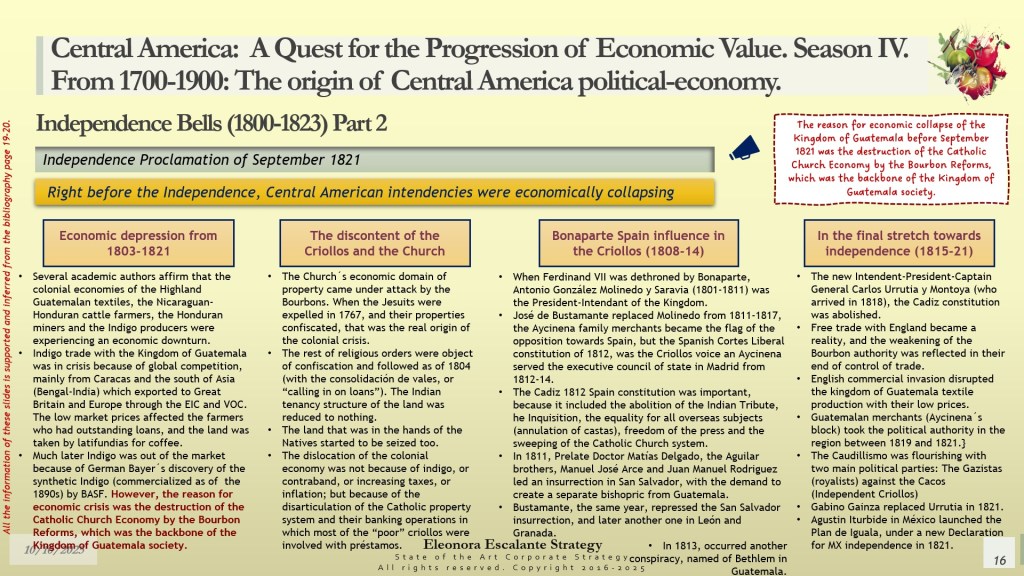
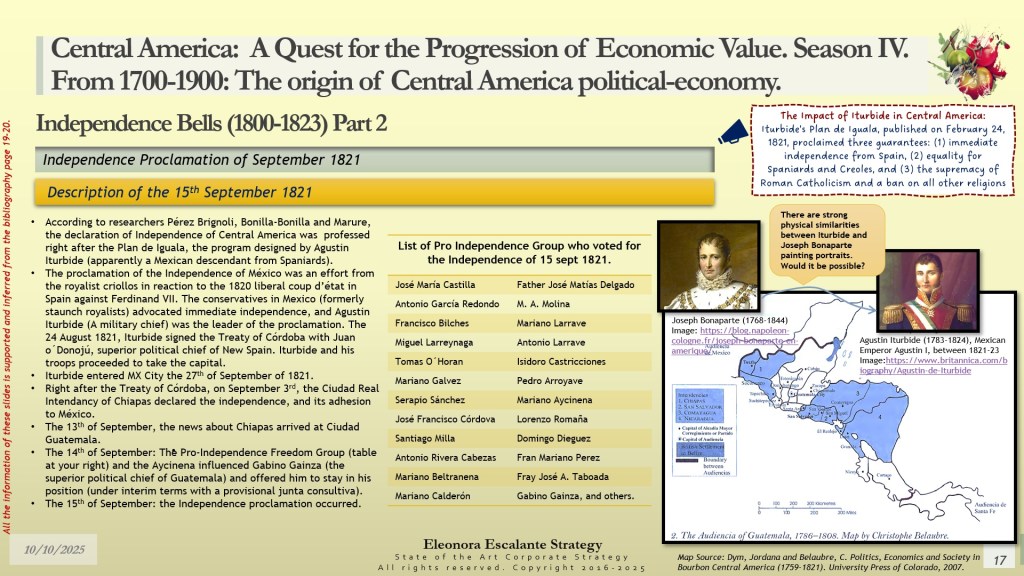
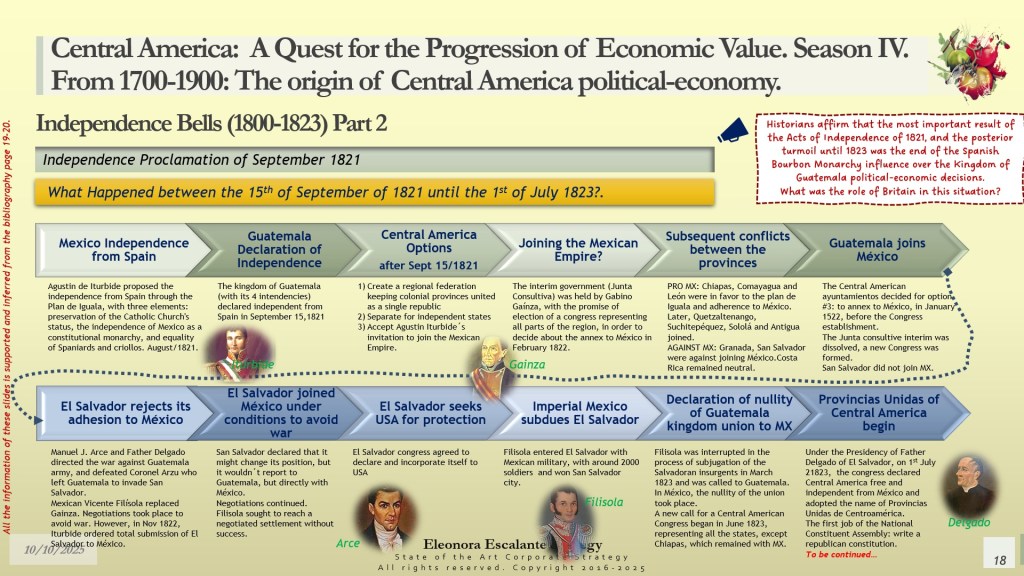
Slide 16-Ep.4. offers a summary of the most relevant logs of the period between 1800 to 1821. The Kingdom of Guatemala was trying to find a door entrance to the mercantilist system that was rolled out between Britain and America before the American Revolution and the Seven Years’ War. The Criollos’ economy was in need to find a star product that could help them to prosper. Indigo cultivation was promising a fantastic future. However, Britain blocked the door. The indigo was also planted in India (Bengal) and Caracas, and the international low prices made the Central American textile dyes totally irrelevant, simply a prosperity dream that was never true. In addition to the economic contradictions of the region, the fear of anarchy that could steal the Catholic structure of the Central American Society was so ingrained in the caudillos of the 4 main intendencies (Chiapas, Comayagua, León-Nicaragua, and San Salvador) that they refused to change under the Bourbons. The Bonapartes blocked the Bourbons in Spain, while in Central America, the Criollos decided to follow Iturbide after the Plan of Iguala, because they had no other choice. Slide 17-Ep. 4 explains the process of the Independence, who were involved directly, and how the pro-independence group voted for the separation from Spain. Historian Lindo Fuentes (Fordham University) has authored a book in which he explains why El Salvador deserves to be called the troublemaker of Central America (2). Despite that, Lindo´s work is focused on the 20th century; El Salvador was an “alborotador” since the Independence epoch. See slide 18-Ep.4. We can observe the remarkable protagonism of the Salvadoran elite social class by their decision not to join Iturbide´s empire, declaring war against the army of Guatemala, and on top of that, how El Salvador requested help from the United States of America to contain the situation. Nothing of that happened as a mere fortuity. El Salvador had people who knew in advance that Iturbide was not going to prevail. Lastly, the United Provinces of Central America project, under Father José Matías Delgado, was going to take place as of 1824.
To be continued…
Announcement.
Episode 4 is a duty journey. It mainly provides an explanation of how the Catholic Church was responsible for organizing colonial life in Central America, with ample details. The Church ruled and maintained the social, cultural, economic, and political interactions between two worlds: the pueblos indios (where the mendicant orders first evangelized, controlled native labor, and later developed monarchical institutions tied to religious Christian values), and the Criollos villages or new cities. Both groups of peoples had different backgrounds and economic interests. The Catholic economic structure was the backbone of Central America, previous to the Bourbon Reforms. We have also covered the Independence situation between 1821 to 1823. We believe that this research will be useful for further episodes, particularly once we finish the analysis of our next episode, the United Provinces of Central America. See you again next week. Thank you for reading to us.
Musical Section.
During season IV of “Central America: A Quest for the Progression of Economic Value,” we will continue displaying prominent virtuosos who play the guitar beautifully. However, we will select younger interpreters who promise to become the new cohort of classical guitarists in the future. For episode 4, we have chosen the Brazilian Plinio Fernandes. Plinio´s has been able to attract DECCA-Gold studios to record his album Sausade; and VEVO, the internet streaming video of Universal Music Group, Sony Music Entertainment, and Warner Music Group. Two other albums have been released: Bacheando and Cinema. For more information about him and his musical endeavors, visit https://www.pliniofernandesmusic.com/. Enjoy!
Thank you for reading http://www.eleonoraescalantestrategy.com. It is a privilege to learn. Blessings.

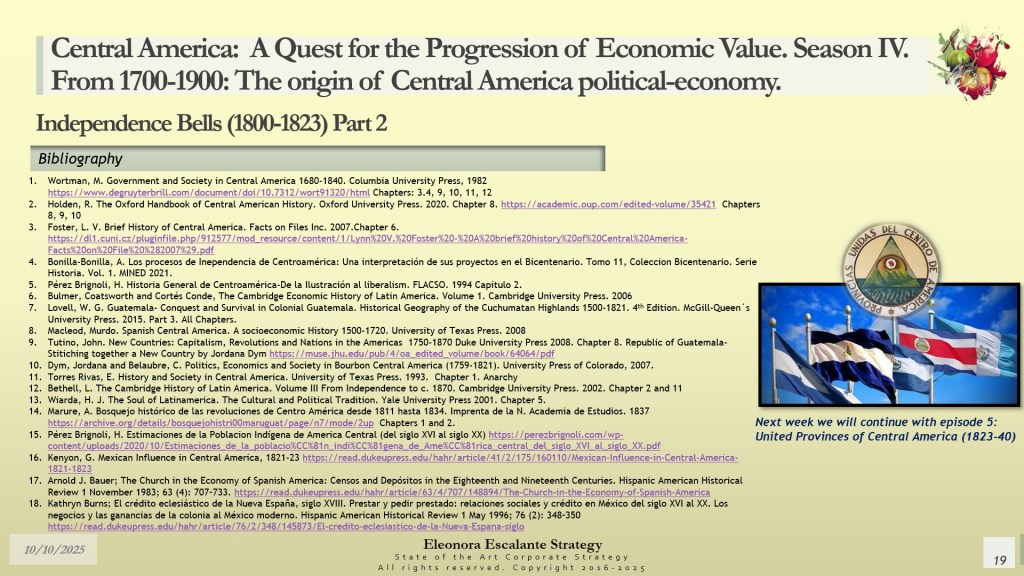
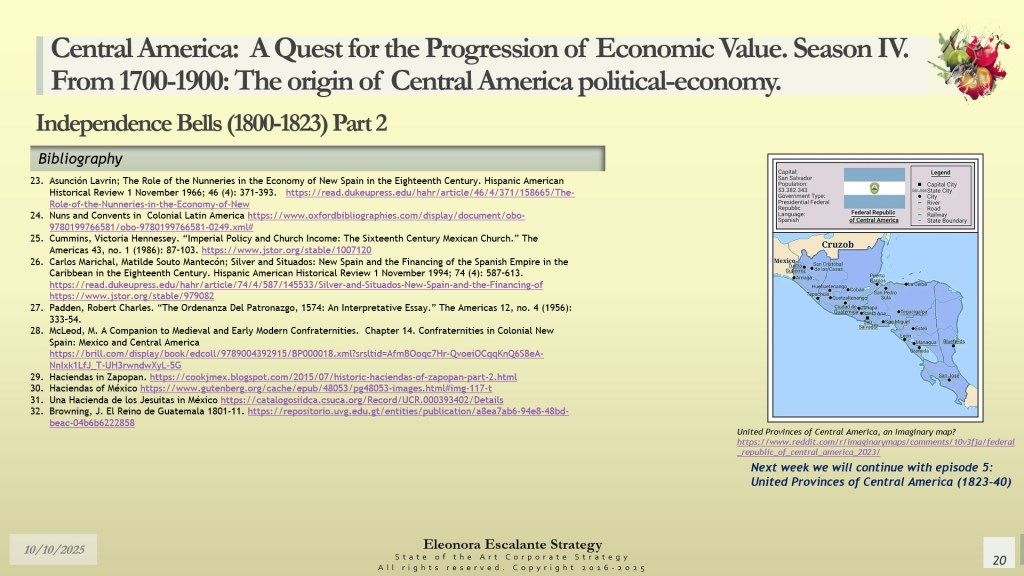
Sources of reference and Bibliography utilized today. All are listed in the slide document. Additional material will be added when we upload the strategic reflections.
(1) McLeod, M. Spanish Central America: A socioeconomic History 1520-1720. University of Texas Press. 2007. https://utpress.utexas.edu/9780292717619/
(2) Lindo F. H. El Alborotador de Centroamerica. UCA Editores. 2019. https://ebooks.libreriauca.com/library/publication/el-alborotador-de-centroamerica-el-salvador-frente-al-imperio
Disclaimer: Eleonora Escalante paints Illustrations in Watercolor. Other types of illustrations or videos (which are not mine) are used for educational purposes ONLY. All are used as Illustrative and non-commercial images. Utilized only informatively for the public good. Nevertheless, most of this blog’s pictures, images, and videos are not mine. Unless otherwise stated, I do not own any lovely photos or images.
 Eleonora Escalante Strategy Strategic Reflections Think Tank