
Central America: A Quest for the Progression of Economic Value. Season IV. Episode 6. A voyage to the Republics Separation (1840-70)
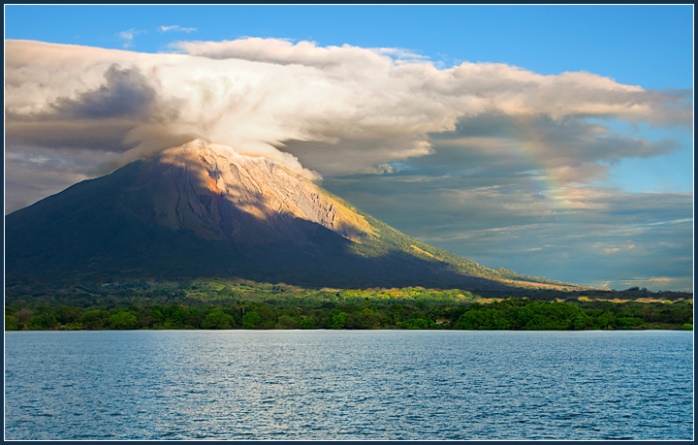
Dear adorable readers, I wish you a lovely month of October. Sadly, here, we do not experience the marvelous autumn leaf colors of North America, but this month, our nocturnal rainy storms are a blessing for our green ecosystems. Our beloved region holds amazing areas of natural reserves that must be consciously cared for by all the generations ahead. Today, this chapter is dedicated to the conservation of the natural reserves of Nicaragua. So, let´s continue our voyage to what ocurred in Central America between 1840 to 1870.
Our masterclass agenda:
1. Conservatives vs. Liberals in the context of 19th-century Central America.
2. The 19th-century British Central America
3. The Carrera and Morazán warfare
4. The Process of Nation Building 1840-70
Find our frame of study for your strategic reflections production below. As usual, we encourage our students to read the slides by printing them first. Write notes, ask yourself questions, and look for additional information related to our bibliography. Feel free to discuss with your family, friends, professors, and colleagues. Print the PDF version and keep it in your binder; you never know how useful it will be for your continuous cultivation, discernment, and professional endeavors.




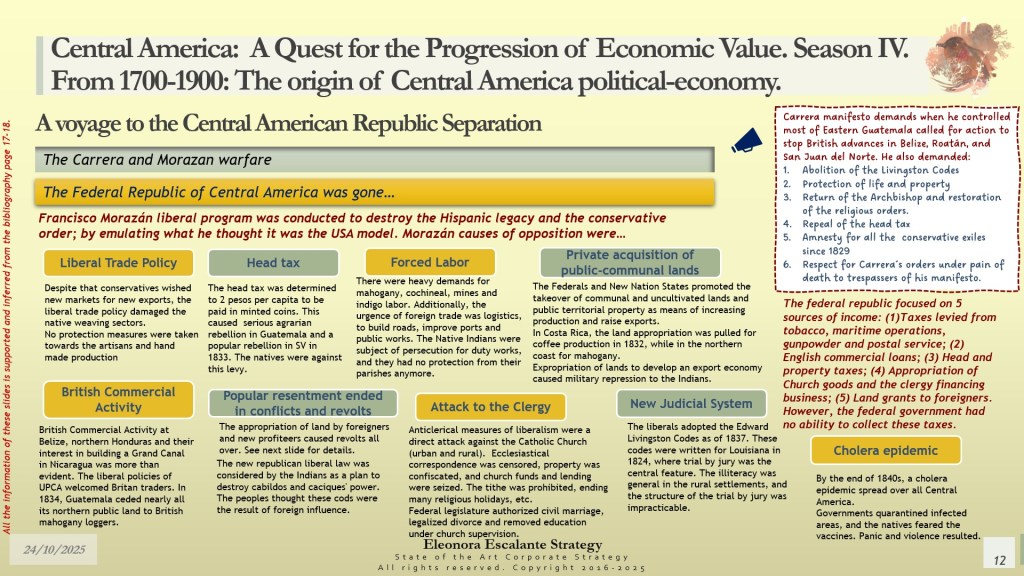


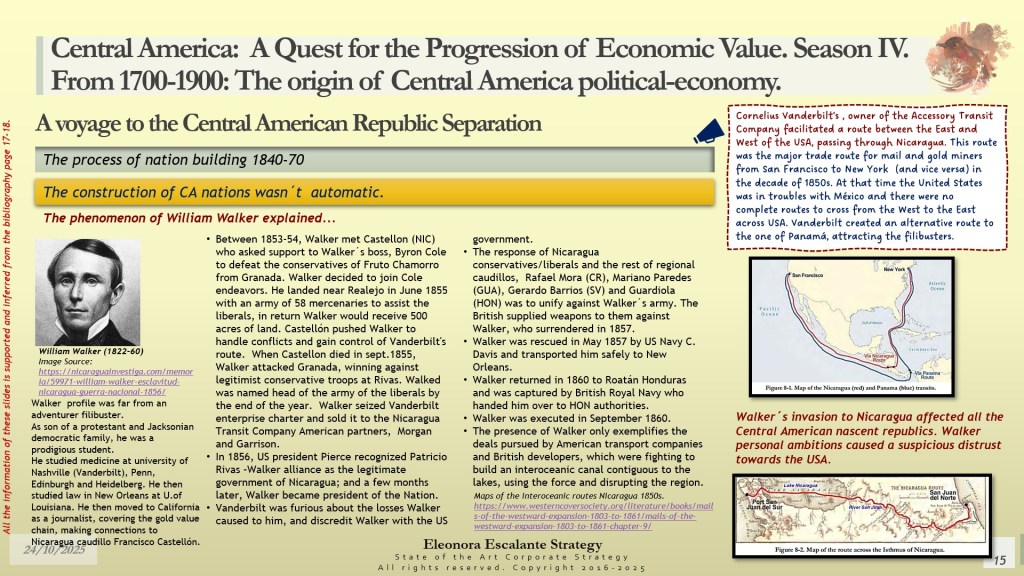


We request that you return next Monday, October 27th, to read our additional strategic reflections on this chapter.
We encourage our readers and students to familiarize themselves with our Friday master class by reviewing the slides over the weekend. We expect you to create ideas that might be strategic reflections or not. Every Monday, we upload our strategic inferences below. These will appear in the next paragraph. Only then will you be able to compare your own reflections with our introspection.
Additional strategic reflections on this episode. These will appear below on Monday, October 27th, 2025.
Conservatives vs. Liberals in the context of the 19th Century of Central America. Slide 5.
This is a crucial slide. We have prepared it with the help of historians listed in our bibliography. If you read it with careful attention, it looks as if this slide of the 19th century still describes what is happening with our modus operandi with businesses. At that time, the extraction of raw precious materials was the role of Spanish America for 300 years as of Charles V, HRE. To change the mental chip of the Criollos (liberals or conservatives) about their possible empowerment to produce and manufacture beyond raw materials extraction has not been developed yet. Since 1524, our nations have been assigned a role in the planet: to deliver and export agricultural or mineral (mining) raw inputs for other nations or multinational corporations. And that´s it. Point. Liberals and Conservatives of the 19th century had no idea how to build a solid manufacturing production beyond raw materials, and if they knew, their impact on the international markets was minimal. For them, progress meant a continuation of what they did with Spain (exporting mineral or agricultural products), while building urban cities, bridges, roads, and railways, and copying and pasting the architecture trend of the moment (French, Spanish, or German). Nowadays, with the Artificial Intelligence Era, the idea of economic progress has imposed a direction of moving from real to virtual, and the eternal conflict between constitutional traditionalists and democratic liberals has been relocated to the technological theater. It is the same thing with a different chapeau. Two World Wars, a United Nations peace global presence, and a technological roller coaster of inventions have not been enough to help us think correctly. What separates us from the conflict between Conservative-royalists and Federal liberals in Central America to our days is a period of 175 years. However, the idea of progress embedded in that ideological problem is the same old song. No matter the geographic location of the meaning of economic development, it is the same scenario, under different circumstances. At the time of the Central American Caudillos of Carrera vs Morazan, everything was about mahogany, indigo, mines, cochineal, an interoceanic channel, and, later, coffee and bananas. Today, it is about using social media to resell products made in China, while all the big nations are trying to extract whatever is left of minerals in Latin America. If you don´t know it yet, Nicaragua´s regime has granted more than 500,000 hectares of mining concessions to Chinese companies during the last two years. Additionally, the current Nicaraguan Government continues to push for a new route of the Interoceanic Channel (1). History repeats itself again and again. If the corporate and government leaders are not aware of the real motives (purpose) of their products and services or projects, any of them might end up serving a political agenda that can seize territories (as William Walker did, but now using MNCs); or hurt the brainiac power of the whole planet (with the AI technologies). Respectively, both situations are happening right now with the reopening of the interoceanic Nicaraguan channel case, or the ubiquity rollout of AI disruptive technologies. This is why all of us are obliged to learn about the details of history and its application to the corporate and business strategy of our times. The conflict between conservatives vs liberals is still outstanding in every single major disruption of projects, products, and services.
British Central America of the 19th Century. Slides 6-9.
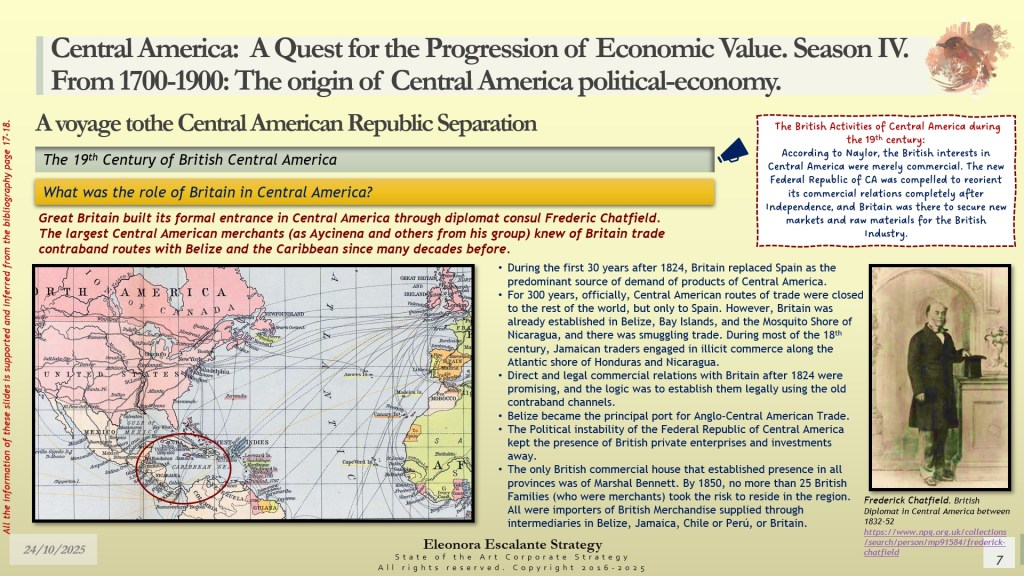
While the United States of America was in full conquest and colonization of all the regions to the West of the Mississippi and Illinois, surely Central America was building its national identity. Separate (by convenience, after the disaster of federalism) or together (when acting against William Walker), the caudillos and the intertwined criollo high-end families were molding their new national identity, trying to understand what to do with their new conservatism, and how convenient it was to keep that flag in a liberal world, while at the same time, they were accepting certain features of liberalism and fighting against anything that was the opposite. The same process of definition occurred with the federalist liberals, who understood economic progress as a one-card development for the former kingdom of Guatemala. Our hypothesis, as we have explained in previous chapters, is that the separation of the region into 5 nations (Guatemala, Honduras, El Salvador, Nicaragua, and Costa Rica) was natural. The aura of working together was kept through family ties; despite that, on paper and juridically, they were 5 different territories. In this context, the role of the traders of Britain was commercial and diplomatic, but at the same time, it was considered a threat to the new sovereignty of the region.
Within the exercise of adding and subtracting benefits and costs, the budget for keeping a Federal Republic of Central America was unaffordable. Each province was defining itself against other commercial external endeavors (Cornelius Vanderbilt, Marshall Benett, Skinner, Klee, the British banks, Walker, etc.): In short, to Britain, it didn´t matter if Aycinena was conservative or not, or if the Salvadoran Indigo elite was liberal or not. The influence of Britain traders, by trying to obtain benefits, was in the hands of former smugglers. The British government (through Consul Chatfield) was not to support former contrabandists, but to help the Central Americans to find a “convenient” path for the future; meanwhile, the British traders were doing their own. Somehow, the British consul Chatfield and the American special agents (as George Washington Mongomery or John Lloyd Stephens) were not considered as trustful for the cause of the Central American leaders. My grand question is: why did the William Walker phenomenon ocurred while Britain was fixing Central American chaos? The occasion to take over Nicaragua in the context of the Walker phenomenon was the perfect roadmap to seize Central America for Britain. But they did not do it. Just look at it so simply: William Walker disrupted Nicaragua in less than two years with an army of a few American men (of which maybe 20% were mercenaries), the rest were fortune seekers with no military training. Do you think that Britain wouldn´t do the same, having all the power of the Navy and international resources from Queen Victoria? Why did Britain leave Central America to find out what to do by itself, with the supervision of their diplomatic influence located in the region? It is up to all of us to judge. If Britain had had in mind to take over Central America from the Criollos, with all the British power of that epoch, this would have been done easily. But it did not happen. On the contrary, it looks like the presence of “tacit” diplomats in Central America was particularly simulated to help the leaders of the nations to find their own definition as a big kingdom of Guatemala (as they were before 1821) or separate themselves to be manageable enough within each group of main elite families within each potential nation. According to Taracena Arriola (2), from 1823 to 1870, the foreign travelers (diplomats, businessmen, merchants) came to the region in three cycles: “the first, from 1823 to 1838, during the federal administration, attracted consular agents, merchants, and foreign adventurers, especially former soldiers from the Napoleonic Wars; the second, from 1839 to 1850, brought publicists, canal and timber entrepreneurs, and promoters of diverse kinds of colonization; and the third, which ran from 1851 to 1870, saw the arrival of naturalists, archeologists, entrepreneurs, and diplomats”. All of them contributed to the integration of the short-lived Federal Republic of Central America and the division into five nations into the world market and the concert of Western nations.
The Carrera-Morazan Warfare. Slides 10-13.
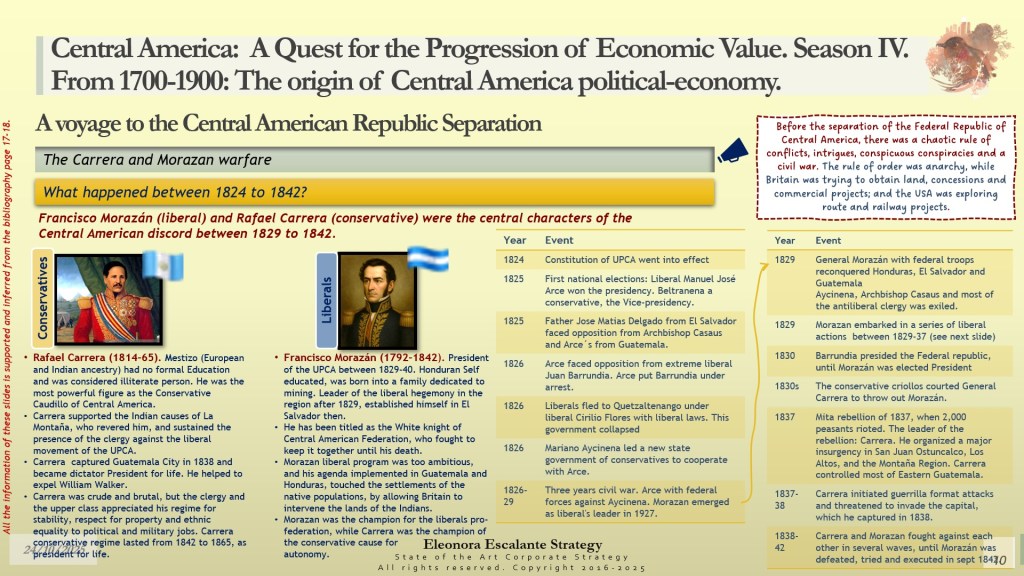
This material is complementary to Episode 5. We have added information about the main historiography, the profiles of the liberal Francisco Morazán (Honduras) and the conservative Rafael Carrera (Guatemala). Researcher Arturo Taracena Arriola has helped us to provide essential chronological information about the local, state, and federal conflicts between 1824 to 1840. The strategic reflections are part of each slide, and we consider this part self-explanatory.
What is the relation between the California Gold Rush and Vanderbilt’s first intent of a Nicaragua interoceanic channel in Central America? Answer: New Helvetia. Slide 15.
We have all been interconnected. Not one inch of the development of Habsburg Central America was far from what was occurring in the USA and Britain. After the Independence from Spain, the México caudillo government was not qualified to keep its land domains under its new tricolor red-white and green flag. California was in the hands of a weakened territorial organization, receiving migrants from the Eastern side of America or Europeans. One of these wanderers was Johann August Sutter (1803-1880), a German-born Swiss hacendado, who arrived in San Francisco in 1839 and negotiated a grant of 48,000 acres at the junction of the Sacramento and American Rivers, where he established his rancho grande “New Helvetia”. His dwelling and the presence of the Mormons who fought the war against México, uncovered Gold in the rivers around his property; and from there, his Sutter-Ville was transformed into Sacramento city. In less than 10 years, gold mining became the industry of the moment. The population of the area tripled, not just because of the gold fever miner activities, but there was a need for labor in the cattle, wheat, wool, and citrus ranching. California was isolated from the rest of the USA because the railway and roads from the west to the east did not exist then. There was a huge danger in using the rural terrestrial ways. In the 1860s, the work on the Central Pacific line began, and the entrance of the Chinese workers gained relevance in the East. An interesting fact: the first railroads linking America´s vast territories were built with a Chinese workforce. In the meantime, between 1848 to the end of 1870, there was a need to use Central America to transport people, mail, American miners, fortune seekers, and gold.
The Vanderbilt Transportation System situation.
The California passenger business began with official US Navy steamships via Panama in 1847, and Cornelius Vanderbilt (1794-1877) took the opportunity. His family, Vanderbilt, was of Dutch descent, with ancestors from the town of De Bilt in the Netherlands who came to New Amsterdam in 1650. Vanderbilt inherited the business of his father, and he became a veteran in steamship and railroad transportation. From his first relevant business, linking a ferry service in Staten Island, New York, he dominated the whole NY region with steamboat ships. The Government of Nicaragua awarded Vanderbilt the American Atlantic and Pacific Ship Canal Company, an exclusive concession to construct a canal between Port San Juan del Sur, crossing the Lake of Nicaragua, then through the river San Juan, to arrive at San Juan Del Norte (Greytown for Britain). Additionally, with the presence of Vanderbilt in Nicaragua, Britain’s next move was to occupy the San Juan del Norte town on the Atlantic side (part of the Miskito Coast king’s domain). Vanderbilt built the Nicaragua Route in less than 2 years, introducing the steamers and the 12-mile road route, which allowed its transit in no more than two days. By July 1851, Vanderbilt’s operation began between New York and California, but his efforts were blocked by William Walker in 1855.
William Walker was not a filibuster.
Walker was hired by the “liberal side” of Nicaragua´s caudillos to kick out conservatives from power. Additionally, he was hired with the purpose of blocking Vanderbilt´s business. And Walker did it. Walker knew what to do and how to do it, with such an outstanding, superb strategy, which can´t be trashed out lightly. Walker was a Southern American, descendant of Irish migrants. He has been characterized as a champion of Manifest Destiny; others have seen him as an imperialist from Tennessee who dreamt of standing as a new king, while most historians catalog him as a filibuster. T.J. Stiles, a Pulitzer Prize author, goes a bit further, categorizing Walker as the most dangerous international criminal of the 19th century (3). For the Central American caudillos, he was hired to block Vanderbilt. And he did it on his own terms. Whatever the tag, Walker´s fate in Central America was initiated in the Gold Rush of California. According to Stiles, the enthusiasm for expanding American geographical growth came to be known by the newspapers´ slogan as “manifest destiny.” The expansionism of America was not different from what the Spanish Conquistadores did 350 years before. The phenomenon of launching freelance invasions to new lands, to annex them to the USA, was relevant, even for William Walker. Walker’s interest in Nicaragua was not to help the Nicaraguan Liberals of León against the Granada Conservatives. On the contrary, his goal in the Isthmus was merely commercial, pursuing the business of Commodore Vanderbilt, who carried thousands of passengers each year with his route between California to New York, passing through Nicaragua. With the entrance of Walker and his strategy to seize the Vanderbilt business, the demand for the service fell, moving it all to Panama. See the volume transit of people below:
| Number of Passengers Carried via Panama vs via Nicaragua | ||
| Year | Panama | Nicaragua |
| 1851 | 29,653 | 5,102 |
| 1852 | 33,108 | 16,484 |
| 1853 | 27,246 | 20,083 |
| 1854 | 29,253 | 22,311 |
| 1855 | 25,809 | 18,987 |
| 1856 | 30,335 | 8,053 |
Walker’s role was not to create English-speaking colonies under his new kingdom in Nicaragua. His influence in Nicaragua shaped a unique defensive front of conservative, native indigenous, and liberal forces united all together (as a strong and robust Central American alliance) against him, and against Vanderbilt. In truth, Walker’s presence in Nicaragua, at the end of this story, saved the Lake of Nicaragua and the natural virgin reserve ecosystems, which would have been damaged if Vanderbilt had continued doing business between Greytown and San Juan del Sur. At the end, according to official history, Walker was executed, and he was then forgotten by Americans, because in 1861, the four-year American Civil War began. The route of Panamá took the important spotlight when Vanderbilt signed a new steamboat route mail contract there. Nicaragua´s lake was miraculously conserved intact because of Walker. Finally, the nationalistic sentiment of unity between Central American leaders against the filibuster Walker got its route for a better common good, despite the destruction of Granada, and all the 12,000 innocent lives killed during Walker´s mandate in the region.
To be continued…
Closing words. Announcement.
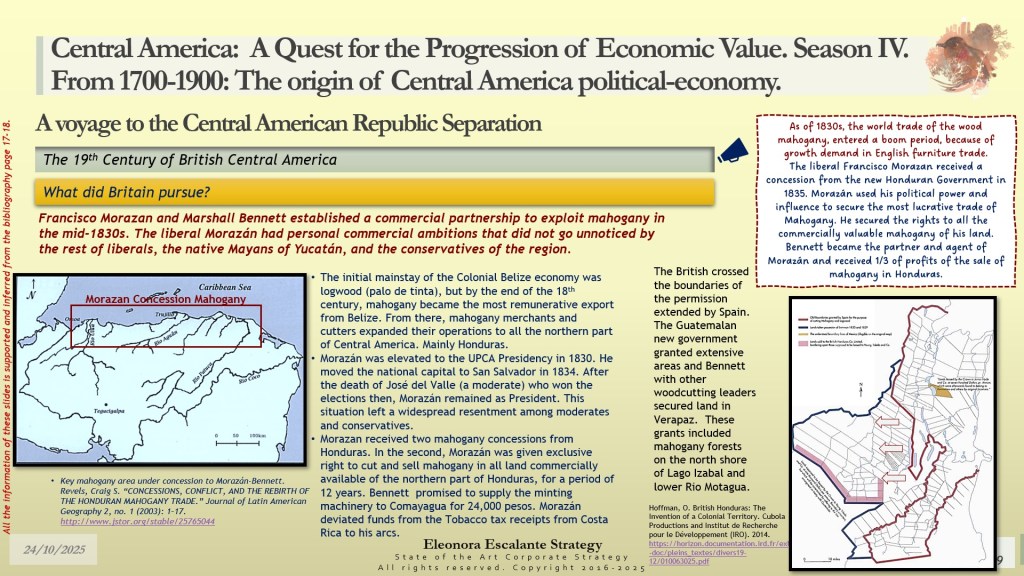
Before Independence, Britain was never far from the Kingdom of Guatemala. The fact that Catherine Aragon was the wife of Henry VIII Tudor linked Britain with Spanish America forever. Two Spanish sisters, Catherine, queen of England and elder sister of Johanna, queen of Spain-Burgundy, and mother of Charles V HRE, locked the fate (for better or for worse) of these two nations forever. During the 19th century, Britain’s presence in the Spanish Habsburg Guatemalan dwelling place was represented by the commercial interests of the logwood trade and the woodcutters of Mahogany in Honduras and Belize. The sight of the United States of America (British, German, and a few Dutch colonists), represented by Cornelius Vanderbilt (a transport tycoon) and William Walker of Tennessee, helps us to notice how the trading systems were dynamically disrupted and adjusted to the corollaries of political conflicts between liberals and conservatives. The Federal Republic of Central America didn´t proceed further, but the nations kept a tacit sense of family unity that has lasted to our days.
Our next chapter is about the dichotomy between urban and rural Central America. See you next Friday.
Musical Section.
During Season IV of “Central America: A Quest for the Progression of Economic Value,” we will continue to display prominent virtuosos who play the guitar beautifully. However, we will select younger interpreters who promise to become the new cohort of classical guitarists in the future. For episode 6, we have chosen Andrew York. This adorable piece came to us this week. We selected him because I couldn´t include him in Season III. But he deserves to be with us on this journey. Additionally, he is a professor of young guitarists in the process of formation. If you wish to learn about his life as a composer and his adoration for the guitar, we invite you to visit his bio here: https://www.andrewyork.net/Press/Bio.html. Enjoy!
Thank you for reading http://www.eleonoraescalantestrategy.com. It is a privilege to learn. Blessings.

Sources of reference and Bibliography utilized today. All are listed in the slide document. Additional material will be added when we upload the strategic reflections.
(1) https://www.intellinews.com/nicaragua-unveils-new-canal-route-in-bid-to-rival-panama-354300/
(2) Taracena Arriola, Arturo. “Nineteenth-Century Foreign Travelers to Central America.” Oxford Research Encyclopedia of Latin American History. 26 Mar. 2019 https://oxfordre.com/latinamericanhistory/display/10.1093/acrefore/9780199366439.001.0001/acrefore-9780199366439-e-609
Disclaimer: Eleonora Escalante paints Illustrations in Watercolor. Other types of illustrations or videos (which are not mine) are used for educational purposes ONLY. All are used as Illustrative and non-commercial images. Utilized only informatively for the public good. Nevertheless, most of this blog’s pictures, images, and videos are not mine. Unless otherwise stated, I do not own any lovely photos or images.
 Eleonora Escalante Strategy - Strategic Reflections Think Tank