
Central America: A Quest for the Progression of Economic Value.Season IV. Episode 7. Philosophical Foundations of Agricultural Liberalism 1870-1900
Adorable readers:
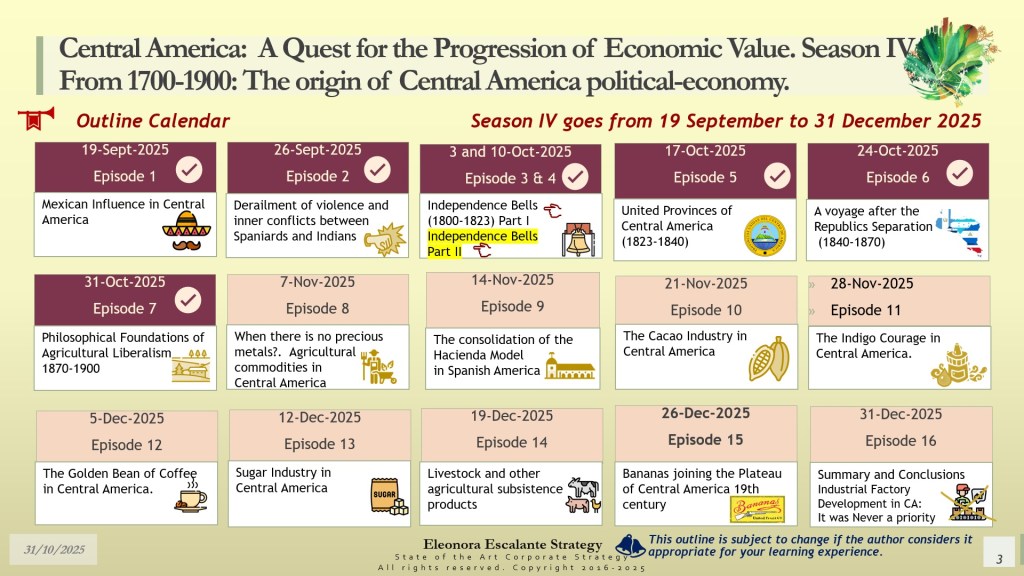
Our last day of October has docked, and with it, our episode 7 has been changed. In our quest to provide a complete picture of the philosophical mentality of the leaders of Central America, we have completed a lovely chapter: The Philosophical Foundations of Agricultural Liberalism during the last quarter of the 19th century. The paradox between urban and rural will be added in the episode about the consolidation of the hacienda model in Central America.
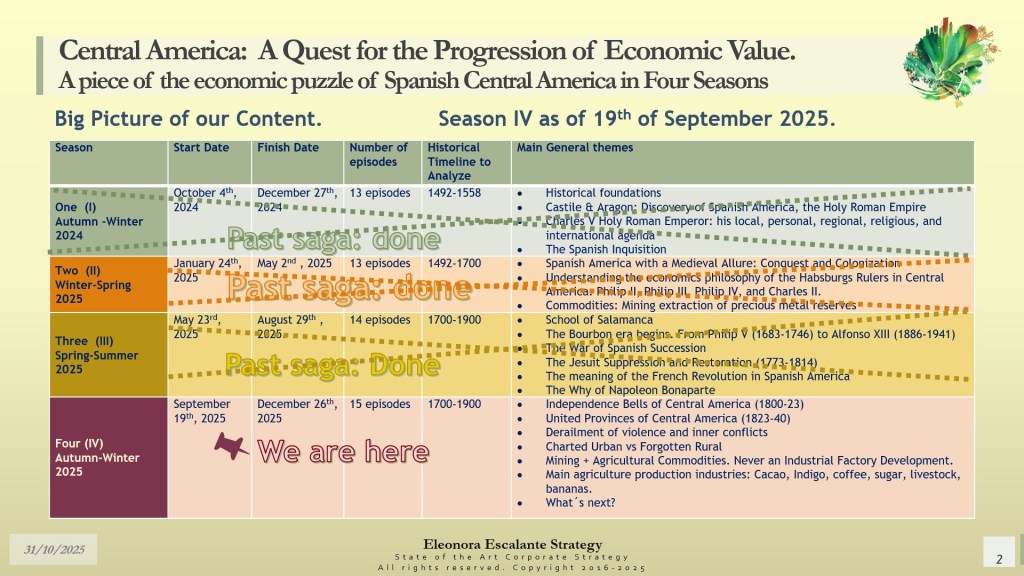
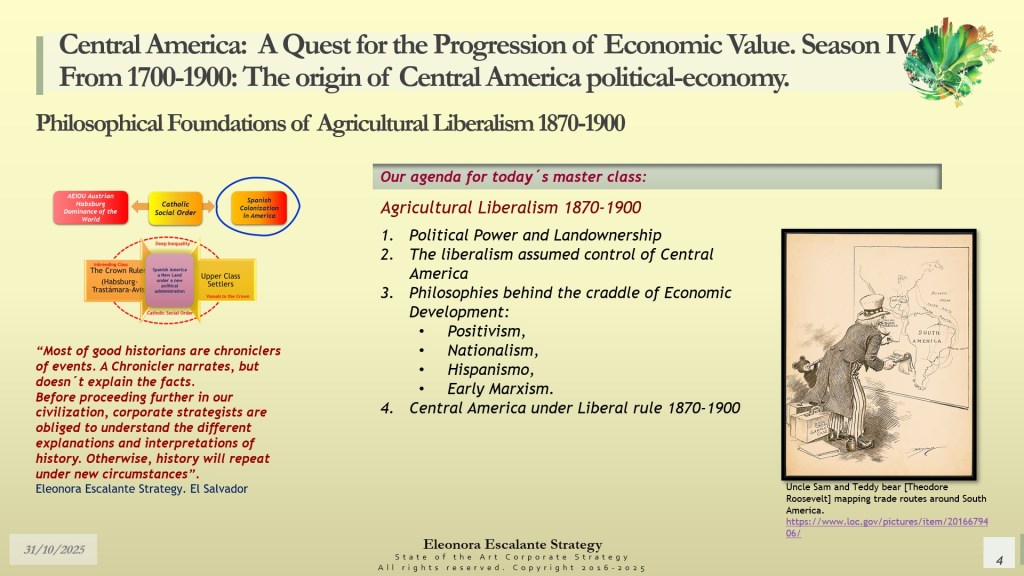
Our plan for today is concentrated on 4 subjects. Initially, we begin with a brush of general concepts related to interest groups, political power exercised by elites, political decisions, and the types of caudillos elected by several groups of landowners. Central America held 5 countries that decided to go alone, and by 1870, they were already conscious of their national identity. Second, we continue with the topic of liberalism understood as of 1870, which was a bit different than the federal liberals. Our third topic for today is about the 4 main philosophies behind the Central American Caudillos. Finally, we share the comparative descriptive situation of the liberal rulers in the region. The agenda below:
- Political Power and Landownership
- The liberalism assumed control of Central America
- Philosophies behind the cradle of Economic Development:
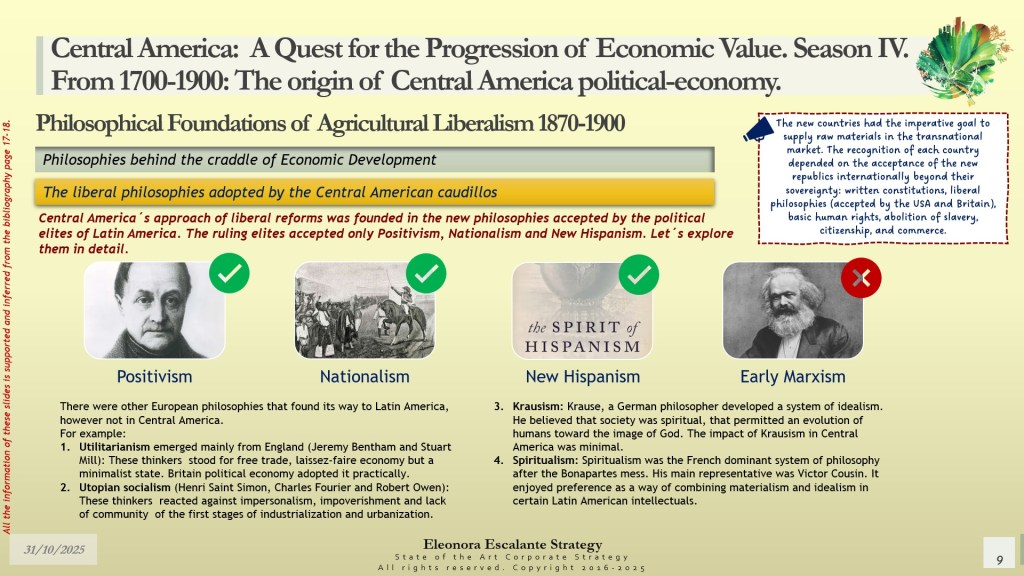
- Positivism,
- Nationalism,
- Hispanismo, and
- Early Marxism.
- Central America under Liberal rule, 1870-1900
We invite you to read during the weekend our frame of reference. This is an obligatory first step before each Monday´s further strategic reflections. This is the previous preparation for all of us to understand the analysis, breakdown, and introspection of this material. You must proceed to download and print the following set of slides. Write your questions and notes, and continue looking for additional information recommended in the bibliography. Feel free to share with your friends, colleagues, and family.



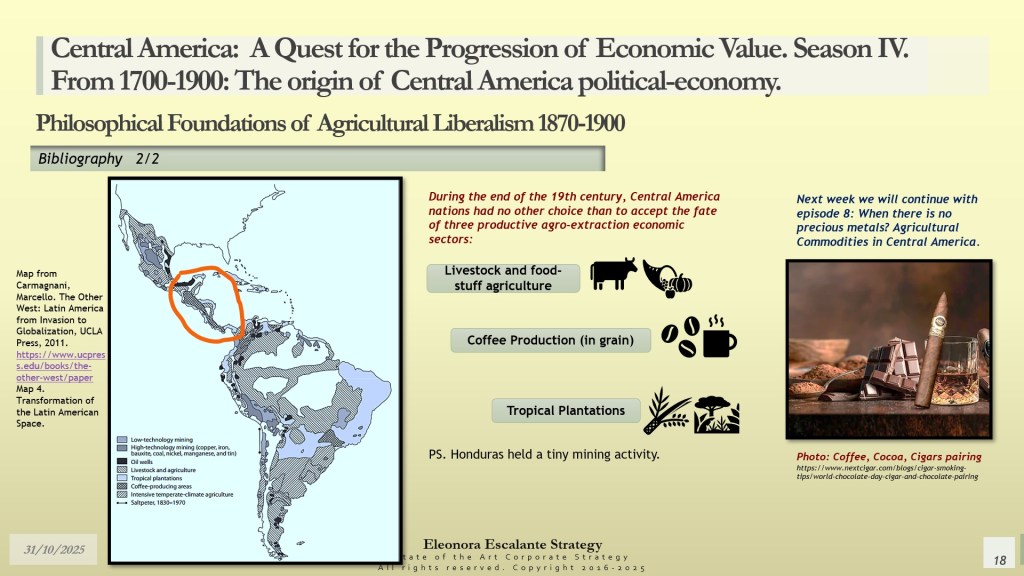
We request that you return next Monday, November 3rd, to read our additional strategic reflections on this chapter.
We encourage our readers to familiarize themselves with our Friday master class by reviewing the slides over the weekend. We expect you to create ideas that may or may not be strategic reflections. Every Monday, we upload our strategic inferences below. These will appear in the next paragraph. Only then will you be able to compare your own reflections with our introspection.
Additional strategic reflections on this episode. These will appear in the section below on Monday, November 3rd, 2025.
Philosophical Foundations of Agricultural Liberalism 1870-1900.
Today´s lesson is one of the most relevant that we could learn during this saga. Why? Simply because any economic system responds to a philosophical purpose. There is always an intention in any system of trade where the rules of the game serve as a strategy (monarchical or corporate). And if we are not aware of the philosophical aims of those who provide trade framework recipes, for selling and buying products, services, or projects, then we might end up supporting economic systems that are not correct for our human development. We come from a past tragedy that is still outstanding in the world: the slavery of human beings. Slavery’s most general definition is: The state of one bound in servitude as the property of a slaveholder or household (1). This definition effectively applies to slavery of yesterday, of today, and of tomorrow. But its format has metamorphosed in multiple presentations over time: vassalage in the feudal system, tribute servitude in the Native-Indians of America in times of the Spanish-British-French American colonies, debt-peonage in the transition from ejidos and communal lands to coffee farm-haciendas, urban serfdom when the people lost their own rural resource plot while migrating to rich urban centers, and nowadays we have evolved back to a mendicant society, by accepting and promoting the combo of NAIQI products-services and projects (Nanotech- Artificial Intelligence-Quantum processing-Internet). This current giga-economy or AI era has exceeded our human limits because it is triggering a massive society of digital beggars who tacitly belong to a new slaveholder technological system, which is another form of enslavement: technological-communications slavery. People are passing their knowledge for free to populations while asking for donations; meanwhile, the applications and data center collection entities provide nothing in return, but charge a commission or a fee for their use. The digital beggars do not own the platforms, but they lease them, and the new techno-feudalism applies, while there is not one percent of protection for your shared content. Beyond the technological slavery to our Smartphones and tablets, modern slavery exists in numerous societies, and it is defined as the condition of being forced by threats or violence to work for little or no pay, and of having no power to control what work you do or where you do it (1-1). To depend on generative AI to think or draw, or do intellectual activity, is also another form of modern slavery.
Our old behemothic economic development of 6,000 years was based on slavery, and all the last-mentioned forms of bondage have been lived. A system as that in any of its flavors can´t produce wealth or prosperity or progress for any society. It only offers a brutal platform for inequality. After the French Revolution (more or less), the middle class began to emerge. And that middle section began to prosper because of academic training, professional careers, and unique knowledge educational parameters that allowed them to obtain a better salary than an artisan or a farmworker.
Economic progress since 1789 has been measured in terms of the creation of wealth. And the household income is one of its crucial variables. The growth of household income has been slow, but it has materialized a little by little. There are plenty of examples of people living in every corner of the world who were able to leave extreme poverty and become middle-class or more during the 20th century. There are millions more stories where people have migrated to rich nations and have been able to leave poverty in a few years. Let´s refresh our knowledge about the ranges of lower and upper limits to classify the household earnings per year and their position in the global society stratification (Source: Eleonora Escalante Strategy Research analysis with data collected from the World Bank, United Nations, and independent thinktanks).
| Social Class (data worldwide average) All Data after taxes and social security retentions. | Income per person per day | Range Household Income per month (4 members of the household working) | Range Household Income per year (4 members of the household working) |
| High-Class | $120 pppd – ↑ | $14,400 – ↑ | $ 172,800 – ↑ |
| Middle-Class | $119.99 – $ 20 | $14,399 – $ 2,400 | $ 172,799 – $57,800 |
| Low-Class | $19.99 – $ 3 | $2,399 – $ 360 | $ 57,599 – $ 4,320 |
| Extreme-Poverty** | $2.99 – $0 | $359 – $0 | $ 4,319 – $ 0 |
| Note**: The international poverty line, which is used to measure extreme poverty in low-income economies, is set at $3.00 pppd (per person per day). For lower-middle-income economies, the extreme poverty line is currently set at $4.20 pppd (per person per day), and for upper-middle-income economies, it is $8.30 pppd. Source: https://www.worldbank.org/en/topic/measuringpoverty#1 (2) | |||
Now we have reflected on the importance of choosing the right economic system for the prosperity of society. Let´s think about what the purpose of choosing agricultural liberalism was between 1870 to 1900. Did the political-economy makers of Central America realize the impact of their option for a coffee-export economy? Or did they think simply of finding a new path to recover the land that Charles V HRE Habsburg Spanish Crown left in the hands of the Native-Indians? Did they choose this path as a replacement for the indigo-cochineal economy, without considering any consequences beyond? Or was coffee the trend of the moment, so internationally fashionable in the liberal world that it fitted as a blockage to any superpower liberal intervention like the one of William Walker?
Whatever the thought of the Central American decision makers of the last part of the 19th century, we are convinced that they were not considering the premise of reducing extreme poverty to none, or the premise of creating and expanding the middle-class range to the maximum possible by moving families from the lower class to the middle class. The prosperity defined by the main interest groups of Central America was not thought to eradicate poverty of the needy, but to protect their territory during the aftermath context of Colonial Spanish America. They honestly believed in a restructuring of the colonial inherited Spanish model, by following what was already working with the plantations of the USA and Britain, but without industrialization. They knew they had to stop Marxism because of its anarchical-violent disasters in Europe. That is how the coffee production era began. And it is also important to clarify that the Catholic charity model continued as a palliative or as a solidarity model for the poor. Now, let´s compare what was the philosophical foundation of the “agricultural liberalism” adopted by Central American Nations between 1870 to 1900.
Political Power and Landownership. Slide 5.
An economic system is not isolated from the state measures and regulations. The Government that rules a nation plays a crucial and institutional role. The definition of political economy, according to Harvard University (3), is “the study of how politics affects the economy and how the economy in turn shapes politics.” In consequence, Eleonora Escalante Strategy integral strategic analysis of Central American Economies between 1870 to 1900 can´t overlook the structure of political power and landownership. Slide 5 shows you how the relationships between the “top leader or caudillo” anointed as the President of each nation, and those landowners or merchants who supported him. Additionally, it shows how they arrived at power. The wealthy criollos landowners of that time were clear-cut about choosing someone else to represent their interests-group strategy. The delegation of power in a “caudillo” character occurred in this period. There could have been concealed Habsburgs all over Latin America who took the public relevant path and perished (or were executed) while playing the game with those unhindered broadcast positions. It was too dangerous to be an active political player to participate in legislation, governorship, ministerial positions, or a presidency. We suggest that most of the liberal presidents of Central America during this period of study were chosen by different types of landowners: contemptuous, armed, bargaining, aldermanic, or hybrid. Each nation had its own test-error strategy about what type of caudillo was better suitable for each of the landownership structures of each nation. Whatever the route, the bottom line of this slide shows us that it is a fallacy to believe that Central America held a plain or similar political elite under liberal terms. Each nation had its own.
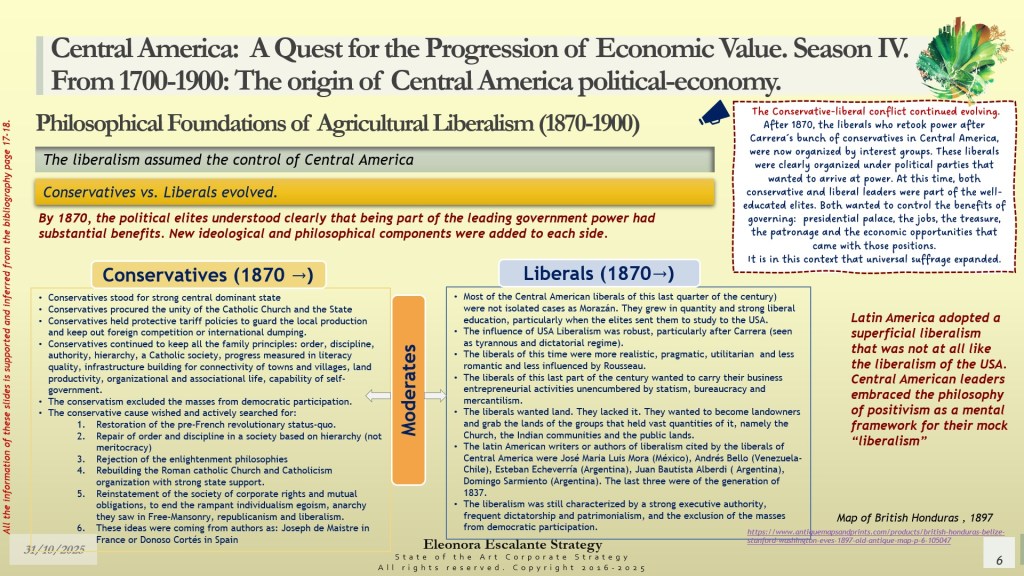
Conservatives vs. Liberals evolved. Slide 6.
Each political elite in each nation of Central America was different, but was traditionally-family intertwined. It is especially important to infer that in an international liberal context, even if all the wealthy families of the isthmus were genuinely conservative, they were obliged to choose the liberal path, regardless of their dislike. The United States of America was a liberal nation with a supra-hegemony. Britain-USA were interested in an interoceanic channel, and that was their priority in this region. The caudillos and wealthy interest groups (landowners, merchants, miners, incipient industrialists, foreign investors, the Church, and others) couldn´t show their royalist face in that context. They were exposed to becoming a colony of the superpowers, and they were defending this region with all they could. This is the time in which conservatives became liberals (under a fake make-up). Their sovereignty was in danger, and to defend it, that is how they ended up adopting a new philosophy: The nationalist-positivism.
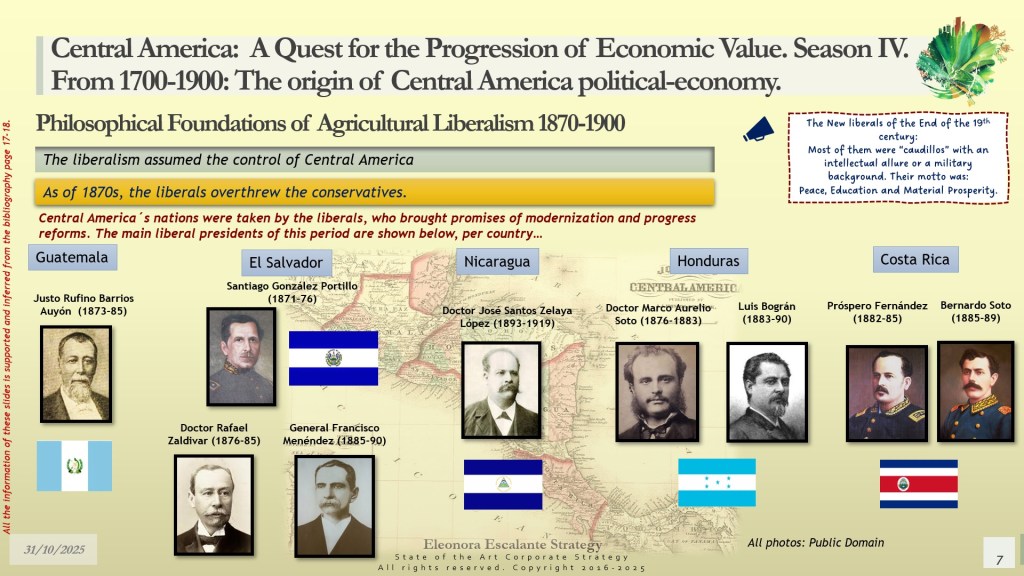
Liberalism assumed control of Central America. Slides 7 and 8.
Slide 7 shows us who was who leading what nation. We have shown you the main liberal presidents (caudillos) per country. Their slogan was “peace, education, and material prosperity.” Their agenda was to modernize, implement progressive liberal reforms, and restructure the landownership order by pursuing the pooling of the lands of the Church and the lands of the Indigenous groups (ejidos and communal lands).
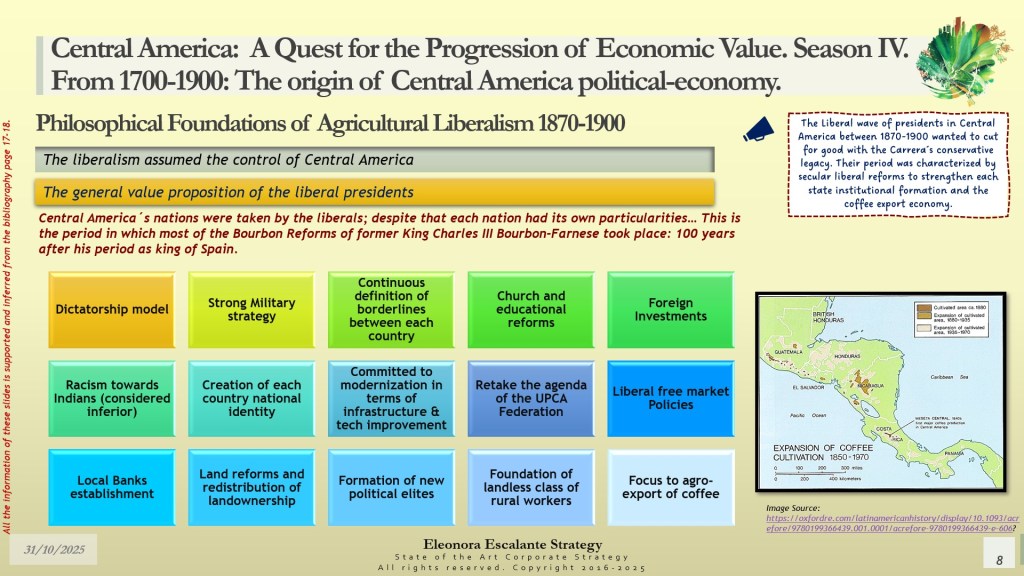
The agenda of all these presidents was interconnected. When President Justo Rufino Barrios joined the plateau of Guatemala, he also placed the rest of the Presidents. Some were coming from a military coup d´etat, others through negotiated elections, and others were rising from a national violent crisis. Whatever the method to arrive at power, all these presidents had in common the following goals (slide 8):
- Dictatorship model
- Strong and robust military strategy
- Continuous negotiations to define the borderlines between each country.
- Church land/entity expropriations and educational secular reforms
- Foreign investments coming from Germany, Spain, and other European newcomers who came to the region to marry the daughters of the elites.
- Racism toward Indian communities was omnipresent in the leading class.
- Nationalism. To be explained below.
- Modernization in terms of the construction of infrastructure and improvement through importing new processes and tools for doing things from Europe and North America.
- Federalism: the agenda of the United Provinces of Central America (UPCA) was retaken.
- Adoption of liberal free-market policies
- Establishment of the first private banks (under the coffee-culture landowners).
- Robust plan for land redistribution
- Formation of a new political class, more professional at the military and academic levels.
- Footing of the landless class of rural workers who migrated to urban centers, in their quest to earn income as helpers for the wealthiest. Additionally, this was the time in which the artisan atelier businesses also migrated to the cities.
- Focusing all the agro-export economic efforts on the new agricultural plantation of the future: Coffee. Coffee was the fashionable beverage of Europeans. And the climate conditions of the region allowed it to excel in quality in a world that did not have robust, dominant competition in that Agri-export product. The areas for best coffee production coincided with the regions where the Indian-Natives were refuged since 1524: the mountains, the high-sierras lands, and that is why the native-indigenous land was meaningful.
The liberal philosophies adopted by the Central American wealthy families and their caudillos. Slide 9-15. These slides are self-explanatory. It didn´t matter if the political-economy decision makers (defined as government authorities under wealthy landowners, merchants, and the high-end professional class) were genuinely liberals or covered conservative players recreating the role of the liberals. What really mattered was why the decision makers wanted to look like liberals if their philosophical premises were not aligned with liberalism. We will add some further advisory comments below.
- The main philosophies of thought that were roaming in the Central American decision makers were: Positivism, nationalism, the new hispanism, and early Marxism (in a minimal sphere). Additionally, there were other European philosophies around: utilitarianism, utopian socialism, kraussism, and spiritualism. See slide 9. Central American leaders (either commercial, political, or bureaucratic) were trying to find how to think in the middle of uncertainty, knowing of the consequences of the revolutionary mindset that killed a Bourbon king and her Habsburg wife in Paris, while in Spain, an alternating chaos was taking place.
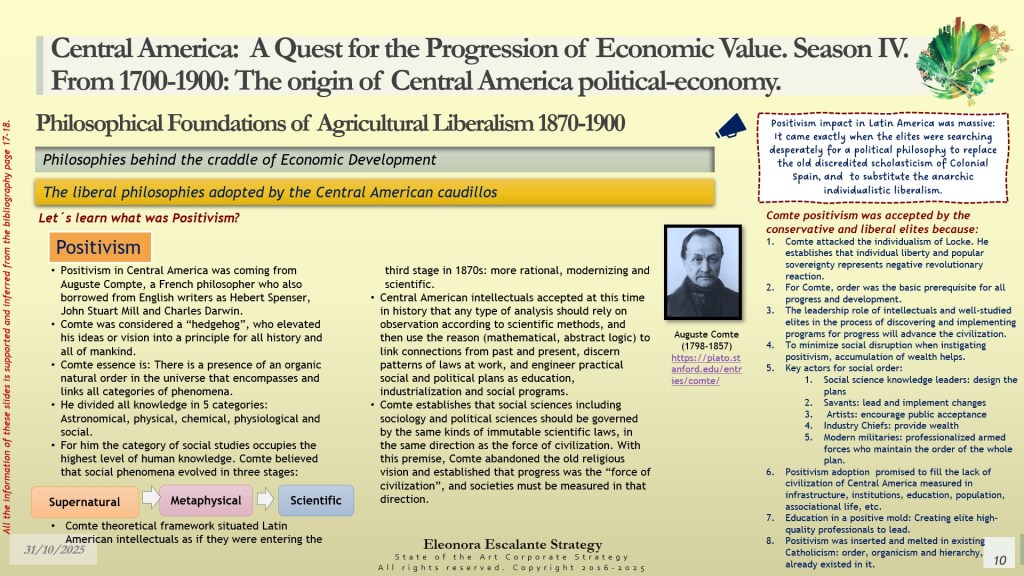
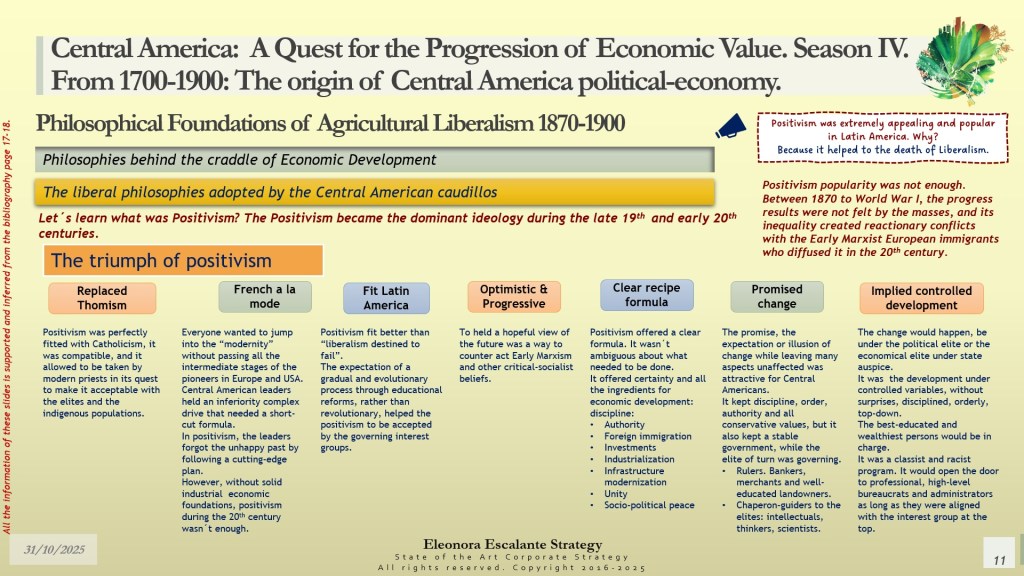
- Positivism (Slide 10): Auguste Comte (1798-1857). Positivism was enormously accepted and adopted by the ruling class. It was an under-covered summary version of the Enlightenment that did not name any of the Enlightened European thinkers. Comte (a French philosopher) was not only aligned with the priorities and troubles of the Central Americans who were building their nations, it also kept the unity of thought among them. Slide 11 shows each of the reasons why positivism triumphed in this region. And unbelievably, it was the positivism that helped to hinder and defeat the other USA liberal influence in the region. Incredible! It was a unique Central American liberalism under Comte’s sway.
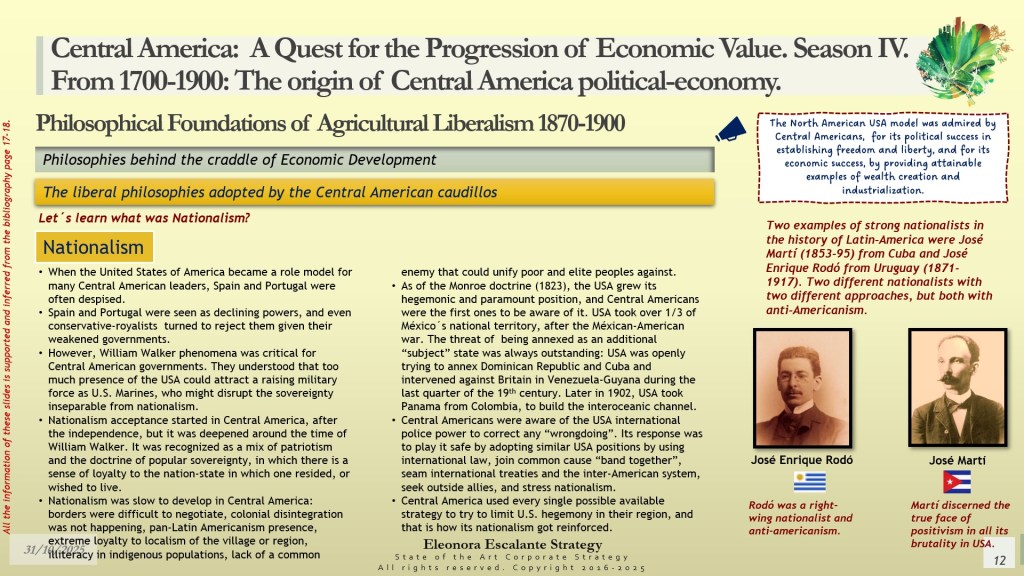
- Nationalism (Slide 12): The USA was growing, in industries, in migration of Germans, and it was also rewiring the economy. The USA became the new hegemonic and paramount superpower in the North, capable of seizing 1/3 of the size of Mexico and the Caribbean. The Habsburg former kingdom of Guatemala was not free of that risk. How to build a nationalistic sentiment in a voyage of 5 separated nations which dropped the federalism of Morazán and continued tumbling the federation plans of Rufino Barrios and his allies? By fear. The fear of becoming slave subjects of a new “North American Lord” was higher than the fear of Britain. And Britain was not planning to move ahead during the Yucatan Caste War that was taking place along the borderline and near Belize. The fear of becoming slaves again made the Habsburg Central America to keep the nations as a Mazinger Z robot: specifically designed to act separately and snap together beneath a head pilot that shuffles all the pieces together, under a distinctive, unique same leadership that was mutating and moving from Chiapas to Costa Rica.
- New Hispanismo (slide 13): The values of the new Hispanismo were discipline, order, authority, family, and Catholicism. These values were superior and untouchable in the mindset of the leaders of Central America. The cultural set-ups and traditions of “Mother Spain” continued, and these cultural beliefs and expressions of art, literature, catholic upbringing, religion, language, and cuisine were the reason why the new Hispanismo was revived during the last quarter of the century. Read slide 13 for a detailed explanation.
- The mix of Nationalism-Hispanism-Racism: The prejudice against anyone who was not a descendant of Peninsulares created a unique racist identity that has survived to our days. This discrimination has existed, and it is the main factor in valuing “personas” in society. The key valuation indicators have been the skin color and look (inherited from the Caste system of Colonial Spain) but over time, new criteria was added: social-financial position, type of education and degrees, dress-fashion trends, type of family behavior, social-economic background of all the relative members of the family, etiquette conduct, discipline rituals, degree of servitude-obedience towards authority, etc.). This new Central American Racism was established towards new non-Hispanic foreigners, and anyone who was trying to raise the economic scale from poverty to middle-class and up. This racism has been deeply ingrained in the mindset of the Spaniard descendants because it has been mentally developed over time, and it has been reinforced from generation to generation. The philosophy of the new Hispanismo and its linkage to eugenics is still outstanding in certain high-end Spaniard descendants, particularly those from Costa Rica. Read slide 14, please.
- Early Marxism: Marx’s writings began to arrive in Central America during the 19th century; however, their impact on most of the population were not yet been felt. See slide 15.

The former kingdom of Guatemala (which held members of the Habsburg family) was aware of the international context, the threats, and the risks of their time. They were acting as a Mazinger Z robot, separated into pieces, but agglutinated under one head and working together to defend their land. It was a kingdom of the Habsburgs; it wasn´t a vice-royalty. It was a main region that required special treatment in the world. It was only by this time that the newly concealed Bourbons, who were trying to arrive at this land, were able to grasp that something beyond their imagination was happening.
We will develop the subject of coffee-exporting nations in a few weeks from now. For the time being, we want to close this master class by encouraging you to acknowledge slides 16 and 18.
To be continued…
Closing words. Announcement.
Central American political leaders between 1870 and 1900 obeyed a philosophical necessity and a purpose. The predicament of the governing caudillos (presidents) was launched as individuals who were not landowners by nature. They lacked the economic power. However, all of them answered to the conductive needs of the main interest groups of each country. In this period of analysis, the adoption of the new liberalism was led by the President of Guatemala, Justo Rufino Barrios, who tried to unify the region and was assassinated in the endeavor. There was a tacit consensus between the nations of Central America facing the hegemony of the United States of America: to show a similar face tied to liberalism, without changing their main core principles coming from Spanish colonialism. These values were order, discipline, respect for vertical authority, family, traditions, strong leadership, and Catholicism.
Our next chapter is the starting point of the Agricultural commodities analysis. See you next Friday with Episode 8.
Musical Section.
During season IV of “Central America: A Quest for the Progression of Economic Value,” we will continue displaying prominent virtuosos who play the guitar beautifully. However, we will select younger interpreters who promise to become the new cohort of classical guitarists in the present and future. It is a hard task to include all the guitarists that have reached the top plateau, but trust us, we are trying to embrace them all here.
Today it is the turn for Japan. She is Kaori Muraji. An excellent guitarist with a lengthy trajectory. For this occasion, she is interpreting a piece composed by Joe Hisaishi. Her biography has been outlined by DECCA Records here: https://www.deccaclassics.com/en/artists/kaori-muraji/biography. Enjoy!
Thank you for reading http://www.eleonoraescalantestrategy.com. It is a privilege to learn. Blessings.

Sources of reference and Bibliography utilized today. All are listed in the slide document. Additional material will be added when we upload the strategic reflections.
(1) Definition of slavery from https://ahdictionary.com/word/search.html?q=slavery
(1-1) https://dictionary.cambridge.org/dictionary/english/modern-slavery
(2) As of June 2025, the World Bank has raised the bar of the extreme poverty threshold for low-income economies https://www.worldbank.org/en/topic/measuringpoverty#1 and https://ourworldindata.org/new-international-poverty-line-3-dollars-per-day
(3) https://www.gov.harvard.edu/undergraduate/programs-of-study/political-economy/
Disclaimer: Eleonora Escalante paints Illustrations in Watercolor. Other types of illustrations or videos (which are not mine) are used for educational purposes ONLY. All are used as Illustrative and non-commercial images. Utilized only informatively for the public good. Nevertheless, most of this blog’s pictures, images, and videos are not mine. Unless otherwise stated, I do not own any lovely photos or images.
 Eleonora Escalante Strategy - Strategic Reflections Think Tank