

Central America: A Quest for the Progression of Economic Value. Season IV. Episode 8. When there is no precious Metal?
Why did the United States of America’s history of the 19th century matter when we study the Central American one? It is just one answer: Those who decided about the Kingdom of Guatemala´s fate were linked to those of the North. Everything was connected. We can´t study Central America without watching what was occurring in the period of economic formation of North America.
Welcome to Episode 8. Today´s master class is about options. Decisions. Economic decisions were solved through warfare. How to decide about a nation’s economic model after its independence from Spain? What fits better with which nation? Why does it count? The answer might be found in the material below.
Feel free to download the slides, print them, and keep them in your files. Share this content with your friends, colleagues, and family. Discuss these topics, please. The Central American economic model was defined by the conflicts between dynasties and their respective economic models, which were related to African slavery, industrialization, railroads, and coffee. The product brands of the Bourbon dynasty (French kings’ branch aligned with Britain interest groups in North America) are omnipresent: Bourbon coffee, Bourbon whiskey, Bourbon Scotch, Bourbon sugar, etc. Who were, in reality, the Bourbons?







We request that you return next Monday, November 10th, to read our additional strategic reflections on this chapter.
We encourage our readers to familiarize themselves with our Friday master class by reviewing the slides over the weekend. We expect you to create ideas that may or may not be strategic reflections. Every Monday, we upload our strategic inferences below. These will appear in the next paragraph. Only then will you be able to compare your own reflections with our introspection.
Additional strategic reflections on this episode. These will appear in the section below on Monday, November 10th, 2025.

Strategic Reflections. Central America: A quest for the progression of economic value. Season VI. Episode 8. When there is no precious metal. Agricultural Commodities in Central America.
The 18th and 19th centuries: USA. Slides 5-13
To suggest inferences from the situation of a lack of relevant precious metal mines in Central America, we would like to open your eyes to the whole-ample picture. For a minute, let´s forget about the former Kingdom of Guatemala in the context of the saga, and let´s see the big continent as the Habsburg-Valois-Bourbon/Castile-Aragón empire. The dynastic constellation of families who conquered Spanish America did not do it in one wave. It was an expansive progression. A work in progress. Any process begins with a first step, a certain minimal initiative position, and then it evolves to other places. In corporate strategic terms, we have already studied how to grow companies by horizontal integration, expanding geographically. And the vertical integration, which is related to the value chain (backward or forward growth) of the project. In this case, the project was Conquest America Inc., and Spanish America was a relevant main section of it.
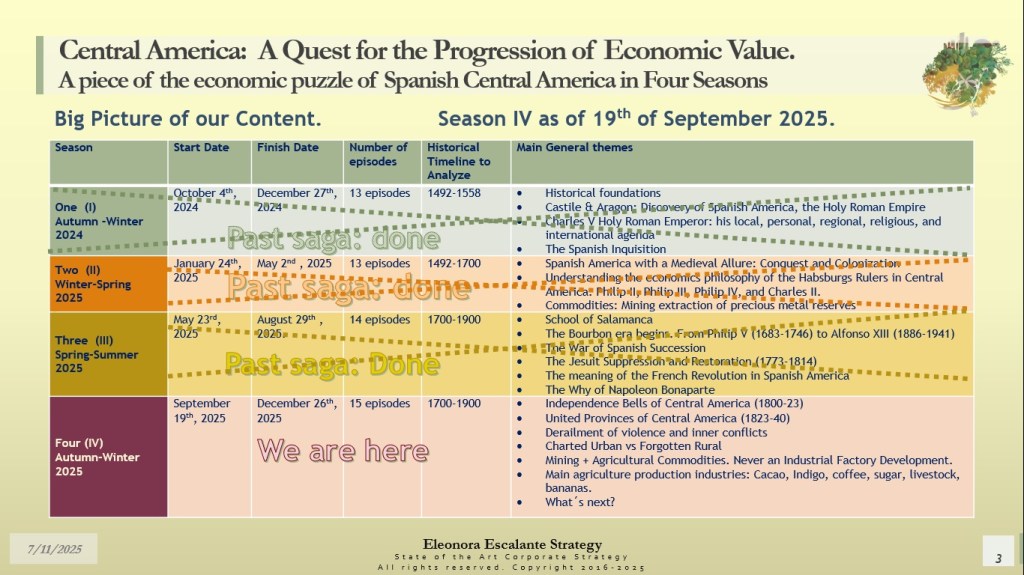
As of 1700, the former old Habsburg strategy was changed by the Bourbon-Wittelsbach dynasty, and the relationship between the new continent and Europe entered a process of reconfiguration. The independence movements of the criollos occurred during the first quarter of the 19th century, the next 25 years were about the Federal Republic’s failure, and the last half of the century was steadfast for the liberals, who imposed a weird liberal agenda while defending their region in a separate format, but under a tacit union arrangement.
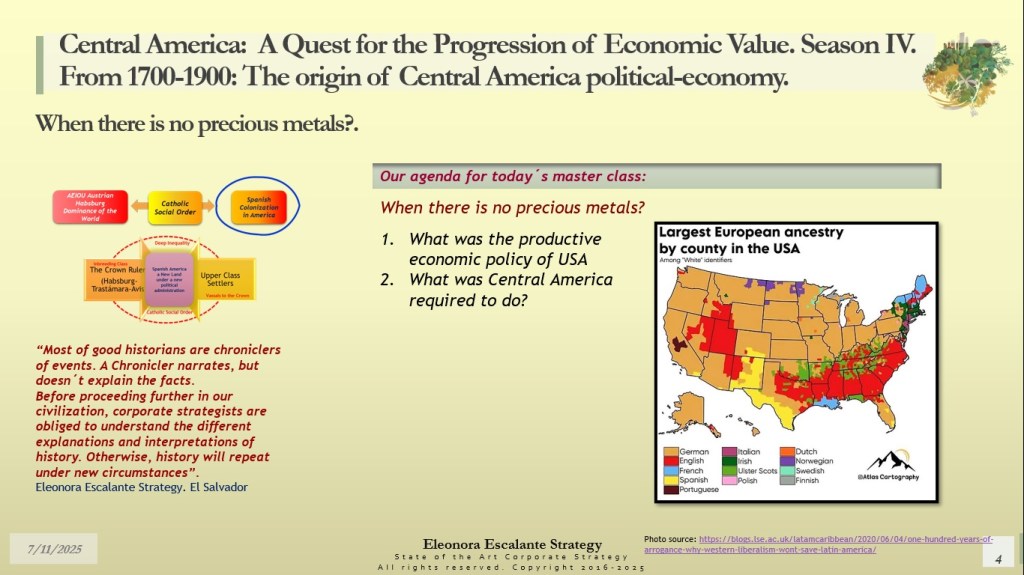
What was occurring in parallel in the USA then? Why does it matter? It is important because the former nations of the kingdom of Guatemala were watching the north for reference. They couldn´t relate to Spain anymore, because Spain and France were in brutal chaos. Even if the conservative leaders wanted to keep a rope with their former Iberian mother, there weren´t trustworthy Bourbonic or former Habsburg stakeholders to look for. The Jesuits (the Habsburg trouble solvers) were starting to return, and their structure was in rehabilitation. Central America, without Spain, was looking for a new reference guideline that could modernize and improve the old royal long-time established colonial system, but “never” to replace the principles and the philosophy of that system.
Building an economic model for prosperity from scratch was not easy. The ruling class (conservative, fake liberal, or real liberalist-progressive) wasn´t simple in the context of a possible takeover by Britain-USA.
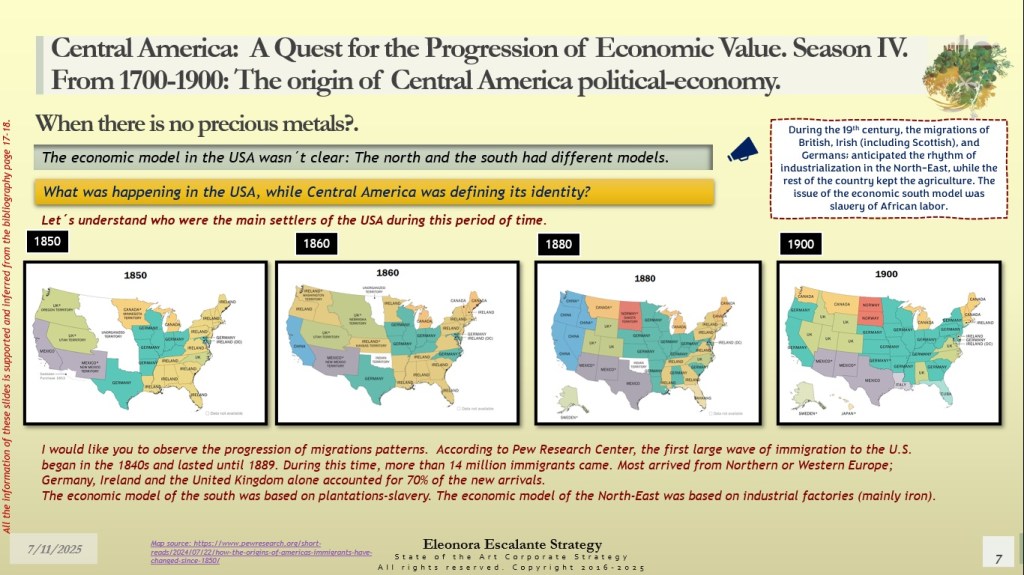
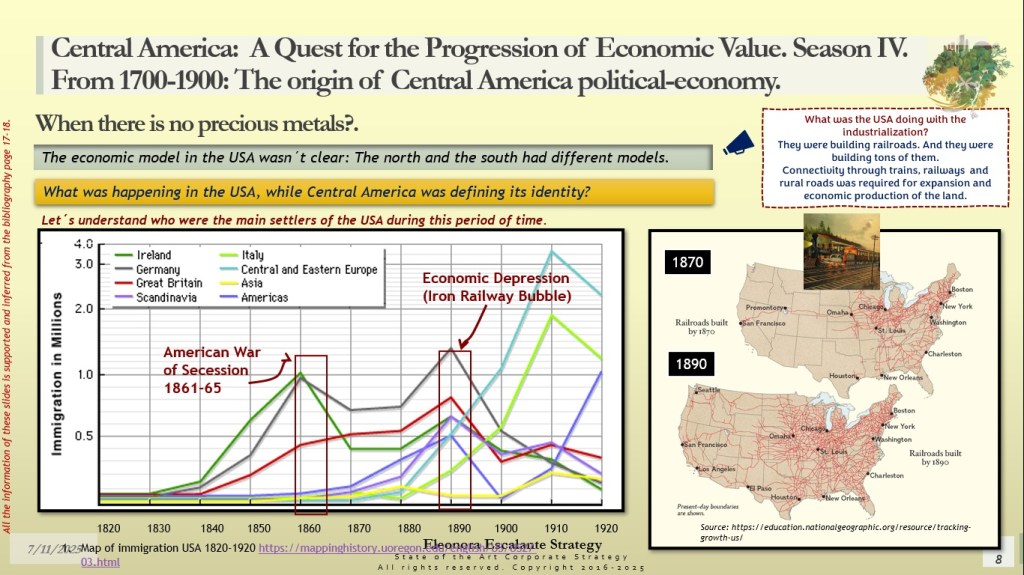
The Central American top families were watching the North. They were observing how the USA was going to be tamed by a new social class of European immigrants, an immigrant wave of people who left everything behind, and were taking the North American Lands as a storm. These new immigrants, mainly from Germany (Rhine lands), Ireland, and Britain, arrived in the USA to search for better conditions of life, in which they were the protagonists of their future. These migrants were clear about what to do, how to do it, and where to do it, and they did it in less than a century. The Native-Americans lost their lands to the Europeans, and a footing of the nascent superpower was not industrialist, but agricultural. The industrialists settled in the North-East, extracting iron ore to manufacture everything that was required to build cities and railroads. Many migrants got jobs in those industries; however, the rest moved to areas where land was available. The Germans’ (and Dutch included) pattern of migration was not to remain around the Philadelphia (German/Dutch Town) area, but to move further westward as soon as the land was ready for their productive endeavors. States as Ohio, Illinois, and Wisconsin were the core for new German methods of agriculture.
Agriculture was the first thing to do. Later during the 18th century, the European Industrial Revolution arrived via the construction of infrastructure. Cities as Milwaukee and Cincinnati were built by German Immigrants. The breweries were also started by Germans. With the takeover of Prussia and its conversion to the new Hohenzollern German Empire, German populations continued to move from Europe, settling mainly in the northern part of North America. Germans shared a common interest: to make the land productive under their domain. But we are not speaking about 300 m2 or 1 hectare of land per migrant family, we are talking about plots of land of at least 100 acres per family (40.47 hectares or 404,686 m2). I would like you to have an idea of the size of the minimum plot of land that German migrants were able to buy cheaply or get free at that time: 100 acres is equivalent to a minimum parcel property of 75 football fields together (each football field measured in 108 mt x 50 mt each).
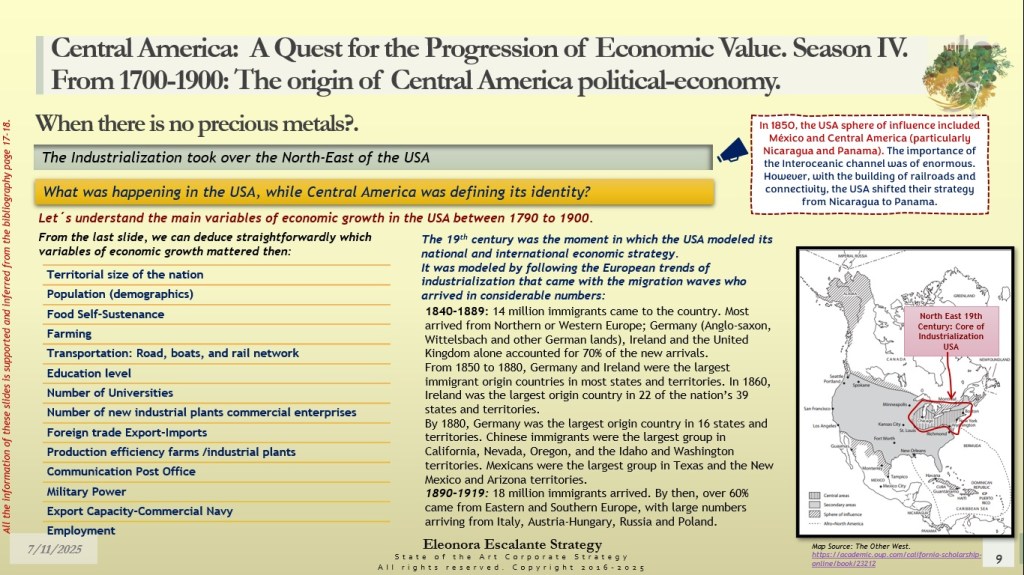
After the war with Mexico (1848), the USA was invaded by Europeans from Northern Europe. The population was 23.2 million in 1850, and it grew to 76 million in 1900. It almost tripled in size. See slides 6 and 7. If agriculture was the core driver of the settlement of Germans and Irish (given their cultural background), who were the ones betting on industrialization? The answer is straightforward: Those migrants who wanted to replicate what they lived and saw happening in Germany and Britain (the cradle of industrialization). Mainly those who settled around New York and Philadelphia. Extreme-poor migrants who couldn´t afford to buy land, or were not interested in leaving the new urban cities, became the worker class in the North-East. While farmer migrants who had a reserve cash were granted the status of “proprietors” of “haciendas” and continued farming as they did in their country of origin. According to the social status of the migrants and their economic conditions (and education), every migrant was able to choose an economic path for their families.
In terms of industrial experiences, the 19th century was the core plateau for connectivity through railroads. An interesting fact: the first railroad that connected San Francisco with New York was built in 1869. And from there, the manufacturing of transportation systems-railroads opened the possibilities for the next industries (communications, electricity, housing, trade-commerce, agriculture). Connectivity through trains, railroads, and rural-vicinity infrastructures was required for the expansion and economic production of the land. The link between the main city with the rural village was imperative. The USA was building accommodation facilities in cities and rural setups, and a connectivity network based on infrastructure. All the materials and talent required for it were made in the USA. See slide 8.
Industrialization took over the North-East of the USA, but not the South.
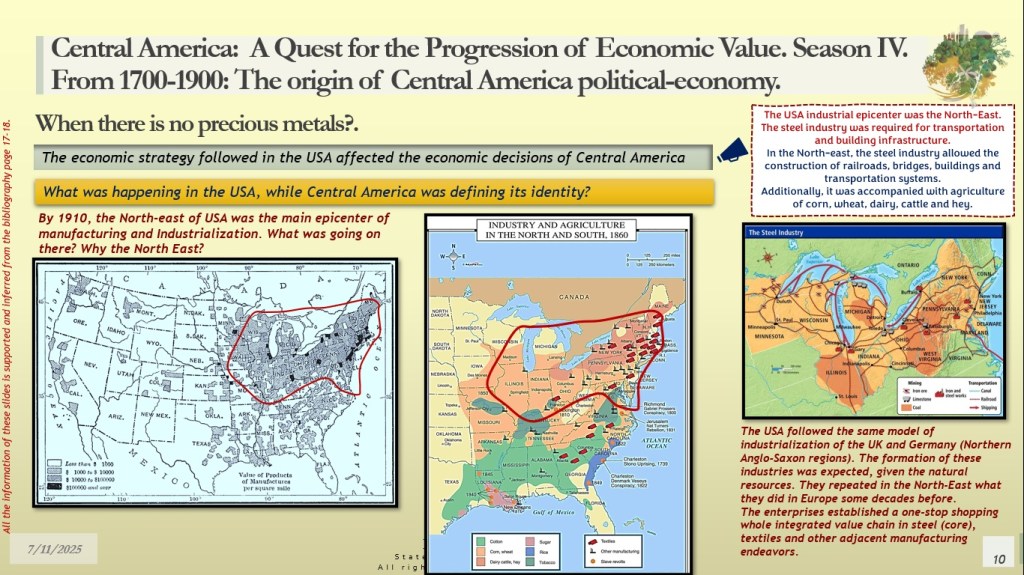
The situation agreed by the different European kingdoms during the 17th century was that the only way to claim the land and exercise power in a colonial territory in America was to populate the new colonies to prevent other powers from doing so. It is in this context that the massive amount of European migrations coming to America was fundamentally and philosophically explained. It was a Northern European migration takeover. However, the USA North-East industrialists were busy building a vertical integration of their economic endeavors: their success recipe wasn´t to extract material and export it to Europe. The industrialists changed the mentality. They designed and put together the whole value chain to build the USA from scratch. It was a local production of inputs for the local production of outputs. That was the shift of mentality and the difference between the migrants of the USA, in comparison to the local dwellers of Central America. The variables of economic growth in the nascent period of the USA were to build the USA, with the natural resources that it held. Migrants from the USA never gave up on agriculture because they came from Europe to acquire the land and produce from farms, to progress through that land. The migrant community already knew that cities were required for several types of services, but they also acknowledged that it was in their land that their steady superpower could be sustainable for the long run. Once the railroads were built, most of the corporations doing those projects went bankrupt. Other new industries replaced them.
The USA variables of economic growth that mattered in the 18th and 19th centuries were the same ones as Prussia (see Slide 9):
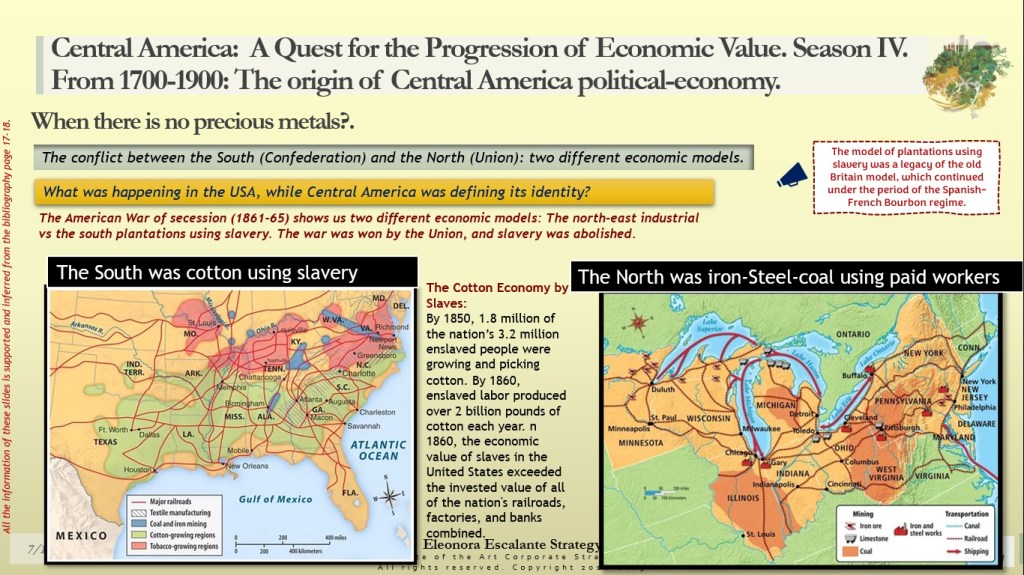
What the USA leaders did with the arrival of German migrants had nothing to do with extractive economies to build export empires. The economic model of Prussia was philosophically rooted in the capacity of self-sustenance under freedom (not slavery) and the population education strengthening for three core pillars: (1) industrialization based on vertical integration of corporations to use the natural resources available in their territories, mainly coal, and iron; (2) Infrastructure development using the natural resources and engineering of the nation; and (3) Agriculture efficient production to feed the locals for a healthy populace. These three pillars were crucial for the economic development of Prussia, and it was replicated intact in the USA. These elements of the Prussian economy were the result of a conjoint philosophical framework of the core elements of Kant and the philosophical elaboration of Hegel, Van Humboldt, Frege, and Herbart. The Prussians intuitively created an economic model that was organically founded in an educational system that helped them to create wealth for those farming and industrialist entrepreneurs without “slavery.” Slavery was the foundation of the economic model of the South of the USA. Slavery was the core element of the old Britain-Portuguese-Spanish-French transatlantic slave trade. See bonus slide below

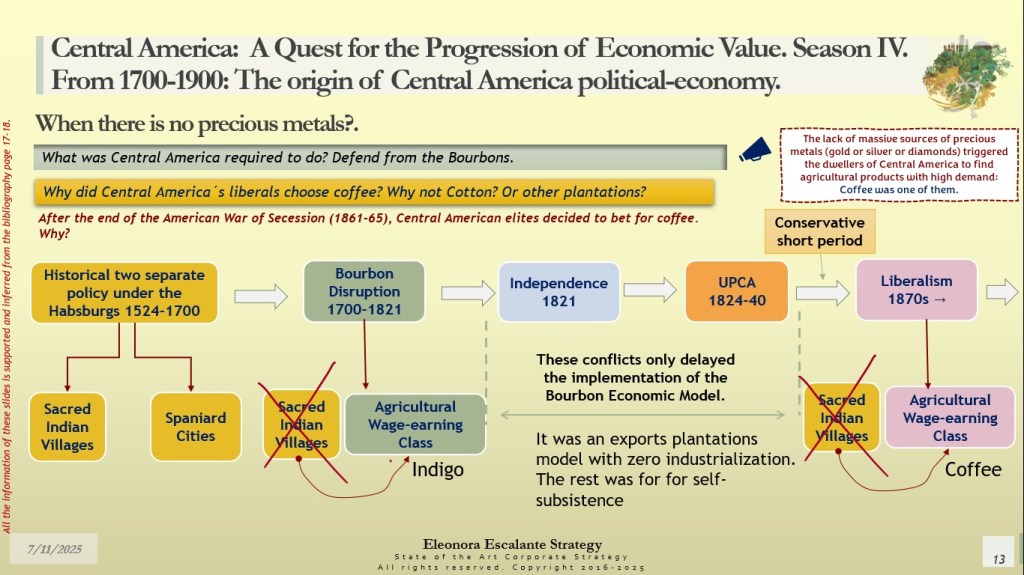
The economic strategy followed in the USA affected the economic decisions of Central America. Slides 10-13.
The result of the American Civil war of Secession (1861-65) is intimately correlated to the decision-making of Central American caudillos about embracing the liberal flag. The winning economic model of the American Civil War was the North-Eastern one. It was the model of industrialization based on coal and iron, the construction of infrastructure development (railroads, cities, water facilities, electricity, and connectivity), and the agriculture combined. The south-slavery model was the loser. And this affected the Central American decision-making of the ruling class. No nation in the region was going to get married to slavery anymore; otherwise, another William Walker scenario was certainly coming to pass.
The Prussian economic model was already in place in North America by 1865. Central America was forced to make choices. And their option was to install a liberal model under the premises of the south-slavery model. The new format of slavery (debt peonage) with zero industrialization was already in place. The export plantation model continued. And coffee was appointed for it. The Central American liberals were used to install this southern agenda as a shield against any possible USA-German industrialist takeover.
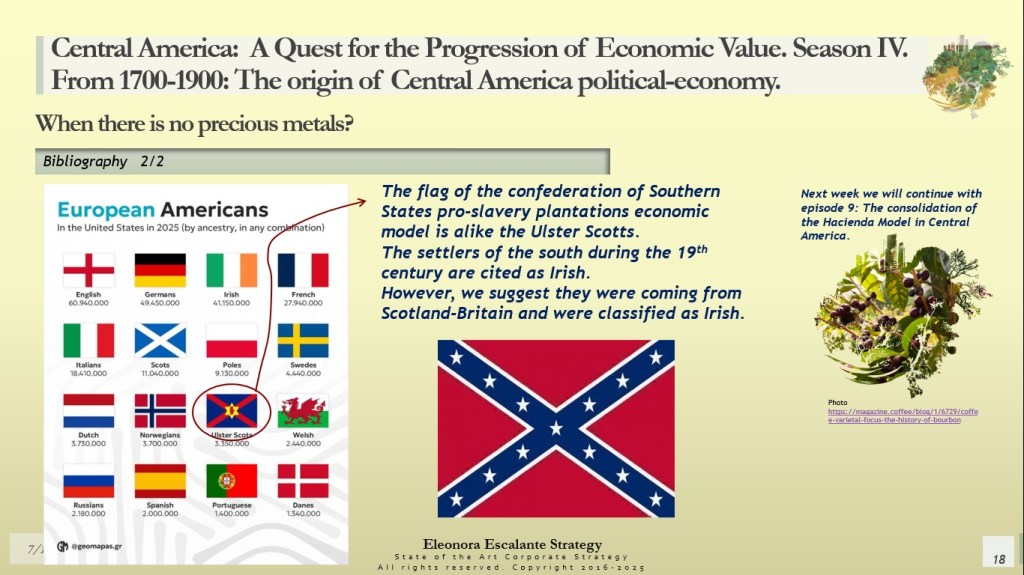
Bourbon Louisiana in America. Slides 14 and 15.
These two slides are extremely interesting because they connect the Bourbons (post-revolutionary France) with the political creation of the USA’s economic decision-making. Despite the North-Eastern economic model winning the American Civil War, the slavery institutional structure legacy continued in the South of the USA. Slaves were free after the war (1865), but they lacked economic opportunities to build their dwellings for a middle class. Most of them ended up under servitude and the same debt-peonage that the Native Mayas of Central America were forced to accept.
Why does this episode matter?
We are currently living and going through a forced transition to a digital economy. A digital economy that has been designed under certain rules of engagement and management. The philosophical premises of the current digital economy do not work for all. Certain economic sectors might find certain short-term benefits, but the system is not helping to make humans free from poverty or free from servitude. It is taking us back to the ancient slavery system. Why? Because it hits the differentiation premise of the working specialization. The reason we landed in the 21st century with a certain percentage of the middle class was because of educational specialization through superior university instruction. The new digital economy destroys the university’s role in its quest to democratize it for free. It ruins the uniqueness of those with artistic and knowledge endeavors that are gifting their talent through platforms as Patreon and similar, all of them begging for survival. It obliterates our reading capacities, which are so important for strategic inferences and critical reflection. It numbs our competence for discernment because high-quality instruction is replaced by the mediocrity of the virtual session and its pro-cheating examinations. In the corporate world, the digital economy is replacing people. Teams are being reduced to a minimum team number, and the government states can´t embrace those workers either. Just look at Trump´s situation at the moment. Even if all the top big corporations of the world collude to enforce the digital economy to function, the reality is that the giga-digital workers are not going to have a job tomorrow, because a new algorithm will replace them. The AI era is not well designed, because it has been created under philosophically wrong arguments, to end the job differentiation, much needed to rise from poverty to the middle class.
To be continued…
Closing words. Announcement.
How to choose an economic model that fits the interest groups of a region that was the kingdom of the Habsburgs? Why did the Central American decision makers choose coffee? Particularly, after the indigo disaster of the 18th century. The considerations of the Bourbon dynasty were not only coming from Spain, but also from the French side. Why did the Bourbons settle in the South of North America?, and what is the relationship between the South of the USA and Central America? Can you try to perceive it? These puzzle questions will be solved for you on Monday.
Our next chapter is Episode 9. The Consolidation of the Hacienda Model in Central America. Thank you.
Musical Section.
During season IV of “Central America: A Quest for the Progression of Economic Value,” we will continue displaying prominent virtuosos who play the guitar beautifully. However, we will select younger interpreters who promise to become the new cohort of classical guitarists in the present and future. It is a hard task to include all the guitarists that have reached the top plateau, but trust us, we are trying to embrace them all here.
Today it is the turn of a young star. Thibaut Garcia from France-Spain. He is interpreting a piece from Agustin Barrios, “Una Limosnita por el Amor de Dios”, originally called “El Último Trémolo”. His biography is here: https://www.thibautgarcia-guitarist.com/biography. Enjoy!
Thank you for reading http://www.eleonoraescalantestrategy.com. It is a privilege to learn. Blessings.

Sources of reference and Bibliography utilized today. All are listed in the slide document. Additional material will be added when we upload the strategic reflections.
Disclaimer: Eleonora Escalante paints Illustrations in Watercolor. Other types of illustrations or videos (which are not mine) are used for educational purposes ONLY. All are used as Illustrative and non-commercial images. Utilized only informatively for the public good. Nevertheless, most of this blog’s pictures, images, and videos are not mine. Unless otherwise stated, I do not own any lovely photos or images.
 Eleonora Escalante Strategy - Strategic Reflections Think Tank