
Central America: A Quest for the Progression of Economic Value. Season IV. Episode 10. The Golden Bean of Coffee.
Dear readers:
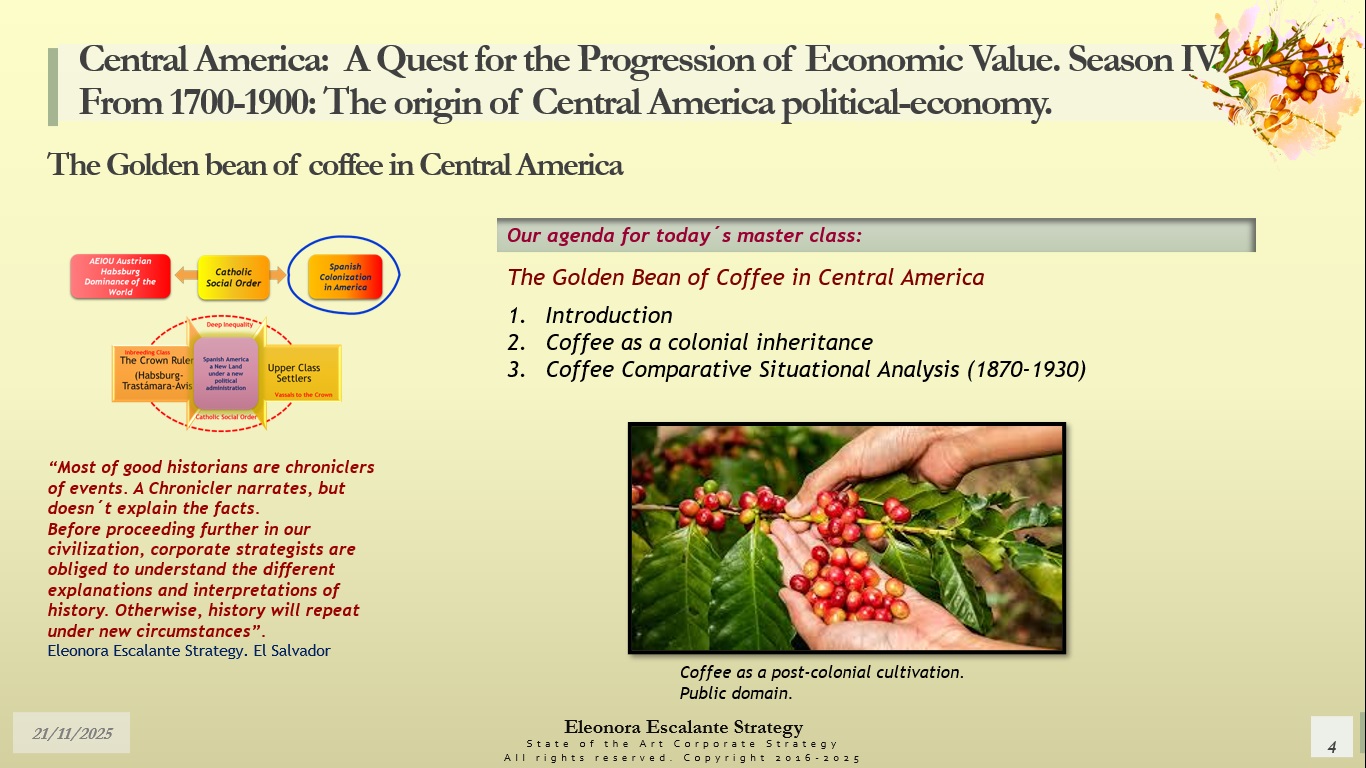
Wishing you a lovely day in November. Our master class today is about coffee, the golden bean of Central America. We have narrowed our analysis to three countries. Guatemala, El Salvador y Costa Rica.
Our frame of reference material is mainly a comparative situational analysis of the coffee farms in Costa Rica, Guatemala, and El Salvador. We have identified the main variables of our study in detail. Please proceed to download the document below. Print it, take notes, share it with your friends, family, professors, or colleagues. Our strategic reflections will come on Monday.
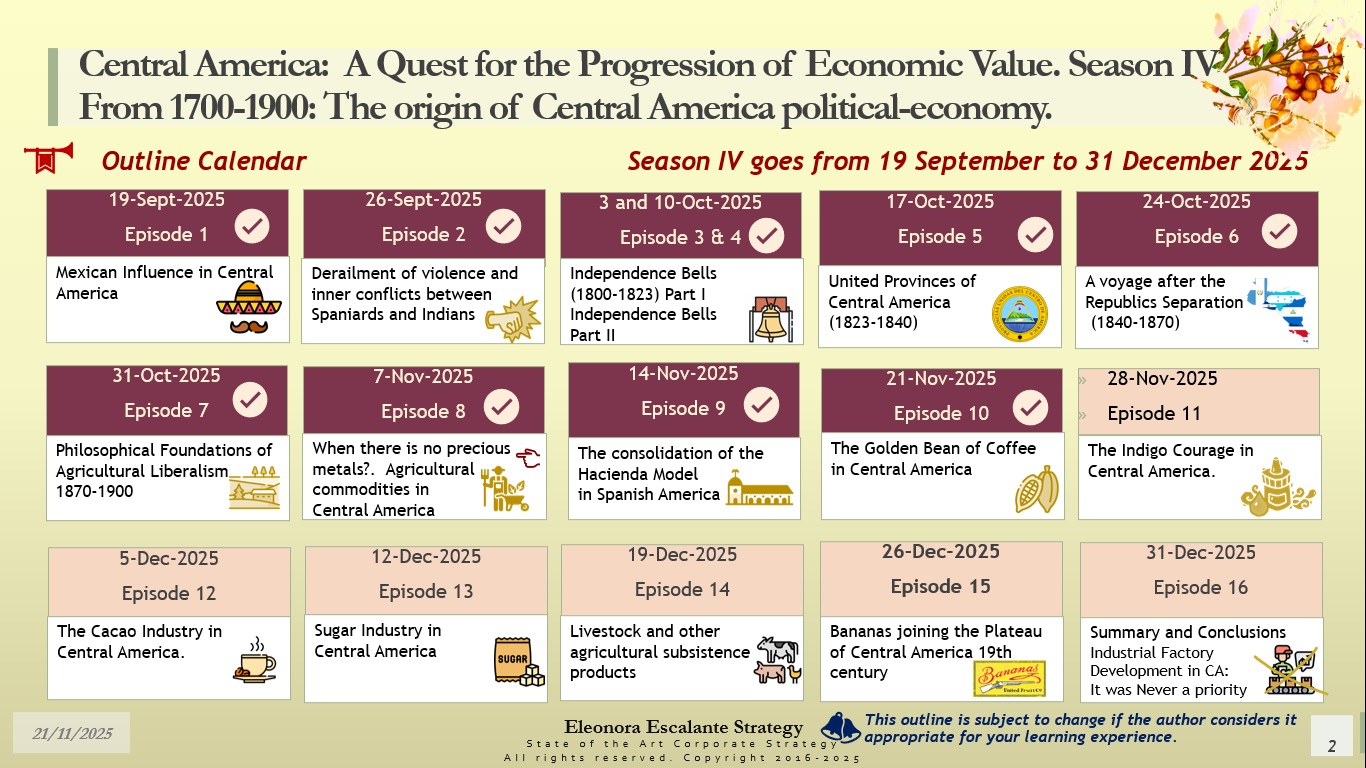
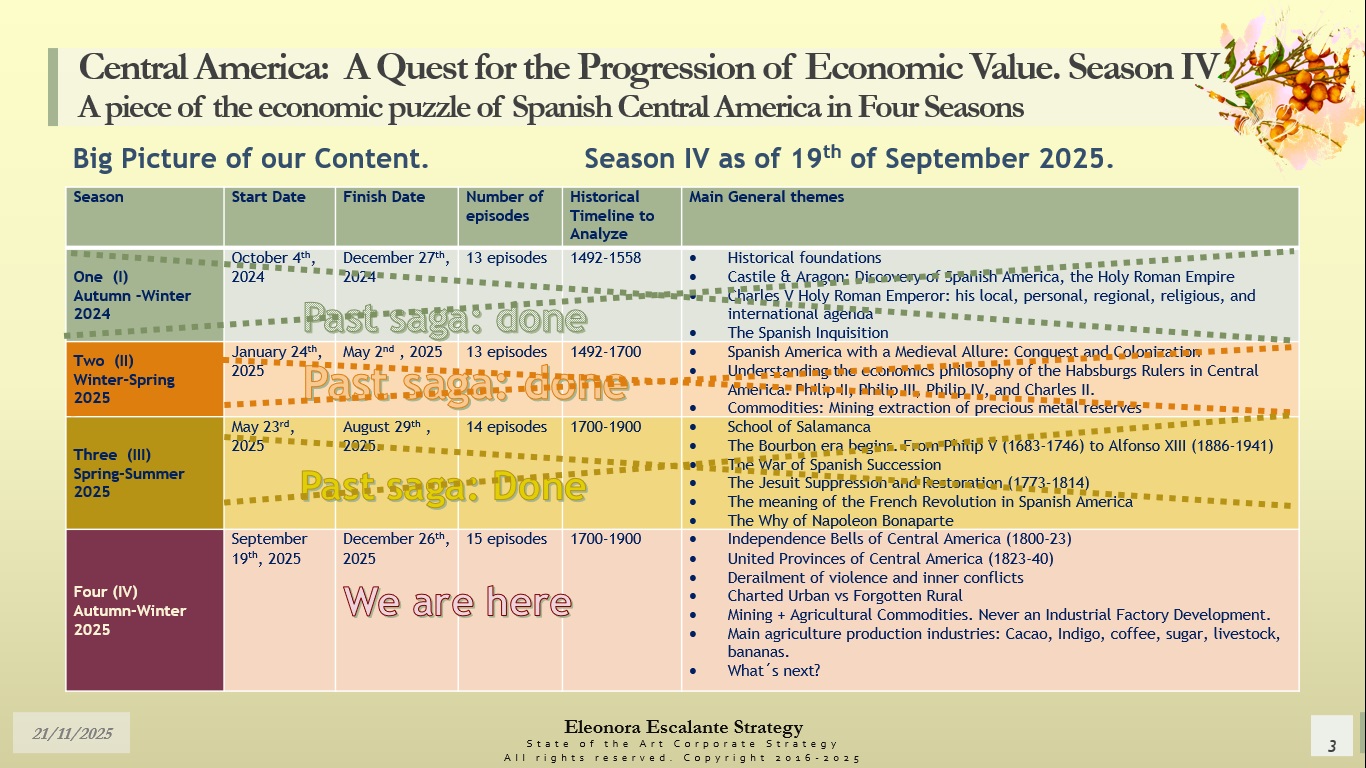









We request that you return next Monday, November 24th, to read our additional strategic reflections on this chapter.
We encourage our readers to familiarize themselves with our Friday master class by reviewing the slides over the weekend. We expect you to create ideas that may or may not be strategic reflections. Every Monday, we upload our strategic inferences below. These will appear in the next paragraph. Only then will you be able to compare your own reflections with our introspection.
Additional strategic reflections on this episode. These will appear in the section below on Monday, November 24th, 2025.

Strategic Reflections about Central America: A quest for the progression of economic value. Season VI. Episode 10. The Golden bean of coffee in Central America.
Introduction. Slides 5-8.
The first section of our journey starts with the main key takeaway from last week. Slide 5 is very important to comprehend, because it is the result of an extensive, consecutive comparative analysis of multiple sources of books and academic papers. This slide shows the genuine economic meaning of Independence from Spain for our region. It is a slide with a value of Cullinan diamond of 3,106 carats. It is a “without a doubt” inference after a year of thousands of pages of research. From my side, we are finally arriving at an unquestionable truth. It has been demanding because we need to read from multiple sources to find elements that connect what is obscured on purpose, or are not explained properly, and we are dragging 525 years of jumbled conceptual misinterpretations about Spanish Central America.

We would like you to observe the difference between the meaning of being a subordinated region, part of the kingdom of Bourbon Spain, a region that was not taking economic decisions by its Criollo and Native Indian leaders but obeying to do what the Bourbon regime wanted. The meaning of freedom has an impactful connotation, because the transition from the Habsburgs to the Bourbons after the year 1700 has shown us why the change of a “monarchical strategy” was not well received in the Kingdom of Guatemala. Our hypothesis that members of the old Spanish Habsburg dynasty were dwelling in the region is not a nonsense invented notion to concoct Steven Spielberg scripts. This precious region was a home, in which the first Habsburgs melted with the local population and decided to leave the new emerging society under a tripartite subsistence farming society: The Native Indian economy, the Catholic Church financial supervision economic system and the Criollos-Spanish Urban administration hanging from the new Bourbon umbilical cord.
The Bourbons caused a disruption in Central America (we have already studied this in detail during the past episodes). And the Bourbons’ destruction of the Spanish American “status quo” caused a French Revolution and the Independence from Spain, when Bourbon Spain-France was in total crisis (after Bonaparte´s sojourn in Europe).
The Kingdom of Guatemala was never a pioneer territory of audacious economic bets. It was a late medieval feudal stronghold. It was secreted from the silver economic hubs of México and Perú. It was the home of a dynasty that had installed a “savoir faire” of doing things, a household that negotiated with the Native Mayas to stay together in the territory, each to their own. A home is not used for manufacturing factories. A royal territorial household in the medieval feudal concept was a complex constellation of villas around the residence of the king, who was the most prestigious manor dwelling bastion. Antigua de Guatemala was chosen for this, among other dwellings in México and South América. The rest of the provinces in Central America were manor villas, and a few of them (particularly those facing the Atlantic) were fortresses, the heavily fortified places that kept Guatemala (and El Salvador) as the core zones for the Habsburg concealed monarchs.
It is clever to remind all our readers that the kings of that time held a constellation of royal houses in Europe, but they also held a semi-itinerant traveling court. It was not in their nature to remain for too long in every main palace, but the Kingdom of Guatemala represented the essential hub in Spanish America. The Kingdom of Guatemala’s relevance was so elevated that they gave up thousands of hectares in North America and México, just to keep Central America out of the new German British tsunami of the 19th century.
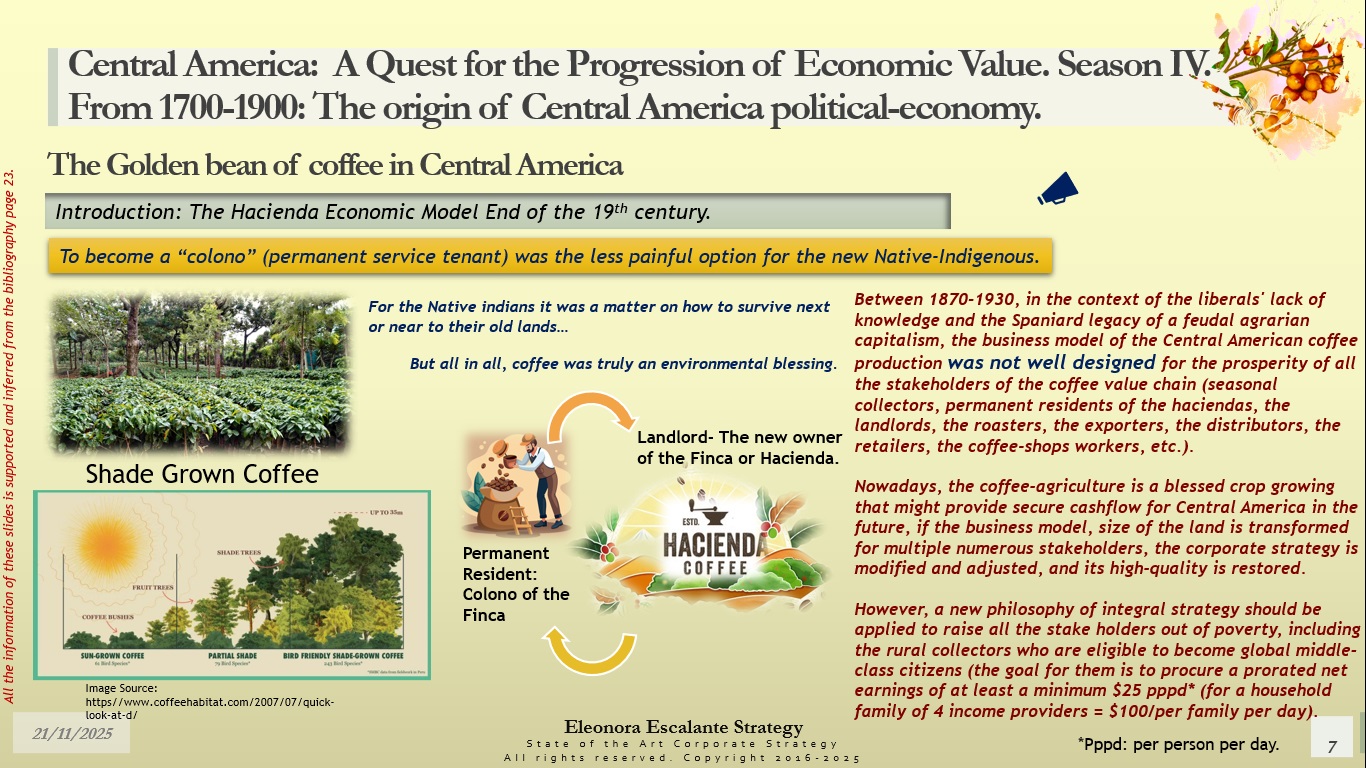
When the Independence from Spain took place, each of the manor dwellings became a nation, leaving Guatemala as the premier dwelling above the rest. Without silver, something else was meant to be done, and the Bourbonic coffee became the star product of the century. Read slides 6 to 8, please. We have gathered why the hacienda of coffee was the best defender for the region against the advancement of North America´s plans in the region. By providing a commodity appreciated by the liberal economies, it was the best crop available for a sure international demand that could be harvested under the climate conditions of the region. The cash flows needed for the region to survive were secured by choosing coffee. The downside was that the indigenous economic system was sacrificed, except for those cold lands above the coffee required meters above sea.
Coffee as a colonial Bourbonic inheritance. Read slides 9 to 11.
These three slides summarize the general overview of the main points that we have been displaying since September this year. The key variables considered by our strategic house that explain the contextual situation in which coffee was chosen as the incipient corporate strategy of the region are:
- The main features lost from the Spanish Regime after the Independence of 1821. The former kingdom of Guatemala lost all political, administrative, economic, and financial strategic direction from Spain. All the monarchical strategic guidelines were terminated.
- The relevant consequence after the Federal Republic of Central America’s termination: A feuding, separate cluster of villas (which were the manor household dwellings serving the authority of the concealed Habsburg king before the Bourbon entrance to Spain).
- Population Imbalances: It is logical to infer that Guatemala (Antigua and then Guatemala City) was chosen as the Criollo Habsburg hub, while the “Montaña region” of Rafael Carrera represented the core rural hub with the Native Indians. It is very interesting to observe how Guatemala and El Salvador have always held the highest density per square mile. However, the exponential growth of population in El Salvador can only be explained by a constant flow of Central American internal migrations and improvement in the conditions of coffee wages, in comparison to Guatemala. Honduras also experienced a significant population expansion.
- Main Poles of political-economic development in each nation. Each country has at least 2 to 3 main cities
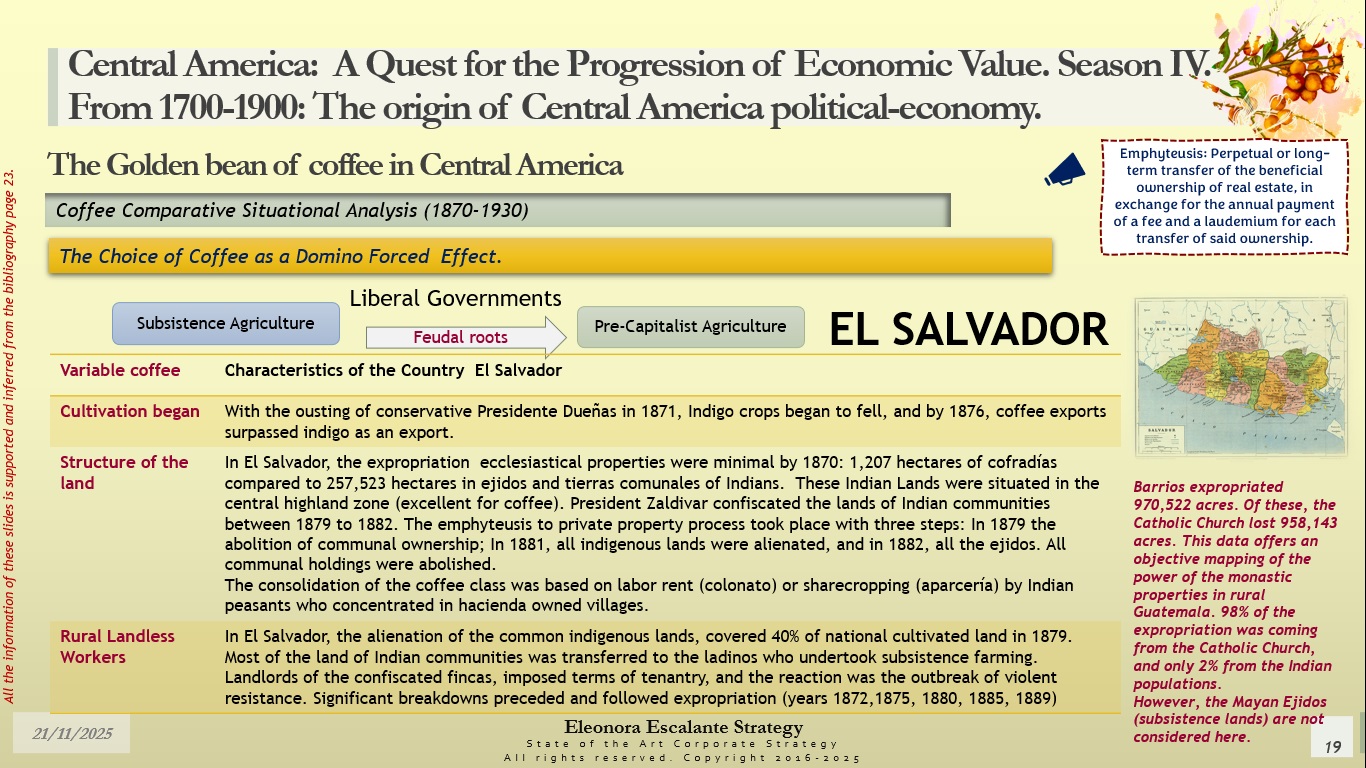
- Political Ideology privileged by the Criollo landlords: Both. The conservative and the liberal. The liberal position was used to expropriate communal lands for coffee.
- Church Position crushed: We have already explained this a few times.
- Fiscal situation: From zero, each of the nations had to reinvent its tax-collection formula, particularly with the Indian populations, who contributed most of the State revenues before Independence.
- Expropriation of the Indian Native lands (ejidos, cofradías, and municipal common lands)
- Military Activity: The 19th century was the span of building armies for each nation. Costa Rica was the least prone to invest in this area.
- The process of ladinization: Three sequential elements occurred in every level of the nascent societies: miscegenation, acculturation, and autochthonous uprooting.
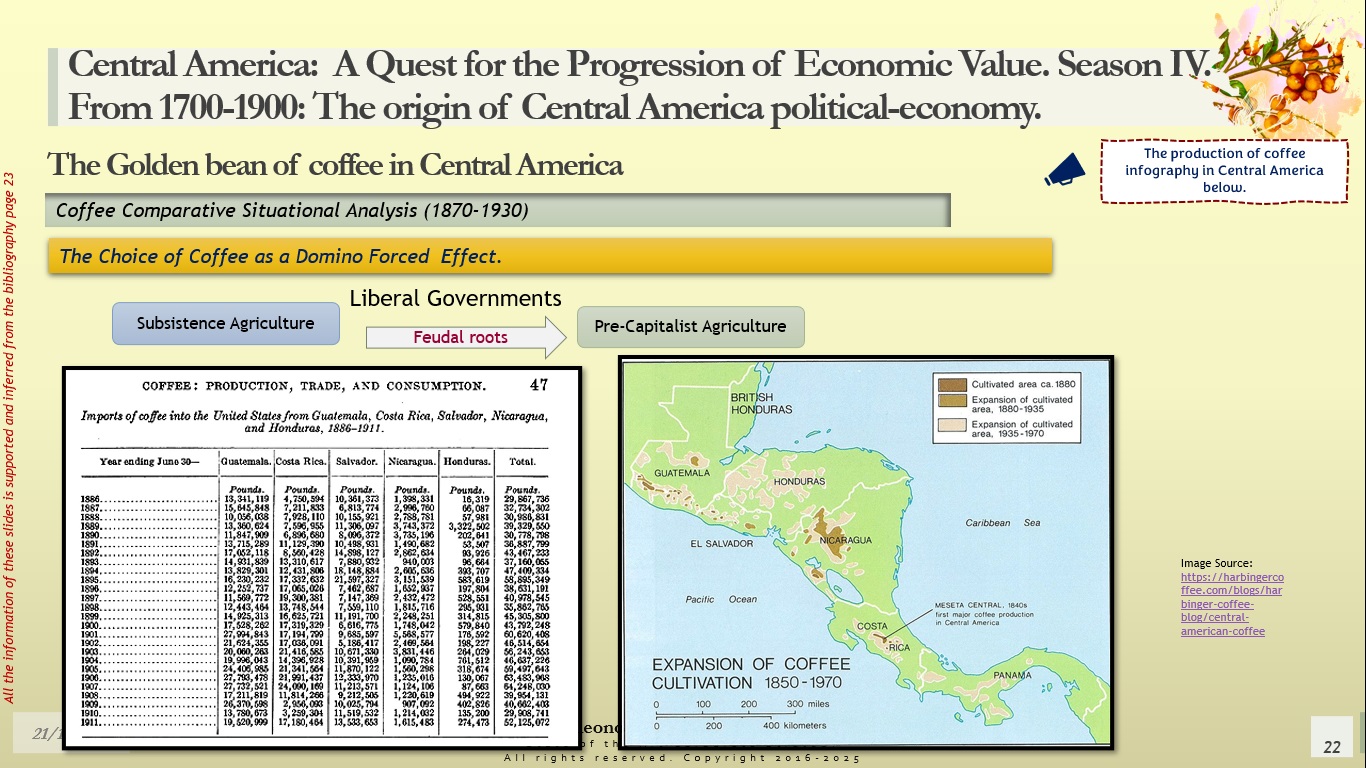
Coffee Comparative Situational Analysis (1870-1930). Slides 12 to 22.
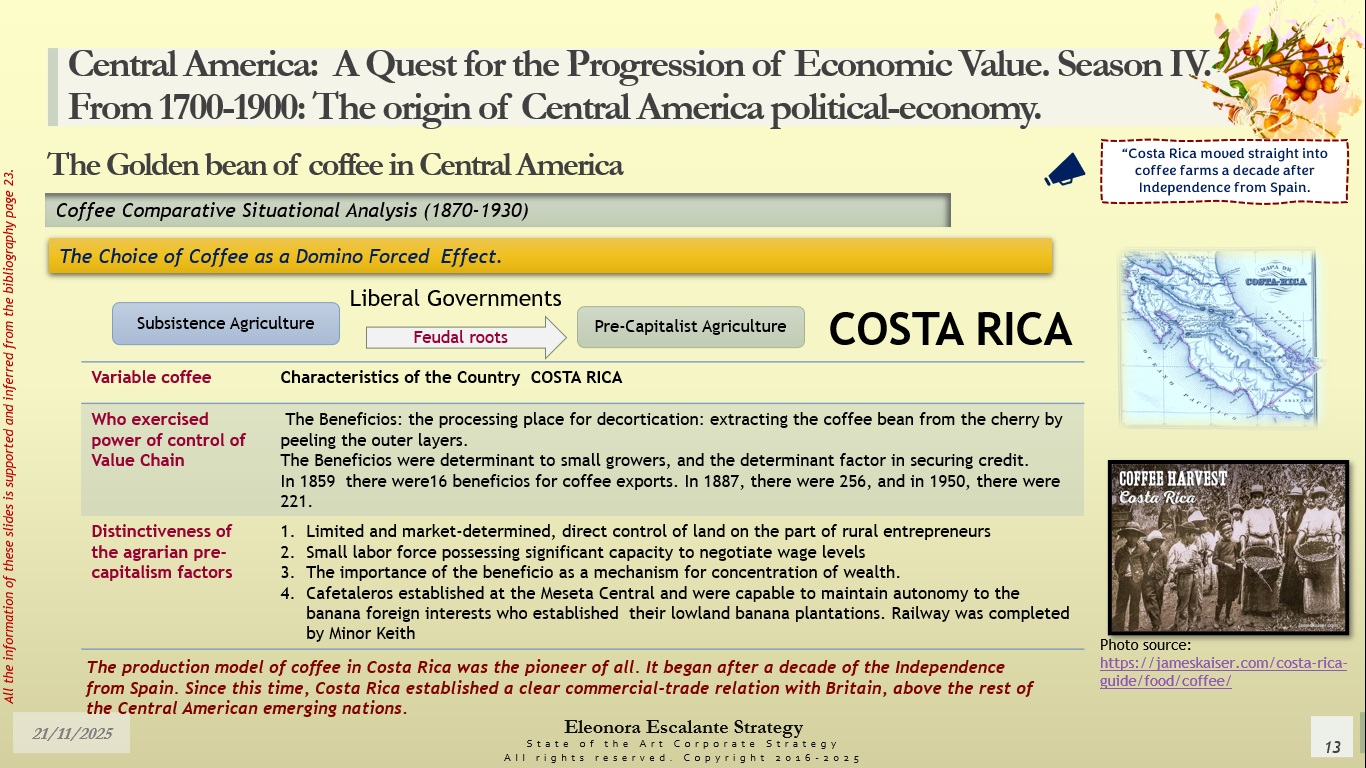
Costa Rica created the initial pilot project and first value proposition loop. Guatemala and El Salvador followed.
It is revealing and fascinating to study how an economic sector (or an industrial activity) began in the middle of a specific historical context. Every group of individuals has faced multiple needs and wants throughout history. Each community (or society) attempted to solve its troubles of functional, emotional, life-changing, and self-transcendent impact. Each society´s leadership (and related interest groups) designed its urban and rural spaces, and every time that we decide to learn about a specific civilization, there is a warfare saga of champion winners and defeated losers. The chronicle of us in the Kingdom of Guatemala was a delayed expropriation epic of a vanquisher, who decided during the 16th century, not to kill or destroy the Native Mayans for good. Charles V HRE didn´t proceed with the destruction of the Mayan civilization, even if he could have done it. His inner remorse for what happened with the Aztec lands was so massive that he didn´t finish the palace for his Portuguese Queen Isabella in the Alhambra Granada Complex, and he commanded his son Philip II to build the Escorial for the Hieronymites order. These things are not irrelevant in the context of Iberian occurrences. The top event of the past millennium was the discovery and conquest of America. In consequence, whatever happened in Spanish America is beyond the winners (Spanish) who defeated the losers (the native populations of the region). The negative of Charles V HRE proceeding to demolish the Mayan people only obeys one single possibility: His family was going to dwell here, sooner or later, and he saw something valuable in the land of the Mayas. Something that can only be explained by the divine mercy of God. Charles V HRE commanded the catholic orders to tame his new society, in which the Mayans were part of a feudal system as “subjects to the king of Spain, in an emphyteutic economic model of the King´s land in exchange for an annual tribute”. Charles V HRE determined to leave the land of the Audiencia de los Confines in perpetual tenancy to the Indian populations, and he commanded his army of Catholic priests to supervise the process after his death.

When the Habsburg promise was broken by the Bourbons (18th century), the mentality of the new Bourbon-Wittelsbach-Farnese kings was not religious anymore; it was mercantilist. The “dwelling place of the Habsburg Spanish kings” was not going to be respected anymore. And coffee was the justification used by the new “liberal” Bourbonic regime to expropriate what the Habsburgs did not seize: We suggest this has been the most incredible strategy of using agricultural cultivation economics to confiscate the lands of the Native Mayas and the rest of Central America´s prehispanic populations. The warfare to capture their lands was played out through a new feudal agrarian economic model, which looked like a pre-capitalist one. However, the divine mercy of God always triumphs. The cultivation of coffee was a miraculous fate game. The green environment of most of the land of Central America was protected. And despite the difficulty of the lives of the Natives, their population has continued to expand, and most of the land of Yucatan and the Mountain Sierras of Guatemala has been respected as natural reserves. There are still some descendants of the original Habsburgs who are caring for them. And that is reality, that no one can deny. At the end, coffee plants have been the saviour of the delicate green ecosystem of the region. God is always with us.
We know that all things work together for the good of those who love God: those who are called according to His purpose. Romans 8:28
These 10 slides (from 12 to 22) are self-explanatory. Please remember that our affairs in this master-class website are about corporate strategy, the origin, and the decision-making process about what to do with our business endeavors. The business strategy is related to how to do it, and we are not covering it in this saga.
Next week, we will continue with the Indigo. Best wishes.
Closing words. Announcement.
Coffee farms in Central America: a curse or a blessing? From a corporate strategy perspective, coffee was the first intention of the new, separate nations of the isthmus to produce something that might offer a competitive advantage. However, the legacy of the former colonial feudalism was too ingrained in the mentality of the dwellers. The liberal period from 1870 to 1900 was an experiment in governance. It was a tragedy for the Indian community’s systems, because the concession of the Habsburg Spanish kings to keep the Native lands under perpetual emphyteutic condition was broken.
Our next chapter is Episode 11. The Indigo in Central America. Thank you.
Musical Section.
During season IV of “Central America: A Quest for the Progression of Economic Value,” we will continue displaying prominent virtuosos who play the guitar beautifully. However, we will select younger interpreters who promise to become the new cohort of classical guitarists in the present and future. It is a hard task to include all the guitarists that have reached the top plateau, but trust us, we are trying to embrace them all here.
Today it is the turn of Johan Smith. He captivated our ears with this lovely piece of Mozart. If you wish to know about his biography, click here: https://www.johansmith.net/
Thank you for reading http://www.eleonoraescalantestrategy.com. It is a privilege to learn. Blessings.

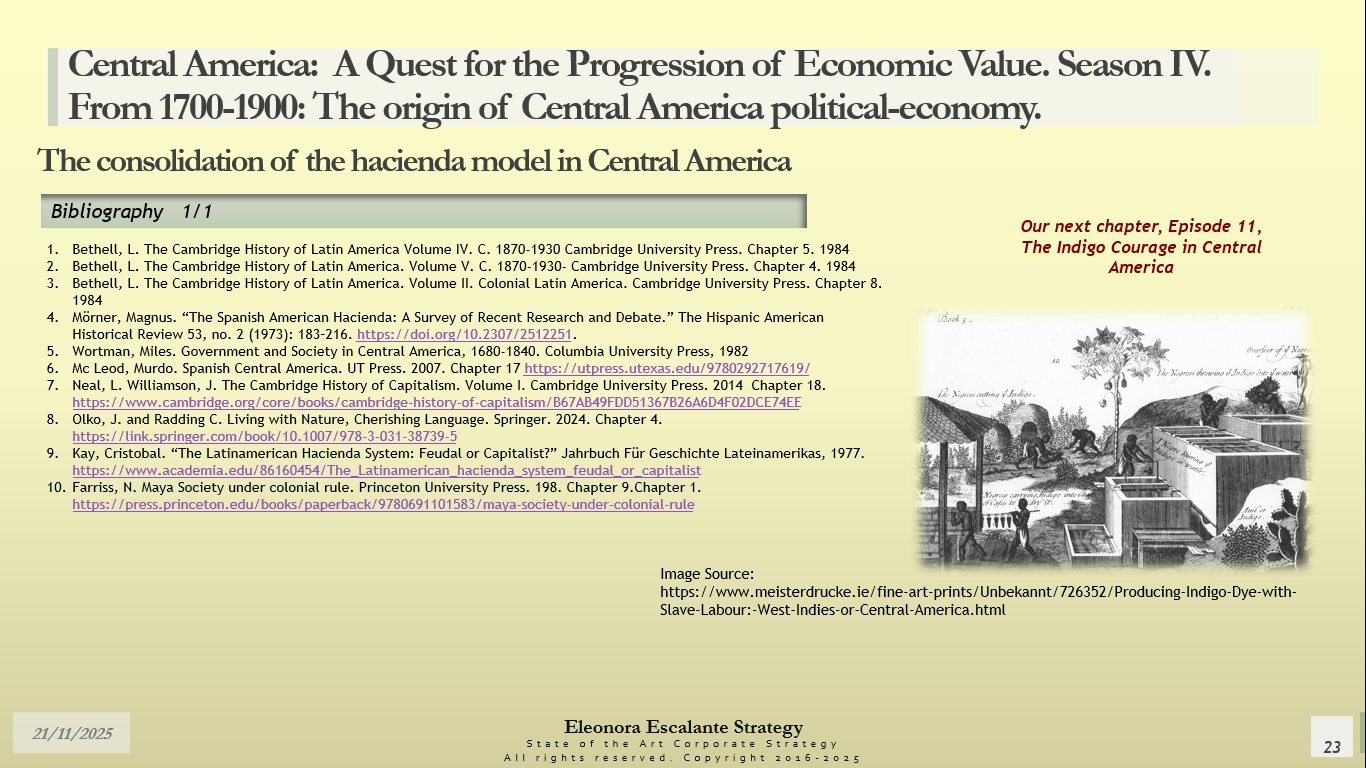
Sources of reference and Bibliography utilized today. All are listed in the slide document. Additional material will be added when we upload the strategic reflections.
Disclaimer: Eleonora Escalante paints Illustrations in Watercolor. Other types of illustrations or videos (which are not mine) are used for educational purposes ONLY. All are used as Illustrative and non-commercial images. Utilized only informatively for the public good. Nevertheless, most of this blog’s pictures, images, and videos are not mine. Unless otherwise stated, I do not own any lovely photos or images.
 Eleonora Escalante Strategy - Strategic Reflections Think Tank