
Central America: A Quest for the Progression of Economic Value.Season IV. Sugar-Sugar Introduction.
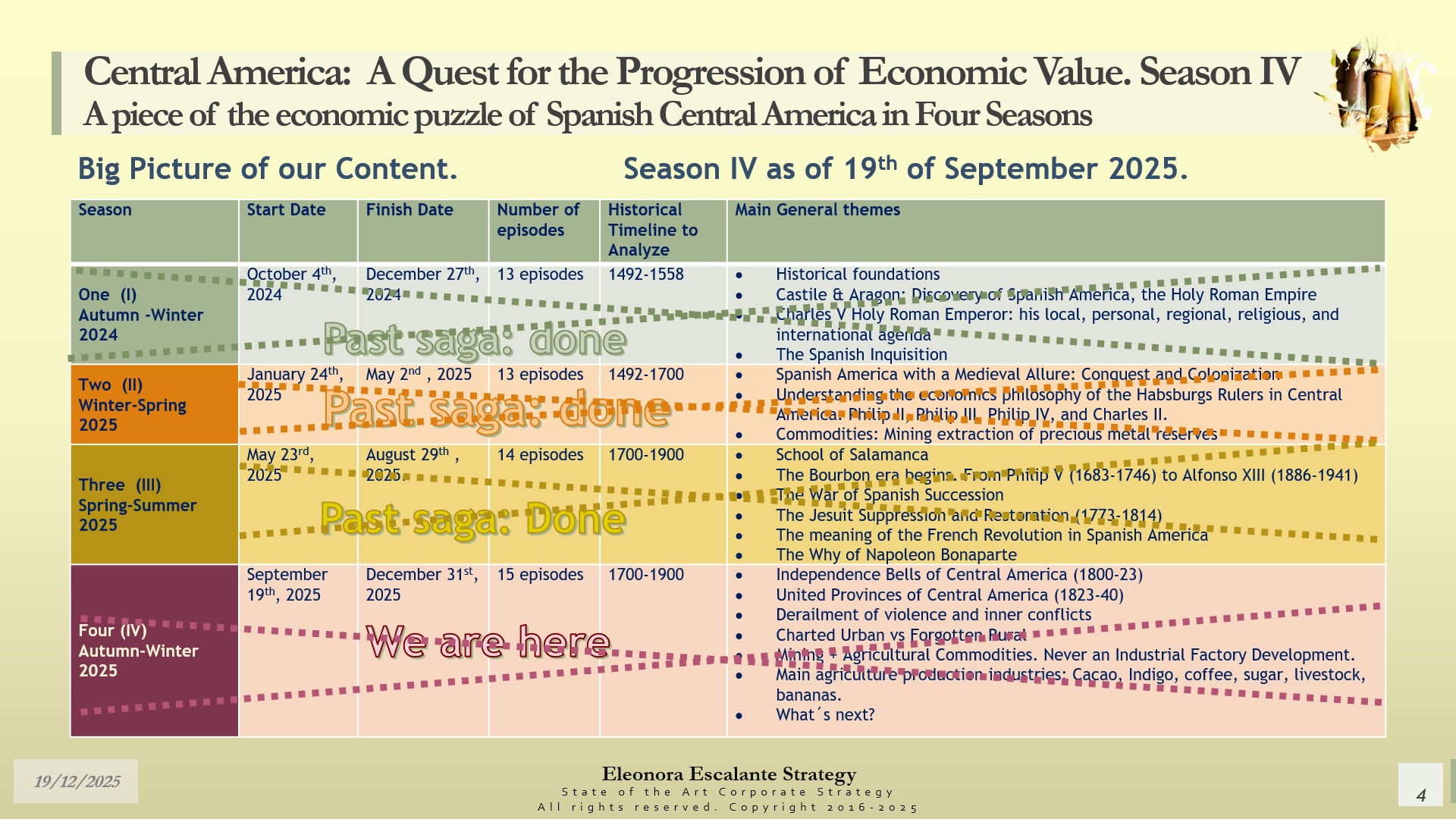
Wishing you a beautiful holiday season and marvelous moments with your loved ones. I wasn´t able to publish last Friday. The first and most crucial reason: I was saturated with reading about sugar. There are thousands of old and new books about this special plantation, and I perceived that I needed more time for it. That is why we have rescheduled our outline. We have extended the saga to Season V. We will dedicate 4 chapters to the history of the sugar economic development business model between 1500 and 1900. We have framed our new outline below. Please take a look at it. We are convinced that you will be more than pleased with our next final Season V. These three cultivars: Sugar, Bananas, and subsistence foodstuff are indeed crucial to explore in detail, and I can´t leave them lightly. We will also explore Livestock and Cattle in Central America. Additionally, during the next 14 days, our educational corporate strategy house is obliged to take a mandatory holiday vacation to maintain our brainiac powers and recharge batteries.

Let´s download the material of reference prepared for you. We always encourage our Master-Class readers to get acquainted with this material, otherwise you will be completely lost once we upload our strategic reflections of the class on Monday. It is better if you print it and write your questions next to each slide. Feel free to share this content with your friends, colleagues, professors, and family. It is lovely to see people discussing and learning together.









We request that you return next Monday, December 22nd, to read our additional strategic reflections on this chapter.
We encourage our readers to familiarize themselves with our Friday master class by reviewing the slides over the weekend. We expect you to create ideas that may or may not be strategic reflections. Every Monday, we upload our strategic inferences below. These will appear in the next paragraph. Only then will you be able to compare your own reflections with our introspection.
Additional strategic reflections on this episode. These will appear in the section below on Monday, December 22nd, 2025.

Strategic Reflections on “Central America: A quest for the progression of economic value. Season VI. Episode 13. Sugar-Sugar. Introduction.”
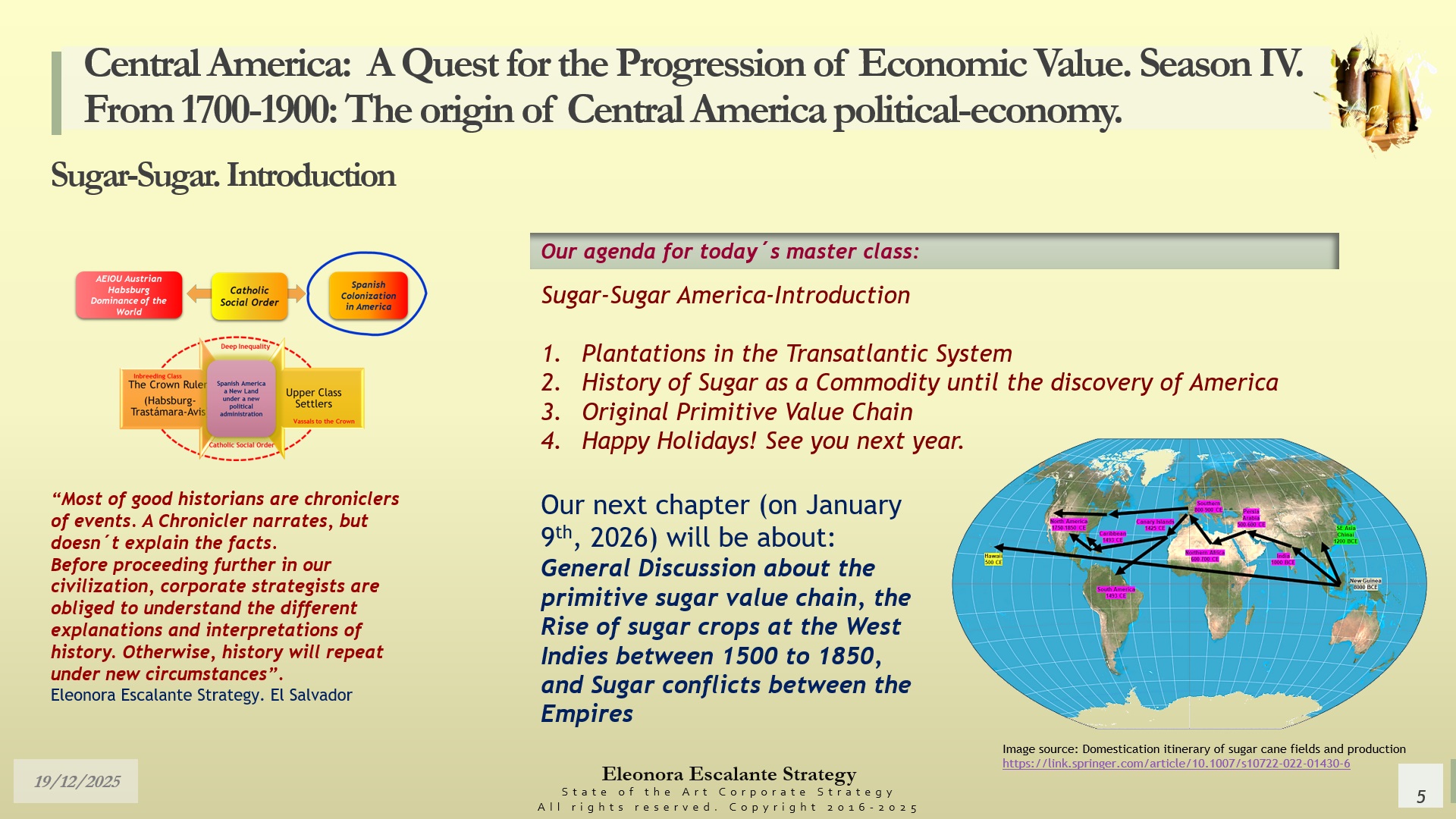
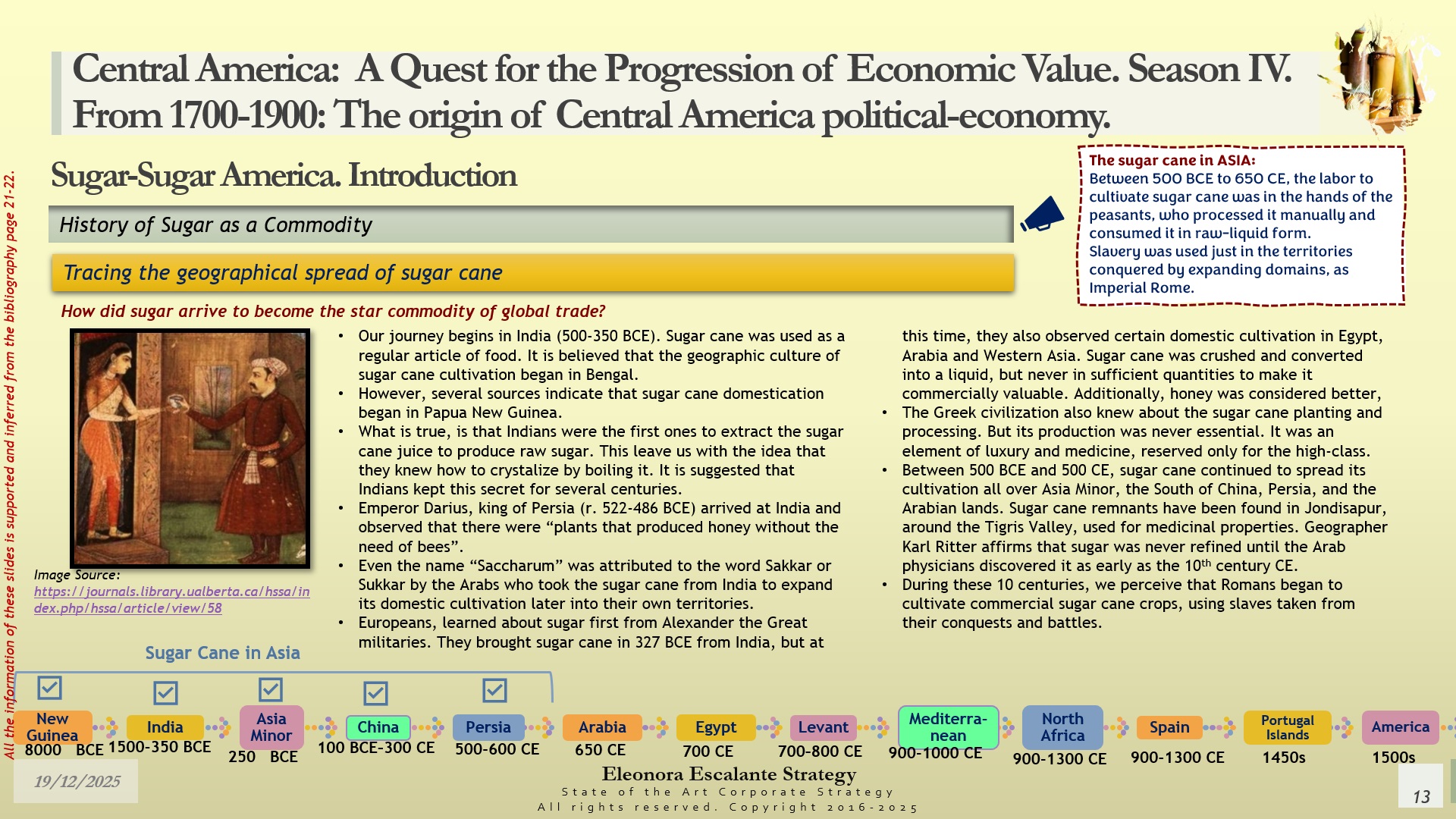
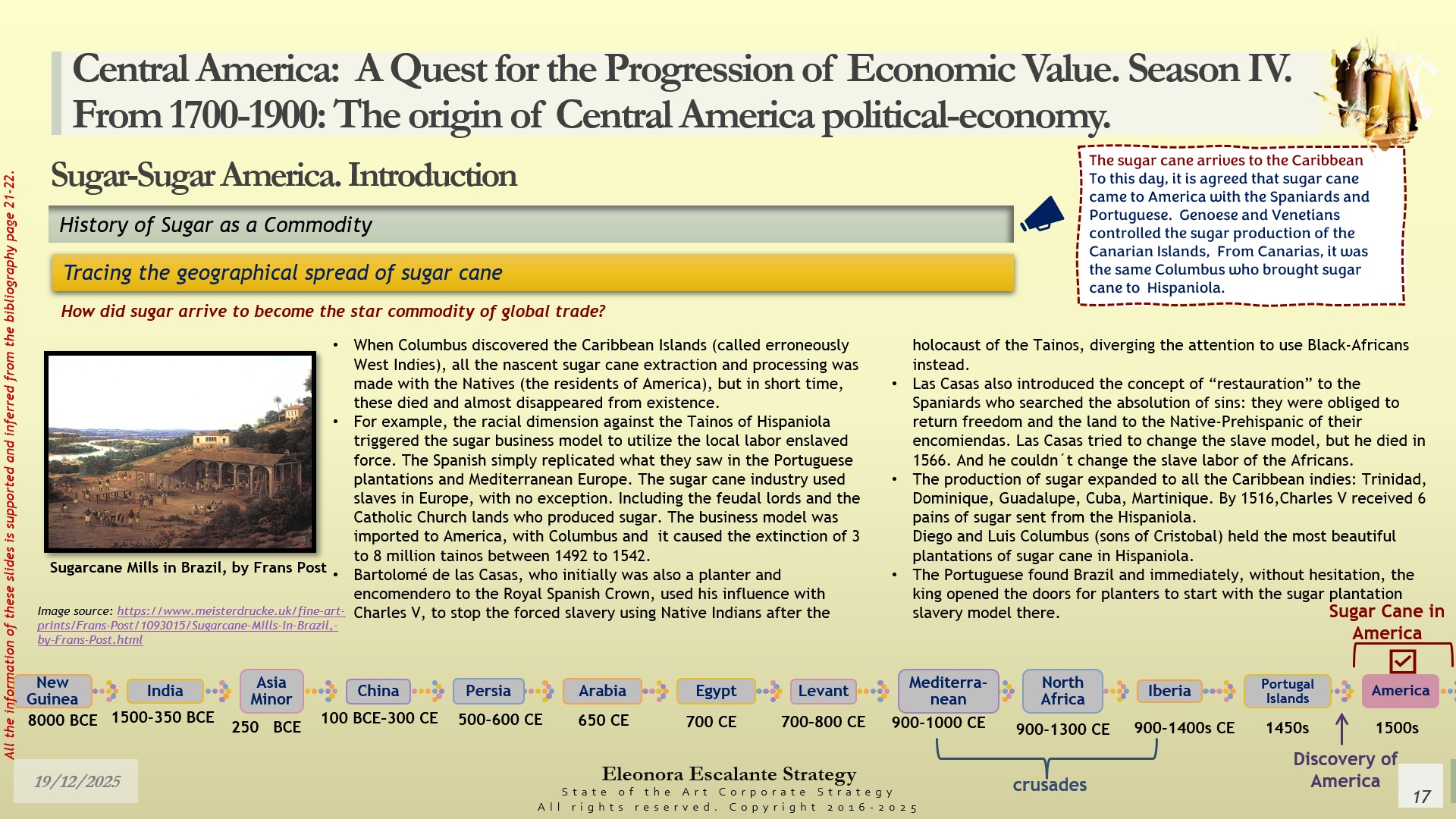
Our introductory material for the theme of sugar cane global production, processing, and distribution has taken us to read and study various sources of scholars´ academic papers and books. How deep and far can we extend our research in our quest to find the origins of the domestication of sugar cane by humankind? With the Saccharum officinarum, we can spend months studying how it traveled from New Guinea (8000 BC), and then how it made its voyage all over Asia, just to arrive at the hands of the nascent Portuguese empire and Columbus (1450s), which spread it into the Caribbean islands and Brazil. However, our aim is by far less sophisticated. We tracked the history of sugar as a commodity because we were looking for the exact moment at which the plantations of sugar shifted from a luxury item to a low-cost commodity. At that exact moment, the business model of sugar plantations also took the fundamental decision of becoming the foundation of mercantilism: it was decided then that labor for plantations in America was going to be in the hands of African slaves. See slides 12 to 20, please.
The Arabs took sugar cane from India, and transferred the know-how of producing sugar with the best irrigation practices and certain technological developments to grow the yields of its productivity; however, before the year 1500, access to sugar was limited to the high-class, and to a minimum amount of people near the nobles. According to historians, Europe was in a feudal medieval labor style then. If that is true, then the Early Modern European practices included slavery at their roots. Then, if that is true, and setting our shoes in the situation of that moment, it is easy to comprehend why the sugar plantation business model of the American colonies used racial slavery. They transferred to the New World what they did in the Old World. Let´s continue reflecting. According to several historians of sugar, as I mentioned above, between 650 CE and 1400 CE, Muslim Arabs transferred the sugar business model to the Iberian kingdoms and Sicily (which also became part of Spain). That signifies that slavery was a strategic axis used by the Arabs, too. In consequence, with the study of the business model of sugar, we can discover that slavery existed throughout European and Middle-East lands as an engine for productivity. We arrive at the same conclusions, just by doing an analysis of the sugar business model. Slavery has accompanied the warfare and territorial conflicts of humankind since archaeological records are available. The Greeks practiced it. The Roman Empire performed it. The Egyptian civilization carried it out. The Persian and Ottoman Turks exercised it. The Indians went plus beyond slavery and lived it out through their caste system. The Mayans and Aztecs also applied the concept of slavery and cacao tribute before the arrival of the Spaniards. Where there was a winner and a loser, in every single culture of our history, the conqueror practiced slavery over the subjugated. As of the 16th century, the remarkable issue with all the plantations (not just sugar) was their international expansion across the Atlantic and Asia, and the racist terms of the Imperial Atlantic planters who uniquely enforced slave labor on the Africans because of their skin color and “alleged intellectual inferiority.
This new type of African slavery was not new during the times of the Iberian reconquest. The Arabian culture style of slavery was all around the peninsula, and they were located in Northern Africa, where they captured Africans and sold them for a profit. In consequence, we wonder what type of feudalism was happening in Spain and Portugal at the time of the discovery and conquest of America? (Let me explain it with the following BONUS slide).
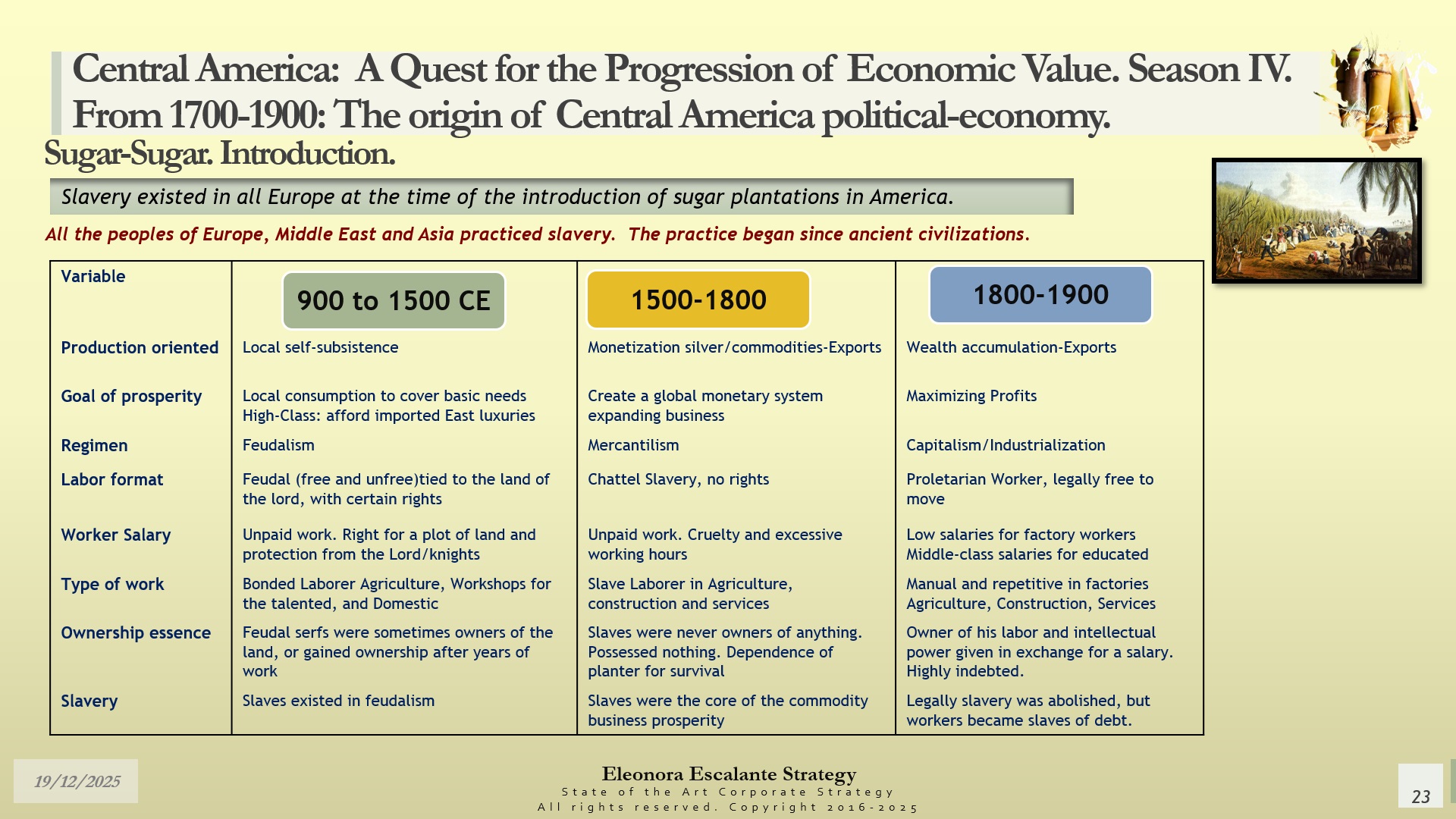
Now, let´s face it. Please. The big issue of all the modern economic systems (capitalism, socialism, and new hybrid mix systems as China, Sweden, Brazil, or Russia) is the foundation of slavery. All these systems have been established over the accepted philosophy of low-cost strategy, jeopardizing the salaries of the lower class. This is also occurring in the design of the current digital AI-based economic digital system. The spiral of undercovered slavery continues. Our business models have not overcome slavery. Even though, legally, slavery was banned during the 19th century, our current strategic premises taught at top business schools since the 1980s hold fundamental patterns of “concealed slavery when they search for cheap labor”, and that is why the digital era won´t work in the long run, either. The idea of an “independent producer” capable of generating more than $200,000 dollars per year in this digital paradigm is sadly a fallacy. Some (a minority of the global population) will attain it for a brief period of years. But the story of sugar comes today, to show us that once a product becomes an ubiquitous commodity, we go back to the same old story of us: reducing wages to cheap labor is slavery. It is impossible to create a world of riches for everyone on earth without a special differentiation strategy. What creates wealth and well-being in human beings is their capacity to formulate a scarce, beneficial, balanced formula of Price x Volume that allows the enterprise to produce profits, while enhancing the quality of life of the employees to a middle-class level, but now on, caring for the environment and the planet. The combo of NAIQIs (Nanotech+Artificial Intelligence+Quantum computing+Internet) kills the differentiation strategy. The combo of NAIQIs destroys excellent education. The combo of NAIQIs obliterates social human competencies such as empathy and trust. Most of the small-medium entrepreneurs are showing off their specialization uniqueness through social media, provoking cannibalization of their own industries and minimizing profits. Additionally, with the gigantic proportions of Chinese imported products at low-cost, the youth in developed poor economies have difficulties staying afloat facing the competition. At the end, to survive, the youth will not have any other choice but to buy the imported Chinese goods and re-sell it for a minimum profit. Is this the society model that we want in the future? If that is our goal for the next generations, then let me reflect a bit more. The history of sugar as a commodity has come as a miracle to shake us to wake up and observe the limits and serious weaknesses of the digital economy
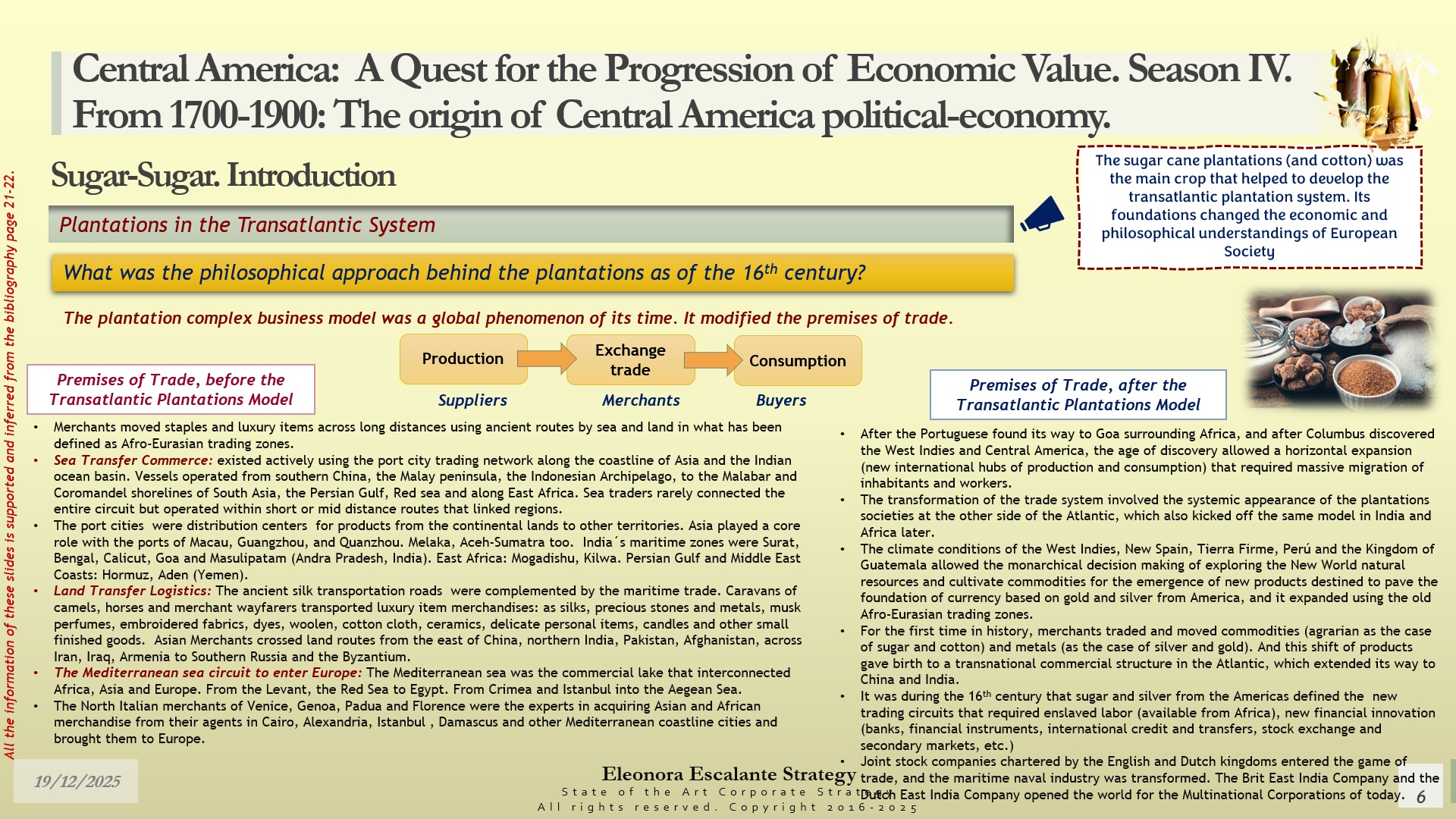
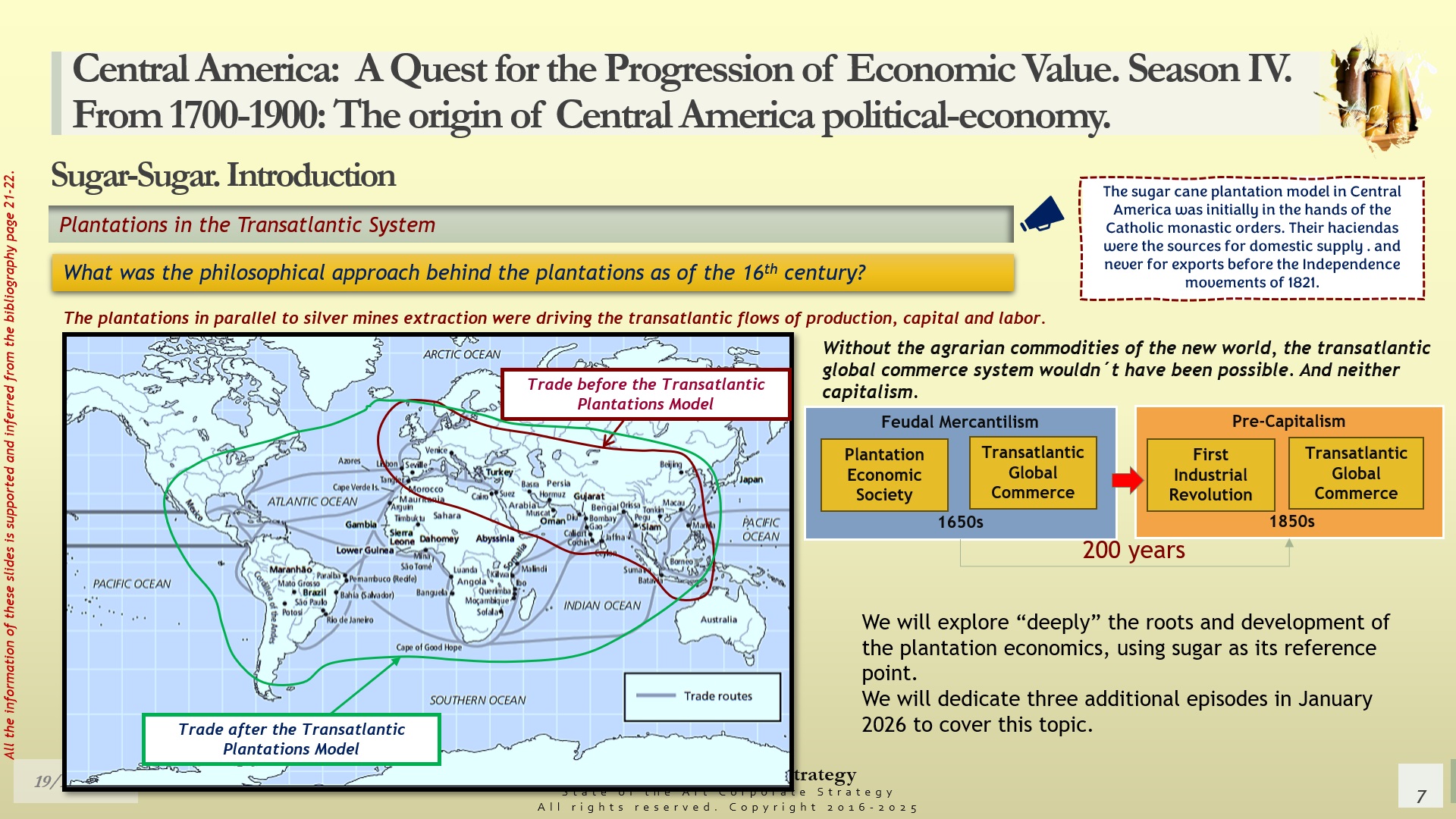
The premises of trade before and after the transatlantic plantation model. Slides 6 to 7.
These two slides are self-explanatory. Our inner debate last week was to make the decision to extend one chapter of sugar to 4 episodes. But we resolved to do it for the benefit of our students. Cacao and coffee plantations also deserved 4 episodes each, but we have already planned the second saga of 2026 called “Coffee and Cacao 101-Strategies for Family Farms and Small Holders,” as an attempt to help small and medium farmers globally (holding between 1 to 10 hectares of land) who are committed to participate in the local, domestic or international marketplaces and make enough profits beyond merely surviving. Be completely sure that our next Season V is the last one of “Central America: A Quest for the Progression of Economic Value”.
Plantations in the transatlantic system. Slides 8 to11.
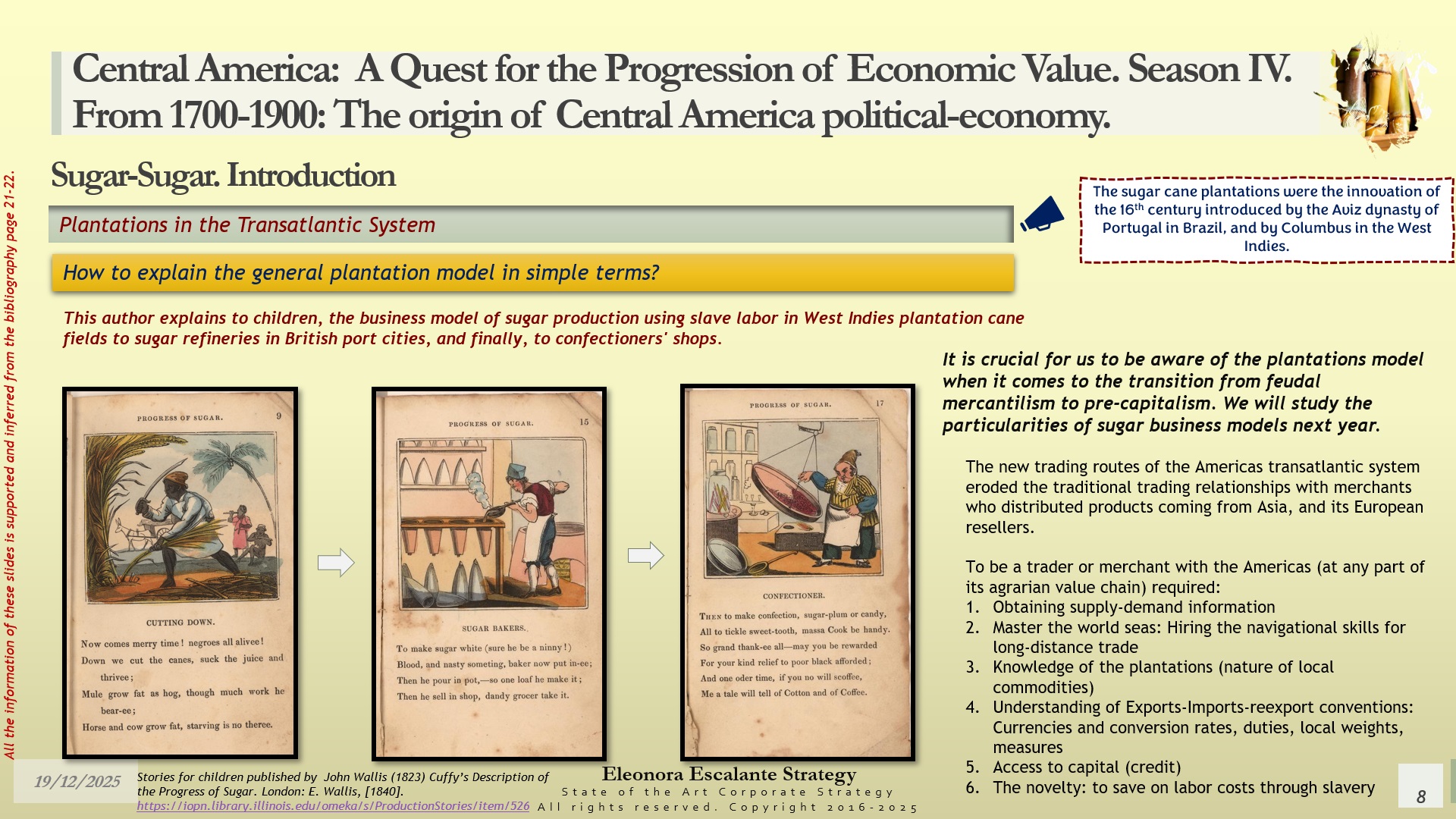
We have researched that sugar cane was historically one of the first plantations that humankind dared to implement using the transatlantic trade system, the mercantilism phase of our memoir. Slide 8 is an effort to define what has been assembled as a definition of a plantation, and what characteristics must be in place to be considered as one. The sugar cane plantation and its respective simple value chain held different business models. We can find subtle but organic differences between the Portuguese Brazilian model, in comparison to the Cuban Spaniard, or the British-West Indies, or the Dutch-Java model. It was the same plant, but the how and expertise of its value chain processing were on a different journey. We will explore these models next year. See slide 9. In general, six factors defined the plantation business model:
- The labor force was instituted by racism,
- Cruel Enslavement (mainly African),
- Lack of Occupational security measures,
- Led by trading merchant enterprises (backed by the State) for profit,
- Crossing oceans (maritime) to serve distant markets (exports to Europe),
- Backbone of colonial societies.
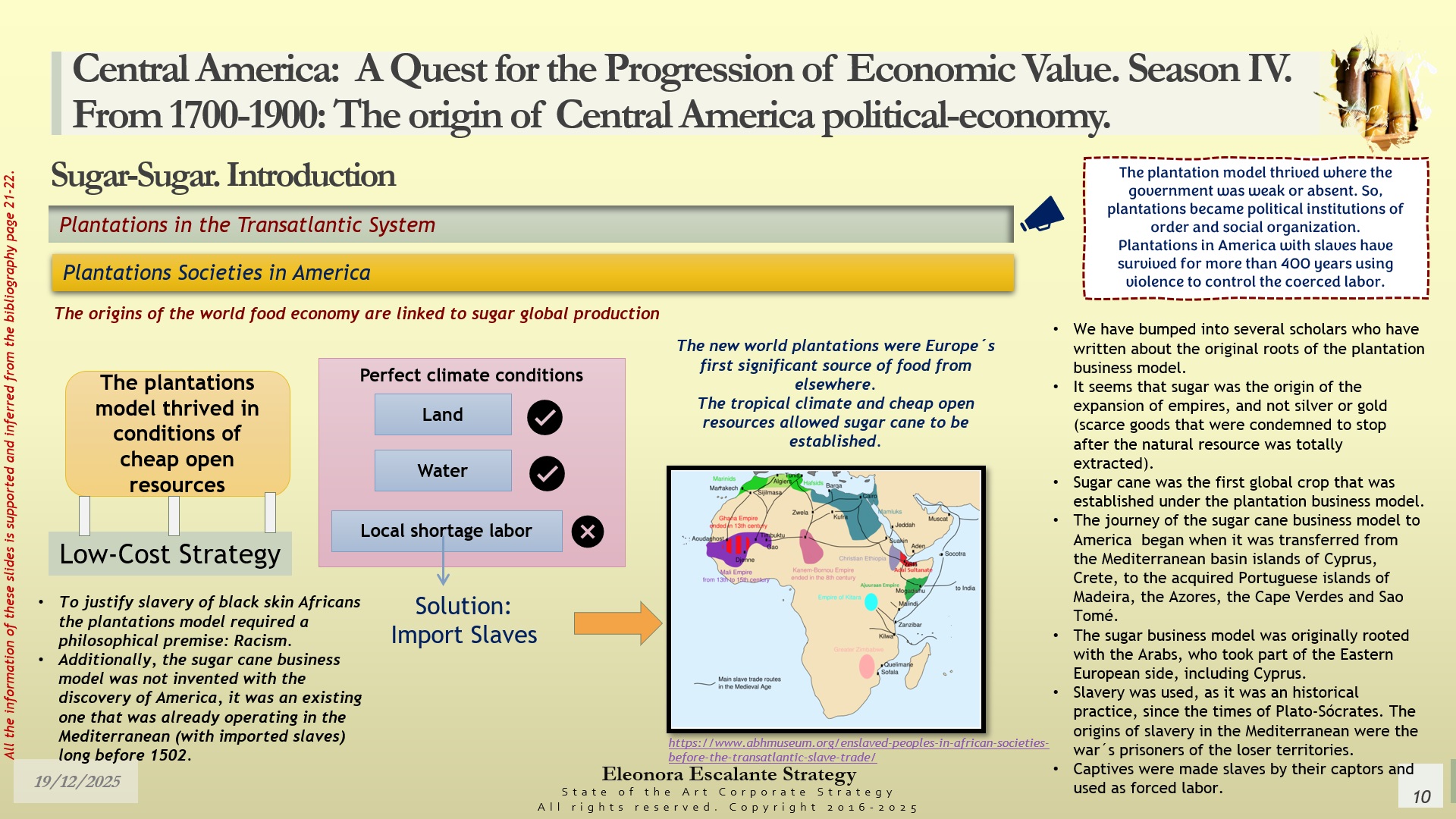
Low-Cost Strategy was the essence of the plantations model. Slide 10. The plantations model thrived in conditions of cheap, open resources. The land was enormous in the American continent. Water was overflowing in tropical regions near the Equator. In consequence, what was missing to make sugar (or cotton or tobacco) a low-cost commodity was cheap labor: To keep the business model inexpensive, it was imperative to reduce the costs of human labor to a minimum. And this is how slavery was used. To justify slavery at a religious and philosophical level, the elements of white supremacy founded in racism were the logic to follow.
Slide 11 is our attempt to show you a faithful comparison between the planter (owners of the British plantations, usually feudal lords submitting their loyalty to their king at the other side of the Atlantic, or the encomenderos of Spanish America before independence, or the engenhoes lords of Brazil), and the African slaves. These elements of comparison were condensed for your detailed understanding of the situation. If you see any parallel between this situation and the prospect of digital modern slavery that will come, do not think it is a coincidence. We are dragging the same premises of our corporate and business strategic frameworks of the past, but now under other high-technological circumstances. Artificial Intelligence is downloading the uniqueness of human talents to null. No entity will pay a super-educated human to do something that takes a year of research for $ 150,000 dollars if Artificial Intelligence can do it in 2 seconds for free. The middle class that emerged during the 20th century was the result of years of education under excellent university standards. Nowadays, all that is gone. NAIQIs have been replacing professors, NAIQIs have been substituting experience, NAIQIs have been degrading the Gen Z student brains, NAIQIs have been spoiling the good journalism, and NAIQIs have already begun to decrease the salaries of all the professional middle-class. And this, in less than a decade. A powered AI software replaces hundreds of Silicon Valley professionals in less than a year, as much as a Generative AI program replaces hundreds of human authors and editors who were able to enter the middle-class American frame in the past because of their good writing skills. (Remember NAIQI is the acronym of devices and apps powered by Nanotech+Artificial Intelligence+Quantum computing+Internet)
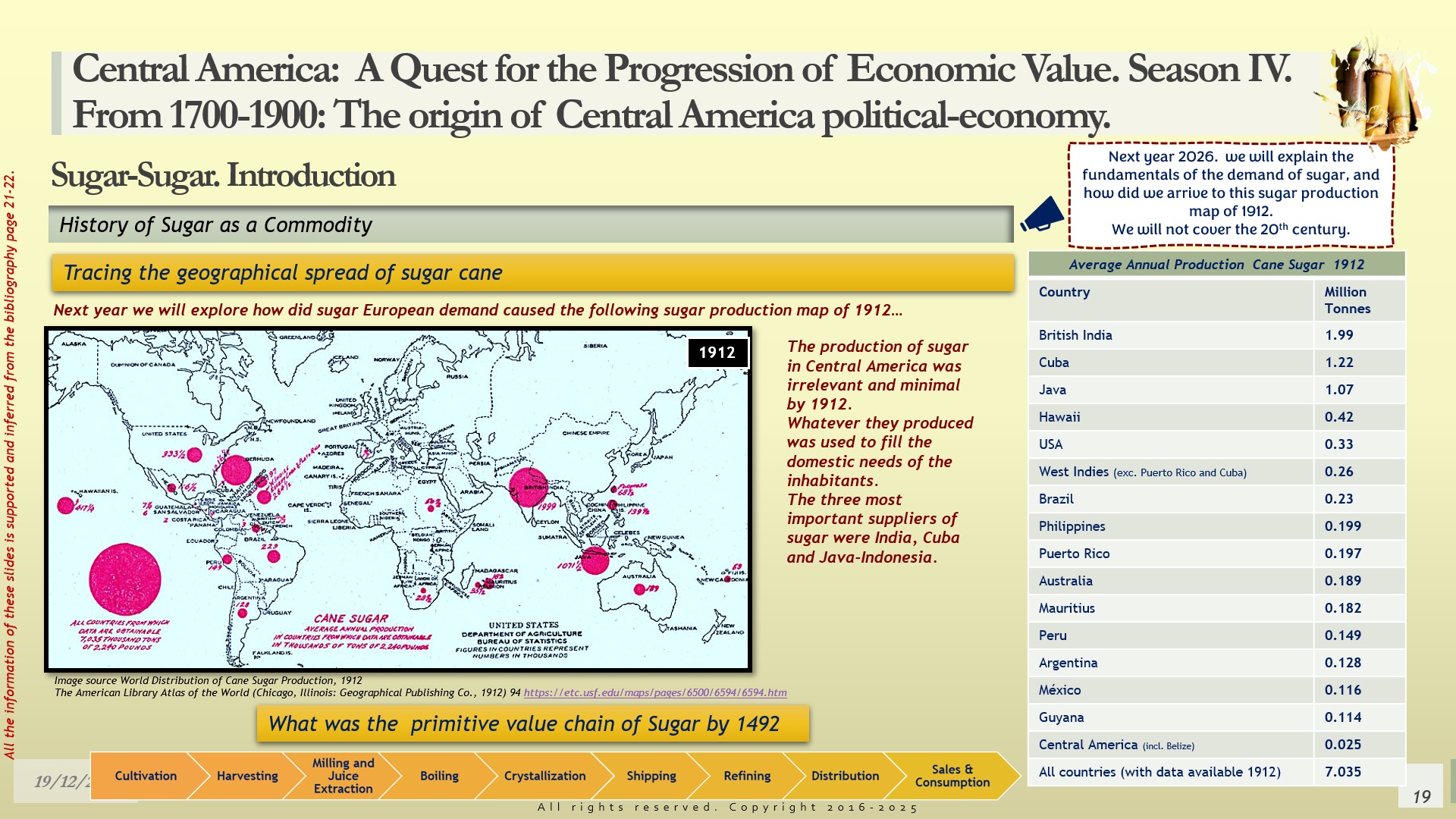
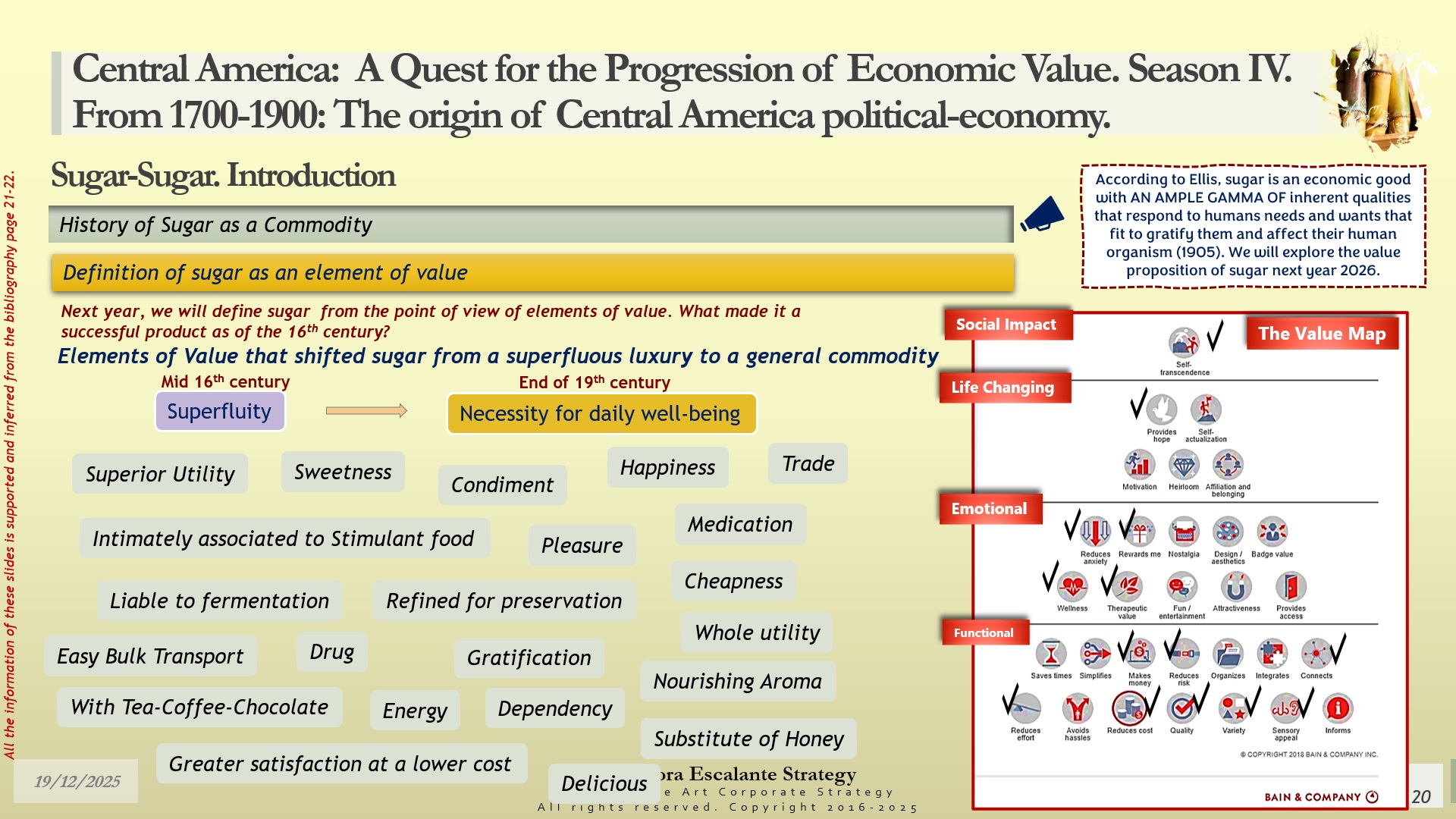
History of sugar as a commodity. Slides 12 to 20. We have gathered the information available about the history of domestication of the sugar cane from its original roots in New Guinea, up to the year 1500s, when the Portuguese kingdom planted sugar in the Madeira Islands. We believe all these slides are self-explanatory. Read them again, please.
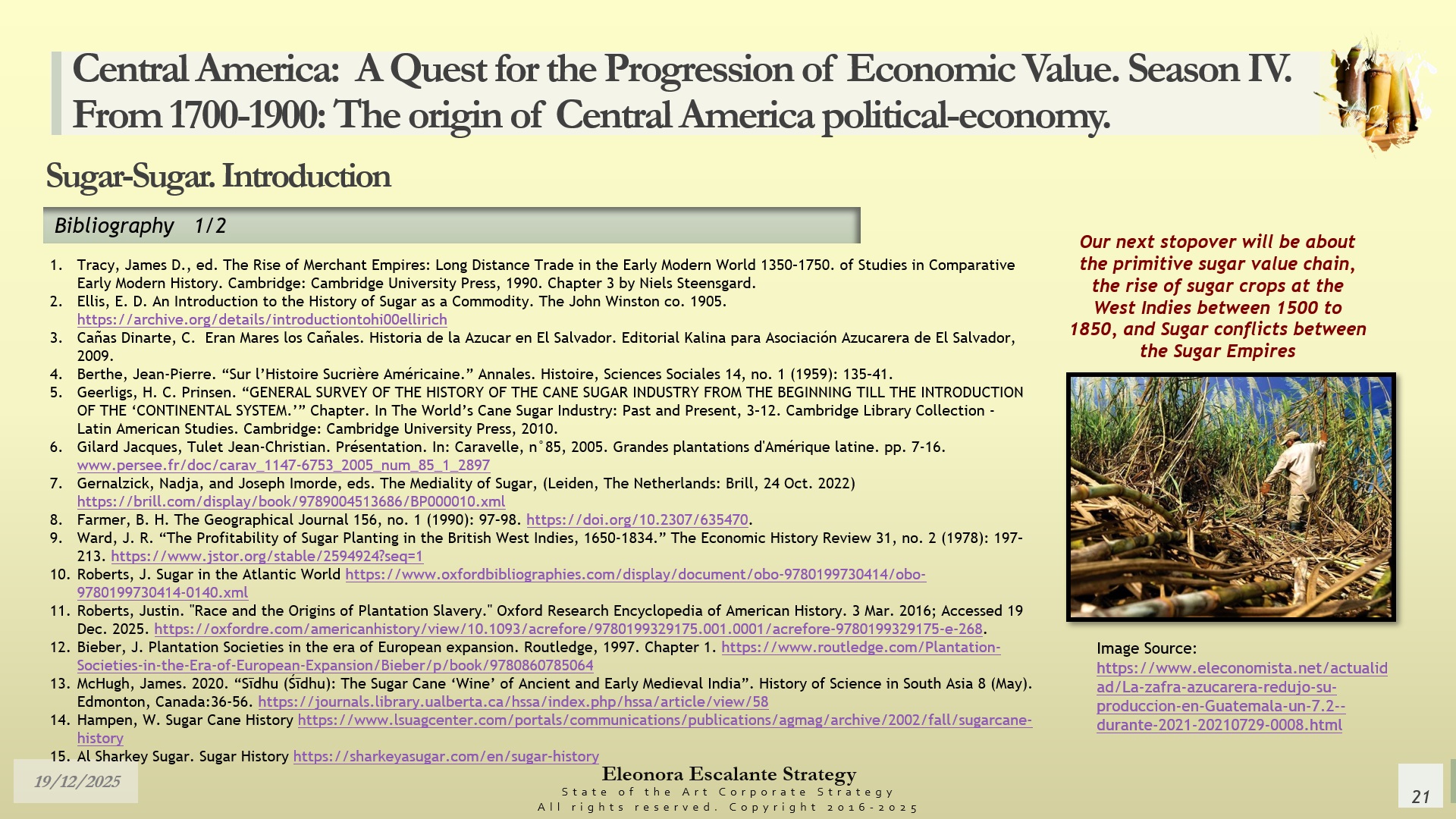
Announcement. This is our last publication of the year 2025. We are grateful for your patience. It has been a long year, full of bumps, surprises, and challenges. I also need to take a mandatory break for personal replenishment and well-being. I truly need to stop reading 300 pages of academic books and research papers per week during these vacations. I will be back at work on Monday, January 5th, 2026. Our first publication of Season V will be on Friday, January 9th. Our next chapter, the first one of season V, will be about: a General Discussion about the primitive sugar value chain (before the Industrial Revolution), the Rise of sugar crops in the West Indies between 1500 and 1850, and the Sugar conflicts between the Empires.
Closing words.
This chapter is the result of a reflection. We can´t close this saga without extending it into Season V. We are going to explore the roots of the low-cost strategy, using sugar plantations and bananas. Sugar was never a relevant crop in Central America until the 20th century. Consequently, we will explore the Caribbean (West Indies) to fulfill the requirements of the study period (1700-1900). This chapter is an introduction to the plantation agriculture in America, and how sugar plantations and their processing voyaged from New Guinea to the Caribbean. We have detected how and when slavery was introduced in the sugar production business model of the Mediterranean locations ( between 900 and 1300 CE), and why this model was so determinant in the replication of it in the New World by the Spaniards and Portuguese.
Thankful wishes. We wish you a joyous and wonderful Christmas celebration. Thank you so much for reading our saga in 2025. There is still more to come, and we truly expect to finalize it in March 2026. Gracias por todo.
Musical Section.
During season IV of “Central America: A Quest for the Progression of Economic Value,” we introduced several young guitarists to our audience. We appreciate their presence in this master-class saga. Thanks so much for accompanying us during the fall-winter season. However, for next season, V, we will return to classical camera orchestra compositions.
We wish to close the work of the year with a lovely collection of instrumental Christmas carols grouped by HalidonMusic. Enjoy!
Thank you for reading http://www.eleonoraescalantestrategy.com. It is a privilege to learn. Blessings.

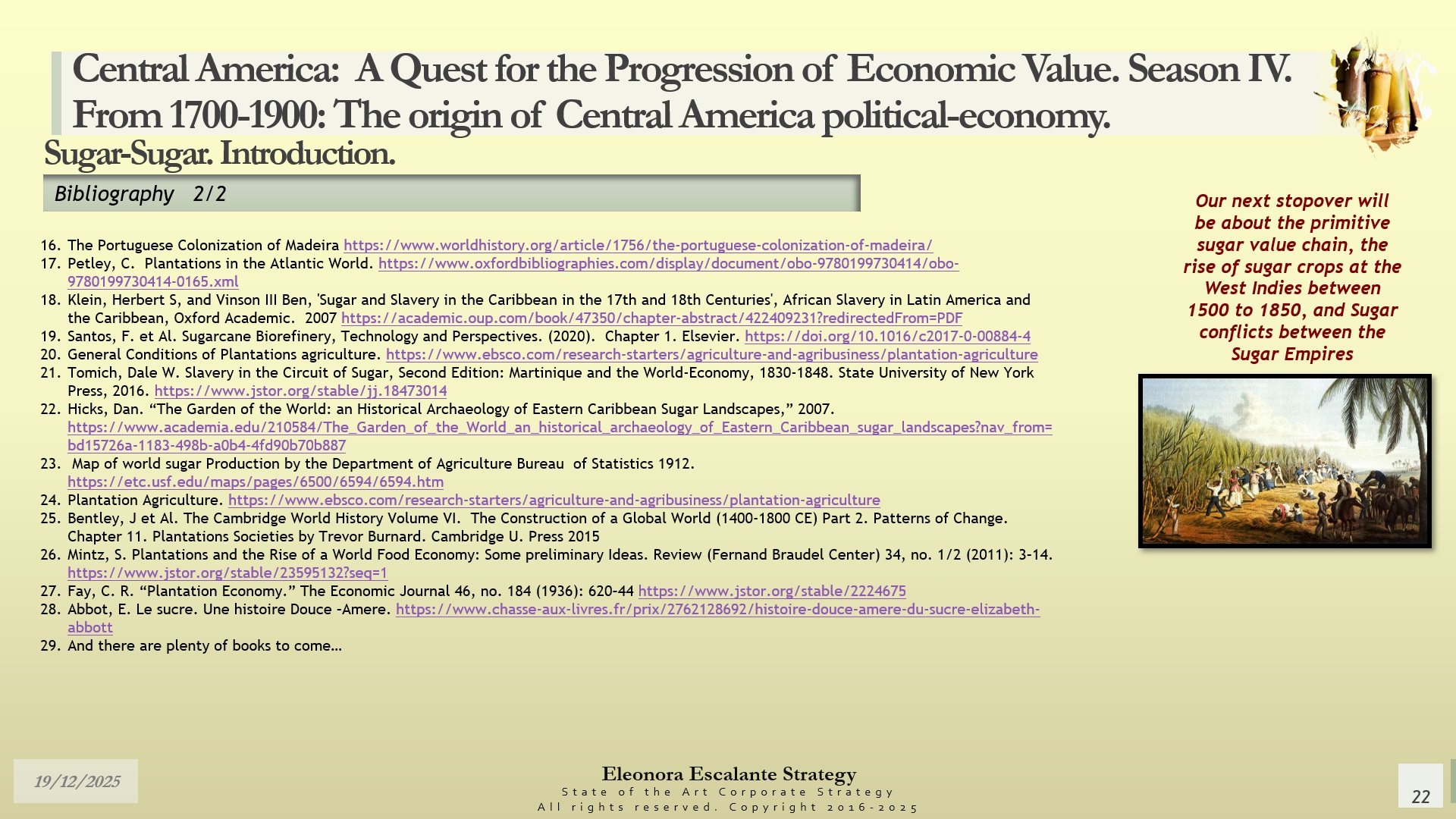
Sources of reference and Bibliography utilized today. All are listed in the slide document. Additional material will be added when we upload the strategic reflections.
Disclaimer: Eleonora Escalante paints Illustrations in Watercolor. Other types of illustrations or videos (which are not mine) are used for educational purposes ONLY. All are used as Illustrative and non-commercial images. Utilized only informatively for the public good. Nevertheless, most of this blog’s pictures, images, and videos are not mine. Unless otherwise stated, I do not own any lovely photos or images.
 Eleonora Escalante Strategy - Strategic Reflections Think Tank