
Central America:A Quest for the Progression of Economic Value. Bonus-Season V. Episode 4. Sugar-Sugar America, Part 4.The British Sugar Model Barbados.
Dear precious readers:
Today, we will continue our exploration of the British Sugar Islands business model from the 17th and 18th centuries. Initially, we thought of formulating a unique business model for the sugar plantations. However, we were interrupted in our discovery journey. The trade of the British Atlantic was not following a unique recipe of functional activities. We analyzed the differences in relation to four variables. These variables are time, land & slave trade ownership, slave labor, and access to credit for paying for the slaves. In general, we have discovered that Britain stimulated different models, because all these variables were changing over time. However, the most relevant of them depended on the degree of financial access to credit. This credit was needed to pay for African slaves. We also decided to concentrate our efforts on two islands: Barbados and Jamaica. Initially, with Barbados, the British Empire kicked off its model during the 17th century. Then it was the turn of Jamaica, which was not designed as a monocultivation model, as it was Barbados. We want to clarify that our strategic house is against any form of human slavery, and we are studying this topic “just” to comprehend the philosophical roots utilized in the past to create the current business modeling tools.
Our strategic reflections from last week were postponed last Monday. We aimed to be fully ready with a better overview of the sugar trade situation in the West Indies region. Our students need to be aware that our approach to teaching is in “fast-track mode”. We are advancing higher, every episode over episode. When we are searching for all the information, we discover a plentiful set of clues. Our quest is to find more answers to the facts described by historians and economic specialists of the epoch. We spend many hours finding and filtering the right information. My academic peers have made this information available. They have done incredible research about the sugar trade by each colonial empire. This has been done despite the lack of all the historical data that assists us in understanding what truly happened. Our mission with this saga is to unfold and discover the philosophical roots of the mistakes of our current theoretical business model frameworks. These have been taught to all of us at the top business schools since the 1980s. We intend to change them little by little for the next generations.
Our agenda for today:
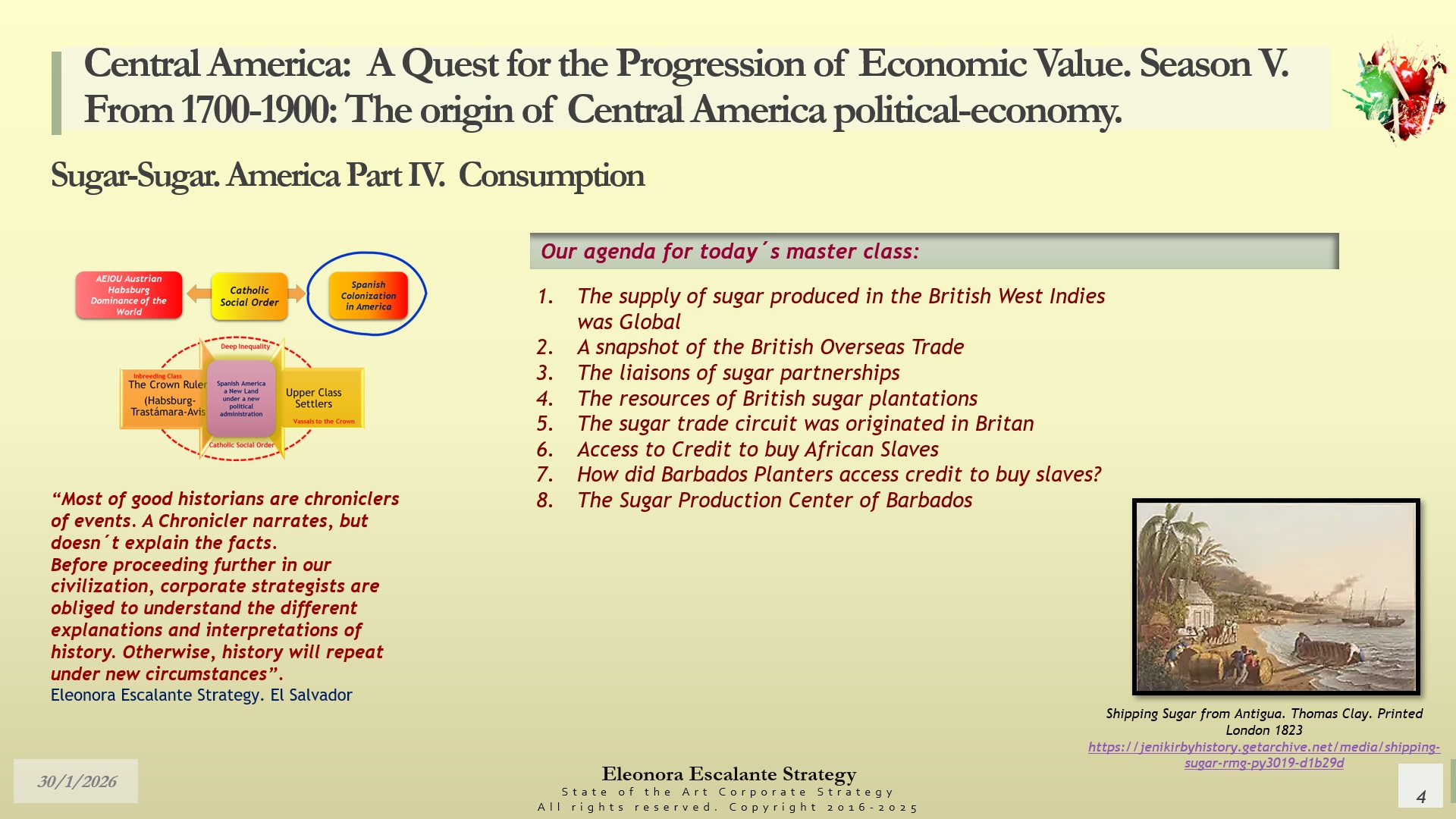
1. The supply of sugar produced in the British West Indies was global
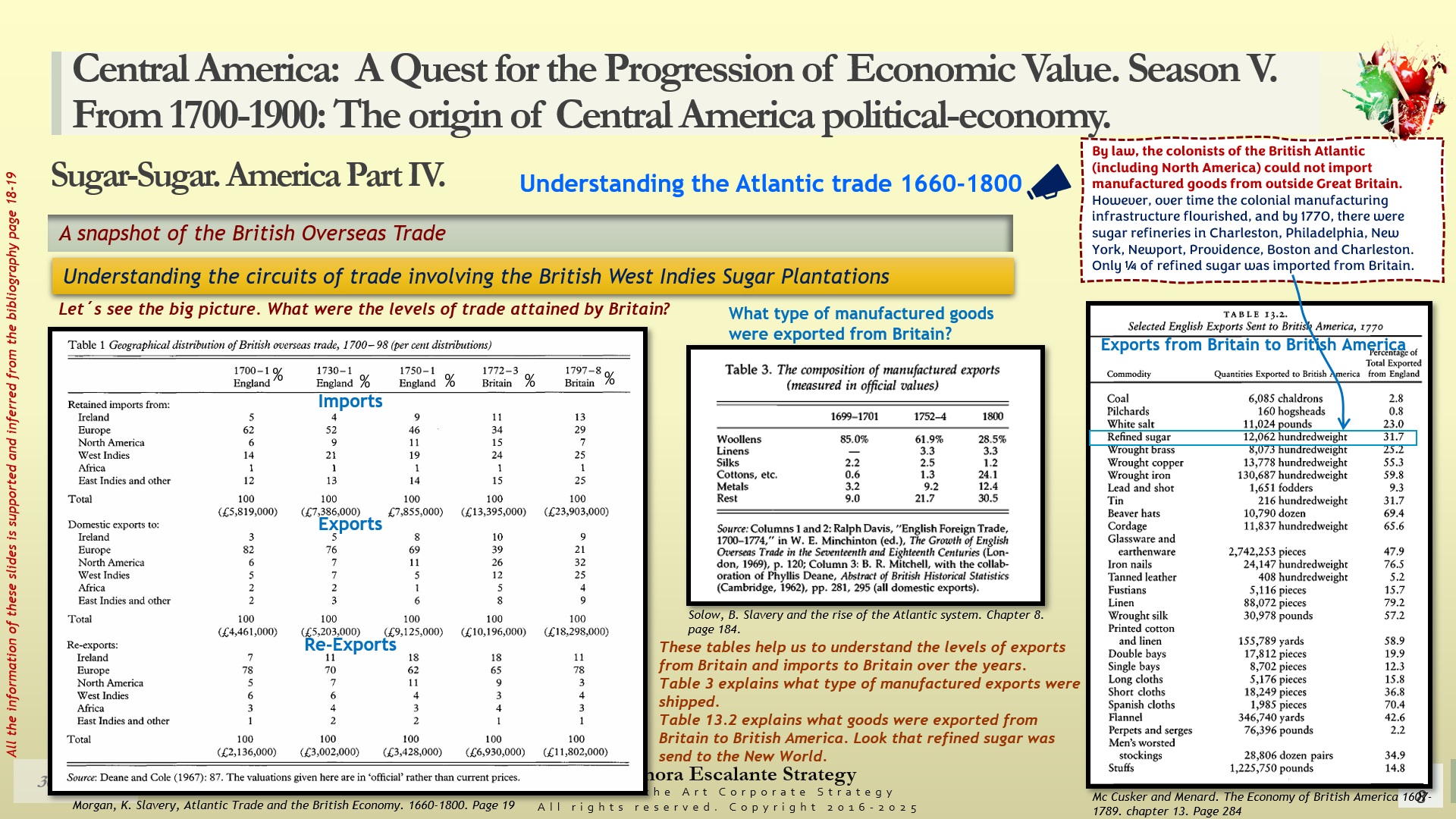
2. A snapshot of the British Overseas Trade
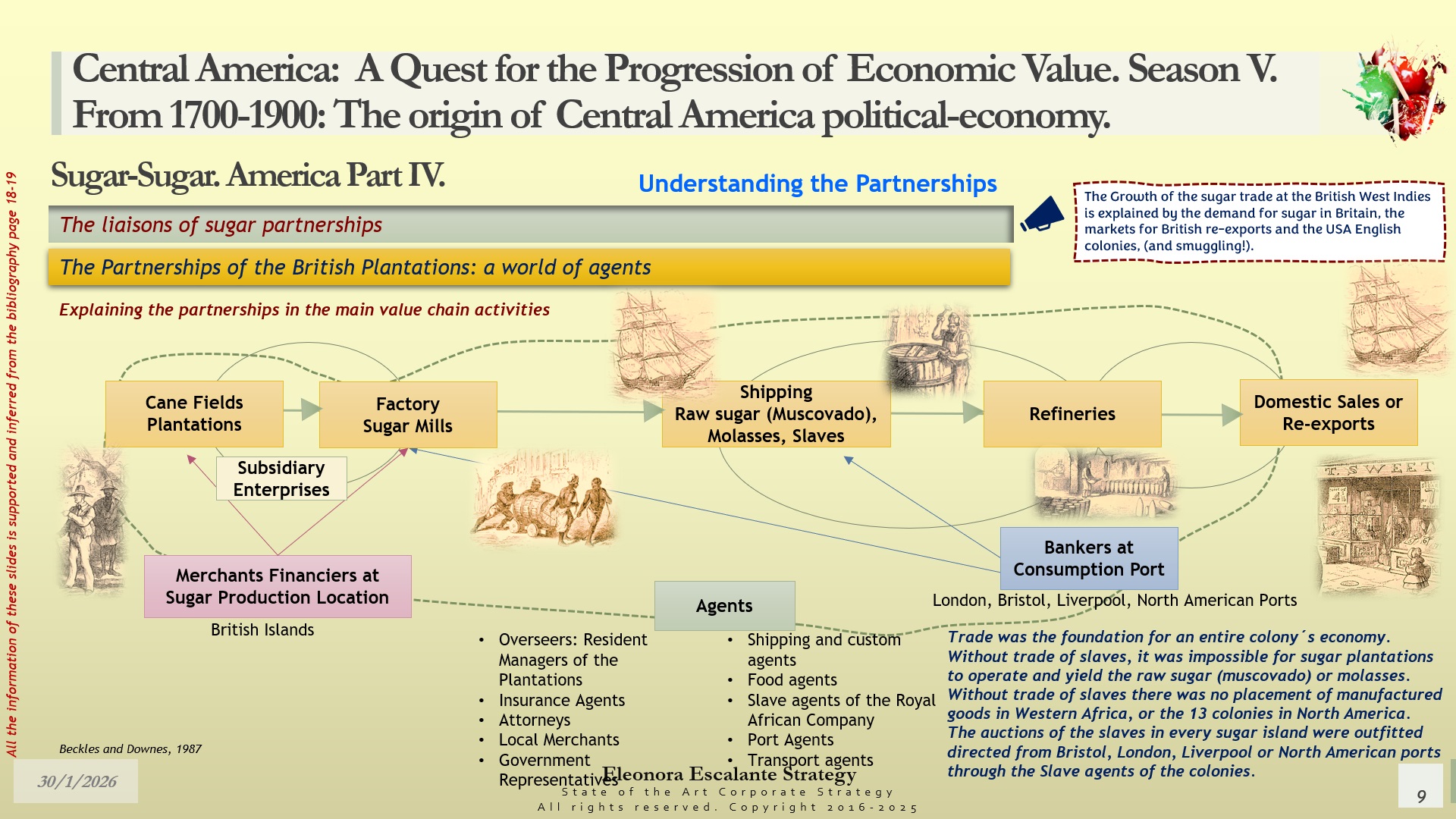
3. The liaisons of sugar partnerships
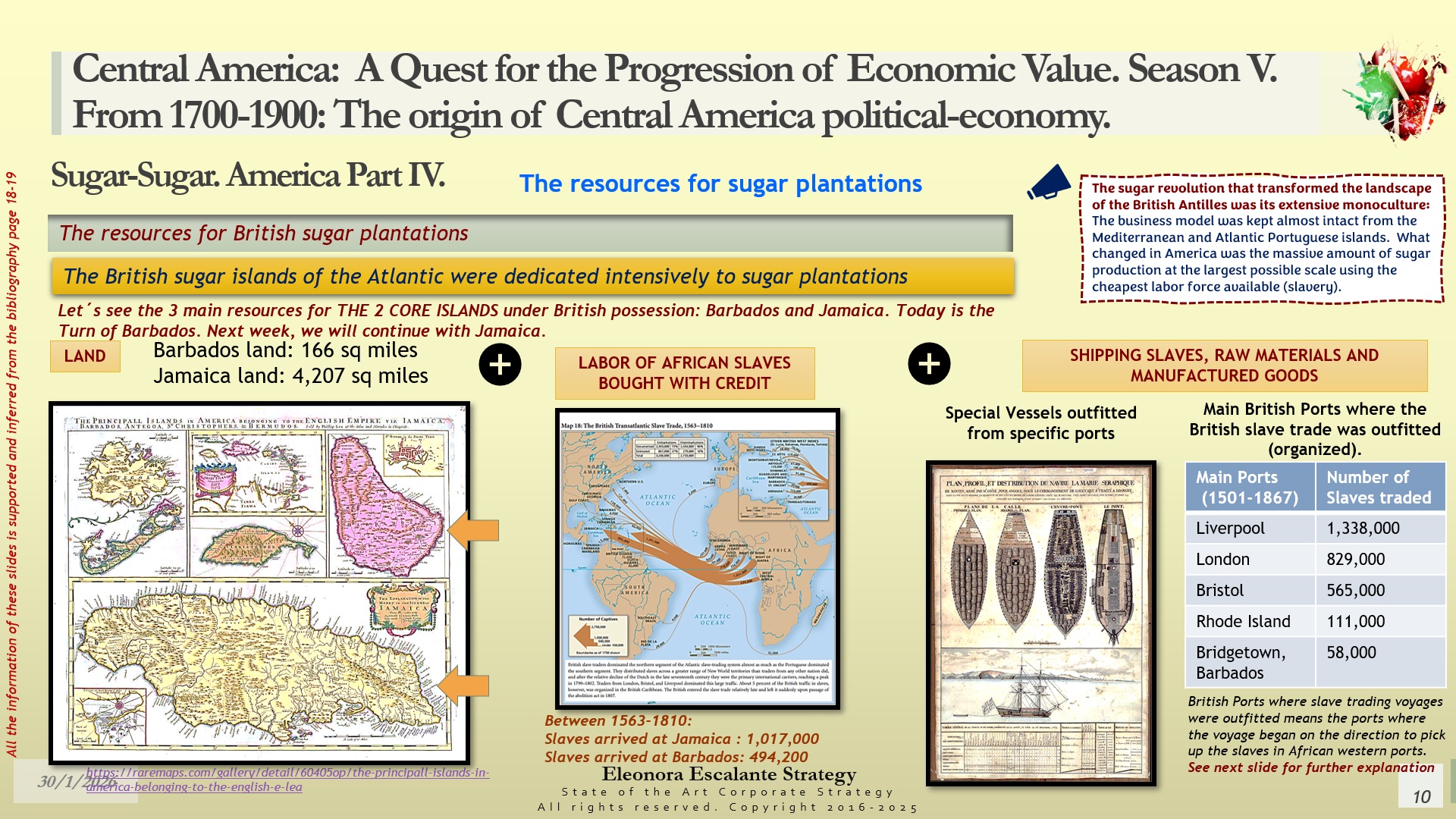
4. The resources of British sugar plantations
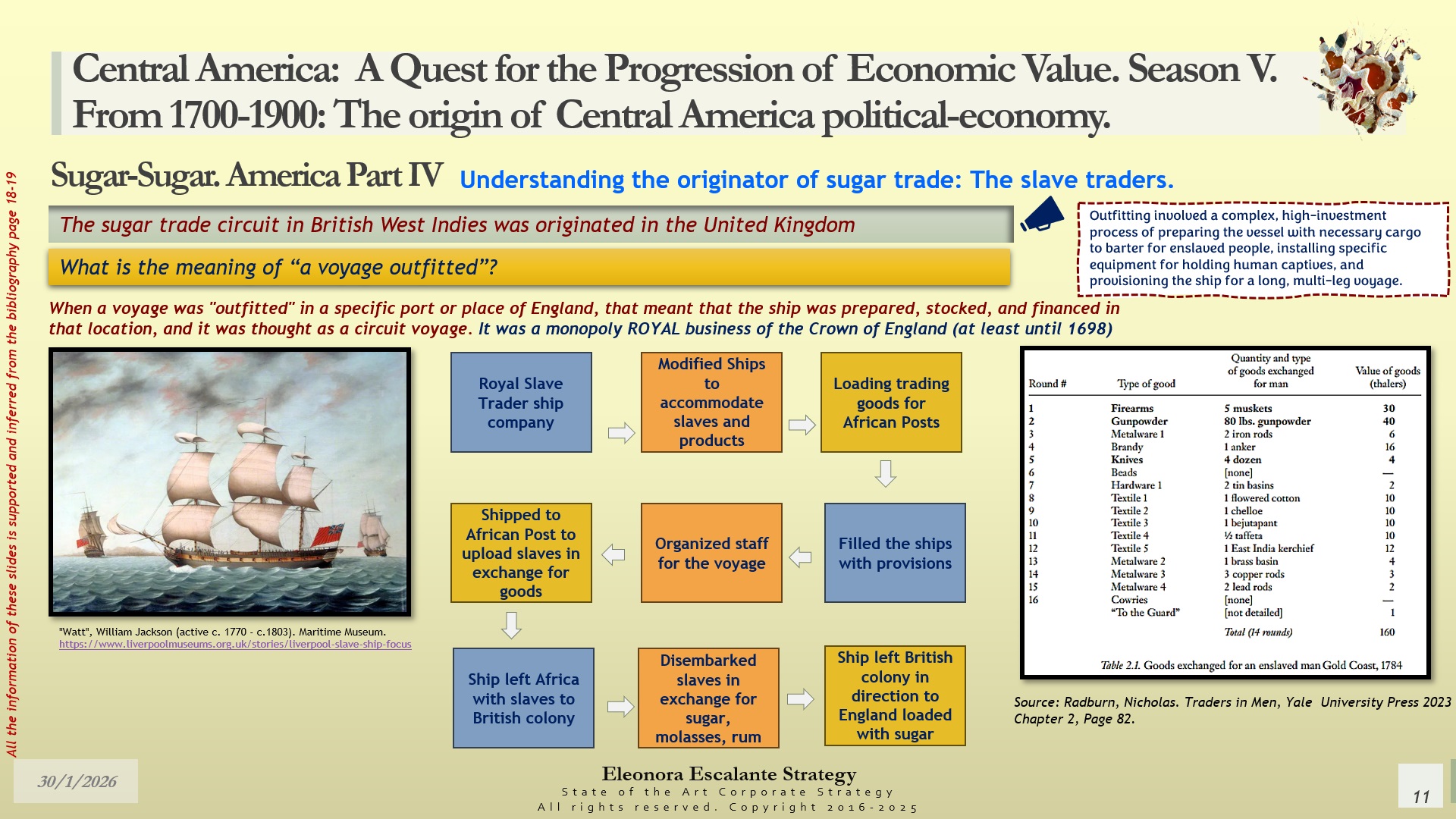
5. The sugar trade circuit originated in Britain
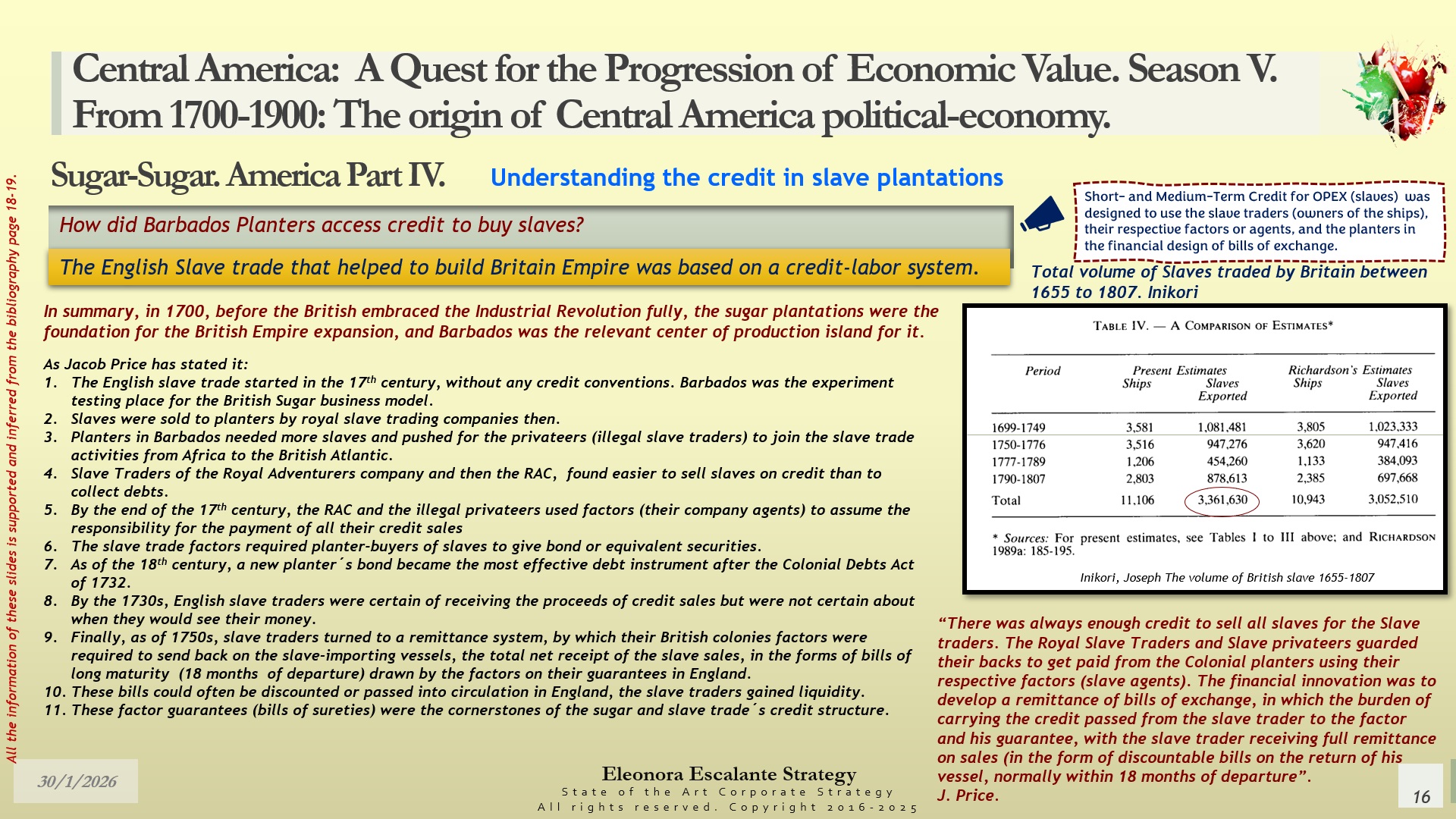
6. Access to Credit to buy African Slaves
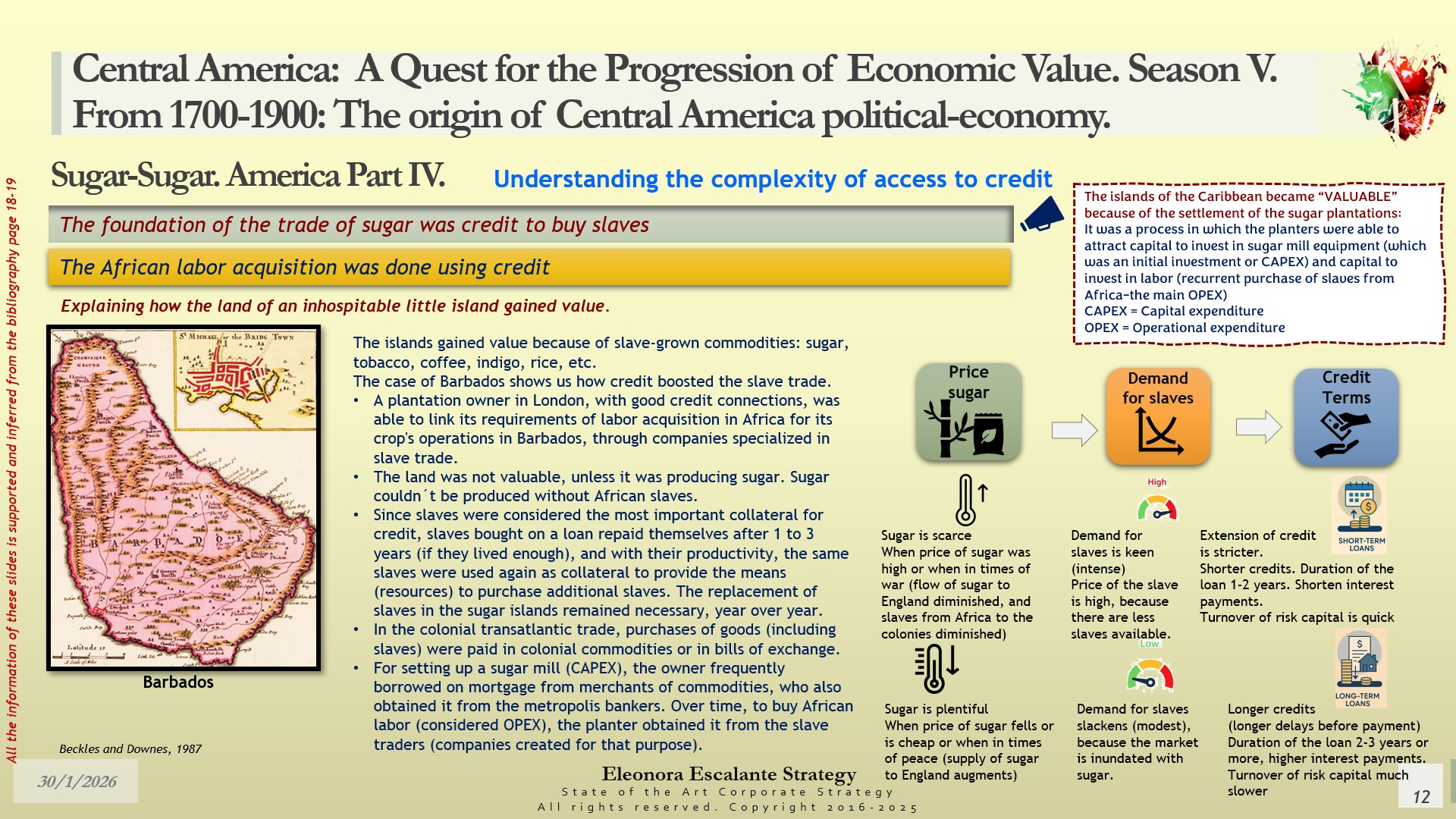
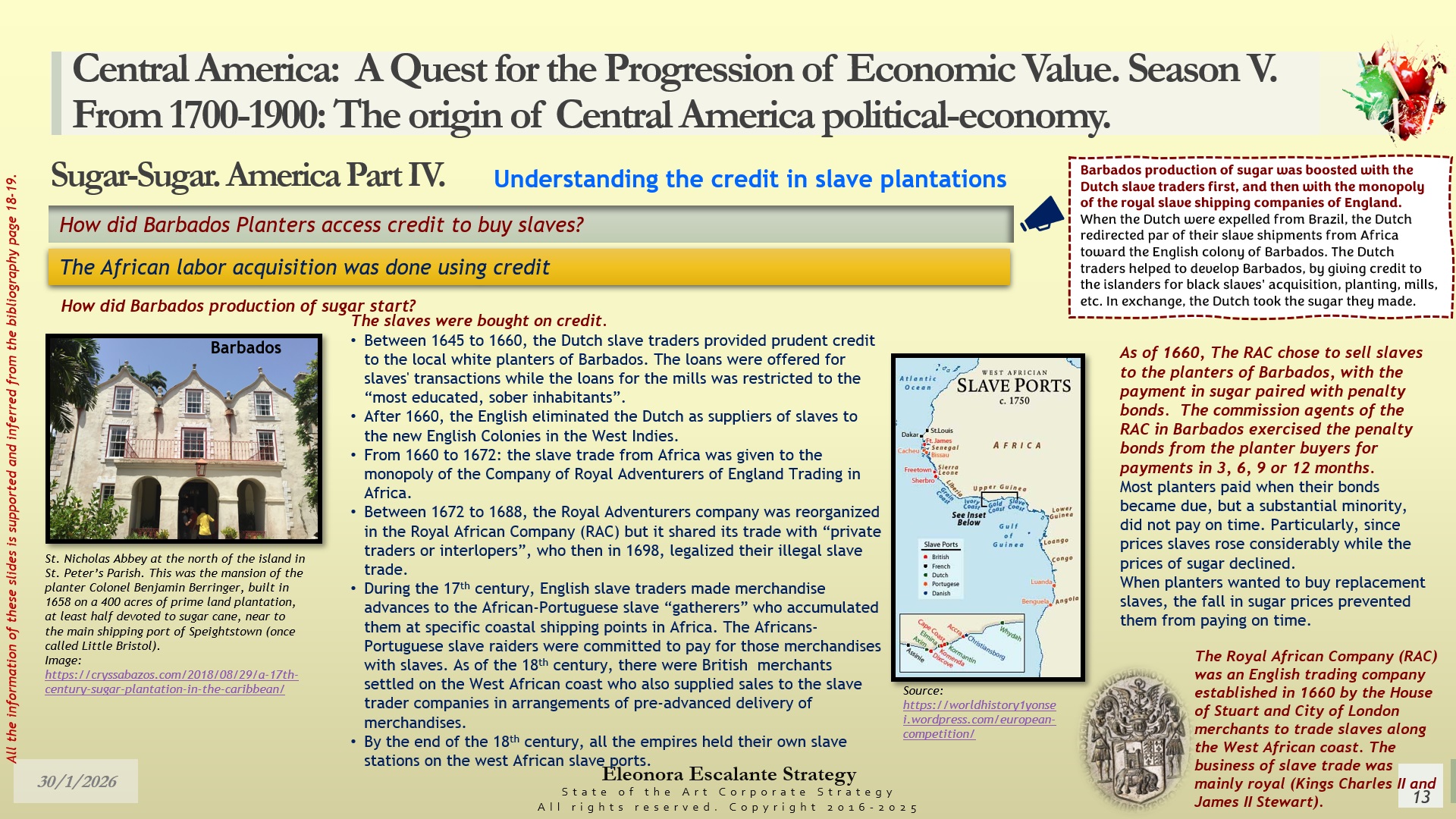
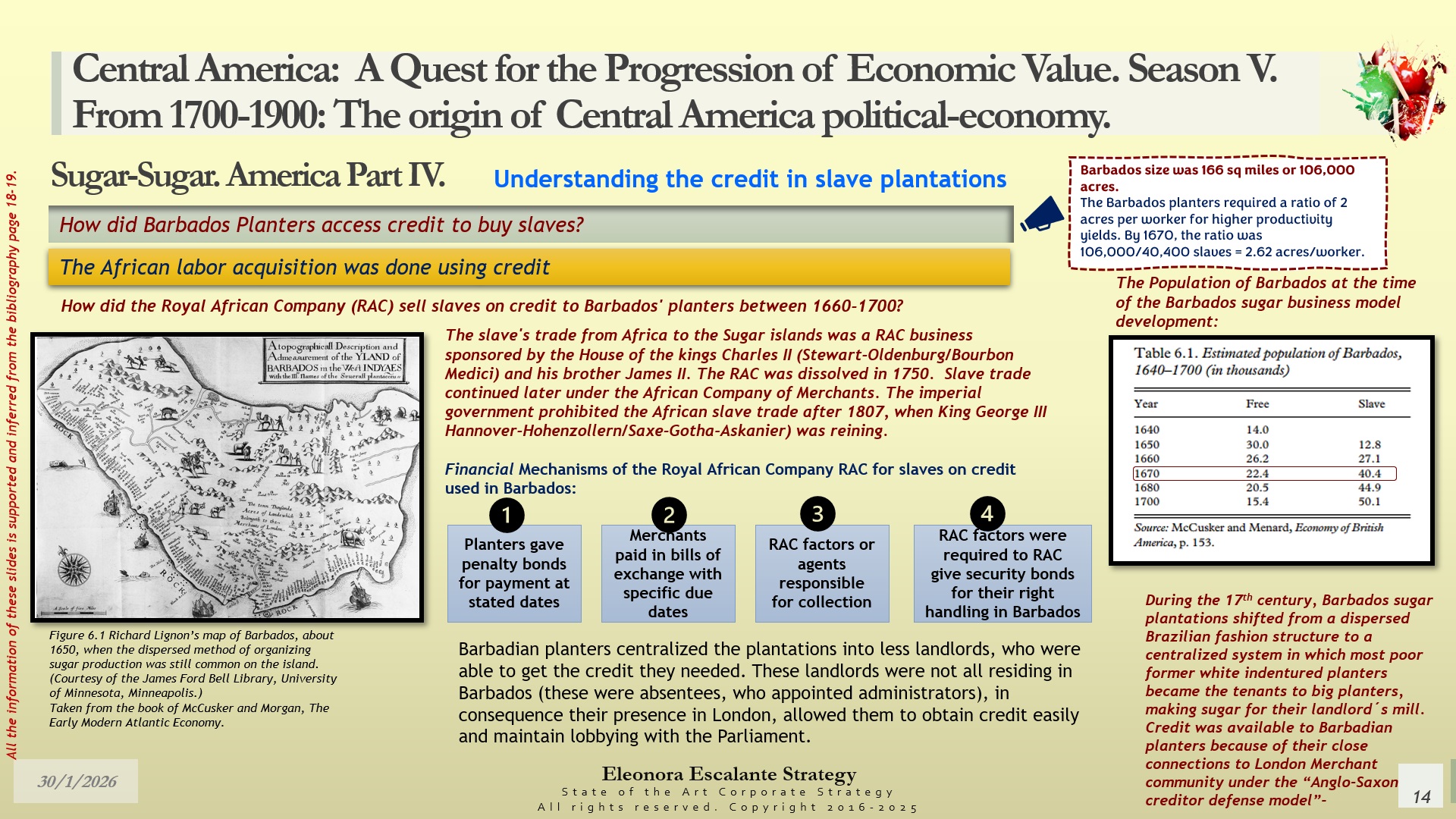
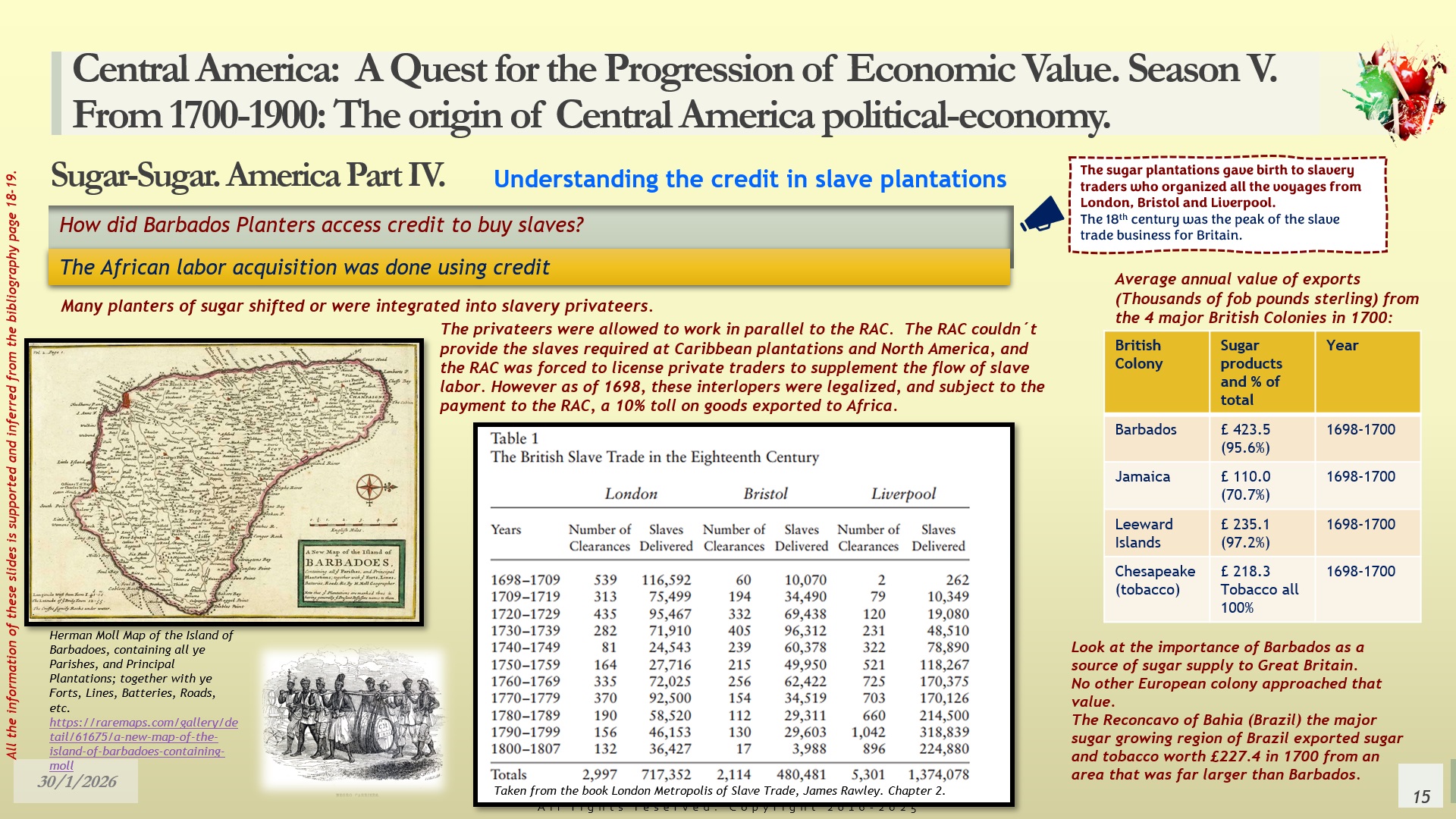
7. How did Barbados Planters access credit to buy slaves?
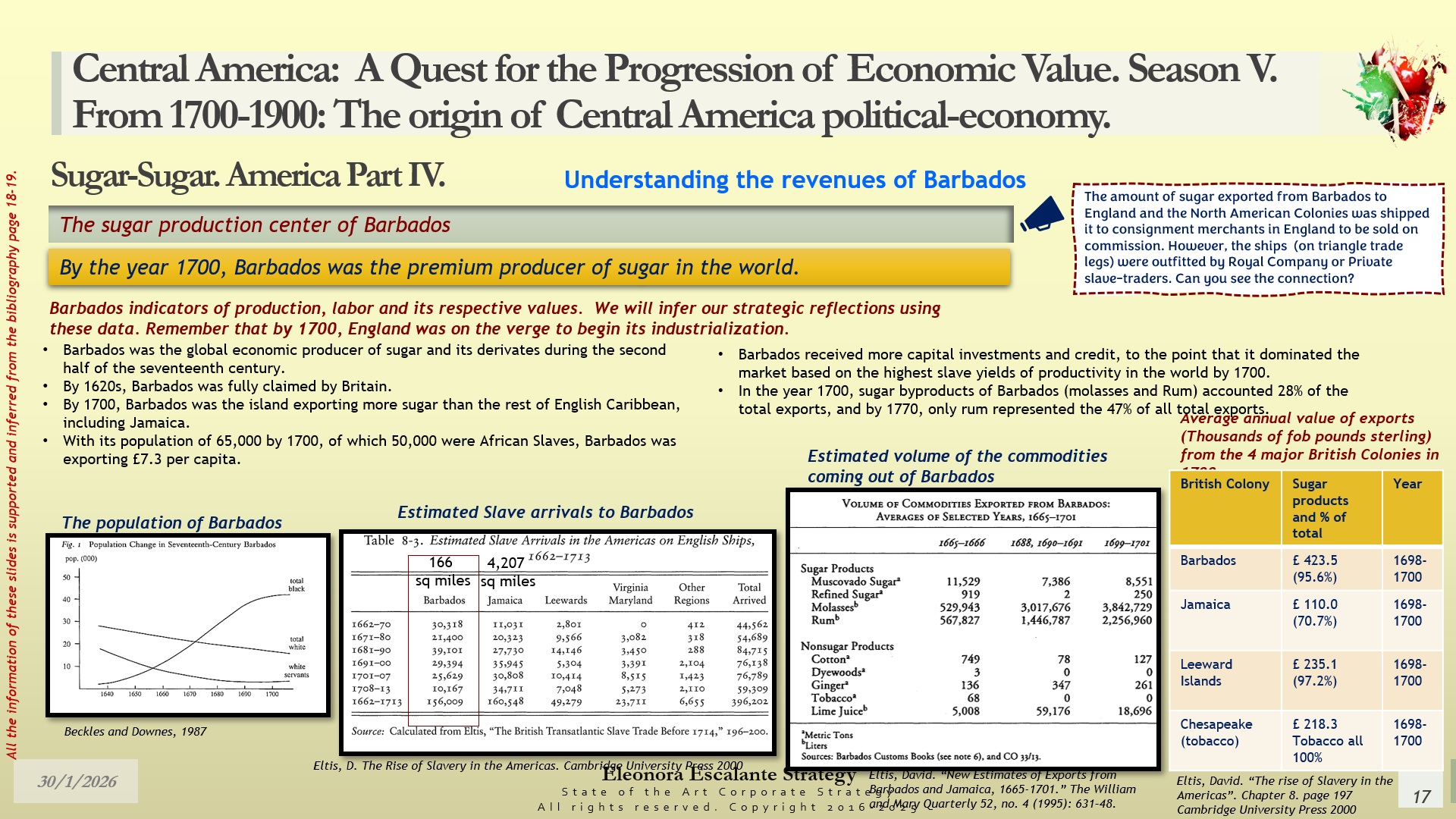
8. The Sugar Production Center of Barbados
As usual, we encourage our students to read our slides. This package of information aids our study. It helps us prepare for our Monday strategic reflections. These are always uploaded then. Feel free to download these slides in PDF. Print them out and write your notes and questions on paper. Discuss with your professors, friends, colleagues, peers, and family. Let´s do it with dedication and lots of energy.
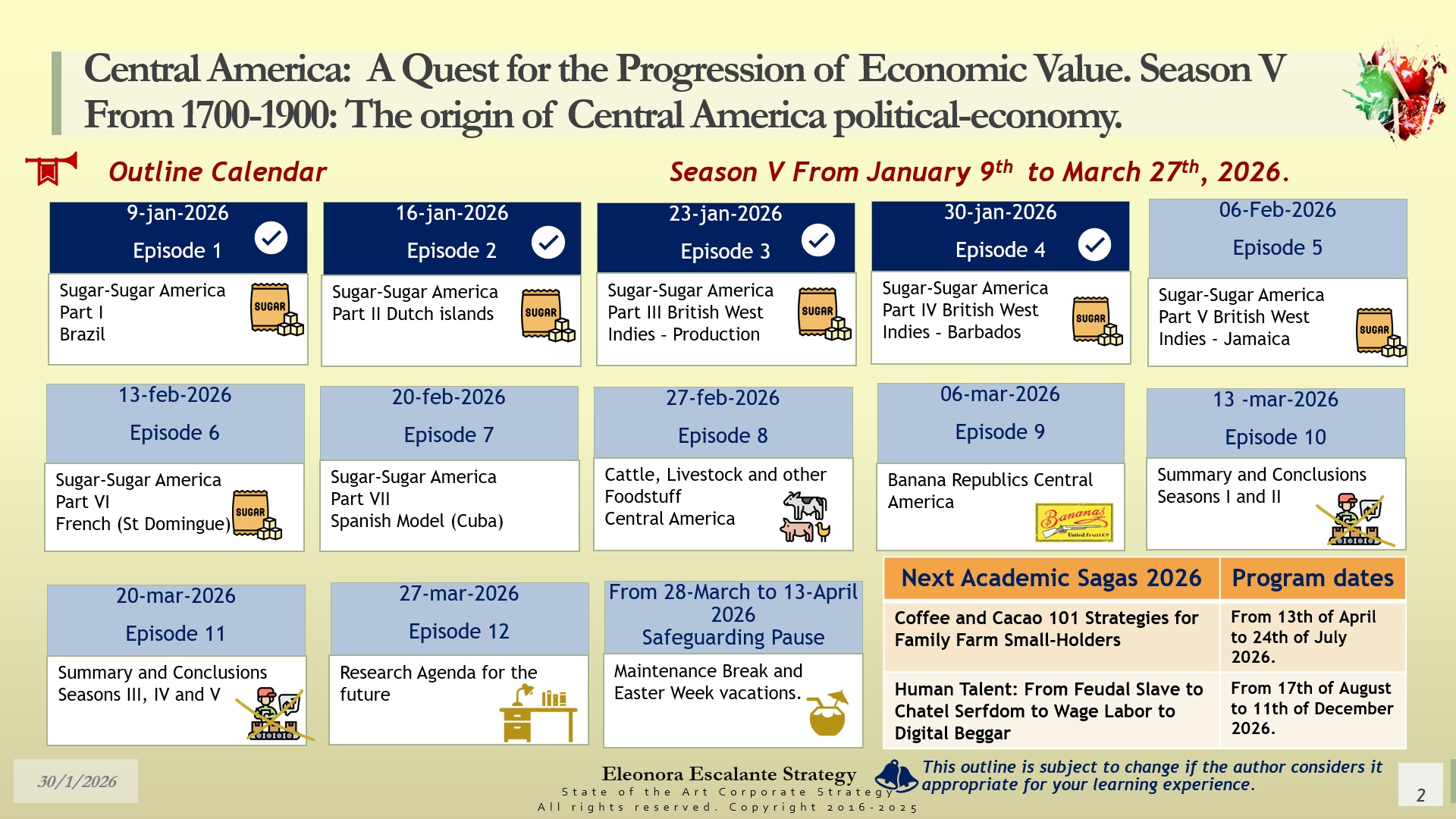
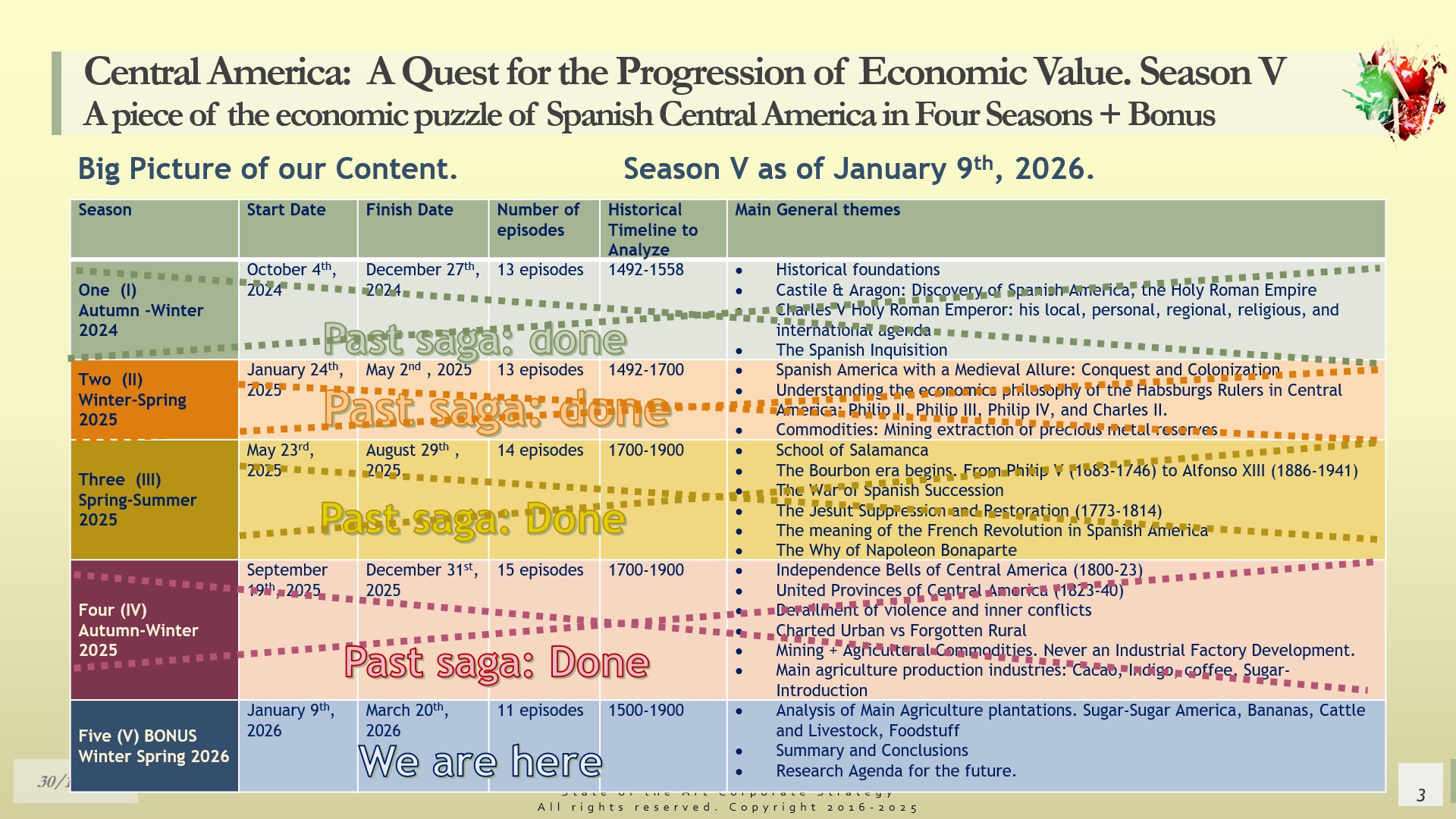
We kindly ask that you return next Monday, February 2nd, 2026, to review our extra strategic reflections on this chapter.
We encourage our readers to familiarize themselves with our Friday master class by reviewing the slides over the weekend. We expect you to create ideas that are or are not strategic reflections. Every Monday, we upload our strategic inferences below. These will be discussed in the next paragraph. Only then will you be able to compare your own reflections with our introspection.
Additional strategic reflections on this episode. These will be in the section below on Monday, February 2nd, 2026.
Public domain. Illustrative and non-commercial GIF image. Used for educational purposes. Used only for the public good, informative for this class.
Strategic Reflections on “Central America: A quest for the progression of economic value. Bonus Season V. Episode 3 and 4. Sugar-Sugar British Atlantic – Barbados.
Dear readers, we are publishing today our philosophical strategic reflection, accumulated strategies from the last two weeks.
To learn about the history of sugar in the British Atlantic region is to comprehend the history of the foundation of the hegemonic British Empire.
The importance of sugar plantations in the Atlantic is beyond reading a simple theoretical analysis report. It is in the sugar business model implemented in the West Indies territories, where the roots of capitalism took place. It is in this moment of time that Adam Smith unapologetically wrote the philosophical elements used later for the further industrialization wave of Britain and the United States of America. Adam Smith (1723-1790) was a Scottish moral philosopher who dared to write about free markets in the time of the sugar mercantilism apogee, beneath an explicit recognition: “British West Indies sugar plantations were more profitable for Britain than any other cultivation that was or has ever been known in Europe or America”. (1) When Smith stated this idea, he acknowledged that sugar high profits, accrued to the sugar planters in the period of 1749-75, were clearly elevated. Sugar was a core business in comparison to the rest of Britain’s centers of production. If a professor of moral philosophy located in Glasgow was able to perceive this, at the exact moment at which the territorial epicenter of conflict was taking place in the Caribbean, that is clearly a bold sign. Let´s shove a little bit more.
Strong British Expansion in the Caribbean. See slides 5-6 from Episode 3. Between 1748 and 1815, a Seven-Year War occurred (1756-63), and Britain was able to gain Dominica, St. Vincent, Grenada, and Tobago (the “Ceded islands”). With the Revolutionary Napoleonic Wars (after the French Revolution, 1793-1815), Britain took the islands of Trinidad, St. Lucia, and Demerara (British Guiana). Britain was augmenting its territories in the Caribbean because the empire wanted to grow more sugar plantations!. It was a horizontal growth strategy. However, the expansion of sugar plantations implied “Sine ulla dubitatione“, an augmentation of the slave trade. It was impossible to be profitable on sugar without African slaves. With an increase in the slave trade, there was a positive correlation to raise credit to buy them. Both latter factors are the main key strategic elements in the development of the sugar plantations production.
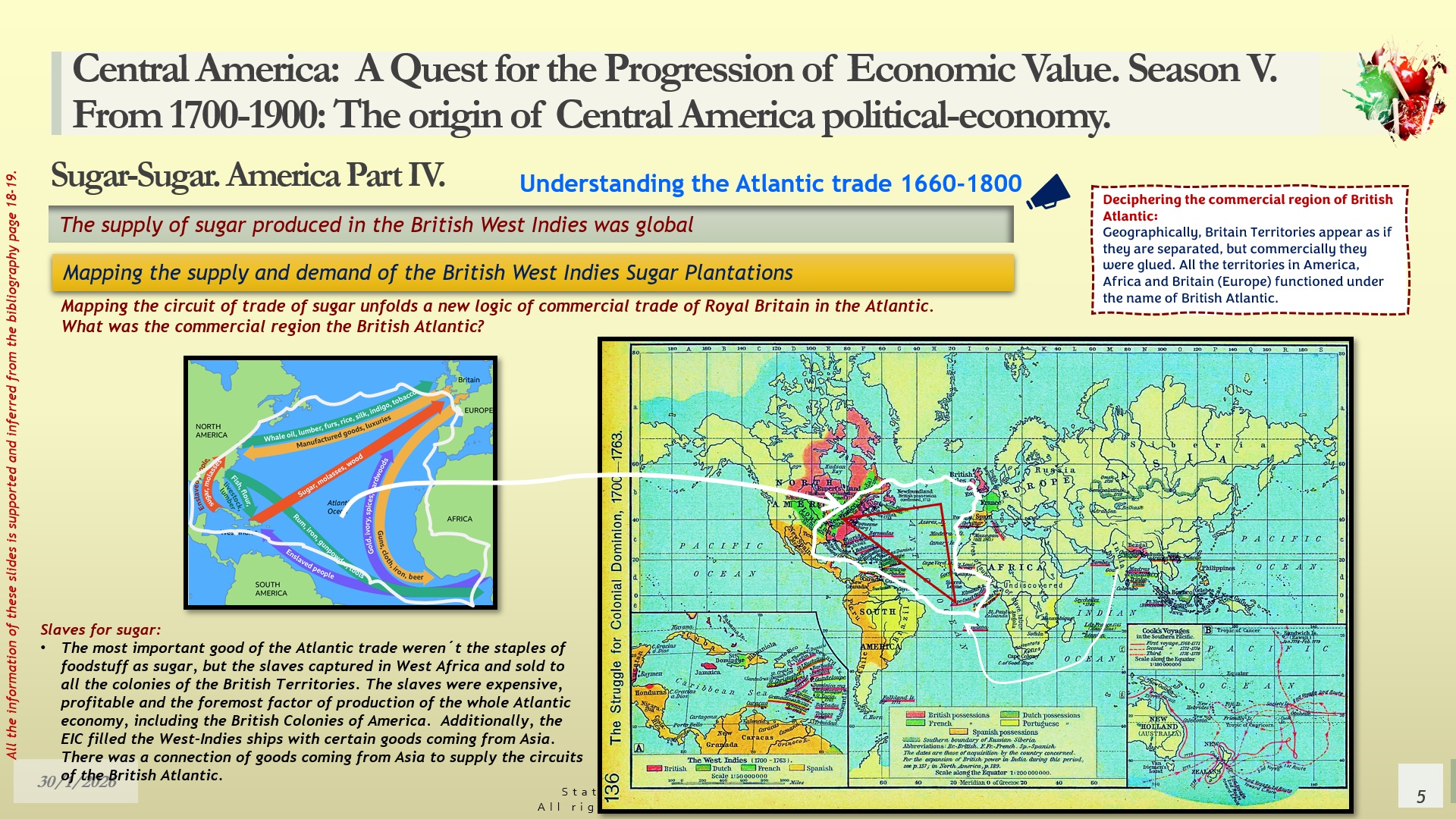
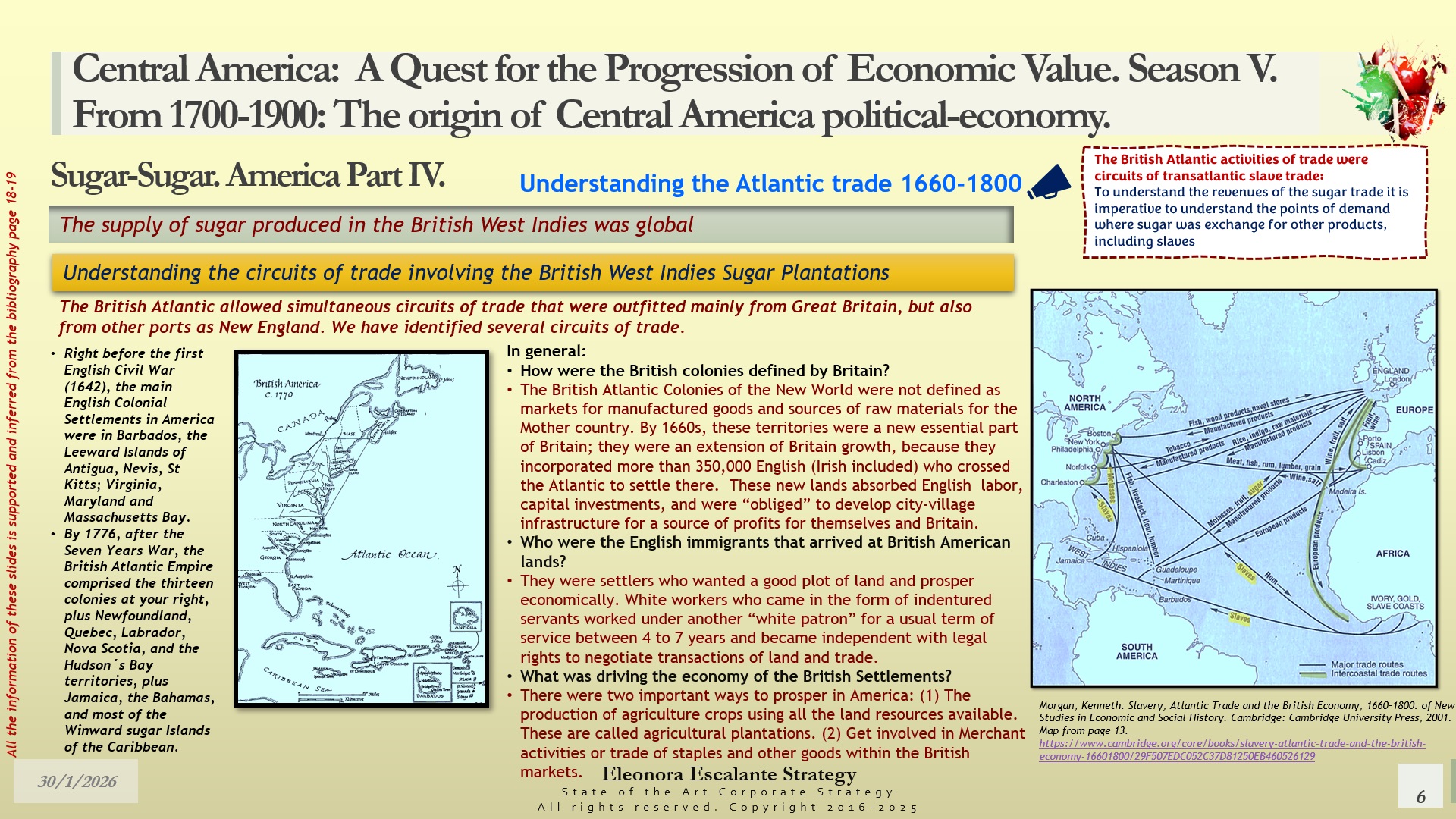
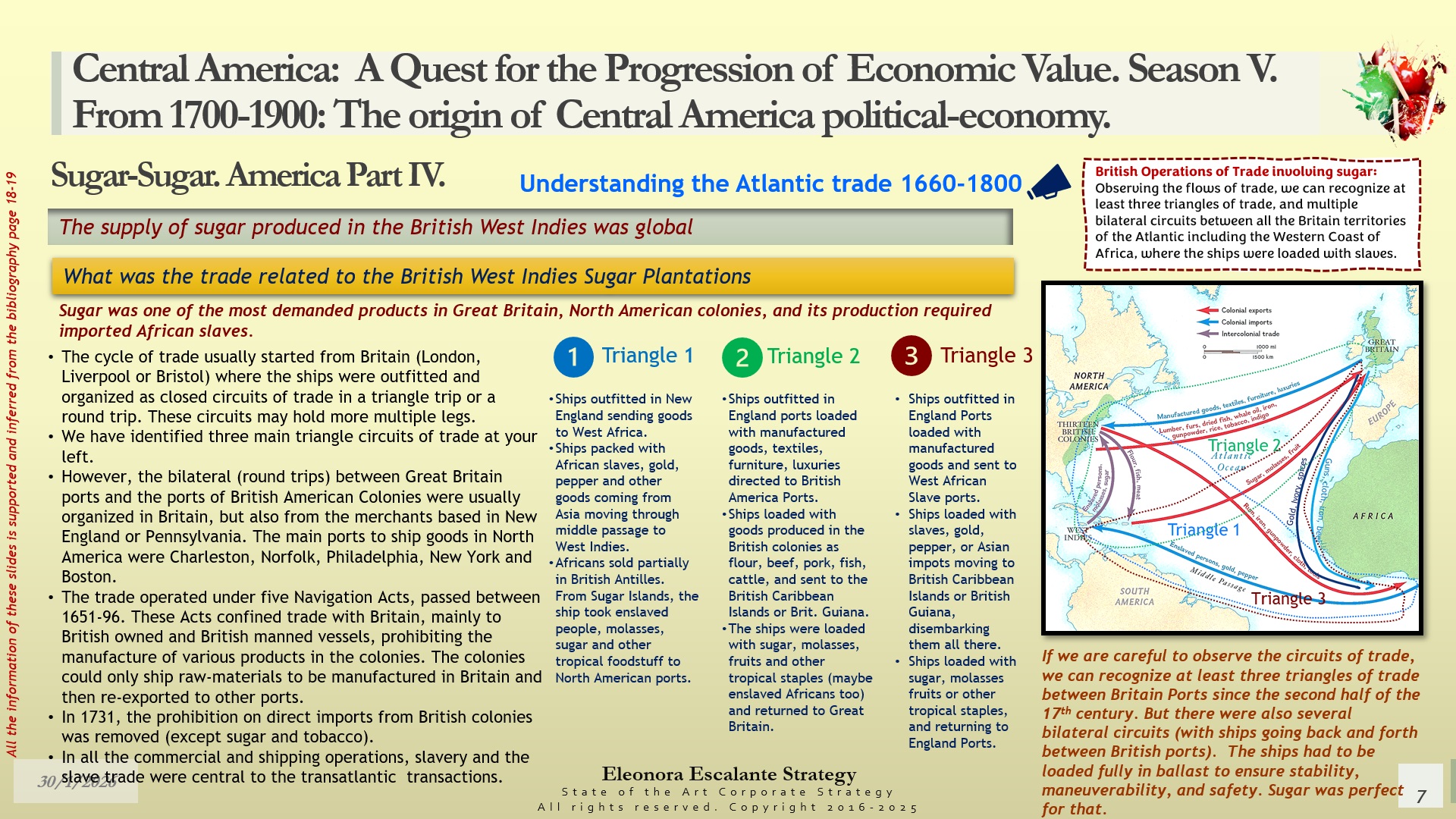
The creation of an empire based on sugar. See slides 7, 10 from Episode 3; and slides 5, 6, 7 from Episode 4. The sugar industry became profitable because it was founded on the transatlantic slave trade. This trade circuit is self-explanatory in detail. Look at slides 5, 6, and 7 of this chapter. Our first inference regarding the transatlantic slave trade links it particularly with sugar. Sugar was the core product of this triangle of trade. Go to slide 5 of today, please. Let´s look at the Atlantic as a big trading region that involved the main trading zones: (1) the ports of Great Britain (mainly London); (2) West-African Slave Ports; (3) the Caribbean Islands located in the British Atlantic, and (4) the ports of the thirteen British colonies of North America. This big area has been described by historians as a triangle. Geographically, it looks as if these three territories are separated and rendering service to the mother country of Britain. But subtly, if you are a keen observer like us, the whole system is not separated, but it is glued together by water. Once you shift the perspective, the union of the British territories was flowing because of the water and the ships traveling between the different trading zones mentioned above. In this transatlantic trade triangle, the British territories don´t exist as disconnected units. It is the ocean that merges them. That is why the ocean is called the British Atlantic, and the zones of production of sugar are called the British Islands as a whole block. The whole idea of extracting commodities, as a vacuum to send them to the Mother Country, has no common sense at all. The British Atlantic was from Britain, and that is how the monarchs regarded it when it came to sugar as the main crop. All these British colonies were an inherent part of Britain, and each king or queen had the crucial responsibility to guard them with the Royal Navy and to keep their sugar plantations operating at 100% efficiency. It was an English royal kingdom with thousands of subjects who migrated to all these new territories, many of them as indentured servants to the nobles who served the Royal crown. It was a kingdom evolving into an international empire. Let´s see the genuine ultimate ownership of the British Caribbean activities, listed consecutively by order of reigning periods:
| British Empire Expansionist Dynasties explained | ||
| King/Queen Monarch | Life Period | |
| 1 | Charles II Stuart-Oldenburg/Bourbon-Medici | 1630-1685 |
| 2 | James II Stuart-Oldenburg/Bourbon-Medici | 1633-1701 |
| 3 | Mary II Stuart-Bourbon/ Hyde-Aylesbury William III Orange Nassau-Solms Braunfels/Stuart-Bourbon | 1662-1694 1650-1702 |
| 4 | Anne Stuart-Bourbon/Hyde-Aylesbury | 1665-1714 |
| 5 | George I Welf-Hessen Darmstadt/Wittelsbach-Stuart | 1660-1727 |
| 6 | George II Welf-Wittelsbach/Welf Brunswick Lüneburg -D’Esmière | 1683-1760 |
| 7 | George III Hannover-Hohenzollern/Saxe Gotha Altenburg-Askanier | 1738-1820 |
| 8 | George IV Hannover-Saxe Gotha Altenburg/Mecklenburg Strelitz-Saxe Hildburghausen | 1762-1830 |
| 9 | William IV Hannover-Saxe Gotha Altenburg/Mecklenburg Strelitz-Saxe Hildburghausen | 1765-1837 |
| 10 | Victoria Hannover-Mecklenburg Strelitz/Saxe Coburg-Saalfeld Reuß | 1819-1901 |
Note: Please remember that the ID Welf-Wittelsbach was converted into Hannover as of King George II.
The British Empire was developed under the design and the approval of these monarchs, who allowed and encouraged a system of trade in its pursuit to maintain the geopolitical control over the British Atlantic and its respective colonies in America. The Royal British Crown was ultimately responsible for the transatlantic slave trade, not just because they held ownership of it through the respective Royal Companies of trade, but also because this was the time in which the Royal Crown decided to use the world of agents for the colonization of their new territories in America. The period between King Charles II and the birth of Queen Victoria marked the foundation of the economic growth of the British Empire, which was built on the prosperity coming from sugar plantations. In one phrase: Without sugar, the British Empire wouldn´t have matured to become what it was in the 19th century.
Wherever sugar was grown in the Caribbean, there was an engine of transcontinental trade, and a motor of conflicts for the riches of the sugar. Every British Island was environmentally transformed for sugar: sweeping the natural conditions of the land for the sake of planting cane, receiving thousands of slaves to become the majority of its population in less than half a century, showing higher rates of mortality and no fertility possibilities for these new peoples who worked in hell miserable conditions, expanding the shipping capabilities of Britain and exchanging products on a diligent basis: manufactured goods in Britain, Slaves from Western-African Ports, and crop commodities or food staples from the British Sugar Islands and North American colonies. Without this British Atlantic system in place, Britain would have never evolved to become an Empire. Additionally, over this period (1660-1800), Britain dominated the global sugar production markets from a privileged place: Britain’s geopolitical position in the Atlantic was the price influencer of all the trade.
The design of the transatlantic sugar trade. Slides 9, 11, and 13. Episode 3. Slides 10 and 11. Episode 4. These slides can be summarized by what Sheridan (2) has identified in the Barbados plantation society (we have added new features to each of these factors):
- The transformation of a settler colony combining subsistence farming and a small staple production for overseas markets to a huge and large one with gigantic slave labor and capital-intensive plantations, focusing all the efforts on one single crop (sugar cane). When a society focuses on producing a mono-cultivation, it doesn´t have space, nor place, nor resources available to supply for its own support and subsistence.
- Dependence upon outside sources of foodstuffs, building materials, implements, machinery, consumer goods, shipping, marketing, and financial services. The British sugar production camps required to import lumber, fish, livestock, and flour from North America, as much as manufactured goods from Britain.
- The shift from the white labor force of indentured servants from Europe to African Slaves
- The rise of a new social class that doesn´t reside on the island (the wealthy planters living in London, absentees from the plantations), who appointed a new governing elite class of administrators or agents to oversee the operations of the Island. The agents to the merchants who were linked to the Royal Crown of Britain became a unique class, not just because they retained the “representation of the Crown in the Islands”, but because they were used as the authority and the local government of the King of Britain in place. The agents were all “his or her majesty’s subjects” and became the “crown regents” and/or the “trade merchants rulers” placed in the Islands.
- The emergence of the sugar colonies as major territories played a lucrative role in geopolitical and economic rivalry in the affairs of the Atlantic World.
The formation of the Caribbean plantations’ societies was the consequence of the design of the transatlantic sugar trade. Re-read the last phrase. Once again. Every single society of the British Caribbean was born because of this philosophical rationale. What gave birth to these new societies of 10% whites-90% slaves was not the settlement of the English-Irish-Welsh immigrants, but the design of the business model of sugar plantations. And that precise detail was the turning point in the layout of the roots of capitalism. With sugar slavery plantations, the British learnt something more valuable than the discovery of America: the secret of the instant economic prosperity of one kingdom lies in the utilization of other kingdoms’ resources at the lowest possible cost. And the lowest cost can only be achieved when labor as a factor of production is reduced to the minimum. Nonetheless, this recipe of wealth accomplishment (or accumulation) was already established since the Mesopotamian civilization; it was with the British Atlantic sugar plantations that its sophistication achieved the highest productivity using a globalization prototype, never experienced before in history. The Barbados sugar plantation model is described from slides 12 to 17 of Episode 4. All slides are self-explanatory.
Sheridan (2) affirms “The New World Plantation represented the capitalistic exploitation of land with a combination of African labor, European technology and management, Asiatic and American crops, European animal husbandry and American soil and climate”. The significance of the sugar plantations of the 17th and 18th centuries in British Atlantic territories is not only essential to understand for any student of economics and history, but also to comprehend the dimension of the fallacies that have accompanied our theories of management rolled out to all of us, academically, during the 20th century. Moreover, the industrialization in each of its phases (Industry 1.0- Water and Steam power; Industry 2.0 – Electricity; Industry 3.0 – Computer and Automation; and Industry 4.0 – Internet-Cyber-physical systems) have been based on the philosophical roots of the British Sugar Plantations, and we are continuing making the same mistake of pursuing the high yields of productivity using the low-cost strategy with the Artificial Intelligence. There is a mega-blunder that all our previous generations have been rolling out without knowing since the1980s: the competitive agenda between nations led by our frameworks of competitive advantage and industry attractiveness analysis is the consequence of analyzing how the British (who metamorphosed to the new United States Empire) rose to become the preeminent rich system with Queen Victoria´s global domains. In consequence, all our key profitability factors are also based on what the sugar plantations model assembled. But ironically, although African Slavery was abolished more than a hundred years ago, it is in the subtle continuation of it (called modern slavery, a situation in which low salaries only help to pay debts and basic needs), that we have continued perpetuating it.
Now, if we go to the socialist system, the roots of the sugar plantations’ slavery system can be found in the premises of Russia’s formation as a nation after the Bolshevik’s revolution. During the 20th century, the Russian collective agricultural system was destined to fail because the same philosophical condition of expropriation of the peasants was taking place, and poverty was the rule of thumb. The collectivity of the peasant land was not designed to improve the quality of life. “Most of the peasants with plots in Russia held their own garden plot and hut, by law, only so long as each of them toiled on the collective. In other words, each of them, too, continued as indentured feudal servants.” (3)
Both systems (socialist and capitalist) have been based on the fundamentals of the sugar plantations, later accompanied by city proletarian employees in the factories (private or state-owned) without any hope to raise from deprivation. Both systems have sought to keep them as indentured bound employees, in which the maximization of “shareholder or state-holder” value is the highest supreme quest. Can you visualize the situation? See slide 17-Episode 4.

To be continued…
Closing words.
This episode is the second dispatch about the British business model for sugar production in the West Indies territories during the 17th and 18th centuries. We have dedicated a lot of time to our quest to integrate all the elements of how the Barbados business model for sugar production was probably operating. There is more analysis coming with the Jamaican production next week, which will be our last episode about Britain sugar trade. We are nearing the point where we can display all the elements of business modeling, preserved from the time of the sugar transatlantic trade. This trade was rooted in African slavery. These elements persist (subtly hidden in our economic foundations of today) and are used whenever we “currently” build business models. This is especially true for issues with AI and the most recent technologies. The Generative AI is eliminating all the jobs that allowed humans to leave poverty. The roots of all our current business problems started from the time of sugar plantations. We do business still today, using the same philosophical premises of low cost for highest productivity. You will be astonished to uncover all these roots with me.
Announcement. Next week, we will continue with the last episode of the British West Indies sugar model, focusing on Jamaica.
Musical Section.
During our closing bonus season V, we will return to the symphonic, philharmonic, or chamber orchestra compositions. Today, we have chosen the Barbados National Youth Symphony Orchestra – a Christmas Performance at ‘Jukwaa’ JB Simpson’s Complex. Joy Knight leads as the director of NYSO of Barbados.
Enjoy!
Thank you for reading http://www.eleonoraescalantestrategy.com. It is a privilege to learn. Blessings.

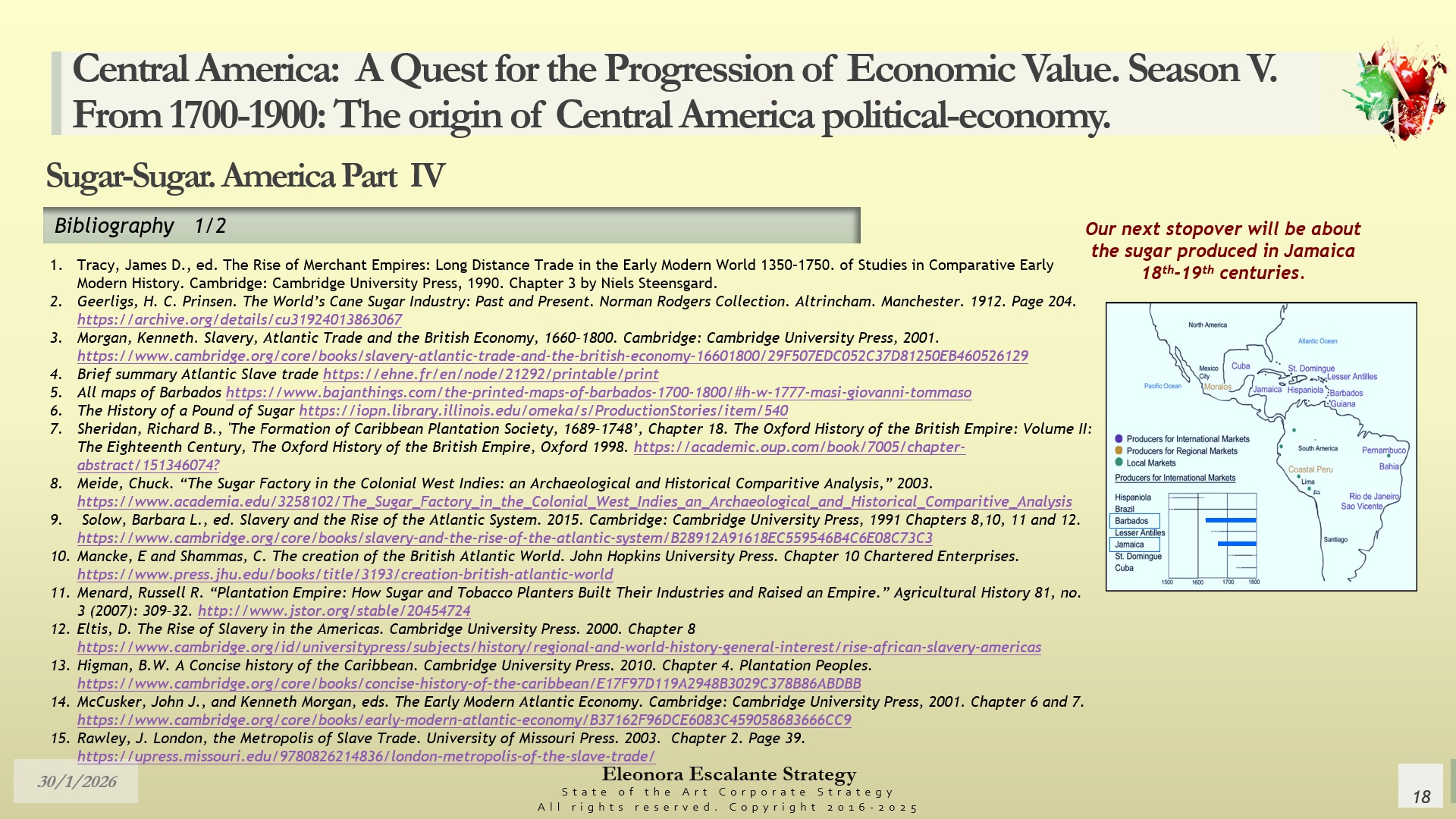
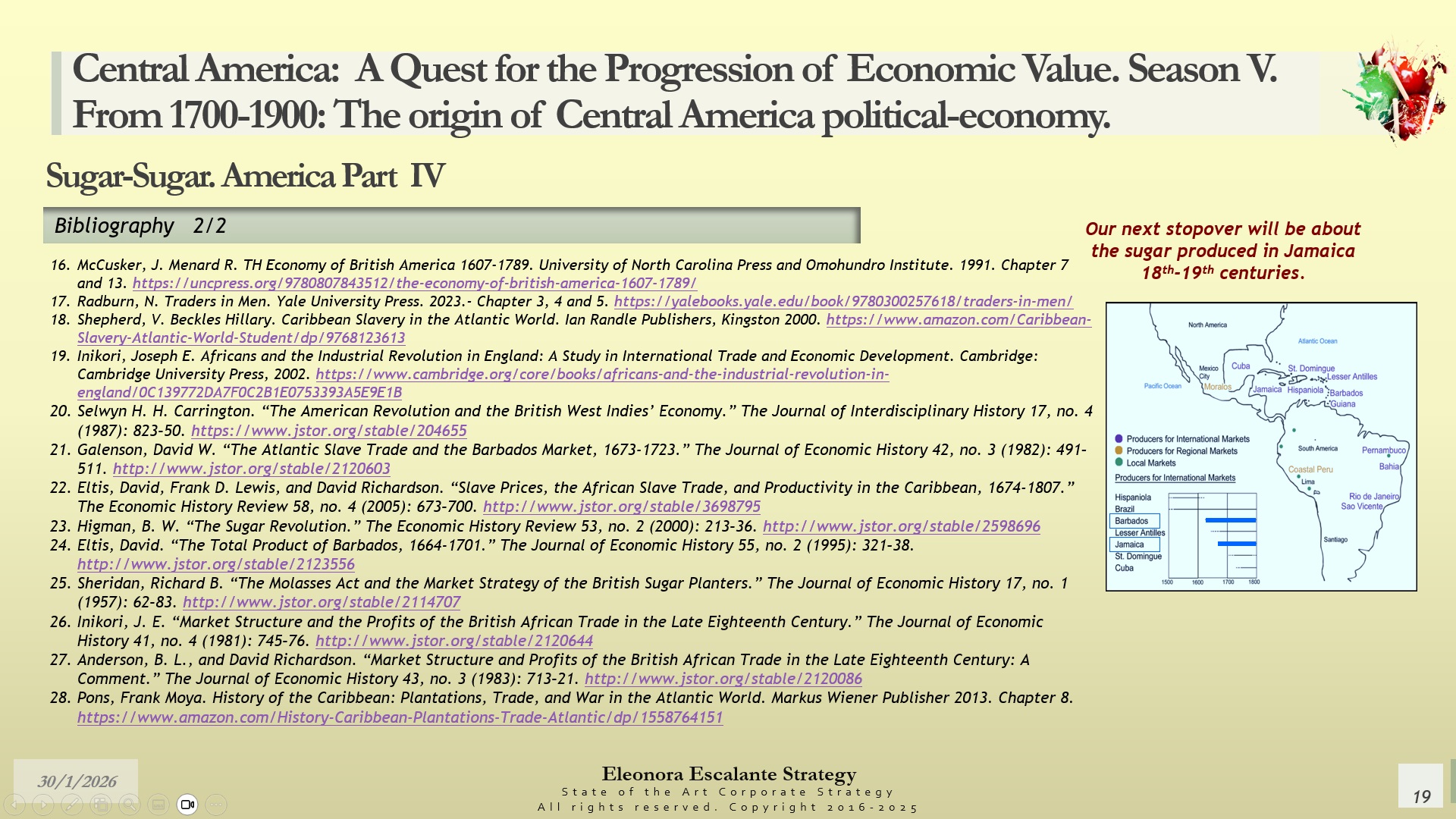
Sources of reference and Bibliography utilized today. All are listed in the slide document. Additional material will be added when we upload the strategic reflections.
(1) and (2) Marshall, P. J. The Oxford History of the British Empire. The Eighteenth Century. Volume II. Chapter 18. Oxford University Press. 1998.
(3) Lissner, Will. “Land Socialization in Soviet Agriculture, 1917-1949.” The American Journal of Economics and Sociology 9, no. 1 (1949): 145–59. http://www.jstor.org/stable/3483737
Disclaimer: Eleonora Escalante paints Illustrations in Watercolor. Other types of illustrations or videos (which are not mine) are used for educational purposes ONLY. All are used as Illustrative and non-commercial images. Utilized only informatively for the public good. Nevertheless, most of this blog’s pictures, images, and videos are not mine. Unless otherwise stated, I do not own any lovely photos or images.
 Eleonora Escalante Strategy - Strategic Reflections Think Tank