

Central America: A Quest for the Progression of Economic Value. Bonus-Season V. Episode 7. Sugar-Sugar America Part 7. The French Sugar Model of Saint-Domingue
Dear beautiful readers:
We are so full of joy because we have finished the French sugar model today. We have discovered elements of the consumption side of the sugar produced in Saint Domingue during the 18th century. It has been a remarkable research week. We have focused all our efforts on providing the different geopolitical conditions occurring in parallel to the planters’ production of sugar in Saint Domingue, and why the West Indies sugar was so important for the French Bourbon monarchy. Right before the French Revolution, Saint Domingue was sending between 150 and 180 million pounds of sugar to the French Ports. The core of the sugar production was the plantation estate French Model, which achieved “the” highest productivity and efficiency at the top level, never before in the colonial era. By the end of the 18th century, Saint Domingue was the leading-edge colony processing sugar. On average, each Saint-Domingue sugar plantation yielded around 240, 000 pounds of sugar based on slavery, and we will discover all the whereabouts of the demand for sugar in Europe and how this happened. We will also explain the situation of the Haitian Revolution and the case of Toussaint Louverture from the Breda Plantations. Finally, Haiti declared independence on January 1, 1804.
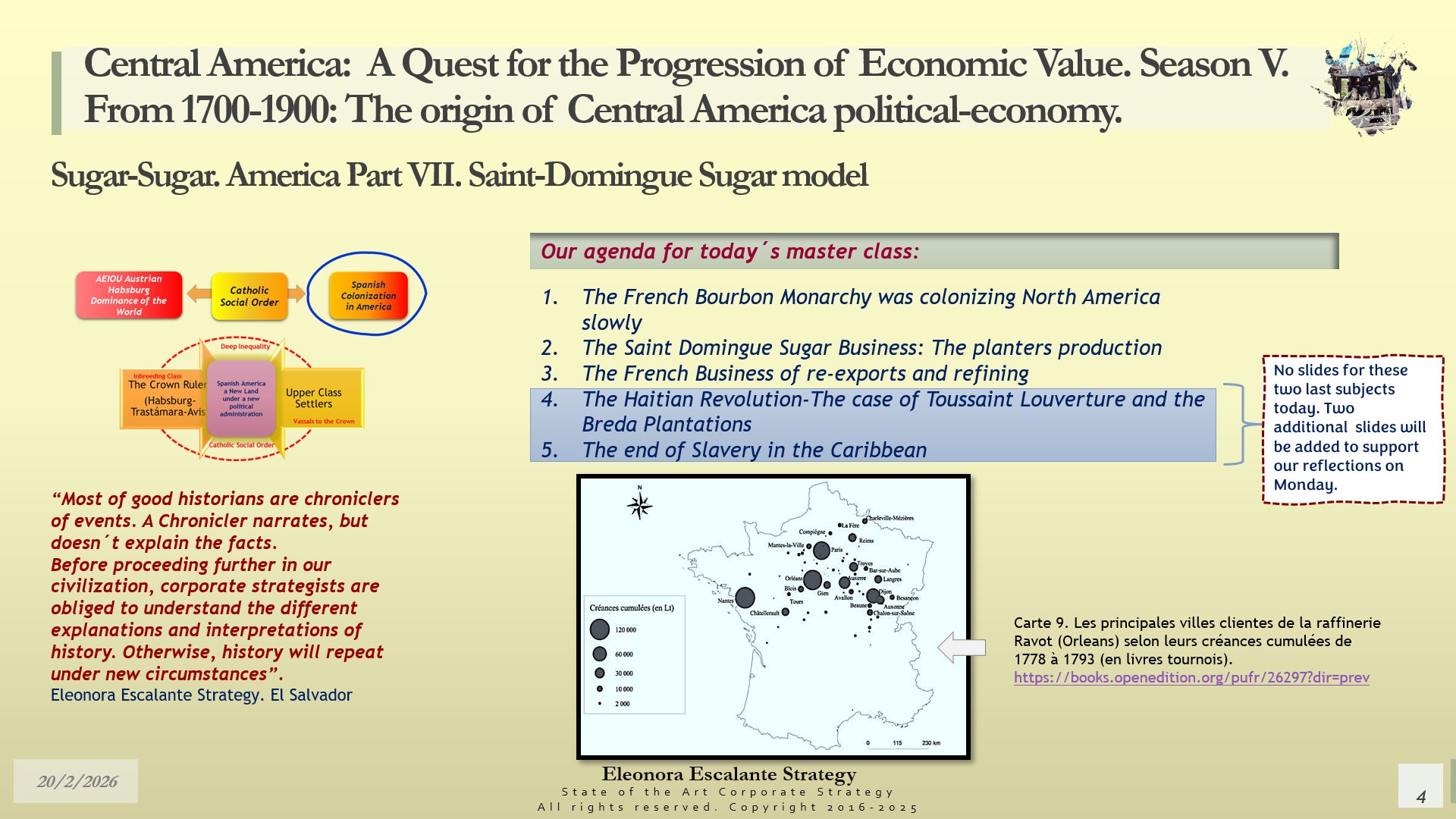
Our master class agenda is below:
- The French Bourbon Monarchy was colonizing North America slowly
- The Saint Domingue Sugar Business: The planters’ production
- The French Business of re-exports and refining (the markets)
- The Haitian Revolution-The case of Toussaint Louverture and the Breda Plantations
- The end of Slavery in the Caribbean
The preparation material for your class is below. Proceed to download the PDF material, print it, take notes, and ask yourself questions. Follow the bibliography on the Internet, and download additional papers if needed. It is great to learn with your friends, family, acquaintances, professors, and everyone that you can touch with the light of knowledge.
We kindly ask that you return next Monday, February 23rd, 2026, to review our extra strategic reflections on this chapter.
We encourage our readers to familiarize themselves with our Friday master class by reviewing the slides over the weekend. We expect you to create ideas that are or are not strategic reflections. Every Monday, we upload our strategic inferences below. These will be discussed in the next paragraph. Only then will you be able to compare your own reflections with our introspection.
Additional strategic reflections on this episode. These will be in the section below on Monday, February 23rd, 2026.
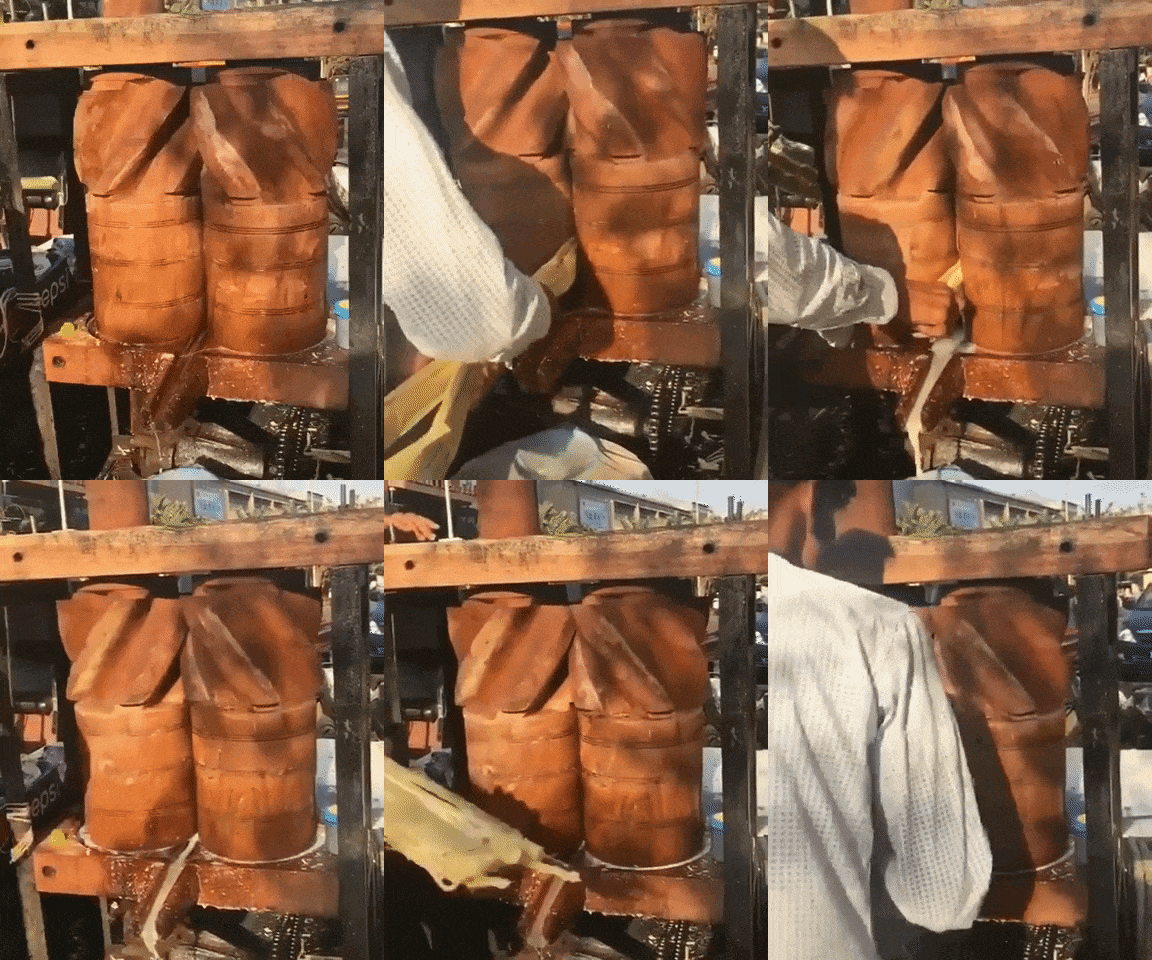
Public domain. Illustrative and non-commercial GIF image. Used for educational purposes. Used only for the public good, informative for this class.
Strategic Reflections on “Central America: A quest for the progression of economic value. Bonus Season V. Episode 6. Sugar-Sugar America Part 7. Saint Domingue´s sugar model.
What was the Bourbons’ position in the 18th century? Slides 5 to 7.
The Bourbon family was not involved directly in the discovery, conquest, and colonization of America. When Maximilian Habsburg married the Burgundian Mary Valois-Avis/Bourbon-Valois (1450-1482), with her death, and the decease of her son Philip I Habsburg-Avis/Valois-Bourbon (1478-1506), we suspect that the Bourbon lineage was far from being considered as co-owners of Spanish America. However, when King Louis XIV Bourbon-Medici won his rights as sovereign over the French Saint-Domingue and Louisiana, and when his descendants were installed on the Spanish Throne after the War of Spanish Succession, the Austrian Habsburg branch realized that the Bourbons were not to be overlooked anymore. Louis XIV´s family was linked to the Stewarts of Britain, who led the establishment of the 13 colonies in America. Additionally, the French Bourbon plantation complex model became so successful as an enterprise institution in the Atlantic that every single European monarch acknowledged it. The main markets for the French sugar were located in Holland, the Austrian Netherlands, and Northern Germany.
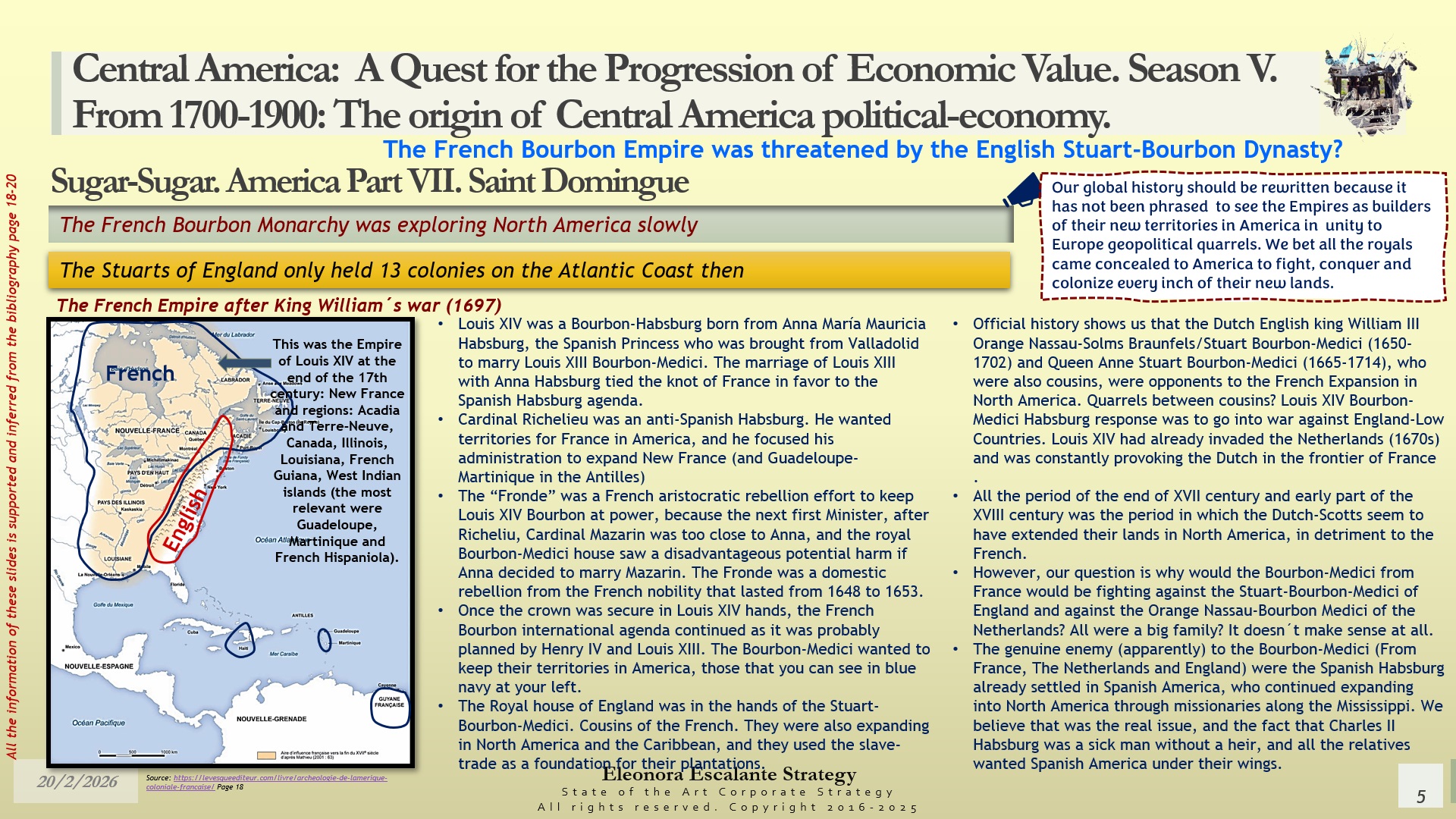
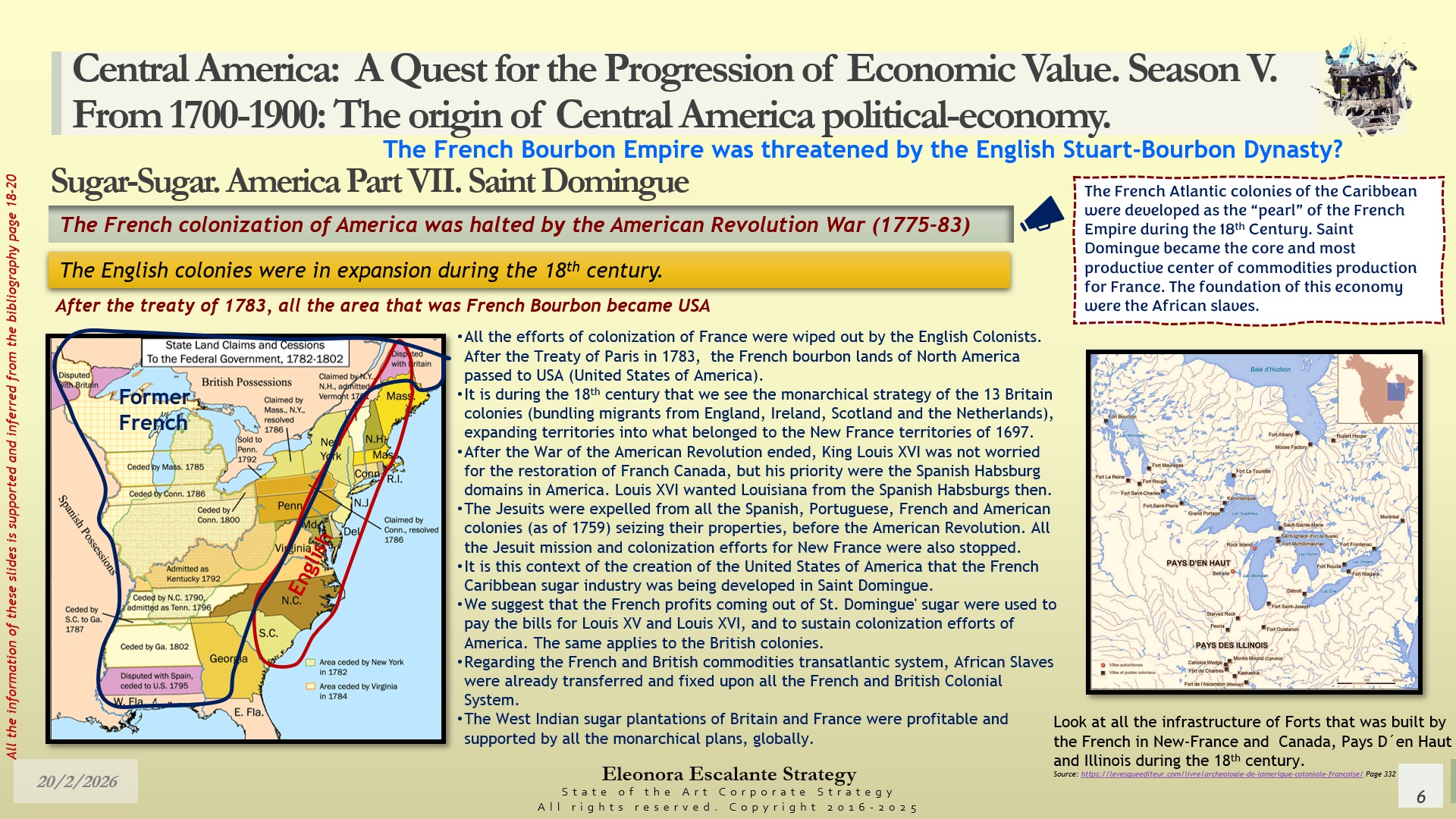
When the door opened to the first quarter of the 18th century, the Bourbons, as a huge family block, were able to mingle, positioning their hegemonic DNA simultaneously in England, France, the Netherlands, and Spain. See slide 5. While the 13 English colonies were in a total expansionist strategy during the 18th century, history has described that the French exploration efforts in North America were the neighbors of the British (see slide 6). However, these French endeavors were halted by two main factors: (1) the expulsion of the Jesuits, and (2) the American Revolutionary War (1775-83). See slide 6.
After the American War of Independence, all the territories of New France were bundled into what the English colonies were. At this point in time, the Dutch Orange-Nassau dynasty was merged with Prussia and the new British family: the Hannover. The Dutch William V Orange Nassau-Hessen Kassel/Hannover-Hohenzollern (1748-1806) married Princess Fredericka Sophia Wilhemina Hohenzollern Hannover/Brunswick Wolfenbüttel (1751-14820) of Prussia.
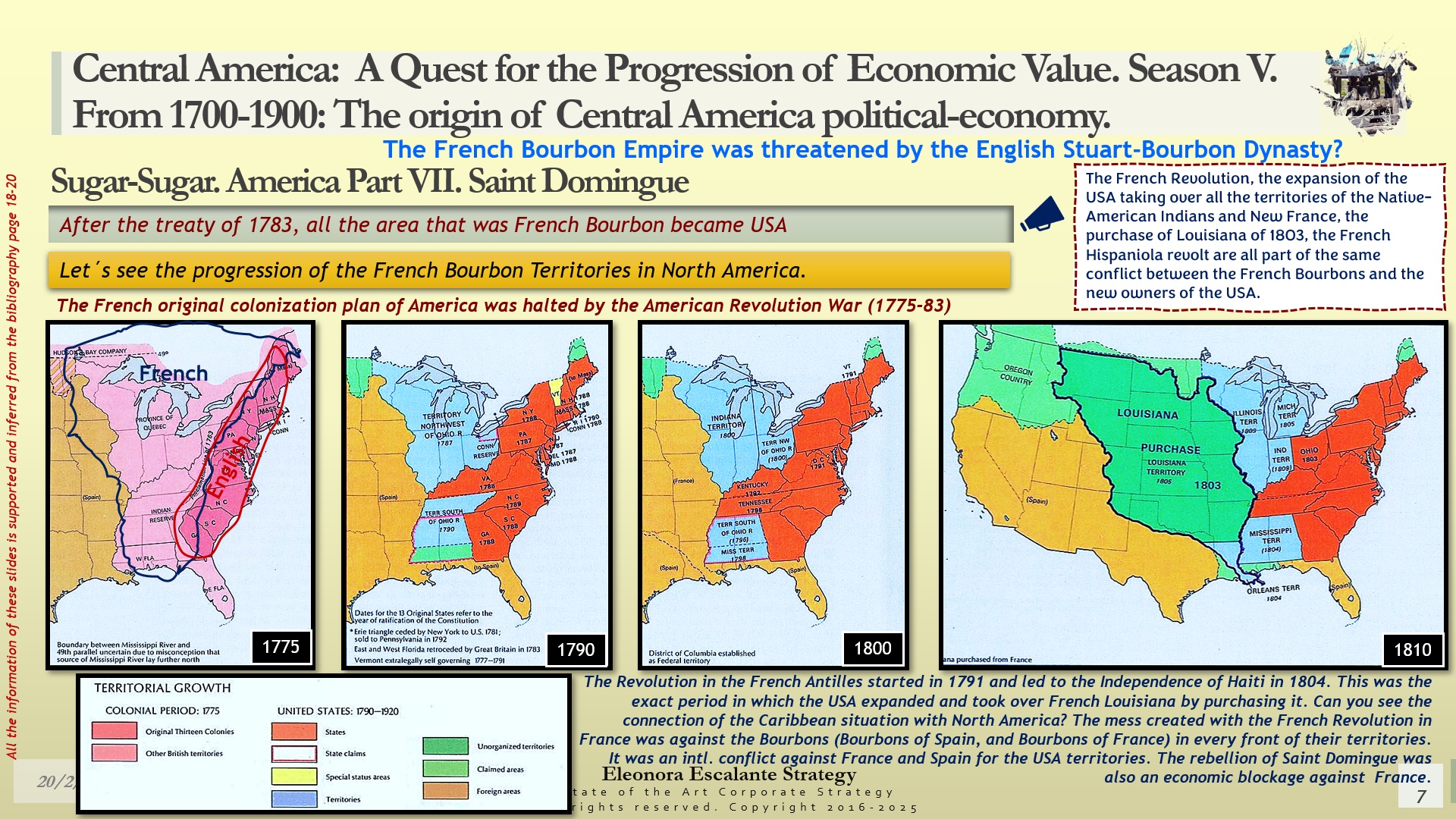
Why does this matter? This is important because, at the top monarchical empire level, a marriage was a symbol of strategic territorial defense or expansion. Extending in America, the marriage of the Dutch William V and the Prussian Wilhelmina princess was the seal of a tacit strategic alliance that shifted the geographical map of North America, in which the Caribbean was left as a side dish. The Dutch-British-Prussian interests were not focusing on the Caribbean anymore, but on the USA. Meanwhile, the Bourbons (French and Spanish) main goal was to establish themselves in the former Spanish Habsburg territories. It is in this context that the Bourbons, acknowledging the expansion of North America under the Dutch-British-Prussian block, decided to focus on the Bourbon Reforms, expelling the Jesuits (who were a hindrance to their new plans in Spanish America), and probably were going to defend unconquered Louisiana later. However, according to official history, the Bourbons were attacked with the French Revolution in their headquarters office, and in every single international location where they held a position in the world. See slide 7. Once the HQ office was in turmoil, any of its respective colonies fell into chaos.
The Saint Domingue sugar business. Slides 8 to 11.
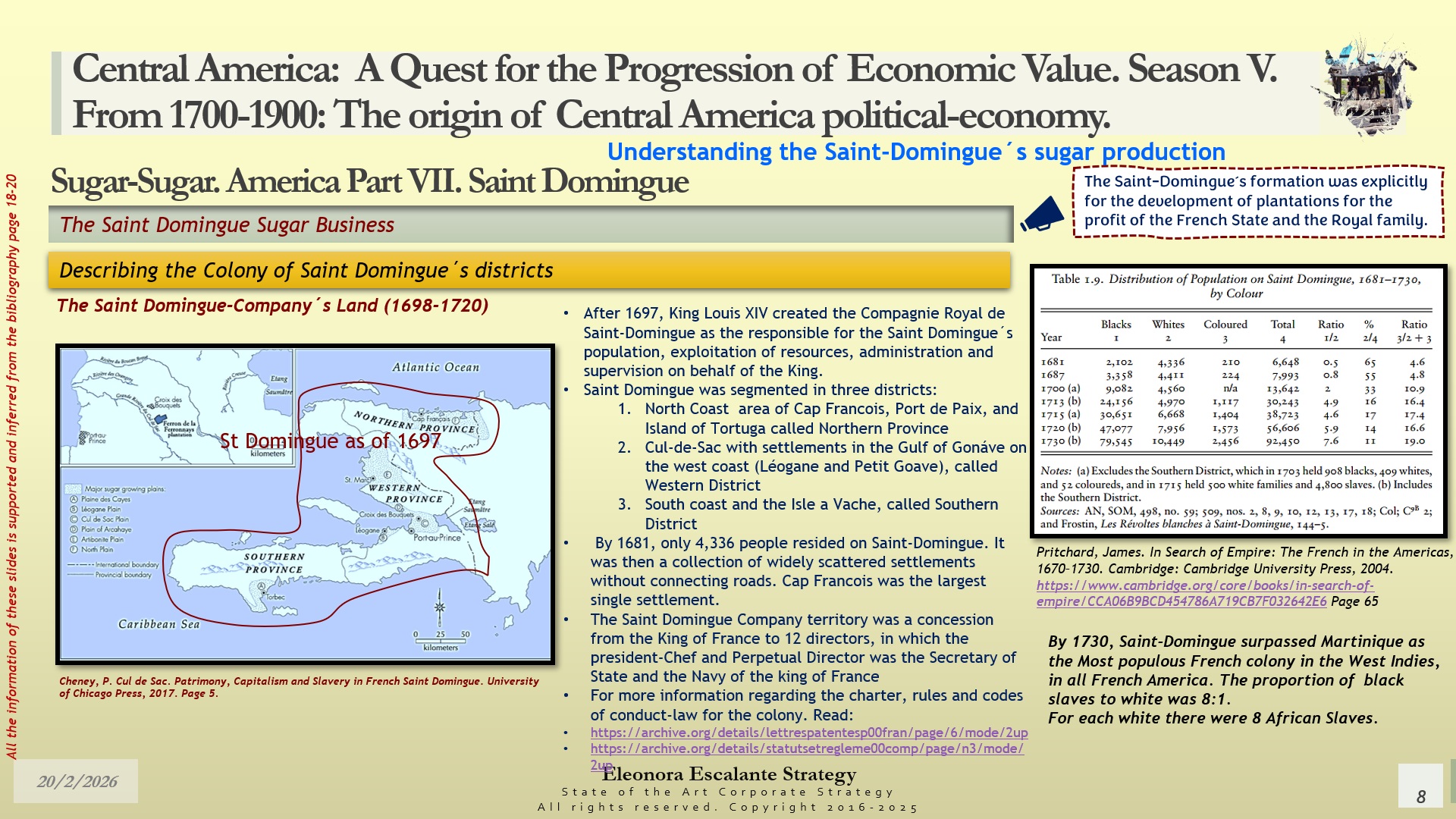
We have chosen the primary features of the Saint Domingue sugar business of the French Planters who were subjects to the Royal Bourbon Crown of France. It was still an absolutist kingdom; consequently, we can´t see the Saint Domingue colony under the property of independent planters and merchants. The Old Regime was not a capitalist one. It was an absolutist monarchy. In less than 100 years, the sugar industry of French Saint Domingue was built from scratch and became as robust and strong as the sum of all the British sugar production in the Antilles. See slide 8. It was not possible to reach high yields of sugar cane crops and sugar mill muscovado without slaves. The more elevated the yields of a French plantation, the higher the level of productivity using slaves, and the longer the cruel working days for them. Saint Domingue´s African population grew at an incredible rate, requiring a proportion of the slave trade never seen before in any of the other empire colonies. This is founded on the proportion of African slaves to whites. In 1730, the proportion of black slaves to white was 8:1. In 1788, right before the French Revolution, the ratio was 17:1. The population of slaves augmented from 79,545 (1730) to 500,000 in 1788.
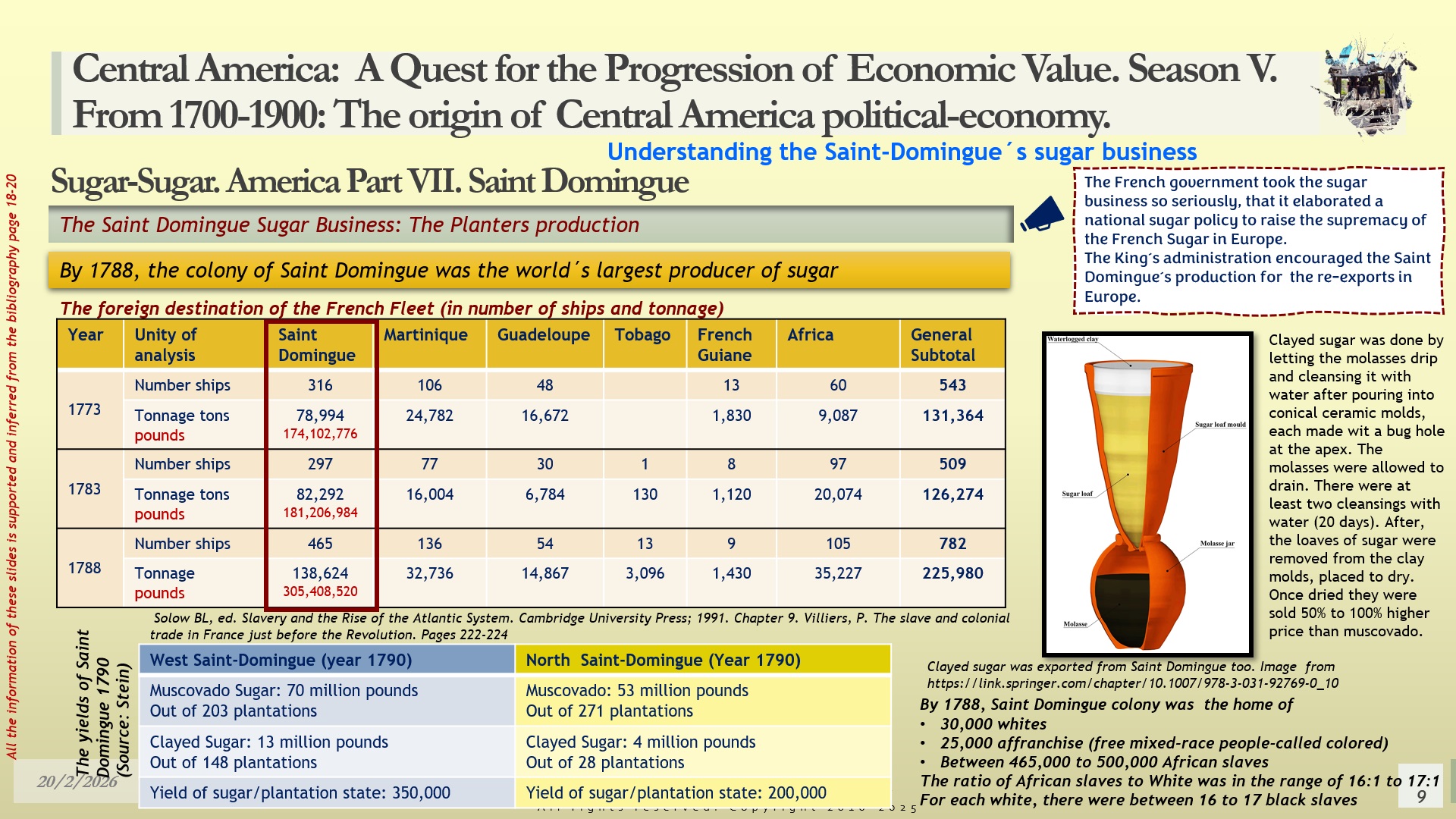
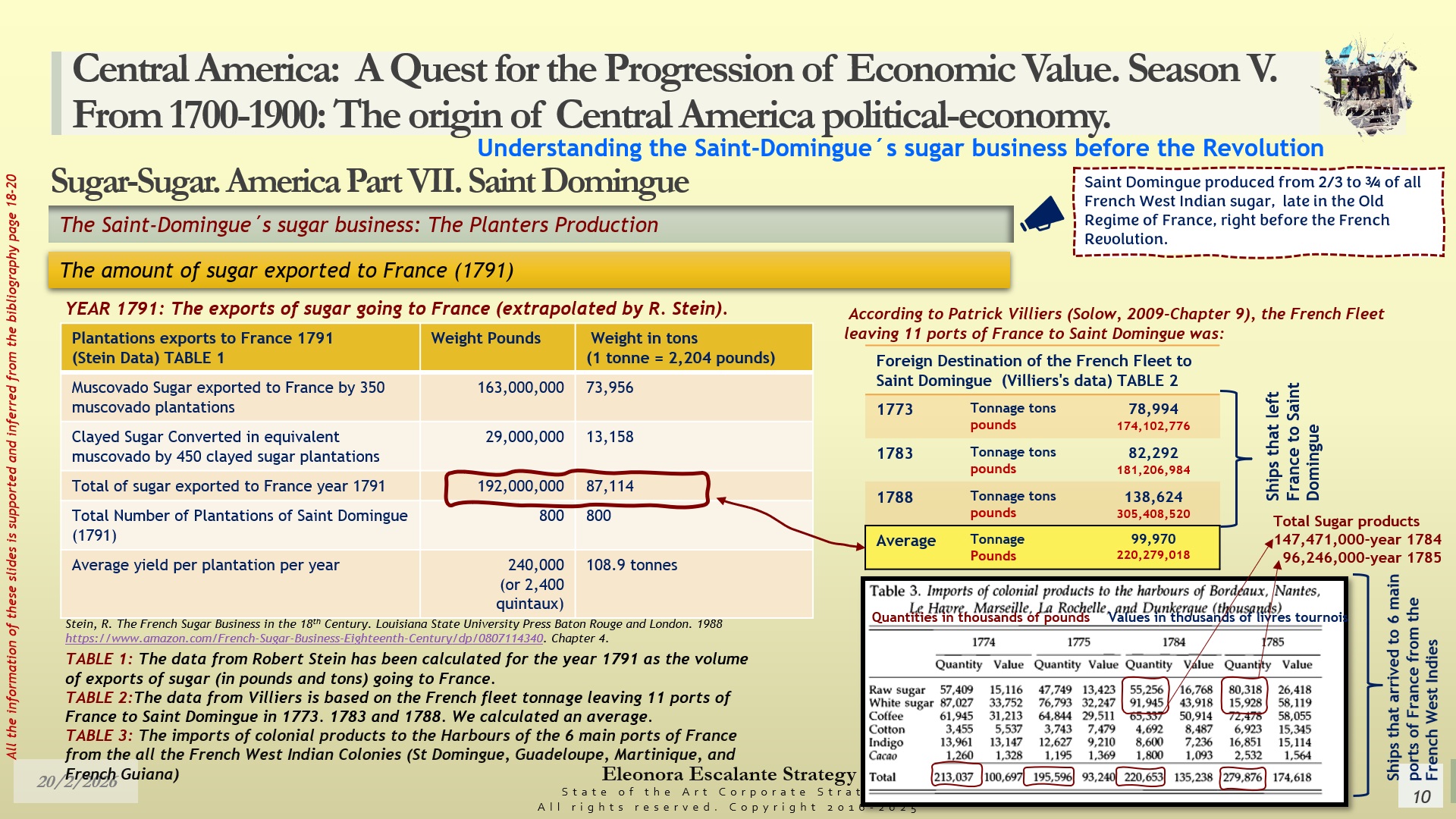
The standing of sugar production in Saint Domingue in comparison to the rest of the islands under French supervision is illustrated in slide 9 in detail. By the year 1788, 465 ships were serving the sugar destination of Saint Domingue, with a capacity of 305.4 million pounds (or 138.624 tons). Saint Domingue represented 62% of all the French shipping activity (in number of ships and tonnage). Additionally, the yields of sugar production per plantation were, on average, at the level of 240,000 pounds per plantation per year (1791), right before the slaves’ revolt of Saint Domingue. Go to slide 10, please. We have prepared a comparison of three tables in our quest to analogize the amount of sugar exported to France. We have utilized the information gathered by 2 researchers: Robert Stein and Patrick Villiers. From our comparison, we are at least certain that between 192 million and 300 million pounds of sugar were shipped to France right before the Haitian Rebellion. From that quantity, between 2/3 and ¾ was dispatched only from French Saint Domingue.
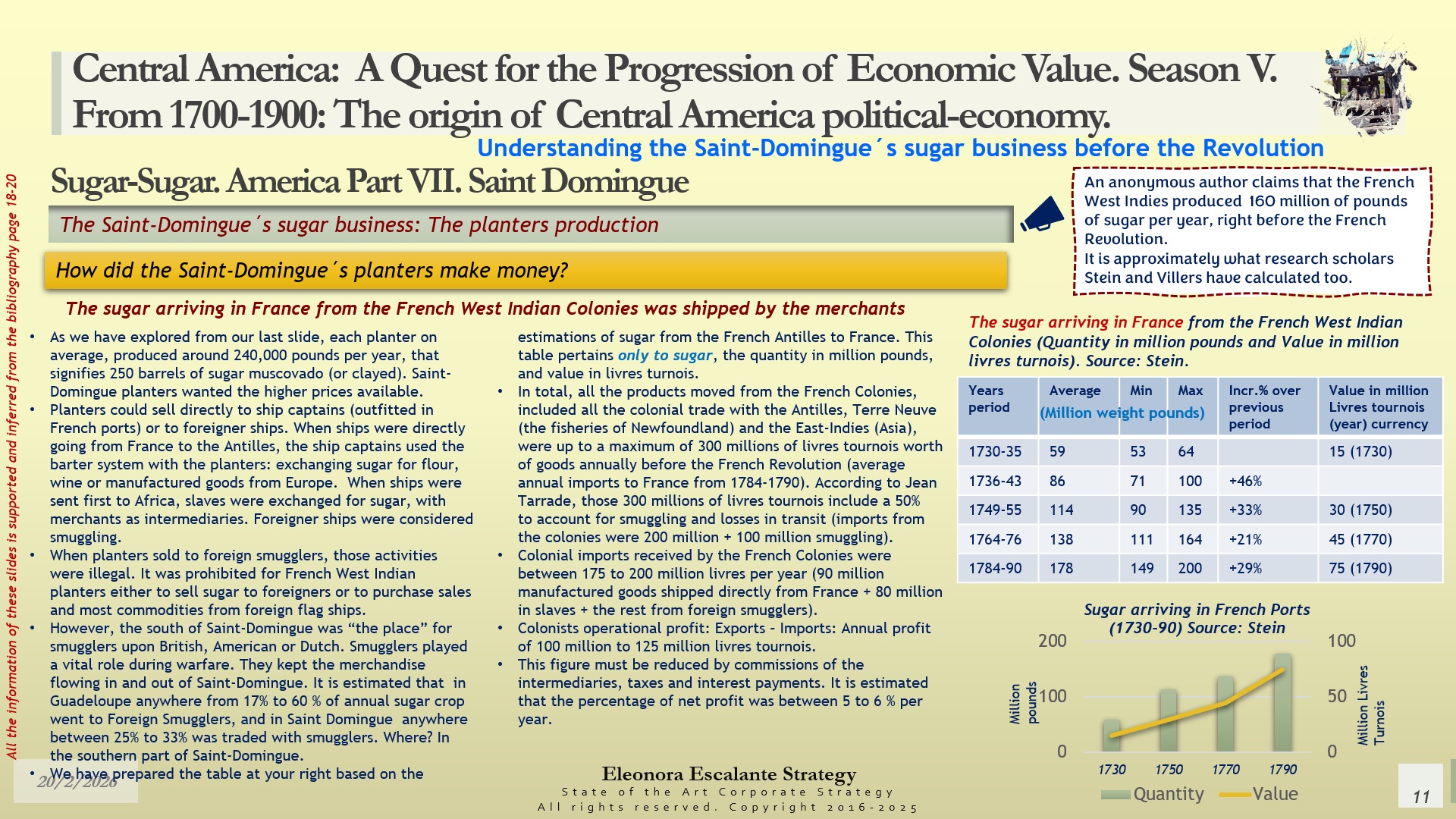
Slide 11 is our effort to summarize how the planters from Saint-Domingue made money. Look at table 3: The estimations of the experts validate the value of money in livres tournois docking in France in a range between 135 million to 174 million livres tournois (years 1784 and 1785), valuing only 6 ports of entrance. However, all the products moved from French Colonies considering all the ports of entry and smuggling were probably between 253 to 317 million livres tournois (including the smuggling). From the last numbers, sugar (muscovado and clayed) represented at least between 50% to 70%, depending on the year. In 1791, right before the Haitian Revolution, the amount of total sugar arriving to France was 192 million weight pounds, and its economic value ascended to 82 million livres tournois approximately.
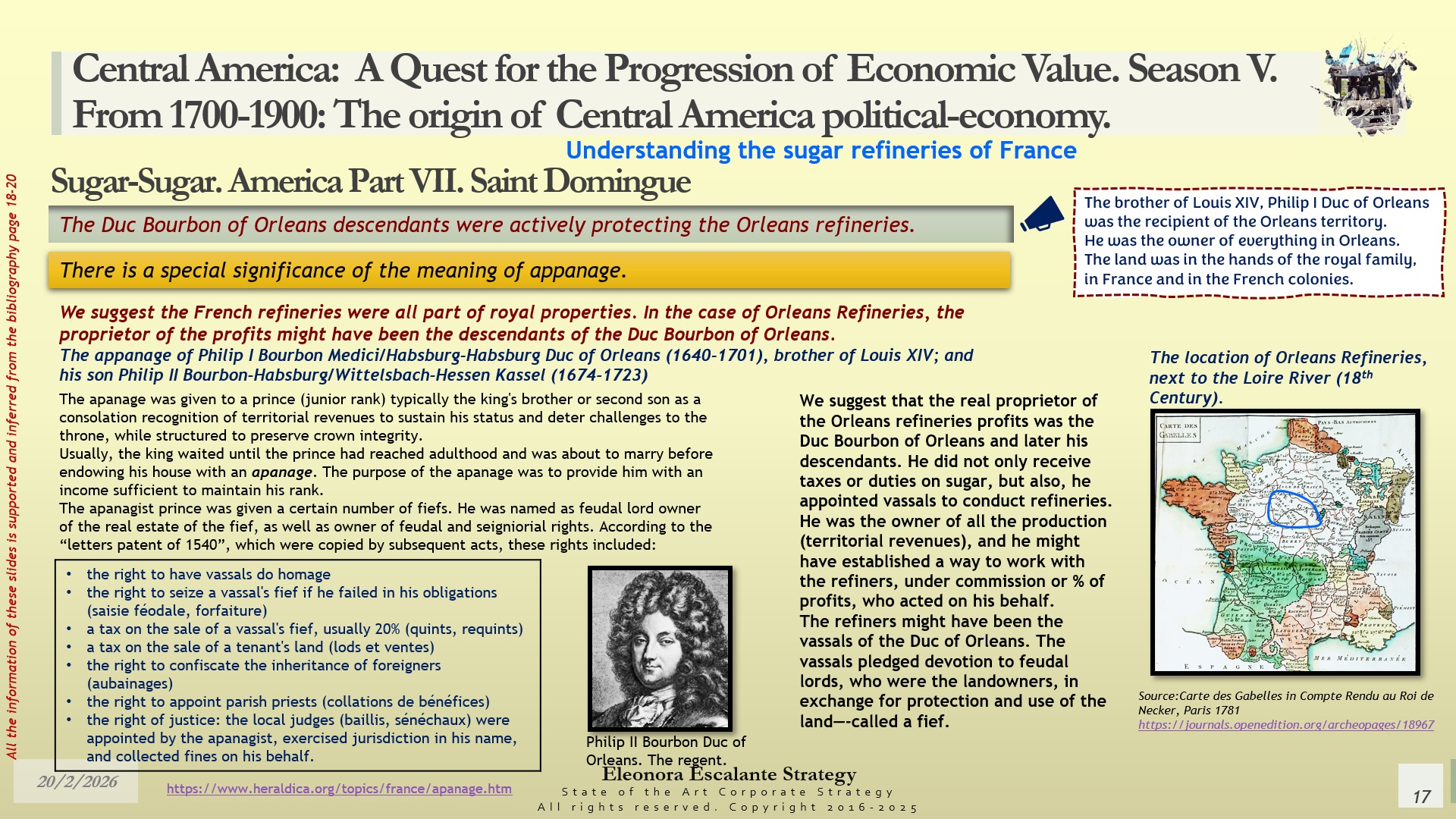
Understanding what happened to the Antilles sugar once arrived at French Ports. The French Business for Re-Exports and Refining. Slides 12 to 17.
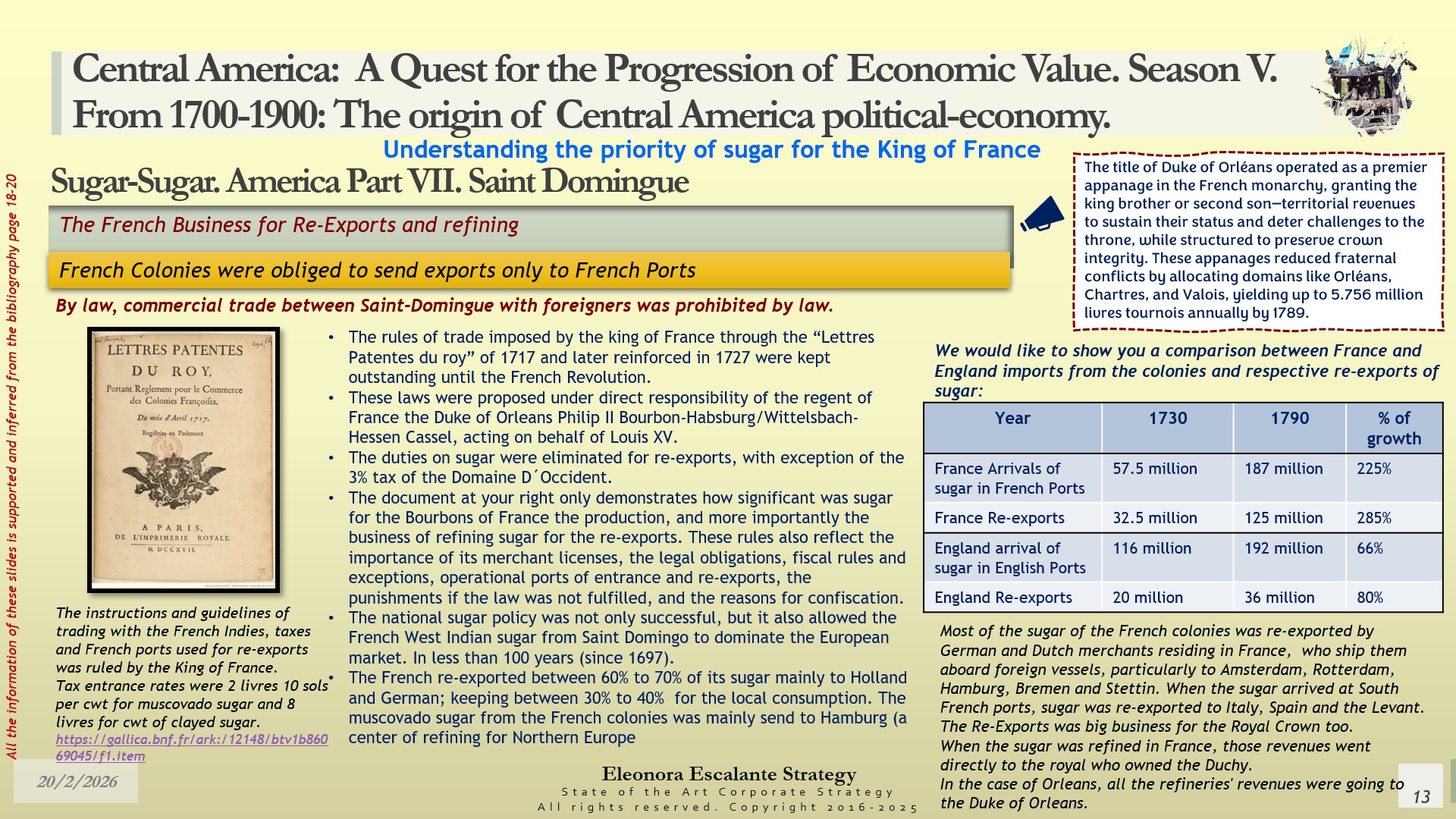
We suggest that the value chain of production of sugar and its distribution in Europe was a business conceived to fill the royal Bourbon coffers. There is written evidence in the “Lettres of Patentes,” in which the Duc of Orleans and his descendants (Philip I Bourbon-Medici/Habsburg) were directly leading, supervising, and controlling the refining business. One of the main zones of refineries of sugar was located in Orleans, the apanage duchy appointed to Prince Philip I’s descendants. The other three refining centers were Bordeaux, La Rochelle, and Marseille.
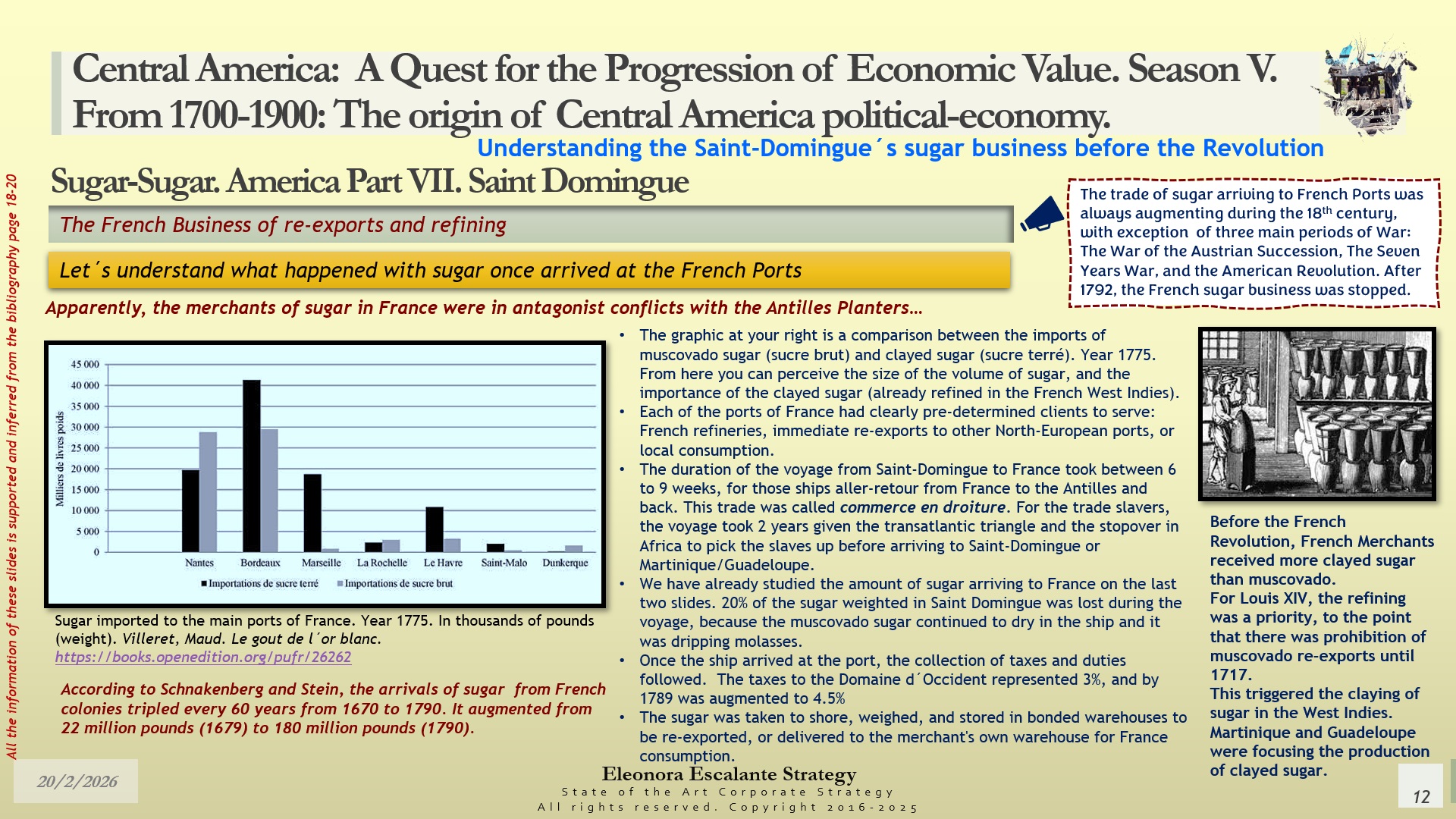
Most of the sugar arriving in France was in the format of muscovado (called sucre bruit), but the French Antilles also refined it (called sucre terré or clayed sugar). The main markets for sugar were Holland and Northern Germany (the territories of the Orange-Nassau and Hohenzollern). These destinations held robust refining industries, greater in a size ratio of 3 to 1 if we compare them with the French refineries.
Read slide 13, which is self-explanatory.
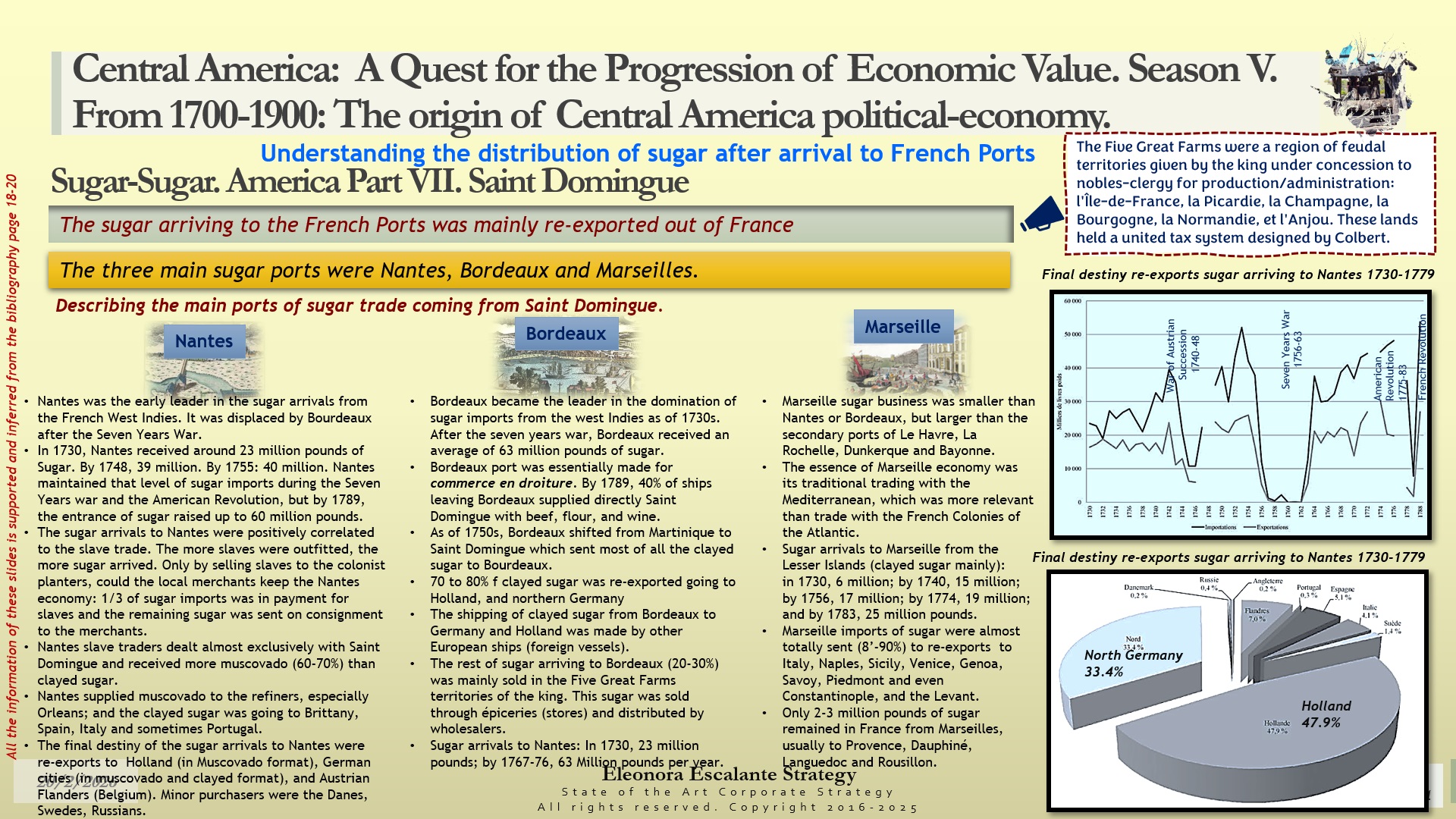
The three main sugar ports that received sugar from the French West Indies were Nantes, Bordeaux, and Marseille. Slide 14 justifies and supports each port’s particularities and differences. Nantes and Bordeaux were the hubs for the sugar re-exports to Holland, German cities, and Austrian Flanders. The pattern of re-exports of sugar was 60%-70%. While the remaining sugar was sent to the French refineries (20%-30%). Marseille was the port for the re-export of clarified sugar arriving from the French Lesser Antilles. From Marseille the sugar was sent to the Levant, Italy, Constantinople, and other Mediterranean locations.
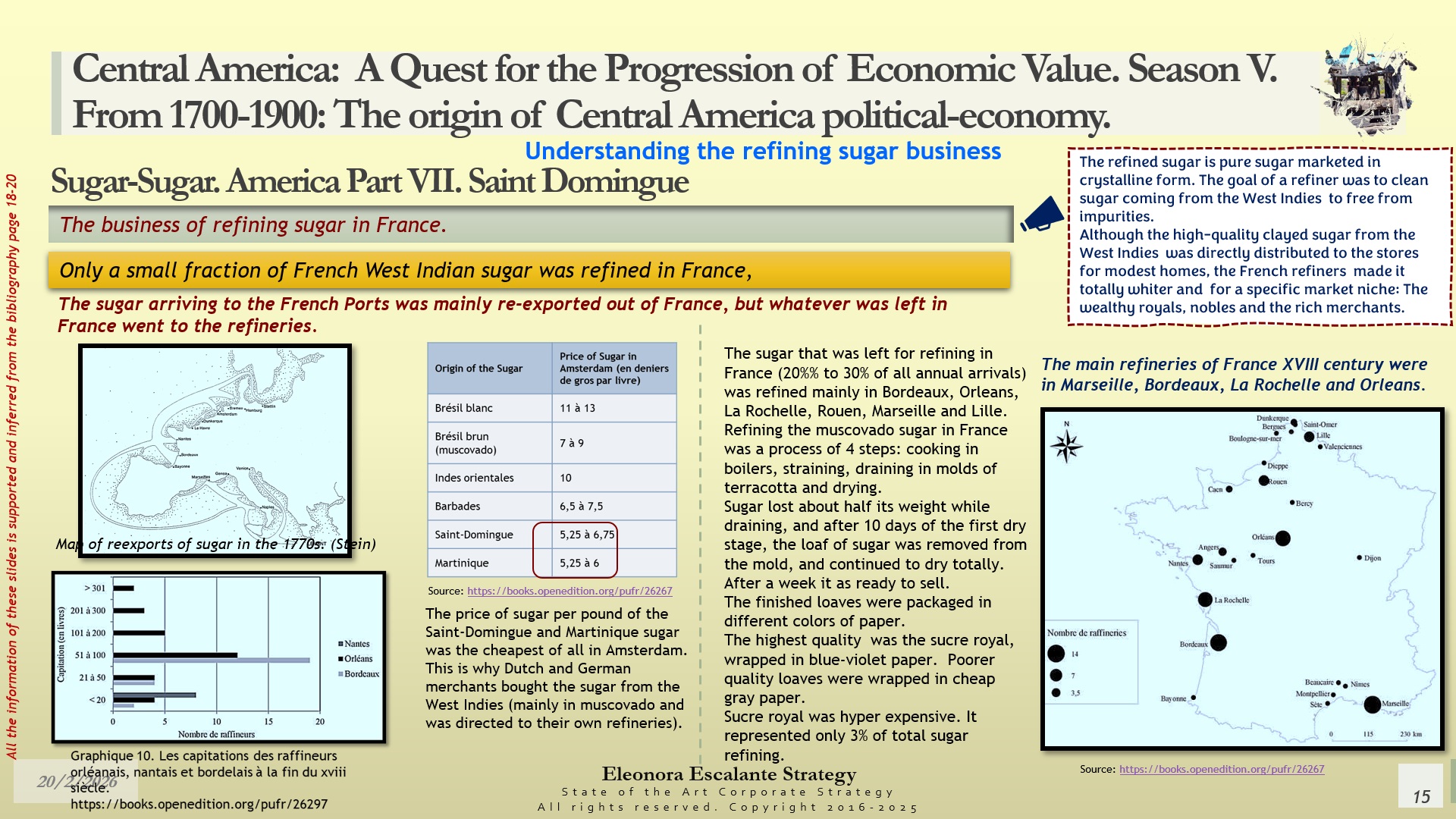
With slide 15, we aim to display the process of sugar refining in France. The refining business here was less competitive in comparison to the Dutch or German refineries. But in the context of 18th century British-German-Dutch-Prussian hegemony, the sugar produced by the French colonies was not irrelevant. The Bourbons were captive to these markets, and their muscovado prices reveal how attractive it was for their re-export clients to keep the Saint-Domingue production afloat. The French were able to sell sugar at half the price of their competitors (Brazil or Britain).
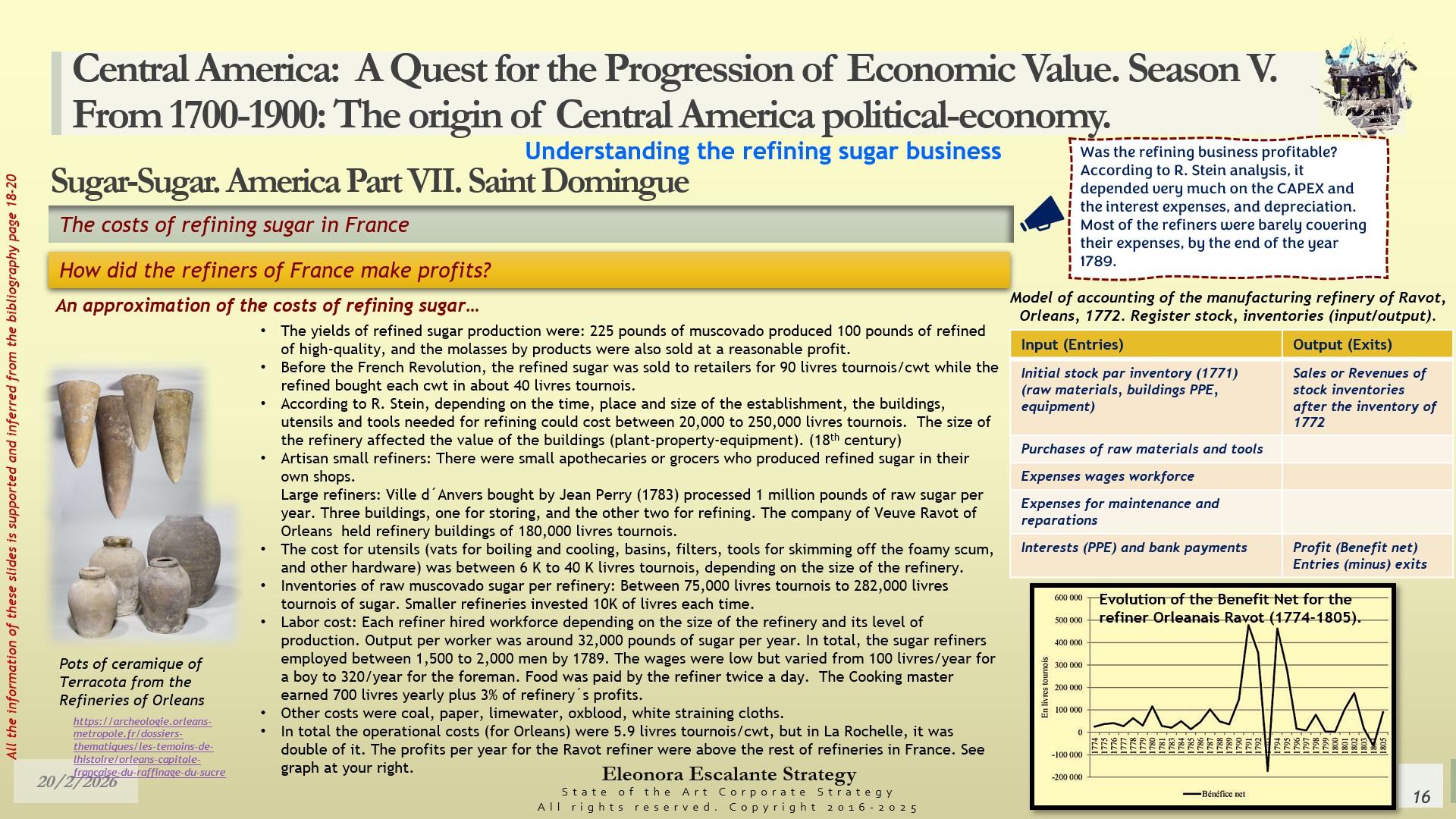
Despite the fact that we do not have all the information from the French refineries, there are some historical records from Orleans, the refinery of Ravot, which was one of the largest ones operating there before the French Revolution. See slide 16. It seems that the process of refining was more profitable for the large refiners, given the economies of scale. Additionally, the refineries of Orleans held the protection of the Royal Bourbon house, which is explained in slide 17.
The Haitian Revolution was the face of the French Revolution in the Caribbean Atlantic.
Slides 18 to 20. We advise to see or print it in PDF for a better view.
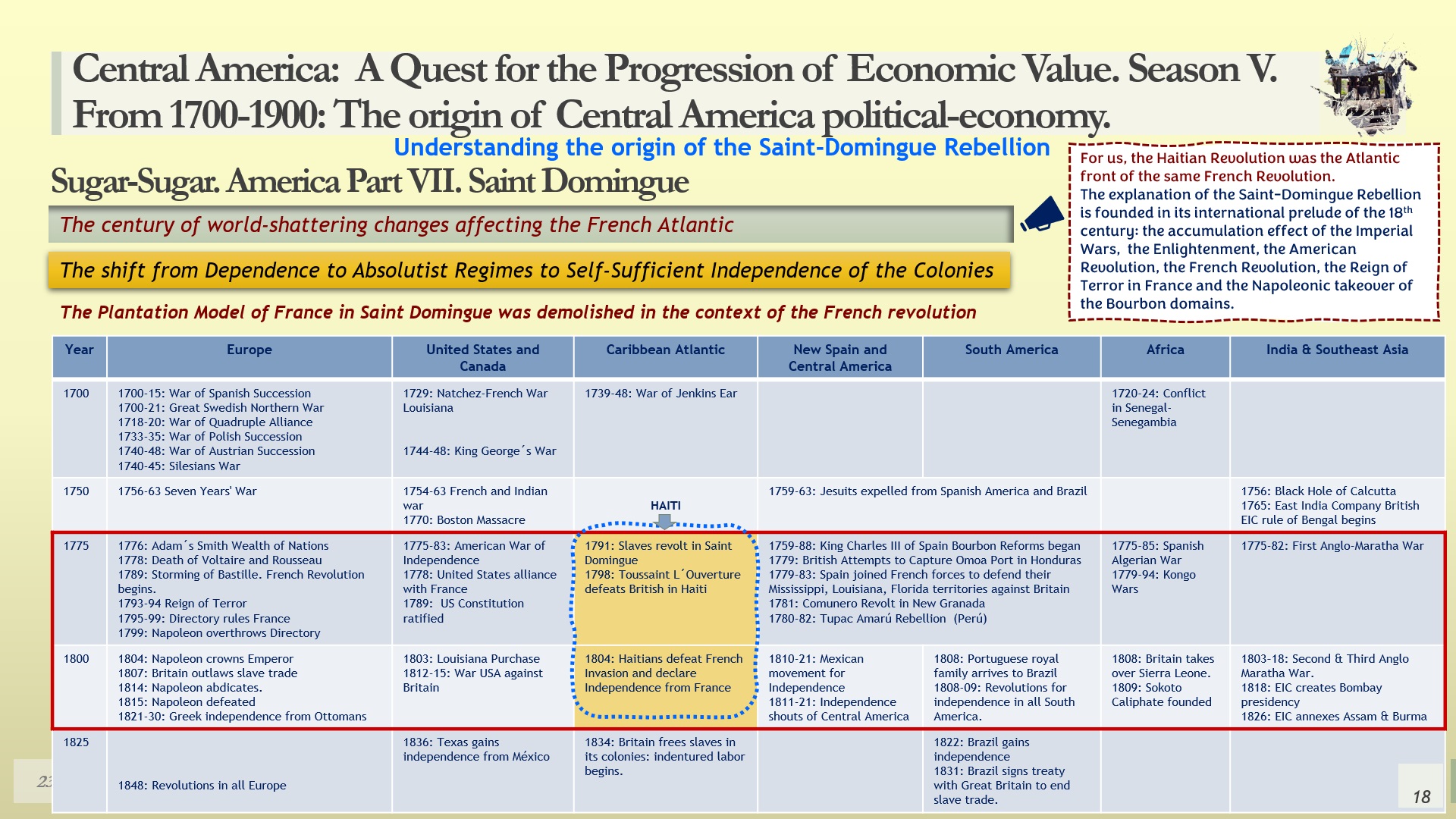
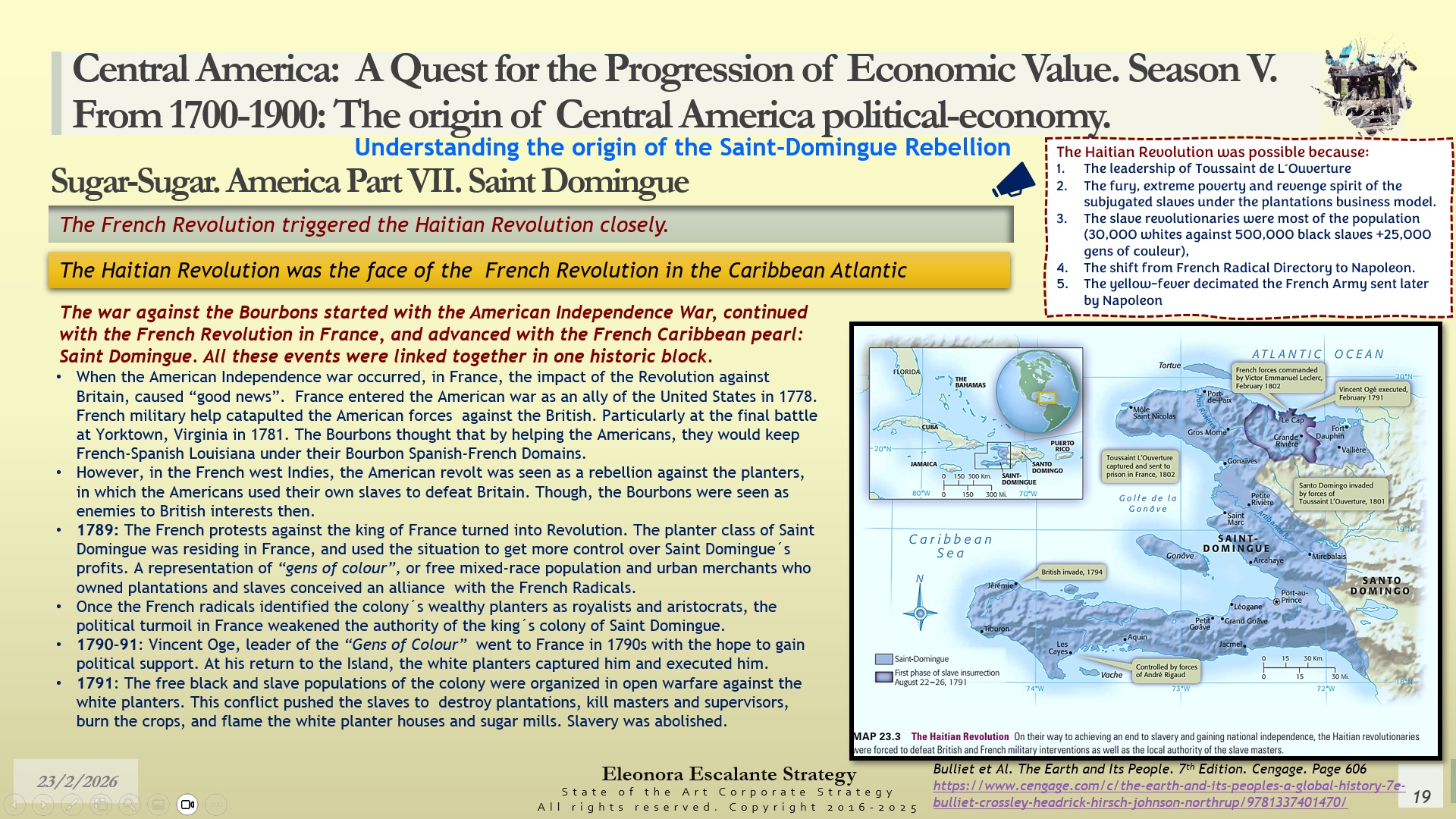
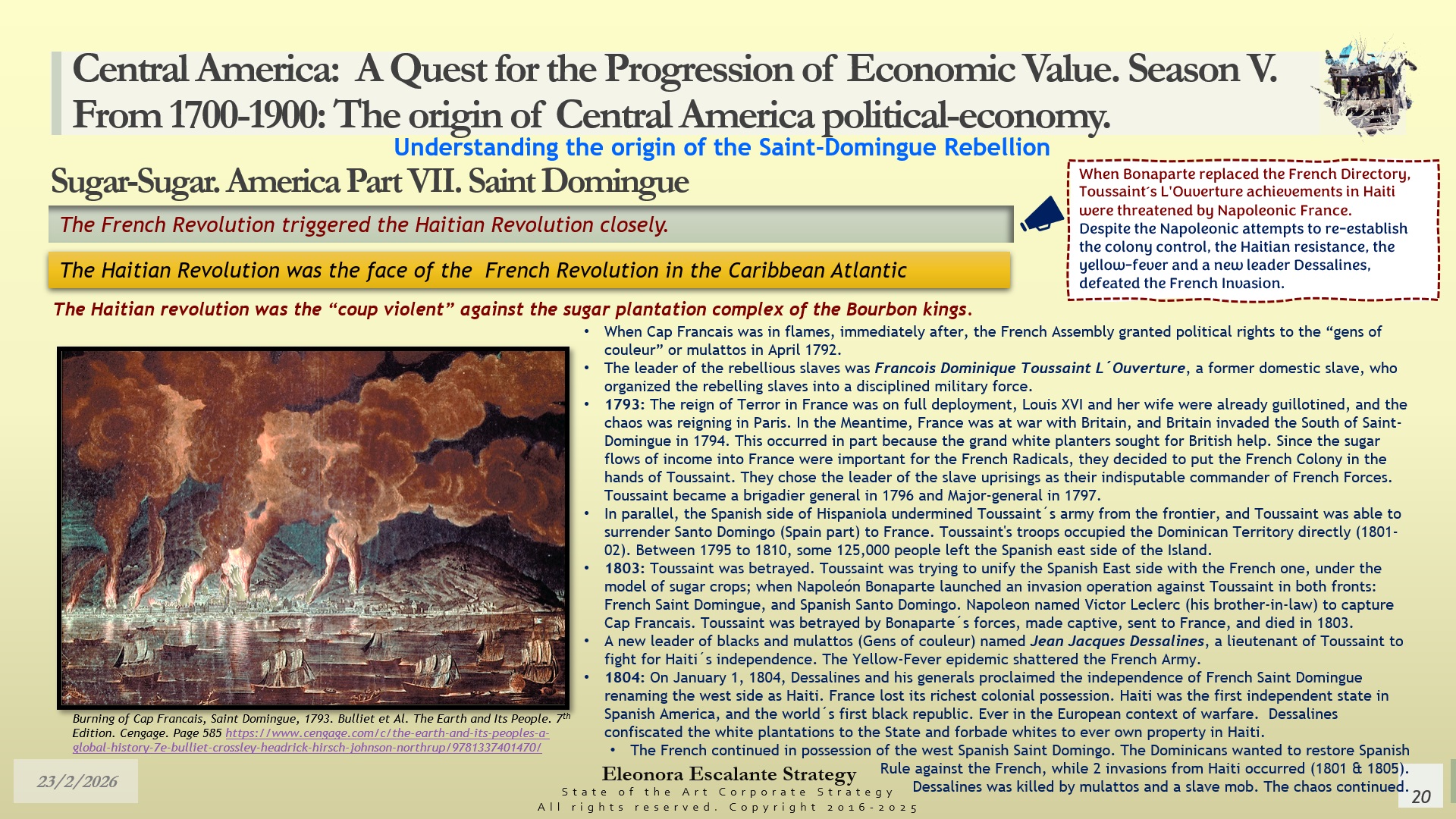
We have prepared an analysis of the Haitian Revolution from the point of view of considering it as essential part of the French Revolution and not as a consequence of the French Revolution Spread. Bourbon France was attacked from several fronts. Including its possessions in the Caribbean. Slide 18 is extremely revealing. If you compare the most relevant conflicts ensuing between 1775 and 1825, it is easy to comprehend the concatenation of events as actions-reactions “within” a bigger conflict that began when the Bourbons demanded their presumed right to change the Habsburg strategy in America. We have already explained this phenomenon in Season IV. In Habsburg America (with all its original dynastic ties to Charles V HRE), the Bourbon plans were not welcomed. As of Louis XIV, the Bourbons thought themselves plenipotentiaries of a new monarchical roadmap (in our current terms, that is called a new corporate strategy), and its new ideas and measures shared with the Wittelsbachs were not welcome by the traditional tandem of the Spanish Habsburg representatives. North America´s conquest was the second act of the Habsburg drama in America, and the rest of the families who didn´t receive a territorial domain before the War of Spanish Succession were claiming it. When the core founding Habsburg dynasties of America expanded to marry the rest of German nobles, the Hannover-Hohenzollern, well bonded to the Orange-Nassau fought for it through the United States of America revolution. The Bourbons did not have any part in the game there.
When the French showoff of the sugar industry based on slavery overtook that of the sluggish production crops of Spain, the French Revolution demolished the Bourbon plans for America, on every single front of their territories.
There is another alternative scenario that Eleonora Escalante Strategy has thoughtfully considered. What if the Bourbons were considered as second-tier monarchs by the Habsburgs? Why did they mix and mingle as of King Henry IV? If the Bourbons were not the antagonists to the main owners of Spanish America, why did they create all this theater warfare? Why did Spanish Habsburg descendants give up on North America after the French Revolution? Was it fear of the new nascent British-German-Dutch block? Or was it convenient? Read slides 18 to 20. All are self-explanatory.
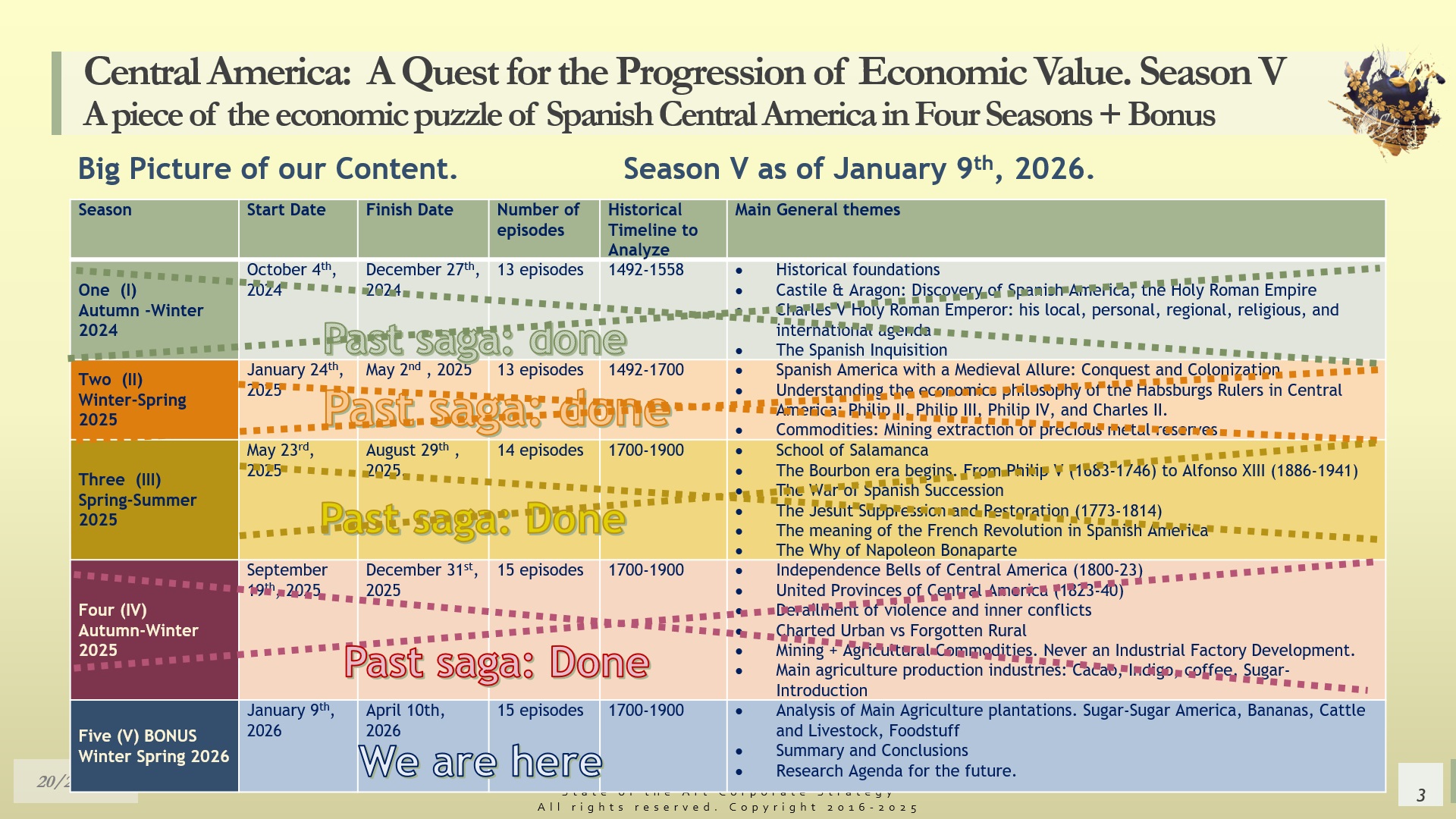
In summary, after 7 episodes, based on our analysis of sugar, we are close to formulating our approximation to demonstrate why our capitalist system has lacked a caring foundation to expand the middle-class. Our theories about strategic management and business modeling have been rolled continuously to the detriment of the full expansion of the middle class during the last 75 years. We also wish to prove that the socialist-Marxist system also lacks a caring foundation for the improvement of the quality of life and expansion of the middle class.
When the capitalist premise of maximizing shareholder value is used for business modeling, our civilization falls into racial discrimination, slavery, and extreme inequality. When the Marxist premise of maximizing collective value is used for business modeling, our civilization falls into racial discrimination, slavery, and extreme inequality too. Two sides of the silver coin that take us to the same thing. Look at it this way, if our theories are misruling our entrepreneurial activities, what else could await us with the Artificial Intelligence and digital era enterprises… Wrong business modeling, sooner or later, is the starting point of what happened to the Bourbons in France, the USA, and Saint-Domingue, two hundred years ago.
To be continued…
Closing words.
Our genuine intention with these two episodes about Saint-Domingue is to show you the economic foundations of an incorrect business model that was totally smashed with the first global revolution on earth. The French Revolution didn´t happen only in France. It was a global phenomenon. It took place in every single colony France held. The Haitian rebellion was hyper-violent, but it also coincided with the period when steam engines were being tested for the industrialization of sugar mills. At the time of King Louis XVI, the French Bourbon royal family was the yardstick by which every single kingdom was judged, and when the Bourbon system was attacked in Europe, the damaging domino effect was transferred to the French West Indies, and it touched the core of the economic wealth of the French Empire. Bonaparte simply gave up Louisiana in 1803, in his effort to contain the collateral damage to the Bourbons. When the cause of a kingdom’s wealth is a wrong business model (cruel slavery, sickness, inequality, and poverty for the workers), the reaction against it is always global and devastating. The French Atlantic economic system was shattered to the core of its existence. Just imagine what could happen in the future if we don´t fix our wrong business models used with the incorrect premises of the new AI digital begging era? Oh, Mon Dieu!
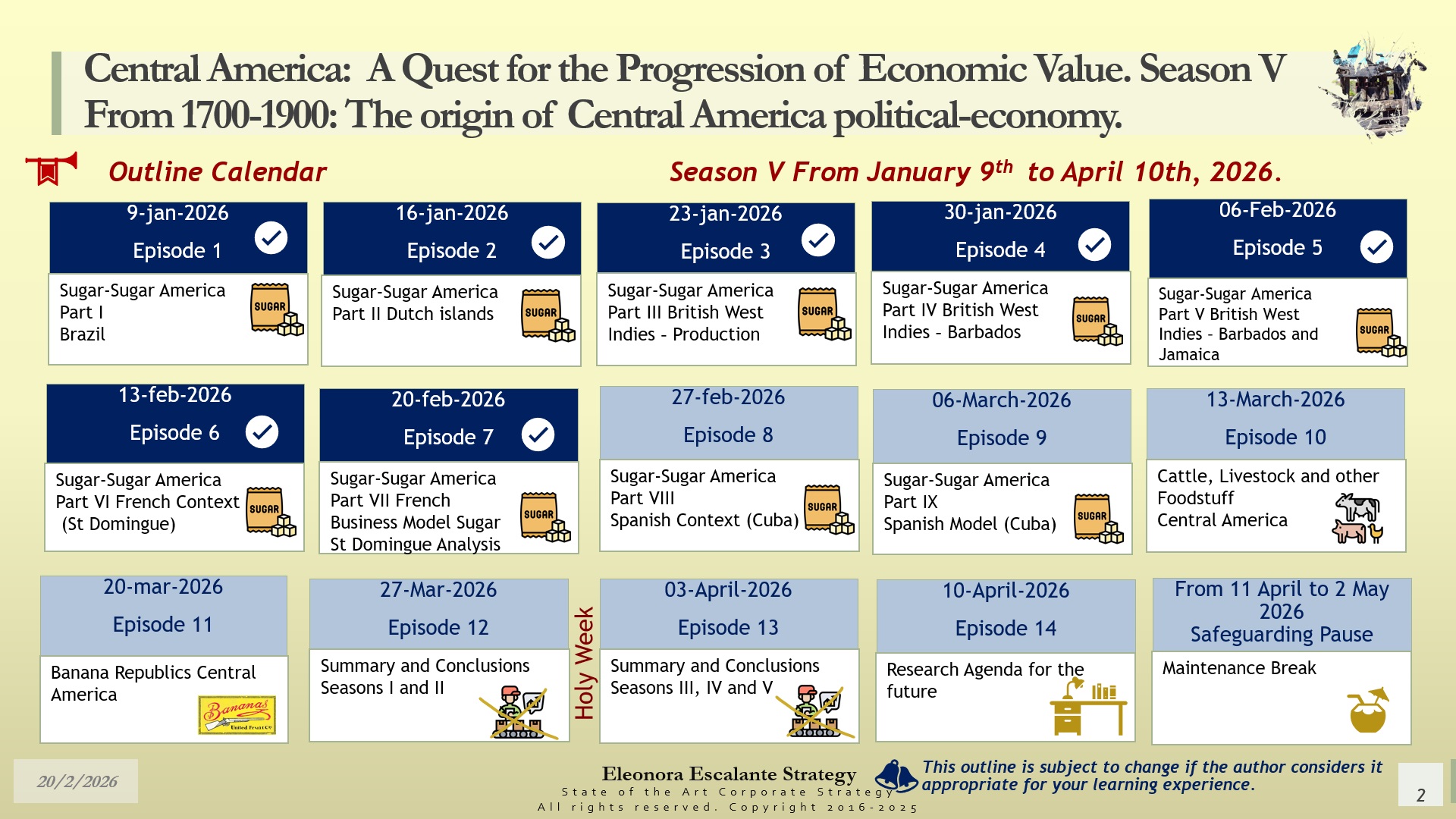
Announcement. Next week, we will continue with the first of two episodes about the sugar plantations of Cuba during the 19th century.
Musical Section.
During our closing bonus season V, we will return to the symphonic, philharmonic, or chamber orchestra compositions. Today, we will make an exception to this rule. In my quest to find a good representative of the Haitian classic orchestras, I found a saxophonist, Ketlersax. According to @Ketlersax, he is a renowned saxophonist, composer, and educator known for his blend of passion and cultural soul. With an international musical background, he has recently released a piece called Konpa-Cowboy. I share it below. Ketlersax work is so captivating that I would love to hear an acoustic version, with a traditional arrangement made for a symphonic orchestra, too. Enjoy the konpa rhythm!
Thank you for reading http://www.eleonoraescalantestrategy.com. It is a privilege to learn. Blessings.

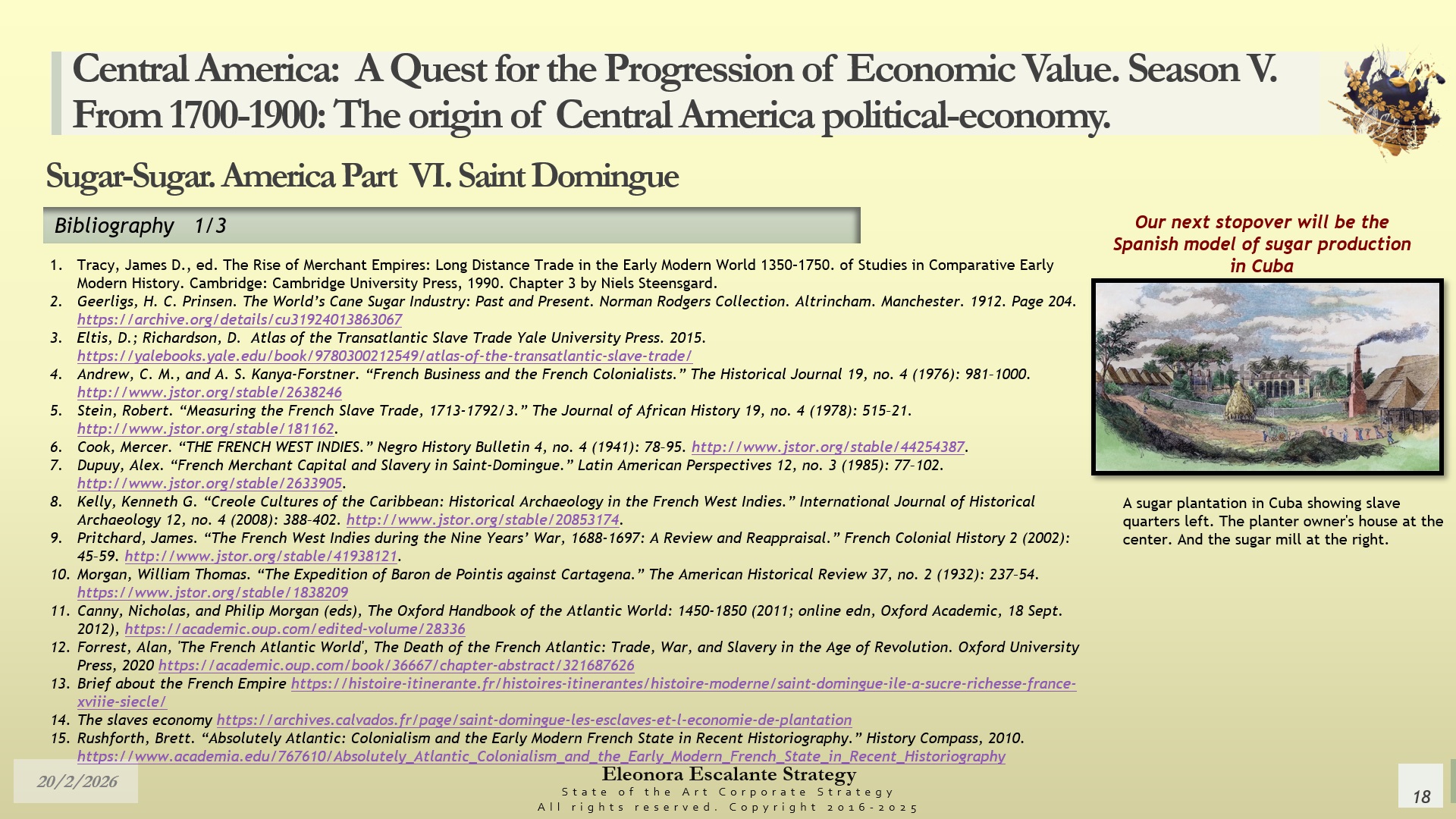
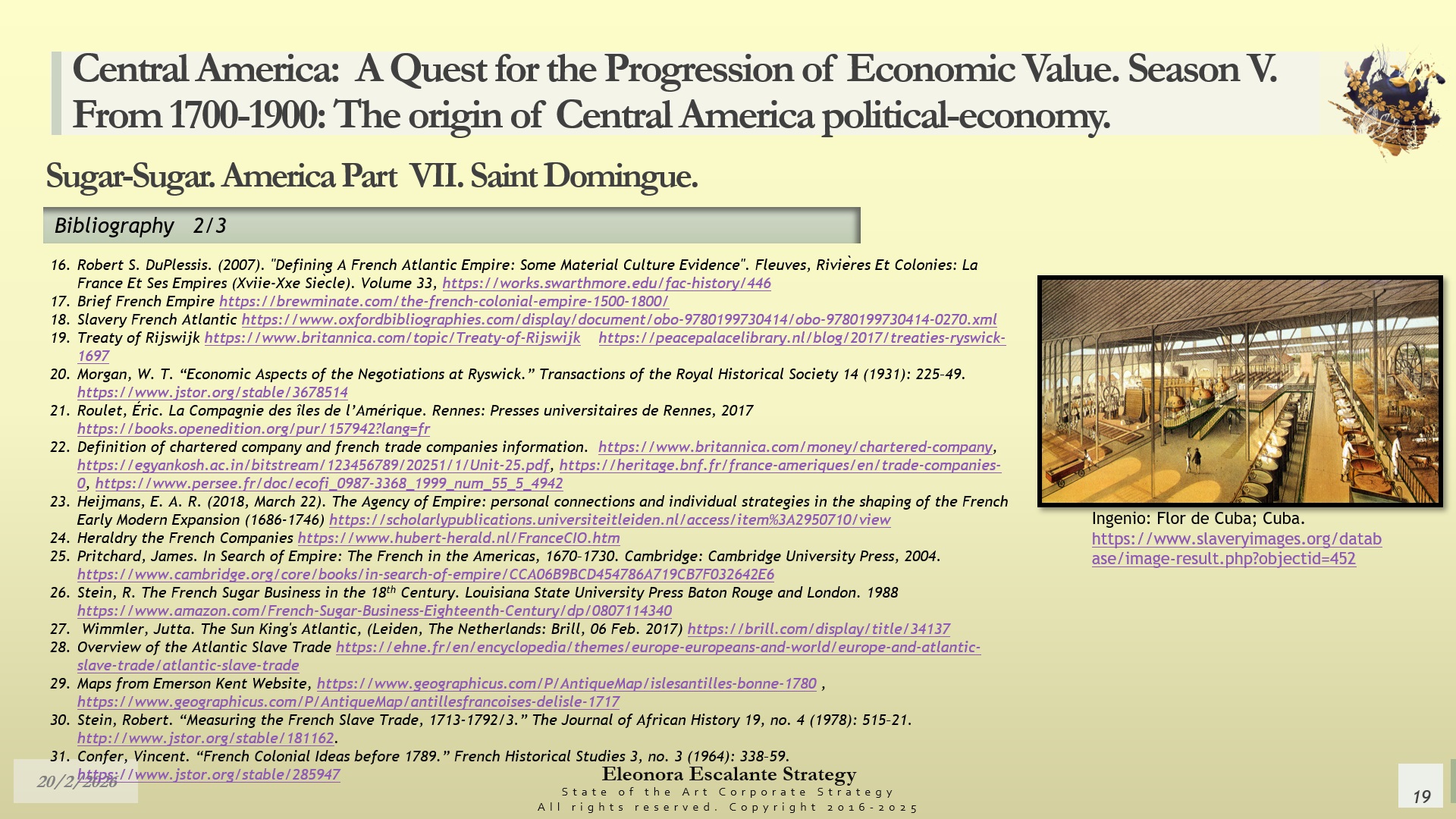
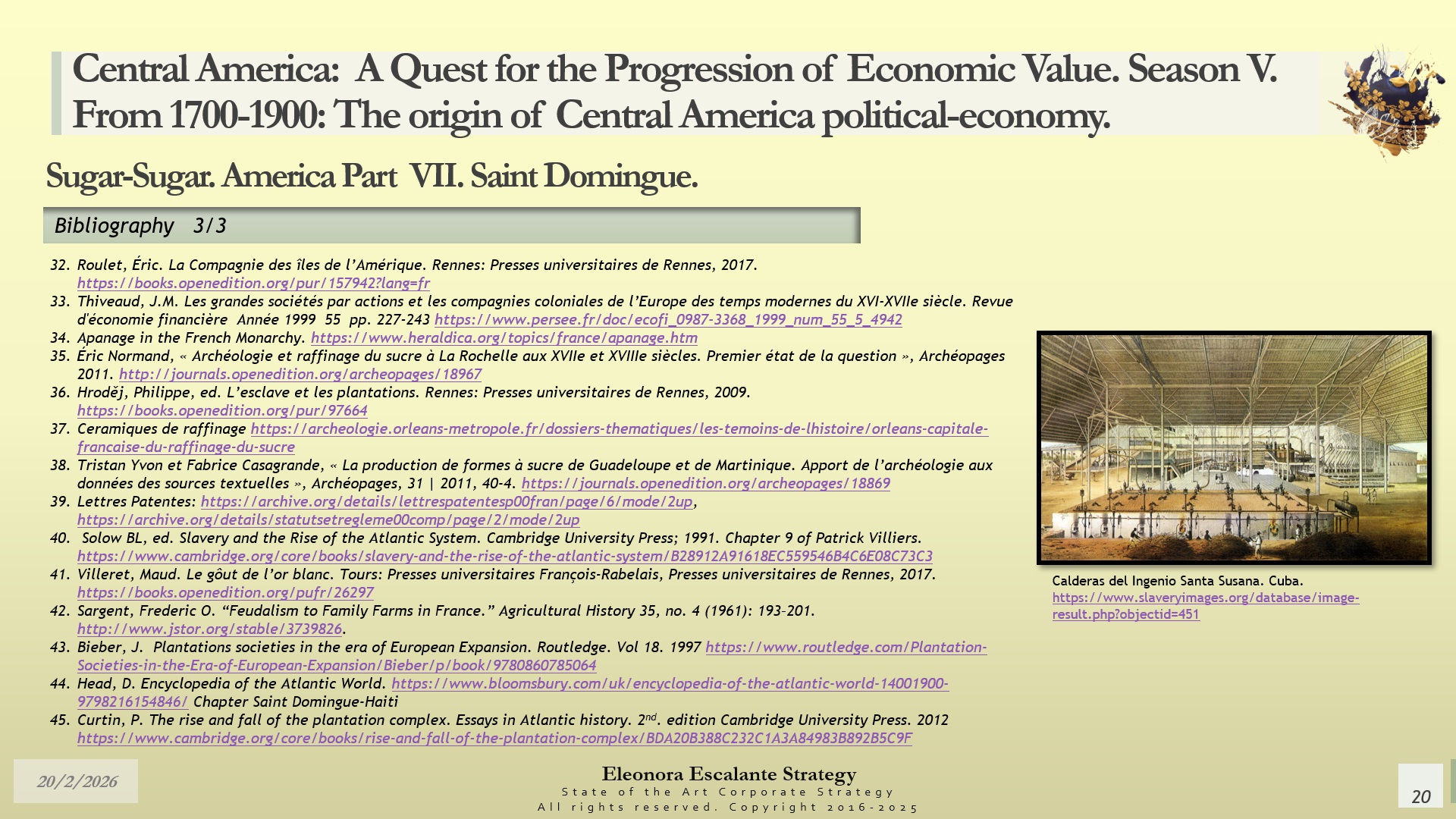
Sources of reference and Bibliography utilized today. All are listed in the slide document. Additional material will be added when we upload the strategic reflections.
Disclaimer: Eleonora Escalante paints Illustrations in Watercolor. Other types of illustrations or videos (which are not mine) are used for educational purposes ONLY. All are used as Illustrative and non-commercial images. Utilized only informatively for the public good. Nevertheless, most of this blog’s pictures, images, and videos are not mine. Unless otherwise stated, I do not own any lovely photos or images.
 Eleonora Escalante Strategy - Strategic Reflections Think Tank